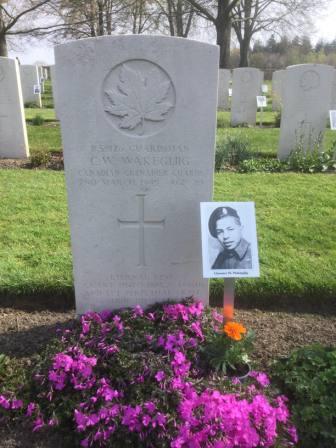
On The War Memorial Trail….2025 Faces of Groesbeek Exhibition Part 4: The Soldiers From New Brunswick

June 30, 2025. The 2025 Faces Of Groesbeek Exhibition, which ran from April 26 to May 18, 2025 at the Canadian War Cemetery in Groesbeek, featured photos of soldiers that were placed by their graves. Photos are printed onto an aluminum backing, making them impervious to rain, and reusable. This year, 80% of the graves had a photo of the soldier.

The many volunteers from Faces To Graves Foundation Groesbeek, of which Alice van Bekkum is the Chair, worked tirelessly to make this exhibition possible.  They also organized the Liberation Day commemoration events. 

Pieter has been involved in finding photos of Canadians who are buried in all three Canadian War Cemeteries in The Netherlands since 2014, with many of their stories told on this blog. 

This was the third Faces Of Groesbeek Exhibition, with the first in 2021 and the second in 2023. Many of the graves with photos of soldiers, whose stories have been told in time for those Exhibitions, have been previously featured.

Placing flags at graves was a labour of love and respect

We were in The Netherlands and Belgium for the 80th Anniversary of Liberation Commemoration events, and placed flags at the graves of 383 soldiers in 14 cemeteries.  Yes, Pieter was on his hands and knees 383 times, placing flags at these graves, as you can see below….

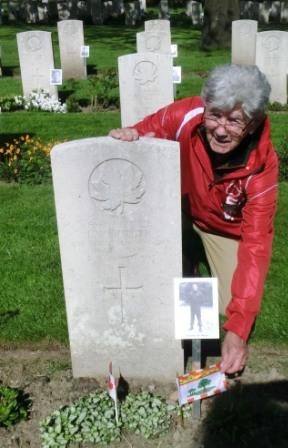
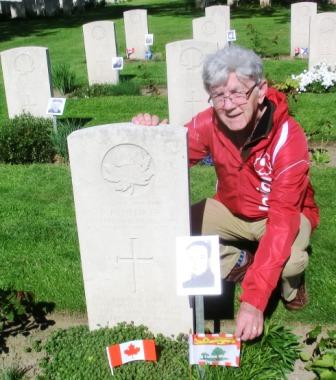
Pieter placing flags at the grave of Gilles Lanteigne of Caraquet, New Brunswick.  (Photo credit: Daria Valkenburg)

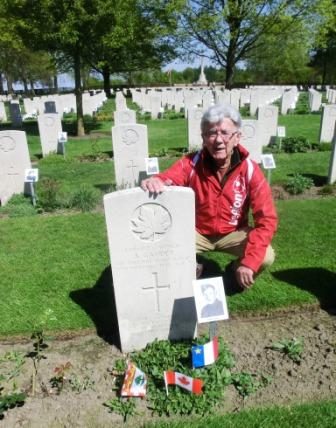
Gilles LANTEIGNE, of Caraquet, New Brunswick, was serving with Le Regiment de Maisonneuve in Germany, when he died of severe wounds on March 9, 1945, just a few weeks before his 21st birthday. You can read his story at https://onthewarmemorialtrail.com/2021/07/11/on-the-war-memorial-trail-atlantic-canada-remembers-part-10/

Grave of Gilles Lanteigne after Pieter had placed New Brunswick, Canadian, and Acadian flags. (Photo credit: Daria Valkenburg)

120 of the graves visited were in the Canadian War Cemetery in Groesbeek alone, including the graves of 36 soldiers from New Brunswick.

3 Soldiers From New Brunswick Commemorated…

In Part 1, an overview of our day of flag placing at 120 graves was provided. (See https://onthewarmemorialtrail.com/2025/06/23/on-the-war-memorial-trail-2025-faces-of-groesbeek-exhibition-part-1-flags-placed-at-120-graves/)

In Part 2, five soldiers from Prince Edward Island, whose stories have previously been told, were featured. (See https://onthewarmemorialtrail.com/2025/06/26/on-the-war-memorial-trail-2025-faces-of-groesbeek-exhibition-part-2-the-soldiers-from-prince-edward-island/)

In Part 3, the graves and photos of 3 soldiers, from the provinces of Alberta, Manitoba, and Quebec, whose stories have previously been told, were featured. (See https://onthewarmemorialtrail.com/2025/06/28/on-the-war-memorial-trail-2025-faces-of-groesbeek-exhibition-part-3-the-soldiers-from-alberta-manitoba-and-quebec/)

Now, in Part 4, the graves and photos of 3 soldiers from New Brunswick, whose stories have previously been told, are featured.

Pieter at the grave of Donald Roy Carter.  (Photo credit: Daria Valkenburg)

Donald Roy CARTER from Central Blissville, New Brunswick, who was killed in action during the Attack on the Goch-Calcar Road in Germany on February 20, 1945.  You can read his story at https://onthewarmemorialtrail.com/2024/06/09/on-the-war-memorial-trail-the-wwii-soldier-from-central-blissville-killed-along-the-goch-calcar-road/

Grave of Edgar M. Guitard.  (Photo credit: Daria Valkenburg)

Edgar M. GUITARD from Belledune, New Brunswick, who was killed by German mortar fire in The Netherlands on January 15, 1945. You can read his story at https://onthewarmemorialtrail.com/2024/06/24/on-the-war-memorial-trail-the-wwii-lumberjack-from-belledune-killed-by-stray-mortar-fire-in-the-nijmegen-salient/

Pieter at the grave of Ange Aimé LeClair.  (Photo credit: Daria Valkenburg)

Ange Aimé LECLAIR from Shannonvale (now part of Eel River Crossing), New Brunswick, was killed by artillery fire in Germany during the Battle of Hochwald Gap on March 2, 1945. You can read his story at https://onthewarmemorialtrail.com/2024/11/27/on-the-war-memorial-trail-the-wwii-acadian-soldier-serving-with-le-regiment-de-maisonneuve-who-made-the-ultimate-sacrifice-in-the-hochwald-forest/

….All of the flags placed at graves were donated…

All of the flags placed at graves were donated.  For the flags placed at the graves of soldiers from New Brunswick, our thanks go to: 

  • Alan Waddell, Constituent Assistant, on behalf of Heath MacDonald, MP for Malpeque, for the Canadian flags.
  • New Brunswick and Acadian flags were provided by Jean-Claude D’Amours, MLA for Edmundston-Madawaska Centre, Minister responsible for Military Affairs, with the help of Cécile LePage, Province of New Brunswick, AND by Armel ‘Mel’ Lanteigne, President of the Caraquet Legion in New Brunswick

May we never forget the sacrifices made by these soldiers.  Perhaps all of the known graves of Canadians buried in Groesbeek will have a photo displayed by their grave at the next Faces Of Groesbeek Exhibition in 2027.

In Part 5, the graves and photos of soldiers from Nova Scotia, whose stories have previously been told, will be featured.

If you have a photo of a soldier buried at the Canadian War Cemetery in Groesbeek or one of the other cemeteries in The Netherlands, Pieter encourages you to email him at memorialtrail@gmail.com, or comment on the blog.

….Want to follow our research?…

If you are reading this posting, but aren’t following our research, you are welcome to do so.  Our blog address: https://onthewarmemorialtrail.com/

4 countries, 6 weeks, 7,000 km – an unforgettable war memorial journey in Europe…. Daria’s book ‘No Soldier Buried Overseas Should Ever Be Forgotten‘ is available in print and e-book formats.  Net proceeds of book sales help support research costs and the cost of maintaining this blog. For more information see https://nosoldierforgotten.com/

Subscribe to our YouTube Channel: On The War Memorial Trail With Pieter Valkenburg: https://www.youtube.com/channel/UCJ591TyjSheOR-Cb_Gs_5Kw

Never miss a posting!  Subscribe below to have each new story from the war memorial trail delivered to your inbox.

On The War Memorial Trail….2025 Faces of Groesbeek Exhibition Part 2: The Soldiers From Prince Edward Island

June 26, 2025. The 2025 Faces Of Groesbeek Exhibition, which ran from April 26 to May 18, 2025 at the Canadian War Cemetery in Groesbeek, featured photos of soldiers that were placed by their graves. Photos are printed onto an aluminum backing, making them impervious to rain, and reusable. This year, 80% of the graves had a photo of the soldier.

The many volunteers from Faces To Graves Foundation Groesbeek, of which Alice van Bekkum is the Chair, worked tirelessly to make this exhibition possible.  They also organized the Liberation Day commemoration events. 

Pieter has been involved in finding photos of Canadians who are buried in all three Canadian War Cemeteries in The Netherlands since 2014, with many of their stories told on this blog. 

We were in The Netherlands and Belgium for the 80th Anniversary of Liberation Commemoration events, and placed flags at the graves of 383 soldiers in 14 cemeteries. 120 of the graves visited were in the Canadian War Cemetery in Groesbeek alone, including the graves of 17 soldiers from Prince Edward Island. (See https://onthewarmemorialtrail.com/2025/06/23/on-the-war-memorial-trail-2025-faces-of-groesbeek-exhibition-part-1-flags-placed-at-120-graves/)

5 Soldiers From Prince Edward Island Commemorated…

In Part 1, an overview of our day of flag placing at 120 graves was provided.  Now, in Part 2, the graves and photos of five soldiers from Prince Edward Island, whose stories have previously been told, are featured.

Pieter by the grave of Lawrence William Bulger.  (Photo credit: Daria Valkenburg)

Lawrence William BULGER from Portage was serving with the North Nova Scotia Highlanders when he was killed during the Battle of Bienen in Germany on March 25, 1945. He was one of several stretcher bearers who lost their lives that day, killed by machine gun fire while attending to the wounded on the battlefield.  You can read his story at https://onthewarmemorialtrail.com/2024/08/19/on-the-war-memorial-trail-the-bulger-brothers-part-2-the-wwii-stretcher-bearer-from-foxley-river-killed-during-the-battle-of-bienen/

Grave of John ‘Weston’ Campbell.  (Photo credit: Daria Valkenburg)

John ‘Weston’ CAMPBELL from Clermont was killed while in command of ‘B’ Company of the North Nova Scotia Highlanders during Operation Veritable in Germany on February 14, 1945. You can read his story at https://onthewarmemorialtrail.com/2024/09/30/on-the-war-memorial-trail-the-wwii-soldier-from-clermont-killed-during-operation-veritable/

Pieter by the grave of Arthur Gaudet.  (Photo credit: Daria Valkenburg)

Arthur GAUDET from 5 Pointe, near Mount Carmel, was wounded during Operation Blockbuster in Germany on February 26, 1945, while serving with Les Fusiliers Mont-Royal, and died later that day.  He was two days short of his 21st birthday!  You can read his story at https://onthewarmemorialtrail.com/2025/02/12/on-the-war-memorial-trail-the-wwii-soldier-from-prince-edward-island-who-lost-his-life-in-germany-two-days-before-his-21st-birthday/

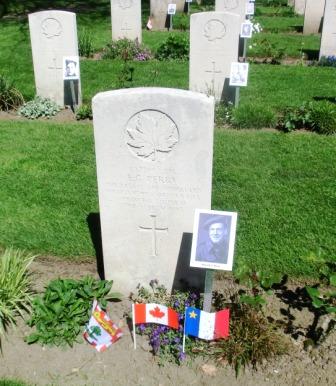
Grave of Edward Gabriel Perry.  (Photo credit: Daria Valkenburg)

Edward Gabriel PERRY from St Nicholas lost his life after being fatally wounded during the Battle of Hochwald Gap in Germany on March 1, 1945, while serving with the Argyll & Sutherland Highlanders (Princess Louise’s).  He was rushed to hospital but died in the early morning of March 2, 1945. You can read his story at https://onthewarmemorialtrail.com/2024/07/06/on-the-war-memorial-trail-the-wwii-soldier-from-st-nicholas-who-lost-his-life-during-the-battle-of-hochwald-gap/

Pieter by the grave of Ralph Kenneth Silliker.  (Photo credit: Daria Valkenburg)

Ralph Kenneth SILLIKER from O’Leary was killed in action during Operation Churchill in Germany on March 2, 1945, while serving with the Lake Superior Regiment (Motor).  He was killed as his Kangaroo (armoured personnel carrier) tried to lunge across an enemy trench. You can read his story at https://onthewarmemorialtrail.com/2024/04/18/on-the-war-memorial-trail-the-wwii-soldier-from-oleary-who-lost-his-life-during-operation-churchill/

….All of the flags placed at graves were donated…

All of the flags placed at graves were donated.  For the flags placed at the graves of Islanders, our thanks go to:  Alan Waddell, Constituent Assistant, on behalf of Heath MacDonald, MP for Malpeque, for the Canadian flags. PEI flags were provided by Matt MacFarlane, MLA for District 19, Borden-Kinkora.  La Société acadienne de Clare in Nova Scotia donated Acadian flags.

May we never forget the sacrifices made by these soldiers.  Perhaps all of the known graves of Canadians buried in Groesbeek will have a photo displayed by their grave at the next Faces Of Groesbeek Exhibition in 2027.

In Part 3, the graves and photos of soldiers from Alberta, Manitoba, and Quebec, whose stories have previously been told, will be featured.

If you have a photo of a soldier buried at the Canadian War Cemetery in Groesbeek or one of the other cemeteries in The Netherlands, Pieter encourages you to email him at memorialtrail@gmail.com, or comment on the blog.

….Want to follow our research?…

If you are reading this posting, but aren’t following our research, you are welcome to do so.  Our blog address: https://onthewarmemorialtrail.com/

4 countries, 6 weeks, 7,000 km – an unforgettable war memorial journey in Europe…. Daria’s book ‘No Soldier Buried Overseas Should Ever Be Forgotten‘ is available in print and e-book formats.  Net proceeds of book sales help support research costs and the cost of maintaining this blog. For more information see https://nosoldierforgotten.com/

Subscribe to our YouTube Channel: On The War Memorial Trail With Pieter Valkenburg: https://www.youtube.com/channel/UCJ591TyjSheOR-Cb_Gs_5Kw

Never miss a posting!  Subscribe below to have each new story from the war memorial trail delivered to your inbox.

On The War Memorial Trail…..The WWII Acadian Soldier Serving With Le Régiment de Maisonneuve Who Made The Ultimate Sacrifice In The Hochwald Forest

Balmoral and Shannonvale Google Maps

We travelled to Balmoral, New Brunswick, to meet the sister of a WWII soldier. (Map source: Google Maps)

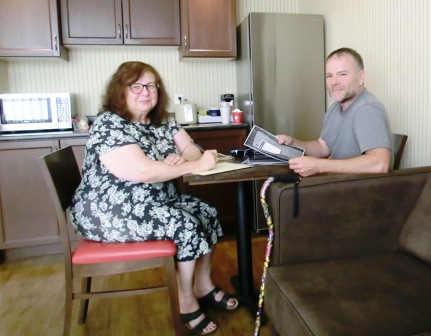
November 27, 2024. After completing our tour along the Acadian Coastal Drive, visiting Acadian Memorials, we went to Balmoral, New Brunswick, to meet with Léa LeClair, the youngest sister of WWII soldier Ange Aimé LECLAIR. (See https://onthewarmemorialtrail.com/2024/11/22/on-the-war-memorial-trail-remembrance-week-2024-visiting-acadian-memorials-in-new-brunswick/)

CIMG7020 Aug 27 2024 Visit to Balmoral Romeo Le Page & Lea Le Clair

Pieter (centre) with Léa LeClair and her brother-in-law, Romeo LePage. (Photo credit: Daria Valkenburg)

When Pieter had begun his research to find family of Ange Aimé, he found an obituary for the soldier’s sister Viola, who was married to Romeo LePage.  Then he found a phone number for Mr. LePage and, with great trepidation given that he isn’t fluent in French, he dialed the number.  After a few minutes, Mr. LePage’s sister-in-law, retired teacher Léa LeClair, came on the line, and listened patiently.  “…Oui…” she had a photo of Ange Aimé, and then, happily, switched to English.  She explained that she was the youngest sister of the soldier, only 10 years old when he died on March 2, 1945.

Pieter let her know that we were planning a trip to New Brunswick, and asked if she would like to meet in person.  This was agreeable, and so, when we went to Balmoral, we were only expecting to get a photo of the soldier.  Boy, were we wrong! The family’s historian, Léa had several photos and letters written by her brother, and more.  Ange Aimé was clearly loved and remembered by his family!

Born in Shannonvale (now part of Eel River Crossing), Restigouche County, New Brunswick on March 14, 1925, Ange Aimé was the son of Thomas and Marguerite Anne (nee Basque) LeClair.  He came from a large family, and had 5 sisters, 3 brothers, 4 half-brothers, and 2 half-sisters.

…..Ange Aimé enlisted under the NRMA in 1944….

Léa recalled that “My brother Albénie was called up in the Spring. He did not pass the physical as he was sick. Ange-Aimé asked Papa if he should stay and wait for a call to join. They chose for him to go to work in the Kedgwick area. Later in the summer, the Army came looking for him in Dundee. Papa did not know exactly where he was cutting wood and said so to the Army. After a while, the Army did find him, in the Kedgwick area…. He was registered and then was sent for training…

Ange Aimé originally enlisted under the National Resources Mobilization Act (NRMA) at the No. 7 District Depot in Fredericton, New Brunswick on May 31, 1944 and underwent basic training at No. 71 Canadian Army Basic Training Centre (CABTC) in Edmundston, New Brunswick. (See https://en.wikipedia.org/wiki/National_Resources_Mobilization_Act)

ange aime le clair as a student colourized

Ange Aimé LeClair as a student.  (Photo courtesy of the LeClair family. Photo colourization by Pieter Valkenburg)

At the time of his enlistment, Ange Aimé had been working for 2 years as a woodsman for Raymond LeBlanc of Darlington, New Brunswick.  Léa recalled that he had studied at a seminary, with his family expecting him to be a priest, but he preferred working outdoors. While his Occupational History Form does not mention studying at a seminary, he most likely had his post-elementary education at a seminary. The form stated that Ange Aimé was fluent in both French and English, which was unusual for a young man who grew up in a rural area and in a French speaking household.

AA Leclair photo from memorial card colourized

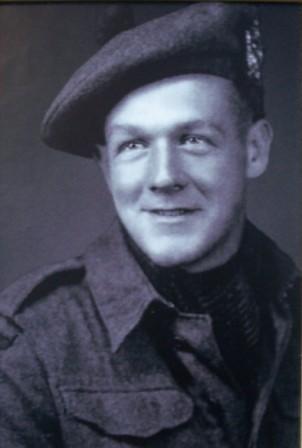
Ange Aimé LeClair in uniform.  (Photo courtesy of the LeClair family. Photo colourization by Pieter Valkenburg)

On July 25, 1944, Ange Aimé enlisted for active duty while in Edmundston, and remained there until September 1, 1944, when he was transferred to the A-30 Canadian Infantry Training Centre (CITC) at Camp Utopia in Pennfield Ridge, New Brunswick.  On September 14, 1944, he received a promotion to Lance Corporal.

….Ange Aimé received embarkation leave….

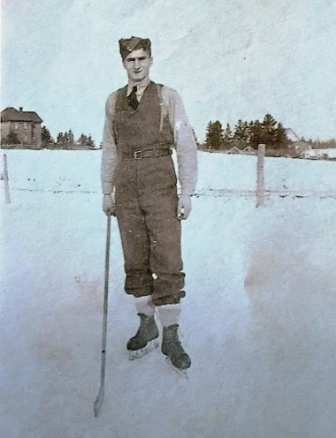
After completing his training at Camp Utopia, Ange Aimé received embarkation leave, prior to being sent overseas, from November 21 to December 7, 1944.  He returned home to the family farm in Dundee, New Brunswick, where a photo was taken of him playing hockey.

20240827_140114 AA Le Clair playing hockey in Dundee during embarkation leave

Ange Aimé LeClair on skates with a hockey stick during his embarkation leave.  (Photo courtesy of the LeClair family)

While on leave, Ange Aimé helped out at home, and spent time in the woods.  Time went by very quickly, and unfortunately he didn’t immediately return to Camp Utopia when his leave was up. Military police came to look for him, thinking he had deserted.  Léa recalled that her …father was in the garden and told them that Ange Aimé was in the woods.  After he returned, he was arrested and taken back to Camp Utopia, where he spent a night in the stockade...

The repercussions were harsh, given that he was only late returning by a few days.  On December 10, 1944, he was transferred to the No. 1 Training Brigade in Debert, Nova Scotia for final preparations and training before being posted overseas.  But, on December 17, 1944, he was demoted in rank and reverted to Private. 

 ….We had help in translating letters from French into English….

CIMG7053 Sep 10 2024 Daria & Etienne Gaudet translating AA LeClair letters in Moncton NB

Daria and Etienne Gaudet worked diligently to translate all the letters from French into English. (Photo credit: Pieter Valkenburg)

Because Léa had saved letters written by her brother, we were able to hear his thoughts during this period.  We were grateful for the help of Etienne Gaudet, who kindly translated all of the letters written by Ange Aimé from the original French into English.

In a December 20, 1944 letter to his sister Delphine, written from Debert, it’s clear that there was illness in the family. “…. Are you better after your flu? … Please give my regards to the others and please tell me if mother is better, and tell her not to worry about me.  It’s not worth it.  Nothing has happened to me yet.  There’s a higher power above us and his wishes must be respected.

I wouldn’t be worse off there (ie heaven) than here. Besides that, I’m lucky that I’m the only one in the army instead of all of us.  I’m not scared and I’m taking things as they come….

On the same day, he also wrote to his brother Ovila, mentioning his demotion.  “I thought I’d be able to have a pass for Christmas or New Year’s, but I won’t now.  I no longer have my stripe and I don’t know if I’ll have one later, or if I’m here for a long time.

….Ange Aimé left Canada for overseas service….

Ange Aimé didn’t have long to wonder how long he’d be in Debert.  On December 24, 1944 he left Canada, arriving in the United Kingdom on December 31, 1944, where he was assigned to No. 4 Canadian Infantry Training Regiment (CITR).

He shared his impressions with his brother Ovila in a January 3, 1945 letter.  “.I am now in England and it’s pretty good and a funny country. Their language is nearly impossible to understand. They do not pronounce their words like we do.

I’m anxious to get to the front and see what it’s like.  If it can be warm, I’ll be happy as here it’s humid and we’re freezing.  The humidity is going through us and we have to ration the coal.  I have had a cold since I arrived here, as have the others….

In a January 4, 1945 letter to his sister Delphine, he wrote about the climate, and shared that he saw his cousin, René LEBLANC.  “I have a cold.  It’s humid as hell here.  My nose is always running.  It takes time to get used to the climate….. René is here....” 

Then, in a January 29, 1945 letter to Delphine, he again mentions the weather, and spending Christmas while on his overseas voyage. “The climate here is humid and a bit cold.  There are 4 inches of snow…. It’s not as beautiful as I had thought and holidays on the water are not fun...

Ange Aimé was aware that he would soon be sent to Northwest Europe. In a February 8, 1945 letter to his brother Ovila, he wrote that “I am preparing for the draft. I have to face the front, see what it looks like, but I would not want to take a bullet or shrapnel….”  

….Ange Aimé was flown to Northwest Europe from the United Kingdom….

The day after he wrote to his brother Ovila, Ange Aimé was transferred to the X-4 Reinforcement List of the 10th Battalion of the Canadian Infantry Corps, and flown to Northwest Europe on February 10, 1945. 

By February 12, 1945 he was at No. 2 Canadian Base Reinforcement Group (CBRG) and wrote to his sister Delphine that he was “now in Belgium.  It’s really beautiful here.

I am not yet at the front.  Those that go come back, at least most of them.  I have as good a chance as them.  I might never go since it looks really bad for the Germans.

People are really nice to us ‘Canadians’ here.  Yesterday I went to supper with a man who brought us to his home.  He has three small children.  They were really nice to us.  I was with two of my friends.  Like he said, it reminded us of home to have a family supper and it took away some of the longing for home….

On the same day, he wrote to his parents about the dinner.  “….Yesterday I went to town with two others, and an older man invited us to his place for supper with him.  We were served like princes.  They are really nice. There were three little boys and they all shook our hands....” This was the last letter the family received from Ange Aimé. 

…. Ange Aimé’s transfer to Le Régiment de Maisonneuve was his last….

On February 15, 1945, Ange Aimé was transferred to Le Régiment de Maisonneuve, joining them near Nijmegen, The Netherlands, as the Regiment prepared to move into Germany. 

The February 18, 1945 war diary entry for the Regiment stated that “…the whole Battalion left Nijmegen at 19:30 hours to proceed via Cleve, Germany and had penetrated in Germany by 20:40 hours...

By the end of February, the Regiment was involved in the Battle of Hochwald Gap, part of Operation Blockbuster, the final push towards the Rhine River, along with several other Canadian Regiments.  This offensive began on February 28, 1945 to clear the Germans from the Reichswald, a heavily forested area between the Maas and the Rhine Rivers, driving them back over the Rhine, taking the fight well into German territory.  (For more information, see https://canadianbattlefieldtours.ca/operation-blockbuster/ and https://civilianmilitaryintelligencegroup.com/10742/the-battle-of-hochwald-gap-one-of-the-largest-armor-engagements-you-probably-have-never-heard-of)

Each day the war diary reported heavy shelling of the troops, with several casualties.  On March 1, 1945, the war diary reflected that because shelling was heavy “…the morale of the troops was quite low as nothing could be done but wait…

On March 2, 1945, the war diary recorded that “…Captain Provost is back with us.  The rifle companies are in position in the Hochwald Gap at 03:40.  ‘C’ Company sent out patrols to feel enemy’s disposition. ….Heavy shelling all day…” Sadly, one of the casualties on March 2 was Ange Aimé. 

….Letter from Captain Provost described how Ange Aimé lost his life….

On March 3, 1945, Captain Paul-Marcel Provost wrote a letter of condolence to Ange Aimé’s mother. “….I have the terrible duty to inform you of the death of your son, Pte LeClair.  He was killed in action on March 2, 1945….. He was an excellent soldier and brave, who made the ultimate sacrifice.

In the name of the commander and all his officers, I ask you, Madame, to accept our deepest condolences for the loss that has struck you. May the legitimate pride you feel for the departed ease your pain. This pride is shared by all in Le Régiment de Maisonneuve…..

This was followed by an April 6, 1945 letter, explaining how Ange Aimé lost his life.  “….Please know that you have all my sincere sympathies in the sorrow with which you have been struck.  I also have a bit of sorrow, as your son was one of ours and I was his commander…..

Your son died a few days after we finished the offensive that brought us to the side of the Rhine and decided the German defeat – two days after an attack that had been especially challenging for our company.  The Regiment was called to take up defensive positions along the Hochwald Forest – a forest situated a few miles from Kleve and Xanten.

Our first hours in these positions were quiet.  Near 6 pm, supper was brought, and Ange Aimé was designated, with a few others, to transport it from our Command Post to his platoon.  It’s when he was on his way back that the German artillery began to fire at us, and your son fell, along with a few other unlucky men.

He was killed instantly and buried the next day in one of our Canadian cemeteries. I include here memorial cards, printed in memory of our friends killed during this period of the offensive in Germany….

Ange Aimé’s cousin, Rene LeBlanc, was injured in this attack, but survived the war to return home.

As with Ange Aimé’s letters, Etienne Gaudet kindly translated the letters written by Captain Provost from the original French into English. I was especially grateful for Etienne’s help with the letters from Captain Provost as it was extremely difficult to read his handwriting.

The memorial card that Captain Provost referred to had been prepared for a March 16, 1945 prayer service at Sint-Bartholomaeuskerk, a Roman Catholic Church in Beek (now Berg en Dal), The Netherlands. The memorial card lists 37 names of those who died between February 8 and March 13, 1945. (See https://rijksmonumenten.nl/monument/35784/grote-stbartholomeus/beek/ and  https://nl.wikipedia.org/w/index.php?title=Sint-Bartholomaeuskerk_(Beek_(Berg_en_Dal))

20240827_143311 Mar 16 1945 Memorial service in Holland for Regt de Maisonneuve KIA in Germany

Memorial card sent to Ange Aimé LeClair’s mother.  (Photo of card courtesy of the LeClair family)

….Ange Aimé is buried in Groesbeek….

20240827_144251 Aug 27 2024 Groesbeek postcard sent by Ton in 1950

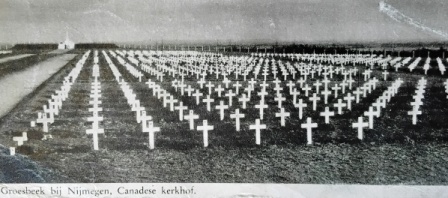
A 1950 postcard, sent by Ton Bersen to the LeClair family, shows how the Canadian War Cemetery in Groesbeek looked in that time period. (Photo courtesy of the LeClair family)

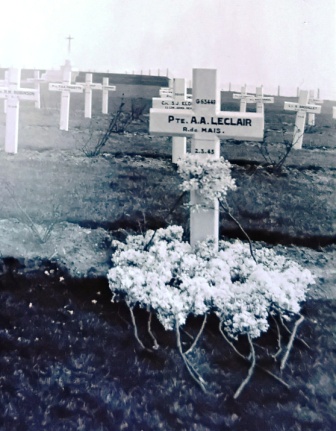
Ange Aimé was temporarily buried on land owned by a Catholic farmer named Augenendt, 3.2 km (two miles) west of Udem in Germany, before being reburied the following year in the Canadian War Cemetery in Groesbeek, The Netherlands.

20240827_144334 Aug 27 2024 Original Groesbeek grave AA Le Clair

The original gravestone for Ange Aimé LeClair in the Canadian War Cemetery in Groesbeek.  (Photo courtesy of the LeClair family)

Grave of AA LeClair from find a grave

Grave of Ange Aimé LeClair in the Canadian War Cemetery in Groesbeek, The Netherlands. (Photo courtesy of FindAGrave)

….Ange Aimé’s grave was adopted by Ton Bersen ….

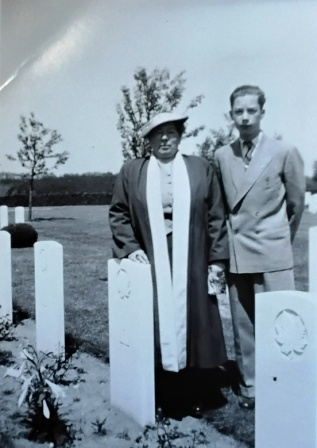
After his reburial in the Canadian War Cemetery in Groesbeek, Ange Aimé’s grave was adopted by a young scout, Ton Bersen, and his family.  Ton remained in contact with the LeClair family until his death in 2020!

20240827_140515 Ton Bersen & mother by grave of AA Le Clair

Ange Aimé LeClair’s grave was adopted by Ton Bersen, seen in this photo with his mother. (Photo courtesy of the LeClair family)

….Ange Aimé is remembered on his parents’ gravestone ….

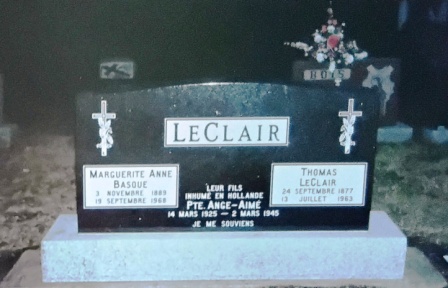
Ange Aimé’s sister Léa told us that after her parents’ original gravestone in Dundee, New Brunswick crumbled, she replaced it with a new headstone and commemorated her brother as well. 

20240827_144026 Aug 27 2024 Le Clair gravestone in Dundee

Gravestone of the LeClair family in Dundee, New Brunswick.  (Photo courtesy of the LeClair family)

Thank you to Léa LeClair for providing photos and information on her brother, and to Etienne Gaudet for help in translating letters from French into English.  Do you have photos or information to share? Email Pieter at memorialtrail@gmail.com, comment on the blog, or tweet to @researchmemori1.

© Daria Valkenburg

….Previous postings about soldiers who died during the Battle of Hochwald Gap….

….Want to follow our research?….

If you are reading this posting, but aren’t following our research, you are welcome to do so.  Our blog address: https://onthewarmemorialtrail.com/

Front cover OnTheWarMememorialTrailinEurope4 countries, 6 weeks, 7,000 km – an unforgettable war memorial journey in Europe…. Daria’s book ‘No Soldier Buried Overseas Should Ever Be Forgotten‘ is available in print and e-book formats.  Net proceeds of book sales help support research costs and the cost of maintaining this blog. For more information see https://nosoldierforgotten.com/ 

You are also invited to subscribe to our YouTube Channel: On The War Memorial Trail With Pieter Valkenburg: https://www.youtube.com/channel/UCJ591TyjSheOR-Cb_Gs_5Kw

Never miss a posting!  Subscribe below to have each new story from the war memorial trail delivered to your inbox.

On The War Memorial Trail…… The WWII Soldier From St. Nicholas Who Lost His Life During The Battle of Hochwald Gap

July 6, 2024.  Back in 2015, Pieter received a photo of WWII soldier Edward Gabriel PERRY, whose name was on a photo wish list from the Canadian War Cemetery in Groesbeek, The Netherlands. 

Edward was born in St. Nicholas, a small community west of Summerside, Prince Edward Island, on October 6, 1924, the son of John F. and Zelia Perry. He was one of 11 children, with 5 brothers, three of whom also served overseas during WWII, and 5 sisters.

….Edward enlisted at age 18….

PERRY Edward Gabriel

Edward Gabriel Perry.

When he enlisted at the No. 6 District Depot in Charlottetown, Prince Edward Island, on February 25, 1943, he was only 18 years old, too young to be sent into an active combat zone.  At the time, he stated that he grew up on a farm, but had spent the past two months working as a carpenter for Fred Cameron of Saint John, New Brunswick, who had a lumber business.

Edward’s Personnel Selection Record noted that he “…plays hockey…” and that his “…chief diversion is reading….”  It went on to describe him as “…reserved, determined…” and concluded that he would “…make an efficient soldier…

From Charlottetown, Edward was sent to Halifax, Nova Scotia, and from there to No. 61 Canadian Army (Basic) Training Centre (CABTC) in New Glasgow, Nova Scotia on March 13, 1943. 

After completing his basic training, Edward was sent to the A1 Canadian Artillery Training Centre in Petawawa, Ontario on May 12, 1943 to be trained as a gunner. 

On June 14, 1943, he was assigned to the 23rd Anti-Aircraft Regiment of the 50th Anti-Aircraft Battery of the Royal Canadian Artillery.  Edward’s new assignment was coastal defence in Sydney, Nova Scotia.  During WWII, Sydney was the second-most-important port for convoy formation after Halifax.

He remained in Sydney until March 23, 1944 when he was transferred to No. 1 Transit Camp in Windsor, Nova Scotia, in preparation for overseas service. Then, on May 15, 1944, he was reallocated to the Training Brigade Group in Debert, Nova Scotia for further training.

….Edward left Canada for overseas service….

On July 19, 1944 Edward left Canada, arriving in the United Kingdom on July 27, 1944, where he was assigned to No. 3 Canadian Infantry Reinforcement Unit (CIRU).

A month later, on August 29, 1944, he was sent to France, and then transferred to the Argyll & Sutherland Highlanders (Princess Louise’s), part of the 21st Army Group, on September 2, 1944. On December 10, 1944, he was promoted to Lance Corporal.

….The Battle of Hochward Gap was deadly….

ASH Can map1

Map shows plan for the Battle of Hochwald Gap.  Note: Kanten on map should read Xanten.  (Map source: ‘The Argyll & Sutherland Highlanders of Canada (Princess Louise’s) 1928-1953, edited by Lt-Col H. M. Jackson)

The end of February 1945 saw the Regiment in Germany for the Battle of Hochwald Gap, part of Operation Blockbuster, the final push towards the Rhine River, along with several other Canadian Regiments.  This offensive began on February 28, 1945 to clear the Germans from the Reichswald, a heavily forested area between the Maas and the Rhine Rivers, driving them back over the Rhine, taking the fight well into German territory for a full-scale invasion of Berlin.  (For more information, see https://canadianbattlefieldtours.ca/operation-blockbuster/ and https://civilianmilitaryintelligencegroup.com/10742/the-battle-of-hochwald-gap-one-of-the-largest-armor-engagements-you-probably-have-never-heard-of)

Troops faced a battlefield that was cold, wet, and muddy, and a ferocious fight by desperate Germans who recognized that they were about to lose the war. On March 1, 1945, Edward was badly wounded during the battle, and brought to a field hospital just after 6 pm “…in very poor condition…” and given “…1 pint of plasma….” 

He was sent on an urgent basis to No. 3 Casualty Clearing Centre, arriving at 9 pm. The medical report noted that he had “…shell fragment wounds with compound fracture of the right femur, injury of the femoral vessels, and multiple lacerations of both legs, and a penetrating wound to the abdomen…”  Edward was rushed into surgery, but died at 5:15 am on March 2, 1945. 

….Edward is buried in the Canadian War Cemetery in Groesbeek….

CIMG3330 Oct 5 2019 grave Groesbeek Edward Perry from daria

Grave of Edward Gabriel Perry in the Canadian War Cemetery in Groesbeek, The Netherlands. (Photo credit: Daria Valkenburg)

Edward was initially buried in the Canadian Military Cemetery in Bedburg, Germany, before being reburied in the Canadian War Cemetery in Groesbeek, The Netherlands. 

Do you have photos or information to share? Email Pieter at memorialtrail@gmail.com, or comment on the blog.

© Daria Valkenburg

 ….Previous postings about soldiers who died during the Battle of Hochwald Gap….

….Want to follow our research?….

If you are reading this posting, but aren’t following our research, you are welcome to do so.  Our blog address: https://onthewarmemorialtrail.com/

Front cover OnTheWarMememorialTrailinEurope4 countries, 6 weeks, 7,000 km – an unforgettable war memorial journey in Europe…. Daria’s book ‘No Soldier Buried Overseas Should Ever Be Forgotten‘ is available in print and e-book formats.  Net proceeds of book sales help support research costs and the cost of maintaining this blog. For more information see https://nosoldierforgotten.com/ 

You are also invited to subscribe to our YouTube Channel: On The War Memorial Trail With Pieter Valkenburg: https://www.youtube.com/channel/UCJ591TyjSheOR-Cb_Gs_5Kw

Never miss a posting!  Subscribe below to have each new story from the war memorial trail delivered to your inbox.

On The War Memorial Trail…..The WWII Soldier From O’Leary Who Lost His Life During Operation Churchill

April 18, 2024.  In August 2019, Alice van Bekkum, Chair of the Faces To Graves Foundation Groesbeek, sent Pieter a list of soldiers from Prince Edward Island who are buried in the Canadian War Cemetery in Groesbeek, The Netherlands.

One of the names for which a photo was missing was that of Ralph Kenneth SILLIKER, born October 16, 1917 in O’Leary, Prince Edward Island, the son of Watson and Ruth Silliker.

Pieter began his research and within a few weeks received a photo from Watson Silliker, Ralph’s nephew.

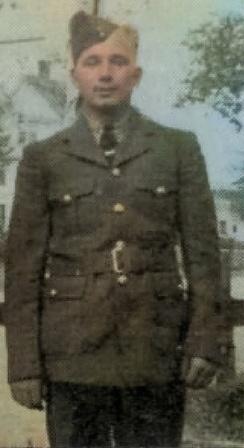
cropped colourized photo Silliker

Ralph Kenneth Silliker. (Photo courtesy of Watson Silliker. Photo colourization by Pieter Valkenburg)

….Ralph’s working life began in childhood….

It soon became clear that Ralph’s working life began in childhood.  His father Watson had began the first oil delivery business in 1922, according to ‘Threads of the past: a history of O’Leary, Prince Edward Island, 1837-1922’, published by the O’Leary Women’s Institute.

…The Silliker family – Watson, Ruth, and their children Ralph, Iva, Lloyd, and Lorne – manually pumped the kerosene and gasoline from the railway tank cars, which held over 8,000 gallons each, into the storage tanks….

This was not an easy business to be in!  “….By truck in summer and sleigh in winter, sparse quantities of gasoline and liberal quantities of kerosene in 45 gallon drums were delivered to stores and homes around the countryside….” 

The entry in the O’Leary history went on to note that “….when Ralph was eight years old, he drove a team of horses to places such as Portage, Glenwood, Campbelltown, and Bloomfield...

….Ralph enlisted in 1943….

When he enlisted with the No. 6 District Depot in Charlottetown, Prince Edward Island on May 13, 1943, Ralph was working as a truck driver in O’Leary, and was married.  He and his wife Ada Blanche were the parents of two daughters, Sylvia Ruth and Opal Irene.

Ralph was sent for basic training at No. 62 Canadian Army Basic Training Centre (CABTC) in Charlottetown, Prince Edward Island. On August 14, 1943, he was seconded to the A27 Canadian Reconnaissance Training Centre – Camp Dundurn, in Dundurn, Saskatchewan. This was a major training centre and transit point for personnel going overseas.

However, not long after arriving at Camp Dundurn, he returned to Prince Edward Island after being granted ‘compassionate family leave’ on September 7, 1943 – without pay and allowance – until December 14, 1943.  In October 1943 he had been transferred to ‘P’ Wing at the No. 6 District Depot in Halifax, Nova Scotia, but due to the compassionate family leave being extended twice he was not on duty in Halifax until his leave ended.

Ralph returned to A27 Canadian Reconnaissance Training Centre in Camp Dundurn on January 11, 1944, where his training resumed.  On March 31, 1944 he qualified as a Driver Wheeled Class III. This meant he was qualified to drive heavy trucks and armoured cars.

….Ralph left Canada for overseas service….

In May 1944 Ralph was given embarkation leave, the last time he would see his family, as on June 27, 1944 he was on his way to the United Kingdom.  Upon arrival on July 3, 1944, he was assigned to No. 1 Canadian Armoured Corps Reinforcement Unit (CACRU).

On August 12, 1944, Ralph was assigned to the Canadian Infantry Corps (CIC) as part of the Canadian Fusiliers and his position changed from trooper to fusilier.  On September 17, 1944, Ralph embarked for France as part of X-4 Reinforcement list of the Canadian Infantry Corps.

….Ralph was assigned to the Lake Superior Regiment….

On October 7, 1944 he was transferred to the Lake Superior Regiment (Motor), part of the 21st Army Group, joining them as the Regiment advanced through France, Belgium and the south of the Netherlands.  

Ralph was in the Regiment at the same time as Harry DAVIS of Yukon Territory, whose story has previously been told.  See https://onthewarmemorialtrail.com/2023/09/30/on-the-war-memorial-trail-the-only-yukon-territory-soldier-buried-in-holten/

Henk Vincent, one of the research volunteers at the Cemetery Information Centre in Holten, The Netherlands, explained that during the “… the winter of 44/45, the Lake Superior Regiment, together with other Canadian regiments, was tasked with guarding the northern front line, in this case the Maas River. ….” 

Most of February saw the Regiment based in the ‘s-Hertogenbosch area as they continued their patrols in the surrounding area. 

….The Battle of Hochwald Gap was a fierce tank battle….

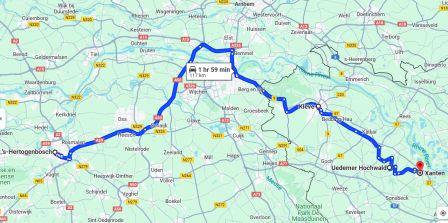
Screenshot 2024-04-16 at 11-06-16 Google Maps

Map shows location of ‘s-Hertogenbosch, Kleve, Hochwald, Xanten, and Groesbeek. (Map source: https://www.google.ca)

On February 21, 1945, the Regiment began moving towards Germany for the upcoming Operation Blockbuster, which would begin at dawn on February 26, 1945. (See https://en.wikipedia.org/wiki/Operation_Blockbuster)

The February 21, 1945 war diary entry noted that “…in the afternoon the men were told of our future role and intentions in Ops Blockbuster….

On February 22, 1945, the war diary recorded that “…the companies spent the day making final preparations for the move into Germany tonight…”  By 2:00 am in the early morning of February 23, 1945 the Regiment had arrived at their initial position in the Reichswald Forest, just over the border from The Netherlands.  The next afternoon the Regiment moved to Kleve.

On March 1, 1945, the war diary for the Lake Superior Regiment recorded that instructions had been received for “…the assault on the Hochwald Forest Gap….” This attack was codenamed Operation Churchill.

Clearing the very narrow Hochwald Gap was a difficult task, given that the weather was anything but cooperative. An early thaw meant that the tanks got bogged down in mud, making them ‘sitting ducks’ for German troops who were positioned to pick them off, one by one. Troops had no choice but to press on, as the Battle of Hochwald Gap, part of Operation Blockbuster, was the final push towards the Rhine River. (See https://the-hochwald-gap.project44.ca/)

….A video shows how the Battle of Hochwald Gap was fought….
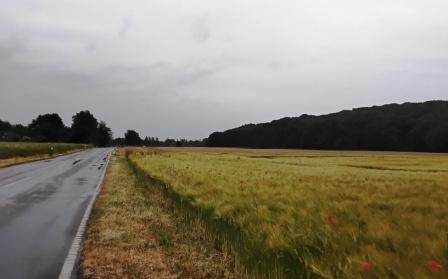
A 46 minute YouTube video on the Battle of Hochwald Gap explained the fierce battle that took place. Watching it made it clear to us that it was a miracle that anyone survived at all, a testament to the determination and courage of those who were in the midst of it.

….Ralph lost his life during Operation Churchill….

March 2, 1945 was a “…cold, blustery day with several snow flurries…” according to the war diary. The after-action report on Operation Churchill noted that the Regiment “…had been fighting already since the 26th of February. Little sleep was had and the Motor Companies had been holding the general line for 24 hours without food….

They’d last eaten on February 28 due to the ground being “…impassable to all vehicles…” and “…incessant shelling by the enemy….

The men may have been tired, cold, and hungry, but there was still a battle to be fought.  By the end of the day, “…the south of the Gap bore the signs of intense shellfire – the ground pitted, scarred, and torn by fire of all kinds. The trees in the gully were cut to ribbons.  The houses were heaps of rubble….

A burial party the following day went out onto the battlefield to look for casualties, and recorded how they were found. “…Further back where two Kangaroos had been knocked out as they lunged across an enemy trench, two more Lake Superior men lay dead. Pte Carriere, F. had been shot through the head as he was de-bussing. Another, Pte Silliker, R. K. was killed as he raced to take up the first position…..”  Dutiful and responsible to the end, Ralph lost his life at the age of 27 during the March 2, 1945 battle.

Private Frank CARRIERE was the son of Emma Carriere of Elm Creek, Manitoba, and the brother of Rifleman William Joseph CARRIERE, who had lost his life on June 8, 1944 while serving with the Royal Winnipeg Rifles.

NOTE: Kangaroo is the nickname given to a Canadian armoured personnel carrier (APC) during the WWII, which was created by converting a tank chassis. (See https://en.wikipedia.org/wiki/Kangaroo_(armoured_personnel_carrier))

….Ralph is buried in the Canadian War Cemetery in Groesbeek….

Ralph was temporarily buried on March 6, 1945 in Xanten, Germany before being reburied in the Canadian War Cemetery in Groesbeek, The Netherlands.

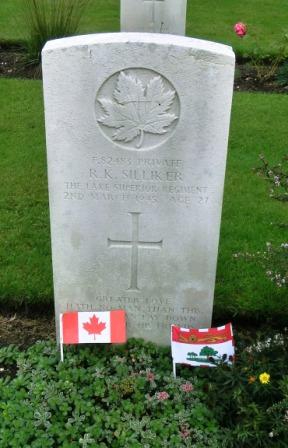
CIMG9016 Sep 16 2017 Groesbeek Cemetery grave of RK Silliker by Daria

Grave of Ralph Kenneth Silliker in the Canadian War Cemetery in Groesbeek, The Netherlands. (Photo credit: Daria Valkenburg)

Thank you to Watson Silliker for sharing a photo. Thank you also to Henk Vincent for additional information on the patrols made along the Maas River. Do you have photos or information to share? Email Pieter at memorialtrail@gmail.com, comment on the blog, or tweet to @researchmemori1.

© Daria Valkenburg

….Want to follow our research?….

If you are reading this posting, but aren’t following our research, you are welcome to do so.  Our blog address: https://onthewarmemorialtrail.com/
Front cover OnTheWarMememorialTrailinEurope4 countries, 6 weeks, 7,000 km – an unforgettable war memorial journey in Europe…. Daria’s book ‘No Soldier Buried Overseas Should Ever Be Forgotten‘ is available in print and e-book formats.  Net proceeds of book sales help support research costs and the cost of maintaining this blog. For more information see https://nosoldierforgotten.com/ 

You are also invited to subscribe to our YouTube Channel: On The War Memorial Trail With Pieter Valkenburg: https://www.youtube.com/channel/UCJ591TyjSheOR-Cb_Gs_5Kw

Never miss a posting!  Subscribe below to have each new story from the war memorial trail delivered to your inbox.
On The War Memorial Trail In North Bay….. The WWII Soldier Who Was Appointed Company Sergeant Major

June 29, 2022. When we knew we would be travelling to North Bay, Ontario in May for an Author Talk at the North Bay Public Library, Pieter also wanted to help the Canadian War Cemeteries in The Netherlands fulfill their photo wish lists of six soldiers from the North Bay area.

Little did we know that a chance meeting with retired history teacher John Hetherington, organized by Don Coutts, to bring together like minded individuals interested in military research, would be the key to receiving one of these photos.

…A meeting that led to a photo of a WWII soldier….

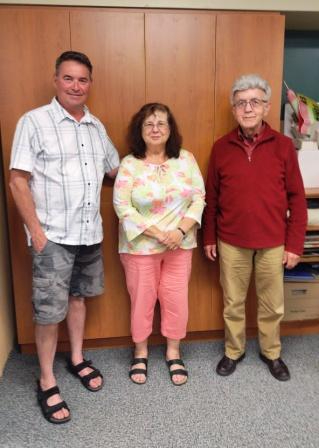
IMG_20220518_195343443_BURST000_COVER May 18 2022 With John Hetherington photo by Don

John Hetherington with Daria and Pieter at the North Bay Public Library.  (Photo credit: Don Coutts)

John Hetherington takes groups to visit war memorials and cemeteries in Europe, and we were delighted to meet him one evening during our visit to North Bay.  After he and Pieter discussed the soldiers on the photo wish lists from the Canadian War Cemeteries in The Netherlands, John recalled that two nephews of Anthony PETTA, one of the soldiers on the list, had been on one of his tours, and had visited their uncle’s grave.

Leave it with me, he said.  He’d look up the contact information and call them.  He did, and within a few days, a photo was sent to Pieter by Anthony Repa, which was in turn sent to The Netherlands.

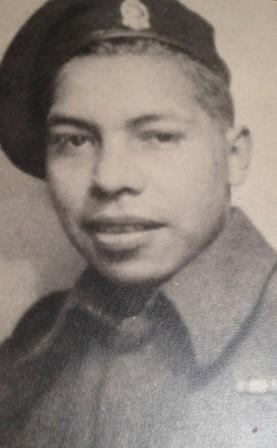
anthony petta colourized

Anthony Petta.  (Photo courtesy of Anthony Petta Family.  Photo submitted by Anthony Repa. Photo restoration and colourization by Pieter Valkenburg)

Antonio ‘Anthony’ PETTA was born November 8, 1915 in North Bay, Ontario, the son of Michael and Raffaela (nee Rota) Petta.  Before enlisting with the Algonquin Regiment in North Bay on May 12, 1941, he was employed as a freight handler with the Temeskaming and Northern Ontario Railroad.

Anthony’s Occupational History Form indicated that he spoke English and Italian fluently, not surprising as both his parents had been born in Italy.  He also indicated that after the war he hoped to take a Commercial Agriculture Course and become a chicken farmer.

On July 12, 1941, he was sent for training at Camp Shilo in Manitoba, followed by a promotion to Acting Corporal and a transfer to Newfoundland on August 8, 1942.

On February 16, 1943, he requested a demotion to Private and was sent to Debert, Nova Scotia, a camp that prepared soldiers for overseas service. The demotion lasted one day, and he was reappointed Acting Corporal.  On April 6, he was confirmed as Corporal, and the following day, received another promotion, to Lance Sergeant.

By July 2, 1943 he was in the United Kingdom. While in the United Kingdom, he was promoted to Acting Sergeant on February 28, 1944, and then promoted again, this time to Sergeant, on May 28, 1944.

His stay in the United Kingdom ended when he left for Normandy, France with the Algonquin Regiment on July 20, 1944. On July 25, 1944, all four companies of the Algonquin Regiment landed on Juno Beach where, in the following days, they supported the 4th Canadian Armoured Division in closing the Falaise Gap. From there they fought to secure many bridgeheads over canals in The Netherlands and into Germany.

From November 5 to 8, 1944 the Algonquin Regiment had a rest period in the area around Steenbergen, in preparation for Operation Blockbuster, which began in February 1945, part of the final push towards the Rhine.   (See https://en.wikipedia.org/wiki/Operation_Blockbuster)

According to his service record, while in Europe Anthony was appointed Acting Company Sergeant Major (CSM) with the rank of Acting Warrant Officer 2. (See https://en.wikipedia.org/wiki/Company_sergeant_major)

….The Battle of Hochwald Gap was fierce and under wet and muddy conditions….

On February 26, 1945, Anthony’s regiment advanced towards the Hochwald Gap, the scene of what became a fierce battle. (See https://civilianmilitaryintelligencegroup.com/10742/the-battle-of-hochwald-gap-one-of-the-largest-armor-engagements-you-probably-have-never-heard-of)

The war diary for the Algonquin Regiment for February 27, 1945 noted that they were huddled beside the tanks which had brought them forward.  Unfortunately, one company and part of another were missing, as the tanks carrying them had bogged down.

The objective for the Algonquin Regiment was a rounded hill which filled the western end of the gap between the Hochwald and the Balberger Wald.

The war diary for the Algonquin Regiment for March 2, 1945 explained that “… ‘D’ Company managed to mount two platoons on the available tanks, and with one platoon on foot, started for their objective. The two platoons on tanks managed to get as far forward as the Lake Superior Regiment position, but by this time 5 of the 8 tanks had been knocked out.  The infantry therefore debussed and the tanks returned to the protective cover of the hill….

The third platoon of ‘D’ Company joined the small force of Lake Superior Regiment holding the furthest position forward.  ‘A’ Company then tried to get forward to join ‘D’ Company, but they were pinned down by murderous fire from both flanks and were being shelled at every moment. It was decided to abandon this effort as casualties had been very heavy.  A/CSM Petta was killed in this action….

Lt Hamilton, taking part in his first action, was also killed. Captain T. P. Richardson, Acting Commander ‘A’ Company, who was with CSM Petta, was missing, believed killed….

It was later confirmed that Captain Richardson had died.  Although the official records state that Anthony Petta died on March 3, 1945, the war diary indicates that he had died a day earlier.  His brother Alexander ‘Leslie’ was also in the Algonquin Regiment and survived the war.

…Tanks helped protect infantry regiments…

A 46 minute YouTube video on the Battle of Hochwald Gap explained the fierce battle that took place.  While this video depicts the tank battle, it shows the horrifying conditions troops were up against.  Infantry units like the Algonquin Regiment depended on the tank regiments for protection.

…The photo at the Canadian War Cemetery in Groesbeek that triggered John’s memory…

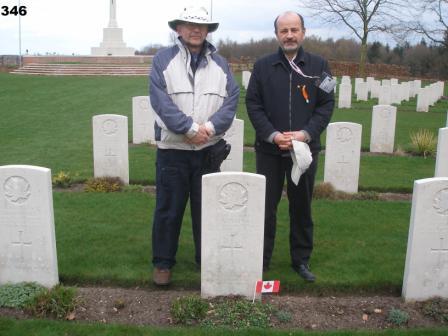
n346 Maurice Petta and Anthony Repa by John Hetherington

Anthony Repa, left, and Maurice Petta, right, by the grave of Anthony Petta at the Canadian War Cemetery in Groesbeek in April 2010.  (Photo courtesy of John Hetherington)

After meeting us, John did look for the photo of the two nephews, and sent it to us.  When Anthony Repa sent us the photo of his uncle, he also gave permission to include the 2010 photo taken of himself and his cousin in Groesbeek.

Anthony went on to share that he has visited the cemetery in Groesbeek “…three times. The first, I was 23, in 1968 and backpacked around England, Belgium and Holland for 2 weeks. The second trip, I was with my wife and young son in 1987. The third was on John’s tour in 2010.

On the second trip, my wife and son and I were taking a Rhine River cruise which originated in Nijmegen.  We booked into a hotel in Nijmegen and after I asked the desk clerk if there was a bus to Groesbeek, he directed us to a bus stop.  As we waited at the stop, a bus came from the direction of the cemetery and stopped. 

The female driver said something to us in Dutch. I told her we were Canadian and she then said in English that this was the last bus and that she was finished her shift. She then asked where we wanted to go.  I said the Groesbeek Cemetery as my uncle was buried there.  She told us to get on the bus, turned the bus around and drove us to the cemetery.  I offered to pay the fare but she declined.

When we arrived she told us to take as long as we wanted to, that she would wait.  After we paid our respects she drove us back to the hotel.

I have told countless people about this experience. I have many wonderful memories of my travels, one of my fondest, is the kindness she showed us on that day….

…The Memorial Plaque from St. Rita Roman Catholic Church…

St. Rita Plaques - Petta death

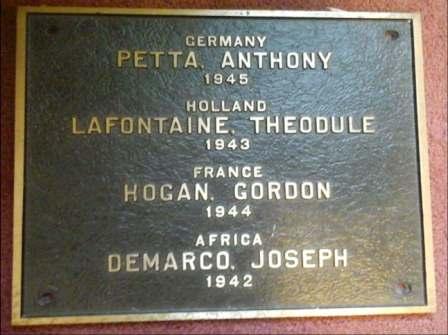
Part of the memorial plaque originally placed by St. Rita Roman Catholic Church. (Photo courtesy of Karen Steel)

We thought we had reached the end of the research for Anthony Petta when we were contacted by 92 year old Don Unger, who said he grew up in the neighbourhood around St. Rita’s Roman Catholic Church and remembered seeing a memorial in the church yard.  The memorial “….mentions Anthony Petta and other Italian boys who served…” he told Pieter.

The church was closed in 2010, but we asked Don Coutts, who lives in North Bay, if he could see if the memorial was still in the yard.  It wasn’t.

Don then went to the Pro-Cathedral of the Assumption and asked Karen Steel if she had any information.  Karen explained that “…the plaques were donated to the North Bay Museum…” but she sent us “…a copy of the plaque information that I took for historical purposes before the plaques were taken to the museum.  I always knew someday someone would be looking for this information!…

The July 23, 1946 edition of the North Bay Nugget newspaper had a picture of the war memorial when it was dedicated.  The text under the picture said “…His Excellency R. H. Dignan, assisted by Rev R. F. Venti, officiated at the unveiling of a splendid war memorial at St. Rita’s Park on Sunday.  Dedicated to the memory of four members of the parish who gave their lives in the Second World War, the memorial is also in honour of those who served during the war. 

The four corners are dedicated to Sgt Joe Demarco of the RCAF, Sgt A. Petta, Pte Gordon Hogan, and Cpl William Lafontaine, all of whom gave their lives during the recent conflict. The honour roll is also inscribed on the memorial. The dedication ceremony was an impressive one…img church memorial for petta North Bay Nugget Jul 23 1946

Thank you to Don Coutts, John Hetherington, and Anthony Repa.  Thank you also to Judie Klassen and Shawn Rainville for researching the newspaper and genealogy archives.  Thank you to Karen Steel and Don Unger for the information on the memorial from St. Rita’s Church. Thanks also go to the North Bay Nugget newspaper as it had extensive coverage of WWII soldiers from the time period and the newspaper archive is digitized.

Our North Bay adventures continue in upcoming postings.  If you know of any soldiers from the North Bay area that are buried in The Netherlands please let Pieter know. You can mail him at memorialtrail@gmail.com, or comment on the blog.

© Daria Valkenburg

….Previous stories told about soldiers who lost their lives during the Battle of Hochwald Gap ….

Two previous stories were told about soldiers who lost their lives during the Battle of Hochwald Gap.  Clarence Wilfred Wakegijig was in a tank regiment that supported the infantry.  Gerald Coolen, like Anthony Petta, was in an infantry regiment.  To read the stories about Clarence and Gerald, see:

…Missed the previous postings about our North Bay Memorial Trail visit?…

…Want to follow our research?….

If you are reading this posting, but aren’t following our research, you are welcome to do so.  Our blog address: https://onthewarmemorialtrail.com/

Front cover OnTheWarMememorialTrailinEurope4 countries, 6 weeks, 7,000 km – an unforgettable war memorial journey in Europe…. Daria’s book ‘No Soldier Buried Overseas Should Ever Be Forgotten‘ is available in print and e-book formats.  Net proceeds of book sales help support research costs and the cost of maintaining this blog. For more information see https://nosoldierforgotten.com/

You are also invited to subscribe to our YouTube Channel: On The War Memorial Trail With Pieter Valkenburg: https://www.youtube.com/channel/UCJ591TyjSheOR-Cb_Gs_5Kw.

Never miss a posting!  Subscribe below to have each new story from the war memorial trail delivered to your inbox.

On The War Memorial Trail….. Atlantic Canada Remembers – Part 11

November 28, 2021. In Part 11, two stories from the many photos submitted about Atlantic Canadian soldiers buried overseas are featured. Pieter continues to ensure that photos of soldiers buried in The Netherlands are forwarded to the appropriate cemetery for their digital archives.

Soldier buried at the Canadian War Cemetery in Groesbeek, The Netherlands

Gerald Coolen from Gerry Smith

Gerald Burnell Coolen.  (Photo submitted by Gerry Smith)

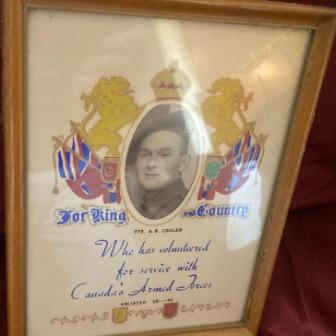
After seeing a November 9, 2021 interview on CTV Atlantic Live at 5, Sherry Muise wrote us about her uncle, Gerald Burnell COOLEN, born June 19, 1923 in Western Head, Nova Scotia, the son of Eben Burnell Coolen and Dorothy Belle (nee Guest) Coolen.  “…I recently saw your interview on CTV News Atlantic and wanted to share this information with you.

Private Gerald Coolen was my mother’s (June) brother. In June of 2010, we learned that his service medals had somehow become for sale on Ebay.  The Legion in Berwick was able to secretly buy them back and a repatriation of the medals ceremony was held in Berwick. Private Coolen’s sister Eleanor and 3 nieces and a nephew were able to attend. The medals remain on display at the Legion Branch in Berwick….” (To watch the CTV interview, see: https://atlantic.ctvnews.ca/video?clipId=2318376&jwsource=em)

On July 16, 1940, Gerald enlisted with the West Nova Scotia Regiment in Aldershot, Nova Scotia, giving a false birthdate of June 16, 1921 as he was underage.  He was discharged on May 5, 1941 at the request of his parents.  On September 15, 1941 he married Gladys Mary Rafuse in Liverpool, Nova Scotia.

Once he was of age, Gerald re-enlisted on January 31, 1942, this time at the No 6 District Depot in Halifax.   An interviewer described him as “…young and strong…” with an “…open and pleasant manner…

After training in Yarmouth and Aldershot in Nova Scotia, Gerald was transferred to the North Nova Scotia Highlanders and sent overseas to the United Kingdom.  He arrived on June 12, 1942 and was attached to the Canadian Infantry Reinforcement Unit (CIRU).

….Gerald Coolen was transferred to the Black Watch….

On December 16, 1944 he was sent to northwest Europe, and then on December 30, 1944 he was transferred to the Black Watch (Royal Highland Regiment) of Canada.

On February 25, 1945 2nd Canadian Division troops began taking their positions in the muddy fields south-west of Calcar, Germany. The goal?  Clear the Rhine River in Xanten, Germany in an operation codenamed Operation Blockbuster.  (See https://en.wikipedia.org/wiki/Operation_Blockbuster)

Five infantry battalions participated as part of the 2nd Canadian Division: Le Régiment de Maisonneuve, The Black Watch (Royal Highland Regiment) of Canada, The South Saskatchewan Regiment, Les Fusiliers Mont-Royal, and The Queen’s Own Cameron Highlanders of Canada.

On February 26, 1945, Gerald’s regiment advanced towards the Hochwald Gap, the scene of what became a fierce battle. (See https://civilianmilitaryintelligencegroup.com/10742/the-battle-of-hochwald-gap-one-of-the-largest-armor-engagements-you-probably-have-never-heard-of)

The Black Watch war diary entry for February 27, 1945 noted that “…Weather – cloudy and cold, clear in afternoon…..”  The Regiment was over an hour late in moving out and then “…moved at a rate of 3 mph owing to the congestion of vehicles on roads due to the awful conditions – the roads being badly cratered in many places. … Enemy fire killed two men from A Company…

These are the only two deaths recorded on February 27, 1945 in the Black Watch diary, the day that the service records for Gerald indicate that he was killed in action.

Gerald was initially buried in Bedburg Military Cemetery in Germany, before being reburied in the Canadian War Cemetery in Groesbeek, The Netherlands in 1946.

Sherry went on to note that “…Pte Coolen’s widower never remarried and they did not have children. The last few years of Aunt Gladys’s life she resided in a private care home.  Thank you for all of your efforts in this research project….

….The Battle of Hochwald Gap was fierce and under wet and muddy conditions….

This is the same event in which Clarence Wilfred WAKEGIJIG, who served with the Canadian Grenadier Guards, lost his life a few days later.  (See https://bordencarletonresearchproject.wordpress.com/2021/08/09/on-the-war-memorial-trail-remembering-ww2-soldier-clarence-wilfred-wakegijig/)

A 46 minute YouTube video on the Battle of Hochwald Gap explained the fierce battle that took place.  Watching it made it clear to us that it was a miracle that anyone survived at all, a testament to the determination and courage of those who were in the midst of it.

Soldier buried at the Canadian War Cemetery in Holten, The Netherlands

Samuel Glazier Porter

Samuel Glazier Porter.  (Photo submitted by Don Hulsman)

Don Hulsman submitted a newspaper photo found in the archives in Fredericton, New Brunswick of Samuel Glazier PORTER, born December 7, 1918 in Dow Flat, Victoria County, New Brunswick, son of George and Amy Porter.

He enlisted in August 1942 in Fredericton, New Brunswick, and underwent basic training, followed by advanced training in Halifax, Nova Scotia, and then spent time in St. John, New Brunswick.  In September 1944 he was transferred to the PEI Highlanders and had additional training in Vernon, British Columbia before going overseas to the United Kingdom in January 1945.

Once in the United Kingdom, he was transferred to the Canadian Infantry Training Regiment (CITR).  On March 28, 1945 he was sent to north-west Europe as part of the troop reinforcements, and transferred to the Carleton & York Regiment on April 2, 1945.

Unfortunately, on April 15, 1945, while with the Carleton & York Regiment, he lost his life as the unit advanced to the Apeldoorn Canal in The Netherlands.  He was one of 6 soldiers initially buried along the main road to Posterenk, a village near Zutphen.  Samuel was later reburied in the Canadian War Cemetery in Holten.

…The Posterenk Memorial…

In September 2017, Pieter and I visited the village of Posterenk with Edwin van der Wolf, one of the research volunteers at the Canadian War Cemetery in Holten.

CIMG9297 Sep 25 2017 Edwin and Pieter with CYR list

Edwin van der Wolf and Pieter in Posterenk in 2017.  Pieter holds up a list of the 6 Carleton & York Regiment soldiers who were temporarily buried in the village.  (Photo credit: Daria Valkenburg)

The village prepared a list of 6 soldiers to commemorate from the Carleton & York Regiment.  Unfortunately, not all soldiers who died are included.

Posterenk list of 6 CYR members

List of 6 Carleton & York Regiment soldiers temporarily buried in Posterenk in 1945.

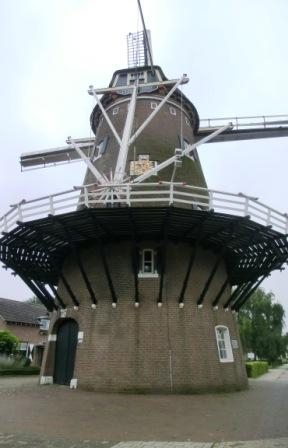
As well, a memorial stone is inscribed in the village windmill:

CIMG9295 Sep 25 2017 Posterenk windmill

Windmill in Posterenk.  (Photo credit: Daria Valkenburg)

CIMG9300 Sep 25 2017 Sign Posterenk freed by CYR Apr 13 1945

Translation of memorial stone on the windmill: Posterenk freed by the Carleton & York Regiment of Canada on April 13, 1945. (Photo credit: Daria Valkenburg)

To read about two more soldiers who lost their lives in the area of Posterenk, see:

Thank you to Don Hulsman, Sherry Muise, and Gerry Smith and for sharing photos and anecdotes to ensure that Atlantic Canadians who are buried overseas are not forgotten.

If you can help with a better photo of Samuel Porter, or have photos or information to share about other Canadian soldiers buried in The Netherlands, please email Pieter at memorialtrail@gmail.com, comment on the blog, or tweet to @researchmemori1.

© Daria Valkenburg

…Previous postings in the Atlantic Canada Remembers series…

Missed the previous postings in this series? See:

…Want to follow our research?….

If you are reading this posting, but aren’t following the blog, you are welcome to do so.  Our blog address: https://onthewarmemorialtrail.com/

Front cover OnTheWarMememorialTrailinEurope4 countries, 6 weeks, 7,000 km – an unforgettable war memorial journey in Europe…. Daria’s book ‘No Soldier Buried Overseas Should Ever Be Forgotten‘ is available in print and e-book formats.  Net proceeds of book sales help support research costs and the cost of maintaining this blog. For more information see https://nosoldierforgotten.com/

Screenshot_2021-02-27 On The War Memorial Trail With Pieter Valkenburg

You are invited to subscribe to our YouTube Channel: On The War Memorial Trail With Pieter Valkenburg: https://www.youtube.com/channel/UCJ591TyjSheOR-Cb_Gs_5Kw.

Never miss a posting!  Subscribe below to have each new story from the war memorial trail delivered to your inbox.

On The War Memorial Trail….. Remembering WW2 Soldier Clarence Wilfred Wakegijig
August 9, 2021. After an interview about the photo quest for soldiers buried in the Canadian War Cemeteries in The Netherlands ran on APTN, Pieter was contacted by Annelind Wakegijig. (ee https://www.aptnnews.ca/national-news/dutch-born-p-e-i-man-on-a-mission-to-find-photos-of-first-nations-soldiers-killed-overseas-in-wwii/)

She sent us a photo of Clarence Wilfred WAKEGIJIG, and wrote that “…I recently saw your story featured on APTN. My great-uncle, Clarence WAKEGIJIG was from the Wiikwemkoong Unceded Territory on Manitoulin Island, Ontario. He died in Holland on March 2, 1945. He is buried in Groesbeek…”  (For more information on the Wiikwemkoong First Nation, see https://en.wikipedia.org/wiki/Wiikwemkoong_First_Nation )

Annelind explained that “… He was the youngest son of Josephine (Shawanda) Wakegijig and Joachim Wakegijig. His siblings were:

  • Victoria Corbiere 
  • Christine Wakegijig 
  • Ethel Wakegijig –  who had suffered a childhood illness and died at 5 years of age 
  • John Wakegijig -also a veteran of WWII, who died in 1971 in a motor vehicle accident 

and 

  • Raymond Wakegijig – who drowned in his late 20s 

 Clarence was a Guardsman with the Canadian Grenadier Guards…. 

Clarence Wakegijig

Clarence Wilfred WAKEGIJIG.  (Photo Courtesy of Clarence Wakegijig Family)

Clarence was born January 9, 1925 in Cutler, Ontario, the son of Joachim and Josephine Wakegijig (nee Shawanda), of Krugersdorf, Ontario. He enlisted on September 25, 1941 with the Sault Ste Marie and Sudbury Regiment in Sudbury, Ontario, giving his birth year as 1922 and birthplace as Wikwemikong (Wiikwemkoong in Ojibwe).  The fact that he was only 16 years old, not 19, doesn’t seem to have been discovered.

He was sent to the Basic Training Centre in North Bay, Ontario.  In February 1942 Clarence was sent to the Driving and Maintenance Training School in Woodstock, Ontario, where he learned driver mechanics and how to drive a motorcycle.

On April 22, 1942 he was posted to Trois-Rivières, Quebec as reinforcement to Infantry (MG) TC A-17 – a Machine Gun Training Centre.

….Clarence arrived in Europe in 1942….

 By the end of September 1942, Clarence was on his way to the United Kingdom, arriving on October 9, 1942 and assigned to the Machine Gun Reinforcement Unit (MGRU), where he underwent additional training.

By June 1943 he had received a promotion to Trooper and was assigned to the 32nd Reconnaissance Regiment.  On September 18, 1943 he was awarded a Good Conduct Badge.

On March 19, 1944 he was assigned to the 22nd Armoured Regiment, known as the Canadian Grenadier Guards, taking further training as a driver mechanic in preparation for the Regiment moving into action in France.

The Regiment arrived in France on July 23, 1944, and underwent heavy fighting in Normandy during Operation Totalize and Operation Tractable, which led to the capture of Falaise. (For more information, see https://en.wikipedia.org/wiki/Operation_Totalize and https://en.wikipedia.org/wiki/Operation_Tractable)

Clarence survived these actions, and continued on with the Regiment as they left Normandy, France for North West Europe, fighting in Belgium, The Netherlands, and Germany.

….The Battle of Hochwald Gap was a fierce tank battle….

According to the war diary for the Canadian Grenadier Guards, the Regiment had travelled from The Netherlands just over the border into Germany, to participate in the Battle of Hochwald Gap, part of Operation Blockbuster, the final push towards the Rhine River, along with several other Canadian Regiments. (For more information, see https://canadianbattlefieldtours.ca/operation-blockbuster/ and https://civilianmilitaryintelligencegroup.com/10742/the-battle-of-hochwald-gap-one-of-the-largest-armor-engagements-you-probably-have-never-heard-of)

On February 26, 1945 they were travelling southeast from Kalkar, Germany, getting bogged down in mud and clay, and through farm fields in which mines had been hidden by the Germans, causing many casualties.

Map showing route thru Hochwald Gap

The Regiment’s objective was to reach Xanten, the last town on the western side of the Rhine, but first they had to get through the very narrow Hochwald Gap. They reached the west end of the Hochwald Gap just after dawn on February 28, 1945.

The weather continued to be uncooperative. An early thaw meant that the tanks got bogged down in mud, making them ‘sitting ducks’ for German troops who were positioned to pick them off, one by one.

The Canadian Grenadier Guards war diary entry for March 2, 1945 noted “… Weather – cloudy, gusts of rain. ...” Artillery fire had caused a temporary halt before starting up again.

…Charge was successful and the 1st objective taken, despite the fact that 6 tanks bogged before then. Confused fighting took place from here on – Lt Ferris (2 tanks) and C Company passed through, but ran into opposition in the form of a Tiger….” Clarence was in C Company.  A Tiger was a German tank.

The war diary entry continued.  “…Somewhere in here, Lt Ferris and his other tank were knocked out, and Lt Ferris was wounded by a sniper...

At some point in this chaos, Clarence lost his life, most likely when one of the tanks was hit by German fire. A 46 minute YouTube video on the Battle of Hochwald Gap explained the fierce battle that took place.  Watching it made it clear to us that it was a miracle that anyone survived at all, a testament to the determination and courage of those who were in the midst of it.

Clarence was temporarily buried in Xanten, Germany before being reburied in 1946 in the Canadian War Cemetery in Groesbeek, The Netherlands.

Grave of Clarence Wakegijig

Grave of Clarence Wilfred Wakegijig.  (Photo credit: Ad Scheepers)

Thank you to Annelind Wakegijig for sharing a photo and information about her great-uncle.  If you have information to share about Clarence Wilfred WAKEGIJIG or other Canadian soldiers, please contact Pieter at memorialtrail@gmail.com, comment on the blog, or send a tweet to @researchmemori1.

© Daria Valkenburg

….Want to follow our research?….

If you are reading this posting, but aren’t following our research, you are welcome to do so.  Our blog address: https://onthewarmemorialtrail.com/

Front cover OnTheWarMememorialTrailinEurope4 countries, 6 weeks, 7,000 km – an unforgettable war memorial journey in Europe…. Daria’s book ‘No Soldier Buried Overseas Should Ever Be Forgotten‘ is available in print and e-book formats.  Net proceeds of book sales help support research costs and the cost of maintaining this blog. For more information see https://nosoldierforgotten.com/

Screenshot_2021-02-27 On The War Memorial Trail With Pieter Valkenburg

You are also invited to subscribe to our YouTube Channel: On The War Memorial Trail With Pieter Valkenburg: https://www.youtube.com/channel/UCJ591TyjSheOR-Cb_Gs_5Kw.

Never miss a posting!  Subscribe below to have each new story from the war memorial trail delivered to your inbox.