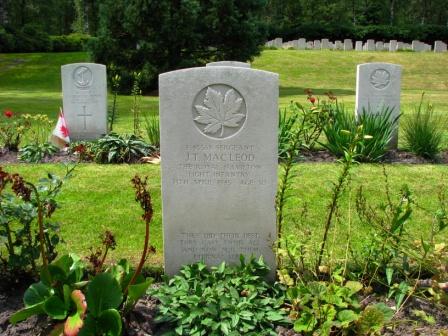
On The War Memorial Trail…..The WWII Gunner Who Died In A Vehicle Accident A Day After The Liberation Of Groningen

May 15, 2026. Since Pieter began receiving photo wish lists of soldiers buried in the Canadian War Cemeteries in The Netherlands, we’ve found that many of the names came from towns and villages that we were unfamiliar with.  We travel quite a bit in the Maritime provinces of New Brunswick, Nova Scotia, as well as our home province of Prince Edward Island.  We also occasionally drive through Quebec towards Ottawa, Ontario, where we lived for several years before Pieter’s retirement.
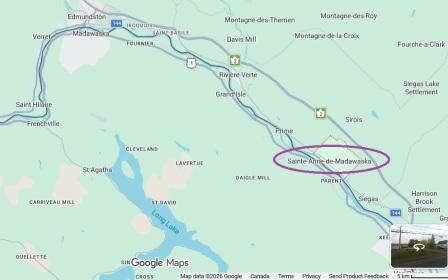
Roger Sirois was born in Sainte-Anne-de-Madawaska, New Brunswick.  (Map source: Google Maps)

The hours of driving go by quickly as it seems that, over the years, we can put a soldier to every place name listed on the highway road signs. Such was the case last fall when we were on our way to Ottawa, and passed by a sign for Sainte-Anne-de-Madawaska, 30 km (18.6 miles) southeast of Edmundston, New Brunswick. Now part of the town of Vallée-des-Rivières since 2023, it was the birthplace of WWII soldier JosephRoger’ SIROIS.

Born December 16, 1922, Roger was the son of John (Jean) and Catherine (nee Pelletier) Sirois, one of 12 children.  With the exception of one brother, who moved to Sarnia, Ontario, the rest of the siblings immigrated to the USA…. and that is where Pieter found a relative with a photo.

….The search for a photo of Roger was successful…

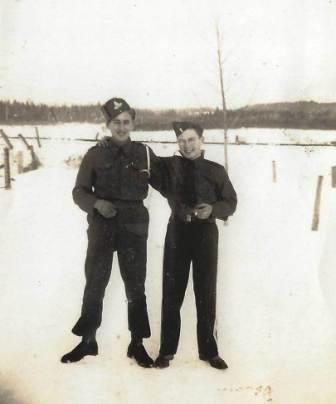
An obituary for Angeline Hounjet, wife of Roger’s brother Aurele, led Pieter to get in contact with her son Roger.  “Roger Sirois was my uncle, who died shortly before I was born in New Brunswick….” he explained.  “…. I have attached a picture of my uncle – he is the tall one on the left–with his friend, Joel.  There is a strong family likeness; definitely a Sirois!…

Roger Sirois (left) with his friend Joel.  (Photo courtesy of the Sirois Family)

When he enlisted at the No. 7 District Depot in Fredericton, New Brunswick on August 21, 1942, he stated that he worked on the family farm, spoke English and French, but was more fluent in French, and for the past year had been employed as a boilerman for the Aluminium Company of Canada (Alcan) in Arvida, Quebec. (See https://arvida.saguenay.ca/en/the-city-of-aluminum/history-and-profile-of-arvida/the-second-world-war)

When asked about hobbies and interests, Roger noted that he hunted and fished, and could play the violin.  He was described by a military interviewer as “…cheerful, sturdy, with good deportment, and appearance….

On September 18, 1942, Roger was sent to No. 70 Canadian Army Basic Training Centre (CABTC) for basic training.  He remained there until December 2, 1942, when he was transferred to A1 Canadian Artillery Corps Training Centre (CATC) in Camp Petawawa, Ontario for advanced training as a gunner.

While still at A1 CATC, he qualified as a Driver i/c Class III wheeled vehicles on January 30, 1943. (The term ‘Driver i/c’ refers to ‘Driver, internal combustion’.  Class III meant he was qualified to drive heavy trucks and armoured cars, but not tanks.)

As a driver in the Royal Canadian Artillery, Roger would be responsible for operating and maintaining military vehicles to transport crews, artillery such as 25-pounder field guns, and heavy ammunition loads to the front lines, often under fire.  As a trained gunner, he could also be expected to double as a gun crew member, switching between driving and firing, depending on the situation.

Roger was there at the same time as Arthur GAUDET of Prince Edward Island, taking the same training and subsequently going overseas at the same time before their paths diverged.  (See https://onthewarmemorialtrail.com/2025/02/12/on-the-war-memorial-trail-the-wwii-soldier-from-prince-edward-island-who-lost-his-life-in-germany-two-days-before-his-21st-birthday/)

On February 10, 1943, he was granted embarkation leave until February 23, 1943, the last chance he would have to see his family before going overseas.

….Roger left Canada for overseas service….

On March 24, 1943, Roger left Canada for the United Kingdom.  Upon arriving on March 31, 1943 he was assigned to No. 3 Canadian Artillery Reinforcement Unit (CARU), effective the following day.

On June 18, 1943, Roger was transferred to the 11th Light Anti-Aircraft (LAA) Regiment, Royal Canadian Artillery for Light Machine-Gun and Rifle training.  After this Regiment disbanded in March 1944, Roger was transferred to the 3rd Light Anti-Aircraft (LAA) Regiment, Royal Canadian Artillery.

Training continued until July 4, 1944, when the Regiment moved to an area near London and boarded a ship in preparation for going to North West Europe.  They arrived in Normandy on July 7, 1944, one month after D-Day, in support of the 3rd Canadian Division, part of the 21st Army Group.

The role of 3rd LAA was to provide mobile anti-aircraft protection for ground troops and positions, and help defend against German Luftwaffe night raids by implementing barrages to combat low-flying aircraft.

They were soon tested as on July 11, 1944, right after the Regiment arrived near Carpiquet Aerodrome, twelve low flying Messerschmitt 109s appeared on the horizon. The German planes banked sharply towards the coast and flew directly over the Regiment’s guns. Every gun in the battery opened up, sending seven Messerschmitts down in flames, while damaging the other five. The following day, six more appeared and three were shot down. This was just one example of what the Regiment experienced.

….Roger was transferred to the 4th Field Regiment….

On August 2, 1944, Roger was transferred to the 4th Field Regiment, Royal Canadian Artillery, joining them in Fleury-sur-Orne, France as they prepared for Operation Totalize. This offensive, fought between August 7-11, 1944, was designed to break through the German defences south of Caen and toward Falaise, with the objective of closing the Falaise gap and cutting off the retreating Germany 7th Army.  (See https://en.wikipedia.org/wiki/Operation_Totalize)

The Regiment moved through Normandy, France, and then into Belgium and The Netherlands in at the end of September and into October 1944 for the Battle of the Scheldt, which began officially on October 2 and lasted until November 8, 1944, and in which the Regiment provided crucial artillery support.

The Battle of the Scheldt’s objective was to free up the way to the Port of Antwerp in Belgium for supply purposes. From Antwerp, they went into The Netherlands, fighting along flooded fields and dikes leading toward Woensdrecht in a battle that lasted until October 21, 1944. (See https://www.veterans.gc.ca/eng/remembrance/history/second-world-war/scheldt)

The Regiment remained in The Netherlands until mid-February.  On February 16, 1945, they arrived in Germany in preparation for Operation Blockbuster, which began at dawn on February 26, 1945 and ended on March 3, 1945. (See https://en.wikipedia.org/wiki/Operation_Blockbuster)

The Regiment’s war diary for March 4, 1945 noted that “…the Hochwald was cleared and the Germans began the withdrawal….so that we did very little firing…

NOTE: For an idea of some of the places that the Regiment travelled through in Germany, see https://onthewarmemorialtrail.com/2026/02/06/on-the-war-memorial-trail-we-follow-the-route-taken-into-germany-by-canadian-troops-in-1945/

By the end of March the Regiment had returned to The Netherlands, and preparing for the upcoming Battle of Groningen, fought from April 14-16, 1945, an offensive to clear all approaches to the city and capture it.  (See https://www.canadiansoldiers.com/history/battlehonours/northwesteurope/groningen.htm and https://library.mcmaster.ca/battle-groningen-april-1945)

….Roger accidentally died after falling from a vehicle…

Roger had survived several major battles up to now, but his luck ran out on the morning of April 17, 1945, the day after Groningen was liberated from Nazi occupation.

According to testimony by Bombadier J.D. FLINT at a Court of Inquiry, Roger, Flint, and Gunner E. BROWN were returning from a battery position when another military vehicle passed by.  Roger “…was standing on the near side of the vehicle as it approached us.  We slowed right down as the road was very narrow…”  Brown, the driver, “…pulled over as far as possible to the right hand side of the road….” and asked Flint “…if everything was clear….”  Flint replied that as far as he could see “…there was plenty of room for both vehicles to pass…

However, Flint went on to say that “…just as we were passing, Gunner Sirois leaned back as if waving to us.  We stopped….” and saw Roger “…lying on the road…

Lt. E. J. MACROW, a passenger in the other vehicle, said that neither vehicle showed “…evidence of a collision… The tracks of both vehicles showed that there should have been ample room to pass …”   When asked if he was aware that Roger was standing on the side of the vehicle, he replied “…No. I did not see him as he must have been standing on the fender by the rear side door

The medical report showed that Roger died from injuries that included a “…crushed right chest with internal injuries, and fractured right humerus…

The Court of Inquiry ruled it an accidental death.  Most likely, Roger lost his balance and fell off the vehicle, and ended up being run over by one of the two vehicles as they passed each other.

Although Roger died on April 17, 1945, his death was incorrectly recorded a day earlier in the April 16, 1945 War Diary entry for the 4th Field Regiment of the Royal Canadian Artillery! “…Gunner Sirois, 2nd Battery driver, was accidentally killed…”  He was 22 years old.

….Roger is buried in Holten…
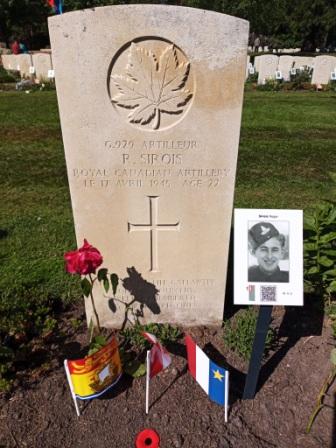
Grave of Roger Sirois with Canadian, New Brunswick, and Acadian flags placed by Pieter.  (Photo credit: Pieter Valkenburg)

Roger was temporarily buried in Eelderwolde, 5 km (3 miles) south of Groningen, before being reburied on February 14, 1946 in the Canadian War Cemetery in Holten, The Netherlands. During our 2025 European War Memorial Tour, Pieter placed Canadian, New Brunswick, and Acadian flags by his grave.
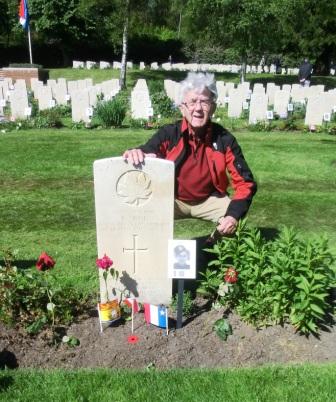
Pieter at the grave of Roger Sirois after placing Canadian, New Brunswick, and Acadian flags. (Photo credit: Daria Valkenburg)
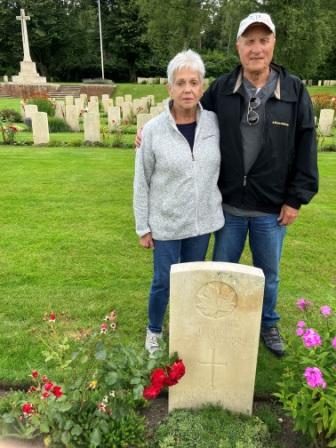
Roger Sirois and his wife Judy visited his uncle’s grave in 2024.  (Photo courtesy of Roger Sirois)

Thank you to Roger Sirois for providing a photo.  “Thank you for the very worthwhile work you do….” he wrote.  After visiting his uncle’s grave in 2024, and meeting Edwin van der Wolf, one of the volunteers at the Information Centre in Holten, Roger expressed his appreciation. “Again, you folks do such great work to, among other things, provide a vehicle to allow families to piece together family histories and a means to remember soldiers who served their respective countries….

The flags placed at Roger’s grave during our 2025 visit were donated.  Our thanks go to:

  • Alan Waddell, Constituent Assistant, on behalf of Heath MacDonald, MP for Malpeque, for the Canadian flag.
  • Jean-Claude D’Amours, MLA (Member of the Legislative Assembly) for Edmundston-Madawaska Centre, Minister responsible for Military Affairs, with the help of Cécile LePage, Province of New Brunswick, for the New Brunswick and Acadian flags.

Pieter’s research efforts to find photos and families of soldiers continue. Do you have a story to tell? Email Pieter at memorialtrail@gmail.com, or comment on the blog.

© Daria Valkenburg

….Want to follow our research?…

If you are reading this posting, but aren’t following our research, you are welcome to do so.  Our blog address: https://onthewarmemorialtrail.com/
4 countries, 6 weeks, 7,000 km – an unforgettable war memorial journey in Europe…. Daria’s book ‘No Soldier Buried Overseas Should Ever Be Forgotten‘ is available in print and e-book formats.  Net proceeds of book sales help support research costs and the cost of maintaining this blog. For more information see https://nosoldierforgotten.com/

Subscribe to our YouTube Channel: On The War Memorial Trail With Pieter Valkenburg: https://www.youtube.com/channel/UCJ591TyjSheOR-Cb_Gs_5Kw.

Never miss a posting!  Subscribe below to have each new story from the war memorial trail delivered to your inbox.
On The War Memorial Trail….. The WWII Soldier From Barney’s River Who Lost His Life During The Battle of Groningen

April 12, 2024.  One of the biases faced by many soldiers during the war was the perception that an excellent education would result in an intelligent and capable leader of those in battle.  This was not always the case, unfortunately, and often an otherwise obvious candidate for promotion into an officer rank was not chosen, solely based on his early educational background.

In researching the story of Joseph Taylor MACLEOD of Barney’s River, Nova Scotia, Pieter encountered a well-respected, capable, and intelligent man, who was rightfully promoted several times.  However, due to having left school after completing Grade 5, he did not rise as high in rank as he might have if he had been a high school graduate.  What he did achieve during his military service is a testament to what can happen when promotions are based on merit.

….Joseph enlisted with The Pictou Highlanders….

Screenshot 2024-03-22 at 12-32-28 Avondale Station

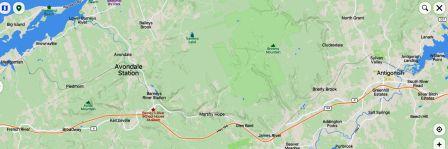
Map shows Avondale Station, Nova Scotia, where Joseph Taylor MacLeod was born.  (Map source: http://www.mapcarta.com)

Born November 11, 1914 in Avondale Station, Pictou County, Nova Scotia, Joseph Taylor MACLEOD was the son of Robert and Ella Margaret MacLeod. He was the youngest in his family and had 5 brothers and 1 sister.  Two of his brothers also served during WWII.

When Joseph enlisted with The Pictou Highlanders in Mulgrave, Nova Scotia on August 5, 1940, he was married and living in Barney’s River, Nova Scotia.  He had left school at age 13, after completing Grade 5, and was working as a tallyman in a sawmill for Robert Gillis.  He’d also worked as a truck driver for his father, a butcher, for several years.

His Personnel Selection Record noted that Joseph enjoyed playing baseball, hockey, and softball, and liked to read about history.

….Joseph’s son Cyril provided a photo….

On September 10, 1935, Joseph had married Irene Elizabeth McGregor and they had 4 children.  One son, Cyril Raymond, kindly provided a photo of his father when Pieter contacted him.

Joseph Taylor MacLeod van zoon Cyril MacLeod

Joseph Taylor MacLeod.  (Photo courtesy of Cyril MacLeod)

….Joseph was in the Intelligence Section of The Pictou Highlanders….

After completing basic training, Joseph took advantage of training opportunities, such as a chemical warfare course in January 1941 in Long Branch, Nova Scotia. He qualified as a Motorcyclist Class III on May 5, 1941.  On October 6, 1941, he was promoted to Lance Corporal, and was assigned to the Intelligence Section under Major Manning, Intelligence Officer for The Pictou Highlanders, in Dartmouth, Nova Scotia.

A month later, he was promoted to Lance Corporal, and then, in April 1942 to Corporal.  On June 1, 1942 he was promoted again, to Lance Sergeant.  All this time he worked in the Intelligence Section of The Pictou Highlanders.

….Joseph was temporarily assigned overseas….

On June 2, 1942, Joseph was sent overseas as a NCO (Non-Commissioned Officer), serving as Acting Platoon Sergeant with the Seaforth Highlanders of Canada until September 21, 1942.  He was then posted to the NETC (Non-Effective Transit Depot) until October 7, 1942, when he was transferred back to Canada.

On November 1, 1942, he returned to The Pictou Highlanders and was sent to the No. 6 District Depot in Halifax, Nova Scotia, before being transferred to Sussex Camp in Sussex, New Brunswick.

On March 16, 1943, he was sent to Newfoundland as Acting Platoon Sergeant.  He continued taking training, completing a Junior Leaders Course in Gander from May to June 1943.

Joseph’s lack of higher education, which was attributed to the distance he lived from school, would eventually hinder his chances at further promotion.  While in Newfoundland he was recommended for a commission – which would mean he would become an officer – but his education level “…spoiled his chances…” according to his Personnel Selection Record.

On August 22, 1943, he returned from Newfoundland and was assigned to Debert, Nova Scotia.  Upon his return, Joseph had been told that his rank as Acting Platoon Sergeant was to be confirmed, but then bad luck intervened when the 7th Division was disbanded. 

On October 1, 1943, Joseph was sent to No. 1 Transit Camp in Windsor, Nova Scotia, in preparation for overseas service.

….Joseph left Canada for overseas service….

On November 26, 1943, Joseph left Canada for the United Kingdom, arriving on December 1, 1943, and assigned to No. 7 Canadian Infantry Reinforcement Unit (CIRU).  He arrived in the United Kingdom as Lance Sergeant, but was then reduced to Corporal.

In a December 14, 1943 interview to update his Personnel Selection Record, the interviewer noted that Joseph felt “…somewhat let down by the non-confirming of his rank in Canada, in view of his long and varied service and qualifications, but has decided to take it philosophically…

A listing of qualifications noted that Joseph qualified as a Driver I/C (Driver, internal combustion), and Motorcyclist Class III (MCIII), Assistant Quartermaster Instructor (AIQI), and Chemical Warfare Q2.

The Personnel Selection Record continued by recording that Joseph “…liked his work with Intelligence Section Pictou Highlanders, but could not carry rank of Lance Sergeant there, so was obliged to become Acting Platoon Sergeant…

On March 22, 1944, with the rank of Corporal, Joseph was transferred to the North Nova Scotia Highlanders.  In May 1944, he requested to revert to the rank of Private. 

Joseph remained with the North Novies in the United Kingdom until July 24, 1944, when he was sent to France as part of the 21st Army Group.  Now a Private, he was transferred to the Royal Hamilton Light Infantry (nicknamed The Rileys) on July 27, 1944.

….Joseph was wounded during the Battle for Clair Tizon….

Clair Tizon

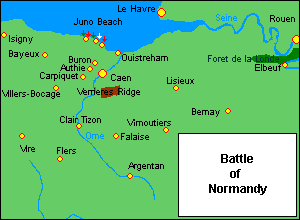
Map with location of Clair Tizon. (Map source: http://www.canadiansoldiers.com)

On August 12, 1944, the Royal Hamilton Light Infantry was ordered to advance towards Clair Tizon, France. At a small crossroads near the abandoned hamlet of Barbery, they encountered fierce German resistance as they moved through wheat fields.

The German counterattacks were an attempt to hold the Falaise pocket, but by dusk the Germans withdrew.  The Canadians had won, but at a cost of 20 soldiers killed and 100 wounded. (See http://canadiansoldiers.com/history/battlehonours/northwesteurope/clairtison.htm)

Among the wounded was Joseph.  He was admitted to the 43rd Battalion General Hospital, and then the 110th Battalion General Hospital.  He didn’t return to his Regiment until October 2, 1944. 

On October 18, 1944, he was promoted to Lance Sergeant.  On January 7, 1945, he received what would be his final promotion – to Acting Sergeant.

….As the Rileys travelled towards Groningen they were attacked by the Dutch SS guarding a concentration camp….

Screenshot 2024-03-20 at 11-47-11 Groningen - Westerbork route planner - journey distance time and costs – ViaMichelin

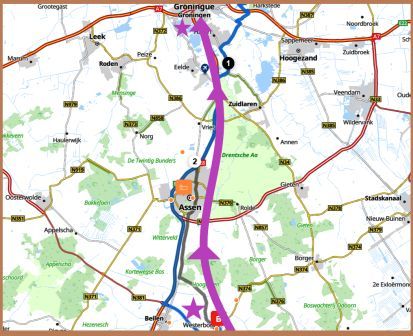
Map shows route taken by the RHLI as they moved from Westerbork towards Groningen.  (Map source: http://www.viamichelin.co.uk)

An excerpt from Semper Paratus: The History of the Royal Hamilton Light Infantry (Wentworth Regiment) 1862-1977 by Kingsley Brown, Sr, Kingsley Brown, Jr, and Brereton Greenhous, recorded that “…the RHLI crossed the Ijeselson Canal by a small foot bridge on April 10 and, moving quickly on tanks and Kangaroos, reached the outskirts of Groningen within two days.  At this point the battalion again became the spearhead for 4th Brigade and 2nd Division…

A description of the fight that followed noted that “…. ‘it took more than a day for the Battalion to fight its way into Groningen’ John Lisson recalled. ‘The Germans were not only firing light arms, but blasting us with four-barreled flak guns. They had developed a nasty technique of firing at the glazed tile roofs of the buildings and bringing them crashing down on top of us. The tiles would fly off in sharp fragments just like shrapnel’….

As if this wasn’t enough to deal with, the Rileys had encountered members of the Dutch SS who had been guarding the Westerbork concentration camp, who “…were fighting desperately because they had nothing to expect but the firing squad if they were caught…”  (See https://en.wikipedia.org/wiki/Westerbork_transit_camp)

….Joseph was killed by sniper fire during the Battle of Groningen….

After travelling from Westerbork to Assen and then on towards Groningen, the War Diary for the Royal Hamilton Light Infantry for April 13, 1945 stated that by 4 pm they had arrived “…approximately one mile from Groningen, our final objective.  Tactical Headquarters was set up in a farm house while the Companies continued to their objective in the town.  The opposition in this sector was increasing, consisting mainly of medium machine gun and small arms fire…

The Battle of Groningen would not be an easy victory.   (See https://www.canadiansoldiers.com/history/battlehonours/northwesteurope/groningen.htm and https://library.mcmaster.ca/battle-groningen-april-1945)

Conditions had deteriorated by the evening of April 13.  “…Word was received that the forward elements are meeting serious resistance in the form of small arms fire, road blocks, and mines….” 

At the same time as over 100 prisoners of war began surrendering, sniper fire continued.  By 8:30 pm, the War Diary entry stated that “…we have suffered several fatal casualties from snipers…” Among the casualties was Joseph.

….Joseph is buried in the Canadian War Cemetery in Holten….

Screenshot 2024-03-20 at 16-29-08 53.205625168048 6.5339885049894 156A Peizerweg Groningen GR - MapQuest

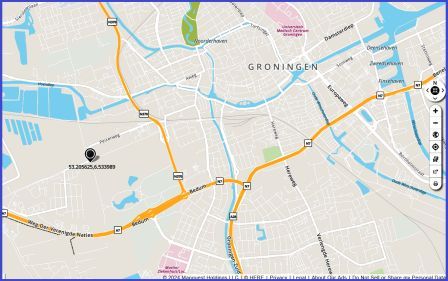
According to the GPS coordinates provided at the time, Joseph was initially buried beside what is today the Peizerweg in Groningen. The black circle marks the spot.  (Map source:  Mapquest)

On April 15, 1945, Joseph was initially buried beside a road in Groningen, before being reburied the following year in the Canadian War Cemetery in Holten, The Netherlands.  

macleod, joseph taylor from Holten

Grave of Joseph Taylor MacLeod in the Canadian War Cemetery in Holten, The Netherlands.  (Photo courtesy of the Information Centre Canadian Cemetery Holten)

….Sam Matvichuk also died during the Battle of Groningen….

Sam MATVICHUK, whose story was previously told, also lost his life during the Battle of Groningen, while serving with the Royal Regiment of Canada.  You can read his story here: https://onthewarmemorialtrail.com/2022/08/19/on-the-war-memorial-trail-the-wwii-soldier-born-in-broadacres-who-died-during-the-battle-of-groningen/

Thank you to Cyril MacLeod for sharing a photo of his father, Henk Vincent for sharing the Royal Hamilton Light Infantry War Diary for April 1945, and to David Ryan for sharing an excerpt from Semper Paratus: The History of the Royal Hamilton Light Infantry (Wentworth Regiment) 1862-1977.

Do you have photos or information to share? Email Pieter at memorialtrail@gmail.com, comment on the blog, or tweet to @researchmemori1.

© Daria Valkenburg

….Want to follow our research?….

If you are reading this posting, but aren’t following our research, you are welcome to do so.  Our blog address: https://onthewarmemorialtrail.com/

Front cover OnTheWarMememorialTrailinEurope4 countries, 6 weeks, 7,000 km – an unforgettable war memorial journey in Europe…. Daria’s book ‘No Soldier Buried Overseas Should Ever Be Forgotten‘ is available in print and e-book formats.  Net proceeds of book sales help support research costs and the cost of maintaining this blog. For more information see https://nosoldierforgotten.com/ 

You are also invited to subscribe to our YouTube Channel: On The War Memorial Trail With Pieter Valkenburg: https://www.youtube.com/channel/UCJ591TyjSheOR-Cb_Gs_5Kw

Never miss a posting!  Subscribe below to have each new story from the war memorial trail delivered to your inbox.

On The War Memorial Trail….. The WWII Soldier Born In Broadacres Who Died During The Battle of Groningen

where-to-blog-header-code-on-a-wordpress-theme-August 19, 2022. When researchers at the Information Centre at the Canadian War Cemetery in Holten, The Netherlands decided to honour 27 soldiers of Ukrainian heritage that are buried in the cemetery, they were missing photos of 4 soldiers. (See https://onthewarmemorialtrail.com/2022/05/31/on-the-war-memorial-trail-the-canadian-war-cemetery-in-holten-pays-tribute-to-ukrainian-canadians-buried-there/)

….The 4 soldiers of Ukrainian heritage without photos ….

Could Pieter help put a face to these names, he was asked?  They were:

  • Elie ANTONYSZYN, born in Rorketon, Manitoba, died July 15, 1945, aged 22
  • Andrew KERELCHUK, born in Zbaraz, Manitoba, died April 19, 1945, aged 21
  • Sam MATVICHUK, born in Broadacres, Saskatchewan, died April 14, 1945, aged 19
  • John RUSNAK, born in Portage La Prairie, Manitoba, died November 22, 1945, aged 21

All four had a connection to the Canadian prairies, and, in what has to be a first, families of all four soldiers came forward within a few weeks. 

Over the next blog postings, their stories will be told. This posting begins with Sam MATVICHUK, whose photo was the first we received.

…We hear from the family of Sam Matvichuk…

The first contact came from Scott Matvichuk, grandson of Sam’s brother Albert.  He mentioned that Sam’s sister, Annie Gregorwich, was 102 years old.

Then Pieter got in contact with Annie’s son Larry, who had photos.  Success!  “...The better one is with my father, Steve Gregorwich, who is sitting on the left….” wrote Larry.

dad and sam (2)

Steve Gregorwich (left) with Sam Matvichuk. (Photo courtesy of Larry Gregorwich)

Born July 13, 1925 in Broadacres, Saskatchewan, Sam was the son of John and Mary Matvichuk.  His first 11 years were spent in Saskatchewan. The family moved to Alberta, first to Smoke Lake and then to Delph, where his father, a Ukrainian immigrant, operated a farm.

…Sam enlisted at the age of 18…..

The 5th in a family of 12 children (of which two had died before 1940), Sam spoke both English and Ukrainian, and worked for his father and neighbouring farms after leaving school.  When he enlisted at the #3 District Depot in Calgary, Alberta on March 24, 1944, he was still only 18 years old.

An interviewer at the time of his enlistment noted in his Personnel Selection Record that Sam was “…a reticent young man…who has been engaged in farming….He is the out-of-doors type….but shows a good attitude to the service.  He states a desire for same Corps as his brother which he should find suitable…” 

Sam’s brother Steve was in the 1st Canadian Armoured Brigade. (See http://www.canadiansoldiers.com/organization/1stcanadianarmouredbrigade.htm) Steve survived WWII and returned home with a war bride and his son.

The Personnel Selection Record also noted that Sam “…likes camping and hiking; swims; baseball…

On April 10, 1944, Sam was sent to No. 26 Canadian Army (Basic) Training Centre (CACBTC) in Orillia, Ontario.  He was there until June 13, 1944, when he was transferred to No. 3 Canadian Armoured Corps Training Regiment (CACTR) at Camp Borden, Ontario.

Sam qualified as a driver – I/C Class III (Wheeled) – on August 17, 1944.  A few months later, on October 4, 1944 he was transferred to No. 1 Canadian Armoured Corps Trained Soldiers Regiment (CACTSR) in Borden, Ontario.

…Sam went overseas…..

Once Sam turned 19, he was eligible to go overseas.  On October 15, 1944 he left Canada and sailed to the United Kingdom, arriving on October 20, 1944.  After additional training with the Rocky Mountain Rangers, he was transferred to the Canadian Infantry Training Regiment (CITR) in November 1944.

In mid-December 1944 he was sent to North-West Europe and transferred to the Royal Regiment of Canada on December 24, 1944. (See https://en.m.wikipedia.org/wiki/The_Royal_Regiment_of_Canada)

According to the War Diary for the Royal Regiment of Canada, they were in the area of Groesbeek, The Netherlands at the time.  On December 24, 1944, the war diary entry recorded that “…The threat of a German drive from Northern Holland aimed through ‘S-Hertogenbosch and Tilburg at Antwerp has resulted in the withdrawal of our Brigade Group to act as a mob res….47 other ranks received….”  One of these other ranks was Sam. (‘Mob res’ referred to mobilization reserve – force of men remaining behind the lines to reinforce the front lines where needed)

On February 8, 1945, the war diary entry reported that “….The stillness of a perfect night was shattered at 0500 hours by the opening of the barrage which was the prelude to the attack on the Reichswald...

On February 9, 1945, the war diary entry stated that “…The battalion was concentrated in Groesbeek area prior to moving to brigade concentration area in preparation for our part in this op ‘Veritable’.  The congestion in the area makes movement difficult.  Roads are becoming quite bad in spots…” (See https://en.wikipedia.org/wiki/Operation_Veritable)

…Sam’s Regiment left The Netherlands for battles in Germany…..

Late in the night of February 16, 1945, the Regiment began its move into Germany.  The war diary entry recorded that “…The CO gave orders for the move at 1145 hours at which time the marching troops….started the journey to Molenhoek….” 

On February 17, 1945, “…the troops were on the move again towards Calcar...” 

By February 27, 1945, the war diary noted that “…at 0430 hours opening barrage for op Blockbuster commenced…” (See https://en.wikipedia.org/wiki/Operation_Blockbuster)

On March 1, 1945, the war diary recorded that “…the area of Xanten was firmly consolidated and the men of the unit spent the day cleaning up…

On March 24, 1945, the war diary entry explained that “….with an amazing amount of air support the Rhine has been crossed and we are waiting in anticipation of what our role in this big push is to be….

…The Regiment returned to The Netherlands…

Screenshot 2022-08-19 at 10-37-57 Google Maps

Map shows location of Groningen, where Sam Matvichuk lost his life, and Assen, where he was initially buried.  (Map source:  Google maps)

The Royal Regiment of Canada’s next task, as part of the 2nd Canadian Infantry Division, was to capture the city of Groningen, in the northeastern part of The Netherlands. It was during the Battle of Groningen that Sam lost his life.  (See https://www.canadiansoldiers.com/history/battlehonours/northwesteurope/groningen.htm and https://library.mcmaster.ca/battle-groningen-april-1945)

During this battle, Sam received a bullet wound in his ‘right loin’ (the area below the rib cage to just above the pelvis) and lost his life on April 14, 1945.  He was a few months shy of his 20th birthday. 

…Sam is buried in the Canadian War Cemetery in Holten…

Sam was initially buried in Assen, and then later reburied in the Canadian War Cemetery in Holten, The Netherlands.

2227678_1 grave of Sam Matvichuk

Grave of Sam Matvichuk at the Canadian War Cemetery in Holten, The Netherlands. His age is incorrectly recorded as 20, when he was only 19. (Photo courtesy of Canadian Virtual War Memorial)

sunflower header

Thank you to Larry Gregorwich for providing the photos, to Scott Matvichuk for contacting us, and to Judie Klassen for helping to find family members.  Another story about a soldier buried in Holten of Ukrainian descent coming up in the next posting.

If you have a story to tell, please let Pieter know. Email him at memorialtrail@gmail.com, comment on the blog, or tweet to @researchmemori1

…Want to follow our research?….

If you are reading this posting, but aren’t following the blog, you are welcome to do so.  See https://onthewarmemorialtrail.com/ or email me at dariadv@yahoo.ca and ask for an invitation to the blog. 

Front cover OnTheWarMememorialTrailinEuropeDaria’s book ‘No Soldier Buried Overseas Should Ever Be Forgotten‘ is available in print and e-book formats.  For more information see https://nosoldierforgotten.com/

You are also invited to subscribe to our YouTube Channel: On The War Memorial Trail With Pieter Valkenburg: https://www.youtube.com/channel/UCJ591TyjSheOR-Cb_Gs_5Kw

© Daria Valkenburg