August 28, 2019. Many years ago, while on the North island of New Zealand, I drove to a meeting with a colleague from the South Island. Driving in New Zealand means driving on the side of the road opposite to the way we are used to driving. Usually I did well with remembering which side of the road to drive on, but sometimes the brain cells reverted to their default setting. That happened one evening after we stopped at a gas station. After pulling back out onto the road, we were listening to music and having a great conversation when all of a sudden I noticed a big truck coming towards us. “What is he doing?” I asked my passenger. He didn’t reply. A quick glance showed him looking terrified and gripping the door handle. “What’s wrong?” I asked. Finally, he very quietly whispered, “In this country, we drive on the other side of the road.” Oops! I quickly switched lanes and the truck safely passed us, but not without a few angry toots on the horn. An angel was sitting on our shoulders that evening!
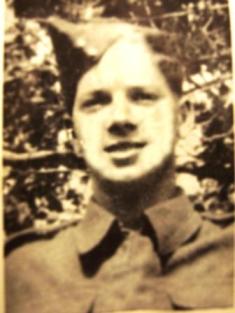
Austin Boulter. (Photo credit: Augustine Cove Women’s Institute 1800-1973 Centennial history project)
I remembered this event after learning from Pieter’s research what happened to WW2 soldier Austin Harry BOULTER, whose driving experience didn’t end as happily. According to his attestation papers, Boulter was born on October 4, 1920 in Freetown, the son of Roy Boulter and Blanche Leard. There is a discrepancy as the Military Service Record’s Declaration and Statement of Relatives records his date of birth as October 4, 1922 in Tryon. A check of the June 1921 census does not record him, indicating that he wasn’t yet born. It’s pretty clear that he fudged his attestation paper during his enlistment on May 27, 1940 in Woodstock, New Brunswick to make sure he wouldn’t be rejected as being too young! At the time of enlistment the family lived in Cape Traverse, but Boulter was working as a lumberman for J. Craig in Stanley, New Brunswick.
While Boulter enlisted with the Carleton and York Regiment, he was transferred to the Canadian Signal Training Corps on September 9, 1940. On May 18, 1941 he was transferred to the 3rd Canadian Division Signals and sent to Debert Camp, Nova Scotia. It was with that group that he left Halifax for England, arriving in Avonmouth on July 31, 1941. The unit was in England to train for deployment to Western Europe. (This was the first Canadian division to fight in the Normandy Campaign, landing at Juno Beach on D-Day on June 6, 1944.)
Boulter never left England, as around 10 pm on January 14, 1943, while not on duty, he borrowed a motorcycle ‘without authority’, according to a court of inquiry into his death. He was “carrying a civilian passenger on the back of the motorcycle”. Unfortunately, he forgot which side of the road to drive on, and crashed into a 4X4 Ford driven by Private M J. O’Grady, between Storrington and the Royal Winnipeg Rifle Lines.
At the court of inquiry, O’Grady stated that after seeing the motorcycle in his lane, O’Grady started to pull over to the left, but Boulter “came straight on, striking his front right bumper and fender and catching on the corner of the box directly behind the cab.” O’Grady stopped immediately and he and his passengers jumped out. He stated that he “saw a soldier on the ground a short distance beyond the bike and saw a lady further away on the ground.” Boulter was dead, but his passenger was hurt. O’Grady “posted a guard on the truck and told the other two men to take over while he ran into Storrington to get help.” O’Grady testified that he was “travelling about 15 mph” and that the motorcycle “appeared to be travelling too fast”.
The finding of the court indicated that Boulter “was not wearing a crash helmet”. The registry of death noted that he died instantly from severe head injuries incurred during the crash.
It’s unknown why Boulter was with a civilian passenger so late at night, and why he took a motorcycle without permission. No testimony by the passenger was recorded in the court of inquiry and she was not identified. He was buried at Brookwood Military Cemetery, Sussex, England.
The Summerside Journal of January 18, 1943 recorded his obituary:
“Bedeque Soldier Dies Overseas
A Prince Edward Island soldier, Sigmn. Austin Harry Boulter of Bedeque, was listed under died overseas in the 252nd Canadian (Active) Army overseas casualty list last night. His next-of-kin was given as his mother, Mrs. Blanche Boulter of Bedeque.”
If anyone can provide a photo or more information on Austin Harry Boulter, please contact Pieter at dariadv@yahoo.ca or comment on the blog.
© Daria Valkenburg




 On The War Memorial Trail Research Project........ with Pieter and Daria Valkenburg