On The War Memorial Trail….The Ruins of Mont St. Eloi

October 1, 2017.  While we were packing to leave Arras to go on to Rouen and Caen, Pieter expressed an interest in seeing the ruins of the Abbey in Mont St. Eloi.  “…Sure...” I said.  “…I’d love to see the Cathedral with the statue that survived hanging down….”  I went on and on until he interrupted, saying I had the wrong Cathedral in mind.  The one I was thinking of was in Albert, in the Somme Valley, the ‘Leaning Virgin of Albert’, which has since been restored and leans no more.

…Doesn’t matter…” I said.  We aren’t planning to return to this area, so if he wanted to see something, we may as well do it.  Of course, in the morning when we were leaving, it was raining and Pieter was of two minds whether to make the trip to Mont St. Eloi or skip it. There was no connection, as far as we knew, to any of the soldiers on the Cenotaph outside the Borden-Carleton Legion, so this would be a side trip.

In the end, off we went.  Mont St. Eloi is on a hill above Arras, and at the top once stood the Mont St. Eloi Abbey.  All that remains today are two towers. The rest was destroyed during various wars.

Legend has it that the Abbey began in the 7th century by Saint Vindicianus, a disciple of Saint Eligius (Saint Eloi in French).  By the Middle Ages it was a powerful religious centre, but during the French Revolution, the stone walls were stolen. Only two towers of white limestone and a porch on the west wall were left.

When WW1 began, the towers were used by French troops to observe German positions on Lorette Spur and Vimy Ridge. The Germans fired every time the French troops moved, causing the French to believe they had a spy in their midst.  It took a while before they realized that what gave them away were birds nesting on the towers which took flight when troops disturbed them.

CIMG8583 Sep 7 2017 Pieter at ruined cathedral in Mont St Eloi

Pieter by the war-damaged towers of Mont St. Eloi Abbey. (Photo credit: Daria Valkenburg)

In the next blog entry we encounter difficulties in finding St. Sever Cemetery Extension in Rouen, and learn that PEI is not alone in charging expensive tolls. Comments or stories?  You can share them by emailing us at memorialtrail@gmail.com or by commenting on this blog.

© Daria Valkenburg

….Want to follow our research?….

If you are reading this posting, but aren’t following our research, you are welcome to do so.  Our blog address: https://onthewarmemorialtrail.com/

Front cover OnTheWarMememorialTrailinEurope4 countries, 6 weeks, 7,000 km – an unforgettable war memorial journey in Europe…. Daria’s book ‘No Soldier Buried Overseas Should Ever Be Forgotten‘ is available in print and e-book formats.  Net proceeds of book sales help support research costs and the cost of maintaining this blog. For more information see https://nosoldierforgotten.com/ 

You are also invited to subscribe to our YouTube Channel: On The War Memorial Trail With Pieter Valkenburg: https://www.youtube.com/channel/UCJ591TyjSheOR-Cb_Gs_5Kw

Never miss a posting!  Subscribe below to have each new story from the war memorial trail delivered to your inbox.

On The War Memorial Trail….Reflections on the Cemetery Visits in the Arras Area

October 1, 2017.  After visiting the cemeteries and Vimy Memorial to honour the memories of the soldiers on the Cenotaph outside the Borden-Carleton Legion who perished in the area around Arras, we went to our “local” café for the past few days, L’Eurostar Café Brasserie, for a well-deserved rest and final meal before leaving the area.

IMG_20170904_185344129 Sep 4 2017 Pieter at LEurostar Cafe in Arras enjoying a Leffe beer

Pieter enjoying Leffe blond beer at L’Eurostar Café Brasserie in Arras. (Photo credit: Daria Valkenburg)

In France, dinner is not served before 7 pm.  Normally that wasn’t a problem for us as we would arrive at a restaurant completely exhausted long after 7 pm, but after the success in finally finding Manitoba Cemetery we arrived back in Arras in the late afternoon, and decided to have an early dinner before packing up to leave the area in the morning.

We arrived at the café at 5:45 pm only to be told the kitchen didn’t open before 7 pm.  We were too tired to go back to the hotel and come back later, so we ordered an appetizer, camembert cheese of course in honour of our host country, and a drink and relaxed until the chef appeared, right on the dot of 7 pm.

Since we had all this time to relax and reflect on our journey so far, I asked Pieter how he felt.  He said that, for him, “visiting the graves made things come full circle.  You start off with a name on the Cenotaph.  Then you begin the research and read up on what happened.  Hopefully you get a photo and personal stories.  Now we’ve ended up where the person died after a very short life….

Pieter thought a bit before he continued, “….on the one side, I feel sorry they died so young.  On the other hand I feel honoured to be there to pay respects to them.  It makes me want to know more about them, now that I’ve visited their grave or memorial….

We both agreed that for the soldiers without a photo the picture is not complete.  “When I stand by a grave at the cemetery and have a photo so I know how the person looked, then I can feel a connection…” Pieter explained.

…It’s especially sad for soldiers like Arthur Collett, buried in Grandcourt Road Cemetery, and James Cairns, buried in Manitoba Cemetery, that they are buried in cemeteries that get very few visitors. They are just a number…. Each identified grave lists the soldier’s name, unit, rank, and identification number.

We both also agreed that the gardeners and maintenance staff at the Commonwealth War Graves Commission do a fantastic job of keeping up the cemeteries.  Over the past days, we’ve handed out Canadian flag pins to anyone we’ve seen driving around in the white vans with CWGC written on them and they have been enthusiastically received.  Up to now, we hadn’t seen anyone in a cemetery itself, but the work they do in sometimes very difficult locations, such as Grandcourt Road Cemetery, is to be commended.

When Pieter began this project, World War I was just history to us, no different than the various dates and historical facts we learned in school over the years.  Now it’s become a story with real people, and along the way, we are meeting wonderful people who work hard to preserve the history that we have largely forgotten.

In the next blog entry we visit the ruins of Mount St. Eloi church before going on to Rouen to St. Sever Cemetery Extension. Do you have photos or information about James Cairns?  Does anyone know the family members who visited the grave of Ted Arsenault of Abrams Village? Comments or stories?  You can share them by emailing us at memorialtrail@gmail.com or by commenting on this blog.

© Daria Valkenburg

….Want to follow our research?….

If you are reading this posting, but aren’t following our research, you are welcome to do so.  Our blog address: https://onthewarmemorialtrail.com/

Front cover OnTheWarMememorialTrailinEurope4 countries, 6 weeks, 7,000 km – an unforgettable war memorial journey in Europe…. Daria’s book ‘No Soldier Buried Overseas Should Ever Be Forgotten‘ is available in print and e-book formats.  Net proceeds of book sales help support research costs and the cost of maintaining this blog. For more information see https://nosoldierforgotten.com/ 

You are also invited to subscribe to our YouTube Channel: On The War Memorial Trail With Pieter Valkenburg: https://www.youtube.com/channel/UCJ591TyjSheOR-Cb_Gs_5Kw

Never miss a posting!  Subscribe below to have each new story from the war memorial trail delivered to your inbox.

On The War Memorial Trail….We Visit Bac-Du-Sud British Cemetery To Honour James Ambrose Cairns

September 25, 2017.  Arras, France was our home base for our trips in and around the Vimy area.  Our hotel was across from the train station.  In front of the station was a plaza with restaurants surrounding it.  Of course, we took a stroll to see what was there.

CIMG8262 Sep 4 2017 Pieter on the street in Arras

Pieter in Arras. On the left is the plaza. We took a stroll to see which of the many cafes took our fancy. (Photo credit: Daria Valkenburg)

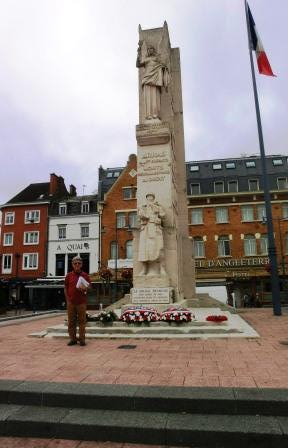
If we still had the idea that war memorials were only in cemeteries and in the countryside, we had a reality check as soon as we ventured outside the hotel.  In the plaza, across from the train station, is a large memorial to the people of Arras who lost their lives in the war.

CIMG8263 Sep 4 2017 Pieter at monument opposite the train station in Arras

Pieter by the memorial to the fallen citizens in Arras. On the left is the plaza. We took a stroll to see which of the many cafes took our fancy. (Photo credit: Daria Valkenburg)

CIMG8264 Sep 4 2017 monument opposite the train station in Arras

The memorial in the plaza in Arras to the fallen citizens also honours the soldiers of France. The inscription says: The French Soldier. Yesterday a soldier of God, today a soldier of humanity, will always be a soldier of law. (Photo credit: Daria Valkenburg)

The memorials and cemeteries made us more determined than ever to honour the memories of as many of the soldiers on the Cenotaph outside the Borden-Carleton Legion in Prince Edward Island that we could while we were in Europe.  After we left the Ligny Saint-Flochel British Cemetery, we made our way to Bac-Du-Sud British Cemetery where James Ambrose CAIRNS is buried.

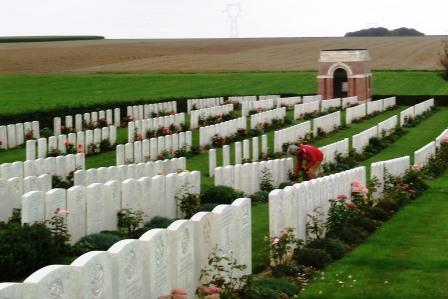
It was our first clue that visiting cemeteries can be a challenge. Bac-Du-Sud British Cemetery in Bailleulval, 13 km southwest of Arras, is just on the side of very busy highway, the N25.  If you think of a highway shoulder and widen the space slightly, you have an idea how we were parked. There are no actual parking spots, just the gate to the cemetery off the side of the highway.  Around the cemetery is a farmer’s field.

CIMG8491 Sep 6 2017 Bac Du Sud British cemetery where James A Cairns is buried

Pieter at Bac-Du-Sud British Cemetery, where James Ambrose Cairns is buried. (Photo credit: Daria Valkenburg)

CIMG8492 Sep 6 2017 Bac Du Sud British cemetery where James A Cairns is buried

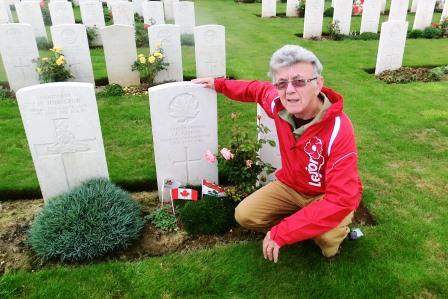
Pieter places flags at the grave of James Ambrose Cairns in Bac-Du-Sud British Cemetery. (Photo credit: Daria Valkenburg)

The cemetery has 688 WWI Commonwealth graves, of which 4 are unidentified, and 55 German graves.  According to the Commonwealth War Graves Commission, the cemetery began in March 1918 by the 7th, 20th, and 43rd Casualty Clearing Stations, but when Germans advanced at the end of March 1918, their place was taken by field ambulances of the units fighting on the Arras front, notably the 31st Division and the Canadian Corps.  In August and September 1918, once the Germans had been pushed back, the 45th and 46th Casualty Clearing Stations were posted here.

James Ambrose CAIRNS, son of Terrence Cairns and Elisabeth Hughes, was born March 16, 1895 in Emerald, PEI.  He was killed in action near Neuville – Vitasse (raid on ‘The Maze’) on June 13, 1918.  Neuville-Vitasse, 16.6 km from Bailleulval, was a village under the control of the Germans.  To protect their position, the Germans had a series of trenches, referred to as ‘The Maze’, on the outskirts of the village.  It was during a raid on these trenches that Cairns lost his life.

Although we have not been able to find a photo of James Ambrose Cairns, we were lucky to have an account of what happened from the Canada War Graves Register Circumstances of death:  Cairns “was one of a carrying party in the frontline trench, when an enemy shell burst nearby, fragments of the shell striking him in the head and body, inflicting fatal wounds. He was immediately taken to a Dressing station and later to the Canadian 4th Field ambulance where he died of his wounds the next morning.

An obituary in the Summerside Journal of September 11, 1918 gave a bit more information on what happened, as well as a few highlights of Cairns’ life and career in banking: “On the evening of June 12th, Pte. James A. Cairns was borne from the field of battle in France to a dressing station severely wounded. He was doing duty in a front line trench, being at the time one of a party, who were carrying out a dead comrade, when an enemy shell burst nearby inflicting fatal wounds, fragments of the shell striking him in the head and body. He was immediately taken out to a dressing station and died the next morning at No 4 Canadian Field Ambulance.

Pte. Cairns was 23 years of age at the time of his death. He enlisted when he was 21 years of age in Liverpool where he was one of the staff of the Royal Bank of Canada. He went to Lieutenant’s training school where he obtained his diploma but did not get a commission. He crossed to England in October 1916, and was held in reserve for some time, but growing eager to get to France he went as a private and was in action three months before his death. He worked in the Royal Bank of Canada in Summerside for three years, also in Tyne Valley, before being transferred to Liverpool, N.S.

CIMG8494 Sep 6 2017 Pieter by the grave of James A Cairns in Bac Du Sud British cemetery

Pieter by the grave of James Ambrose Cairns in Bac-Du-Sud British Cemetery after placing the flags of Canada, PEI, and Canada 150. (Photo credit: Daria Valkenburg)

In the next blog entry we visit Bellacourt Military Cemetery before continuing our search for the Manitoba and Grandcourt cemeteries. Do you have information or photos for James Ambrose Cairns?  Comments or stories?  You can share them by emailing us at memorialtrail@gmail.com or by commenting on this blog.

© Daria Valkenburg

….Want to follow our research?….

If you are reading this posting, but aren’t following our research, you are welcome to do so.  Our blog address: https://onthewarmemorialtrail.com/

Front cover OnTheWarMememorialTrailinEurope4 countries, 6 weeks, 7,000 km – an unforgettable war memorial journey in Europe…. Daria’s book ‘No Soldier Buried Overseas Should Ever Be Forgotten‘ is available in print and e-book formats.  Net proceeds of book sales help support research costs and the cost of maintaining this blog. For more information see https://nosoldierforgotten.com/ 

You are also invited to subscribe to our YouTube Channel: On The War Memorial Trail With Pieter Valkenburg: https://www.youtube.com/channel/UCJ591TyjSheOR-Cb_Gs_5Kw

Never miss a posting!  Subscribe below to have each new story from the war memorial trail delivered to your inbox.

On The War Memorial Trail….A Visit To Vimy Ridge

September 12, 2017.  After a few hectic days when there was no time to do any writing as we were on the go from early morning until quite late in the evening, we now are settled for a few days in a quiet cottage in a forested area, and hopefully can catch up with all of the memorable days we’ve just experienced.

The most anticipated stop on our memorial trail of honouring the men listed on the Borden-Carleton Cenotaph was Vimy Ridge.  Two WWI soldiers are listed on the Canadian National Vimy Memorial, John ‘Lymon’ WOOD and Patrick Raymond ARSENAULT.

Our hotel was in Arras, and Vimy Ridge was a 20 minute drive from there.  Just before the turn-off to Vimy Ridge we passed through the town of Thélus.  There is one stop light in town.  To the left are signs directing you to cemeteries and memorials.  To the right are signs directing you to more memorials.

Right by the stop light is the Canadian Artillery Memorial, built to remember the sacrifice of Canadians from Artillery battalions who died in the battle for Vimy Ridge and the surrounding area.

CIMG8309 Sep 5 2017 Cdn Artillery Memorial in Thelus with sign posts

The Canadian Artillery Memorial in Thélus was built during WW1 by the Canadian Corps. (Photo credit: Daria Valkenburg)

It’s daunting to see how many reminders of war there are in France.  Everywhere you go, you see memorials and cemeteries – both civilian and military.  It’s a grim reminder of how many people lost their lives.  It’s impossible to ignore or forget.  And it’s a very big reminder of how many countries came to help in the Allied cause during World War I.  It truly became an international war.  Every one of them has at least one memorial and the war cemeteries are filled with Allied and German lives lost.
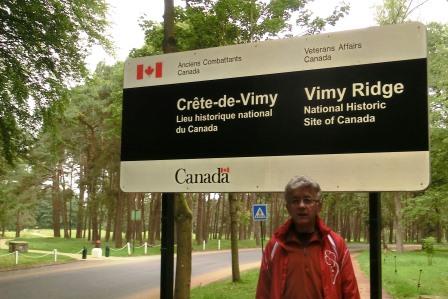
CIMG8270 Sep 2017 Pieter at entrance to Vimy Memorial Park

Pieter at the entrance to Vimy Ridge in France. (Photo credit: Daria Valkenburg)

The turn-off to the Vimy Ridge memorial and visitors centre is a tree-lined road, with jogging and walking paths, well used by citizens of the area.  It’s a public road that goes to the nearby villages of Givenchy and Vimy.

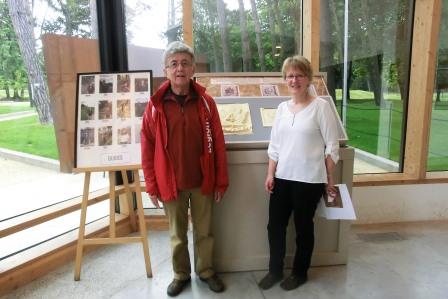
We were very lucky to have been given a guided tour of the Vimy Ridge Visitors Centre, which opened in April 2017, by site manager Johanne Gagné.
CIMG8275 Sep 5 2017 Pieter with site manager Johanne Gagne

Pieter with Johanne Gagné, Senior Manager, European Operations at the Canadian National Vimy Memorial, who gave us a guided tour. (Photo credit: Daria Valkenburg)

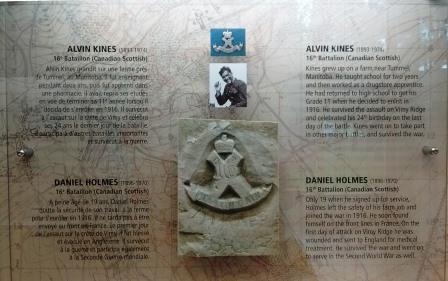
Among the many exhibits in the Visitors Centre is one that replicates the graffiti found in the tunnels of Vimy Ridge.  Using 3-D technology, exact replicas of the graffiti have been made, and researchers have tried, where possible, to provide a face and story to the men who made the graffiti.

Ms. Gagné noted that this graffiti display will be on tour in various places in Canada after leaving Vimy Ridge.  If it comes to your area, you won’t want to miss it!

We certainly had the right person to give us a tour, as Ms. Gagné worked for two years in Canada in developing the visitors centre before coming to France for two years as part of an interchange agreement with Parks Canada.  Hailing from Coteau-du-Lac, Quebec, she has a background in museology, exhibit design, and developing visitors programming.  Our interest was certainly caught, and this was from one exhibit only.
IMG_20170905_093513986 Sep 5 2017 Graffiti at Vimy Ridge by Kines & Holmes

Graffiti replicas of the 15th Battalion and a photo and short bio of two names inscribed below the insignia, that of Alvin Kines and Daniel Holmes. (Photo credit: Pieter Valkenburg)

The Visitors Centre has many interactive displays, in three languages (English, French, German), and one of the displays is very personal.  It tells the story of World War I from the perspectives of a young girl, a soldier, a nurse, etc, and all the stories are based on letters and diaries of real life people.

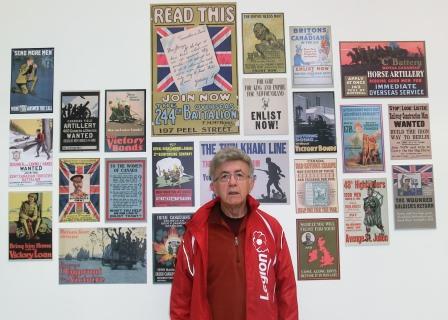
We were fascinated by a wall of patriotic signs, urging support for the war.
CIMG8277 Sep 5 2017 Vimy Ridge Visitors Centre Pieter by patriotic signs

Pieter by one of the displays of patriotic signs. (Photo credit: Daria Valkenburg)

An interactive display explained the troop movements during the Battle of Vimy Ridge on April 8, 1917.  Another interactive display gave a tour of the tunnels below Vimy Ridge. This was a marvellous solution to see the tunnels, especially if you were not physically capable of entering the tunnels yourself.

CIMG8283 Sep 5 2017 Daria by interactive displays in Vimy Ridge Visitors Centre

Daria by the interactive display of the Vimy Ridge tunnels. Behind are the displays of stories of WW1 by individuals. (Photo credit: Johanne Gagné)

We asked Ms. Gagné her perspective of the Vimy Ridge Visitors Centre and Memorial.  “Most of the time, people come and say that they came to honour the sacrifices made.  I asked myself, what does it mean to me?  Why have I spent three years on this project?  I’m giving the soldiers a voice.  I hope that through the exhibits, that we can show the public how the soldiers lived, what they saw, what they did, and close the loop by telling their stories”  The exhibits certainly do that.  They are interesting and well done.

The tour of the Visitors Centre over, it was time to see the rest of Vimy Ridge.  On Pieter’s bucket list was a tour of the tunnels, a wish that was granted, and discussed in the next blog.  While he and Ms. Gagné prepared themselves for the tunnels, I took a look at the tunnels from the comfort and safety of the Visitors Centre.

Comments or stories?  You can share them by emailing us at memorialtrail@gmail.com or by commenting on this blog.

© Daria Valkenburg

….Want to follow our research?….

If you are reading this posting, but aren’t following our research, you are welcome to do so.  Our blog address: https://onthewarmemorialtrail.com/
Front cover OnTheWarMememorialTrailinEurope4 countries, 6 weeks, 7,000 km – an unforgettable war memorial journey in Europe…. Daria’s book ‘No Soldier Buried Overseas Should Ever Be Forgotten‘ is available in print and e-book formats.  Net proceeds of book sales help support research costs and the cost of maintaining this blog. For more information see https://nosoldierforgotten.com/ 

You are also invited to subscribe to our YouTube Channel: On The War Memorial Trail With Pieter Valkenburg: https://www.youtube.com/channel/UCJ591TyjSheOR-Cb_Gs_5Kw

Never miss a posting!  Subscribe below to have each new story from the war memorial trail delivered to your inbox.