On The War Memorial Trail…… The WWII Soldier From St. Nicholas Who Lost His Life During The Battle of Hochwald Gap

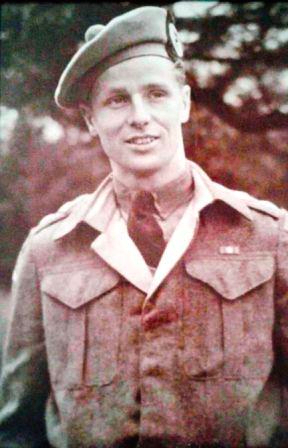
July 6, 2024.  Back in 2015, Pieter received a photo of WWII soldier Edward Gabriel PERRY, whose name was on a photo wish list from the Canadian War Cemetery in Groesbeek, The Netherlands. 

Edward was born in St. Nicholas, a small community west of Summerside, Prince Edward Island, on October 6, 1924, the son of John F. and Zelia Perry. He was one of 11 children, with 5 brothers, three of whom also served overseas during WWII, and 5 sisters.

….Edward enlisted at age 18….
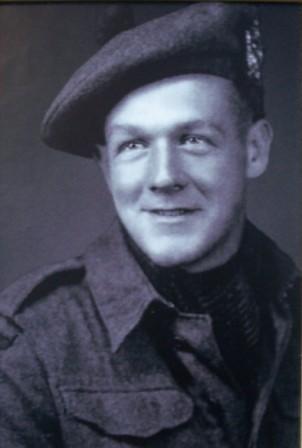
PERRY Edward Gabriel

Edward Gabriel Perry.

When he enlisted at the No. 6 District Depot in Charlottetown, Prince Edward Island, on February 25, 1943, he was only 18 years old, too young to be sent into an active combat zone.  At the time, he stated that he grew up on a farm, but had spent the past two months working as a carpenter for Fred Cameron of Saint John, New Brunswick, who had a lumber business.

Edward’s Personnel Selection Record noted that he “…plays hockey…” and that his “…chief diversion is reading….”  It went on to describe him as “…reserved, determined…” and concluded that he would “…make an efficient soldier…

From Charlottetown, Edward was sent to Halifax, Nova Scotia, and from there to No. 61 Canadian Army (Basic) Training Centre (CABTC) in New Glasgow, Nova Scotia on March 13, 1943. 

After completing his basic training, Edward was sent to the A1 Canadian Artillery Training Centre in Petawawa, Ontario on May 12, 1943 to be trained as a gunner. 

On June 14, 1943, he was assigned to the 23rd Anti-Aircraft Regiment of the 50th Anti-Aircraft Battery of the Royal Canadian Artillery.  Edward’s new assignment was coastal defence in Sydney, Nova Scotia.  During WWII, Sydney was the second-most-important port for convoy formation after Halifax.

He remained in Sydney until March 23, 1944 when he was transferred to No. 1 Transit Camp in Windsor, Nova Scotia, in preparation for overseas service. Then, on May 15, 1944, he was reallocated to the Training Brigade Group in Debert, Nova Scotia for further training.

….Edward left Canada for overseas service….

On July 19, 1944 Edward left Canada, arriving in the United Kingdom on July 27, 1944, where he was assigned to No. 3 Canadian Infantry Reinforcement Unit (CIRU).

A month later, on August 29, 1944, he was sent to France, and then transferred to the Argyll & Sutherland Highlanders (Princess Louise’s), part of the 21st Army Group, on September 2, 1944. On December 10, 1944, he was promoted to Lance Corporal.

….The Battle of Hochward Gap was deadly….

ASH Can map1

Map shows plan for the Battle of Hochwald Gap.  Note: Kanten on map should read Xanten.  (Map source: ‘The Argyll & Sutherland Highlanders of Canada (Princess Louise’s) 1928-1953, edited by Lt-Col H. M. Jackson)

The end of February 1945 saw the Regiment in Germany for the Battle of Hochwald Gap, part of Operation Blockbuster, the final push towards the Rhine River, along with several other Canadian Regiments.  This offensive began on February 28, 1945 to clear the Germans from the Reichswald, a heavily forested area between the Maas and the Rhine Rivers, driving them back over the Rhine, taking the fight well into German territory for a full-scale invasion of Berlin.  (For more information, see https://canadianbattlefieldtours.ca/operation-blockbuster/ and https://civilianmilitaryintelligencegroup.com/10742/the-battle-of-hochwald-gap-one-of-the-largest-armor-engagements-you-probably-have-never-heard-of)

Troops faced a battlefield that was cold, wet, and muddy, and a ferocious fight by desperate Germans who recognized that they were about to lose the war. On March 1, 1945, Edward was badly wounded during the battle, and brought to a field hospital just after 6 pm “…in very poor condition…” and given “…1 pint of plasma….” 

He was sent on an urgent basis to No. 3 Casualty Clearing Centre, arriving at 9 pm. The medical report noted that he had “…shell fragment wounds with compound fracture of the right femur, injury of the femoral vessels, and multiple lacerations of both legs, and a penetrating wound to the abdomen…”  Edward was rushed into surgery, but died at 5:15 am on March 2, 1945. 

….Edward is buried in the Canadian War Cemetery in Groesbeek….

CIMG3330 Oct 5 2019 grave Groesbeek Edward Perry from daria

Grave of Edward Gabriel Perry in the Canadian War Cemetery in Groesbeek, The Netherlands. (Photo credit: Daria Valkenburg)

Edward was initially buried in the Canadian Military Cemetery in Bedburg, Germany, before being reburied in the Canadian War Cemetery in Groesbeek, The Netherlands. 

Do you have photos or information to share? Email Pieter at memorialtrail@gmail.com, or comment on the blog.

© Daria Valkenburg

 ….Previous postings about soldiers who died during the Battle of Hochwald Gap….

….Want to follow our research?….

If you are reading this posting, but aren’t following our research, you are welcome to do so.  Our blog address: https://onthewarmemorialtrail.com/
Front cover OnTheWarMememorialTrailinEurope4 countries, 6 weeks, 7,000 km – an unforgettable war memorial journey in Europe…. Daria’s book ‘No Soldier Buried Overseas Should Ever Be Forgotten‘ is available in print and e-book formats.  Net proceeds of book sales help support research costs and the cost of maintaining this blog. For more information see https://nosoldierforgotten.com/ 

You are also invited to subscribe to our YouTube Channel: On The War Memorial Trail With Pieter Valkenburg: https://www.youtube.com/channel/UCJ591TyjSheOR-Cb_Gs_5Kw

Never miss a posting!  Subscribe below to have each new story from the war memorial trail delivered to your inbox.

The WWII Soldier Born In Zbaraz Who Lost His Life During The Battle Of The Küsten Canal

where-to-blog-header-code-on-a-wordpress-theme-August 24, 2022. When researchers at the Information Centre at the Canadian War Cemetery in Holten, The Netherlands honoured 27 soldiers of Ukrainian heritage that are buried in the cemetery, they didn’t have photos of 4 soldiers.  Could Pieter help?
All four had a connection to the Canadian prairies. Families of all four soldiers came forward within a few weeks.

 ….The 4 soldiers of Ukrainian heritage without photos ….

  • Elie ANTONYSZYN, born in Rorketon, Manitoba, died July 15, 1945, aged 22
  • Andrew KERELCHUK, born in Zbaraz, Manitoba, died April 19, 1945, aged 21
  • Sam MATVICHUK, born in Broadacres, Saskatchewan, died April 14, 1945, aged 19
  • John RUSNAK, born in Portage La Prairie, Manitoba, died November 22, 1945, aged 21

The first posting was about Sam Matvichuk. This posting is about Andrew KERELCHUK, who was born September 17, 1923 in Zbaraz, Manitoba, the son of Michael (Mike) and Tina (nee Stonoga) Kerelchuk.

…Family of Andrew Kerelchuk contribute a photo…

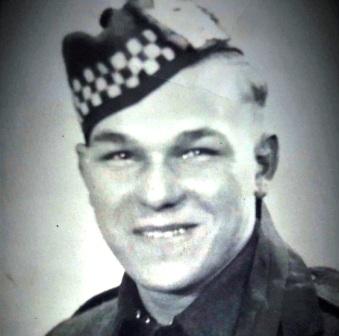
The only son in the family, Andrew had five sisters: Linda, Olga, Helen, Steffie, and Rosie. It was Olga’s daughter, Barbara (Barb) Dobbie, who contributed a photo of her uncle.  When Pieter spoke with Barbara, she told him that her husband Ted served in the army and had been posted to the United Nation in New York at the same time as Pieter was posted to the Dutch consulate there.  Small world!

IMG_6657 Andrew Kerelchuk from Barb Dobbie

Andrew Kerelchuk.  (Photo courtesy of the Kerelchuk Family)

Andrew grew up speaking English and Ukrainian.  At the time of his enlistment with the #2 District Depot in Hamilton, Ontario on April 6, 1943, he was a factory worker at Electric Motors Company in Welland, Ontario.

On April 29, 1943 he was transferred to #26 Canadian Army Basic Training Centre (CABTC) in Orillia, Ontario. After completing his basic training, Andrew was transferred to Camp Borden in Ontario.  Camp Borden was a Service Flying Training School, as well as the home of the Canadian Armoured Fighting Vehicle School.  As Andrew was not in the Royal Canadian Air Force, he was there for tank training.

On August 23, 1943 he was transferred to #4 Canadian Infantry Reinforcement Unit (CIRU) and a few days later, on August 25, he was on his way overseas, arriving in the United Kingdom on September 1, 1943.

… Andrew was transferred to the Argyll and Sutherland Highlanders…

On October 1, 1943 Andrew was transferred to the Argyll and Sutherland Highlanders of Canada (Princess Louise’s), which had become part of the 10th Brigade of the 4th Canadian (Armoured) Division.    (See https://en.wikipedia.org/wiki/The_Argyll_and_Sutherland_Highlanders_of_Canada_(Princess_Louise%27s))

On 26 July 1944, the Regiment landed in France and fought in Operation Totalize, a battle to capture Caen and clear the way to Falaise. (See https://en.wikipedia.org/wiki/Operation_Totalize). This was followed by Operation Tractable, to capture Falaise and smaller towns in the area. (See https://en.wikipedia.org/wiki/Operation_Tractable)

… Andrew was wounded in France…

On August 17, 1944, during Operation Tractable, Andrew received a gunshot wound in his right hand.

According to the War Diary of the Argyll and Sutherland Highlanders of Canada for August 17, 1944, “…In the morning, the Battalion attacked and cleared Domblainville…. All the time that we were here, we were subjected to very heavy mortaring and shelling from enemy mortars on a hill to the south of Domblainville…

He didn’t rejoin the unit again until November 1944, where he was attached to Company ‘B’. By then the Regiment had moved through Belgium and was in The Netherlands.  Andrew joined them when they were in the vicinity of Heusden.

… After several months in The Netherlands, the Regiment entered Germany…

In the early hours of February 22, 1945 the Regiment left The Netherlands for the upcoming battles in Germany, all part of Operation Blockbuster.  (See https://en.wikipedia.org/wiki/Operation_Blockbuster)

The War Diary of the Argyll and Sutherland Highlanders of Canada for February 22, 1945 noted that “…shortly after turning onto Ruby Route near Nijmegen we began to encounter signs that we were ‘approaching enemy territory’, and at 0243 hours the C.O. led the Battalion into Germany….By 0615 the Battalion was concentrated around Hau….

On March 13, 1945 the Regiment returned to The Netherlands for training and a much needed rest.  However, on Good Friday, March 30, 1945, the Regiment returned to Germany, arriving in Cleve, just on the other side of the Dutch border.

On April 2, 1945, they re-entered The Netherlands.  According to that day’s War Diary of the Argyll and Sutherland Highlanders of Canada, they “…began their push towards Lochem and the Twenthe Canal.” With Lochem liberated and a bridgehead established over the Twenthe Canal, the Regiment was ordered back into Germany, “…into the plains of Northern Germany…

They arrived in Meppen, Germany on April 6, 1945.

…Andrew was photographed in Meppen…

On April 7, 1945, the War Diary of the Argyll and Sutherland Highlanders of Canada noted that “…the task of establishing a bridgehead over the Ems and capturing Meppen fell to the Argylls…”  This was accomplished the next day.

a145725-v6 Karelchuk LAC photo

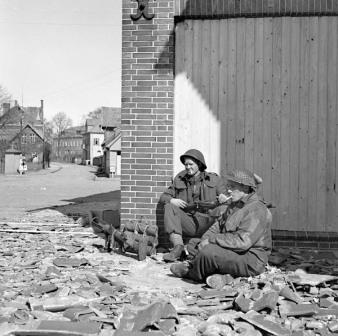
Lance-Corporal A. Kerelchuk and Private H.M. Sigurdson, both of The Argyll and Sutherland Highlanders of Canada, guarding the northern approach to a bridge across the Hase River, Meppen, Germany, 8 April 1945. Photographer: Alexander Mackenzie Stirton. (Source: Library and Archives Canada/Department of National Defence fonds/a145725)

According to the War Diary for April 11, 1945, “… The entire Battalion left Meppen at 1145 hours, travelling on kangaroos…”  Kangaroos are turret-less tanks with a platform for carrying troops.  “…We travelled fairly slowly, passed Sögel in the early afternoon, and headed east towards Werlte…

On April 14, 1945 the Regiment moved to Friesoythe and after clearing the town, the War Diary of April 15, 1945 noted that “… ‘C’ Company and the carrier platoons left Friesoythe… Their task was to go as far as possible towards the Küsten Canal bridge, which was known to have been blown by the retreating enemy… ‘A’ Company left Friesoythe shortly after ‘C’ had reached its position. This Company was to advance on the road west of ‘C’ Company…

…The Battle of the Küsten Canal was fatal…

On April 17, 1945, the fight to capture the Küsten Canal began, with several Regiments involved.  The role of the Argyll and Sutherland Highlanders of Canada was to reinforce the bridgehead and help drive off counterattacks. (See https://www.canadiansoldiers.com/history/battlehonours/northwesteurope/kustencanal.htm)

The War Diary of April 19, 1945 reported that “…it was planned that during the night ‘B’ Company, supported by tanks, would recce north…. The tanks found it very difficult to maneuver on the soft roads, which had been torn and cratered by three days of continuous shelling.  The engineers were called in to work on the road…Several times during the night, fanatical enemy infantry counter-attacked our well dug-in forces…. with some losses among our own troops…

Among those who lost their lives that night of April 19, 1945 was Andrew Kerelchuk.  He was initially buried in Friesoythe, Germany.

…Andrew was reburied in the Canadian War Cemetery in Holten…

In 1946, Andrew was reburied in the Canadian War Cemetery in Holten, The Netherlands.

2227462_2 Grave Andrew Kerelchuk

Grave of Andrew Kerelchuk in the Canadian War Cemetery in Holten.  (Photo courtesy of Canadian Virtual War Memorial)

sunflower header

Thank you to Barbara Dobbie for providing a photo of her uncle, and to Judie Klassen for helping to find family members and newspaper articles. Watch for another story about a soldier of Ukrainian descent who is buried in the Canadian War Cemetery in Holten in the next posting.

If you have a story to tell, please let Pieter know. Email him at memorialtrail@gmail.com, comment on the blog, or tweet to @researchmemori1.

…Missed the previous postings about the soldiers of Ukrainian heritage?…

…Want to follow our research?….

If you are reading this posting, but aren’t following the blog, you are welcome to do so.  See https://onthewarmemorialtrail.com/ or email me at dariadv@yahoo.ca and ask for an invitation to the blog.

Front cover OnTheWarMememorialTrailinEuropeDaria’s book ‘No Soldier Buried Overseas Should Ever Be Forgotten‘ is available in print and e-book formats.  For more information see https://nosoldierforgotten.com/

You are also invited to subscribe to our YouTube Channel: On The War Memorial Trail With Pieter Valkenburg: https://www.youtube.com/channel/UCJ591TyjSheOR-Cb_Gs_5Kw.

© Daria Valkenburg

On The War Memorial Trail….. Atlantic Canada Remembers – Part 3

‘No soldier buried overseas should be forgotten’ …. Pieter Valkenburg

January 16, 2021.  “No soldier buried overseas should be forgotten.” This statement by Pieter in a news clip on CTV’s Atlantic Live At 5 touched many people who watched it, and many photos and stories continue to be emailed to him.  As mentioned in Parts 1 and 2, Pieter has been working to ensure every email is acknowledged, and that the photos of soldiers buried in The Netherlands are forwarded to the appropriate cemetery for their digital archives.

This posting features more of the photos submitted…..

Soldiers buried at the Canadian War Cemetery in Holten, The Netherlands

William Broome restored

William Harold Broome. (Photo submitted by the Fleet Family)

On behalf of the Fleet Family, Diane Russo submitted a photo of her uncle, William Harold BROOME of Galt, Ontario, was born in 1913, the son of Simeon and Charlotte (nee Gilbert) Broome.  In 1937 he married Edith Cavel Gillies, and they had a son Billy.  A machine operator before enlisting in the war, he died of wounds received in action on April 25, 1945 during the Battle of Friesoythe in NW Germany, while serving with the Argyll and Sutherland Highlanders of Canada. He was buried there temporarily, before being reburied on March 9, 1946 in Holten.

Lt. Percy Dexter Higgins

Percy Dexter Higgins.  (Photo courtesy of the Higgins Family)

On behalf of the Higgins Family, Donald Higgins submitted a photo of his uncle, Percy Dexter HIGGINS, and wrote that “…My father’s brother, Lt. Percy Dexter Higgins, is buried in Holten Cemetery. He served with North Nova Scotia Highlanders R.C.I.C. (from N.S.)…

Lt Higgins lost his life during the Battle of Warnsveld which began late in the day on April 4, 1945. An account of the events is in Will R. Bird’s ‘No Retreating Footsteps… the story of the North Novas’: “…. April 4th was bright and sunny…The Brigadier arrived and the Novas’ next objective was the town of Warnsveld…. The troops were carried in vehicles to a debussing point in the woods…… there was a delay as a huge crater in the road had to be filled by the Sappers before the ‘Wasps’ could get over. Then the tanks had not arrived and the company could not get forward until 1730 hours. A Company started to hit snipers in concealed positions and progress was slow as each house had to be searched in turn….

Bird’s account mentions what happened next…. “….There was considerable shooting going on in various spots and B Company sent a platoon to make sure of an area between them and A Company.  Lt Higgins was in command. There was open ground to be crossed with a fence running at an angle. Three attempts to get over were driven back by machine gun fire.  Lt Higgins then tried to lead a rush up by the cover of the fence and was killed as he jumped over on the other side….

Like John James MURRAY, whose story was told in Atlantic Canada Remembers – Part 2, he is listed on a monument in Warnsveld. (See https://www.tracesofwar.com/sights/57960/Memorial-Canadian-Soldiers.htm).

An error might have been made in recording the date of his death as April 7, 1945 on the Canadian Virtual War Memorial and on his gravestone.  The family has been provided with the service file records should they wish to ask the Commonwealth War Graves Commission for a correction to be made on his gravestone, and for a correction to be made on the Canadian Virtual War Memorial.

IMG_7900 James King

James King. (Photo courtesy of Terry McCormick)

Aaron Bouma submitted a photo of James Gordon KING on behalf of Terry McCormick. Born July 3, 1910 in Woodstock, New Brunswick, the son of Harris Weston and May King, James was a salesman and radio technician in a music store before enlisting on September 1939.

While serving with the Royal Canadian Artillery, he died in a road accident on August 5, 1945, and was temporarily buried in Ostercheps (north west Germany) before being reburied on March 7, 1946 in Holten.

Pte Richard J Raney - 1

Richard Joseph Raney. (Photo courtesy of The Raney Family)

On behalf of the Raney family, Michelle Sutherland submitted a photo of Richard Joseph RANEY, explaining that “…My great uncle (my grandmother’s brother) was killed in action on April 8, 1945 and is buried at the Holten Canadian War Cemetery.  He was born April 12, 1926 in Point Michaud, Richmond County, Nova Scotia.  I was able to get a copy of his World War II Records & Service Files. As I was reading through his file, I realized that he actually lied about his age at the time of his enlistment. He enlisted in Sydney, Nova Scotia on August 31, 1942. He gave his birthday as February 8, 1924. Immediately I knew that could not be correct because my grandmother was born in September 1923. As it turns out, Richard was actually born on April 12, 1926 and was only 16 years old when he enlisted. He was killed a few days before his 19th birthday….

Following the successful liberation of Warnsveld, the North Nova Scotia Highlanders, which Richard Joseph was serving with, continued their advance. Will R. Bird’s ‘No Retreating Footsteps… the story of the North Novas’ explains that: “…. April 8th was clear and sunny and an O-group was held at noon.  The general plan was to seize a bridgehead over the Schipbeek Canal and penetrate into the village of Bathmen.  The bridgehead was to be taken quickly to allow Sappers to set up a Bailey bridge and open the road to traffic….” Richard Joseph lost his life at some point during the ensuing sortie.

Soldiers buried at the Canadian War Cemetery in Bergen Op Zoom, The Netherlands

Ernie Thornton

Arnold Ernest “Ernie” Thornton.  (Photo courtesy of Susan Hudson)

Susan Hudson submitted a photo of her uncle, Arnold Ernest “Ernie” THORNTON.  “…He was born in Amherst on September 30th, 1921 and was killed September 22, 1944, eight days before he turned 23….” she explained. “… He was the son of Edward Arnold and Doris Maude (MacDonald) Thornton.  He served with the Calgary Highlanders….

Ernie was killed in Belgium during the Battle of the Scheldt and initially buried near Wommelgem, Belgium, before being reburied in the Canadian War Cemetery in Bergen op Zoom.

Thank you to Aaron Bouma, Donald Higgins, Susan Hudson, Terry McCormick, Diane Russo, and Michelle Sutherland for sharing photos and anecdotes.  Thank you again to CTV’s Atlantic Live At 5 for helping to get the word out on this quest of remembrance. Atlantic Canadians remember their loved ones who are buried overseas.

More photos and stories in Atlantic Canada Remembers – Part 4! If you have photos or information to share, please email Pieter at memorialtrail@gmail.com, comment on the blog, or tweet to @researchmemori1.

© Daria Valkenburg

….Previous postings in the Atlantic Canada Remembers series….

Missed the previous postings in this series? See:

….Want to follow our research?….

If you are reading this posting, but aren’t following our research, you are welcome to do so.  Our blog address: https://onthewarmemorialtrail.com/

Front cover OnTheWarMememorialTrailinEurope4 countries, 6 weeks, 7,000 km – an unforgettable war memorial journey in Europe…. Daria’s book ‘No Soldier Buried Overseas Should Ever Be Forgotten‘ is available in print and e-book formats.  Net proceeds of book sales help support research costs and the cost of maintaining this blog. For more information see https://nosoldierforgotten.com/ 

You are also invited to subscribe to our YouTube Channel: On The War Memorial Trail With Pieter Valkenburg: https://www.youtube.com/channel/UCJ591TyjSheOR-Cb_Gs_5Kw

Never miss a posting!  Subscribe below to have each new story from the war memorial trail delivered to your inbox.

On the War Memorial Trail ….. PEI Soldiers Buried In The Canadian War Cemetery in Groesbeek

December 30, 2017.  During our first visit to the Canadian War Cemetery in Groesbeek in The Netherlands, we were able to place flags at the graves of three PEI soldiers buried there.  In the last blog entry we told the story of George Preston SMITH of Kinkora, who was with the North Shore (New Brunswick) Regiment, and the accident in which he lost his life. (See On the War Memorial Trail ….. At The Canadian War Cemetery in Groesbeek)

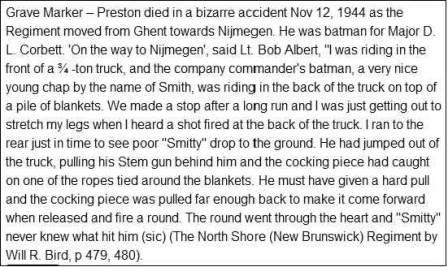
Our thanks to Alice van Bekkum of the Faces to Graves Project, who shared an eye witness account that was recorded by Will Bird in his 1963 book about the North Shore (New Brunswick) Regiment. (See https://books.google.com/books/about North_Shore_New_Brunswick_Regiment.html?id=Iz7WAAAAMAAJ)

Will Bird account of what happened to George Preston Smith

Excerpt about George Preston Smith from Will Bird’s book about The North Shore (New Brunswick) Regiment.

Before returning to place flags at the rest of the known soldiers from PEI, we stopped by a memorial marking the route on February 8, 1945 where soldiers marched into Germany on their way from Groesbeek, as part of Operation Veritable.  This was the northern part of an Allied pincer movement that took place between February 8 and March 11, 1945 during the final stages of the Second World War.

The operation was conducted by Field Marshal Bernard Montgomery’s Anglo-Canadian 21st Army Group, primarily consisting of the First Canadian Army under Lieutenant-General Harry Crerar and the British XXX Corps under Lieutenant-General Brian Horrocks. Their objective was to clear German forces from the area between the Rhine and Maas rivers, east of the German/Dutch frontier, in the Rhineland.

CIMG8998 Sep 15 2017 Pieter by memorial showis where soldiers marched into Germany from Groesbeek operation veritable

Pieter at the memorial for Operation Veritable in Groesbeek. (Photo credit: Daria Valkenburg)

CIMG8996 Sep 15 2017 memorial shows where soldiers marched into Germany from Groesbeek operation veritable

Close-up view of the text on the memorial for Operation Veritable in Groesbeek. (Photo credit: Pieter Valkenburg)

On our second visit to the Canadian War Cemetery in Groesbeek we were joined by Pieter’s former colleague in the Dutch Foreign Service, Ad Scheepers, and his wife Noor, who live in Groesbeek.

CIMG9023 Sep 16 2017 Groesbeek Cemetery Ad & Noor Scheepers with Pieter by Gaudets grave

Ad and Noor Scheepers with Pieter by the grave of Cpl Arthur Gaudet. (Photo credit: Daria Valkenburg)

Ad was a fountain of information about the cemetery, and noted that it was along the Liberation Route, which one can take to visit the many monuments and memorials in this part of The Netherlands.  The cemetery, on a road called Zeven Heuvelenweg (Seven Hills Way), is the largest war cemetery of the Commonwealth Graves Commission in The Netherlands.

Most of the soldiers buried here fell during the fighting on the Lower Rhine between February 8 and March 26, 1945.  It’s called the Canadian War Cemetery and we’d always assumed all of the burials were Canadian, but it’s not true.  By number and nationality, the 2,617 soldiers buried here are from:

  • 2,399 from Canada
  • 267 from Great Britain
  • 3 from Belgium
  • 2 from Poland
  • 2 from Australia
  • 1 from New Zealand
  • 1 from Russia
  • 1 from Yugoslavia
  • 1 from The Netherlands

Inscribed on the Groesbeek Memorial in the cemetery are the names of 1,103 soldiers reported missing in action between August 1944 and May 1945. Only a few have been identified since the memorial was put up. Unfortunately, most are still listed as MIA (Missing In Action).

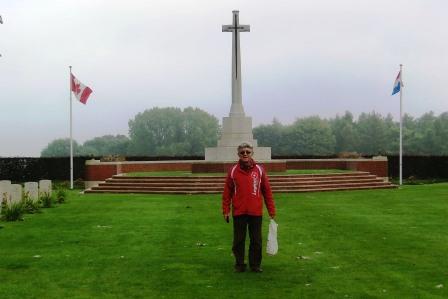
Ad told us he’d read that the Cross of Sacrifice in the cemetery was positioned where it was so it could be clearly seen from Germany, a stone’s throw away from the border.  It’s likely true, as one prerequisite that Canadian Officers had in selecting land for the cemetery was to have a view of Germany.

In a Dutch reference we read that construction on the cemetery began in 1945 by six Canadian soldiers. The location of the cemetery, on a hilltop, was chosen by Groesbeek Mayor Grotenhuis van Onstein for its view on the German border from the cemetery. The Cemetery was officially opened on May 4, 1947 by the Dutch Queen Wilhelmina. When the cemetery opened, the headstones were made from wood, as was the Cross of Sacrifice.  Later, the headstones were temporarily replaced by metal versions, and beginning in 1950 the headstones and Cross of Sacrifice were replaced by stone designs.

CIMG8945 Sep 15 2017 Groesbeek cemetery Pieter at Cross for remembrance

Pieter by the Cross of Sacrifice at the Canadian War Cemetery in Groesbeek. (Photo credit: Daria Valkenburg)

In alphabetical order, here are the known soldiers from PEI that are buried in the cemetery:

  • L/Cpl Ralph Schurman BOULTER, North Nova Scotia Highlanders, from West Point
  • Pte Lawrence BULGER, North Nova Scotia Highlanders, from Foxley River
  • Major John Weston CAMPBELL, North Nova Scotia Highlanders, from Clermont
  • Cpl Preston D. CAMPBELL, Algonquin Regiment, from Coleman
  • Rifleman William Alfred CANNON, Regina Rifle Regiment, from Pownal
  • Cpl Arthur GAUDET, Les Fusiliers Mont-Royal, from Mont Carmel
  • Sapper Joseph Edmond HENNEBERY, Corps of Royal Canadian Engineers, from Morrell
  • Cpl George Ivan MACKINNON, North Nova Scotia Highlanders, from Mt. Albion
  • Cpl Robert Bruce MACNEILLL, North Nova Scotia Highlanders, from Charlottetown
  • Pte Barney R. MCGUIGAN, North Shore (New Brunswick) Regiment, born in Souris
  • Cpl Stephen A. MCKINNON, Royal Hamilton Light Infantry, from St. Peter’s Bay
  • L/Cpl Edward Gabriel PERRY, Argyll & Sutherland Highlanders of Canada (Princess Louise), from St. Nicholas
  • Pte John Clifford ROGERS, North Shore (New Brunswick) Regiment, born in Hope River
  • Pte Ralph K. SILLIKER, Lake Superior Regiment, from O’Leary
  • Sgt Edison Alexander SMITH, North Nova Scotia Highlanders, from West Point
  • Pte George Preston SMITH, North Shore Regiment, from Kinkora
  • Pte William L. WEATHERBIE, Royal Regiment of Canada, from Charlottetown

Do you have photos or information on any of these soldiers?  If you know of other soldiers from PEI, please help the researchers at the Faces to Grave project by sharing that information. Photos and stories can be sent either through their website at http://facestograves.nl/index.html or by email to info@facestograves.nl.  Alternatively, you can contact us and we will forward your info for you.

Comments or stories?  You can share them by emailing us at memorialtrail@gmail.com, commenting on the blog, or tweet to @researchmemori1.    

© Daria Valkenburg

…Want to follow our research?…

If you are reading this posting, but aren’t following our research, you are welcome to do so.  Our blog address: https://onthewarmemorialtrail.com/

Front cover OnTheWarMememorialTrailinEurope4 countries, 6 weeks, 7,000 km – an unforgettable war memorial journey in Europe…. Daria’s book ‘No Soldier Buried Overseas Should Ever Be Forgotten‘ is available in print and e-book formats.  Net proceeds of book sales help support research costs and the cost of maintaining this blog. For more information see https://nosoldierforgotten.com/

Subscribe to our YouTube Channel: On The War Memorial Trail With Pieter Valkenburg: https://www.youtube.com/channel/UCJ591TyjSheOR-Cb_Gs_5Kw

Never miss a posting!  Subscribe below to have each new story from the war memorial trail delivered to your inbox.