On The War Memorial Trail…..The Bulger Brothers – Part 1: The WWII Soldier From Foxley River Killed During The Battle of Moerbrugge

August 5, 2024.  Can you imagine how difficult it was for parents to send their children off to conflict zones during WWII, and having to live with the uncertainty of whether they would return safely? For the Bulger family of Foxley River, Prince Edward Island, they suffered a double tragedy, losing two sons:  Harold ‘Hal’ Gabriel BULGER, who is buried in the Canadian War Cemetery in Adegem, Belgium, and Lawrence William BULGER, who is buried in the Canadian War Cemetery in Groesbeek, The Netherlands.

We were aware of Lawrence Bulger from last year’s series on soldiers from the North Nova Scotia Highlanders who lost their lives during the Battle of Bienen on March 25, 1945. As his name was not on a photo wish list, we didn’t research his story at that time. (See https://onthewarmemorialtrail.com/2022/11/29/on-the-war-memorial-trail-the-search-for-a-photo-of-austin-havelock-munroe-is-on-youtube/

This year we decided to tell the story of one more soldier killed during the Battle of Bienen, and asked Edison Smith for help in contacting a family member for Lawrence Bulger.  Edison’s grandfather, Edison Alexander SMITH, and great-uncle Ralph Schurman BOULTER, both lost their lives in the Battle of Bienen.  As they were from the same area of the Island, the families would have known each other.  Sometimes, it’s as simple as that to make contact with the family of a soldier!

We then learned that Lawrence’s brother, Harold ‘Hal’ Gabriel, also served in WWII and was killed in action on September 10, 1944 near the town of Oostkamp in Belgium during the early stages of the Battle of the Scheldt. (See https://www.veterans.gc.ca/eng/remembrance/history/second-world-war/scheldt and https://en.wikipedia.org/wiki/Battle_of_the_Scheldt)

We decided to tell the story of both brothers, and began with Hal, the first of the brothers to lose his life.

….Hal’s family was soon found….

Shortly after the request was made, Edison wrote to say “I was up to O’Leary this past week and spoke with my father and did some digging around for a relative of the Bulgers you had asked me about.  I was able to speak with Bev and Bernard Jeffery….. I briefly explained the work you … do and she was kind enough to email me some info and pictures which I have forwarded to you…

Bev also contacted us, explaining that her “mother was Harold and Lawrence’s sister Agatha….”  The family historian in the family, Bev was the keeper of the family photos and information.  Edison had found the right person!

It wasn’t long before we had a chance to meet Bev, and to learn more about the Bulger brothers.

CIMG6836 May 27 2024 Bev Jeffery & Pieter Mill River Resort

Pieter with Bev Jeffery at Mill River Resort in Mill River, Prince Edward Island.  (Photo credit: Daria Valkenburg)

Born September 9, 1918 in Portage, Prince Edward Island, Hal was the son of Gabriel and Anne ‘Annie’ Marion (nee Milligan) Bulger of Foxley River, Prince Edward Island.  One of 16 children, Hal had two brothers and thirteen sisters. 

…..Hal enlisted in 1940….
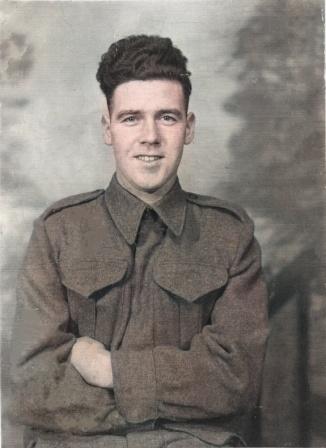
Harold Bulger colourized and restored by Pieter

Harold ‘Hal’ Gabriel Bulger. (Photo courtesy of Bev Jeffery.  Photo restoration and colourization by Pieter Valkenburg)

After leaving school at the age of 13, Hal worked on the family farm until he enlisted with the PEI Highlanders in Charlottetown, Prince Edward Island on July 31, 1940. After completing his basic training at No. 62 Canadian Army (Basic) Training Centre in Charlottetown, Hal was sent to Dartmouth, Nova Scotia for additional training.
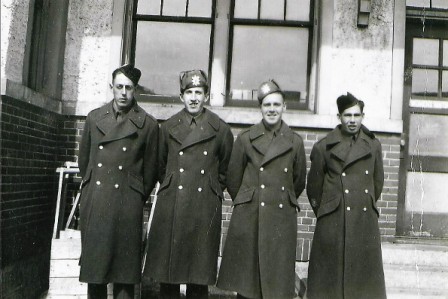
Leo Lynch, Leo Moran, Harold Bulger, Cecil MacKinnon

Left to right: Leo Lynch, Leo Moran, Harold ‘Hal’ Bulger, Cecil MacKinnon. (Photo courtesy of Bev Jeffery)

During a furlough in March 1941, a notice in the March 22, 1941 edition of the Summerside Journal noted that Pte. Leo Moran, Freeland, Pte. John McFayden, Freeland, Pte. Leo Lynch, Portage, Pte. Harold Bulger, Freeland, all of the P.E.I. Highlanders, returned to their unit in Nova Scotia. They were the guests of the Veterans’ Guard, Summerside….

HAROLD BULGER AND mother ANNIE BULGER 001

Harold ‘Hal’ Gabriel Bulger with his mother, Annie Bulger. (Photo courtesy of Bev Jeffery)

On June 4, 1941, Hal was transferred to A13 Canadian Infantry Training Centre in Camp Valcartier, Quebec, as preparation for guard duty in Newfoundland. 

Hal was sent to Newfoundland….

NFLD Map shows Botwood

Location of Botwood Military Base in Newfoundland. (Map source: http://postalhistorycorner.blogspot.com/2012/12/wwii-canadian-forces-in-newfoundland.html)

After France was occupied by the Germans in 1940, Newfoundland’s defensive position became more precarious. A British dominion at the time, Newfoundland did not join Canada until March 31, 1949. 

In 1940, Canada assumed responsibility for the defence of Newfoundland with the establishment of ‘W Force’, a Canadian garrison force responsible for defending Newfoundland against enemy incursions and providing security for existing and proposed defence facilities during WWII. It included infantry, artillery, and anti-aircraft units. (See https://en.wikipedia.org/wiki/Military_history_of_Newfoundland_during_World_War_II)

On July 23, 1941, as part of ‘W Force’, Hal was sent to Botwood, Newfoundland.  In addition to the PEI Highlanders, troops from the Black Watch of Canada, Royal Rifles of Canada, The Algonguin Regiment, Queens Own Rifles, also served at various times. While an RCAF base in Botwood had aircraft patrolling the east coast of the Atlantic, Canadian Army personnel based at Botwood were charged with protection of military facilities that had been installed there, as well as in Gander. (See https://www.heritage.nf.ca/articles/politics/botwood-base.php)

…..Four other soldiers were in Botwood…..

Hal was in Botwood at the same time as four other soldiers whose stories have been told on this blog:

Hal briefly returned to Canada….

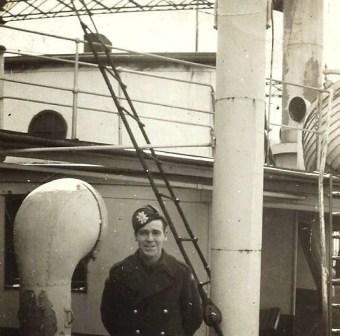
Harold Bulger aboard a ship likely in 1943 from NFLD

Harold ‘Hal’ Bulger aboard a ship returning to Canada from Newfoundland. (Photo courtesy of Bev Jeffery)

Hal remained in Newfoundland until February 12, 1943, when he was briefly sent to A14 Canadian Infantry Training Centre in Camp Aldershot, Nova Scotia and then on to Camp Sussex, New Brunswick. 

On February 23, 1943, he sent his mother a brief letter, thanking her for “…the $5.00 you sent me…” as he was getting low “…on tobacco and money….”  He explained that he didn’t know “…just when I will get home, but I will be home the first chance I get.  I might have to stay here a month before I get home…”  Based on Hal’s service record, he never did get leave to go home.

On March 8, 1943, Hal was no longer attached to ‘W’ Force, and remained at Camp Sussex until March 27, 1943, when he was transferred to the No. 1 Transit Camp in Debert, Nova Scotia, for final preparation and training before being sent overseas. 

In a March 16, 1943 interview for his Personnel Selection Record, it was noted that Hal was a “…pleasant, smiling, sturdy, well-behaved stable lad…

….Hal left Canada for overseas service….

On April 10, 1943, Hal left for Great Britain with the PEI Highlanders.  Upon arrival on April 17, 1943, he was assigned to No. 7 Canadian Infantry Reinforcement Unit (CIRU).

On June 25, 1943, he was briefly assigned to the Princess Louise Fusiliers, before being transferred to the Algonquin Regiment on August 21, 1943.  On May 28, 1944, Hal was promoted from Private to Lance Corporal. 
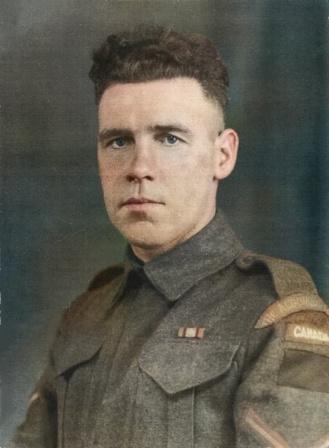
Harold Bulger in Algonquin Regiment Harold Bulger photo restored & colourized by Pieter

Harold ‘Hal’ Gabriel Bulger in his Algonquin Regiment uniform. (Photo courtesy of Bev Jeffery. Photo restoration and colourization by Pieter Valkenburg)

An excerpt from a research paper entitled ‘Rebuilding Trust: The Algonquin Regiment at War, July-September 1944’ by Ty Backer, noted that “In the summer of 1944, the Algonquins received word from divisional commander, General Kitching that the 4CAD would be used after the secret invasion of Normandy….” 4CAD refers to 4th Canadian Armoured Division. 

There was a delay in moving into France as although D-Day was a success, “…the failure to capture Caen on D-Day set back the division’s schedule for deployment… Formations were not able to move as far into Normandy as planners hoped, leaving 4CAD with no room to land at the beachheads until Caen and its surrounding area were captured. Consequently, they were delayed nearly a month and a half…

….Hal survived Operation Tractable and Operation Totalize….

Hal remained in the United Kingdom until July 20, 1944, when he and his Regiment left for France, arriving in Normandy on July 25, 1944, as part of the 21st Army Group, along with “the rest of the 10th Infantry Brigade landed in Normandy. Initially tasked with breaking through and driving south behind enemy lines, the battalion had to ensure getting armoured vehicles and infantry past the heavily entrenched areas surrounding the greater Caen area…” 

This was the lead-up to Operation Totalize, an offensive to break through German defences south of Caen and then capture the high ground north of the city of Falaise.  (See https://en.wikipedia.org/wiki/Operation_Totalize)

On August 2, 1944, Hal wrote to his father from France.  “…Well, Pop, I suppose you are going to kill me for not writing sooner, but really it is hard to get time to write over here….This is quite the place…but I can’t talk French….”  The letter ended with “…All my love. Your ever loving son. Hal…

By the end of August 1944, the Regiment was on the move towards the liberation of Belgium. Liberating the port of Antwerp, Belgium was key.  “…As the Allies progressed deeper into Europe, their supply lines needed to be augmented and strengthened…” 

The Allied High Command “…tasked 4CAD with fighting preliminary skirmishes of the Scheldt battle along the northern sector of the coast. The Algonquins and the rest of the 4CAD were tasked with clearing the areas west of the Leopold Canal on the Dutch-Belgian border.”

….Hal lost his life during the Battle of Moerbrugge….

Screenshot 2024-08-05 at 10-44-28 Moerbrugge · 8020 Oostkamp Belgium

Map shows location of Oostkamp and Moerbrugge, near Bruges in Belgium.  (Map source: Google maps)

The Algonquin Regiment arrived in Belgium from France on September 8, 1944.  The next day, the Regiment attempted to cross a bridgehead at Moerbrugge near Oostkamp, not far from Bruges, during the Battle of Moerbrugge. (See https://www.canadiansoldiers.com/history/battlehonours/northwesteurope/moerbrugge.htm)

In ‘Warpath The Story of the Algonquin Regiment 1939-1945’, author Major G. L. Cassidy wrote that “…On the evening of the 9th, ‘D’ Company was detailed to cover the bridging operations in Oostkamp, and moved up to do the job. The remainder of the battalion moved south to the chateau area behind the bridgehead. Enemy resistance was still heavy across the canal….

Hal was in ‘C’ Company, which was to cross the bridgehead at Moerbrugge across the Ghent-Bruges Canal the next day.  The War Diary for September 10, 1944 for the Algonquin Regiment recorded that “…at 21:00 hours ‘C’ Company was ordered to cross the canal and consolidate at Eekhoute farm by passing through the Argyll and Sutherland Highlanders of Canada.  The position was taken and held against continuous enemy fire. Casualties were reported to be 4 killed and 4 wounded...

Hal was one of the fatal casualties.  The other 3 soldiers who lost their lives that day were:

  • Pte Gerald Bertram MCEACHERN of Galt, Ontario
  • Sgt Marquis De MYERS of Wawota, Saskatchewan
  • Cpl John Walter PARYSEK of Timmins, Ontario

….Hal is buried in Adegem….

Hal was initially buried in Moerbrugge, before being reburied in the Canadian War Cemetery in Adegem, Belgium, along with the other 3 Algonquin Regiment soldiers killed on September 10, 1944.
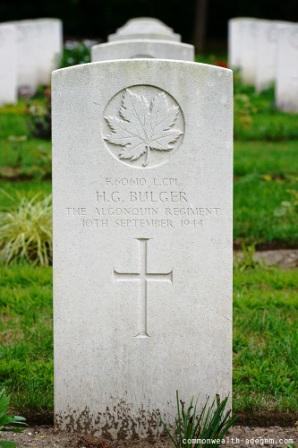
Grave of Harold Gabriel Bulger from CVWM

Grave of Harold Gabriel Bulger in the Canadian War Cemetery in Adegem, Belgium. (Photo courtesy of Canadian Virtual War Memorial)
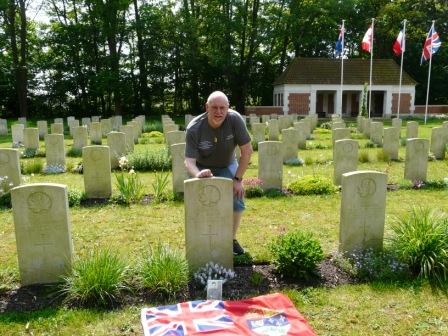
P1450929 May 11 2024 Patrick Michaels at grave of Harold Bulger in Adegem

Patrick Michiels visited the grave of Harold ‘Hal’ Gabriel Bulger in Adegem in May 2024, bringing with him the Red Ensign and a photo of Hal.  (Photo courtesy of Patrick Michiels)

Belgian citizen Patrick Michiels, Moderator of the Facebook group Canadian Scottish Regiment Adegem Canadian War Cemetery, visited Hal’s grave on May 11, 2024 at our request.  He brought with him a photo of Hal and the Red Ensign flag that was the precursor of the Maple Leaf flag we are familiar with. (See https://en.wikipedia.org/wiki/Canadian_Red_Ensign)

Coming up in Part 2, the Bulger Brothers series continues, with Lawrence William BULGER, who lost his life six months after Hal’s death.

Thank you to Bev Jeffery for submitting photos and information on her Uncle Harold, to Edison Smith for contacting the Jeffery family, and to Patrick Michiels for visiting the Canadian War Cemetery in Adegem and taking a photo of Hal’s grave.

Do you have photos or information to share? Email Pieter at memorialtrail@gmail.com, comment on the blog, or tweet to @researchmemori1.

© Daria Valkenburg

…..Missed the stories on Smith and Boulter?….

To read about Edison Smith’s grandfather and great-uncle, please see:

….Want to follow our research?….

If you are reading this posting, but aren’t following our research, you are welcome to do so.  Our blog address: https://onthewarmemorialtrail.com/
Front cover OnTheWarMememorialTrailinEurope4 countries, 6 weeks, 7,000 km – an unforgettable war memorial journey in Europe…. Daria’s book ‘No Soldier Buried Overseas Should Ever Be Forgotten‘ is available in print and e-book formats.  Net proceeds of book sales help support research costs and the cost of maintaining this blog. For more information see https://nosoldierforgotten.com/ 

You are also invited to subscribe to our YouTube Channel: On The War Memorial Trail With Pieter Valkenburg: https://www.youtube.com/channel/UCJ591TyjSheOR-Cb_Gs_5Kw

Never miss a posting!  Subscribe below to have each new story from the war memorial trail delivered to your inbox.

On The War Memorial Trail….. The WWII Soldier From Hallowel Grant Who Lost His Life During The Battle For The North Shore Of The Scheldt

July 24, 2024.  On November 7, 2022, Pieter was interviewed by Ceilidh Millar of CTV Atlantic News At 5 about the search for 4 soldiers of the North Nova Scotia Highlanders Regiment who died during the Battle of Bienen on March 25, 1945.  (You can read the article and watch the video.  See P.E.I. man identifying Canadian soldiers in the Netherlands | CTV News https://atlantic.ctvnews.ca/maritime-man-appealing-to-public-for-help-identifying-lost-canadian-soldiers-1.6143236)

Following the broadcast, several people got in contact to help with the photo search request, and to let him know about other soldiers buried in The Netherlands or Belgium. Among these was Martin Sullivan, who emailed Pieter, saying “My uncle Edward died October 20, 1944 near Brasschaet. Buried in Bergen Op Zoom.  He was in the Algonquin Regiment, C Company. Thank you to the Dutch people for taking care of Pte E. D. Chisholm’s grave and doing this research….

It took a while, but we eventually had a chance to meet Martin and look at the treasure trove of information and photos he had about his uncle, Edward ‘Ed’ Dalton CHISHOLM.

20230918_150701 Sep 18 2023 Pieter with Martin Sullivan in Cap Pele

Pieter with Martin Sullivan. (Photo credit: Daria Valkenburg)

Born November 5, 1924 in Hallowell Grant, Antigonish County, Nova Scotia, Ed was the son of Willliam John and Annie Jane Chisholm. He had 7 brothers and 5 sisters. Martin explained that his mother Josephine was one of Ed’s older sisters.

Ed Chisholm with siblings

A young Edward Chisholm and his older brother John William Chisholm identified in ‘Limbs’ by Lewis B. Chisholm.  (Photo courtesy of Martin Sullivan)

… Ed first enlisted in the Royal Canadian Naval Volunteer Reserve…

After leaving school at age 15, Ed worked on his parents’ farm, and then on a dairy farm, before going on to work as a stevedore for Scotia Stevedore Company in Halifax, Nova Scotia.  (A stevedore works at a dock to load and unload cargo from ships.)  

On March 22, 1943, at the age of 17, Ed left his employer and enlisted in the Royal Canadian Naval Volunteer Reserve as an ordinary seaman.  However, he was discharged as ‘medically unfit’ on May 12, 1943 due to being colour-blind. 

… Ed enlisted in the Canadian Army in 1944…

Ed Chisholm from Martin Sullivan

Edward ‘Ed’ Dalton Chisholm. (Photo courtesy of Martin Sullivan)

Ed returned to work as a stevedore in Halifax, this time with Cunard White Star Ltd, until January 4, 1944, when he enlisted at the No. 6 District Depot of the Canadian Army in Halifax, Nova Scotia.

His Personnel Selection Record noted that red-haired Ed had “…considerable experience in hockey and other sports. Attends dances ….” and reads “….popular fiction magazines and follows the news…”  His height of 6 feet 1 inch (1.85 metres) was remarked upon, and he was described as having “…a fine physique and a steady, calm, well balanced spirit…General characteristics point to suitability for vigorous activity along general combatant lines….

On January 14, 1944, Ed was sent to No. 60 Canadian Infantry Basic Training Centre (CIBTC) in Yarmouth, Nova Scotia.  After completing his basic training, Ed was transferred to A14 Canadian Infantry Training Centre (CITC) in Aldershot, Nova Scotia on March 12, 1944.

Next, Ed was attached to S-5 Canadian Driving and Maintenance School (CD & M School) in Woodstock, Ontario on May 5, 1944, for a Driver Course. He successfully completed this on June 29, 1944 and was qualified as a Driver i/c Class III (W).  (The term ‘Driver i/c’ refers to ‘Driver, internal combustion’.  Class III meant he was qualified to drive heavy trucks and armoured cars. ‘W’ refers to ‘Wheeled’.)

He was reassigned back to A14 CITC in Aldershot in preparation for overseas service, and granted two weeks embarkation leave, from July 7 to 20, 1944, the last chance he had to see his family.

… Ed left Canada for overseas service in August 1944…

On August 4, 1944, Ed left Canada for the United Kingdom.  Upon arriving on August 10, 1944 he was assigned to No. 4 Canadian Infantry Reinforcement Unit (CIRU).

On September 2, 1944 he was sent to France with the X-L infantry reinforcement troops of the 21st Army Group.

… Ed joined the Algonquin Regiment in Belgium…

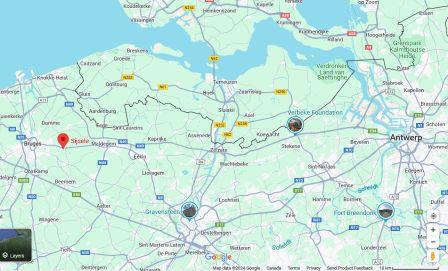
Screenshot 2024-07-20 at 12-30-12 Sijsele · 8340 Damme Belgium

Edward ‘Ed’ Dalton Chisholm joined the Algonquin Regiment in Sijsele, Belgium, as they travelled eastward. (Map source: Google maps)

On September 15, 1944 he was assigned to the Algonquin Regiment, joining them in Sijsele, Belgium, located not far from the Dutch border.  The Regiment had suffered heavy losses during the battles to capture the canals around Moerkerke and needed reinforcements as they slowly advanced towards the Scheldt and the need to liberate the port of Antwerp.

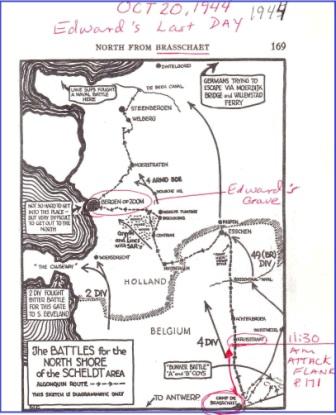
By October 18, 1944, the Regiment was near Westmaele, north-east of Antwerp.  In ‘Warpath The Story of the Algonquin Regiment 1939-1945’, author Major G. L. Cassidy wrote that “… on October 19th, a battalion reconnaissance party went north to Camp de Brasschaet for a look at the terrain where the next day’s battle was to be fought…..” This was the Battle for the North Shore of the Scheldt.

The Algonquin Regiment war diary for October 19, 1944 stated that “…at 13:15 hours, the battalion left on its journey north, arriving at our destination, a badly bombed sanitarium, about 16:30 hours.  Here the men were briefed on the forthcoming operation and after digging in, settled down to spend another quiet night…

The ‘Warpath’ entry for that day stated that when the orders were issued on the evening of October 19, the “…divisional plan was to advance and capture the town of Esschen, moving along two centre lines in two brigade groups…

….The Battle for the North Shore Of The Scheldt was fatal for Ed….

The Battle for the North Shore of the Scheldt began on October 20, 1944 at 7:30 am, with “… ‘B’ Company leading, ‘A’ Company on the right, and ‘D’ Company on the left...” according to the Algonquin Regiment’s war diary for that day.

Ed Chisholm was in ‘C’ Company, which didn’t go into position until later in the morning, as noted in the war diary.  “…At 11:30 hours, ‘C’ Company was placed under command of 28 Canadian Armoured Regiment, and with ‘C’ Squadron of that unit, made a flanking attack and captured the cross roads.  During this operation, one ‘C’ Company man was killed, and one tank was knocked out with one man killed and one officer wounded. Twenty one prisoners of war were captured….

The ‘C’ Company man killed was Ed, as was confirmed in ‘Warpath’. “… ‘C’ Company suffered only one fatal casualty, Pte E.D. Chisholm….”  He was 19 years old, only two weeks away from his 20th birthday.

Martin Sullivan had been given an eyewitness account by Stanley Cameron with a bit more information on what happened to his Uncle Edward. Stanley, from Grande Prairie, Alberta, was with the Royal Canadian Engineers 2nd Division.  “…When a German 30 mm cannon took out the tank, Edward was hit by tank shrapnel and was pushed into a ditch until taken to hospital.  He died in a field hospital, with a priest who gave him his last confession…” 

Map page 169 Warpath - Algonquin Regt Oct 20 1944 Chisholm_Page_3

Notes made by Martin Sullivan about Ed Chisholm’s last battle. (Map source: ‘Warpath The Story of the Algonquin Regiment 1939-1945’)

….Ed is buried in Bergen Op Zoom….

Screenshot 2023-09-17 at 21-00-01 kalmthout belgie at DuckDuckGo

Edward ‘Ed’ Dalton Chisholm was temporarily buried in Kalmthout, Belgium. (Map source: DuckDuckGo)

On October 21, 1944, Ed was temporarily buried “…in a field opposite the house of Joseph Goosenaerts…” in the village of Kalmthout, Belgium, before being reburied in the Canadian War Cemetery in Bergen Op Zoom, The Netherlands.

grave Chisholm from Find A Grave

Grave of Edward ‘Ed’ Dalton Chisholm in the Canadian War Cemetery in Bergen Op Zoom, The Netherlands. (Photo courtesy of Find A Grave)

….A family was left to grieve their son….

Martin wrote in his copy of ‘Warpath’ that when his grandmother (Momma) learned about her son’s death, she “…went to church and Edward appeared in her hands to tell her he was in heaven…”  When asked if this anecdote could be shared, Martin agreed.

Martin explained that upon hearing such devastating news about their son “….our grandfather Billy John Chisholm (PaPa) went to the woods to cry, and then hitched up the team of horses to take Momma to church in town….

His grandmother’s faith helped her to cope with the loss of a beloved son.  “…After several days of living in town and going to church all day, PaPa and the children were worried that their Momma would never be coming home. Momma prayed for her son to the Blessed Virgin and St. Joseph. Then one day they smiled down on her. Her prayers were answered.  There in her open hands was Edward’s face saying ‘Thank you Momma, I’m in heaven and you don’t have to worry about me anymore’. Her boy’s soul had been received into heaven and Momma went home to take care of the remaining twelve children. Thanks be to God….” 

Thank you to Martin Sullivan for sharing photos and information.  Do you have photos or information to share? Email Pieter at memorialtrail@gmail.com, comment on the blog, or tweet to @researchmemori1.

© Daria Valkenburg

….Want to follow our research?….

If you are reading this posting, but aren’t following our research, you are welcome to do so.  Our blog address: https://onthewarmemorialtrail.com/

Front cover OnTheWarMememorialTrailinEurope4 countries, 6 weeks, 7,000 km – an unforgettable war memorial journey in Europe…. Daria’s book ‘No Soldier Buried Overseas Should Ever Be Forgotten‘ is available in print and e-book formats.  Net proceeds of book sales help support research costs and the cost of maintaining this blog. For more information see https://nosoldierforgotten.com/ 

You are also invited to subscribe to our YouTube Channel: On The War Memorial Trail With Pieter Valkenburg: https://www.youtube.com/channel/UCJ591TyjSheOR-Cb_Gs_5Kw

Never miss a posting!  Subscribe below to have each new story from the war memorial trail delivered to your inbox.

On The War Memorial Trail….. The WWII Soldier Killed By Mortar Fire When His Brother Was Two Years Old

November 29, 2023.  After posting a photo search request for WWII soldier James ‘Jim’ Andrew MACLEOD on a Restigouche Facebook page, Pieter was contacted by Sheila Braun, who wrote that “…his brother Earle lives on Prince Edward Island…” and she let Earle know about the request. 

Very quickly Pieter and Earle were in touch with each other and we met him and his wife Nancy at their home in Little Sands. “…I was only 2 years old when my brother died...” Earle explained.

CIMG6667 Nov 17 2023 Pieter with Nancy & Earl MacLeod

Pieter with Nancy and Earle MacLeod. (Photo credit: Daria Valkenburg)

… Jim altered his birth year in order to enlist…

Born in Campbelltown, New Brunswick, James ‘Jim’ Andrew MacLeod was the son of John Earle and Christina MacLeod.  According to his Attestation form and Militia documents, he was born on December 19, 1924, but Earl and Nancy explained that he lied about his age and he was actually a year younger.  This matches what was filled out by his mother on the Estate Form, listing his date of birth as December 19, 1925.

When Jim enlisted with the No. 7 District Depot in Fredericton, New Brunswick on July 16, 1943, he had already been in the 2nd Battalion, 103rd Battery Non-Permanent Militia since October 25, 1941.  He also had a full time position as a watchman at Fraser Company, a pulp and paper mill in Campbelltown. 

Jim MacLeod coulourized photo2

James ‘Jim’ Andrew MacLeod. (Photo courtesy of Earle and Nancy MacLeod on behalf of the MacLeod Family.  Photo colourization: Pieter Valkenburg)

The interviewer for his Canadian Army Personnel Selection Record noted that Jim enjoyed “…hockey, swimming, fishing….” and wanted to be in the “…infantry so as to take Basic and Advanced Training in New Brunswick with friends…

On August 5, 1943, Jim was sent to No. 70 Canadian Army Basic Training Centre (CA(B)TC) in Fredericton for basic training.  On September 28, 1943, his Personnel Selection Record was updated, stating that Jim “…is not satisfied with Infantry.  He had training in the Royal Canadian Artillery Reserve and desires an allocation to that arm…..He had some experience as a truck driver and as a mechanic’s helper. Could be used as a driver i/c …

On October 8, 1943 he was posted to the A-30 Canadian Infantry Training Centre at Camp Utopia, located northeast of St. George, New Brunswick.  After his 5th week of training, his Personnel Selection Record was updated. “…Very good progress in Advanced training (Infantry)….Good stability, well disciplined….Outstanding in platoon….

… Jim became a driver mechanic…

On December 5, 1943, Jim was sent to Woodstock, Ontario for a Driver Course i/c course at the S-5 Canadian Driving and Maintenance School (CD & M School).  He successfully completed this on January 21, 1944 and was qualified as a Driver i/c Class III.  (The term ‘Driver i/c’ refers to ‘Driver, internal combustion’.  Class III meant he was qualified to drive heavy trucks and armoured cars.)

Jim remained in Woodstock to take a Driver Mechanic Course, and on March 15, 1944 was qualified as a Driver Mechanic Class I.

On March 18, 1944, Jim returned to the A-30 Canadian Infantry Training Centre at Camp Utopia in preparation for overseas service.  He received two weeks of embarkation leave, from April 14 to 27, 1944, the last time he would see his family.

The last day at home

James ‘Jim’ Andrew MacLeod on his last day at home.  (Photo courtesy of Earle and Nancy MacLeod on behalf of the MacLeod Family.)

… Jim left Canada for overseas service in May 1944…

On May 1, 1944 Jim left Canada for the United Kingdom.  Upon arriving on May 7, 1944 he was assigned to No 4 Canadian Infantry Reinforcement Unit (CIRU).

While in the United Kingdom, Jim continued his training, completing a First Aid Course shortly after his arrival, and then qualifying as a Driver i/c (T) Q2 in July 1944.

On September 10, 1944 he was sent to France with the X-L infantry reinforcement troops of the 21st Army Group.

… Jim joined the Algonquin Regiment in Belgium…

Screenshot 2023-11-28 at 11-59-28 Assenede · Belgium with arrows

James ‘Jim’ Andrew MacLeod joined the Algonquin Regiment in Assenade, Belgium, as they travelled towards Brasschaat.  (Map source: Google maps)

On September 19, 1944 he was assigned to the Algonquin Regiment, joining them in Assenade, Belgium, located not far from the Dutch border.  The Regiment had suffered heavy losses during the battles to capture the canals around Moerkerke and needed reinforcements as they slowly advanced towards the Scheldt and the need to liberate the port of Antwerp.

By October 18, 1944, the Regiment was near Westmaele, north-east of Antwerp.  In ‘Warpath The Story of the Algonquin Regiment 1939-1945’, author Major G. L. Cassidy wrote that “… on October 19th, a battalion reconnaissance party went north to Camp de Brasschaet for a look at the terrain where the next day’s battle was to be fought…..” 

… Jim was hit by a mortar shell while on patrol…

Screenshot 2023-11-26 at 13-48-12 Where is Esschen in Belgium

Map shows the location of Essen, Belgium, where James ‘Jim’ Andrew MacLeod lost his life.  (Map source: Google)

That night, orders came to “…advance and capture the town of Esschen, moving along two centre lines in two brigade groups….

While the Algonquin Regiment was in Esschen (Essen in English), Belgium, the October 23, 1944 War Diary entry recorded that “…patrols were sent out during the night.  An ‘A’ Company patrol which went out to recce a bridge east of town came under heavy mortar fire and one man was killed and two wounded…

Warpath’ provided a bit more clarity. “….An ‘A’ Company patrol, sent out to recce a bridge to the east, came under a mortar concentration and lost two men wounded, Ptes J.  Burant and J. Bordignon, and one man killed, Pte J. A. MacLeod….”  Jim was only 18 years old.

… Jim is buried in the Canadian War Cemetery in Bergen Op Zoom…

Grave of Jim MacLeod in BOZ from Find A Grave

Grave of James ‘Jim’ Andrew MacLeod at the Canadian War Cemetery in Bergen Op Zoom. (Photo source: http://www.findagrave.com)

Jim was initially buried in Brasschaat, Belgium, along a road at the entrance to the Sanatorium, before being reburied the following year in the Canadian War Cemetery in Bergen Op Zoom, The Netherlands.

Earle remembers that “…my mother would never put up the Christmas tree before December 19 after Jim died.  That was the first official Christmas day….” Needless to say, this is a family that never forgot the loss of a beloved son and brother.

Thank you to Earle and Nancy MacLeod for providing photos and information.  Thank you also to Sheila Braun for help with contacting family. Do you have a story to tell? Email Pieter at memorialtrail@gmail.com, comment on the blog, or send a tweet to @researchmemori1.  

© Daria Valkenburg

….Want to follow our research?….

If you are reading this posting, but aren’t following our research, you are welcome to do so.  Our blog address: https://onthewarmemorialtrail.com/

Front cover OnTheWarMememorialTrailinEurope4 countries, 6 weeks, 7,000 km – an unforgettable war memorial journey in Europe…. Daria’s book ‘No Soldier Buried Overseas Should Ever Be Forgotten‘ is available in print and e-book formats.  Net proceeds of book sales help support research costs and the cost of maintaining this blog. For more information see https://nosoldierforgotten.com/ 

You are also invited to subscribe to our YouTube Channel: On The War Memorial Trail With Pieter Valkenburg: https://www.youtube.com/channel/UCJ591TyjSheOR-Cb_Gs_5Kw

Never miss a posting!  Subscribe below to have each new story from the war memorial trail delivered to your inbox.
On The War Memorial Trail…..The WWII Soldier From Disley Who Lost His Life While Swimming Across The Maas River

July 20, 2023. After Pieter was interviewed by Kevin Rollason of the ‘Winnipeg Free Press‘ in November 2022, we received an email from Mike Wilson about his great-uncle, Adam KLEIN.

Mike wrote that “….my mother Joyce recently read the ‘A Name Without A Face’ article in The Winnipeg Free Press and passed it on to me. Thank you for the important work that you are doing with this project….”  (See https://onthewarmemorialtrail.com/2022/11/09/on-the-war-memorial-trail-the-importance-of-remembrance/)

He went on to explain that “… my great-uncle on my mother’s side, Adam, served in the Second World War and is buried in the Bergen-op-Zoom Canadian War Cemetery in the Netherlands (Plot 8, Row G, Grave 4)…..Pte. Adam Klein was from Disley, Saskatchewan (near Regina Beach) and served with the Algonquin Regiment.  I have attached a picture of my Great Uncle Adam

Adam was born August 9, 1924 in Disley, Saskatchewan, the son of Joseph and Eva (nee Huber) Klein, who had immigrated to Canada from Czernowitz, Romania. (That area is now part of Ukraine. See https://en.wikipedia.org/wiki/Bukovina)

… Adam enlisted at the age of 19…

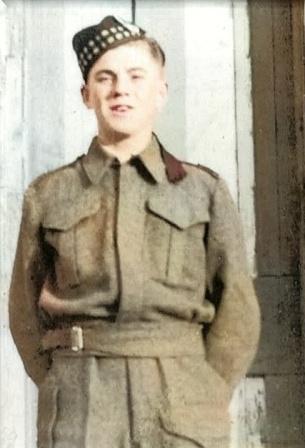
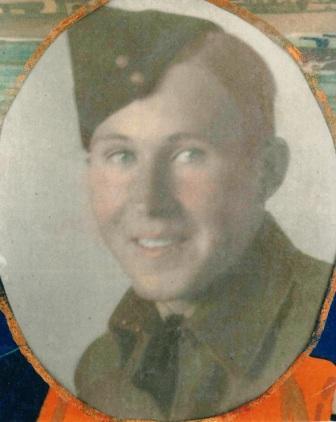
Uncle Adam Klein picture #2

Adam Klein. (Photo courtesy of the Klein Family)

When he enlisted with the 12th District Depot in Regina, Saskatchewan on October 6, 1943, at the age of 19, he was working for his father as a truck driver, who had a general hauling business in Regina Beach. 

The interviewer for his Personnel Selection Record recorded that Adam could “…speak some German…” and “…reads quite a lot of fiction. Plays baseball and rugby, likes most sports…. Likes comedy and western pictures….”   It was also noted that “…he is a proficient driver and licenced, so should prove suitable for Driver i/c…”  The term ‘Driver i/c’ refers to ‘Driver, internal combustion’, meaning someone qualified to drive a motor vehicle, but not a tracked vehicle, such as a tank.

On November 4, 1943, Adam was transferred to No. 122 Canadian Army Basic Training Centre (CABTC) in Prince Albert, Saskatchewan.  After completing his training there, his Personnel Selection Record was updated, noting that he was “… cooperative, has a good attitude, and appears to like Army life… He has a keen desire to drive in Army.  Brother overseas is a driver…”  This was Adam’s older brother August.

… Adam took courses to qualify as a Driver…

Adam was next sent to the A15 Canadian Infantry Training Camp (CITC) in Shilo, Manitoba.  From there, he went to the S-5 Canadian Driving and Maintenance School (CD & M School) in Woodstock, Ontario, on March 2, 1944, where he successfully completed a 6 week driving course to qualify as a Driver i/c Class III Wheeled Vehicles. This meant he was qualified to drive heavy trucks and armoured cars.

He remained in Woodstock for additional training, taking a Driver Mechanic W course, which he successfully completed on June 9, 1944.  This meant he was trained to drive tracked vehicles, such as tanks.

On June 10, 1944, Adam returned to A15 Canadian Infantry Training Camp (CITC) in Shilo, where an update to his Personnel Selection Record noted “…his suitability for overseas service…

Adam was now qualified as a Driver Mechanic Group C.  In addition to being a driver, he would also be responsible for minor vehicle repairs on vehicles in his unit.

… Adam left Canada a few days after his 20th birthday…

On August 4, 1944 Adam left Canada for the United Kingdom, arriving on August 11, 1944, and assigned to No 1 Canadian Infantry Reinforcement Unit (CIRU).  His stay in the United Kingdom was short, as on August 31, 1944 he was sent to France with the X-4 reinforcement troops of 11th Battalion.

On September 15, 1944 he was transferred to the Algonquin Regiment, which was in Belgium, having just fought in the Battle of the Leopold Canal. Reinforcements were badly needed. asualty figures for the Regiment during the fighting September on September 13 to 14, 1944 in the Belgian village of Moerkerke on the Leopold Canal were recorded as 168 killed, wounded or missing. (See https://www.canada.ca/en/department-national-defence/services/military-history/history-heritage/casualty-identification-military/battle-leopold-canal-september-13-14-1944.html)

Adam arrived at the Regiment on the same day as Bruce Wilbur CHURCHILL, whose story has been previously told on this blog.  (See https://onthewarmemorialtrail.com/2022/06/05/on-the-war-memorial-trail-the-ww2-soldier-who-lost-his-life-in-a-monastery-garden/)

The beginning of January 1945 found the Regiment in Meerle, Belgium.  Not long after the New Year the Regiment moved into the area around Drunen, The Netherlands.

… Adam was part of a patrol with ‘C’ Company…

The January 18, 1945 war diary for the Regiment recorded that after ‘C’ Company had been interviewed by a war correspondent for a radio station in Toronto, part of the evening was spent in “…carrying forward ammunition that will be used in the early morning when they will take part in a fire plan to cover a fighting patrol…”  Adam would be a member of this planned patrol.

On the morning of January 19, 1945, the war diary for the Regiment recorded that “….Weather: Dull, raw wind, hail and snow in AM...”  In spite of the poor weather, ‘C’ Company was sent on patrol, and the war diary recorded the patrol commander’s subsequent report.

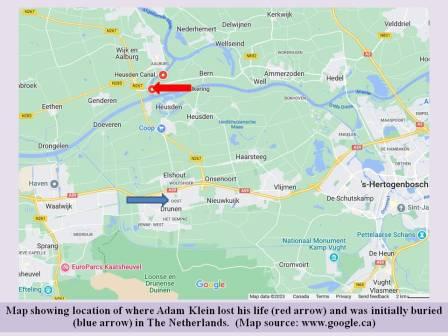
Map showing where Adam Klein died

...At 0700 hours this morning, a fighting patrol of 23 men from 15 Platoon, commanded by W. A. Godefroy, crossed the north bank of the Maas, just west of the Heusden Canal….The patrol crossed the river and reached the top of the dyke without incident….

The patrol spread out. “…Cpl Carrier led his section to the left flank to a well developed trench system, which led to a pill box.  Hearing voices inside, he tossed in a hand grenade, which brought two Germans undamaged into the open….

Two men were assigned to guard them, while Cpl Kenneth John CARRIER and Adam Klein “…flushed out five more….and took them to the embarking point, only to find that owing to some error the remainder of the patrol had withdrawn with the two prisoners of war…

An explanation was given in an article in the January 26, 1945 edition of the ‘Maple Leaf’ newspaper. “…The boats had left. The corporal and the private hadn’t heard the whistled signal for withdrawal.…They stood alone in a snowstorm, in enemy territory, with the freezing river between them and our lines…

… German prisoners attacked Adam…

One of the five new prisoners was wounded and left behind.  “…Leaving Pte Klein with the four prisoners, the corporal ran along the beach, endeavouring to find a boat...”  He was unsuccessful.  Then, when he returned “…he found the four Germans had jumped Pte Klein and were pounding his head with a rock….

Cpl Carrier killed three of the prisoners but “…the fourth one managed to run away…” Later accounts stated that the fourth German was also killed by Carrier.

It wasn’t safe to remain in enemy territory.   Without a boat, their options were limited.  Therefore, they “…walked out onto the ruined bridge and swam for safety….

… A dangerous swim across the Maas River…

As they were halfway across, “…Pte Klein called out for help. Cpl Carrier, although he himself was almost exhausted, dragged his comrade to within a few yards of the shore….Only when further assistance arrived did he release his friend and swim the last few yards to safety…

The war diary entry explained that “… Cpl Carrier made the trip successfully, but Pte Klein was swept under as he was within an ace of being rescued by an ‘A’ Company man who dived in to help him…”  This was Pte Arnold Edward BOEHLER, who noticed “…two figures struggling frantically in the icy water about 10 yards from the shore...

… Adam died before reaching shore…

An account of Boehler’s actions noted that without hesitation, he “…rushed through a field of anti-personnel mines and, fully clothed, dove into the river…

The war diary entry explained that Boehler “…reached Klein and grabbed him by the shoulders, but unfortunately he got a cramp and was forced to relinquish his hold on the drowning man and it was only with great difficulty that he got back to shore himself...” The war diary entry differs from the account in a January 26, 1945 article in the Maple Leaf newspaper and in Boehler’s nomination for a military medal, both of which state that Boehler managed to drag Adam’s body to shore.

Adam’s body was recovered by Lt Godefroy, Lt Grandbois, and Pte Neely.  In ‘Warpath – The Story of the Algonquin Regiment 1939-1945’, the regimental history of the Algonquin Regiment written by Major G. L. Cassidy, it was stated that Adam did not drown but died from “…a heart attack brought on by the exertion and the cold…”  This was not in his service file, nor in the war diary.

The war diary recorded that on that same day as his death, Adam “…was given a military funeral in the afternoon, the pall bearers and firing party being composed of members of the patrol...”  He was buried just north of Drunen.       

While the war diary and the subsequent nominations for military medals for Cpl Carrier and Pte Boehler, the two soldiers that tried to rescue Adam, state that the incident happened on January 19, 1945, Adam’s military service file states he died on January 18, 1945. This date is repeated in ‘Warpath – The Story of the Algonquin Regiment 1939-1945’.  January 18, 1945 is also the date on his headstone.

… Adam is buried in the Canadian War Cemetery in Bergen Op Zoom…

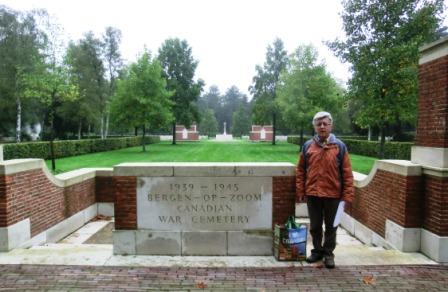
After the war, Adam was reburied in the Canadian War Cemetery in Bergen Op Zoom, The Netherlands, which we visited in 2019.  The British War Cemetery is right next to it, which we mistakenly went to first.  A teacher with a group of students noticed our bag of flags and directed us to the right cemetery!

CIMG3382 Oct 7 2019 Bergen Op Zoom Pieter at Cdn War Cemetery

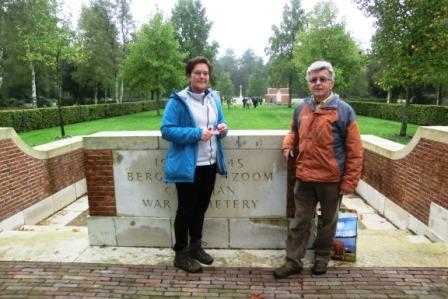
Pieter at the entrance to the Canadian War Cemetery in Bergen Op Zoom.  Our Sobey’s bag saved us from wandering around the wrong cemetery!  (Photo credit: Daria Valkenburg)

Grave of Adam Klein from findagrave

Grave of Adam Klein at the Canadian War Cemetery in Bergen Op Zoom. (Photo source: http://www.findagrave.com)

…Klein Island is named in honour of Adam…

On May 31, 1967, the Province of Saskatchewan’s Department of Natural Resources named Klein Island in honour of Adam.  (See https://geonames.nrcan.gc.ca/search-place-names/unique?id=HAETD)

Joyce Forshaw (nee Klein)

Joyce Forshaw (nee Klein), niece of Adam Klein. (Photo courtesy of Mike Wilson)

Mike Wilson wrote that “….Pte. Adam Klein was only 21 years old when he died, and he is still thought of, remembered and named often by his niece Joyce, who has proudly displayed Adam’s picture every November to honour him. It was during a quiet Remembrance Day visit with my mother … that we gathered information to send to you….

Thank you to Mike Wilson and Joyce Forshaw for contacting Pieter about Adam Klein. Adam lost his life in a part of The Netherlands that we are very familiar with, as so many of Pieter’s ancestors lived in this area.

Pieter reflected that “…the story of the liberation of The Netherlands is one my parents engrained in me, and I have never forgotten the sacrifices made by so many so that the Dutch people could live in peace and freedom…

Do you have a story to tell? Pieter encourages you to email him at memorialtrail@gmail.com, comment on the blog, or tweet to @researchmemori1.    

© Daria Valkenburg

…Want to follow our research?…

Follow our blog

If you are reading this posting, but aren’t following our research, you are welcome to do so.  Our blog address: https://onthewarmemorialtrail.com/

Front cover OnTheWarMememorialTrailinEurope4 countries, 6 weeks, 7,000 km – an unforgettable war memorial journey in Europe…. Daria’s book ‘No Soldier Buried Overseas Should Ever Be Forgotten‘ is available in print and e-book formats.  Net proceeds of book sales help support research costs and the cost of maintaining this blog. For more information see https://nosoldierforgotten.com/

Subscribe to our YouTube Channel: On The War Memorial Trail With Pieter Valkenburg: https://www.youtube.com/channel/UCJ591TyjSheOR-Cb_Gs_5Kw

Never miss a posting!  Subscribe below to have each new story from the war memorial trail delivered to your inbox.
On The War Memorial Trail…..The WWII Soldier From Guysborough Whose Nieces Ensured His Photo Reached Pieter

July 15, 2023. The route to finding family and a photo of a soldier has many twists and turns. Sometimes a family member contacts us about a relative, usually after a media interview, but most of the time it’s sheer detective work to find a living family member. If no family connection can be found, then an appeal is made through the media.

In the majority of cases, possible family connections are found. Then Pieter has the challenge of making contact – through genealogy sites such as Ancestry, Facebook accounts, Legion branches, and by email if an address is found.

Quite often, though, an initial inquiry is made by phone. If you’ve ever had to cold call a stranger and explain the purpose of your call, you know it’s a daunting prospect. With a few exceptions, people are generally very polite, listen carefully to Pieter, and are good enough to let him know if he’s reached the right person (a relative) or not.

Over the years, he’s had very engaging calls and met delightful people. That was the case when he was looking for a photo of WWII soldier Lawrence Edward LUCAS of Guysborough, Nova Scotia.

Lawrence was born December 9, 1925, the son of Charles and Amelia Hattie Lucas. He had a brother Charles, and three sisters: Caroline, Mildred, and Vivian.

…The photo search was successful thanks to two nieces…

…It’s usually the women who have the photos…” Pieter told me, “…so I’m starting with the sisters….” It was a wise decision.

Lawrence’s sister, Mildred O’Connor, had been president of the Ladies Auxiliary in the Royal Canadian Legion in Guysborough. Pieter spoke with her daughter, Marie Ehler, who told him that her mother “….had placed a photo in the Legion….

Unfortunately, the Legion never seemed to be open, and there was no response to inquiries made by phone and social media.

Pieter then contacted Mildred McLeod, whose mother Caroline ‘Carrie’ Tovey, was another sister of Lawrence. When Mildred heard that the Legion had not responded, she got involved.  Within a few days, a photo was emailed to Pieter from Lorne MacDonald.

…Lawrence enlisted at the age of 18…

Lawrence Edward Lucas

Lawrence Edward Lucas. (Photo courtesy of the Lucas Family. Photo colourization by Pieter Valkenburg)

When Lawrence enlisted with the No. 6 District Depot in Halifax, Nova Scotia, on June 23, 1944, he had been working as a carpenter at Eastern Wood Works in New Glasgow, Nova Scotia.  He also noted that he had served with the 2nd Reserve Battalion Pictou Highlanders from September 1941 to May 1942.  As a teenager during that period, he would not have been eligible for active service.

On July 6, 1944, he was sent to No. 60 Canadian Infantry Basic Training Centre (CIBTC) in Yarmouth, Nova Scotia. Then, on September 3, 1944 he was transferred to the A14 Canadian Infantry Training Centre (CITC) in Aldershot, Nova Scotia.

…Lawrence completed an anti-tank course…

Among the training that Lawrence completed was a 6 Pounder Anti-Tank Gun course, for which he received his qualification on October 16, 1944.  This was a relatively small gun that could be pushed by its crew when necessary. Towed by a Universal Carrier, it could be brought into action quickly. (For more information, see https://www.canadiansoldiers.com/weapons/ordnance/6pounder.htm)

You can get an idea of how this gun works at this short re-enactment video on YouTube:

On December 12, 1944, Lawrence was transferred to the Training Brigade Group in Debert, Nova Scotia, for final training and preparations for going overseas.

…Lawrence arrived in the UK on Christmas Day 1944…

Lawrence left Canada on December 19, 1944, and after arriving in the United Kingdom on Christmas Day, he was assigned to No. 3 Canadian Infantry Training Regiment (CITR) for further training.

On February 10, 1945 he was in North West Europe with the X-4 reinforcement troops of 10th Battalion. Then, on April 6, 1945, he was transferred to the Algonquin Regiment, which was in the vicinity of Almelo, The Netherlands.

…Lawrence joined The Algonquin Regiment in The Netherlands…

The Algonquin Regiment was part of the 1st Canadian Army, which had two tasks: liberate the western Netherlands, and advance to the North Sea while protecting the left flank of the British 2nd Army as they advanced into northern Germany.

Algonquin Regt map to Apr 16 1945

Green arrows mark the movement of The Algonquin Regiment through The Netherlands and Germany. (Map source: http://www.canadiansoldiers.com)

By April 17, 1945 the Regiment had passed Friesoythe, Germany and was engaged in clearing a bridgehead over the Küsten Canal.  The war diary for April 20, 1945 recorded that “…in four days of steady fighting, the bridgehead has been slowly but steadily enlarged, both in depth and width, always against fanatical opposition and over terrain that is definitely in favour of the enemy….

kustencanal from Cdn Soldiers

Clearing of the Küsten Canal in Germany. (Map source: http://www.canadiansoldiers.com)

By April 22, 1945 more reinforcements had arrived, and the various companies of The Algonquin Regiment had been moved.  Lawrence was in ‘D’ Company, which, per ‘D’ Company’s war diary entry, stated that “…at 0230 we got orders to move so we packed up and moved …. and bedded down in a barn to await orders. We came under cover of the Argylls today…

…Lawrence lost his life due to artillery fire in Germany…

On April 23, 1945, ‘D’ Company recorded that just after midnight they “…moved up the road 600 yards as far as ‘C’ Company of the Argylls….”  After a two hour wait for further orders, they were “… to infiltrate a platoon across the water obstacle to determine the strength of the opposition. Things went OK, not a shot was fired and at first light we found ourselves dug in with the Jerries almost in the same trenches…

Then things weren’t so rosy as the day unfolded as “…16 Platoon hung on to the east side of the river all day and we took a lot of shelling.  Our casualties were one killed and three wounded. At 1900 hours we received orders to move onto the railway and take up positions at the road and rail crossing. We teed off at 2145 and 17 Platoon came under our own artillery fire and lost 14 men in killed and wounded…

At some point during that fateful day, Lawrence lost his life.  It’s unknown if he was the casualty killed by German shelling or one of the casualties from the Regiment’s own artillery fire.

…Lawrence is buried in the Canadian War Cemetery in Holten…

He was temporarily buried in Edewecht, Germany before being reburied in the Canadian War Cemetery in Holten, The Netherlands a year later.

lucas, lawrence edward grave from Holten

Grave of Lawrence Edward Lucas in Holten, The Netherlands.  (Photo courtesy of the Information Centre Canadian Cemetery Holten)

Thank you to Mildred McLeod and Marie Ehler for ensuring that Pieter received a photo of their uncle. Do you have a story to tell? Pieter encourages you to email him at memorialtrail@gmail.com, comment on the blog, or tweet to @researchmemori1.

© Daria Valkenburg

…Want to follow our research?…

Follow our blog

If you are reading this posting, but aren’t following the blog, you are welcome to do so. Our blog address: https://onthewarmemorialtrail.com/.

Front cover OnTheWarMememorialTrailinEurope4 countries, 6 weeks, 7,000 km – an unforgettable war memorial journey in Europe…. Daria’s book ‘No Soldier Buried Overseas Should Ever Be Forgotten‘ is available in print and e-book formats.  Net proceeds of book sales help support research costs and the cost of maintaining this blog. For more information see https://nosoldierforgotten.com/

You are also invited to subscribe to our YouTube Channel: On The War Memorial Trail With Pieter Valkenburg: https://www.youtube.com/channel/UCJ591TyjSheOR-Cb_Gs_5Kw.

Never miss a posting!  Subscribe below to have each new story from the war memorial trail delivered to your inbox.
On The War Memorial Trail In North Bay….. The WWII Soldier Who Was Appointed Company Sergeant Major

June 29, 2022. When we knew we would be travelling to North Bay, Ontario in May for an Author Talk at the North Bay Public Library, Pieter also wanted to help the Canadian War Cemeteries in The Netherlands fulfill their photo wish lists of six soldiers from the North Bay area.

Little did we know that a chance meeting with retired history teacher John Hetherington, organized by Don Coutts, to bring together like minded individuals interested in military research, would be the key to receiving one of these photos.

…A meeting that led to a photo of a WWII soldier….

IMG_20220518_195343443_BURST000_COVER May 18 2022 With John Hetherington photo by Don

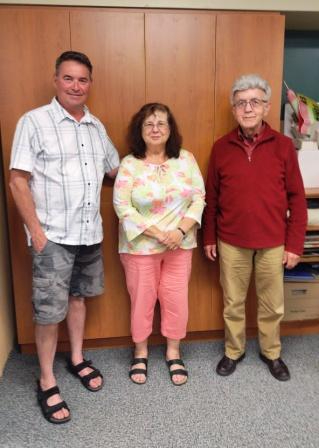
John Hetherington with Daria and Pieter at the North Bay Public Library.  (Photo credit: Don Coutts)

John Hetherington takes groups to visit war memorials and cemeteries in Europe, and we were delighted to meet him one evening during our visit to North Bay.  After he and Pieter discussed the soldiers on the photo wish lists from the Canadian War Cemeteries in The Netherlands, John recalled that two nephews of Anthony PETTA, one of the soldiers on the list, had been on one of his tours, and had visited their uncle’s grave.

Leave it with me, he said.  He’d look up the contact information and call them.  He did, and within a few days, a photo was sent to Pieter by Anthony Repa, which was in turn sent to The Netherlands.

anthony petta colourized

Anthony Petta.  (Photo courtesy of Anthony Petta Family.  Photo submitted by Anthony Repa. Photo restoration and colourization by Pieter Valkenburg)

Antonio ‘Anthony’ PETTA was born November 8, 1915 in North Bay, Ontario, the son of Michael and Raffaela (nee Rota) Petta.  Before enlisting with the Algonquin Regiment in North Bay on May 12, 1941, he was employed as a freight handler with the Temeskaming and Northern Ontario Railroad.

Anthony’s Occupational History Form indicated that he spoke English and Italian fluently, not surprising as both his parents had been born in Italy.  He also indicated that after the war he hoped to take a Commercial Agriculture Course and become a chicken farmer.

On July 12, 1941, he was sent for training at Camp Shilo in Manitoba, followed by a promotion to Acting Corporal and a transfer to Newfoundland on August 8, 1942.

On February 16, 1943, he requested a demotion to Private and was sent to Debert, Nova Scotia, a camp that prepared soldiers for overseas service. The demotion lasted one day, and he was reappointed Acting Corporal.  On April 6, he was confirmed as Corporal, and the following day, received another promotion, to Lance Sergeant.

By July 2, 1943 he was in the United Kingdom. While in the United Kingdom, he was promoted to Acting Sergeant on February 28, 1944, and then promoted again, this time to Sergeant, on May 28, 1944.

His stay in the United Kingdom ended when he left for Normandy, France with the Algonquin Regiment on July 20, 1944. On July 25, 1944, all four companies of the Algonquin Regiment landed on Juno Beach where, in the following days, they supported the 4th Canadian Armoured Division in closing the Falaise Gap. From there they fought to secure many bridgeheads over canals in The Netherlands and into Germany.

From November 5 to 8, 1944 the Algonquin Regiment had a rest period in the area around Steenbergen, in preparation for Operation Blockbuster, which began in February 1945, part of the final push towards the Rhine.   (See https://en.wikipedia.org/wiki/Operation_Blockbuster)

According to his service record, while in Europe Anthony was appointed Acting Company Sergeant Major (CSM) with the rank of Acting Warrant Officer 2. (See https://en.wikipedia.org/wiki/Company_sergeant_major)

….The Battle of Hochwald Gap was fierce and under wet and muddy conditions….

On February 26, 1945, Anthony’s regiment advanced towards the Hochwald Gap, the scene of what became a fierce battle. (See https://civilianmilitaryintelligencegroup.com/10742/the-battle-of-hochwald-gap-one-of-the-largest-armor-engagements-you-probably-have-never-heard-of)

The war diary for the Algonquin Regiment for February 27, 1945 noted that they were huddled beside the tanks which had brought them forward.  Unfortunately, one company and part of another were missing, as the tanks carrying them had bogged down.

The objective for the Algonquin Regiment was a rounded hill which filled the western end of the gap between the Hochwald and the Balberger Wald.

The war diary for the Algonquin Regiment for March 2, 1945 explained that “… ‘D’ Company managed to mount two platoons on the available tanks, and with one platoon on foot, started for their objective. The two platoons on tanks managed to get as far forward as the Lake Superior Regiment position, but by this time 5 of the 8 tanks had been knocked out.  The infantry therefore debussed and the tanks returned to the protective cover of the hill….

The third platoon of ‘D’ Company joined the small force of Lake Superior Regiment holding the furthest position forward.  ‘A’ Company then tried to get forward to join ‘D’ Company, but they were pinned down by murderous fire from both flanks and were being shelled at every moment. It was decided to abandon this effort as casualties had been very heavy.  A/CSM Petta was killed in this action….

Lt Hamilton, taking part in his first action, was also killed. Captain T. P. Richardson, Acting Commander ‘A’ Company, who was with CSM Petta, was missing, believed killed….

It was later confirmed that Captain Richardson had died.  Although the official records state that Anthony Petta died on March 3, 1945, the war diary indicates that he had died a day earlier.  His brother Alexander ‘Leslie’ was also in the Algonquin Regiment and survived the war.

…Tanks helped protect infantry regiments…

A 46 minute YouTube video on the Battle of Hochwald Gap explained the fierce battle that took place.  While this video depicts the tank battle, it shows the horrifying conditions troops were up against.  Infantry units like the Algonquin Regiment depended on the tank regiments for protection.

…The photo at the Canadian War Cemetery in Groesbeek that triggered John’s memory…

n346 Maurice Petta and Anthony Repa by John Hetherington

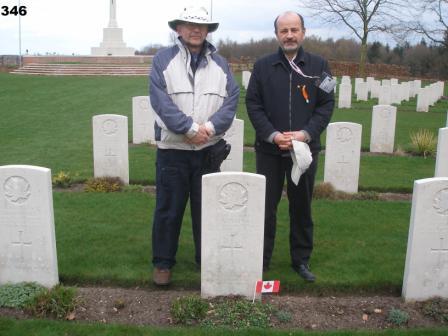
Anthony Repa, left, and Maurice Petta, right, by the grave of Anthony Petta at the Canadian War Cemetery in Groesbeek in April 2010.  (Photo courtesy of John Hetherington)

After meeting us, John did look for the photo of the two nephews, and sent it to us.  When Anthony Repa sent us the photo of his uncle, he also gave permission to include the 2010 photo taken of himself and his cousin in Groesbeek.

Anthony went on to share that he has visited the cemetery in Groesbeek “…three times. The first, I was 23, in 1968 and backpacked around England, Belgium and Holland for 2 weeks. The second trip, I was with my wife and young son in 1987. The third was on John’s tour in 2010.

On the second trip, my wife and son and I were taking a Rhine River cruise which originated in Nijmegen.  We booked into a hotel in Nijmegen and after I asked the desk clerk if there was a bus to Groesbeek, he directed us to a bus stop.  As we waited at the stop, a bus came from the direction of the cemetery and stopped. 

The female driver said something to us in Dutch. I told her we were Canadian and she then said in English that this was the last bus and that she was finished her shift. She then asked where we wanted to go.  I said the Groesbeek Cemetery as my uncle was buried there.  She told us to get on the bus, turned the bus around and drove us to the cemetery.  I offered to pay the fare but she declined.

When we arrived she told us to take as long as we wanted to, that she would wait.  After we paid our respects she drove us back to the hotel.

I have told countless people about this experience. I have many wonderful memories of my travels, one of my fondest, is the kindness she showed us on that day….

…The Memorial Plaque from St. Rita Roman Catholic Church…

St. Rita Plaques - Petta death

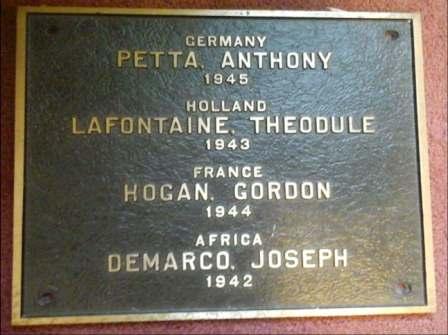
Part of the memorial plaque originally placed by St. Rita Roman Catholic Church. (Photo courtesy of Karen Steel)

We thought we had reached the end of the research for Anthony Petta when we were contacted by 92 year old Don Unger, who said he grew up in the neighbourhood around St. Rita’s Roman Catholic Church and remembered seeing a memorial in the church yard.  The memorial “….mentions Anthony Petta and other Italian boys who served…” he told Pieter.

The church was closed in 2010, but we asked Don Coutts, who lives in North Bay, if he could see if the memorial was still in the yard.  It wasn’t.

Don then went to the Pro-Cathedral of the Assumption and asked Karen Steel if she had any information.  Karen explained that “…the plaques were donated to the North Bay Museum…” but she sent us “…a copy of the plaque information that I took for historical purposes before the plaques were taken to the museum.  I always knew someday someone would be looking for this information!…

The July 23, 1946 edition of the North Bay Nugget newspaper had a picture of the war memorial when it was dedicated.  The text under the picture said “…His Excellency R. H. Dignan, assisted by Rev R. F. Venti, officiated at the unveiling of a splendid war memorial at St. Rita’s Park on Sunday.  Dedicated to the memory of four members of the parish who gave their lives in the Second World War, the memorial is also in honour of those who served during the war. 

The four corners are dedicated to Sgt Joe Demarco of the RCAF, Sgt A. Petta, Pte Gordon Hogan, and Cpl William Lafontaine, all of whom gave their lives during the recent conflict. The honour roll is also inscribed on the memorial. The dedication ceremony was an impressive one…img church memorial for petta North Bay Nugget Jul 23 1946

Thank you to Don Coutts, John Hetherington, and Anthony Repa.  Thank you also to Judie Klassen and Shawn Rainville for researching the newspaper and genealogy archives.  Thank you to Karen Steel and Don Unger for the information on the memorial from St. Rita’s Church. Thanks also go to the North Bay Nugget newspaper as it had extensive coverage of WWII soldiers from the time period and the newspaper archive is digitized.

Our North Bay adventures continue in upcoming postings.  If you know of any soldiers from the North Bay area that are buried in The Netherlands please let Pieter know. You can mail him at memorialtrail@gmail.com, or comment on the blog.

© Daria Valkenburg

….Previous stories told about soldiers who lost their lives during the Battle of Hochwald Gap ….

Two previous stories were told about soldiers who lost their lives during the Battle of Hochwald Gap.  Clarence Wilfred Wakegijig was in a tank regiment that supported the infantry.  Gerald Coolen, like Anthony Petta, was in an infantry regiment.  To read the stories about Clarence and Gerald, see:

…Missed the previous postings about our North Bay Memorial Trail visit?…

…Want to follow our research?….

If you are reading this posting, but aren’t following our research, you are welcome to do so.  Our blog address: https://onthewarmemorialtrail.com/

Front cover OnTheWarMememorialTrailinEurope4 countries, 6 weeks, 7,000 km – an unforgettable war memorial journey in Europe…. Daria’s book ‘No Soldier Buried Overseas Should Ever Be Forgotten‘ is available in print and e-book formats.  Net proceeds of book sales help support research costs and the cost of maintaining this blog. For more information see https://nosoldierforgotten.com/

You are also invited to subscribe to our YouTube Channel: On The War Memorial Trail With Pieter Valkenburg: https://www.youtube.com/channel/UCJ591TyjSheOR-Cb_Gs_5Kw.

Never miss a posting!  Subscribe below to have each new story from the war memorial trail delivered to your inbox.

On The War Memorial Trail….. The WWII Soldier Who Lost His Life In A Monastery Garden

June 5, 2022. After seeing Pieter on the news during Remembrance Week 2021, Sylvia Churchill of Nova Scotia contacted us.  “My husband’s father, Bruce W. Churchill, was killed in Hulst, The Netherlands, buried there, and later exhumed after the war was over and buried in the Adegem Canadian War Cemetery.  He was killed in a garden near a Monastery while their Regiment was cleaning their Bren guns. He died instantly, on September 29, 1944.  My husband was born January 1945 and named after his father, Bruce W. Churchill (Jr). …”  (See https://onthewarmemorialtrail.com/2021/11/15/on-the-war-memorial-trail-ctvs-atlantic-live-at-5-update-on-the-photo-search-for-soldiers-buried-in-the-netherlands/)

Bruce W Churchill Sr Sep 21 1942

Bruce Wilbur Churchill in a September 21, 1942 photo.  (Photo courtesy of Bruce (Jr) and Sylvia Churchill)

Bruce Wilbur CHURCHILL was born April 17, 1921 in Sandford, Yarmouth County, Nova Scotia, the son of Ralph Lloyd and Ethel Mae Churchill.  He had 5 brothers and 6 sisters, and worked as a farm labourer and fisherman after leaving school at the age of 16.

…Bruce was not the only family member who served in the military…

When he enlisted in Yarmouth, Nova Scotia on October 10, 1939 with the 6th Anti-Aircraft Battery,  not only were 4 of his brothers in the Army, but also his father, who was a gunner.

Bruce’s service file noted that he played volleyball and swam, and liked to read popular magazines and novels.

On November 1, 1941, Bruce was transferred to the 1st Anti-Aircraft Search Light Battery as a member of the search light crew, all the time remaining in Canada, understandable given that 5 members of his family were already serving.  He had been a cook since April 11, 1940 and held the rank of Gunner.

He married Dora Mae Goodwin on February 14, 1942, and they became the parents of a daughter, Donna Fay, born in Argyle Sound, Nova Scotia on September 3, 1942.

…Bruce was anxious to serve overseas…

In an August 4, 1943 interview with the Personnel Selection Board of the Army, it was noted that Bruce was “…anxious to see action in an active theatre of war.  For this purpose he has volunteered for the parachute battalion…

Bruce didn’t meet the requirements for the parachute battalion, but was considered suitable for the artillery.

On February 14, 1944, Bruce and Dora Mae’s son Eric Bruce was born in Argyle Sound, but sadly he passed away on May 28, 1944.  May 28 is the same day that Bruce’s desire for overseas service was about to be granted, as he was transferred to the Canadian Infantry Training Centre (CITC) in Aldershot, Nova Scotia.

He was on his way to England as of August 3, 1944, arriving on August 10, and at his request, he changed from cook to general duty as of August 21, 1944.  He became part of the Canadian Infantry Reinforcement Unit (CIRU) and sent to France on September 4, 1944.

…Bruce lost his life when a gun ricocheted…

On September 15, 1944 he was transferred to the Algonquin Regiment. On September 29, 1944, he lost his life in Hulst, The Netherlands, accidentally killed when a Bren gun ricocheted.

Soldiers Service Book with bullet hole

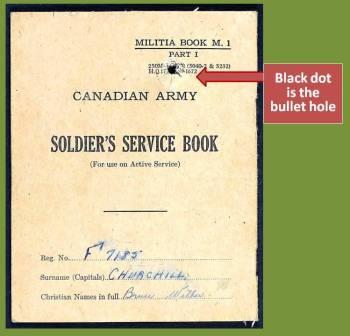
Soldier’s Service Book showing the bullet hole.  (Image courtesy of Bruce (Jr) and Sylvia Churchill)

Among the documents that Sylvia shared was “…the first page of Bruce Churchill Sr.’s Soldier’s Service Book. I want to point out the bullet hole in that book (which is on all the other pages) ….he obviously was wearing that when he died. How sad to see that….

When Bruce died, his wife Dora Mae was pregnant with their son Bruce, who was born in January 1945.

…Account of the accident by George Spittael…

cms_visual_1335496.jpg_1582646467000_600x858An account of the incident was recorded by George E. Spittael of Belgium in his book ‘Librera Me’, published in 1989 in Flemish.  By September 27, 1944, several companies were given a rest period in Hulst while others patrolled the shoreline of the Scheldt.

A translated excerpt from September 29, 1944 explained what happened to Bruce.  “Although there was no enemy activity in Hulst, there were two casualties when a Bren gun ricocheted. Pte. Poole was wounded and Pte. Bruce Wilbur Churchill, F/7185, killed. The 27-year-old Canadian from Yarmouth, Nova Scotia, was temporarily buried in Hulst General Cemetery, but after the hostilities his remains were transferred to Adegem…

According to the Graves Registration Card, however, Bruce was buried on the Monastery grounds, not in the Hulst General Cemetery.  A letter from the Protestant Chaplain to Bruce’s family noted that Bruce had been buried on the Monastery grounds.

…. A letter from the Chaplain….

In a November 19, 1944 letter from Canadian Army Chaplain, Honorary Captain A. Phillips Silcox to Bruce’s parents, he described what happened on the day Bruce lost his life:

…a small group of soldiers were sitting in a garden, cleaning weapons, or taking them apart and reassembling them, when in some way a single shot was most unexpectedly fired from a Bren Gun close to Bruce.  He was instantly killed as the bullet passed through his body.  It then continued through a hedge and lodged in another soldier’s leg – though fortunately he was not seriously wounded…..

Our location at the time was in a small town in Holland not far from the border of Belgium, but well away from the enemy and we felt fairly secure for a few days rest.  The garden was the most unlikely place to expect death – a lovely spot, across from a Roman Catholic monastery….

The Father Superior of the Monastery (where I was staying) offered a pleasant corner of their garden for the grave, so there we laid him to rest while his Company stood ground, a few of the priests and a civilian woman looking on, for the brief military service.  Afterward the soldiers who completed the grave laid a lovely spray of flowers and I know that the priests will care for it until the day that our government agents transfer all graves to certain central cemeteries….

…Sylvia and Bruce Churchill visited the grave of his father…

Sylvia explained that “…in 2019, Bruce and I were fortunate to have visited Belgium and The Netherlands for two weeks, and we were able to visit his father’s gravesite for the first time….

P1040467 Bruce Churchill at his fathers grave in Adegem

Bruce Churchill at his father’s grave in the Canadian War Cemetery in Adegem in 2019.  (Photo courtesy of Bruce (Jr) and Sylvia Churchill)

…Sylvia and Bruce Churchill also visited Hulst…

In addition to the visit to the Canadian War Cemetery in Adegem, Belgium, Sylvia explained that “…when we went to Belgium/Netherlands, in particular to the town of Hulst, we went to the Town Hall and spoke to a historian. Prior to our visit to Europe, we had mailed him everything we had as far as finding the grounds where Bruce’s father had originally been buried, and they gave us a location where an old Monastery used to be. It is a school now. …

P1040331 Tree in Hulst taken by Sylvia

The former Monastery in Hulst, The Netherlands, and the tree that jogged a memory.  (Photo courtesy of Bruce (Jr) and Sylvia Churchill)

The visit to Hulst brought back a memory of an old photo Bruce remembered seeing.  “…There was a huge tree that jogged Bruce’s memory of his Mother showing him a picture of his dad sitting on a tree (which was small then but low lying).  That particular photo is lost. I’ve attached a picture I took of that tree when we were in Hulst….

P1040431 Hulst taken by Sylvia

A view of Hulst. (Photo courtesy of Bruce (Jr) and Sylvia Churchill)

Sylvia noted that “…Bruce felt a connection with Hulst, perhaps because he knew that is where his Father died. It was so peaceful and beautiful. …

Thank you to Sylvia and Bruce Churchill for sharing photos and information on Bruce’s father, and their own memorial journey. Do you have more information to share? Email Pieter at memorialtrail@gmail.com, or comment on the blog.

© Daria Valkenburg

…Want to follow our research?….

If you are reading this posting, but aren’t following our research, you are welcome to do so.  Our blog address: https://onthewarmemorialtrail.com/

Front cover OnTheWarMememorialTrailinEurope4 countries, 6 weeks, 7,000 km – an unforgettable war memorial journey in Europe…. Daria’s book ‘No Soldier Buried Overseas Should Ever Be Forgotten‘ is available in print and e-book formats.  Net proceeds of book sales help support research costs and the cost of maintaining this blog. For more information see https://nosoldierforgotten.com/

Subscribe to our YouTube Channel: On The War Memorial Trail With Pieter Valkenburg: https://www.youtube.com/channel/UCJ591TyjSheOR-Cb_Gs_5Kw

Never miss a posting!  Subscribe below to have each new story from the war memorial trail delivered to your inbox.

On The War Memorial Trail….. 7 Indigenous Soldiers Buried in Adegem Canadian War Cemetery

August 18, 2021. After reading the posting about WWII Soldier Clarence Wilfred Wakegijig, Pieter was contacted by Willy van Ee of Sas-van-Gent, The Netherlands, who explained that he is the son of Indigenous soldier Walter MEKAJI of the Sagamok Anishnawbek First Nation and Hendrike Herber of The Netherlands.  “My father also came from Wikwemikong and met my mother in Utrecht during the liberation of The Netherlands…

Willy’s compelling story has been extensively told.  See:

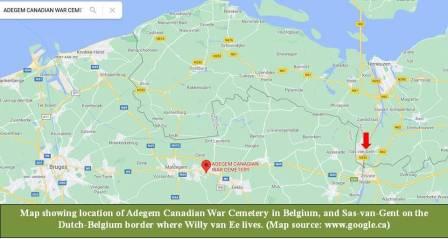
In a translation of Willy’s email exchange with Pieter, he wrote “…I live 20 km from the Adegem Canadian War Cemetery in Belgium.  Every year, on the second weekend of September, there is a ceremony with many VIPs, and a lot of people.  This year it’s on September 12. I’ve been going there for about 40 years, because of a veteran from Vancouver Island, Art BRIDGE, who has visited us a number of times.  His friend L MORGAN is buried there....”   Most likely, Willy is referring to Lionel Albert MORGAN, son of Reuben and Pearl Morgan, of Toronto, Ontario, who died on September 8, 1944 while serving with the Argyll and Sutherland Highlanders of Canada (Princess Louise’s).

Map showing Adegem Canadian War Cemetery

Willy wanted to let Pieter know that he believed that 7 Indigenous soldiers are buried in Adegem Canadian War Cemetery.  He visited the cemetery and sent the names:

No photo available

  • Maurice BELLEGARDE, son of Moise and Margaret Bellegarde, of Abernethy, Saskatchewan. Died November 3, 1944 while serving with the Regina Rifle Regiment.
Jacob Shelby Brant

Jacob Shelby Brant. (Photo source: Canadian Virtual War Memorial)

  • Jacob Shelby BRANT, born February 12, 1925 in Hagersville, Ontario, son of Austin and Bessie Brant.  Died September 11, 1944 while serving with the Lincoln and Welland Regiment, aged 19.
Harvey Dreaver

Harvey Dreaver. (Photo source: Canadian Virtual War Memorial)

  • Harvey DREAVER, born November 29, 1914 in Leask, Saskatchewan, son of Joseph and Evelyn Dreaver of Saskatoon, Saskatchewan. Husband of Mary Dreaver of Saskatoon, Saskatchewan. Died October 6, 1944 while serving with the Regina Rifle Regiment, aged 29.

No photo available

  • Joseph HENRY, son of Thomas and Philomene Henry. Husband of Alice Henry, of Roseau River Reserve, Manitoba.  Died October 2, 1944 while serving with the Algonquin Regiment, aged 22.
Roland David Riel

Roland David Riel. (Photo source: Canadian Virtual War Memorial)

  • Roland David RIEL, born December 8, 1925 in St Vital (now Winnipeg), Manitoba, son of Henry and Yvonne Mary Eugenie Riel.   Died October 15, 1944 while serving with the Regina Rifle Regiment, aged 18.
Kenneth Scribe

Kenneth Scribe. (Photo source: Canadian Virtual War Memorial)

  • Kenneth SCRIBE, son of John and Jessie Scribe, of Norway House, Manitoba. Died October 11, 1944 while serving with the Highland Light Infantry of Canada, aged 23.

No photo available

  • Charles William Myers ST GERMAINE, son of John and Lillian St. Germaine, of Rama, Ontario. Died September 16, 1944 while serving with the South Saskatchewan Regiment, aged 23.

Thank you to Willy van Ee for sharing his story and letting us know about the soldiers buried in Adegem Canadian War Cemetery.  If you have photo or information to share about any of the men mentioned in this posting, or other Canadian soldiers, please contact Pieter at memorialtrail@gmail.com, comment on the blog, or send a tweet to @researchmemori1.

© Daria Valkenburg

 ….Want to follow our research?….

If you are reading this posting, but aren’t following the blog, you are welcome to do so.  Our blog address: https://onthewarmemorialtrail.com/

Front cover OnTheWarMememorialTrailinEurope4 countries, 6 weeks, 7,000 km – an unforgettable war memorial journey in Europe…. Daria’s book ‘No Soldier Buried Overseas Should Ever Be Forgotten‘ is available in print and e-book formats.  Net proceeds of book sales help support research costs and the cost of maintaining this blog. For more information see https://nosoldierforgotten.com/

Screenshot_2021-02-27 On The War Memorial Trail With Pieter Valkenburg

You are also invited to subscribe to our YouTube Channel: On The War Memorial Trail With Pieter Valkenburg: https://www.youtube.com/channel/UCJ591TyjSheOR-Cb_Gs_5Kw.

Never miss a posting!  Subscribe below to have each new story from the war memorial trail delivered to your inbox.

On The War Memorial Trail…..A Face For WWII Soldier James Walter Auld

July 7, 2020.  Last year, a request was made for photos and information on PEI soldiers from WWII who were buried in The Netherlands.  (See Photos and Info Requested For WW2 Soldiers From PEI Buried In The Netherlands)

It’s been a slow and difficult quest, but in the past few months two photos have been found, one for Joseph Edmund HENNEBERY (See On The War Memorial Trail…..A Face For Joseph Hennebery!) and now one for James ‘Walter’ AULD.

The story of how Walter’s photo was found has several twists and turns.  Pieter had zero luck in finding anyone related to this WWII soldier, who is buried in the Canadian War Cemetery in Bergen Op Zoom in The Netherlands, until we met Helen MacEwen, who had invited us to see a WWI era map her father-in-law had sent to the Island in 1918.  (See The WW1 Era ‘Course Of The Rhine’ Map of Germany)

We brought along a ‘wish list’ of photos and after looking at the list, Helen suggested that Pieter contact Allison Ellis, as his wife Melba came from the same area as Walter.  “…Allison is a retired politician…” Helen explained, “...and knows a lot of people…”  (See http://www.peildo.ca/fedora/repository/leg:27520)

It was a long shot. Lots of people over the years have suggested names, which turned out to be a fruitless exercise, but this time Pieter found a kindred spirit.  Allison remembered a Walter Auld and it was soon determined that this was the same person.  “…. I’ve been to his grave in The Netherlands….” Pieter was told. Allison didn’t have a photo, but thought he knew who to ask.  “…Leave it with me…” he said. A week later, we were sitting in the home of Allison and Melba, and Pieter had a photo that Walter’s niece, Judy Bartlett, had provided.

CIMG4156 Jun 23 2020 Pieter with Melba & Allison Ellis

Left to right: Melba Ellis, Pieter, Allison Ellis.  (Photo credit: Daria Valkenburg)

James Walter Auld

Walter Auld. (Photo courtesy of Judy Bartlett Family Collection)

James ‘Walter’ AULD was born October 21, 1923 in Glenwood, the son of James and Margaret Auld of O’Leary Station, and was a garage mechanic with Corney Brothers in Summerside.  After enlisting in Charlottetown on February 20, 1942, he was sent for basic training as a rifleman.

A note in his service file indicates he was unhappy with this placement and noted he had been promised a position as a driver or mechanic when he enlisted.  His mechanical knowledge was assessed as ‘superior’ and the recommendation was made that he be transferred to a position where his skills could be used.

In May 1942 he was transferred to the Princess Louise Fusiliers (Motor Division), and by October 1942 he was on his way to England. In August 1943 he was transferred to the Algonquin Regiment.  In July 1944 he was with his unit, first in France and then as they moved into The Netherlands.

According to the War Diary for the Algonquin Regiment, on November 1, 1944 they were under the command of the 10th Canadian Infantry Brigade, 4th Canadian Armoured Division, and in action to try and take the town of Welberg, The Netherlands.   This was part of Operation Suitcase, which began on October 20, 1944, and as part of the bigger Battle of the Scheldt operation.  (See https://canadianbattlefieldtours.ca/operation-suitcase/)

self propelled tank p49

The war diary entry for November 1, 1944 recorded that “… Zero hour was at 19:00 hours…. We had 17 SP (self-propelled) tanks in support to deal with the enemy SP tanks…. Shortly after the kick-off, ‘A’ Company reported that one SP had bogged down and was holding the Company up  and before they got going again ‘D’ Company reported they were 300 yards from Welberg.  At 20:45 hours ‘A’ Company reported that one of the SPs had been hit and was burning.  At 21:00 hours ‘A’ Company reported another SP burning and that the situation was very confused due to heavy shelling of their positions by enemy SPs….

At some point in this battle on November 1, 1944, Walter lost his life, aged 21. On November 6, 1944, he was buried in a cemetery in Steenbergen, not far from where he died.

Map where Auld died with arrow

Map with a black arrow showing the approximate location where Auld lost his life near Welberg. The unit had come from the area of Moerstaten. He was initially buried in Steenbergen, then later in Bergen Op Zoom. (Map courtesy of Michelin)

In October 1946 Walter was reburied in the Canadian War Cemetery in Bergen Op Zoom.  We were there in October 2019 and Pieter placed Canadian and PEI flags by his grave.  (See On The War Memorial Trail…..Our 2019 Visit To The Canadian War Cemetery In Bergen Op Zoom for an account of our visit.)

CIMG3388 Oct 7 2019 Bergen Op Zoom James Auld

Pieter by the grave of Walter Auld at the Canadian War Cemetery in Bergen Op Zoom.  (Photo credit: Daria Valkenburg)

Thanks to the combined efforts of Allison and Melba Ellis, Judy Bartlett, and Helen MacEwen, a photo of James ‘Walter’ Auld is on its way to the researchers at the Canadian War Cemetery in Bergen Op Zoom. If you have information to share about Canadian soldiers buried in The Netherlands, please contact Pieter at memorialtrail@gmail.com or comment on the blog.

© Daria Valkenburg

….Want to follow our research?….

If you are reading this posting, but aren’t following our research, you are welcome to do so.  Our blog address: https://onthewarmemorialtrail.com/

4 countries, 6 weeks, 7,000 km – an unforgettable war memorial journey in Europe…. Daria’s book ‘No Soldier Buried Overseas Should Ever Be Forgotten‘ is available in print and e-book formats.  Net proceeds of book sales help support research costs and the cost of maintaining this blog. For more information see https://nosoldierforgotten.com/

You are also invited to subscribe to our YouTube Channel: On The War Memorial Trail With Pieter Valkenburg: https://www.youtube.com/channel/UCJ591TyjSheOR-Cb_Gs_5Kw

Never miss a posting!  Subscribe below to have each new story from the war memorial trail delivered to your inbox.

On The War Memorial Trail…..Our 2019 Visit To The Canadian War Cemetery In Bergen Op Zoom

December 7, 2019.  While in The Netherlands this fall, we visited the three Canadian War Cemeteries and laid down flags of Canada and PEI for the names listed on the Cenotaph outside the Borden-Carleton Legion, as well as other Islanders who have been identified by Dutch researchers. The third Canadian War Cemetery we visited on our 2019 trip was in Bergen Op Zoom, near the Belgian border.  As no one listed on the Cenotaph is buried in this cemetery, we had not visited it before.

….Oops!  Wrong cemetery!….

On this trip, however, we decided to lay flags down at the graves of 6 soldiers from Prince Edward Island and 1 from Nova Scotia.  Our first surprise was that there are two war cemeteries, side by side, and of course we went to the wrong one, which turned out to be a British War Cemetery.  Luckily, a teacher visiting with a group of high school students noticed the bag we carried the flags in, and asked if we thought we were in the Canadian War Cemetery.  If so, it was further down the road.  Thank goodness the Dutch are not shy!

….We finally arrive at the Canadian War Cemetery!….

CIMG3382 Oct 7 2019 Bergen Op Zoom Pieter at Cdn War Cemetery

Pieter at the entrance to the Canadian War Cemetery in Bergen Op Zoom.  Our Sobey’s bag saved us from wandering around the wrong cemetery!  (Photo credit: Daria Valkenburg)

We weren’t alone in the cemetery as there were more teachers, supervising schoolchildren carrying roses.  With our Sobey’s bag filled with flags, we were easily picked out as visitors!  A teacher told us that 2,600 schoolchildren would be visiting the Canadian and British War Cemeteries, each carrying a rose to place at a designated grave, until October 28, the day of liberation for this part of The Netherlands.

….Canadian flags placed at 7 graves….

One of the most recent photos Pieter received of PEI soldiers buried in The Netherlands was that of Lawrence Adolphus SWEENEY, provided by his nephew David Perry.  Placing flags by a grave when you have a photo of the person makes this small event more meaningful.

Lawrence Sweeney from David Perry

Lawrence Sweeney.  (Photo courtesy of David Perry)

CIMG3392 Oct 7 2019 Bergen Op Zoom Lawrence Sweeney

Pieter by the grave of Lawrence Sweeney, buried in the Canadian War Cemetery in Bergen Op Zoom. (Photo credit: Daria Valkenburg)

In alphabetical order, here are the known soldiers from PEI that are buried in the cemetery:

  • Pte James Walter AULD, Algonquin Regiment, from O’Leary Station
  • Tpr Alvah Ray LEARD, Sherbrooke Fusiliers Regiment – 27th Armoured Regiment, from Northam
  • Pte Milton Evangeline LIVINGSTONE, Lincoln and Welland Regiment, from Murray River
  • Bdr Hugh Allister MACDONALD, Royal Canadian Artillery – 02 Anti-Tank Regiment, from Georgetown
  • L/Cpl Roy SMITH, Black Watch (Royal Highland Regiment) of Canada, from O’Leary
  • Pte Lawrence Adolphus SWEENEY, Lincoln and Welland Regiment, from Souris

Canadian and Nova Scotia flags were placed at the grave of one soldier from Nova Scotia, who had mistakenly been recorded as being from PEI by the Cemetery:

  • Pte Elmer D. SCHOFIELD, Lincoln and Welland Regiment, from North Alton

Unfortunately, no photo has been found for one PEI soldier:

  • James Walter AULD, born in Glenwood, son of James and Margaret Auld of O’Leary Station. He died on November 1, 1944, aged 21.

….A visit with Caroline Raaijmakers….

The weather in Bergen Op Zoom was cloudy, but it was dry.  We had just missed a rainfall, as we found out while walking through the cemetery.  The ground was saturated and my shoes were soaking wet by the time we finished, giving me an excuse to go to the car and change my shoes and warm up.  In the meantime, Caroline Raaijmakers of the Faces To Graves Bergen Op Zoom Project dropped by to invite us over for coffee and a stroopwafel (a delicious Dutch treat).

CIMG3411 Oct 7 2019 Bergen Op Zoom Pieter & Caroline Raaijmakers

Pieter with Caroline Raaijmakers at the Canadian War Cemetery in Bergen Op Zoom.  (Photo credit: Daria Valkenburg)

Caroline explained that most of the burials in the British and Canadian War Cemeteries in Bergen Op Zoom are due to casualties from the Battle of the Scheldt (For more information, see https://www.veterans.gc.ca/eng/remembrance/history/second-world-war/scheldt#scheldt03).  We learned that information on this battle, in which 6,300 Canadian lives were lost, is in the Liberation Museum Zeeland in nearby Nieuwdorp, which will be on our list of places to visit next trip.  (See https://liberationroute.com/the-netherlands/spots/l/liberation-museum-zeeland-(spot221))

CIMG3413 Oct 7 2019 Bergen Op Zoom holding up poster at Carolines house

Holding up a poster for the 75th Anniversary of the Liberation of the province of Brabant on October 28, 2019.  (Photo credit: Caroline Raajmakers)

Pieter gave Caroline a large Canadian flag, which was provided by Senator Mike Duffy for this war memorial trip.  Flags had also been provided for Pieter to give to the cemeteries in Harlingen, Holten, and Groesbeek, which he did.

Thank you to Senator Mike Duffy for the large Canadian flag, to the office of Malpeque MP Wayne Easter for the small Canadian flags placed by the graves, and to John Wales of the North Nova Scotia Highlanders Regimental Museum in Amherst for the Nova Scotia flag. If anyone has more information to share on any of the soldiers listed above, or know of more Islanders buried in the cemetery in Bergen Op Zoom, please contact Pieter at memorialtrail@gmail.com, comment on the blog, or send a tweet to @researchmemori1.  

© Daria Valkenburg

….Want to follow our research?….

If you are reading this posting, but aren’t following our research, you are welcome to do so.  Our blog address: https://onthewarmemorialtrail.com/

Front cover OnTheWarMememorialTrailinEurope4 countries, 6 weeks, 7,000 km – an unforgettable war memorial journey in Europe…. Daria’s book ‘No Soldier Buried Overseas Should Ever Be Forgotten‘ is available in print and e-book formats.  Net proceeds of book sales help support research costs and the cost of maintaining this blog. For more information see https://nosoldierforgotten.com/ 

You are also invited to subscribe to our YouTube Channel: On The War Memorial Trail With Pieter Valkenburg: https://www.youtube.com/channel/UCJ591TyjSheOR-Cb_Gs_5Kw

Never miss a posting!  Subscribe below to have each new story from the war memorial trail delivered to your inbox.