On The War Memorial Trail…. Battlefields Tour With Joël Stoppels Part 3: Visit To Stefanuskerk in Holwierde

A life’s ambition realized! Daria in the driver’s seat of a jeep! Spoiler alert – our battlefield tour was in an SUV, not the jeep! (Photo credit: Joël Stoppels)

October 10, 2025.  While in Europe this spring for the 80th Anniversary of Liberation Commemoration events, we visited 14 cemeteries to place flags at the graves of 383 soldiers that Pieter has researched since 2014, with the stories of many of these soldiers previously told on this blog. 

On the wish list for our 2025 European War Memorial Tour was to tour some of the battlefields in which these soldiers lost their lives in order to have a better appreciation of what they had faced. 

Battlefields guide Joël Stoppels, of Groningen, The Netherlands, offered to spend a day showing us locations where the various battles that comprised the Battle of the Delfzijl Pocket took place.  Over the years, we’ve featured stories of many soldiers who lost their lives in the last weeks of the North-West Europe campaign during WWII, and we eagerly anticipated learning more. (See https://www.canadiansoldiers.com/history/battlehonours/northwesteurope/delfzijlpocket.htm)
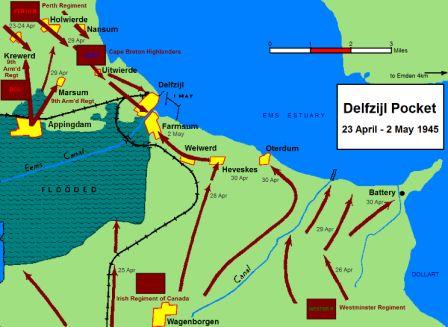
Map showing the locations during the Battle of the Delfzijl Pocket. (Map source: http://www.canadiansoldiers.com)

In Part 1, our battlefield tour began at a field where 19 Canadians lost their lives during the Battle for Wagenborgen, the preliminary battle before the Battle of the Delfzijl Pocket. (See https://onthewarmemorialtrail.com/2025/10/01/on-the-war-memorial-trail-battlefields-tour-with-joel-stoppels-part-1-battle-for-wagenborgen/)

In Part 2, we travelled to Appingedam, the town where the Battle of the Delfzijl Pocket began. (See https://onthewarmemorialtrail.com/2025/10/05/on-the-war-memorial-trail-battlefields-tour-with-joel-stoppels-part-2-the-battle-of-the-delfzijl-pocket-began-in-appingedam/)

Now, in Part 3, we left Appingedam and travelled to Holwierde, where our first stop was at the Canada Memorial.

…. The Canada Memorial in Holwierde…

Pieter and Joël at the Canada Memorial in Holwierde. (Photo credit: Daria Valkenburg)

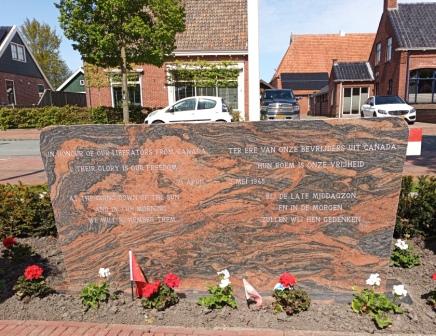
Front view of the Canada Memorial in Holwierde.  (Photo credit: Daria Valkenburg)

We knew that there was a plaque at the church in Holwierde that commemorated the Canadians who lost their lives during the Battle of Delfzijl Pocket, but had no idea there was also a monument in the town itself…. with houses on either side of the main road where it’s located.

Called the Canada Memorial, with red and white flowering plants around it, the stone plaque simply states ‘In honour of our liberators from Canada. Their glory is our freedom. 21 April – 2 May 1945

Closeup of stone plaque at the Canada Memorial in Holwierde.  (Photo credit: Pieter Valkenburg)

…. Canadian soldiers called Holwierde ‘a killing ground’…

Battlefields Tour poster describing Howierde as a ‘Killing ground’.

As we walked through this quiet and picturesque town towards the Stefanuskerk, we asked Joël about his poster describing Holwierde as a ‘Killing ground’.  He explained that ….Holwierde was one of the most heavily contested villages during the Battle of the Delfzijl Pocket in April 1945. The Perth Regiment fought intense house-to-house combat here, as German paratroopers and naval infantry had fortified nearly every building.  Many Canadian soldiers referred to the village as ‘a killing ground’ due to the high casualties on both sides…..

Holwierde in April 1945, with a temporary bailey bridge, leading towards the Stefanuskerk. (Photo Courtesy of Joël Stoppels / Battlefield Tours)

Holwierde in April 1945.  A temporary bailey bridge allowed residents and troops to cross the canal.  The Stefanuskerk is on the right. (Photo Courtesy of Joël Stoppels / Battlefield Tours)

…The Stefanuskerk, although spared from destruction, stood right in the middle of the battlefield and witnessed days of shelling and close-quarters fighting….  

Holwierde in 2025, 80 years after its liberation.  The bailey bridge from 1945 is now a permanent bridge over the canal! (Photo credit: Daria Valkenburg)

 …. We found a banner for one soldier whose story was previously told…

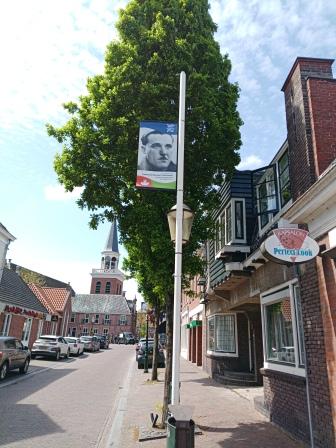
Banner for Joseph ‘Gerald’ Fougere in Holwierde. (Photo credit: Pieter Valkenburg)

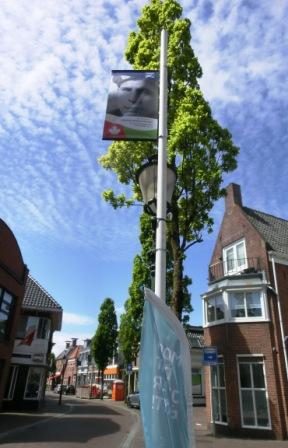
As we walked down the street towards the Stefanuskerk, the main reason for our visit to Holwierde, we saw a banner for Joseph ‘Gerald’ FOUGERE, who was serving with the Perth Regiment. He was wounded on April 24, 1945, during the Battle of the Delfzijl Pocket, and died on April 26, 1945, one month before his 29th birthday. (See https://onthewarmemorialtrail.com/2021/01/27/on-the-war-memorial-trail-atlantic-canada-remembers-part-5/)

Joseph ‘Gerald’ Fougere’s banner was by the canal in Holwierde, but this wasn’t where he died.  (Photo credit: Daria Valkenburg)

The banner was by the canal, and while I was busy snapping photos, thinking this is where he died, Joël said “…no, he actually died in nearby Nansum.  Since Nansum is such a small village, his banner was placed in Holwierde for greater visibility...” He then kindly pointed out that “…the bridge over the canal had been blown up by the Germans on April 25, 1945.

Never mind…Nansum was quickly added as our next stop after Holwierde!

…. A solemn few moments at Stefanuskerk…

Entrance to Stefanuskerk in Holwierde. (Photo credit: Pieter Valkenburg)

We continued walking down the road until we got to the Stefanuskerk.  A plaque near the door noted that the church dates to the 11th century!  In the 13th century the church was enlarged.  It was severely damaged in April 1945, but restored by 1950, to give the appearance as to how the church would have looked before 1830.
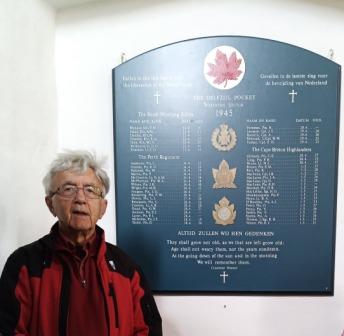
Pieter by the plaque in Stefanuskerk that commemorates Canadian soldiers who died during the Battle of the Delfzijl Pocket.  (Photo credit:  Joël Stoppels)

We wanted to visit the church in order to see the plaque that commemorates many of the Canadian soldiers who died during the Battle of the Delfzijl Pocket.  It was a very solemn few moments for us, as we looked over the names, many of them of soldiers that Pieter had researched over the past years.

From the Royal Winnipeg Rifles:

From the Perth Regiment:

From the Cape Breton Highlanders:

Not mentioned on the plaque:

From the 9th Armoured Regiment (BC Dragoons), who is commemorated on a plaque in Appingedam:

…. We couldn’t miss seeing Nansum…

We left Stefanuskerk in a reflective mood after looking at the names on the plaque, and quietly got back in the car for the short drive to Nansum, which is indeed a tiny place, near the coast.   Joël didn’t know exactly where Joseph ‘Gerald’ FOUGERE was killed, unfortunately.  What remained of a German bunker was still visible, so he likely died of shrapnel wounds. 
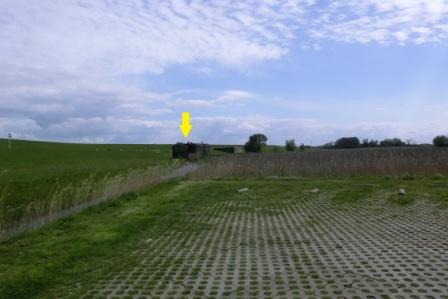
Yellow arrow indicates the remains of a German bunker in Nansum.  (Photo credit: Daria Valkenburg)

Joël noted that 177 Kriegsmarine were captured here. The Kriegsmarine was Nazi Germany’s Navy from 1939-1945.  By 1945, as the war progressed, the Kriegsmarine formed infantry units from its personnel, who were re-trained as infantry to fight on land, all in an attempt to alleviate the strain on the German Army.
From Nansum we continued on the last leg of our battlefields tour, as we followed the route taken by the Cape Breton Highlanders to Delfzijl. Coming up in Battlefields Tour With Joël Stoppels Part 4: From Nansum To Delfzijl And Wirdum.

Thank you to Joël Stoppels, guide and founder of Battlefield Tours, for a wonderful and informative tour. (See www.battlefieldtours.nu)  If you have a story or photo to share, please contact Pieter at memorialtrail@gmail.com or comment on the blog. 

© Daria Valkenburg

….Want to follow our research?…

If you are reading this posting, but aren’t following our research, you are welcome to do so.  Our blog address: https://onthewarmemorialtrail.com/
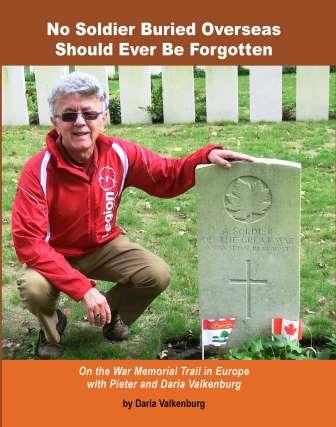
4 countries, 6 weeks, 7,000 km – an unforgettable war memorial journey in Europe…. Daria’s book ‘No Soldier Buried Overseas Should Ever Be Forgotten‘ is available in print and e-book formats.  Net proceeds of book sales help support research costs and the cost of maintaining this blog. For more information see https://nosoldierforgotten.com/

Subscribe to our YouTube Channel: On The War Memorial Trail With Pieter Valkenburg: https://www.youtube.com/channel/UCJ591TyjSheOR-Cb_Gs_5Kw

Never miss a posting!  Subscribe below to have each new story from the war memorial trail delivered to your inbox.
On The War Memorial Trail…. Battlefields Tour With Joël Stoppels Part 2: The Battle of the Delfzijl Pocket Began In Appingedam

A life’s ambition realized! Daria in the driver’s seat of a jeep! Spoiler alert – our battlefield tour was in an SUV, not the jeep! (Photo credit: Joël Stoppels)

October 5, 2025.  While in Europe this spring for the 80th Anniversary of Liberation Commemoration events, we visited 14 cemeteries to place flags at the graves of 383 soldiers that Pieter has researched since 2014.  The stories of many soldiers have been told on this blog. 

On our wish list for this trip was to tour some of the battlefields in which these soldiers lost their lives in order to have a better appreciation of what they had faced. 

Battlefields guide Joël Stoppels, of Groningen, The Netherlands, offered to spend a day showing us locations where the various battles that comprised the Battle of the Delfzijl Pocket took place.  Over the years, we’ve featured stories of many soldiers who lost their lives in the last weeks of the North-West Europe campaign during WWII, and we eagerly anticipated learning more. (See https://www.canadiansoldiers.com/history/battlehonours/northwesteurope/delfzijlpocket.htm)

Map showing the locations during the Battle of the Delfzijl Pocket. (Map source: http://www.canadiansoldiers.com)

In Part 1, our battlefield tour began at a field where 19 Canadians lost their lives during the Battle for Wagenborgen, the preliminary battle before the Battle of the Delfzijl Pocket. (See https://onthewarmemorialtrail.com/2025/10/01/on-the-war-memorial-trail-battlefields-tour-with-joel-stoppels-part-1-battle-for-wagenborgen/)

Now, in Part 2, we travelled to Appingedam, the town where the Battle of the Delfzijl Pocket began…. 

From Wagenborgen, we made our way towards Appingedam, the location of the beginning of the Battle of the Delfzijl PocketWilliam ‘Willie’ DANIELS, Donald Charles MACKENZIE, whose stories were previously told on this blog, along with William James ‘Jimmy’ Sutherland HOLE, who Pieter also researched, lost their lives here.

…. We found banners for two soldiers whose stories were previously told…

We found the banners for Daniels and MacKenzie, but no banner was made for Hole as up to now no photo has been found of him. 

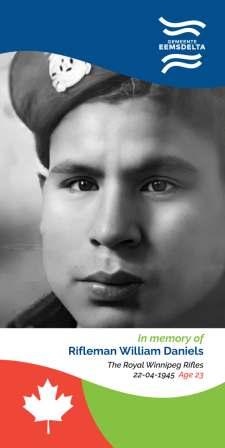
Banner for William ‘Willie’ Daniels in Appingedam. (Photo credit: Daria Valkenburg)

The banner for William ‘Willie’ Daniels was quite high up and it was hard for me to get a good angle, but thankfully Joël was kind enough to send us a better photo of the banner. 

Banner for William ‘Willie’ Daniels. (Photo courtesy of Joël Stoppels/ Battlefield Tours)

William ‘Willie’ DANIELS, from the Big River Reserve in Depton, Saskatchewan, was serving with the Royal Winnipeg Rifles when he was killed, aged 20, on April 22, 1945 as troops moved through Appingedam in The Netherlands at the very beginning of the Battle of the Delfzijl Pocket. You can read his story at https://onthewarmemorialtrail.com/2021/07/23/on-the-war-memorial-trail-remembering-ww2-soldier-william-willie-daniels/

Banner for Donald Charles MacKenzie in Appingedam. (Photo credit: Pieter Valkenburg)

Donald Charles MACKENZIE of Springhill, Nova Scotia, was serving with the Royal Winnipeg Rifles when he was killed, aged 30, on Sunday, April 22, 1945. He had been wounded during heavy fighting at the railway bridge near Appingedam, and placed in a house temporarily to rest. However, he was fatally hit by shrapnel by German shelling of the house.  You can read his story at https://onthewarmemorialtrail.com/2022/01/23/on-the-war-memorial-trail-the-ww2-soldier-from-springhill-who-received-a-memorial-cross/

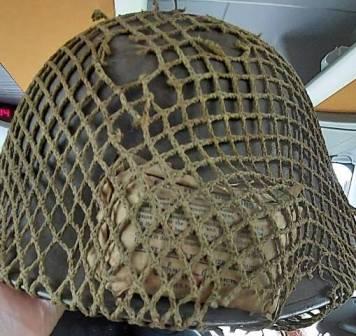
Helmet that had belonged to Donald Charles MacKenzie. (Photo Courtesy of Joël Stoppels / Battlefield Tours)

Joël told us that he has Donald Charles MacKenzie’s helmet in his private collection, and was kind enough to share a photo…a link of the past with the present! 

…. The Royal Winnipeg Rifles were in Appingedam as of April 21, 1945…

Map helped explain what happened in Appingedam in 1945.  (Photo credit: Daria Valkenburg)

In setting the scene on what unfolded in Appingedam back in 1945, Joël referred to a map that he had brought along for the battlefields tour.  “….Two roads led into Appingedam in 1945, both heavily mined by the defending Kriegsmarine…” he explained. The Kriegsmarine was Nazi Germany’s Navy from 1939-1945.  By 1945, as the war progressed, the Kriegsmarine formed infantry units from its personnel, who were re-trained as infantry to fight on land, all in an attempt to alleviate the strain on the German Army.

…The Canadians were aware of the mines…” Joël noted, and on “…April 21, 1945, the Royal Winnipeg Rifles attacked.  Heavy fighting ensued but the town was partially liberated on April 23, 1945….” allowing “….the Royal Winnipeg Rifles to move back into Wirdum….

The Regimental history, ‘Little Black Devils: a history of the Royal Winnipeg Rifles’, by Bruce Tascona and Eric Wells, describes what happened at Appingedam. “…..Beginning on April 21….the Rifles attacked with the 7th Reconnaissance Regiment, and several of the armoured cars were knocked out by anti-tank guns.  The Germans then blew up the bridge which the Rifles intended to cross…

In trying to find another plan of attack, patrols had discovered a small bridge.  …The bridge, deemed too feeble to carry motor transport, was still intact and patrols affirmed that it would carry the weight of jeeps.  With that information, the Rifles shifted position on a new start line during the night…

The plan in place, “…in the early hours of April 22, A Company….went over the bridge, followed closely by C Company.  They were met by heavy machine gun fire but the worst problem they faced were the minefields….

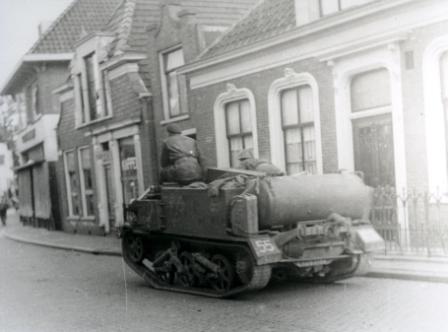
A WASP carrier with 2 soldiers from the Royal Winnipeg Rifles on a street in Appingedam in April 1945.  (Photo Courtesy of Joël Stoppels / Battlefield Tours)

In spite of the challenges, during the day “… the Battalion consolidated its position in front of the town…”  Then, a surprise attack during the night meant that…by dawn the Rifles were inside Appingedam and by mid-morning of April 23, they were mopping up. On April 24, the Rifles were replaced by the Perth Regiment….

The 9th Armoured Regiment (British Columbia Dragoons) were assigned to support the Perth Regiment.  The war diary for the BC Dragoons for April 22, 1945 explained the orders. …Lt Col Angle liaised with Commander Perth Regiment as BCD will form one portion of the 5 CAB Battle Group…” (CAB referred to Canadian Armoured Brigade)

The Situation Report for ‘A’ Squadron of the BC Dragoons noted that “…troops moved forward and positions taken over from Winnipeg Rifles before last light.  Approach to town heavily shelled by enemy heavy calibre guns…

…. Appingedam was evacuated on the night of April 23, 1945…

Per the war diary for the BC Dragoons for April 23, 1945, it was overcast and orders had been received at 2 am from HQ CAB that the Regiment was to relieve the Royal Winnipeg Rifles at 12:30 pm, and that troops from ‘A’ and ‘B’ squadrons were to be temporarily reorganized into one infantry squadron.  The tanks were parked in an area away from the town, with ….one crew member per tank to remain in the tanks and perform necessary maintenance and act as guards….”….all in preparation for the upcoming battle.

Appingedam had a population of 7,000, who were about to be in the midst of a heavy fight.  Joël told us that after “…a Dutch resistance fighter named Leugs went to Battalion HQ and offered to help, he was tasked with evacuating the town.  With the aid of Canadian trucks, this was done on the night of April 23, 1945…

On April 24, 1945, the Situation Report for ‘A’ Squadron of the BC Dragoons recorded that …the troop of tanks under Lt Gamlin, ‘C’ Squadron, took up positions at first light, spasmodic shelling throughout the day.  Underground contacted and reliable information was received concerning enemy positions….Enemy continued heavy shelling…. 

The Germans surrendered on May 2, 1945, and residents were able to return home and assess the damage to their properties.

…. Plaques to commemorate the RWR and BC Dragoons are in Appingedam…

Daria and Joël in Appingedam’s town square. The commemorative plaques are on a wall in the passageway to the right. (Photo credit: Pieter Valkenburg)

We learned about all that happened in Appingedam while standing in the town square, and next went to see two plaques placed nearby – one for the Royal Winnipeg Rifles, and the other for the British Columbia Dragoons.  We could still see shrapnel in the bricks of the buildings!

Commemorative plaque for the Royal Winnipeg Rifles.  (Photo credit: Daria Valkenburg)

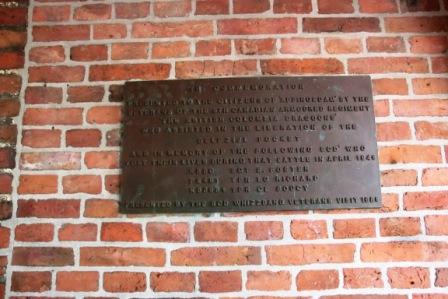
Commemorative plaque for the BC Dragoons.  (Photo credit: Daria Valkenburg)

Three soldiers from the BC Dragoons are remembered on the plaque:

  • Sgt Stanley FOSTER, aged 24, died April 30, 1945
  • Trooper Louis Graham RICHARD, aged 27, died April 26, 1945
  • Trooper Charles Ernest SOUCY, aged 30, died April 30, 1945

Sgt Foster is buried in the Canadian War Cemetery in Groesbeek.  Troopers Richard and Soucy are buried in the Canadian War Cemetery in Holten.  You can read Richard’s story at https://onthewarmemorialtrail.com/2021/02/22/on-the-war-memorial-trail-atlantic-canada-remembers-part-7/

…. ‘The best stroopwafel I ever ate!’…

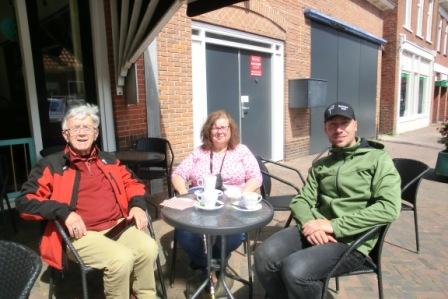
Pieter, Daria, and Joél having a much needed break in Appingedam.  (Photo courtesy of Valkenburg Family)

After digesting all the history from Wagenborgen and Appingedam, we desperately needed a break, so were very receptive to Joël’s suggestion that we go for coffee at ‘Stroopwoafeltje, Koffie & Meer’, a café in the town square.

Joël recommended the homemade stroopwafels made by the lady running the café, and both he and Pieter ordered one.  After Pieter told me “…this is the best stroopwafel I ever ate!!!!..” I tried a piece of his, and he was right.  It was much nicer than the syrupy, overly chewy ones you get commercially! 

In case you’ve never tried this treat, a stroopwafel is a traditional Dutch cookie made from two thin waffle layers sandwiched around a warm caramel filling.  I’m only sorry that I didn’t think to take a photo of Pieter’s stroopwafel before he ate it all up!

Our stay in Appingedam ended once we finished our coffee break.  It was time to move on and continue our battlefields tour as part of our 2025 European War Memorial Tour. Coming up in Battlefields Tour With Joël Stoppels Part 3: Visit To Stefanuskerk In Holwierde.

Thank you to Joël Stoppels, guide and founder of Battlefield Tours, for a wonderful and informative tour. (See www.battlefieldtours.nu)  If you have a story or photo to share, please contact Pieter at memorialtrail@gmail.com or comment on the blog. 

© Daria Valkenburg

….Want to follow our research?…

If you are reading this posting, but aren’t following our research, you are welcome to do so.  Our blog address: https://onthewarmemorialtrail.com/

4 countries, 6 weeks, 7,000 km – an unforgettable war memorial journey in Europe…. Daria’s book ‘No Soldier Buried Overseas Should Ever Be Forgotten‘ is available in print and e-book formats.  Net proceeds of book sales help support research costs and the cost of maintaining this blog. For more information see https://nosoldierforgotten.com/

Subscribe to our YouTube Channel: On The War Memorial Trail With Pieter Valkenburg: https://www.youtube.com/channel/UCJ591TyjSheOR-Cb_Gs_5Kw

Never miss a posting!  Subscribe below to have each new story from the war memorial trail delivered to your inbox.
On The War Memorial Trail….. Atlantic Canada Remembers – Part 7

February 22, 2021. We continue to feature more of the photos submitted by Atlantic Canadians of soldiers buried overseas. Pieter is ensuring that every email is acknowledged, and that the photos of soldiers buried in The Netherlands will be forwarded to the appropriate cemetery for their digital archives.  Thank you to the various members of Royal Canadian Legions in Nova Scotia and New Brunswick for their help.

The volunteers at all three Canadian War Cemeteries in Holten, Groesbeek, and Bergen Op Zoom are now active, and Pieter has received wish lists for photos from all three cemeteries.  Submissions for soldiers buried in municipal cemeteries are being held until Pieter gets the go-ahead that those volunteers are active again.

Soldiers buried at the Canadian War Cemetery in Holten, The Netherlands

Ken Dennis of Yarmouth let us know about the Wartime Heritage Association website, which features some of the soldiers from the area who served in WW2.  One of the profiles, written by Flip Jonkman, was of a soldier on the photo wish list of the Canadian War Cemetery in Holten…. Brenton Leroy RINGER. (See http://wartimeheritage.com/whaww2ns2/wwii_ringer_brenton_leroy.htm)

Born on March 22, 1925 in Northfield, Nova Scotia, the son of Ralph and Alberta Ringer of Clementsport, he was an electrician’s helper when he enlisted, at age 18, with the North Nova Scotia Highlanders in Halifax on January 17, 1944.  He later transferred to the 10th Armoured Regiment on March 27, 1945, and lost his life on April 12, 1945 during the liberation of Heino, The Netherlands, when the Sherman tank he was in was hit on the road to Zwolle. 

There were 5 men in the tank, with one survivor.  The survivor knocked on the door of a nearby farmhouse to ask for help, the home of Flip Jonkman’s parents.  Flip was not born at the time, but always remembered the story, and in 2020, was instrumental in getting a memorial stone placed near the site of the attack.  (See the article in Dutch for more information: https://www.destentor.nl/raalte/vurige-wens-in-vervulling-voor-flip-jonkman-73-uit-heino-nu-gedenksteen-is-geplaatst~a694b86d/?referrer=https%3A%2F%2Fduckduckgo.com%2F)

Another of the names on the photo wish list for the Canadian War Cemetery in Holten was found on the Wartime Heritage Association website…. that of Louis Graham RICHARD. (See http://wartimeheritage.com/whaww2ns/wwii_richard_louis_graham.htm)

Born February 13, 1918, the son of Raphael Daniel and Mary Ann Richard of Londonderry, Nova Scotia, Louis was a store clerk before enlisting with the No 2 Canadian Armed Corps in Halifax on February 17, 1943 as a trooper.  On October 14, 1944 he was sent to the United Kingdom, and then on March 31, 1945 to Western Europe with the 9th Armoured Regiment (BC Dragoons).  

Louis was killed in action in The Netherlands during the Battle of Delfzijl Pocket on April 26, 1945, at the age of 27, and was temporarily buried in Wirdum in the province of Groningen, The Netherlands before being reburied in the Canadian War Cemetery in Holten. (For more information on this battle, see https://www.canadiansoldiers.com/history/battlehonours/northwesteurope/delfzijlpocket.htm)

Soldiers buried at the Canadian War Cemetery in Groesbeek, The Netherlands

Percy Clayton Cromwell photo only

Percy Clayton Cromwell.  (Photo submitted by Ken Dennis)

Ken Dennis submitted a photo of Percy Clayton CROMWELL, explaining that “…I am a member of the Yarmouth Branch 61 Legion…” After receiving a wish list of photos from Pieter, he noticed one name from Yarmouth, Nova Scotia.  “…Having been shown this email, I decided to trace his local roots…

…He was a labourer, then for CP out of the Halifax area and upon enlisting moved his family to Yarmouth where they grew up….” CP refers to the Canadian Pacific Railway.

Percy was born in Yarmouth on February 12, 1914, the son of James Alfred and Annie May Cromwell.  He enlisted with the West Nova Scotia Regiment in Aldershot, Nova Scotia on May 14, 1940.

Percy was with the Royal Canadian Electrical and Mechanical Engineers when he drowned in The Netherlands on February 8, 1945.  He’d been on guard duty along a canal in the Dutch province of Brabant on a very dark, windy, and rainy night, and it would have been very easy to lose his bearings and accidentally fall into the canal.  His body was not found until March 12, 1945.  He left behind a wife, Lillian Beryl, and four children. 

Frank Lewis Libby photo only

Francis Lewis Libby. (Photo from the New Brunswick Military Recognition Booklet)

Kent Caldwell, a member of the Royal Canadian Legion in New Brunswick, sent an entry on Francis ‘Frank’ Lewis LIBBY from one of the annual issues of the New Brunswick Military Recognition Booklet, explaining that the photo was a copy from a newspaper clipping.  The entry stated that “…Francis served with the Calgary Highlanders in England and Northwest Europe.  He was killed in The Netherlands in 1945…” 

Francis was born February 21, 1918 in Milltown, New Brunswick, the son of Clifford and Mary Christine Libby.  Before enlisting on July 25, 1941, he worked at the Canadian Cottons Plant in Milltown.  On October 4, 1941, he married Dorothy Louise Caswell.  He and Dorothy had a son Francis Brian in 1944 while he was overseas in Europe, and where he transferred to the Calgary Highlanders in September 1944. Francis lost his life on January 5, 1945 after being killed along the Dutch-German border. He was temporarily buried in Nijmegen, before his reburial, on July 30, 1945, in Groesbeek.

Hiram Albion Lord photo only

Hiram Albion Lord. (Photo from the New Brunswick Military Recognition Booklet)

Kent Caldwell, a member of the Royal Canadian Legion in New Brunswick, also sent an entry on Hiram Albion LORD from one of the annual issues of the New Brunswick Military Recognition Booklet, explaining that the photo was a copy from a newspaper clipping.  The entry stated that “…Hiram served with the North Shore (New Brunswick) Regiment during the Second World War and was killed in action in 1945…” 

Born November 7, 1924 in Lords Cove, Deer Island, New Brunswick, the son of Minnie Smith, Hiram was a fisherman before enlisting on November 4, 1943 and served in Canada until his arrival in the United Kingdom on July 21, 1944.   On August 17, 1944 he went with his unit to Western Europe and lost his life on January 8, 1945 near Nijmegen, The Netherlands.

Stanley Spray

Stanley Spray. (Photo submitted by Royal Canadian Legion Branch #20 in Digby)

Donna Flaherty, President of Royal Canadian Legion Branch #20 in Digby, Nova Scotia, submitted a photo of Stanley SPRAY, writing “…This picture hangs on our Memorial Wall….

Born April 24, 1913 in Nottinghamshire, England, the son of Edgar and Edith Spray, Stanley immigrated to Canada, and settled in Digby, Nova Scotia, where he ran a small farm and worked for J. J. Wallis as a printer before his enlistment on July 6, 1940 with the 52nd Anti-Tank Battery.  He was married to Alda May and the father of two daughters, Jean Carolyn and Joan Carol. 

He received several promotions, and was a battery quartermaster sergeant with the Royal Canadian Artillery when WW2 ended.  Stanley lost his life in a tragic vehicle accident near Nijmegen, The Netherlands on July 23, 1945, when he was catapulted out of the back of an army truck that collided with an oncoming military vehicle.

Thank you to Kent Caldwell, Ken Dennis, and Donna Flaherty for sharing photos and anecdotes.  Atlantic Canadians remember their loved ones who are buried overseas. If you have a higher resolution photo of Percy Clayton Cromwell, Frank Lewis Libby, or Hiram Albion Lord, please send it in to us.

More photos and stories in Atlantic Canada Remembers – Part 8! To share photos or information, please email Pieter at memorialtrail@gmail.com, or comment on the blog. 

© Daria Valkenburg

…..Previous postings in the Atlantic Canada Remembers series….

Missed the previous postings in this series? See:

…..Want to follow our research?….

If you are reading this posting, but aren’t following the blog, you are welcome to do so.  Our blog address: https://onthewarmemorialtrail.com/

Front cover OnTheWarMememorialTrailinEurope4 countries, 6 weeks, 7,000 km – an unforgettable war memorial journey in Europe…. Daria’s book ‘No Soldier Buried Overseas Should Ever Be Forgotten‘ is available in print and e-book formats.  Net proceeds of book sales help support research costs and the cost of maintaining this blog. For more information see https://nosoldierforgotten.com/

You are also invited to subscribe to our YouTube Channel: On The War Memorial Trail With Pieter Valkenburg: https://www.youtube.com/channel/UCJ591TyjSheOR-Cb_Gs_5Kw

Never miss a posting!  Subscribe below to have each new story from the war memorial trail delivered to your inbox.