On The War Memorial Trail…..The WWI Era ‘Course Of The Rhine’ Map of Germany

July 3, 2020.  It’s always a pleasure to hear from readers.  After reading about Harold Keith Howatt’s travels to WWI Germany as part of the post-occupation forces, Helen MacEwen contacted us about a map that her father-in-law sent to his future wife in 1918.  “I have been reading with interest your reports about the WWI Veterans and wondered if I could bring further information about my father-in-law’s last tour after the German surrender. His name was Sgt. Herbert ‘Herb’ S. MACEWEN from Stanley Bridge…

Helen went on to describe the map.  “…I have a copy of the ‘COURSE OF THE RHINE: From Mayence to Cologne’. It is a fold-out map of the Rhine River within a hard-cover. It is very fragile but does mention the different towns that you mentioned in your stories…” (You can read Howatt’s account at The WW1 Soldier Who Went To Post WW1 Germany)  Today we know Mayence as Mainz.
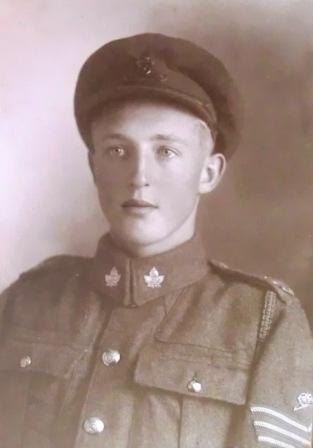
CIMG4111 Jun 14 2020 Herbert MacEwan in uniform

Herbert MacEwen.  (Photo courtesy of Helen MacEwen collection)

Howatt was in the 8th Canadian Siege Battery during WWI, while MacEwen was in the 2nd Canadian Siege Battery.  Both batteries were later attached to the 2nd Brigade, the only Canadian Heavy Artillery Brigade that went to Germany.

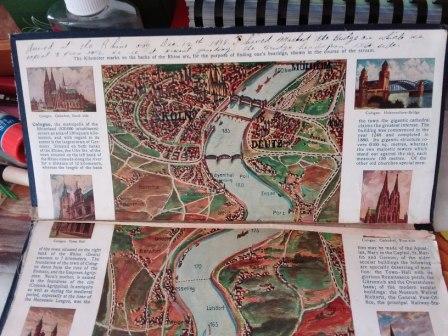
We were intrigued and made arrangements to meet Helen and see the map.  It turned out to be a surprise, as it was a foldable, panoramic map in full colour, showing the area along the Rhine River between Mainz and Cologne.  To complete the surprise, the map was written in English, but published in Germany.  It was clear that this had to be a map that pre-dated WWI and was designed for tourists!

20200614_144359 Jun 14 2020 Pieter & Helen MacEwan with panoramic map of Rhine River

Pieter and Helen MacEwen with the foldable, panoramic map. (Photo credit: Daria Valkenburg)

Ralf Gräfenstein, a historian in Berlin, found a document that might explain why a map published in Germany over 100 years ago would be in English. “These maps were made in English for tourists from Britain and Overseas, who came before the beginning of WWI and after the war to the German Rhine area…” he explained.

Ralf referred me to a 2006 dissertation written by Thilo Nowack of the University of Bonn, entitled ‘Rhein, Romantik, Reisen. Der Ausflugs- und Erholungsreiseverkehr im Mittelrheintal im Kontext gesellschaftlichen Wandels (1890 bis 1970)’ and gave a reference to the chapters that would be of interest. (Translation of the dissertation: ‘Rhine, romance, travel. Excursion and recreational travel in the Middle Rhine Valley in the context of social change (1890 to 1970)’).

In the dissertation, it was explained that “… the Tourism Society of the Rhine Area was founded in 1904… with the goal “to promote and make traveling and the stay on the Rhine and its side valleys pleasant’…” in response to the view that “… the Rhineland had lost its attraction as a travel destination since the late 19th century…”  As part of the tourism promotion effort, “… posters, brochures and other booklets were used to advertise in German, English, French and Dutch…” and placed “…in train stations at home and abroad…”  Tourist promotion was economically important as “… the invention and expansion of steam shipping and railroads enabled an enormous increase in travel on the Rhine…

It seems likely that Herbert MacEwen could have found the map in a shop or train station someplace in Germany, most likely Cologne.  It’s clearly a tourist map, with key destinations identified along the Rhine, with brief explanations and diagrams.

20200614_144505 EXCERPT Jun 14 2020 Portion of map between Cologne & Mehlem - Copy

An excerpt from the map, showing illustrations and descriptions.  (Photo credit: Daria Valkenburg)

Helen noted that “…Herb had sent this map to his girlfriend in Stanley Bridge. They married in 1921.  He states that they stayed near Mehlem-on-Rhine…

At the top of the map Herb had written “… Arrived at the Rhine on December 12th, 1918.  I have marked the bridge on which we expect to pass over. We are at present guarding the bridgehead from this site…”  This confirms the entry in Harold Howatt’s account, which stated that they had arrived in Cologne on December 12.
20200614_143410 Jun 14 2020 note on map saying unit was guarding bridge head

Herb MacEwen’s note at the top of the map.  (Photo credit: Pieter Valkenburg)

A bridgehead is the strategically important area of ground around the end of a bridge over a body of water.  (For more information, see https://en.wikipedia.org/wiki/Bridgehead)

On December 13, Harold Howatt had noted that “….the Canadian troops marched across the Rhine, reviewed as they crossed the bridge by General Plumer and General Currie…” The bridge crossed was the Hohenzollern Bridge in Cologne. (See https://en.wikipedia.org/wiki/Hohenzollern_Bridge)

To our amazement, Pieter found a video from the Imperial War Museum of this march across the Hohenzollern Bridge: https://www.iwm.org.uk/collections/item/object/1060008233.

Herb MacEwen was discharged on May 18, 1919.   His daughter-in-law Helen told us that “…he would be 21 years old.  He apparently, ‘conveniently,’ put his birthdate down as older than fact when he joined the Army…

The individual stories of our soldiers enrich the sometimes dry facts of history, and it was wonderful to learn of the shared history of Herb MacEwen and Harold Howatt.

For more information on the post WWI occupation of the Rhineland, see https://en.wikipedia.org/wiki/Occupation_of_the_Rhineland

For more information on General Sir Herbert Plumer, who commanded the Army of Occupation, see https://en.wikipedia.org/wiki/Herbert_Plumer,_1st_Viscount_Plumer

For more information on General Sir Arthur Currie, see https://en.wikipedia.org/wiki/Arthur_Currie

Thank you to Helen MacEwen for sharing the story of Herb MacEwen and Course Of The Rhine Map from the early 20th Century.  If you have a story to share, please contact Pieter at memorialtrail@gmail.com or comment on the blog.

© Daria Valkenburg

….Want to follow our research?….

If you are reading this posting, but aren’t following our research, you are welcome to do so.  Our blog address: https://onthewarmemorialtrail.com/
4 countries, 6 weeks, 7,000 km – an unforgettable war memorial journey in Europe…. Daria’s book ‘No Soldier Buried Overseas Should Ever Be Forgotten‘ is available in print and e-book formats.  Net proceeds of book sales help support research costs and the cost of maintaining this blog. For more information see https://nosoldierforgotten.com/

You are also invited to subscribe to our YouTube Channel: On The War Memorial Trail With Pieter Valkenburg: https://www.youtube.com/channel/UCJ591TyjSheOR-Cb_Gs_5Kw

Never miss a posting!  Subscribe below to have each new story from the war memorial trail delivered to your inbox.
 

The WW1 Soldier Who Went To Post WW1 Germany

April 29, 2020.  In an earlier posting, the observations made by Harold Keith HOWATT of Augustine Cove towards the end of WW1 were recorded.  (See One Soldier Records His Observations During The Last Few Days Of World War I) Howatt was in the 8th Canadian Siege Battery during WW1 and came home after the war.

8th Siege Battery photo

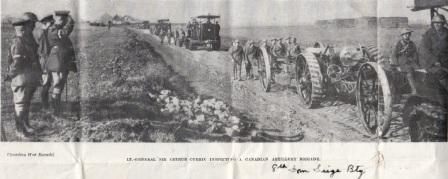
On October 30, 1918, as Howatt’s unit travelled towards Belgium from France in the last days of the war, the Brigade was inspected by Lt-General Sir Arthur  Currie.  (Harold Howatt collection.  Photo from ‘Purely Personal’ issue of November 30, 1918.)

After the official hostilities ended on November 11, Howatt was in Belgium with his unit, and hoped he could go to Germany with the Army of Occupation.  He got his wish.

On November 17, 1918, Howatt’s unit was informed it would be attached to the 2nd Brigade, the only Canadian Heavy Artillery Brigade going to Germany.

Before the march into Germany, however, Howatt wrote, on November 19, 1918, how happy he was to have a real bath… “...Wonderful to relate, we had a bath parade to the bath at one of the mines. It was a rather long walk but a great bath when we got there, a shower bath with lots of warm water…

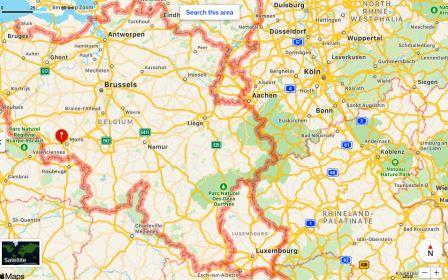
Screenshot Map of route to Germany at DuckDuckGo

Route from Mons, Belgium to Mehlem (near Bonn), Germany taken by Howatt’s unit. (Map courtesy of http://www.duckduckgo.com)

On November 20, the unit was on the move. “…Breakfast at 5 o’clock this morning, then we fell in at 6:30 and marched up to the square.  Here we formed up and started for Germany, the lorries ahead, then the signallers and B.C.A.s, then the guns with the gun crews walking behind….” (B.C.A. is an acronym for Battery Commander Assistant, the position held by Howatt.) “...We stopped at a town called Jemappes, about four kms west of Mons.  We were billeted in a big factory, away up in the top story...”  The unit stayed there for a week.

On November 28, 1918, Howatt and his unit were on their way again.  “…Up this morning at 5:30, had two cups of coffee, then breakfast, and away.  We travelled in the lorries through town after town.  Had great fun waving our hands to all the pretty girls as we passed…”  Pretty girls weren’t all that caught Howatt’s interest. “…We stopped in one town for a few minutes and we were talking to a Canadian infantry corporal.  His company was guarding trainloads of munitions left by the Germans.  They had big munitions works in the town, and there were over 300 cars of shells and high explosives in the railway yards…”  Howatt didn’t identify this town, but mentioned that they stopped overnight in Ligny, and he was billeted in a farmhouse with a Belgian family.

The next day, November 29, Howatt continued his account.  “…Left Ligny this morning at about eight o’clock and arrived here in Namur about twelve.  All along the road are abandoned German lorries, tractors, and motorcars.  They must have left hundreds and hundreds behind them.  I don’t know whether these cars have broken down or whether the petrol gave out.  I saw one yard full of lorries….

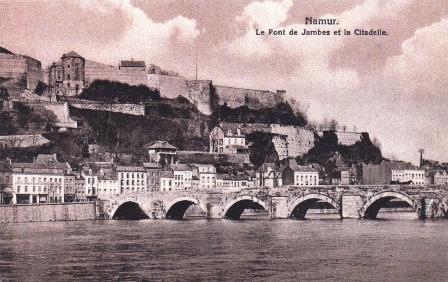
Namur postcard

Postcard showing the citadel in Namur. (Harold Howatt collection.)

The unit stopped in Namur for a rest break, giving Howatt time to explore the town.  “…Namur is quite a place.  The forts are on a high cliff or hill behind the town.  The town has been badly smashed up in some places….

On December 1, the unit was moving ahead again.  “…We started about seven.   The road ran along the bank of the Meuse, and on the other side are enormous cliffs towering high in the air…..”  While Howatt, as part of the advance party, arrived in Huy around noon to secure accommodations “….the guns did not get in until nearly dark.  Just as we were waiting around for supper Mr. Goodwin came around and said that the B.C.A.s and signallers had to clear the mud off the wheels…”  Howatt, along with a small group, cleared off one gun, but noted that a number of men disappeared, rather than going out in the dark to tackle this task!

The next day, rather than continuing on, the unit was put to work cleaning the guns. On December 4, the unit moved further along to Hamoir, where they stopped for another few days.  On December 8, the unit travelled as far as Petit-Thier “…only 3 kms from the border.  It is a very small place…

On December 9, Howatt recorded that “…At last we are where we have been trying to get for over four years.  ‘In Germany’ This morning, at about eight o’clock we crossed the frontier, the first Canadian Siege Battery to enter Germany….

He noted that the mood in Germany was not the same as in Belgium.  “…About the only difference we noted on crossing the frontier was the absence of flags and any demonstrations on the part of the people.  They still came out when we passed and just looked at us without a word or smile.  One or two we met on the road saluted us.  The people do not seem to fear us, in fact I think they welcome us, hoping the presence of the troops will restore order, and result in a more even distribution of food. The country we passed through today was desolate….” That night they stopped in a small village, Mirfeld, where Howatt was “…billeted in a schoolroom...

On December 10, while trying to find a place to stay in Büllingen, the unit ran into opposition.  “…At first they were going to put us in the station house, but the old station master kicked about it, saying he had a telegram from a conference in Aix-la-Chapelle saying that station houses were not to be used for billeting troops...”  The Canadians found other accommodation.

By December 12, they had reached Cologne, and the next day, December 13, “….the Canadian troops marched across the Rhine, reviewed as they crossed the bridge by General Plumer and General Currie.  It was an inspiring sight to see the Canadians cross to the east bank of the Rhine….. The people here do not seem to be very hostile, in fact many are quite friendly but it must have been a bitter pill for these proud Prussians to swallow to have to witness the occupation of their city by the hated Canadians….

On December 16, the unit travelled to its final destination in Germany.  “….We started about 1:30 pm for Bonn or somewhere near.  We passed through Bonn…. and arrived about dusk in a little town called Mehlem.  We are billeted in an old theatre….

The 2nd Canadian Brigade stayed in Mehlem until January 28, 1919, when the Canadian Army of Occupation was relieved by the British 84th Brigade Royal Garrison Artillery.  Canadian troops moved back to Belgium and then onwards towards demobilization and home. Howatt was discharged on May 18, 1919.

There is an Island link between the Canadian Brigade, which Howatt was part of, and the British Brigade! One of the members of the British Army of Occupation was Lt. Henry “Harry” Warburton STEWART, one of the names listed on the Cenotaph outside the Borden-Carleton Legion.  Stewart died in hospital while in Germany and is buried in Cologne.  (For an account of our visit to the cemetery and his story, see On the War Memorial Trail ….. In Cologne)

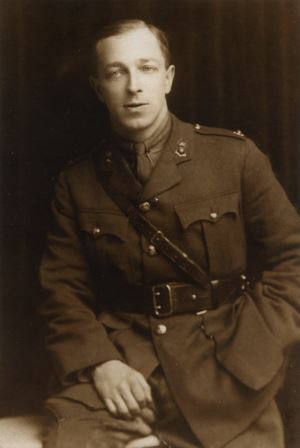
Henry Warburton Stewart

Henry “Harry” Warburton Stewart. (Photo courtesy B. Stewart family collection)

At the time we visited Cologne we did not have access to the war diaries for Stewart’s unit.  Thanks to the coronavirus pandemic we got a lucky break.  The National Archives in the United Kingdom has offered free access to its digitized records while the Archives are closed to the public. Pieter was able to get the war diaries, so we now have confirmation why Stewart was in Germany.

His unit, the 77th Siege Battery Royal Garrison Artillery, became part of the 84th Brigade Royal Garrison Artillery, sent to relieve the Canadians.  According to the war diary, on January 29, 1919 “….a party of the 77th Siege Battery arrived in Namur…”  Unlike Howatt’s unit, which travelled by road, this unit “…. travelled to Mehlem by train...”  No mention is made of where in Mehlem the 77th Siege Battery was billeted.  Stewart must have fallen ill shortly after arriving in Mehlem as he ended up in hospital in nearby Bonn and died on February 11.

Unfortunately, as yet, we have not yet found a photo of Harold Howatt.  As well, the service file for Henry Warburton Stewart has not yet been digitized by the National Archives and is not available online. Can you help?  If so, please let Pieter know.  You can email him at dariadv@yahoo.ca or comment on the blog.

© Daria Valkenburg