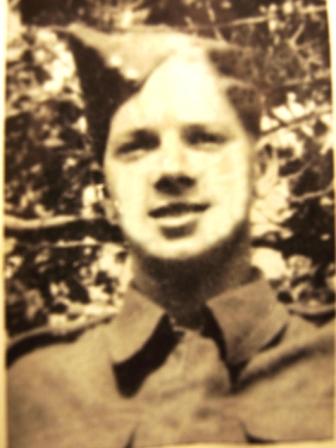
On The War Memorial Trail…..A Face For WWII Soldier William Weatherbie

September 27, 2019. A few months ago, a request was made by Dutch researchers trying to gather photos for the thousands of WWII Canadian soldiers buried in Dutch cemeteries, as part of their Faces To Graves Project.   (See https://onthewarmemorialtrail.com/2019/06/27/photos-and-info-requested-for-ww2-soldiers-from-pei-buried-in-the-netherlands/) While not part of the Borden-Carleton Cenotaph Research Project, Pieter has been trying to help these researchers.

Faces To Graves Chair Alice van Bekkum, who was recently honoured with the Governor General’s Sovereign Medal for Volunteers, explained that “the Commonwealth War Graves Commission has given permission to place photos by the graves, for a two week period in May 2020, at the Canadian War Cemetery in Groesbeek, in commemoration of the 75th Liberation of Holland.

20190831_110157 Alice van Bekkum

In August, The Governor General of Canada presented the Sovereign’s Medal for Volunteers to three Dutch recipients who have worked to preserve the memory of Canadian soldiers who served in World War II, and a Meritorious Service Medal to a Dutch captain for his service alongside the Canadian Armed Forces. Left to right in back: Albert Hartkamp, Captain Paul D. Schouten (Dutch military), Marc Fraser. Left to right in front: Canadian ambassador to The Netherlands, Her Excellency Sabine Nölke, Alice van Bekkum, Her Excellency The Right Honourable Julie Payette, Governor General of Canada. (Photo: courtesy of Alice van Bekkum)

One of the names of soldiers from Prince Edward Island for which a photo was requested was William L. WEATHERBIE, born in Charlottetown, was with the Royal Regiment of Canada.  He died on March 8, 1945, aged 18, and is buried at the Canadian War Cemetery in Groesbeek.  We had placed flags at his grave in 2017. (See https://onthewarmemorialtrail.com/2017/12/30/on-the-war-memorial-trail-pei-soldiers-buried-in-the-canadian-war-cemetery-in-groesbeek/)

CIMG9032 Sep 16 2017 Groesbeek Cemetery grave of WL Weatherbie

Grave of William Weatherbie at the Canadian War Cemetery in Groesbeek. (Photo credit: Pieter Valkenburg)

The route to a photo of Weatherbie was a circuitous one, illustrating how many Islanders are helping Pieter in this quest.  It began with Jack MacEachern at the Royal Canadian Legion in Charlottetown, who knew some of the Weatherbie family members.  This led to a phone call with Gloria Weatherbie, who explained that her maiden name was Cameron and that she had grown up in Augustine Cove, not far from where we live.  She confirmed that Weatherbie was the older brother of her husband Winston.  “He was always known as ‘Buddy”, she said.  “My husband and his younger brother Roger never knew him, as they were born after Buddy died.

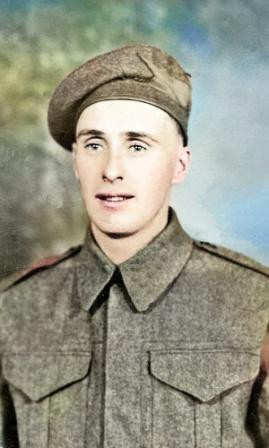
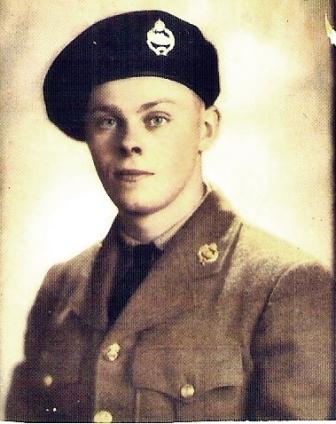
William Weatherbie from Winston Weatherbie

William ‘Buddy’ Weatherbie. (Photo: Winston Weatherbie family collection. Photo colourization: Pieter Valkenburg)

CIMG3079 Aug 26 2019 Gloria Weatherbie with Pieter

Gloria Weatherbie and Pieter hold up the photo of William Weatherbie. (Photo credit: Daria Valkenburg)

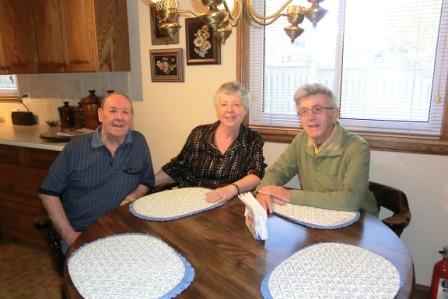
When Pieter met with Winston and Roger, they explained that “Buddy had been injured and was scheduled to be repatriated back home after being discharged from hospital in England.  He refused to leave his unit, so he went back, and two weeks later was killed in Germany.

CIMG3082 Aug 26 2019 Roger Weatherbie Pieter & Winston

Pieter (centre) with Roger (left) and Winston (right) Weatherbie. (Photo credit: Daria Valkenburg)

Not long after our visit, Gloria called us back.  “We found a letter from a nurse that looked after Buddy in England” she said.

The letter, dated August 30, 1945, from Marie Cave of Colchester, was written to Buddy’s parents, after she learned of his death.  “I have had the pleasure of meeting your son whilst he was here in England in our Military Hospital.  He was a son any mother could feel proud to own.  I think he was a very nice boy and was sorry to hear he has since lost his life…..  I send you my deepest sympathy in your loss.

Miss Cave goes on to explain that she met Buddy through his friend “George Shelfoon, who wrote and told me about his death.” Shelfoon survived the war and returned back to Prince Edward Island, always carrying a photo of Weatherbie in his wallet, until he himself passed away.

Thank you to the Weatherbie family and to Jack MacEachern for helping to put a face to the name of this young soldier.  If anyone can provide more information on William Weatherbie, or any of the other Canadian soldiers from WWII who are buried in The Netherlands, please contact Pieter at memorialtrail@gmail.com or comment on the blog.

© Daria Valkenburg

….Want to follow our research?….

If you are reading this posting, but aren’t following our research, you are welcome to do so.  Our blog address: https://onthewarmemorialtrail.com/

Front cover OnTheWarMememorialTrailinEurope4 countries, 6 weeks, 7,000 km – an unforgettable war memorial journey in Europe…. Daria’s book ‘No Soldier Buried Overseas Should Ever Be Forgotten‘ is available in print and e-book formats.  Net proceeds of book sales help support research costs and the cost of maintaining this blog. For more information see https://nosoldierforgotten.com/ 

You are also invited to subscribe to our YouTube Channel: On The War Memorial Trail With Pieter Valkenburg: https://www.youtube.com/channel/UCJ591TyjSheOR-Cb_Gs_5Kw

Never miss a posting!  Subscribe below to have each new story from the war memorial trail delivered to your inbox.

On The War Memorial Trail…..The WWII Soldier Who Had An Allergic Reaction

September 22, 2019.  How many of you have an allergy, perhaps to a food, insect, or medication?  These days, people can be treated with the aid of an EpiPen, or by avoiding the item causing an allergic reaction. During WWII, when antibiotics first came into use, researchers and medical personnel soon learned that they were not the miracle drug for all. Adverse reactions to pain medication and anesthesia also happened.

While researching the names on the Cenotaph outside the Borden-Carleton Legion, Pieter learned of a few instances where soldiers on active duty died, not as a result of war, but due to a medical condition.  Such was the case for Harrison William CRAIG, born January 3, 1909 in Cape Traverse, Prince Edward Island, the son of John Russell Craig and Mary Ellen Howatt.  Unlike most of the servicemen listed on the Cenotaph, Craig was married and a father.

blog color photo Graig

Harrison William Craig. (Source:https://www.findagrave.com/memorial/29137050/harrison-william-craig. Photo colourization: Pieter Valkenburg)

A farm labourer before enlisting with the PEI Highlanders in Summerside on February 23, 1940, Craig spent several months in a military hospital in Dartmouth, Nova Scotia before being sent to Valcartier, Quebec for training on June 3, 1941. In July 1941 he ended up in a military hospital again for several weeks, before leaving for Newfoundland on July 31, 1941.

Unfortunately, he again landed in and out of hospital in Botwood and Gander, with a final admission to the RCAF Hospital in Gander on December 1, 1942.  While being prepared for a tonsillectomy operation, he suffered an anaphylactic reaction and died a day later, leaving behind his widow, Mildred Smith, and four children, who were living in Central Bedeque.  The youngest child had been born 8 months earlier, on April 2, while the oldest was only 7 years old. Craig was buried in Gander Military Cemetery, Newfoundland.

An obituary in the ‘Summerside Journal’ of December 17, 1942, page 4, column 1 noted that:

The community of Bedeque was deeply saddened by the news that on Wednesday, Dec. 2nd, Pte. Harrison Wm. Craig of the P.E.I. Highlanders, had passed away in the Military Hospital at St. John’s, Newfoundland, while on active service there. He was buried with full military honors in the Protestant Cemetery at St. John’s on Friday afternoon at 2 p.m., December 4. Pte. Craig joined the P.E.I Highlanders in March, 1940, and trained at Dartmouth, N.S. and in July 1941 went on active service to Newfoundland.

He is survived by his wife, Mrs. Mildred Craig, and their four children at Central Bedeque, P.E.I., his father and brother Heath at Chelton, P.E.I., and five sisters: Mrs. Stanley Jack, Glace Bay, C.B.; Mrs. Wm. Heckbert, Summerside, P.E.I.; Mrs. Charles Robertson, Carleton, P.E.I.; Mrs. Simpson Affleck, Halifax, N.S.; and Mrs. Alfred Waite of Sherbrooke, P.E.I. His Commanding Officer, Col. C. C. Thompson, wrote of his faithfulness and fidelity to duty and his splendid record of service.

The sympathy of the whole community goes out to the family in their sorrow and loss.

Craig’s death left the family in financial straits, as stated in a declaration made by his widow on January 4, 1943 before magistrate Earle. D. Leard.  Mrs. Craig wrote “I have a small house and lot on a quarter acre of land.  My husband had no insurance.  I have been paying for this place since he joined up and have no money.  I want to give my children an education.  I had quite a bill of expense when the last child was born and have no money at all laid aside.  I have to buy everything, including fuel.”  Craig’s military service record does not indicate if the declaration resulted in financial assistance.

If anyone can provide more information on Harrison William Craig, please contact Pieter at memorialtrail@gmail.com or comment on the blog.

© Daria Valkenburg

….Want to follow our research?….

If you are reading this posting, but aren’t following our research, you are welcome to do so.  Our blog address: https://onthewarmemorialtrail.com/

Front cover OnTheWarMememorialTrailinEurope4 countries, 6 weeks, 7,000 km – an unforgettable war memorial journey in Europe…. Daria’s book ‘No Soldier Buried Overseas Should Ever Be Forgotten‘ is available in print and e-book formats.  Net proceeds of book sales help support research costs and the cost of maintaining this blog. For more information see https://nosoldierforgotten.com/ 

You are also invited to subscribe to our YouTube Channel: On The War Memorial Trail With Pieter Valkenburg: https://www.youtube.com/channel/UCJ591TyjSheOR-Cb_Gs_5Kw

Never miss a posting!  Subscribe below to have each new story from the war memorial trail delivered to your inbox.

CBC Radio Interview With Pieter Valkenburg & Elmer MacDonald

September 20, 2019. Regular readers of this blog are aware of the project to put up a memorial panel in Wons, The Netherlands, to honour WW2 pilot from Cape Traverse, Elmer Bagnall MUTTART, and the crew of Halifax L9561.  (See The Elmer Bagnall Muttart Story and On the War Memorial Trail ….. At Harlingen General Cemetery and On the War Memorial Trail ….. At The Politiek Farm In Wons)

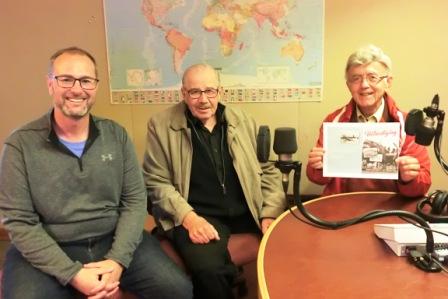
This special commemoration event will occur on October 12 of this year. A radio interview with Pieter and Elmer MacDonald, one of the Islanders who will be travelling to The Netherlands and whose parents were close friends of Elmer Muttart, recently ran on CBC Radio’s Mainstreet PEI with interviewer Matt Rainnie.

CIMG3145 Sep 12 2019 Matt Elmer Pieter

At the CBC PEI studio in Charlottetown. Left to right: Interviewer Matt Rainnie, Elmer MacDonald, Pieter Valkenburg. Pieter is holding the invitation issued by the Stichting Missing Airmen Memorial Foundation. (Photo credit: Daria Valkenburg)

From the CBC Mainstreet PEI website:

Two Islanders are travelling to the Netherlands next month for the unveiling of a memorial panel in honour of World War 2 Flight Sergeant Elmer Muttart of Cape Traverse. The memorial came about because of Pieter Valkenburg’s extensive research and Elmer MacDonald i Muttart’s namesake.

https://www.cbc.ca/listen/live-radio/1-130-mainstreet-pei/clip/15737113-war-memorial

Thank you to CBC PEI for forwarding the link to this broadcast so that it can be shared.  If you have a story to share about a WW2 soldier buried in The Netherlands, please contact Pieter at dariadv@yahoo.ca or comment on the blog.

 © Daria Valkenburg

The WW2 Soldier Who Drove On The Wrong Side Of The Road

August 28, 2019.  Many years ago, while on the North island of New Zealand, I drove to a meeting with a colleague from the South Island.  Driving in New Zealand means driving on the side of the road opposite to the way we are used to driving.  Usually I did well with remembering which side of the road to drive on, but sometimes the brain cells reverted to their default setting.  That happened one evening after we stopped at a gas station.  After pulling back out onto the road, we were listening to music and having a great conversation when all of a sudden I noticed a big truck coming towards us.  “What is he doing?” I asked my passenger.  He didn’t reply.  A quick glance showed him looking terrified and gripping the door handle.  “What’s wrong?” I asked.  Finally, he very quietly whispered, “In this country, we drive on the other side of the road.” Oops!  I quickly switched lanes and the truck safely passed us, but not without a few angry toots on the horn.  An angel was sitting on our shoulders that evening!

x-default

Austin Boulter. (Photo credit: Augustine Cove Women’s Institute 1800-1973 Centennial history project)

I remembered this event after learning from Pieter’s research what happened to WW2 soldier Austin Harry BOULTER, whose driving experience didn’t end as happily.  According to his attestation papers, Boulter was born on October 4, 1920 in Freetown, the son of Roy Boulter and Blanche Leard.  There is a discrepancy as the Military Service Record’s Declaration and Statement of Relatives records his date of birth as October 4, 1922 in Tryon. A check of the June 1921 census does not record him, indicating that he wasn’t yet born.  It’s pretty clear that he fudged his attestation paper during his enlistment on May 27, 1940 in Woodstock, New Brunswick to make sure he wouldn’t be rejected as being too young!  At the time of enlistment the family lived in Cape Traverse, but Boulter was working as a lumberman for J. Craig in Stanley, New Brunswick.

While Boulter enlisted with the Carleton and York Regiment, he was transferred to the Canadian Signal Training Corps on September 9, 1940.  On May 18, 1941 he was transferred to the 3rd Canadian Division Signals and sent to Debert Camp, Nova Scotia. It was with that group that he left Halifax for England, arriving in Avonmouth on July 31, 1941.  The unit was in England to train for deployment to Western Europe.  (This was the first Canadian division to fight in the Normandy Campaign, landing at Juno Beach on D-Day on June 6, 1944.)

Boulter never left England, as around 10 pm on January 14, 1943, while not on duty, he borrowed a motorcycle ‘without authority’, according to a court of inquiry into his death.  He was “carrying a civilian passenger on the back of the motorcycle”.  Unfortunately, he forgot which side of the road to drive on, and crashed into a 4X4 Ford driven by Private M J. O’Grady, between Storrington and the Royal Winnipeg Rifle Lines.

At the court of inquiry, O’Grady stated that after seeing the motorcycle in his lane, O’Grady started to pull over to the left, but Boulter “came straight on, striking his front right bumper and fender and catching on the corner of the box directly behind the cab.”  O’Grady stopped immediately and he and his passengers jumped out.  He stated that he “saw a soldier on the ground a short distance beyond the bike and saw a lady further away on the ground.” Boulter was dead, but his passenger was hurt.  O’Grady “posted a guard on the truck and told the other two men to take over while he ran into Storrington to get help.”  O’Grady testified that he was “travelling about 15 mph” and that the motorcycle “appeared to be travelling too fast”.

The finding of the court indicated that Boulter “was not wearing a crash helmet”.  The registry of death noted that he died instantly from severe head injuries incurred during the crash.

It’s unknown why Boulter was with a civilian passenger so late at night, and why he took a motorcycle without permission.  No testimony by the passenger was recorded in the court of inquiry and she was not identified. He was buried at Brookwood Military Cemetery, Sussex, England.

The Summerside Journal of January 18, 1943 recorded his obituary:

Bedeque Soldier Dies Overseas

A Prince Edward Island soldier, Sigmn. Austin Harry Boulter of Bedeque, was listed under died overseas in the 252nd Canadian (Active) Army overseas casualty list last night. His next-of-kin was given as his mother, Mrs. Blanche Boulter of Bedeque.

If anyone can provide a photo or more information on Austin Harry Boulter, please contact Pieter at dariadv@yahoo.ca or comment on the blog.

© Daria Valkenburg


The WWII Flight Officer Whose Plane Went Down While On Patrol Near The Arctic Circle

August 17, 2019.  In researching the names on the Cenotaph outside the Borden-Carleton Legion, normally Pieter encounters one of four situations:

  • family members who have a photo but know little or nothing else about the soldier.
  • family members who are aware of the soldier but have no photo and little or no information.
  • family members who know nothing about the soldier, have no photo, and aren’t at all interested. This situation tends to occur with WW1 soldiers, who died at a young age, with no spouse or children. “It happened over 100 years ago! That’s ancient history!” one woman told Pieter.
  • family members who have a photo and have saved letters or cards written by the soldier or about him, and may have his medals. These family members have a general idea of what happened to the soldier and may have visited his grave or a memorial listing his name.

In researching the story of Flight Officer Joseph “Joe” Charles MCIVER of Kinkora, Pieter encountered a fifth situation …… family members so dedicated to preserving his memory that they did extensive research on their own!  Not only were there photos and documents, but one nephew, Alan A. McIvor of Kelowna, BC, wrote a book on his uncle called ‘United In Effort..Flying Officer Joseph Charles McIver…Royal Canadian Air Force…1940-1944’ and was kind enough to send it to Pieter.
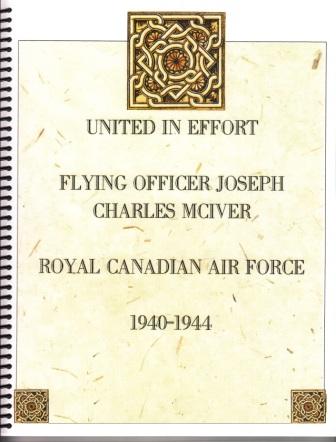
Cover of Alan McIvors book

Cover of Alan McIvor’s book.

But the story begins here on Prince Edward Island with Alan McIvor’s sister-in-law Joyce Philips and her husband Gordon, who invited us to visit them at their home.
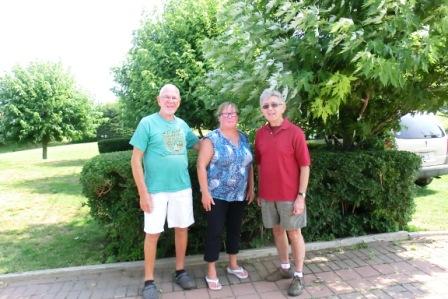
CIMG2545 Aug 28 2018 Pieter with Gordon & Joyce Philips

Left to right: Gordon Philips, Joyce Philips, Pieter Valkenburg. (Photo credit: Daria Valkenburg)

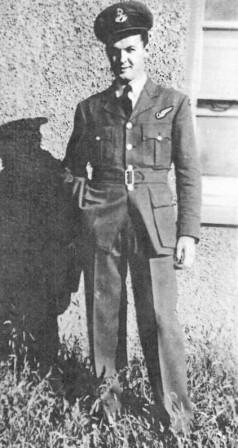
Joseph Charles McIver was born July 26, 1916 in Kinkora, the son of Peter D McIver and Margaret Anne McKenna, “the sixth of fourteen children” as noted in Alan McIvor’s book ‘United In Effort’. Before enlisting with the Royal Canadian Air Force in Charlottetown on November 15, 1940, he was a warehouse foreman for the PEI Potato Growers Association.  McIvor goes on to explain in his book that his uncle enlisted “as an Aircraftsman 2nd Class.  In the area on his application form where it asked for the reason he wanted to join he declared ‘Wanted to help Win the War.’

Joseph Charles McIver

Joseph Charles McIver. (Photo: The Canadian Virtual War Memorial – Veterans Affairs Canada)

McIver didn’t qualify as a pilot, but was trained for the position of Observer/Navigator in Ontario.  On June 16, 1941 he married Helen Elizabeth McNeill, “a nurse from Summerside”, in Trenton, Ontario.

UNCLE JOE & HELEN McIvor from Alan McIvor

Helen and Joseph Charles McIver. (Photo courtesy A. McIvor family collection)

In January 1942, McIver was posted to England to train with the British Royal Air Force in Coastal Command.  RAF Coastal Command, a formation with the Royal Air Force (RAF) had a mandate to protect convoys from German U-boats and Allied shipping from aerial threats from the German Air Forces.  Squadrons operated from various bases and McIver soon found himself in the Arctic Circle. (For more information on Coastal Command see https://en.wikipedia.org/wiki/RAF_Coastal_Command_during_World_War_II)

On September 4, 1942, McIver was in the Royal Australian Air Force’s (RAAF) 455 Squadron with a group flying to the Soviet Union as part of ‘Operation Orator’, a search and strike force to operate over the Barents Sea.  The plan was to fly on a course to reach Norway, cross the mountains in the dark, overfly northern Sweden, in violation of Swedish neutrality, Finland and land at Afrikanda air base, at the southern end of Murmansk Oblast (an oblast is similar to a province). The flight to Afrikanda was expected to take five to eight hours, depending on the weather and German opposition. After refuelling, the group McIver was in was to fly the remaining 190 km to Vayenga, following the Kandalaksha–Murmansk railway northwards.  (See https://en.wikipedia.org/wiki/Operation_Orator for more information on Operation Orator and https://en.wikipedia.org/wiki/Afrikanda_(air_base) for more information on Afrikanda.)

1024px-Barents_Sea_map

Map shows the location of the Barents Sea north of Russia and Norway, and the surrounding seas and islands. (Map created by Norman Einstein, 2005. Courtesy of https://en.wikipedia.org/wiki/Operation_Orator#/media/File:Barents_Sea_map.png)

McIvor’s ‘United In Effort’ explains what happened to his uncle’s plane after making it to Afrikanda…. “after several attempts at landing in the mist their fuel position became critical.”  The pilot flew towards Kandalaksha to find an emergency landing spot.  “All he could find was an area where the silver birch trees had been cut down, leaving tall thin stumps.

The plane landed intact and no one was hurt, but containers of tools brought by a ground crew passenger “were strewn along the crash path as the bomb bay had been torn open.”  In trying to retrieve the containers, “a bullet smashed into the ground at his feet.”  The ground crew passenger returned to the plane very quickly!  “Eventually a troop of Soviet soldiers arrived and thinking the crew were the hated Nazis, treated them roughly.  They were taken to an underground interview room where an English speaking Soviet Commissar was able to understand they were allies.”  They were then reunited with the rest of the Squadron at Afrikanda and the next day escorted to Vayenga.  Over the next months McIver and his crewmates flew 35 flights, 30 of them Operational Patrols.

In September 1943, McIver was promoted to Temporary Flying Officer, transferred to No. 1 Torpedo Training Unit, and sent to the United Kingdom for further training, followed by a stint as an instructor.  In May 1944 he was given Special Leave and allowed 30 days back in Canada with his wife and relatives before returning to the United Kingdom.

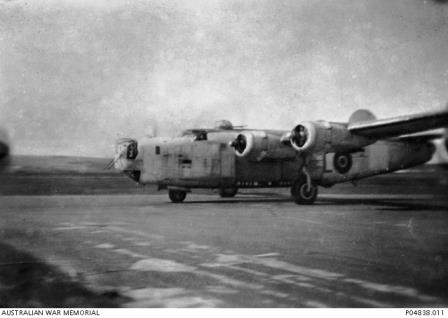
In August 1944, McIver was transferred to RAF No. 53 Squadron, which flew Liberator planes.  These planes were important in the war effort as they “doubled the reach of Britain’s maritime reconnaissance force.  This added range enabled Coastal Command patrols to cover the Mid-Atlantic gap, where U-boats had operated with near impunity.

Liberator No. 53 Squadron RAF Coast Command Credit Australian War Memorial

A B24 Liberator MkVIII, aircraft of 53 Squadron, RAF, Coastal Command, on the runway at the airfield at Reykjavik, Iceland. (Photo courtesy of Australian War Memorial https://www.awm.gov.au)

In September 1944, the Squadron, along with McIver, was posted to Reykjavik, Iceland. At 1:10 am on November 18, 1944 he was part of the crew of aircraft EV895 that took off on anti-submarine patrol looking for a suspected U-boat off Gardskagi, Iceland ….. and “were never heard from again.” When the plane was overdue back at base, a search began, with wreckage and floating debris seen at sea.  “A surface vessel is dispatched and recovers a nose wheel that appears to be from a Liberator and other flotsam floating on the surface.

Among the items recovered were clothing identified as belonging to the pilot,  wireless operator, and gunner, suggesting that the plane had sunk.  “There were no surface ships reported missing or overdue from that time frame.  No German U-boats operating in the area were reported missing.

A fire spotted at 2:47 am by another aircraft in the Squadron “was not very far from Iceland and EV895 was very early into its patrol.  It would have been loaded with enough fuel for 14 hours of flying. It would take some time for that amount of fuel to burn off and it would create quite a heat.  It was not uncommon for some Liberators to fly into the water.  It was a big heavy aircraft and flying at night 100 feet above the ocean was potentially risky business.

No one to this day knows what happened, but the likeliest explanation is that the plane flew too close to the ocean and couldn’t pull back up.  The B-24 Liberator was nicknamed ‘The Flying Coffin’ because the only entry and exit from the bomber was in the rear, making it almost impossible for the flight crew and nose gunner to get from the flight deck to the rear when wearing parachutes. Plus, the roller-type bomb bay doors retracted into the fuselage, creating a minimum of aerodynamic drag to keep speed high over a target area.  (See https://sites.google.com/site/willowrunvillage/b-24-bombers)

Reported missing in action were:

  • Captain W.C. PAYNE
  • 2nd Pilot L. A. WINDRESS
  • 1st Navigator J. C. MCIVER
  • 2nd Navigator A. PALMER
  • Warrant Officer R.A. SCOTT
  • Warrant Officer J. G. CHAMBERLAIN
  • Warrant Officer H.A. STEPHEN
  • Warrant Officer Mechanical K. J. SPACKMAN
  • Air Gunner J. BASSETT
  • Flight Engineer G. M. COCKBURN

Although McIver’s plane disappeared on November 18, 1944 he was not officially declared dead until September 1945.  At the time of the disappearance his wife Helen was pregnant, and gave birth to a son Peter Joseph Charles in March 1945.  Helen died in 1978 and son Peter passed away in 2007.

While there is no memorial to the crew in Iceland, there is one in Runnymede, England. As well, McIver has a commemorative stone at the Air Force Heritage Park in Summerside, located at the entrance to the former Canadian Armed Forces Base.
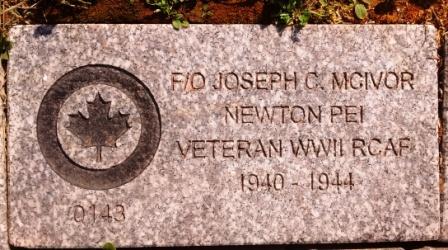
IMG_20190807_101038750 McIver Commemorative Stone Summerside

Commemorative Stone at Air Force Heritage Park, Summerside, Prince Edward Island. (Photo credit: Pieter Valkenburg)

Today, McIver’s medals are on display at the community centre in Kinkora since 2014.  Unfortunately, the whereabouts of the original medals are unknown.  As explained in ‘United In Effort’, “In 2013, through the combined efforts of Joe McIver’s last remaining sibling, Mary Ita Smith and the author, we have had all his medals reissued, including a new one called The Arctic Star for his time spent in the Arctic Circle with RAAF Squadron 455.

OLYMPUS DIGITAL CAMERA

Shadow box with medal of Flight Officer Joseph Charles McIver in the community centre in Kinkora, Prince Edward Island. (Photo credit: Pieter Valkenburg)

Thank you to Alan McIvor and Gordon and Joyce Philips for sharing so much information.  If you have information and photos to share on Flight Officer Joe McIver, the other crew members on that last flight, or any of the other names on the Cenotaph, please contact Pieter at memorialtrail@gmail.com or comment on the blog.

© Daria Valkenburg

….Want to follow our research?….

If you are reading this posting, but aren’t following our research, you are welcome to do so.  Our blog address: https://onthewarmemorialtrail.com/
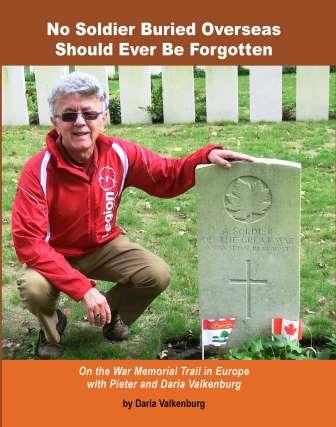
Front cover OnTheWarMememorialTrailinEurope4 countries, 6 weeks, 7,000 km – an unforgettable war memorial journey in Europe…. Daria’s book ‘No Soldier Buried Overseas Should Ever Be Forgotten‘ is available in print and e-book formats.  Net proceeds of book sales help support research costs and the cost of maintaining this blog. For more information see https://nosoldierforgotten.com/ 

You are also invited to subscribe to our YouTube Channel: On The War Memorial Trail With Pieter Valkenburg: https://www.youtube.com/channel/UCJ591TyjSheOR-Cb_Gs_5Kw

Never miss a posting!  Subscribe below to have each new story from the war memorial trail delivered to your inbox.

In Memoriam

In_memoriam

August 14, 2019.  Over the past years, the Borden-Carleton Cenotaph Research Project has been telling the stories of the soldiers listed on the cenotaph.  Along the way, we’ve also introduced you to the families who have contributed photos and stories of these men.

Sadly this summer, three participants in the project have passed away.  We’d like to acknowledge their help and support by honouring their memories.

Harry Norton & Pieter

Harry Norton, left, with Pieter Valkenburg. (Photo credit: Daria Valkenburg)

On May 18, 2019, Harry Norton, brother of WW2 soldier Ernest Murray NORTON, passed away in Charlottetown, Prince Edward Island. (See link to obituary: https://www.theguardian.pe.ca/obituaries/harry-hv-norton-24050/) The poignant story of Ernest Murray Norton, who was killed in Italy, was told in the blog posting The Last Valentine From A WWII Soldier.

CIMG9470 Oct 24 2017 Follet home in Ajax Terry Greta Pieter

Terry and Greta Follett with Pieter. (Photo credit: Daria Valkenburg)

On July 17, 2019, Greta Follett, daughter of WW2 soldier  Everett Samuel FRANCIS, passed away in British Columbia.  The story of how her father, on his way to meet baby Greta for the first time, lost his life when his ship, the SS Caribou, was torpedoed off the coast of Newfoundland, was one of the first that Pieter researched.  (See The Cenotaph Research Project Begins)  At the time of that first article, we didn’t have a photo of Everett Samuel Francis. That changed once Greta learned about the project, and later we were able to visit and meet her and husband Terry.  (See The Face of Everett Samuel Francis)

CIMG9481 Oct 25 2017 Pieter with Helen Elgin & Don Coutts in Toronto

Pieter (standing left) with Elgin Coutts (seated), Elgin’s wife Helen (centre) and son Donald (standing right) during a visit in 2017. (Photo credit: Daria Valkenburg)

On August 7, 2019, Elgin Coutts, brother-in-law of WW2 pilot Elmer Bagnall MUTTART, passed away in Toronto, Ontario. (See link to obituary: https://www.theguardian.pe.ca/obituaries/elgin-coutts-24809/) The story of Elmer Bagnall Muttart, who died after his plane was shot down over The Netherlands, has unfolded over the years, and began with this posting: The Elmer Bagnall Muttart StoryThis October, a memorial panel to honour Muttart and his crew will be placed near the crash site in Wons, The Netherlands.  (See Update For Those Intending To Go To The Netherlands For The Memorial Panel Unveiling In Wons To Honour the Crew of Halifax L9561)

We extend our condolences to the families of Harry Norton, Greta Follett, and Elgin Coutts, and thank them for their participation in and contributions to the Borden-Carleton Cenotaph Research Project.  If you have information and photos to share on the names on the Cenotaph, please contact Pieter at dariadv@yahoo.ca or comment on the blog.

© Daria Valkenburg


Photos and Info Requested For WWII Soldiers From PEI Buried In The Netherlands

June 27, 2019.  As blog readers know, Pieter has been researching the names on the Cenotaph outside the Borden-Carleton Legion over the last few years.  As well, he’s been asked by the three Canadian War Cemeteries in The Netherlands for help in getting photos and personal information on Island soldiers buried in their cemeteries.  This is part of their Faces To Graves project, where they are working towards a digital memorial archive on all Canadian soldiers buried on Dutch soil.

Recently, Dutch researchers have identified more soldiers from PEI.  CBC PEI’s Angela Walker interviewed Pieter on a few of these names, and the interview ran on June 21, 2019 during the program Mainstreet PEI.  We thank CBC for sending us the audio clip of the interview, and Jane Scott for turning the clip into a web link so that we can post it on this blog.  To listen to the interview, click here:  https://drive.google.com/file/d/1lcLHurGAsgmYpk9pGBZHj-dzX7WOc7I1/view

Here is the complete list given by the three cemeteries:

CANADIAN WAR CEMETERY IN BERGEN OP ZOOM

Bergen Op Zoom, not far from the Belgian border, identified 6 soldiers, all of whom died in 1944:

Hugh Allister MACDONALD, born in Georgetown, son of H. Allister and Elizabeth (Bessie) MacDonald, was with the Royal Canadian Artillery – 02 Anti Tank Unit. He died on October 10, 1944, aged 31.

Lawrence Adolphus SWEENEY, born in Souris, son of Ralph and Celina Sweeney, was with the Lincoln and Welland Regiment. He died on October 27, 1944, aged 23. UPDATE: Photo subsequently found.

Milton Evangeline LIVINGSTONE, born in Gladstone, son of Joseph and Agnes Livingstone of Murray River, and husband of Mae Isabel Livingstone, was with the Lincoln and Welland Regiment. He died on November 6, 1944, aged 26. UPDATE: Photo subsequently found.

Alvah Ray LEARD, born in Alberton, son of Lloyd and Margaret Leard of Northam, was with the Sherbrooke Fusiliers Regiment – 27th Armed Regiment. He died on September 26, 1944, aged 23.

Roy SMITH, born in O’Leary, son of James and Clara Smith, was with the Black Watch (Royal Highland Regiment) of Canada. He died on September 30, 1944, aged 24.

James Walter AULD, born in Glenwood, son of James and Margaret Auld of O’Leary Station, was with the Algonquin Regiment. He died on November 1, 1944, aged 21. UPDATE: Photo subsequently found.

CANADIAN WAR CEMETERY IN GROESBEEK

The cemetery in Groesbeek identified 5 soldiers for whom they are missing photos or other information, and who all died in 1945:

Joseph Edmond HENNEBERY, born in Morell, was with the Royal Canadian Engineers -33rd Field Company. He died on April 20, 1945, aged 25. UPDATE: Photo subsequently found.

Barney Ruben MCGUIGAN, born in St. Peter’s, son of Thomas and Sadie McGuigan, was with the North Shore (New Brunswick) Regiment. He died on February 26, 1945, aged 16. UPDATE: Photo subsequently found.

Stephen Augustine MCKINNON, born in St. Peter’s Bay, was with the Royal Hamilton Light Infantry. He died on March 2, 1945, aged 27. UPDATE: Photo subsequently found.

Ralph Kenneth SILLIKER, born in O’Leary, was with the Lake Superior Regiment (Motor). He died March 2, 1945, aged 27. UPDATE: Photo subsequently found.

William Leo WEATHERBIE, born in Charlottetown, was with the Royal Regiment of Canada. He died on March 8, 1945, aged 18. UPDATE: Photo subsequently found.

CANADIAN WAR CEMETERY IN HOLTEN

The Canadian War Cemetery in Holten identified 1 soldier:

Maurice James HUGHES, F/26373 served with Royal Canadian Corps, killed on May 2, 1945 in Leer, Germany. He was 27 years old and came from Charlottetown. UPDATE: Photo subsequently found.

Did you know that most soldiers who died in Germany during WWII were later reburied in The Netherlands? The only time a soldier wasn’t reburied was if the family specifically requested the body not be disinterred.

All three cemeteries have put in a request for photos, personal stories, letters or postcards, etc.  Can you help the Dutch to remember these men buried on their soil?  Perhaps you know family or friends of these men?  If so, please contact them.  Information and photos can be emailed to Pieter at memorialtrail@gmail.com who will forward to the appropriate cemetery.

We will be in The Netherlands this fall and Pieter will visit each of these graves and place flags.  Pieter notes that “It means so much more when I’m standing at a grave if I know what the soldier looked like and a bit about him.”

© Daria Valkenburg

….Want to follow our research?….

If you are reading this posting, but aren’t following our research, you are welcome to do so.  Our blog address: https://onthewarmemorialtrail.com/

Front cover OnTheWarMememorialTrailinEurope4 countries, 6 weeks, 7,000 km – an unforgettable war memorial journey in Europe…. Daria’s book ‘No Soldier Buried Overseas Should Ever Be Forgotten‘ is available in print and e-book formats.  Net proceeds of book sales help support research costs and the cost of maintaining this blog. For more information see https://nosoldierforgotten.com/ 

You are also invited to subscribe to our YouTube Channel: On The War Memorial Trail With Pieter Valkenburg: https://www.youtube.com/channel/UCJ591TyjSheOR-Cb_Gs_5Kw

Never miss a posting!  Subscribe below to have each new story from the war memorial trail delivered to your inbox.

On The War Memorial Trail….The WWII Soldier Killed in Germany But Buried in Holland

February 22, 2019.  Most of the men listed on the Cenotaph outside the Borden-Carleton Legion were unmarried.  However, William Douglas SHERREN, born November 25, 1914 in Crapaud, Prince Edward Island, son of William Douglas Sherren and Florence Amanda Carrier, was married, to Florence Mead Strickland, and the father of two children, Hubert and Harrison Blair.

An electrician with Palmer Electric in Charlottetown before WWII broke out, William Douglas enlisted with the First Survey Regiment of the Royal Canadian Artillery on January 6, 1940, receiving the rank of Lieutenant.  He was sent to England and on March 29, 1944 was promoted to Captain.  He arrived in France in July 1944, a month after D-Day.

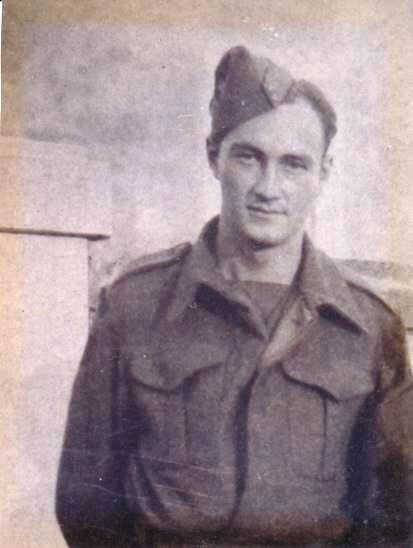
Wiliam Douglas Sherren

William Douglas Sherren. (Photo courtesy of Holten Canadian War Cemetery Information Centre)

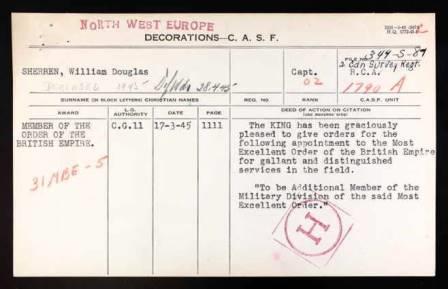
On March 17, 1945, he was recognized by King George VI as a Member of the Military Division of the Most Excellent Order of the British Empire for “gallant and distinguished services in the field” in North West Europe.  Unfortunately, we don’t know the circumstances of him receiving the award.  If anyone has more information, please let us know.

Notice of decoration awarded to WD Sherren

Notice of decoration awarded to William Douglas Sherren. (Source: http://www.ancestry.ca)

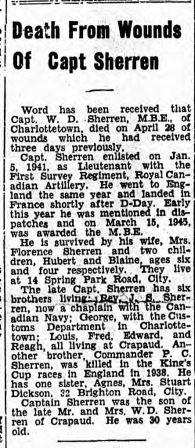
On April 25, 1945, just a few days before the end of WWII, he was severely injured when the vehicle he was travelling in drove over a land mine in Germany.  According to his service file, William Douglas died of his wounds at 3:30 am on April 28, 1945.

Originally buried in Cloppenburg Hospital Cemetery in Lower Saxony, William Douglas was reburied in Holten Canadian War Cemetery in The Netherlands in 1947.  This was one of the cemeteries we visited while in Europe, and of course we placed flags at his grave. (See On the War Memorial Trail ….. At Holten Canadian War Cemetery)

IMG_20170918_134108826 Sep 18 2017 grave of WD Sherren Holten cemetery

Grave of Captain William Douglas Sherren at Holten Canadian War Cemetery. (Photo credit: Pieter Valkenburg)

Obituary W.D. Sherren

Obituary of William Douglas Sherren. (Source: The Charlottetown Guardian, Friday, May 4, 1945, page 1)

Do you have photos or information to share on William Douglas Sherren, or any of the soldiers discussed in previous blog postings?  You can send an email to memorialtrail@gmail.com or comment on this blog.

© Daria Valkenburg

….Want to follow our research?….

If you are reading this posting, but aren’t following our research, you are welcome to do so.  Our blog address: https://onthewarmemorialtrail.com/

4 countries, 6 weeks, 7,000 km – an unforgettable war memorial journey in Europe…. Daria’s book ‘No Soldier Buried Overseas Should Ever Be Forgotten‘ is available in print and e-book formats.  Net proceeds of book sales help support research costs and the cost of maintaining this blog. For more information see https://nosoldierforgotten.com/

You are also invited to subscribe to our YouTube Channel: On The War Memorial Trail With Pieter Valkenburg: https://www.youtube.com/channel/UCJ591TyjSheOR-Cb_Gs_5Kw

Never miss a posting!  Subscribe below to have each new story from the war memorial trail delivered to your inbox.
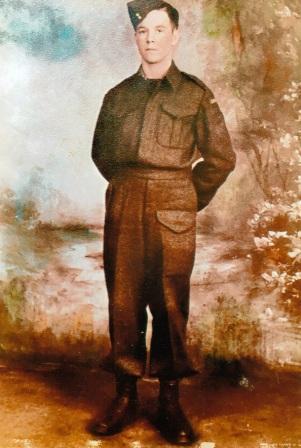
On The War Memorial Trail…..The Last Valentine From A WWII Soldier

February 13, 2019. When family members have saved information about their loved ones who died, and are willing to share, it warms our hearts and makes Pieter’s research into the names on the Cenotaph outside the Borden-Carleton Legion that much more relevant.  So, when Harry Norton invited us to come to his home in Charlottetown to talk about his older brother, WWII soldier Ernest Murray NORTON, we didn’t hesitate.

Harry Norton & Pieter

Harry Norton, left, with Pieter Valkenburg. (Photo credit: Daria Valkenburg)

Ernest was born April 18, 1924 in Crapaud, the son of Harry Vernon Norton and Hazel Reid.  He enlisted on July 4, 1940 with the Prince Edward Highlanders and later was transferred into the West Nova Scotia Regiment.  In 1942 he left Canada for England.

Ernest Murray Norton

Ernest Murray Norton. (Photo credit: Harry Norton family collection)

Among the treasures saved by Harry Norton were letters that give a picture of the man behind the soldier’s uniform.  In a May 3, 1944 letter from Italy, written to his younger brother Fred, Ernest gave a summary of his travels.  Because of censorship he couldn’t give any details, but he explained that from England he had “gone to North Africa, then to Sicily, to Italy, went to hospital in Malta by plane, returned back to North Africa, and then again to Italy.” The reference of going to hospital by plane to Malta was because he’d been wounded.   In the same letter, he also thanks Fred for giving their mother a Valentine’s card from him.


The last Valentine’s card to his mother, lovingly made on Ernest Norton’s behalf by his brother Fred.  (Photo credits: Harry Norton family collection)

Unfortunately, it was the last Valentine’s card from Ernest.  Shortly after the letter was written, Ernest was killed, and is now buried at Cassino War Cemetery in Italy.

On June 2, 1944, Chaplain Herlaut of the West Nova Scotia Regiment wrote to Mrs. Norton about her son’s death.  He explained that Ernest and another signaller were instantly killed on May 20, 1944 while operating their signal set. He wrote: “I was at the scene a few moments afterwards and buried both boys together.  I was able to return a few days ago and erected a white cross to mark their graves.

Original wooden cross Norton

Original wooden cross placed by Chaplain Herlaut in 1944. (Photo credit: Harry Norton family collection.)

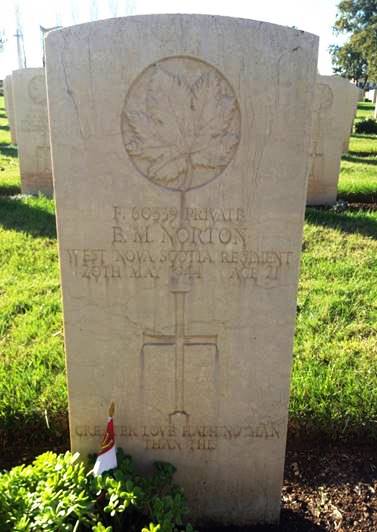
Norton gravestone

Current gravestone of Ernest Norton at Cassino War Cemetery in Italy. (Photo Credit: Canadian Virtual War Memorial at http://www.vetarans.gc.ca.)

Ernest Norton was a lucky man never to have been forgotten by his loved ones, with so much family information about him!  Do you have photos or information to share on any of the soldiers discussed in this and previous blog postings?  If so, please let us know. We still are in need of photos.  You can send an email to memorialtrail@gmail.com, comment on the blog, or tweet to @researchmemori1

© Daria Valkenburg

….Want to follow our research?….

If you are reading this posting, but aren’t following our research, you are welcome to do so.  Our blog address: https://onthewarmemorialtrail.com/

Front cover OnTheWarMememorialTrailinEurope4 countries, 6 weeks, 7,000 km – an unforgettable war memorial journey in Europe…. Daria’s book ‘No Soldier Buried Overseas Should Ever Be Forgotten‘ is available in print and e-book formats.  Net proceeds of book sales help support research costs and the cost of maintaining this blog. For more information see https://nosoldierforgotten.com/ 

You are also invited to subscribe to our YouTube Channel: On The War Memorial Trail With Pieter Valkenburg: https://www.youtube.com/channel/UCJ591TyjSheOR-Cb_Gs_5Kw

Never miss a posting!  Subscribe below to have each new story from the war memorial trail delivered to your inbox.

On the War Memorial Trail …..The Spirit of Remembrance Continues

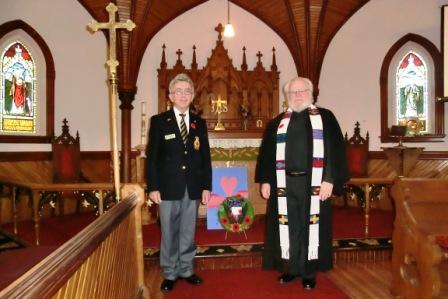
November 13, 2018.  This year, Pieter was invited to be the guest speaker at St John The Evangelist Anglican Church in Crapaud, during their Remembrance Day Service.  In his opening remarks, Pieter noted that: “This special Remembrance Day marks the end of the First World War.  It’s a day to remember the memories and sacrifices made by those who did their best to answer the call to fight for freedom. 

This church remembers those who served through the Honour Rolls that hang on the wall to my left.  Every Remembrance Day, the names are read out, as they were today.  Five of these men are listed on the Cenotaph outside the Borden-Carleton Legion, 3 from WWI and 2 from WWII.  I’d like to briefly tell you a bit about them…

CIMG2820 Nov 11 2018 Pieter with Rev Eric Lynk

Pieter with Rev Eric Lynk at St John the Evangelist Anglican Church in Crapaud. (Photo credit: Daria Valkenburg)

Pieter then talked about the following men: Arthur Leigh COLLETT, Percy Earl FARROW (FARRAR), Henry “Harry” Warburton STEWART, William Douglas SHERREN, and Ernest Murray NORTON.  One focus was on how they were remembered, as Pieter explained:  “When we think of soldiers in war, we picture them in trenches, facing an enemy.  But they were also people with hopes and dreams, just like you and me, who made the difficult choice to put aside their immediate futures and accept the duty thrust upon them…

Remembrance Day is now over for another year, but the Borden-Carleton Cenotaph Research Project continues in its quest to put a face and story to every name.  This posting is to thank the many people who have supported this project by providing information and photos, and in adding their own voices to the importance of remembrance.

The County Line Courier newspaper has supported this project from the beginning.  We thank Mike and Isabel Smith for helping to get the word out by publishing a story in almost every issue.

CBC PEI Radio has also been supportive in helping us reach a wider audience, with a special thank you to Angela Walker of CBC’s Mainstreet PEI.

We thank the three churches in the South Shore area that invited Pieter to come and speak about the Cenotaph Research Project:  Central Trinity United Church in Breadalbane, St John The Evangelist Anglican Church in Crapaud, and South Shore United Church in Tryon.

Several ministers referenced the project or some of the names on the Cenotaph in their sermons.  Rev Dr Karen MacLeod-Wilkie of South Shore United Church made mention of the project and PEI pilot Elmer Bagnall MUTTART in her November 4 sermon.  Our thanks to Jack Sorensen for sending us this sound clip:  https://soundcloud.com/user-756553111/rev-karens-remarks-about-elmer-muttart-november420182/s-uCEps.

We also thank Rev Kent Compton of the Church of Scotland in Cape Traverse.  We’ve been informed by neighbours that he mentioned the project in his remarks during the Remembrance Service organized by the Augustine Cove Women’s Institute.

We thank the Tryon & Area Historical Society here on PEI and the Missing Airmen Memorial Foundation in The Netherlands for their efforts to raise funds for a memorial panel in Wons to honour Elmer Muttart and the crew of Halifax L9561, and we thank all who donated to this project.  The ceremony to install the memorial panel is planned for October 12, 2019.

On November 1, 2018, PEI Senator Mike Duffy spoke about the Cenotaph Research Project in the Senate.  It’s now recorded in the official Hansard records, and we thank him for highlighting this project of remembrance. (See Hansard entry: 2018 Hansard Entry remarks by Mike Duffy ) Mr. Duffy went one step further, by submitting an article to the newspaper with his comments, a complete surprise to us when we opened up the newspaper.  (See article:  CLC Nov 7 2018 p15 article by Mike Duffy)

Meeting the families of the men listed on the Cenotaph is a particular honour.  We thank those who sent photos, letters, documents, and hope to meet more families in the coming year.

We also thank you, the readers of these postings.   Research continues, and we hope you will enjoy the stories in upcoming blog postings.

If you have photos or information to share on soldiers from the Cenotaph outside the Borden-Carleton Legion, please let us know. Send us an email to memorialtrail@gmail.com, comment on the blog, or tweet to @researchmemori1.

© Daria Valkenburg

….Want to follow our research?….

If you are reading this posting, but aren’t following our research, you are welcome to do so.  Our blog address: https://onthewarmemorialtrail.com/

Front cover OnTheWarMememorialTrailinEurope4 countries, 6 weeks, 7,000 km – an unforgettable war memorial journey in Europe…. Daria’s book ‘No Soldier Buried Overseas Should Ever Be Forgotten‘ is available in print and e-book formats.  Net proceeds of book sales help support research costs and the cost of maintaining this blog. For more information see https://nosoldierforgotten.com/ 

You are also invited to subscribe to our YouTube Channel: On The War Memorial Trail With Pieter Valkenburg: https://www.youtube.com/channel/UCJ591TyjSheOR-Cb_Gs_5Kw

Never miss a posting!  Subscribe below to have each new story from the war memorial trail delivered to your inbox.