On The War Memorial Trail….The Search For A Photo Of James Cairns Moves To YouTube

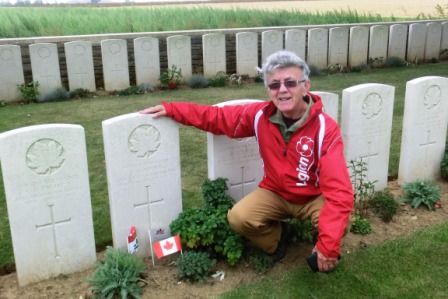
CIMG8559 Sep 6 2017 Pieter by grave of James Cairns at Manitoba Cemetery

Pieter by the grave of James Cairns at Manitoba Cemetery in Caix, France.  (Photo credit: Daria Valkenburg)

December 17, 2020.  When you look at a gravestone in a cemetery, particularly one filled with graves from soldiers who were killed, you can easily see them as a collection of graves, not individuals who had hopes and dreams of their own.

In 2017, when we visited cemeteries in France, Belgium, The Netherlands, and Germany to honour soldiers from WWI and WWII who are listed on the Cenotaph outside the Borden-Carleton Legion, Pieter tried to have a photo of each person whose grave or memorial we were visiting.

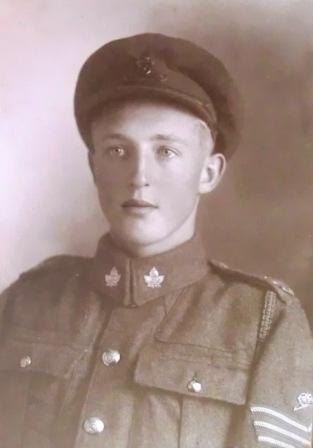
It wasn’t always possible, and one of those without a photo was WWI soldier James CAIRNS, who was born on February 22, 1897 in Kinkora, the son of Thomas Cairns and Mary Jane MacDonald.

Before WWI began, several members of the family moved to Manitoba from the Island, and so it was no surprise to learn that Cairns enlisted with the 190th Battalion Manitoba Regiment on July 8, 1916. This Regiment became part of the Winnipeg Rifles.  (See https://en.m.wikipedia.org/wiki/190th_Battalion_(Winnipeg_Rifles),_CEF#:~:text=The%20190th%20(Winnipeg%20Rifles)%20Battalion,that%20city%20and%20surrounding%20district)

James was killed in action during the Battle of Amiens on August 9, 1918 and is buried in the Manitoba Cemetery in Caix, France.

Appeals for a photo on the blog and in newspaper articles went nowhere, and neither did a letter to the editor in a Manitoba newspaper in the area where members of the Cairns family had lived.

Four years of an unsuccessful search later, Pieter has taken his appeal for a photo to YouTube, in the hope that a viewer might come forward:

Pieters saying

You can read more about James Cairns, our visit to the Manitoba Cemetery, and the appeal for a photo, here:

Thank you to post-production editor Wendy Nattress, who made this YouTube video a reality. If you have photos or information to share about James Cairns, please email Pieter at memorialtrail@gmail.com, or  comment on the blog.    

© Daria Valkenburg

..Want to follow our research?…

If you are reading this posting, but aren’t following our research, you are welcome to do so.  Our blog address: https://onthewarmemorialtrail.com/

Front cover OnTheWarMememorialTrailinEurope4 countries, 6 weeks, 7,000 km – an unforgettable war memorial journey in Europe…. Daria’s book ‘No Soldier Buried Overseas Should Ever Be Forgotten‘ is available in print and e-book formats.  Net proceeds of book sales help support research costs and the cost of maintaining this blog. For more information see https://nosoldierforgotten.com/
Subscribe to our YouTube Channel: On The War Memorial Trail With Pieter Valkenburg: https://www.youtube.com/channel/UCJ591TyjSheOR-Cb_Gs_5Kw

Never miss a posting!  Subscribe below to have each new story from the war memorial trail delivered to your inbox.

The Veterans Tree At Borden-Carleton Legion

CIMG4942 Nov 24 2020 Legion Veterans tree

The Veterans Tree at Borden-Carleton Legion (Photo credit: Daria Valkenburg)

November 25, 2020.  When the phone rang the other day, it was to let us know about a wonderful way to remember veterans past and present at the Borden-Carleton Legion.

‘Our veterans at the Branch deserve to be remembered at Christmas’

…….Kathy Henry, Borden-Carleton Legion member

Kathy Henry, member of the Borden-Carleton Legion, wanted to do something special this year to honour the many veterans who have been identified with the Branch over the past years.  “I’ve been thinking about it for 10 years, but when we had a tree donated to the Branch, it was time to do it...” she explained.

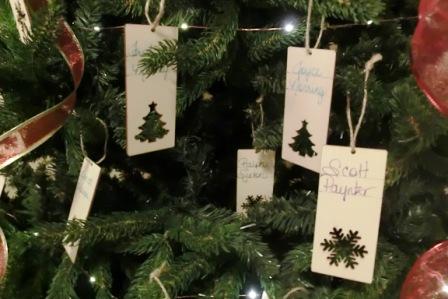
The tree, donated by Ashley Steele, whose uncle Danny Bernard is a Branch member, led Kathy and Dawn Gradwell to find ornament tags and painstakingly handwrite the name of a veteran on each card.  “We’ve done 187 ornament tags so far…” Kathy noted.

CIMG4931 Nov 24 2020 Legion Veterans tree

Some of the ornament tags on the Veterans Tree, each with the handwritten name of a veteran.  (Photo credit: Daria Valkenburg)

Veterans residing in the area were invited to place their own ornament tags on the tree, and one of these was Pieter.

CIMG4934 Nov 24 2020 Legion Veterans tree

Kathy Henry, left, with Pieter Valkenburg, right. Pieter wears a clear-window mask since I have difficulty following conversations when masks cover faces and mouths. (Photo credit: Daria Valkenburg)

CIMG4937 Nov 24 2020 Legion Veterans tree

Pieter places the ornament tag on the tree. (Photo credit: Daria Valkenburg)

CIMG4944 Nov 24 2020 Legion Veterans tree Pieters tag

Pieter’s ornament tag is next to that of WW1 soldier James Ambrose Cairns.  (Photo credit: Daria Valkenburg)

Kathy is the wife of veteran Mario Henry, who served over 20 years in the Canadian military.  “…I’m supporting the Branch, the members, and the veterans with this initiative.  The veterans deserve a tree!…” she explained.

The Borden-Carleton Legion has ensured that those who served have not been forgotten during this holiday season.  Well done, Kathy and Dawn!

If you have photos or information to share, please email Pieter at dariadv@yahoo.ca or comment on the blog.

© Daria Valkenburg

On The War Memorial Trail…..The Continuing Search For A Photo of WWI Soldier Joseph Arthur Desroches

CIMG4888 Nov 10 2020 Pieter being interviewed by Radio Canada Acadie

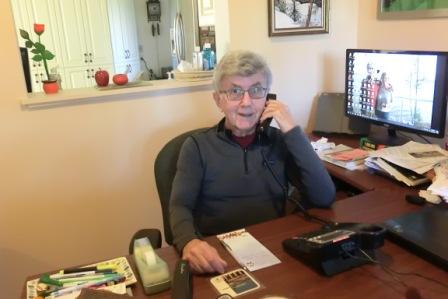
Pieter during a phone interview with CBC Radio-Canada Acadie. (Photo credit: Daria Valkenburg)

November 15, 2020. In the fall of 2017, when we visited the graves of WWI soldiers buried in France, who are listed on the Cenotaph outside the Borden-Carleton Legion, it was always more meaningful for Pieter if he had a photo of the soldier and knew what he looked like.

After returning home, Pieter became more determined than ever to find a photo and family for every WWI and WWII soldier he researches.  “… I do not believe that there are Canadian soldiers buried overseas who are forgotten.  Family is out there somewhere...” he maintains.

….Finding a photo of Arthur Desroches has been a challenge….

One of the WWI soldiers he’s had no luck with finding a photo or family was Joseph ‘Arthur’ DESROCHES, whose story was told over 3 years ago, when we visited the cemetery he is buried in.  (See https://onthewarmemorialtrail.com/2017/09/23/paying-our-respects-to-private-joseph-arthur-desroches/)

Born August 8, 1891 in Miscouche, Prince Edward Island, he was the son of Zephirim Desroches and Priscilla Gaudet.  Unlike many WW1 soldiers, Desroches was married, to Mary Ann Wedge of Fernwood, and had four children: Elizabeth Eileen, Joseph Alfred, Lucy Priscilla, and Charles Arthur. With a wife and four children, it doesn’t seem possible that Desroches would not have sent a photo of himself home.

Many archives and researchers were contacted over the years, particularly those researching Acadian history.  An article was published last year in the County Line Courier. (See CLC Jul 10 2019 p11 WW1 Soldier Incorrectly Recorded on Gravestone)  Still no luck.

Since Desroches was of Acadian descent, maybe we needed to ask the French language media for help?

.CBC Radio-Canada Acadie helped publicize the search for a photo….

CBC’s Radio-Canada Acadie in Moncton was approached, and reporter Anne-Marie Parenteau interviewed Pieter for a Remembrance Day broadcast.  The reporter and the radio station showed a deep commitment to this story as Pieter was interviewed in English, and then his interview was translated into French.  Both Anne-Marie and the translator did an incredible job, resulting in an excellent interview.

If you understand French, you’ll want to listen to it:  “La quête d’un homme de l’Î.-P.-É. pour retrouver des photos d’un soldat acadien” … See http://www.radio-canada.ca/util/postier/suggerer-go.asp?nID=4582099

Unfortunately, up to today, no one has come forward in response to the appeal for a photo or family of Joseph Arthur Desroches. UPDATE: A photo was received in 2023.

UPDATE: In last month’s posting about photos of soldiers that Pieter is searching for, he has been successful with two soldiers:  Vernon James NIXON and Philip Hubert LONG.

You can read the original posting and the follow-up on Philip Hubert Long at:

Thank you to the County Line Courier for featuring the ‘On The War Memorial Trail’ stories, and an enormous Merci Beaucoup to Anne-Marie Parenteau and CBC’s Radio-Canada Acadie.  If you have photos or information to share, please email Pieter at memorialtrail@gmail.com or comment on the blog.

© Daria Valkenburg

….Want to follow our research?….

If you are reading this posting, but aren’t following our research, you are welcome to do so.  Our blog address: https://onthewarmemorialtrail.com/

Front cover OnTheWarMememorialTrailinEurope4 countries, 6 weeks, 7,000 km – an unforgettable war memorial journey in Europe…. Daria’s book ‘No Soldier Buried Overseas Should Ever Be Forgotten‘ is available in print and e-book formats.  Net proceeds of book sales help support research costs and the cost of maintaining this blog. For more information see https://nosoldierforgotten.com/ 

You are also invited to subscribe to our YouTube Channel: On The War Memorial Trail With Pieter Valkenburg: https://www.youtube.com/channel/UCJ591TyjSheOR-Cb_Gs_5Kw

Never miss a posting!  Subscribe below to have each new story from the war memorial trail delivered to your inbox.

On The War Memorial Trail….. Remembering WWI Soldier William Earle Davison

Remembrance-Day-2019-Images-1024x520

November 8, 2020.  If you have a family member who lost his life in war, this is a poignant time of year of remembrance.  Recently Earle Davison of Kensington wrote us that “….As November 11 comes around, I start to think about my uncle, William Earle Davison, who was killed in the First World War.  He was attending Mount Allison University and he enlisted in St John, New Brunswick. He was with the Sixth Canadian Siege Battery in France and Belgium…

Coloured photo Davison

William Earle ‘Davy’ Davison.  (Photo courtesy of Earle Davison & Family. Photo restoration and colourization by Pieter Valkenburg)

Earle explained that “…My father always kept a box about the size of a chocolate box in one of his desk drawers.  It contained the last possessions of Earle, most of it must have been sent back from Europe.  Every fall getting near November 11th he would take it out and we would look through it….

The original box is long gone, but it’s a tradition that Earle and his wife Irene keep up with a replacement box.

CIMG4858 Oct 28 2020 Irene & Earle Davison

Irene and Earle Davison with a chocolate box containing mementos of his uncle, WW1 soldier William Earle Davison. (Photo credit: Daria Valkenburg)

According to his attestation document, William Earle DAVISON was born March 7, 1897 in Kensington, the son of Joseph and Annie Davison. Before enlisting on May 3, 1916 as a gunner with the No. 7 Overseas Siege Battery Artillery in St. John, he was a theology student at Mount Allison.

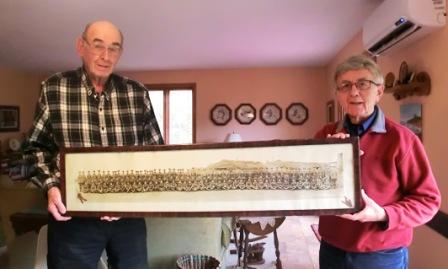
Earle Davison explained that he had a group photo from the No. 7 Siege Battery and wondered why, as he had only known his uncle to be in the 6th Siege Battery.  This was explained by a series of changes in designation.  ‘No. 7 “Overseas” Battery Siege Artillery, CEF’ was re-designated as ‘167th (Canadian) Siege Battery’ on 10 June 1916, and as ‘No. 6 Canadian Siege Battery, CEF’ on 24 January 1917. (For more information, see https://www.canada.ca/en/department-national-defence/services/military-history/history-heritage/official-military-history-lineages/lineages/artillery-regiments/3rd-field-artillery-regiment.html)

CIMG4792 Oct 28 2020 Pieter & Earl Davison with group photo No 7 Siege Battery

Earle Davison shows Pieter the group photo of the No 7 Siege Battery that was taken May 23, 1916.  (Photo credit: Daria Valkenburg)

From St. John, Davison was sent to Halifax, Nova Scotia.  With his Battery he left for Britain on September 18, 1916, arriving in Bristol on September 26, 1916.  A day later they were in France to provide siege artillery support as part of the 2nd Brigade, CGA, CEF in France and Flanders until the end of the war.  (NOTE: CGA refers to Canadian Garrison Artillery, and CEF refers to Canadian Expeditionary Force.)

On September 18, 1918, he was wounded in an early afternoon bombardment while they were in the area of Villers-lès-Cagnicourt, 24.1 km southeast of Arras.  A letter written by Fred KILLEN of St. John to Davison’s father on September 19, 1918 from France explained what happened to his friend, known as ‘Davy’: … There were five of us went up to the forward section to run the telephone exchange. There was Davy, Fowler, Simpson, Bomb Yeomans, and myself….”  The additional men mentioned in Killen’s letter were H. E. FOWLER of St. John, H. L. SIMPSON of Springhill, and H. L. YEOMANS of St. John.

Killen then explained that “…Davy, Fowler, Simpson, and I all lived together like 4 brothers. We always had a dugout of our own and got along well.  But we all went forward to do our exchange work under Bomb Yeomans. We had been up there for about 6 days and we were going to be relieved the next morning….

While waiting to be relieved they had a bit of time to relax, as Killen wrote “.… on the afternoon of the casualties we were all playing crib at the time….” Crib refers to the game of cribbage.

Then the shelling by the Germans, referred to as Fritz by Killen, began.  “…Fritz started to put a few shells around. The first one went about 100 yards from us.  We did not mind it.  About five minutes later another one came and lit about 20 yards behind us….

At first the men thought they were under a gas attack.  “… It did not make much noise when it exploded and we all thought it was gas. So we started to look for our gas masks.  The place was small and it was pretty well crowded when we all got in there.  Fowler handed me mine and I got outside the door to look at the explosion of the last one…. when all of a sudden I heard an explosion and jumped clear of the dugout…

Killen was the only one outside at the time of the third explosion.  “… The other four were inside at the time, and Davy got a slight wound in the side of the head, Fowler got it in the back, and Yeomans got it in the leg and hand and a bruised shoulder, and Simpson got a few burns about his face. I fell as soon as I jumped and when I got up I saw Davy and Yeomans running….

Killen relates what happened next.  “…We dressed them up and sent them all to a Field Ambulance. They told us then they were all right and need not to worry.  They are all clean cuts and they should all make Blighty on them….”  Blighty referred to being sent back to England.

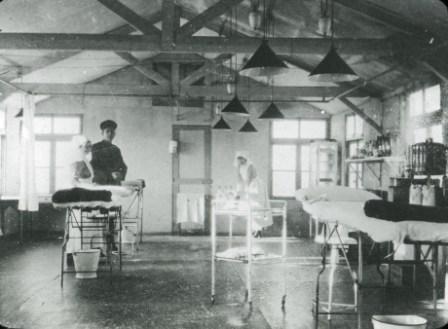
No 22 General Hopsital Camiers

Glass lantern slide of interior of ward at No. 22 General Hospital, Camiers. (Source: Photographer unknown, “Interior of ward at No. 22 General Hospital” OnView: Digital Collections & Exhibits, https://collections.countway.harvard.edu/onview/items/show/17961)

It seems clear that no one was aware that the injury to Davison would prove fatal, as he was treated for a gunshot wound at a field hospital, No. 22 General Hospital in Camiers, France.  He was not sent to England.  “… Davy was in the best of spirits after he was hit, although it was paining him a bit.  But he stuck it well. I will only be too glad to let you know of any further particulars that we receive here.  But likely you will hear from Davy yourself. But I thought I would drop you these few lines so as you won’t worry too much about him as I know how Mothers and Fathers worry about their boys.  Hoping you have received good news by the time this letter reaches you. And hoping he will recover soon…

On September 23, 1918 Davison’s service record recorded him as being ‘dangerously ill’ and on October 5, 1918 he ‘died of wounds’.  He was buried in Étaples, France. This is located near Boulogne on the north-west coast of France.

Earle Davison noted that of the men in the 6th Siege Battery killed in action, his uncle was the only Islander. The other men who were wounded with him on September 18, 1918 survived the war.

Among the mementos in the chocolate box were photos and a pipe.  One of the photos was of a group of men, likely taken in France. The back of the photo had most of the men thoughtfully identified!

CIMG4821 group photo

Photo of men from the 6th Siege Battery, identified as 1: D. Daley (killed in action), 2: Sgt W. A. McLaggan, 3: Sgt unknown, 4: Gunner E. O. Jennings, 5: Gunner R. A. Redmond, 6: Gunner William Earle Davison. (Photo courtesy of Earle Davison & Family)

Thank you to Earle and Irene Davison for sharing information about Earle’s uncle, William Earle Davison, and how they ensure his memory is never forgotten.  If you have information to share about him, or any of the other men mentioned, please contact Pieter at memorialtrail@gmail.com or comment on the blog.

© Daria Valkenburg

….Want to follow our research?…

If you are reading this posting, but aren’t following our research, you are welcome to do so.  Our blog address: https://onthewarmemorialtrail.com/

4 countries, 6 weeks, 7,000 km – an unforgettable war memorial journey in Europe…. Daria’s book ‘No Soldier Buried Overseas Should Ever Be Forgotten‘ is available in print and e-book formats.  Net proceeds of book sales help support research costs and the cost of maintaining this blog. For more information see https://nosoldierforgotten.com/

Subscribe to our YouTube Channel: On The War Memorial Trail With Pieter Valkenburg: https://www.youtube.com/channel/UCJ591TyjSheOR-Cb_Gs_5Kw

Never miss a posting!  Subscribe below to have each new story from the war memorial trail delivered to your inbox.

On The War Memorial Trail….. Continuing The Search For Soldiers Killed In Action In WWI and WWII

October 17, 2020.  One of the many characteristics I admire about Pieter is his commitment to find a photo and family for every WWI and WWII soldier he researches.  He refuses to believe that there is a Canadian soldier lying in an overseas cemetery who has been completely forgotten. 

When he exhausts his research leads, he asks for help from the media.  Today’s posting will mention some of the searches through the media and provide an update on what he’s learned as of today.

pieter recherche photo de militaire

Pieter during an interview about WW1 soldier Basil Cormier.  (Photo credit: Jacinthe LaForest, courtesy of La Voix Acadienne)

WWI Soldier Bazil Cormier

The story of WWI soldier Bazil CORMIER, whose name is listed on the Cenotaph outside the Borden-Carleton Legion, was told when we visited his grave in Rouen, France in 2017. (See https://bordencarletonresearchproject.wordpress.com/2017/10/01/on-the-road-to-rouen/)

In addition to the blog posting, an article was published in the Country Line Courier newspaper. (See CLC Dec 6 2017 p17 Bazil Cormier Rouen France)

Up to now, no family or photo has been found, so we wondered if we would have any success if an appeal was made in the French language media.  Jacinthe LaForest interviewed Pieter for the La Voix Acadienne newspaper.  (You can read the article here, which is in French: LaVoix14oct2020_06_10 Bazil Cormier ) So far, no one has come forward.

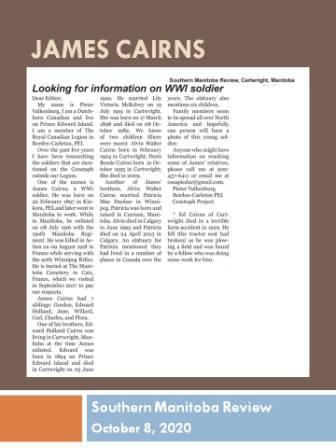
WWI soldier James Cairns

Another WWI soldier whose name is listed on the Cenotaph outside the Borden-Carleton Legion is James CAIRNS.  He’s buried in Caix, France, which we visited in 2017. (For his story, see https://onthewarmemorialtrail.com/2017/09/30/the-search-for-manitoba-cemetery/

In addition to the blog posting, an article was published in the Country Line Courier newspaper. (See CLC Oct 18 2017 p23 Manitoba Cemetery in France

Before war broke out, he had moved to Manitoba and lived in the community of Cartwright.  With no luck on the Island to find family or a photo, Pieter contacted the Southern Manitoba Review newspaper and his letter was published earlier this month. The editor, Vicki Wallace, is a history buff and dug into the story, giving Pieter more information about the family.  However, up to now, no one has responded and a photo has not yet been found.  UPDATE: A photo was received in 2022.

James Cairns

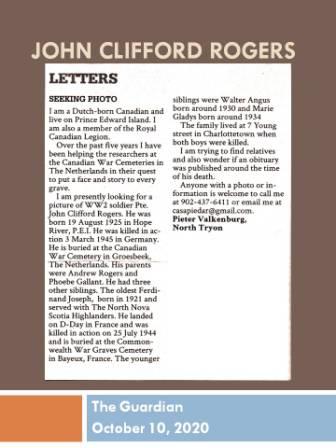
WWII soldier John Clifford Rogers

For the Faces To Grave project, which is trying to find photos of WWII soldiers in The Netherlands, Pieter was unsuccessful in finding a photo for John Clifford ROGERS, whose grave at the Canadian War Cemetery in Groesbeek, The Netherlands we’d visited in 2019. (See https://onthewarmemorialtrail.com/2019/12/04/on-the-war-memorial-trail-our-2019-visit-to-the-canadian-war-cemetery-in-groesbeek/)

In addition to the blog posting, an article was published in the Country Line Courier newspaper. (See CLC Jan 29 2020 p26 2019 Visit To Groesbeek)

In an attempt to find family and a photo, Pieter contacted The Guardian newspaper, and his letter was published last week. (See https://www.theguardian.pe.ca/opinion/local-perspectives/letter-seeking-photo-of-soldier-from-second-world-war-508864/) Although he received some inquiries about his letter, to date no family or photo has been found. UPDATE: A photo was received in 2021.

John Clifford Rogers

WWII soldier Vernon James Nixon

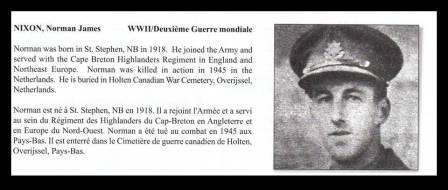
In another Faces To Grave project search, Pieter contacted The Saint Croix Courier in St. Stephen, New Brunswick about WWII soldier Vernon James NIXON, who is buried in the Canadian War Cemetery in Holten, The Netherlands.   We didn’t receive a copy of this letter from editor Kristi Marples, but a few people did contact Pieter. 

Kent Caldwell of the local Legion branch mentioned that an old scrapbook had been found several years ago, and an old newspaper photo submitted for the New Brunswick Military Recognition Booklet.  The Royal Canadian Legion’s New Brunswick Command subsequently mailed Pieter the entry from the booklet.

Nixon writeup

Excerpt from the New Brunswick Military Recognition Booklet.

Then Pieter was contacted by a family member, who had visited the grave.  Hopefully, a photo will be provided.  UPDATE: A photo was received in 2021.

WWII soldier Philip Hubert Long

In another Faces To Graves project search, Pieter was interviewed by David Pate of CBC Radio’s Maritime Noon about Philip Hubert LONG of New Brunswick, who is also buried at the Canadian War Cemetery in Holten, The Netherlands.  (You can listen to the interview here: https://drive.google.com/file/d/1R07RkSjTeshJA_-UO_W68fsY3FHCSLPB/view?usp=sharing

Within two hours of the broadcast, Pieter received a call from a family member, and hopefully a photo will be provided. UPDATE: A photo was received in 2020, shortly after the radio interview.

More photos of soldiers are still to be found

For a list of more soldiers from PEI that Pieter is hoping to find photos of, see here: List of photos needed

Our thanks go to the media for helping us to tell these stories:  CBC Radio’s Maritime Noon, County Line Courier, La Voix Acadienne, Southern Manitoba Review, The Guardian, and The Saint Croix Courier.  If you can help with providing information on James Cairns, Bazil Cormier, Philip Hubert Long, Vernon James Nixon, or John Clifford Rogers, please email Pieter at memorialtrail@gmail.com, comment on the blog, or tweet to @researchmemori1.    

© Daria Valkenburg

…Want to follow our research?…

If you are reading this posting, but aren’t following our research, you are welcome to do so.  Our blog address: https://onthewarmemorialtrail.com/

Front cover OnTheWarMememorialTrailinEurope4 countries, 6 weeks, 7,000 km – an unforgettable war memorial journey in Europe…. Daria’s book ‘No Soldier Buried Overseas Should Ever Be Forgotten‘ is available in print and e-book formats.  Net proceeds of book sales help support research costs and the cost of maintaining this blog. For more information see https://nosoldierforgotten.com/
Subscribe to our YouTube Channel: On The War Memorial Trail With Pieter Valkenburg: https://www.youtube.com/channel/UCJ591TyjSheOR-Cb_Gs_5Kw

Never miss a posting!  Subscribe below to have each new story from the war memorial trail delivered to your inbox.

On The War Memorial Trail…..The WWI Era ‘Course Of The Rhine’ Map of Germany

July 3, 2020.  It’s always a pleasure to hear from readers.  After reading about Harold Keith Howatt’s travels to WWI Germany as part of the post-occupation forces, Helen MacEwen contacted us about a map that her father-in-law sent to his future wife in 1918.  “I have been reading with interest your reports about the WWI Veterans and wondered if I could bring further information about my father-in-law’s last tour after the German surrender. His name was Sgt. Herbert ‘Herb’ S. MACEWEN from Stanley Bridge…

Helen went on to describe the map.  “…I have a copy of the ‘COURSE OF THE RHINE: From Mayence to Cologne’. It is a fold-out map of the Rhine River within a hard-cover. It is very fragile but does mention the different towns that you mentioned in your stories…” (You can read Howatt’s account at The WW1 Soldier Who Went To Post WW1 Germany)  Today we know Mayence as Mainz.

CIMG4111 Jun 14 2020 Herbert MacEwan in uniform

Herbert MacEwen.  (Photo courtesy of Helen MacEwen collection)

Howatt was in the 8th Canadian Siege Battery during WWI, while MacEwen was in the 2nd Canadian Siege Battery.  Both batteries were later attached to the 2nd Brigade, the only Canadian Heavy Artillery Brigade that went to Germany.

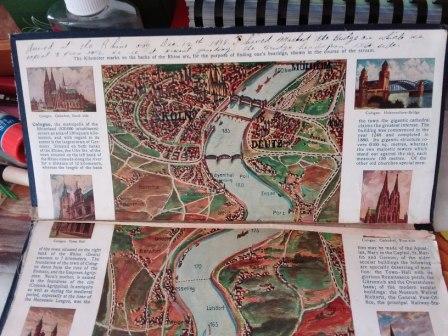
We were intrigued and made arrangements to meet Helen and see the map.  It turned out to be a surprise, as it was a foldable, panoramic map in full colour, showing the area along the Rhine River between Mainz and Cologne.  To complete the surprise, the map was written in English, but published in Germany.  It was clear that this had to be a map that pre-dated WWI and was designed for tourists!

20200614_144359 Jun 14 2020 Pieter & Helen MacEwan with panoramic map of Rhine River

Pieter and Helen MacEwen with the foldable, panoramic map. (Photo credit: Daria Valkenburg)

Ralf Gräfenstein, a historian in Berlin, found a document that might explain why a map published in Germany over 100 years ago would be in English. “These maps were made in English for tourists from Britain and Overseas, who came before the beginning of WWI and after the war to the German Rhine area…” he explained.

Ralf referred me to a 2006 dissertation written by Thilo Nowack of the University of Bonn, entitled ‘Rhein, Romantik, Reisen. Der Ausflugs- und Erholungsreiseverkehr im Mittelrheintal im Kontext gesellschaftlichen Wandels (1890 bis 1970)’ and gave a reference to the chapters that would be of interest. (Translation of the dissertation: ‘Rhine, romance, travel. Excursion and recreational travel in the Middle Rhine Valley in the context of social change (1890 to 1970)’).

In the dissertation, it was explained that “… the Tourism Society of the Rhine Area was founded in 1904… with the goal “to promote and make traveling and the stay on the Rhine and its side valleys pleasant’…” in response to the view that “… the Rhineland had lost its attraction as a travel destination since the late 19th century…”  As part of the tourism promotion effort, “… posters, brochures and other booklets were used to advertise in German, English, French and Dutch…” and placed “…in train stations at home and abroad…”  Tourist promotion was economically important as “… the invention and expansion of steam shipping and railroads enabled an enormous increase in travel on the Rhine…

It seems likely that Herbert MacEwen could have found the map in a shop or train station someplace in Germany, most likely Cologne.  It’s clearly a tourist map, with key destinations identified along the Rhine, with brief explanations and diagrams.

20200614_144505 EXCERPT Jun 14 2020 Portion of map between Cologne & Mehlem - Copy

An excerpt from the map, showing illustrations and descriptions.  (Photo credit: Daria Valkenburg)

Helen noted that “…Herb had sent this map to his girlfriend in Stanley Bridge. They married in 1921.  He states that they stayed near Mehlem-on-Rhine…

At the top of the map Herb had written “… Arrived at the Rhine on December 12th, 1918.  I have marked the bridge on which we expect to pass over. We are at present guarding the bridgehead from this site…”  This confirms the entry in Harold Howatt’s account, which stated that they had arrived in Cologne on December 12.

20200614_143410 Jun 14 2020 note on map saying unit was guarding bridge head

Herb MacEwen’s note at the top of the map.  (Photo credit: Pieter Valkenburg)

A bridgehead is the strategically important area of ground around the end of a bridge over a body of water.  (For more information, see https://en.wikipedia.org/wiki/Bridgehead)

On December 13, Harold Howatt had noted that “….the Canadian troops marched across the Rhine, reviewed as they crossed the bridge by General Plumer and General Currie…” The bridge crossed was the Hohenzollern Bridge in Cologne. (See https://en.wikipedia.org/wiki/Hohenzollern_Bridge)

To our amazement, Pieter found a video from the Imperial War Museum of this march across the Hohenzollern Bridge: https://www.iwm.org.uk/collections/item/object/1060008233.

Herb MacEwen was discharged on May 18, 1919.   His daughter-in-law Helen told us that “…he would be 21 years old.  He apparently, ‘conveniently,’ put his birthdate down as older than fact when he joined the Army…

The individual stories of our soldiers enrich the sometimes dry facts of history, and it was wonderful to learn of the shared history of Herb MacEwen and Harold Howatt.

For more information on the post WWI occupation of the Rhineland, see https://en.wikipedia.org/wiki/Occupation_of_the_Rhineland

For more information on General Sir Herbert Plumer, who commanded the Army of Occupation, see https://en.wikipedia.org/wiki/Herbert_Plumer,_1st_Viscount_Plumer

For more information on General Sir Arthur Currie, see https://en.wikipedia.org/wiki/Arthur_Currie

Thank you to Helen MacEwen for sharing the story of Herb MacEwen and Course Of The Rhine Map from the early 20th Century.  If you have a story to share, please contact Pieter at memorialtrail@gmail.com or comment on the blog.

© Daria Valkenburg

….Want to follow our research?….

If you are reading this posting, but aren’t following our research, you are welcome to do so.  Our blog address: https://onthewarmemorialtrail.com/

4 countries, 6 weeks, 7,000 km – an unforgettable war memorial journey in Europe…. Daria’s book ‘No Soldier Buried Overseas Should Ever Be Forgotten‘ is available in print and e-book formats.  Net proceeds of book sales help support research costs and the cost of maintaining this blog. For more information see https://nosoldierforgotten.com/

You are also invited to subscribe to our YouTube Channel: On The War Memorial Trail With Pieter Valkenburg: https://www.youtube.com/channel/UCJ591TyjSheOR-Cb_Gs_5Kw

Never miss a posting!  Subscribe below to have each new story from the war memorial trail delivered to your inbox.


Canada Day In Tryon

20200630_200525 Jul 1 2020 Happy Canada Day

The Canadian flag flies proudly! (Photo credit: Daria Valkenburg)

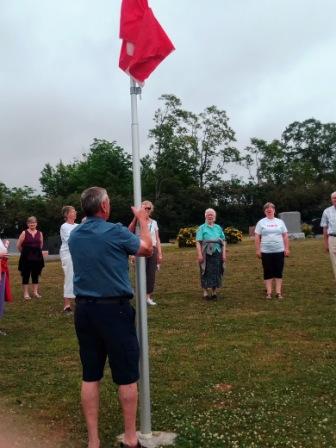
July 1, 2020.  Happy Canada Day! On July 1, a Canada Day ceremony to inaugurate a new flagpole and bench at the Tryon Cenotaph at the Tryon People’s Cemetery was attended by several members of the community, including Pieter and myself.  This event was coordinated by the Tryon Women’s Institute, Tryon People’s Cemetery, and Merry Pop-Ins Childcare Centre, with funding for the flagpole and bench provided by Heritage Canada.

Exif_JPEG_420

Pieter by the Tryon Cenotaph. (Photo credit: Daria Valkenburg)

Three names from WW1 that are listed on the portion of the Tryon Cenotaph shown in the photo above are also listed on the Cenotaph outside the Borden-Carleton Legion.  Over the years, their stories have been told in this blog:

Dignitaries attending today’s event included:

  • The Honourable Wayne Easter, Member of Parliament for Malpeque
  • The Honourable Jamie Fox, Minister of Fisheries and Communities and MLA for District 19
  • The Honourable Peter Bevan-Baker, Leader of the Official Opposition and MLA for District 17
  • Reverend Doctor Karen MacLeod-Wilkie, Minister of South Shore United Church

Exif_JPEG_420

Peter Bevan-Baker plays ‘O Canada’ as the flag is raised. (Photo credit: Daria Valkenburg)

Exif_JPEG_420

Tom Albrecht raises the flag on new flagpole.  (Photo credit: Daria Valkenburg)

Exif_JPEG_420

Of course there were Canada Day cupcakes!  Left to right: Jamie Fox, Fran Albrecht, Helen Green, Jack Sorensen.  (Photo credit: Daria Valkenburg)

Exif_JPEG_420

Standing by the Tryon Cenotaph, left to right: Wayne Easter, Peter Bevan-Baker, Jamie Fox. (Photo credit: Daria Valkenburg)

Barb Clement was kind enough to send a short video made while ‘O Canada’ was played. See https://drive.google.com/file/d/1vLQOBYtgnnOET7gAdi88C-9Z4HHf3BQr/view?usp=sharing

Thank you to the organizers of this Canada Day event, and to Barb Clement for sharing the video. If you have a story to share about any of the names on the Tryon Cenotaph, please contact Pieter at dariadv@yahoo.ca or comment on the blog.

© Daria Valkenburg

The WW1 Soldier Who Went To Post WW1 Germany

April 29, 2020.  In an earlier posting, the observations made by Harold Keith HOWATT of Augustine Cove towards the end of WW1 were recorded.  (See One Soldier Records His Observations During The Last Few Days Of World War I) Howatt was in the 8th Canadian Siege Battery during WW1 and came home after the war.

8th Siege Battery photo

On October 30, 1918, as Howatt’s unit travelled towards Belgium from France in the last days of the war, the Brigade was inspected by Lt-General Sir Arthur  Currie.  (Harold Howatt collection.  Photo from ‘Purely Personal’ issue of November 30, 1918.)

After the official hostilities ended on November 11, Howatt was in Belgium with his unit, and hoped he could go to Germany with the Army of Occupation.  He got his wish.

On November 17, 1918, Howatt’s unit was informed it would be attached to the 2nd Brigade, the only Canadian Heavy Artillery Brigade going to Germany.

Before the march into Germany, however, Howatt wrote, on November 19, 1918, how happy he was to have a real bath… “...Wonderful to relate, we had a bath parade to the bath at one of the mines. It was a rather long walk but a great bath when we got there, a shower bath with lots of warm water…

Screenshot Map of route to Germany at DuckDuckGo

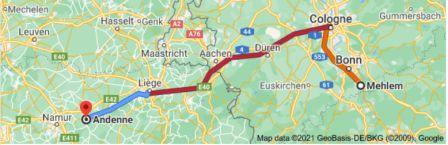
Route from Mons, Belgium to Mehlem (near Bonn), Germany taken by Howatt’s unit. (Map courtesy of http://www.duckduckgo.com)

On November 20, the unit was on the move. “…Breakfast at 5 o’clock this morning, then we fell in at 6:30 and marched up to the square.  Here we formed up and started for Germany, the lorries ahead, then the signallers and B.C.A.s, then the guns with the gun crews walking behind….” (B.C.A. is an acronym for Battery Commander Assistant, the position held by Howatt.) “...We stopped at a town called Jemappes, about four kms west of Mons.  We were billeted in a big factory, away up in the top story...”  The unit stayed there for a week.

On November 28, 1918, Howatt and his unit were on their way again.  “…Up this morning at 5:30, had two cups of coffee, then breakfast, and away.  We travelled in the lorries through town after town.  Had great fun waving our hands to all the pretty girls as we passed…”  Pretty girls weren’t all that caught Howatt’s interest. “…We stopped in one town for a few minutes and we were talking to a Canadian infantry corporal.  His company was guarding trainloads of munitions left by the Germans.  They had big munitions works in the town, and there were over 300 cars of shells and high explosives in the railway yards…”  Howatt didn’t identify this town, but mentioned that they stopped overnight in Ligny, and he was billeted in a farmhouse with a Belgian family.

The next day, November 29, Howatt continued his account.  “…Left Ligny this morning at about eight o’clock and arrived here in Namur about twelve.  All along the road are abandoned German lorries, tractors, and motorcars.  They must have left hundreds and hundreds behind them.  I don’t know whether these cars have broken down or whether the petrol gave out.  I saw one yard full of lorries….

Namur postcard

Postcard showing the citadel in Namur. (Harold Howatt collection.)

The unit stopped in Namur for a rest break, giving Howatt time to explore the town.  “…Namur is quite a place.  The forts are on a high cliff or hill behind the town.  The town has been badly smashed up in some places….

On December 1, the unit was moving ahead again.  “…We started about seven.   The road ran along the bank of the Meuse, and on the other side are enormous cliffs towering high in the air…..”  While Howatt, as part of the advance party, arrived in Huy around noon to secure accommodations “….the guns did not get in until nearly dark.  Just as we were waiting around for supper Mr. Goodwin came around and said that the B.C.A.s and signallers had to clear the mud off the wheels…”  Howatt, along with a small group, cleared off one gun, but noted that a number of men disappeared, rather than going out in the dark to tackle this task!

The next day, rather than continuing on, the unit was put to work cleaning the guns. On December 4, the unit moved further along to Hamoir, where they stopped for another few days.  On December 8, the unit travelled as far as Petit-Thier “…only 3 kms from the border.  It is a very small place…

On December 9, Howatt recorded that “…At last we are where we have been trying to get for over four years.  ‘In Germany’ This morning, at about eight o’clock we crossed the frontier, the first Canadian Siege Battery to enter Germany….

He noted that the mood in Germany was not the same as in Belgium.  “…About the only difference we noted on crossing the frontier was the absence of flags and any demonstrations on the part of the people.  They still came out when we passed and just looked at us without a word or smile.  One or two we met on the road saluted us.  The people do not seem to fear us, in fact I think they welcome us, hoping the presence of the troops will restore order, and result in a more even distribution of food. The country we passed through today was desolate….” That night they stopped in a small village, Mirfeld, where Howatt was “…billeted in a schoolroom...

On December 10, while trying to find a place to stay in Büllingen, the unit ran into opposition.  “…At first they were going to put us in the station house, but the old station master kicked about it, saying he had a telegram from a conference in Aix-la-Chapelle saying that station houses were not to be used for billeting troops...”  The Canadians found other accommodation.

By December 12, they had reached Cologne, and the next day, December 13, “….the Canadian troops marched across the Rhine, reviewed as they crossed the bridge by General Plumer and General Currie.  It was an inspiring sight to see the Canadians cross to the east bank of the Rhine….. The people here do not seem to be very hostile, in fact many are quite friendly but it must have been a bitter pill for these proud Prussians to swallow to have to witness the occupation of their city by the hated Canadians….

On December 16, the unit travelled to its final destination in Germany.  “….We started about 1:30 pm for Bonn or somewhere near.  We passed through Bonn…. and arrived about dusk in a little town called Mehlem.  We are billeted in an old theatre….

The 2nd Canadian Brigade stayed in Mehlem until January 28, 1919, when the Canadian Army of Occupation was relieved by the British 84th Brigade Royal Garrison Artillery.  Canadian troops moved back to Belgium and then onwards towards demobilization and home. Howatt was discharged on May 18, 1919.

There is an Island link between the Canadian Brigade, which Howatt was part of, and the British Brigade! One of the members of the British Army of Occupation was Lt. Henry “Harry” Warburton STEWART, one of the names listed on the Cenotaph outside the Borden-Carleton Legion.  Stewart died in hospital while in Germany and is buried in Cologne.  (For an account of our visit to the cemetery and his story, see On the War Memorial Trail ….. In Cologne)

Henry Warburton Stewart

Henry “Harry” Warburton Stewart. (Photo courtesy B. Stewart family collection)

At the time we visited Cologne we did not have access to the war diaries for Stewart’s unit.  Thanks to the coronavirus pandemic we got a lucky break.  The National Archives in the United Kingdom has offered free access to its digitized records while the Archives are closed to the public. Pieter was able to get the war diaries, so we now have confirmation why Stewart was in Germany.

His unit, the 77th Siege Battery Royal Garrison Artillery, became part of the 84th Brigade Royal Garrison Artillery, sent to relieve the Canadians.  According to the war diary, on January 29, 1919 “….a party of the 77th Siege Battery arrived in Namur…”  Unlike Howatt’s unit, which travelled by road, this unit “…. travelled to Mehlem by train...”  No mention is made of where in Mehlem the 77th Siege Battery was billeted.  Stewart must have fallen ill shortly after arriving in Mehlem as he ended up in hospital in nearby Bonn and died on February 11.

Unfortunately, as yet, we have not yet found a photo of Harold Howatt.  As well, the service file for Henry Warburton Stewart has not yet been digitized by the National Archives and is not available online. Can you help?  If so, please let Pieter know.  You can email him at dariadv@yahoo.ca or comment on the blog.

© Daria Valkenburg

One Soldier Records His Observations During The Last Few Days Of World War I

April 20, 2020.  As we stay in social isolation during the Coronavirus (Covid-19) pandemic, many people are wondering how we will react once the restrictions are lifted, how they will be lifted, and when they will be lifted.  At the moment there are no clear answers.  But there are examples in the past about how people reacted when major events came to an end.  One of these was the reaction of WW1 soldiers when they learned that the war would end on the 11th hour of the 11th month in 1918.  Some didn’t believe it would happen, others wondered why wait when a ceasefire was already in the works.  Some thought to reduce the loss of life by not actively pursuing the soon to be ex-enemy, while others strove to aggressively take out as many enemies out as possible.  George Lawrence PRICE, the Canadian soldier who was shot by a German sniper and died two minutes before the 11 am ceasefire comes to mind as an example of the latter. (See https://en.wikipedia.org/wiki/George_Lawrence_Price)

Harold Keith HOWATT, of Augustine Cove, was in the 8th Canadian Siege Battery during WW1 and survived the war.  With this year’s pandemic in mind, we looked through his writings to see if there was any mention of what later became known as the Spanish flu among the troops.  To our surprise, only one mention was made of flu, and it had nothing to do with soldiers!  On October 29, 1918 he wrote that “….I received three letters from PEI and in one of them was the news that Morley Newsome had died of influenza.  It was quite a blow to me, we had always been such good friends….” (Newsome, the son of Samuel Newsome and Charlotte Dawson, died on October 8, 1918, and is buried in Charlottetown.)

Next we wondered what he wrote once the news of an upcoming ceasefire was announced.  The first mention is of a rumour on November 5, 1918, while he was in Hérin, France, not that far from the Belgian border. “…The Allied Army is going strong all along the line, the Belgians are reported to be in Ghent, the Americans have captured Sedan, and the French are going strong.  There are rumours of an armistice…

Wikipedia Western_front_1918_allied

Orange star is the approximate location of Hérin, France where Howatt was located in early November.  Brown arrow is the location of Sedan, Belgium. (Map source: https://en.wikipedia.org/wiki/Hundred_Days_Offensive)

On November 6, 1918, he wrote that “…Peace rumours growing stronger.  It is reported that Mons is captured, also that the Germans have asked the Allied Command if they will receive a peace delegation…” Mons is in Belgium.

The next day, November 7, he recorded that it was “….officially reported that Turkey and Austria have unconditionally surrendered, that the Allied Fleet is in the Black Sea, and that Austria has to allow the Allies to march through their territory to attack Germany from the south…

On November 8, he sounds a hopeful note.  “…It is official that Germany is sending a peace delegation across the lines.  No one knows where the Germans are in front of here, somewhere beyond Mons.  There is great expectation of peace….

On November 9, he writes about going into the nearby town of Denain for a concert and later to visit a canteen where he met Canadians who recently arrived from England. “… There were a great number of Canadians in Denain today, two or three thousand reinforcements who have just come over from Blighty.  The rumour tonight is that the Allies have given Germany until Monday at 11:00 hours to agree to the terms of the armistice….”  All these rumours in the days before social media indicate the keen interest in what was happening!

Google Maps Cambrai

Hérin is circled in purple.  Denain is circled in orange. (Source: Google map for area around Cambrai, France.)

On November 10, Howatt’s unit was woken up at 5 am and told they would be on the move to Boussu, Belgium, a small town 10 kms west of Mons.  Then nothing happened all morning!  Hurry up and wait?  Finally, after dinner, Howatt was part of an advance party that left in a truck with “several signallers, two cooks, and Lutly and I…

Google maps Boussu

Howatt’s advance party travelled through Valenciennes to Boussu.  (Map source: Google)

When they arrived in Boussu, Howatt recorded that “…There are a large number of civilians in the town, and there was great excitement among the civilians, the band started to play, and the civilians flocked around, and started to dance, sing, and shout ‘La guerre est fini’.  The general impression seems to be that the war is about over…..

The first entry for Monday, November 11, 1918 was in quotes and underlined.  “Hostilities have ceased.”  Howatt then gave an account of the reaction.  “….At eleven o’clock this morning fighting ceased, the Germans have evidently accepted the terms of the armistice.  There was not much excitement today, the fellows hardly believe that it is true.  There is just a quiet undertone of gladness…

With fighting over, the rest of Howatt’s unit came to Boussu and they were billeted in a chateau built in 1539 and belonging to the Marquisse de Charbonne, a Parisian who used the chateau as a summer home.  Howatt mentions that the chateau had been “used by Fritz as billets. When we got over there to hold the billets we found about twenty Belgian girls here cleaning out the place.  It was in an awful mess….. We certainly had a circus here this morning with those girls, they would work for a while, then they would have a dance. I laughed more than I have for ages….

The end of fighting didn’t mean that soldiers were free to leave. On November 12, Howatt reports that “…Gun crews went down to clean the guns and signallers and B.C.A.s to clean their stores…” (B.C.A. is an acronym for Battery Commander Assistant, the position held by Howatt.)

On November 13, Howatt mentions more rumours going through his unit.  “...There are all sorts of rumours going around today, some say that we are going up into Germany, others say we are going right back to Canada.  I wouldn’t mind going into Germany at all….”  Not long afterwards, Howatt did go to Germany as part of the Army of Occupation.

We think of major events as having a beginning and an end.  They do, but the timing is staggered and never crystal clear.  Not only are there rumours, but there is a time lag when people begin to believe that what they have been told is true.  It must have been an enormous shock, mixed with relief, to learn that fighting was over, and then came the uncertainty while waiting to hear what would happen next. This is a lesson for us with the pandemic.

After returning home, Howatt married Louise Wright, and died on October 15, 1985, aged 93.  Does anyone have a photo of Harold Howatt? If so, please let Pieter know.  You can email him at dariadv@yahoo.ca or comment on the blog.

© Daria Valkenburg

The WWI Names On The Cenotaph Have Stories Of Their Own

February 8, 2020. Recently, Pieter and a friend went to see the British WW1 movie ‘1917’, which is nominated for several Oscars and has a Canadian connection due to a map used in the film.  (For that story see https://www.cbc.ca/news/entertainment/1917-canadian-contribution-1.5450608)  The story takes place in France on April 6, 1917, and is about two men tasked with delivering a message to another unit to warn of a German ambush.  The men go through several towns and villages in France’s Western Front.  Canadians may remember this period as being the lead up to the Battle of Vimy Ridge on April 9, 1917.

Pieter found the movie of great interest for several reasons. It was a depiction of the horrors of war… without being overly gory.  After being through the trenches and tunnels in Vimy Ridge a few years ago, he was intrigued to see the way soldiers sat on either side of a trench while waiting to go up into battle.   But the main reason he liked the movie is that it told the story of two people.

Contrary to what we learn in history books and classes, in the end all history is the cumulative stories of individuals.  A list of names on a cenotaph, such as the one outside the Borden-Carleton Legion, is meaningless without knowing who those people were and what happened to them.  This is what started Pieter on the journey to uncover the stories behind the names on the Cenotaph.

Over the years, the stories of those from WWI have been told in this blog.  24 are listed on the Cenotaph and half of them died in France…. Patrick Raymond ARSENAULT and John Lymon ‘Ly’ WOOD are listed on the Vimy Memorial as their bodies were never identified.    Also killed in France were Kenneth John Martin BELL, James CAIRNS, James Ambrose CAIRNS, Arthur Leigh COLLETT, Bazil CORMIER, Patrick Phillip DEEGAN (DEIGHAN), Joseph Arthur DESROCHES, Percy Earl FARROW (FARRAR), Ellis Moyse HOOPER, and Charles W. LOWTHER.  We were at the Vimy Memorial and visited each grave.

Five men died in Belgium. Two are listed on the Menin Gate Memorial in Ypres, as their bodies were never identified: Charles Benjamin Murray BUXTON and George Albert CAMPBELL.  We visited Menin Gate and the area where they died.  We also visited the graves of James Lymon CAMERON, Vincent Earl CARR, and Arthur Clinton ROBINSON.

Vincent Carr, who died during the Battle of Passchendaele on October 30, 1918, was initially buried in a trench with 4 others – two Canadian and two British soldiers.  Decades later, when they were reburied in a Commonwealth War Graves Commission cemetery, all three Canadians were still identifiable.  The British Army’s cardboard identity ‘tags’ had disintegrated, leaving the two British soldiers as unidentified.  Today, DNA testing can be done to help with identity, but decades ago this was impossible.

Two men died in England.  John Goodwill HOWATT was wounded in France, and died in a British hospital.  Bruce Sutherland McKAY had gotten ill during the transport from Canada to England and also died in a British hospital.

Henry Warburton STEWART survived the war, only to fall ill while in Germany as part of the occupation forces.  He’s buried in a German cemetery in Cologne, which we visited.

James Graham FARROW (FARRAR) was not a soldier, but in the Merchant Navy, transporting vital supplies between England and France, when his ship was torpedoed by a U-boat.

Three men died on Canadian soil.  Leigh Hunt CAMERON died of illness, while Harry ROBINSON died from blood poisoning.  William Galen CAMPBELL was poisoned with mustard gas on May 28, 1918, a few months before the end of the war, but was able to return home.  And yes, we’ve visited those graves as well.

We were also able to tell you parallel stories, such as that of Clifford Almon WELLS, who had many of the same experiences as John Lymon Wood, and also died in France. Another story was that of George BRUCKER, of the German Army, who was taken prisoner during the Battle of Vimy Ridge, and survived the war, never forgetting the two ‘tall’ Canadians who didn’t shoot him.  Decades later his son, now in his 80s, is still hoping to thank the families of those two unknown men.

Thanks to Pieter’s curiosity in trying to find out why one Commonwealth War Graves Commission gravestone in a cemetery in Cape Traverse was not recorded on the Cenotaph, we were able to tell you the story of Elmyr KRUGER, a soldier from Saskatchewan who died of illness while guarding German prisoners of war from a POW camp in Amherst.

We’ve told the stories of each man, and shared our visits to the various cemeteries and war memorials.  As photos and letters came in, we shared those experiences as well.

We are still missing photos of several of these soldiers, so the quest to put a face to every name and story is still ongoing.  Who are we missing?  Take a look and see if you can help:

Slide6

Slide8

Slide9

Slide10

Slide13

Slide15

Slide16

Slide20

Slide22

Slide23

UPDATE:  Photos of James Cairns, Joseph Arthur Desroches, and Harry Robinson have been found!

It’s great to watch a movie about fictional characters, but let’s not forget the stories of real life people! There won’t be any Academy Awards given out, but they will be remembered. Research continues to uncover more stories.  If you have a story or photo to share about any of the names mentioned in this posting, please contact Pieter at memorialtrail@gmail.com or comment on the blog.

© Daria Valkenburg

....Want to follow our research?…

If you are reading this posting, but aren’t following our research, you are welcome to do so.  Our blog address: https://onthewarmemorialtrail.com/

4 countries, 6 weeks, 7,000 km – an unforgettable war memorial journey in Europe…. Daria’s book ‘No Soldier Buried Overseas Should Ever Be Forgotten‘ is available in print and e-book formats.  Net proceeds of book sales help support research costs and the cost of maintaining this blog. For more information see https://nosoldierforgotten.com/

Subscribe to our YouTube Channel: On The War Memorial Trail With Pieter Valkenburg: https://www.youtube.com/channel/UCJ591TyjSheOR-Cb_Gs_5Kw

Never miss a posting!  Subscribe below to have each new story from the war memorial trail delivered to your inbox.