On The War Memorial Trail….. The Search For A Photo Of Gordon Frederick Johnson Is Over!

July 17, 2021. The four year search for a photo of WWII soldier Gordon Frederick JOHNSON of Truro, Nova Scotia, who is buried in the Canadian War Cemetery in Holten, The Netherlands is over!  (To read the original story about the search, see https://bordencarletonresearchproject.wordpress.com/2021/04/16/on-the-war-memorial-trail-the-search-for-a-photo-of-gordon-frederick-johnson/)

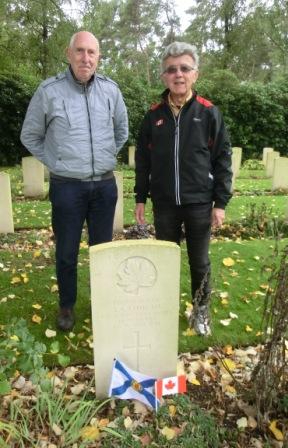
CIMG3304 Oct 3 2019 Holten Gordon Johnson

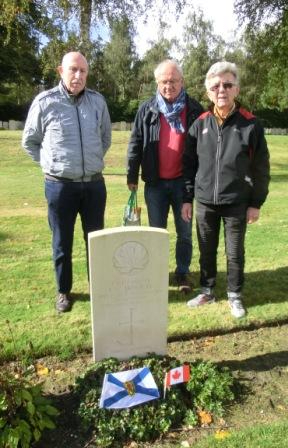
Grave of Gordon Frederick Johnson at the Canadian War Cemetery in Holten, The Netherlands. (Photo credit: Daria Valkenburg)

… A letter to the editor proved successful….

On June 24, 2021, Pieter’s letter to the editor was published in the Truro News. The first we knew of it was when the phone rang one Sunday.  The caller, Claudia Putnam, said a neighbour had dropped off the article while she was at church.  Her father, Clyde McCarthy, was a half-brother of Johnson, and her brother Randy had a photo.
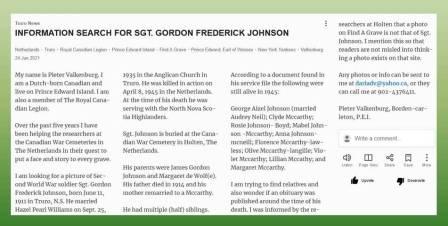
Letter about GF Johnson in Truro News Jun 24 2021 with border

Pieter’s letter to the editor in the Truro News.

Thanks to the opening of the Atlantic Bubble and a medical appointment in Halifax, we were soon able to meet Claudia and Randy, and learn more about this remarkable soldier.

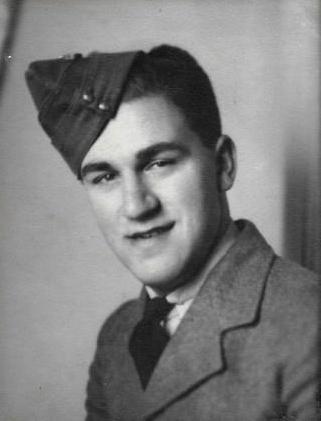
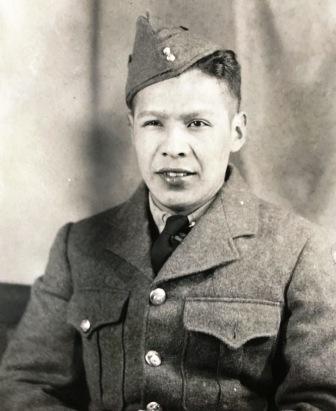
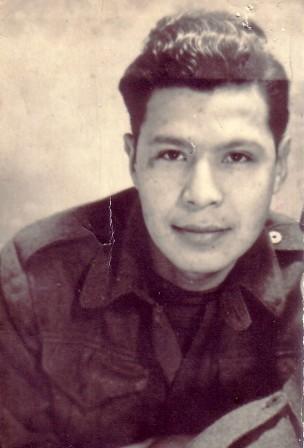
20210705_131112 Gordon Frederick Johnson

Gordon ‘Gordie’ Frederick Johnson.  (Photo courtesy of The McCarthy Family)

Randy explained that “…our father Clyde was very close to Gordon, who was known as Gordie…

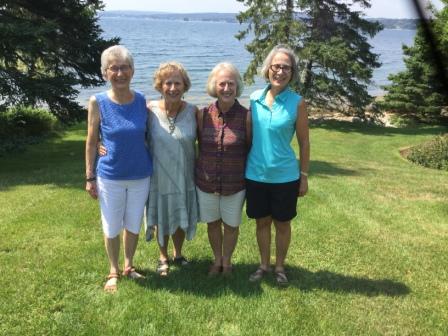
Randy McCarthy & Claudia Putnam with Pieter Masstown Market

Pieter, centre, with Randy McCarthy and Claudia Putnam.  (Photo credit:  Daria Valkenburg)

Randy and Claudia’s father was one of the children born to the second marriage of Gordon’s mother, Margaret.  Randy explained that “…Gordon’s father was a miner working in Missouri when he got black lung from working in the mines.  Margaret brought him back to Truro and he died in 1914, when Gordon was 3 years old...

Gordon’s brothers, George Johnson and Clyde McCarthy (Randy and Claudia’s father), also served in WWII. Thankfully, both survived the war.

In researching further, Pieter learned that Gordon had joined the militia in 1927 and received an Efficiency Medal and Clasp in 1939 for 12 years of service.  On October 13, 1939 he enlisted for active service with the North Nova Scotia Highlanders.

20210705_131129 Gordon Frederick Johnson

Gordon ‘Gordie’ Frederick Johnson.  (Photo courtesy of The McCarthy Family)

He served many years as an instructor in the use of mortars in England, with the rank of Warrant Officer, and took a demotion to Sergeant in order to join his regiment in Italy.  Instead, he was demoted and sent back to Canada as an instructor.

….’He had a very strong sense of duty’….

Gordon filed a grievance.  “...He had a very strong sense of duty to his unit...” remarked Pieter. In early August 1944 he was back in the United Kingdom. On September 29, 1944 he rejoined the North Nova Scotia Highlanders in France.

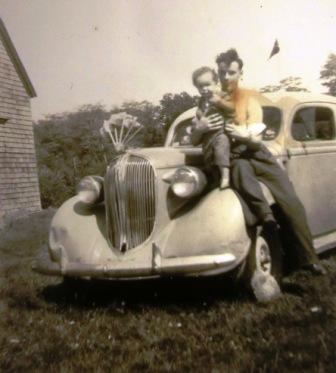
20210705_131316 Gordon Frederick Johnson on a motorcycle

Gordon Frederick Johnson.  (Photo courtesy of The McCarthy Family)

On April 8, 1945, Gordon was killed in action near Zutphen while trying to retrieve an anti-tank weapon that one of the members in his platoon had left behind.

…It’s worth repeating what had been said about him by a fellow soldier…” Pieter said. In ‘No Retreating Footsteps… the story of the North Novas’, Will Bird wrote that “A PIAT was left by the canal by someone in D Company and Sgt Gordie Johnson went back to get it.  He was killed by a sniper as he reached the spot. His passing was a sad loss…

Gordon’s mother died at the age of 93.  His wife Hazel Pearl stayed in touch with the family but as the older generation passed away, contact between the families faded.

Thank you to Claudia Putnam and Randy McCarthy for sharing information and photos.  Do you have photos or information about Gordon Frederick Johnson to share?  Please email Pieter at memorialtrail@gmail.com or comment on the blog.

© Daria Valkenburg

…Help needed to find two more photos …..

Your help is needed to put a face to two more members of the North Nova Scotia Highlanders for which a photo continues to be on the wish list:

  • Allan G. COUTTS of Alberta  UPDATE:  Photo found!
  • Archibald Henry NELSON of Prince Edward Island

….Want to follow our research?….

If you are reading this posting, but aren’t following our research, you are welcome to do so.  Our blog address: https://onthewarmemorialtrail.com/
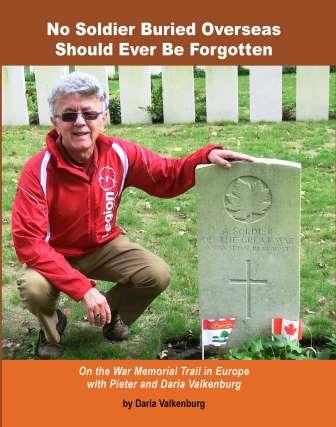
4 countries, 6 weeks, 7,000 km – an unforgettable war memorial journey in Europe…. Daria’s book ‘No Soldier Buried Overseas Should Ever Be Forgotten‘ is available in print and e-book formats.  Net proceeds of book sales help support research costs and the cost of maintaining this blog. For more information see https://nosoldierforgotten.com/

Screenshot_2021-02-27 On The War Memorial Trail With Pieter Valkenburg

You are also invited to subscribe to our YouTube Channel: On The War Memorial Trail With Pieter Valkenburg: https://www.youtube.com/channel/UCJ591TyjSheOR-Cb_Gs_5Kw.

Never miss a posting!  Subscribe below to have each new story from the war memorial trail delivered to your inbox.
On The War Memorial Trail….. The WW1 Letters Of Arthur Clinton Robinson

July 4, 2021. In 2017 we visited the grave of Arthur Clinton ROBINSON, a WW1 soldier with the 26th (New Brunswick) Battalion, from Tryon, Prince Edward Island, who is buried in Belgium, (See https://bordencarletonresearchproject.wordpress.com/2017/10/16/on-the-war-memorial-trail-in-belgium-and-a-visit-to-la-laiterie-military-cemetery/)  Up to today, we have not found of a photo of him, and neither has his family.

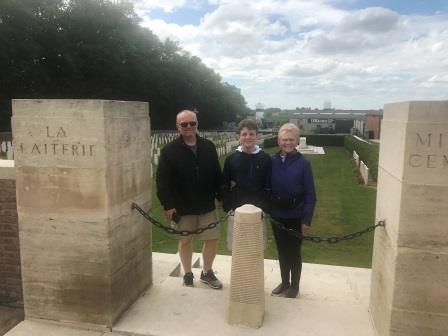
In June 2018, Arthur’s nephew, Arthur ‘John’ Robinson and his wife Hazel visited the grave with their son, dentist Dr. Alan Robinson, and Alan’s son, William Robinson.

2018-06-16 Arthur C Robinson grave (1)

At La Laiterie Military Cemetery in Belgium.  Left to right: Dr Alan Robinson, William Robinson, Hazel Robinson.  (Photo credit: John Robinson)

While no photo has yet been found, the Robinsons were able to find two letters that Arthur wrote to his aunts. 

In an August 30, 1915 letter to his aunt, Robbie Blanchard, written in England just before travelling to France,  he describes the composition of men in his platoon from the 26th (New Brunswick) Battalion: … You should just see the bunch of men … in this 26th alone. They are a magnificent body of fellows….and this Platoon I am in is a corker… there are, I don’t know how many different nationalities in it… Indian, French, Russians, Belgians, English, Irish, Scotch, Americans and Canadians.  Some mob, eh? You can hear nearly any language around here any time of day….” 

While in England, Arthur saw injured troops arriving back from the front and reflected that “…when you see the hundreds of maimed soldiers, some far worse off than if they were dead, and when nearly daily train loads of freshly wounded men pass right before your eyes, it makes you wonder at the ups and downs of this human life…” 

It was a miracle that the August 30 letter arrived in Canada, as the ship the mail had been travelling on, the Hesperian, was torpedoed by a German submarine off the coast of Plymouth, England on September 4, 1915! Luckily it was one of the items salvaged from the wreckage. (See https://www.rmslusitania.info/related-ships/hesperian/ for more information) 

In a September 16, 1915 letter, written in France to his aunt, Carrie Robinson, he outlines life in a trench: …I am quite comfortable here in our cosy little dugout, out of reach of all the Germans in Europe.  I must tell you about the nice dugout and the 4 fellows who are in it with me.  It is a kind of a tunnel running into the side of a loamy hill, with rubber sheets and blankets hung over the mouth of it….” 

There was no electricity in the trench, as Arthur goes on to mention that …We have niches in the back, where we keep our equipment, and we put candles in them at night so we won’t be too lonesome…” 

He then describes how the equipment is turned into a bed for the night. “…On the floor we have straw, stolen from a stack near by, and all over our kits, which make excellent beds, when you know how to arrange them…” 

Although he doesn’t identify them by name, Arthur mentions his 4 trench companions: …1st They are all six footers. 2nd They all wear a seven cap or larger. 3rd They cannot get their feet into smaller boots than nines, and 4th They all weigh over one hundred and seventy pounds each…”  He goes on to say that he weighs over 170 pounds himself and is well fed.  

The saying goes that an army marches on its stomach, and Arthur’s account of his dinner indicates the importance of food.  “…We had potatoes and meat, bread and butter, and tea of course.  We could have had cheese and jam too if we wanted to, but we always try and keep it over for tea.  The bread and butter is great and the cooks of our company seem to have a natural gift of making good tea so we are lucky in that line…” 

One of the challenges in writing letters from the front during wartime is censorship so as not to divulge any information that might be used by the enemy.  Arthur writes about that: …I find it hard to write a letter here for they are so particular about what a person tells that if you write anything you are not supposed to tell they destroy the whole shooting match…

It’s wonderful that these letters survived so that we get a glimpse into Arthur Robinson’s thoughts and experiences.  Sadly, he lost his life on March 27, 1916 when shellfire hit the trenches southeast of Kemmel, Belgium. 

IMG_3466 Hazel and John Robinson

Hazel and John Robinson. (Photo courtesy of the Robinson Family)

Hazel Robinson explained that their 2018 trip was a war memorial tour.  “…Besides visiting Arthur’s grave on this trip, we followed in the footsteps of the Sherbrooke Fusiliers from England to France, Belgium, Germany, ending in the area of Wons. The Sherbrooke Fusiliers was my father’s unit. We also visited Vimy Ridge where my great-uncle is buried….

Hazel’s great-uncle was “William John HILL from Cassius on the Miramichi River in New Brunswick…”  He lost his life on April 9, 1917 and is buried in Canadian Cemetery No 2 in Pas de Calais, France.

During the trip, Hazel noted two coincidences.  “… A member of the Sherbrooke Fusiliers was buried beside Elmer Muttart in 1945….”  Elmer Bagnall MUTTART of Cape Traverse, Prince Edward Island is buried at Harlingen General Cemetery in The Netherlands. (See https://bordencarletonresearchproject.wordpress.com/2017/07/28/the-elmer-bagnall-muttart-story/ and https://bordencarletonresearchproject.wordpress.com/2019/10/15/on-the-war-memorial-trail-the-visit-to-harlingen-general-cemetery/)

Most likely, Hazel is referring to Thomas ‘Tommy’ Clayton REID.  We’d placed flags on his grave when we visited in October 2019.

CIMG3450 Oct 12 2019 Harlingen General Cemetery

Grave of T.C. Reid at Harlingen General Cemetery in The Netherlands.  (Photo credit: Daria Valkenburg)

Hazel found another coincidence in France. “…When we visited the cemetery in Vimy where my great-uncle is buried, the last family to sign the guest book was a family from my home town, Douglastown, in New Brunswick, and whose parents I knew well and who lived a few houses from my parents!…” 

Thank you to Hazel and John Robinson for sharing Arthur’s letters and information about their 2018 trip. If you have photos or information to share, please contact Pieter at dariadv@yahoo.ca, comment on the blog, or send a tweet to @researchmemori1

If you are reading this posting, but aren’t following the blog, you are welcome to do so.  See https://bordencarletonresearchproject.wordpress.com or email me at dariadv@yahoo.ca and ask for an invitation to the blog. 

Screenshot_2021-02-27 On The War Memorial Trail With Pieter Valkenburg

You are invited to subscribe to our YouTube Channel: On The War Memorial Trail With Pieter Valkenburg: https://www.youtube.com/channel/UCJ591TyjSheOR-Cb_Gs_5Kw

© Daria Valkenburg

On The War Memorial Trail….. Remembering WWII Soldier Leo Francis Toney

May 22, 2021. No soldier buried overseas should be forgotten. This statement by Pieter underlines the efforts he has been making over the past years.  Currently he’s been working his way through a ‘photo wish list’ of soldiers buried in The Netherlands, on behalf of Dutch researchers.  After completing a list of soldiers from Prince Edward Island, last fall he started on a list of soldiers from New Brunswick and Nova Scotia who are buried in the Canadian War Cemetery in Holten.

In January 2021 a series entitled Atlantic Canada Remembers began on this blog.  Currently it’s up to Part 9, with ongoing research for Part 10.  The list has expanded to include the two Canadian War Cemeteries in Groesbeek and Bergen Op Zoom, and Adegem Canadian War Cemetery in Belgium.

An article ‘First Nations in The Second World War’ by Berry Swarthoff and Glenn Miller, published in the Dutch magazine ‘Nanai’ noted that after Canada declared war in 1939, “the country’s indigenous community responded quickly…. Officially, about 4,000 First Nations soldiers served abroad in World War I, while 4,250 First Nations soldiers served in World War II. Recent research has shown that thousands of other First Nations, Métis and Inuit soldiers … volunteered without identifying themselves as a First Nation….In total, more than 500 native soldiers died…”  This posting honours the sacrifice of one of these Indigenous soldiers.

….Remembering Leo Toney….

Leo Toney

Leo Francis Toney. (Photo courtesy of the Toney Family)

When Della Maguire contributed photos and information about her uncle, Leo Francis TONEY, on behalf of the Toney family, she explained that he “…was of Mi’kmaq ancestry and a member of the Annapolis Valley First Nation in Nova Scotia. The Mi’kmaq way to spell Leo is Li’o…

Born March 24, 1924 in Wolfville, Nova Scotia, Leo was the son of Frank Robert Toney and Mary Lucy Bradford of Cambridge, Nova Scotia.

Before he enlisted in 1943 in Halifax, Nova Scotia, Leo worked as a farmer for Earl Brown of Cambridge.  Upon enlistment he was initially stationed at the No 6 District Depot on Chebucto Road in Halifax.

On January 14, 1944 he was sent to the Canadian Infantry Training Centre (CITC) in Yarmouth, Nova Scotia for training.  On April 30, 1944 he was assigned to the Canadian Infantry Training Centre (CITC) in Aldershot, Nova Scotia.

He arrived in the United Kingdom on July 27, 1944 and transferred to the Canadian Base Reinforcement Group (CBRG).   On August 18, 1944 he went to France as a member of the PEI Light Horse Regiment, and then, on October 6, 1944 was transferred to the South Saskatchewan Regiment.

leo xxx

Leo Francis Toney. (Photo courtesy of the Toney Family)

….The South Saskatchewan Regiment liberated the Schipbeek Canal bridge….

In a brief account by Lt Col G. B. Buchanan in ‘The March Of The Prairie Men – being a story of the South Saskatchewan Regiment’, in early April 1945, the liberation of Holten, The Netherlands, began as troops crossed the Twente Canal and began to build a bridge. “...The intention of the 6th Canadian Infantry Brigade was to pass through 5th Canadian Infantry Brigade and hold a bridgehead over the Schipbeek Canal north of Laren….”  (See https://en.wikipedia.org/wiki/Schipbeek)

They made it safely across on April 5.  They got stuck at the Schipbeek after the Germans blew up all bridges on April 6, and a bridgehead was formed at a weir on the border of the municipalities of Bathmen and Holten. The heavily defended Wipperts Bridge (Wippertsbrug) was a major obstacle between Laren and Holten.

…The South Saskatchewan Regiment was to make the crossing with ‘H’ hour set at 0330 hours, 7th April.  ‘C’ and ‘D’ Companies were to make the initial crossings with ‘A’ and ‘B’ Companies passing through them.  The opening artillery barrage caused casualties when a few rounds fell short….

….10 soldiers were buried on Nijenhuis farm…

At some point during the fighting, Leo was killed in action on Saturday, April 7, 1945. In addition to Leo, the following members of the South Saskatchewan Regiment lost their lives in the battle:

  • Pte Murray James Hilton ELLIS, died April 9, 1945
  • Lt Richard Kelso KERR, of Port Arthur, Ontario, died April 8, 1945
  • Pte Edwin Allan ‘Eddie’ NUGENT, of Delisle, Saskatchewan, died April 9, 1945
  • Pte Arthur Francis PURCELL, of  East Petpeswick, Nova Scotia, died April 7, 1945
  • Pte Elmer Alphonso RICHARDS, of  Thorold, Ontario, died April 7, 1945
  • Pte Neil Patrick O‘Connor STEWART, of St. Paul, Alberta, died April 8, 1945
  • Sgt Kenneth Earl STUBBS, of Winnipeg, Manitoba, died April 7, 1945

Leo and his fellow soldiers from the South Saskatchewan Regiment, with the exception of Nugent and Stewart, were temporarily buried in a field on the Nijenhuis farm, along with 4 soldiers from other Regiments:

  • Lance Cpl Roger George COLLIN, Le Regiment de Maisonneuve, of Gogama, Ontario, died April 9, 1945
  • Sgt Donald Mayford FIFE, Canadian Provost Corps, of Halfway River, Nova Scotia, died April 7, 1945
  • Sapper Andrew Lawrence FORD, Royal Canadian Engineers, of St. Thomas, Ontario, died April 7, 1945
  • Pte Cyrille GIGUERE, Le Regiment de Maisonneuve, of Quebec City, Quebec, died April 9, 1945
Map showing Nijenhuis farm location

Map showing location of burials on the Nijenhuis farm.  (Map courtesy of the Holten Canadian War Cemetery Information centre.)

An account in ‘The Liberation Of The Beuseberg – How Canadians set a village in the Netherlands free’ quotes Bertus Ebrecht, who was 16 years old at the time, that the burials were “…in the meadow of Nijenhuis, about 70 metres from the ‘Larensweg’…”  This book, edited by Agnes van Wieringen, written by Joice Schutte, records the stories told to Gert Jansen by the people from the Beuseberg area.

In another excerpt from the book, Florina Dijkshoorn, 15 years old at the time, recalled that the Nijenhuis farm housed a German hospital.  “…April 7, half past four, it was still dim….”  People had been hiding in a dugout shelter, and after the shooting stopped, they were able to get out.  “… we walked to the farm….The German hospital flag was replaced by an allied flag.  What we also saw were a lot of soldiers walking in the meadow and on the road from the direction of ‘Schipbeek’. We had to go to Meijerman’s farm. Nijenhuis’ farm was probably filled with wounded Canadians…..

When they were allowed to leave “…we were shown a path in the meadow which was cleared of explosive material.  It also meant we had to walk along the dead.  Once I was alone….I …. thought of all the mothers, fathers, women and children that might not even know they were dead!…. An hour later they were picked up and carried away in a closed lorry….

On April 7, 2016 a memorial was placed to honour the members of the South Saskatchewan Regiment who died during this event. (See https://www.tracesofwar.com/sights/100747/Memorial-The-South-Saskatchewan-Regiment.htm)

….Nugent and Stewart were buried elsewhere….

Map showing location of Nijenhuis farm and burial location near Lochem

Map showing location of burials on the Nijenhuis farm and near Lochem.  (Map courtesy of the Holten Canadian War Cemetery Information centre.)

I asked Henk Vincent, one of the researchers for the Canadian War Cemetery in Holten, if he had information on where Nugent and Stewart were first buried.  He confirmed that they “were temporarily buried near Lochem, where there was a military hospital at the time. Perhaps they had been transported there seriously injured….

….Leo’s brother-in-law was concerned….

Della’s father, Abraham ‘Abe’ SMITH, was with the Royal Canadian Army Service Corps 36 Depot, an administrative and transport corps of the Canadian Army. “….My Father enlisted in September 1, 1943.  He became a truck driver delivering food, supplies, troops, and equipment to various places in England, Germany, France and Belgium, and was discharged May 29, 1946….”  (To learn more about Abraham Smith, see https://www.saltwire.com/atlantic-canada/news/canada/honouring-first-nations-wartime-experiences-accomplished-nova-scotian-mikmaq-basket-maker-remembered-518058/)

Abe had a feeling something had happened to his brother-in-law.   “….When he told us about Uncle Leo he said: ‘I used to write to Leo and he’d write back. I didn’t hear from him for a long time and I told Rita he must be wounded or got killed’….”   They had been in regular correspondence with each other and the silence suggested Leo was either wounded or had lost his life.

… Leo has a permanent resting place at the Canadian War Cemetery in Holten….

Leo was reburied at the Canadian War Cemetery in Holten after the war.

toney, leo francis

Grave of Leo Toney at the Canadian War Cemetery in Holten.  (Photo courtesy of Holten Canadian War Cemetery Information Centre)

Della reflected that her Uncle Leo “would have been proud of his sister, my mother Rita, for being the only Mi’kmaq woman to become Chief of two communities…

Thank you to Della Maguire for sharing photos and anecdotes of Leo Toney.  If you have information to share about Leo Toney or any Canadian soldiers buried in The Netherlands, please contact Pieter at memorialtrail@gmail.com, or comment on the blog.

© Daria Valkenburg

…Want to follow our research?….

If you are reading this posting, but aren’t following the blog, you are welcome to do so.  Our blog address: https://onthewarmemorialtrail.com/

Front cover OnTheWarMememorialTrailinEurope4 countries, 6 weeks, 7,000 km – an unforgettable war memorial journey in Europe…. Daria’s book ‘No Soldier Buried Overseas Should Ever Be Forgotten‘ is available in print and e-book formats.  Net proceeds of book sales help support research costs and the cost of maintaining this blog. For more information see https://nosoldierforgotten.com/

Screenshot_2021-02-27 On The War Memorial Trail With Pieter Valkenburg

You are also invited to subscribe to our YouTube Channel: On The War Memorial Trail With Pieter Valkenburg: https://www.youtube.com/channel/UCJ591TyjSheOR-Cb_Gs_5Kw.

Never miss a posting!  Subscribe below to have each new story from the war memorial trail delivered to your inbox.

On The War Memorial Trail…..A Tragic Drowning On The Leda River in Germany – Part 3

May 17, 2021.  When we visited the Canadian War Cemetery in Holten in October 2019, we laid flags down at the graves of five soldiers from the North Nova Scotia Highlanders who drowned in a tragic accident in Germany on April 28, 1945.

Recap: In Part 1, the 5 soldiers were identified and the circumstances leading up to the accident were summarized. In Part 2, more information on the accident was discussed, as well as a brief story on Lloyd William Murray, one of the 5 soldiers.  The rest of this series features the other North Nova Scotia Highlanders who lost their lives that day.

In October 2018, while we were in Nova Scotia, we were able to meet two nieces of Joseph Ambroise COMEAU, the only family members of the 5 soldiers we were able to meet in person – up to now.

CIMG2715 Oct 11 2018 Simone Comeau Pieter Jacqueline Comeau in Windsor

Pieter with Simone Comeau, left, and Jacqueline Comeau, right.  (Photo credit: Daria Valkenburg)

Simone, Jacqueline, and their two sisters are diligent in remembering their uncle.

IMG-1039 Comeau sisters

The Comeau sisters of Nova Scotia.  Left to right:  Simone Comeau, Jacqueline Comeau, Anna (Comeau) Gammell, and Rose-Marie Comeau. (Photo courtesy of Simone Comeau)

…. Joseph ‘Ambroise’ Comeau Remembered….

Joseph Ambroise Comeau from Simone

Joseph ‘Ambroise’ Comeau.  (Photo courtesy of niece Simone Comeau)

Niece Simone Comeau wrote a brief overview of her ‘oncle Ambroise’.  “… Private Joseph Ambroise Comeau was born on October 1, 1923 in Lower Saulnierville, Nova Scotia, Canada, the fourth of six children to Gustave and Jessie (Saulnier) Comeau.

Ambroise was baptized on October 4, 1923 in Sacred Heart, Saulnierville, the local parish church. He also made his first confession, first Communion, and confirmation, all sacraments of the Roman Catholic faith in this church.

According to records, he had little schooling. Being from a poor family, his farmer/blacksmith father had no financial means to send him to the private local boys’ college. At the time of his draft he was employed as a carpenter for Clare Shipbuilding Company.

One has to wonder as to whether he had a premonition regarding the probability of his not returning to Canada as a veteran, since he was most reluctant to leave, according to the family of his then three old goddaughter, to whom he had brought a gift on his good-bye visit.

Sadly, Private J. Ambroise Comeau (F.602531) of the North Nova Scotia Highlanders was killed on April 28, 1945, a victim of World War II. On June 3, 1945, a memorial was held in Sacred Heart Church where he had practised his faith until his departure for the war. Being ever faithful to his beliefs, at the time of his death he carried a religious medal and a rosary on his person….

Ambroise, who was fluent in both English and French, enlisted on April 28, 1944 in Halifax, Nova Scotia, and lost his life exactly a year later.  As part of the Canadian Infantry Training Regiment (CITR) he arrived in the United Kingdom on January 10, 1945.  He was temporarily assigned to the St John Fusiliers, before being reassigned to the CITR.  On March 28, 1945 he arrived in North West Europe as part of the IGU (Infantry General Unit) before being transferred to the North Nova Scotia Highlanders on April 19, 1945.

According to his service file, on May 19, 1945 Ambroise was buried on top of a dike in Leer, Germany before being reburied in the Canadian War Cemetery in Holten.

Grave of Joseph Ambroise Comeau

Original grave marker in Germany for J.A. Comeau.  (Photo from the service file.)

CIMG3274 Oct 3 2019 Holten Joseph Comeau

By the grave of Joseph ‘Ambroise’ Comeau at the Canadian War Cemetery in Holten in October 2019.  Pieter is standing with Dutch researcher Edwin van der Wolf, left. (Photo credit: Daria Valkenburg)

…. to be continued…..

In Part 4 we learn about more of the North Novies who lost their lives.   Thank you to Simone and Jacqueline Comeau for sharing photos and information about their uncle.

If you have information to share about these or any Canadian soldiers buried in The Netherlands, please contact Pieter at memorialtrail@gmail.com, or comment on the blog.

© Daria Valkenburg

…. Previous postings in this series…..

Missed the previous postings in this series? See:

…Want to follow our research?…

If you are reading this posting, but aren’t following our research, you are welcome to do so.  Our blog address: https://onthewarmemorialtrail.com/

Front cover OnTheWarMememorialTrailinEurope4 countries, 6 weeks, 7,000 km – an unforgettable war memorial journey in Europe…. Daria’s book ‘No Soldier Buried Overseas Should Ever Be Forgotten‘ is available in print and e-book formats.  Net proceeds of book sales help support research costs and the cost of maintaining this blog. For more information see https://nosoldierforgotten.com/

Screenshot_2021-02-27 On The War Memorial Trail With Pieter Valkenburg

You are also invited to subscribe to our YouTube Channel: On The War Memorial Trail With Pieter Valkenburg: https://www.youtube.com/channel/UCJ591TyjSheOR-Cb_Gs_5Kw.

Never miss a posting!  Subscribe below to have each new story from the war memorial trail delivered to your inbox.

On The War Memorial Trail…..A Tragic Drowning On The Leda River in Germany – Part 2

May 16, 2021.  When we visited the Canadian War Cemetery in Holten in October 2019, we laid flags down at the graves of five soldiers from the North Nova Scotia Highlanders who drowned in a tragic accident in Germany on April 28, 1945. 

Recap: In Part 1, the 5 soldiers were identified and the circumstances leading up to the accident were summarized. (See https://onthewarmemorialtrail.com/2021/05/15/on-the-war-memorial-trail-a-tragic-drowning-on-the-leda-river-in-germany-part-1/)

….Another account of what happened….

Part 2 provides more information.  In ‘River Assault – Operation Duck: The 3rd Canadian Infantry Division’s Attack On Leer 28th April 1945’, author John Sliz wrote that “…The Highland Light Infantry cleared the north landing dock of the Leda River ferry in time for ‘C’ Company of the North Novas to be transported over in storm boats….. Unfortunately, ‘C’ Company’s crossing was eventful…

…It started at 1540 when Lt MacLean of the 20th Field Company, RCE, called the boat pool for 12 Storm Boats to go to the Leda River ferry site. The trip was fine, despite the choppy water and wind.  Sgt G. Stewart and 13 Platoon were the first to be ferried over…” RCE refers to Royal Canadian Engineers.

…The next were company headquarters, Lt Laskin with 14 Platoon and Lt R.S. McGlashen with 15 Platoon….”  After crossing the river, all 3 Platoons were to “… swing north towards the town….” of Leer.

… All was fine until a very unfortunate incident occurred when one boat, containing half of 15 Platoon, including Lt McGlashen, set out from the south bank. That is when the shelling started. The young engineer operating the motor became very excited.  The other sapper shouted at him not to turn on full power because when the motor dipped it would upset the boat’s balance. Unfortunately, when they were halfway across, a shell landed very close to the boat and the nervous sapper gunned the engine, shifting the weight and allowing water to flow over the gunwales….

…Lt McGlashen managed to shed his heavy equipment and not only made it to the shore, but managed to help another man ashore. All but 5 men made it to the shore…”  These were the 5 men from the North Nova Scotia Highlanders.

….Why did the men drown?….

Why did the five men drown?  John Sliz noted that “…These men sank, never to rise again, even though life belts were worn.  The reason for this was the heavy equipment worn by the men was too much for the life belt that was used….

Sliz quotes from a report by Brigadier John M. Rockingham.  “…The equipment was worn….. in such a way that the waist belt alone had to be unbuckled to permit the soldier to shake it free. There was, however, a tendency for this equipment to slide down the arms, pressing them into the side, preventing any swimming motion, until it was finally clear….”  It would have been like trying to swim while wearing a straightjacket!

….From the Lloyd William Murray records….

Lloyd W Murray photo

Lloyd William Murray.  (Photo courtesy of Murray Baillie)

The accounts of the accident match the war diary entry for the North Nova Scotia Highlanders Regiment.  In the service file for Lloyd William MURRAY, a ‘Questionnaire On A Missing Officer Or Soldier’ noted that the boat capsized at “…about 1630 hours...”

A description of the event states that “…Boat was moving full throttle across Leda River which was very rough at the time.  Other boats were also making water choppy.  Waves breaking over bow of storm boat capsized the boat.  Pte Murray, LW was in boat when it sank...”

On May 22, 1945, Chaplain Graydon O. Coy wrote to Lloyd Murray’s mother, explaining that “…Lloyd was killed in action near the town of Leer in Germany when the North Novas were crossing the Emms Canal, one of the boats was hit; and your son and several others were killed. On account of the action, the bodies were not recovered until several days ago.

I buried Lloyd in the allied military plot in the Lutheran cemetery in Leer. I understand though that the Graves Commission will see that the bodies of our Canadian boys are brought together in a central cemetery as soon as possible….” 

On June 8, 1945, Lt McGlashen wrote to Lloyd Murray’s mother, to tell her that “…Your son was a loyal and efficient member of my platoon in C Company and in action proved himself a courageous leader…

McGlashen went on to describe the events leading to the boat capsizing, and noted that “…other boats came to our rescue quickly, but 5 boys of my platoon were gone…

…. Lloyd William Murray Remembered….

Lloyd Murray’s nephew, Murray Baillie, explained that “…Lloyd had three brothers and four sisters; they felt immense pain when they heard of his death near the end of the war in 1945…

Born on April 4, 1917, Lloyd was the son of John and Bessie Murray, of Tatamagouche, Nova Scotia.  Before officially enlisting on June 1, 1944 in Halifax, Nova Scotia, he worked for several years in Ontario mines and later in Pictou shipyards. 

CIMG2699 Lloyd Murrary & Murray Baillie 1941 in Corktown

Lloyd Murray with his nephew Murray Baillie in 1941. (Photo courtesy of Murray Baillie)

In 1944 Lloyd was at Camp Ipperwash in Forest, Ontario, and wrote to his sister Emma that “…I am getting along fine and like it here good. It is a very nice camp here. It is only about twenty miles from the border to US. I go over to Detroit quite often. They sure use the servicemen great there. We get leave every two weeks…

On March 29, 1945 he wrote Emma from Europe.  “…I am in Germany now and getting along fine. I am writing this letter in a slit trench and there is sure quite a bit of noise around. We got the Germans on the run. Don’t think war will last much longer.

I hope not anyway. I was in Belgium quite a little while and like it great there. It sure is a nice place.

We are having nice weather here. Hope it stays this way….

CIMG3234 Oct 3 2019 Holten Lloyd Murray

By the grave of Lloyd William Murray at the Canadian War Cemetery in Holten in October 2019.  Pieter is standing with Dutch researchers Edwin van der Wolf, left, and Henk Vincent, centre. (Photo credit: Daria Valkenburg)

…. to be continued…..

In Part 3 we learn more about the North Novies who lost their lives.   Thank you to Murray Baillie for sharing photos and the letters written by Lloyd William Murray. 

If you have information to share about these or any Canadian soldiers buried in The Netherlands, please contact Pieter at memorialtrail@gmail.com, or comment on the blog. 

© Daria Valkenburg

…Want to follow our research?…

If you are reading this posting, but aren’t following our research, you are welcome to do so.  Our blog address: https://onthewarmemorialtrail.com/

Front cover OnTheWarMememorialTrailinEurope4 countries, 6 weeks, 7,000 km – an unforgettable war memorial journey in Europe…. Daria’s book ‘No Soldier Buried Overseas Should Ever Be Forgotten‘ is available in print and e-book formats.  Net proceeds of book sales help support research costs and the cost of maintaining this blog. For more information see https://nosoldierforgotten.com/

Screenshot_2021-02-27 On The War Memorial Trail With Pieter Valkenburg

You are also invited to subscribe to our YouTube Channel: On The War Memorial Trail With Pieter Valkenburg: https://www.youtube.com/channel/UCJ591TyjSheOR-Cb_Gs_5Kw

Never miss a posting!  Subscribe below to have each new story from the war memorial trail delivered to your inbox.
The Photo Tribute At The Canadian War Cemetery In Groesbeek

20210505_091943 May 5 2021 Dutch flag on Liberation Day

The Dutch flag flies proudly at the Valkenburg household on Liberation Day. (Photo credit: Daria Valkenburg)

May 10, 2021. In the last blog posting, we featured photos at the graves of 7 soldiers buried in the Canadian War Cemetery in Groesbeek, The Netherlands.  As part of the Liberation Day 2021 commemoration, photos of over 1,600 soldiers were placed by their graves and will remain until May 17. 

In that posting, photos of the graves of 4 soldiers from PEI whose stories have already been told in this blog, and 3 Indigenous soldiers that Pieter is currently researching, were featured. (See https://bordencarletonresearchproject.wordpress.com/2021/05/05/commemorating-liberation-day-at-the-canadian-war-cemetery-in-groesbeek/)

Recently, we received information on one more Indigenous soldier, who has been added to Pieter’s research list.  We asked Alice van Bekkum, Chair of the Groesbeek Faces to Graves Committee, to take the photo of his grave.

…. Grave of 1 Indigenous Soldier….


IMG_8567-AVB Grave of Thomas Big Canoe in Groesbeek

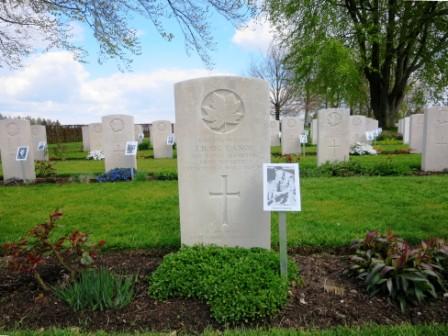
Grave of Thomas Beresford Big Canoe. (Photo courtesy of Alice van Bekkum)

Thomas Beresford BIG CANOE, son of Thomas H. and Hannah Bigcanoe, of Georgina Island, Ontario, was serving with the Royal Hamilton Light Infantry when he lost his life on March 8, 1945, at the age of 19.

…. The Faces Of Groesbeek video….

Alice sent a short film about the photo exhibition at the cemetery, entitled ‘The Faces of Groesbeek’.   Make sure you have tissues handy when you watch this.  There will be tears once you see the piper playing as he walks, row by row, through the cemetery.

Thank you to Alice van Bekkum for taking the photos of the grave of Thomas Beresford Big Canoe, and for sharing ‘The Faces of Groesbeek’ video.

If you have photos or information to share about any Canadian soldiers buried in The Netherlands, please contact Pieter at memorialtrail@gmail.com, comment on the blog, or send a tweet to @researchmemori1

© Daria Valkenburg

…Want to follow our research?…

If you are reading this posting, but aren’t following our research, you are welcome to do so.  Our blog address: https://onthewarmemorialtrail.com/

Front cover OnTheWarMememorialTrailinEurope4 countries, 6 weeks, 7,000 km – an unforgettable war memorial journey in Europe…. Daria’s book ‘No Soldier Buried Overseas Should Ever Be Forgotten‘ is available in print and e-book formats.  Net proceeds of book sales help support research costs and the cost of maintaining this blog. For more information see https://nosoldierforgotten.com/

Screenshot_2021-02-27 On The War Memorial Trail With Pieter Valkenburg

You are also invited to subscribe to our YouTube Channel: On The War Memorial Trail With Pieter Valkenburg: https://www.youtube.com/channel/UCJ591TyjSheOR-Cb_Gs_5Kw

Never miss a posting!  Subscribe below to have each new story from the war memorial trail delivered to your inbox.
Commemorating Liberation Day At The Canadian War Cemetery In Groesbeek

20210505_091943 May 5 2021 Dutch flag on Liberation Day

The Dutch flag flies proudly at the Valkenburg household on Liberation Day. (Photo credit: Daria Valkenburg)

May 5, 2021.  Last year, one of the events planned for the 75th Anniversary of the Liberation of The Netherlands was to place photos by the graves of soldiers at the Canadian War Cemetery in Groesbeek.  Unfortunately, due to social distancing measures, this had to be cancelled.  Instead, white tulips were placed at each grave.  (See   https://bordencarletonresearchproject.wordpress.com/2020/05/05/tulips-placed-at-each-grave-at-the-canadian-war-cemetery-in-groesbeek/)

This year, the planned photo tribute was possible, with photos placed at more than 1,600 graves. They will remain in place until May 17. Readers of this blog are aware that Pieter has been working towards finding as many photos as possible from the Atlantic region over the past few years.  Here on PEI, all but two soldiers buried in this cemetery have their photo tributes.  We asked Alice van Bekkum, Chair of the Groesbeek Faces to Graves Committee,  to take photos of 4 soldiers whose stories have been previously told here.

….Graves of 4 PEI soldiers ….

IMG_8528 Grave of Willie Cannon

Grave of William ‘Willie’ Alfred Cannon. (Photo courtesy of Alice van Bekkum)

To read about William ‘Willie’ Alfred CANNON of Mt Mellick, please see https://bordencarletonresearchproject.wordpress.com/2018/08/04/canadian-war-graves-netherlands-foundation-project/

IMG_8522 Grave of Joe Hennebery

Grave of Joseph ‘Joe’ Edmund Hennebery. (Photo courtesy of Alice van Bekkum)

To read about Joseph ‘Joe’ Edmund HENNEBERY of Morell, please see https://bordencarletonresearchproject.wordpress.com/2020/05/31/on-the-war-memorial-trail-a-face-for-joseph-hennebery/

IMG_8526 Grave of George Preston Smith

Grave of George Preston Smith.  (Photo courtesy of Alice van Bekkum)

To read about George Preston SMITH of Kinkora, please see:

IMG_8523 Grave of William Weatherbie

Grave of William Weatherbie.  (Photo courtesy of Alice van Bekkum)

To read about William WEATHERBIE of Charlottetown, please see https://bordencarletonresearchproject.wordpress.com/2019/09/29/a-face-for-ww2-soldier-william-weatherbie/

Alice shared a short video in which she is interviewed, and volunteers can be seen placing the photos by the graves.  The photos were printed onto an aluminum backing, making them impervious to rain.  Whether you understand Dutch or not, the video is wonderful as it shows the care and precision taken for this photo tribute.

….Graves of 3 Indigenous soldiers….

Recently, several photos have come in for soldiers whose stories Pieter is still researching.  Three of these are of Indigenous soldiers, which came about after an article about Pieter’s search for photos was written by Brett Forester of APTN News.  (See https://www.aptnnews.ca/national-news/dutch-born-p-e-i-man-on-a-mission-to-find-photos-of-first-nations-soldiers-killed-overseas-in-wwii/) Their stories will be told in a future posting.

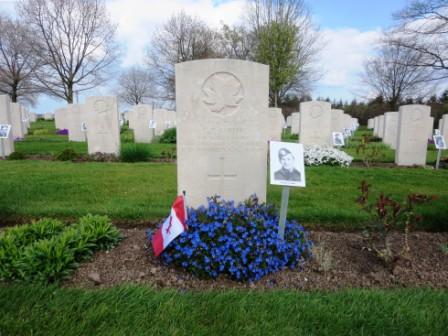
Pieter asked his friend and former colleague, Ad Scheepers, if he would take photos of 3 graves at the cemetery in Groesbeek.  Ad visited the cemetery and placed an orange flower beside each grave he took a photo of.

Grave of Alfred Pitwanakwat

Grave of Alfred Louis Pitwanakat.  (Photo credit: Ad Scheepers)

Alfred Louis PITAWANAKWAT (PITWANAKWAT) was born September 12, 1924 in Little Current, Ontario, son of Agatha Pitwanakwat, of Wikwemikong, Ontario.

Grave of Eli Snake

Grave of Eli Snake. (Photo credit: Ad Scheepers)

Eli SNAKE was born November 29, 1919 on the Muncey Reserve, the son of Eli and Marjorie Snake.

Grave of Clarence Wakegijig

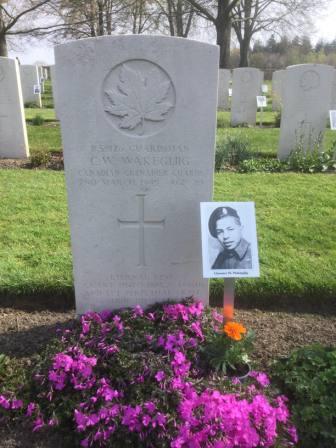
Grave of Clarence Wilfred Wakegijig.  (Photo credit: Ad Scheepers)

Clarence Wilfred WAKEGIJIG was born January 9, 1925 in Wikemwikong, Ontario, the son of Joachim and Josephine Wakegijig (nee Shawanda), of Krugersdorf, Ontario.

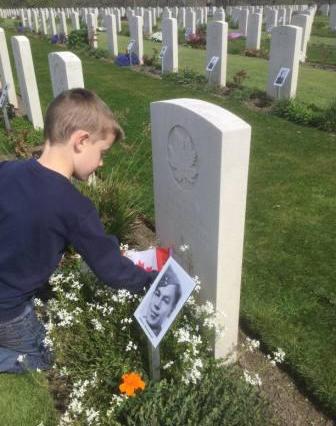
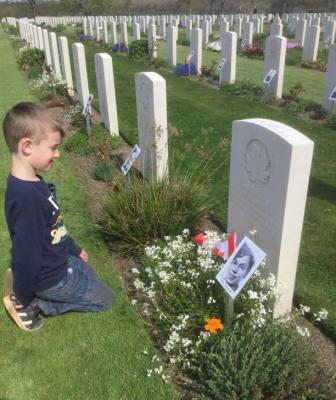
Ad wrote that while he was near the grave of Alfred Pitwanakat, “….a boy visiting the site with his family put a Canadian flag in front of the grave of Alfred….

Child places flag by Alfreds grave

A young boy places a flag by the grave of Alfred Pitwanakat. (Photo credit: Ad Scheepers)

Child by Alfreds grave

A young boy inspects the flag he placed by the grave of Alfred Pitwanakat.  (Photo credit: Ad Scheepers)

It’s clear that the Dutch pass on the importance of remembrance to the next generation so they can continue to remember those who lost their lives in WW2!

Thank you to Alice van Bekkum and Ad Scheepers for their kindness in taking the photos of the graves.  If you have information to share about any Canadian soldiers buried in The Netherlands, please contact Pieter at  memorialtrail@gmail.com, comment on the blog, or send a tweet to @researchmemori1.

© Daria Valkenburg

…Want to follow our research?…

If you are reading this posting, but aren’t following our research, you are welcome to do so.  Our blog address: https://onthewarmemorialtrail.com/

4 countries, 6 weeks, 7,000 km – an unforgettable war memorial journey in Europe…. Daria’s book ‘No Soldier Buried Overseas Should Ever Be Forgotten‘ is available in print and e-book formats.  Net proceeds of book sales help support research costs and the cost of maintaining this blog. For more information see https://nosoldierforgotten.com/

Screenshot_2021-02-27 On The War Memorial Trail With Pieter Valkenburg

You are also invited to subscribe to our YouTube Channel: On The War Memorial Trail With Pieter Valkenburg: https://www.youtube.com/channel/UCJ591TyjSheOR-Cb_Gs_5Kw.

Never miss a posting!  Subscribe below to have each new story from the war memorial trail delivered to your inbox.

On The War Memorial Trail….. The WWI Soldier Who Returned To Tryon

April 24, 2021.  One of the joys in doing research for the On The War Memorial Trail research project is the opportunity to learn more about the families of our friends and neighbours.  Much of the focus is on those who served our country and lost their lives while in service.

Pieter with Mary Ferguson, daughter of Maynard Foy.  (Photo credit: Daria Valkenburg)

However, the majority of military service personnel in WWI and WWII returned home.  We don’t often know much about their time in service, or what happened afterwards.  As families come forward with information, Pieter is trying to tell these stories. Recently we met with Mary Ferguson of Crapaud, who shared photos about her father.

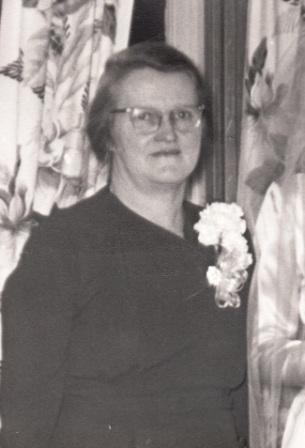
Maynard Foy.  (Photo courtesy of Mary Ferguson)

WWI veteran Maynard FOY of Tryon, Prince Edward Island was born December 22, 1886, the son of Theodore Seth Harding Foy and Almira Boulter. By the time he enlisted with the 105th Overseas Battalion on March 2, 1916, he already had served 8 years in the 82nd ‘Abegweit Light Infantry’ Regiment (which later became the PEI Highlanders.  For more information, see https://en.wikipedia.org/wiki/The_Prince_Edward_Island_Highlanders).

On July 25, 1916 he arrived in England aboard the SS Empress of Britain. On March 2, 1918 he was transferred to the 13th Reserve Battalion, then a month later to the 26th Overseas (New Brunswick) Battalion.

The medical case history sheet at Camp Hill Hospital in Halifax, Nova Scotia noted that Maynard was admitted on July 13, 1919 – straight from the hospital ship HMHS Araguaya. (See https://wartimememoriesproject.com/greatwar/ships/view.php?pid=3451) His injuries had occurred during the Battle of Amiens. (See https://www.thecanadianencyclopedia.ca/en/article/battle-of-amiens

According to the medical file, during the battle Maynard “…was carrying a smoke bomb in his left trousers pocket in the attack of August 8, 1918 when a machine gun bullet struck the bomb, causing it to explode, burning his left leg from the trochanter major to ankle, and palms of both hands…”  The trochanter major is a bony prominence toward the near end of the thighbone ie the femur, the point at which the hip and thigh muscles attach.

In a report for the 2004 Foy Reunion, Maynard’s great-granddaughter, Melissa Gauthier wrote that “As a result of the explosion, Maynard’s leg caught fire. In Maynard’s attempt to put it out with his hands, they were burnt so bad he couldn’t straighten them. They greatly resembled claws….

The medical care history report explained that “… The bullet penetrated the thigh in upper third.  Has been in hospital since that time….” Maynard had been taken to England from a hospital in Rouen, France, then returned to Canada once he was stable enough to travel, and remained in hospital quite a while longer.  He wasn’t discharged until January 12, 1920.

Emma Howatt Foy.  (Photo courtesy of Mary Ferguson)

Once back on the Island, he settled in Tryon and ran a mixed farming operation.  “He married the love of his life, Emma Howatt, then proceeded to have 11 children…” said Melissa in her report. They had married in Bedeque on September 13, 1923.

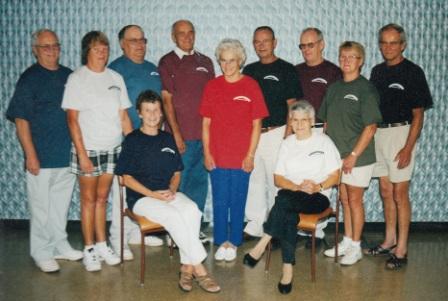
The Foy siblings. Left to right, standing: Ralph, Mary, Cecil (+), Theo (+), Marion, Keith, Percy, Ruth (+), Lorne.  Seated, left to right: Louise, Betty (+) (Photo courtesy of Mary Ferguson)

Maynard’s leg never healed properly. Melissa recounted that “…my grandfather…Ralph Foy… often took Maynard to the doctors to have the bone fragments extracted from Maynard’s leg. As painful as it sounds, Maynard didn’t feel a thing for the explosion had left his leg numb….

Maynard died on April 18, 1957, and is buried at the Tryon People’s Cemetery in Tryon, Prince Edward Island. He’s never been forgotten by his family.  Mary Ferguson recalled that “… he was a very patient guy who never got cross.  Eleven kids and he never got cross!….

Thank you to Mary Ferguson for sharing photos and information about her father.  Maynard Foy was fortunate as he was able to return home from WWI. Three men from the same area were not as lucky in the Battle of Amiens, and are buried overseas:

If you have photos or information to share, please email us at memorialtrail@gmail.com, or comment on the blog. Please note that Pieter is still looking for a photo of James Cairns and Bazil Cormier.  UPDATE:  A photo of James Cairns has been found!

© Daria Valkenburg

….Want to follow our research?….

If you are reading this posting, but aren’t following our research, you are welcome to do so.  Our blog address: https://onthewarmemorialtrail.com/

Front cover OnTheWarMememorialTrailinEurope4 countries, 6 weeks, 7,000 km – an unforgettable war memorial journey in Europe…. Daria’s book ‘No Soldier Buried Overseas Should Ever Be Forgotten‘ is available in print and e-book formats.  Net proceeds of book sales help support research costs and the cost of maintaining this blog. For more information see https://nosoldierforgotten.com/

You are also invited to subscribe to our YouTube Channel: On The War Memorial Trail With Pieter Valkenburg: https://www.youtube.com/channel/UCJ591TyjSheOR-Cb_Gs_5Kw

Never miss a posting!  Subscribe below to have each new story from the war memorial trail delivered to your inbox.

On The War Memorial Trail….. The Search For A Photo Of Gordon Frederick Johnson

April 16, 2021.  Sometimes a soldier’s story is one that Pieter feels a personal connection to.  This was the case when he was asked by the researchers at the Canadian War Cemetery in Holten, The Netherlands for help in finding a photo of WW2 soldier Gordon Frederick JOHNSON.

That was back in 2017 when help was requested to find photos of 6 soldiers from the North Nova Scotia Highlanders Regiment.  After going through Gordon’s service file, Pieter was determined to find a photo.  “….This was a responsible man, who took care of his men….” he said.

Gordon was born June 11, 1911 in Windsor, Nova Scotia, the son of James Gordon Johnson and Margaret Elizabeth de Wolfe. Later the family moved to Truro, Nova Scotia.  Sadly, he lost his father when he was only 3 years old. He had 6 brothers and sisters, and after his mother remarried to John McCarthy, had 6 half-brothers and sisters.

In 1935, Gordon married Hazel Pearl Williams and was employed as a machinist. On October 13, 1939, with WW2 underway, he enlisted with the North Nova Scotia Highlanders.

During the spring of 1945, it was clear to both sides that the war in Europe was nearing its end, but extreme resistance from the German army still resulted in many casualties during the liberation of The Netherlands.  By now a sergeant, Gordon was killed in action near Zutphen on April 8, 1945 while trying to retrieve an anti-tank weapon that one of the members in his platoon had left behind.  Going back to retrieve a weapon is exactly what Pieter would have done!

In ‘No Retreating Footsteps… the story of the North Novas’, Will Bird wrote that “A PIAT was left by the canal by someone in D Company and Sgt Gordie Johnson went back to get it.  He was killed by a sniper as he reached the spot. His passing was a sad loss…”  A PIAT is an anti-tank weapon.  (For more information, see https://en.wikipedia.org/wiki/PIAT)

Grave of Gordon Frederick Johnson at the Canadian War Cemetery in Holten, The Netherlands. (Photo credit: Daria Valkenburg)

Gordon is buried in the Canadian War Cemetery in Holten.  Pieter had no luck finding family members, so in 2018 when we were in Nova Scotia, he made a stop in Truro and went to the Anglican Church that Gordon had belonged to.  Perhaps someone from the church office could help find family members, he thought.   He was told that no Johnsons were left in Truro, but that there were McCarthys and someone from the church would try to find someone who might have a photo.

Unfortunately, finding a photo has so far been surprisingly unsuccessful, given that he had 6 siblings and 6 half-siblings, plus a wife.

Now an appeal for a photo of Gordon Frederick Johnson has gone out on YouTube, which you can watch here:

A huge thank you goes to post-production editor Wendy Nattress, who made this YouTube video a reality.

Of the 6 soldiers for which photos were sought, family members and photos of three were found, but three remain outstanding.  In addition to Gordon Frederick Johnson, the other two members of the North Nova Scotia Highlanders for which a photo is on the wish list are:

  • Allan G. COUTTS of Alberta
  • Archibald Henry NELSON of Prince Edward Island

Can you help put a face to any of these men! If you have photos or information, please email Pieter at dariadv@yahoo.ca, comment on the blog, or tweet to @researchmemori1.  As well, photos and stories are still being collected for the Atlantic Canada Remembers series, and for Canadian soldiers buried in The Netherlands.

You are also invited to subscribe to our YouTube Channel: On The War Memorial Trail With Pieter Valkenburg: https://www.youtube.com/channel/UCJ591TyjSheOR-Cb_Gs_5Kw.

© Daria Valkenburg

On The War Memorial Trail….. Atlantic Canada Remembers – Part 9

April 15, 2021. More of the photos submitted by Atlantic Canadians of soldiers buried overseas are featured in Part 9. Pieter is ensuring that every email is acknowledged, and that the photos of soldiers buried in The Netherlands are forwarded to the appropriate cemetery for their digital archives.

Soldiers buried at the Canadian War Cemetery in Holten, The Netherlands

Alexis Daigle (Photo submitted by Gilberte Manuel)

After being contacted by Marc Comeau, President of Royal Canadian Legion Branch 45 in Tracadie, New Brunswick, Gilberte Manuel submitted a photo of Alexis D.  DAIGLE on behalf of “…Alfrida Richard, the niece of Alexis Daigle of Pointe-Sapin….

Born March 2, 1920 in Lower Spain, New Brunswick, the son of Dominique Daigle and Exelda Mazerolle, Alexis was a fisherman before enlisting in Fredericton on August 28, 1941.  After completing basic training, he was attached to the Canadian Army (Basic) Training Centre in Montmagny, Quebec on a Home War Established (HWE) basis as an engineer’s helper.

His service file noted that he was a “jack of all trades…” and could speak both French and English.  He was described as a “…quiet and non-talkative single young man of above average intelligence...”

In January 1945 he arrived in the United Kingdom and assigned to the Canadian Infantry Training Regiment (CITR).  A month later, on February 24, 1945, he was sent to continental Europe, and on March 1, 1945 transferred to Le Régiment de la Chaudière.

On April 6, 1945, while serving with Le Régiment de la Chaudière in The Netherlands, Alexis was killed in action (‘mort au champ d’honneur‘) near Zutphen, during the Battle of Zutphen.  (For more information on this battle, see https://www.canadiansoldiers.com/history/battlehonours/northwesteurope/zutphen.htm)

According to the Regiment’s war diary for April 1945, the Battalion had “…proceeded on foot to a concentrated area just past Almen, approximately 3 miles short of Zutphen…..”  where they rested until the start of an operation which began “…on the night 5-6 April…

The attack started at 4:30 am. “… Only slight opposition was encountered up to the outskirts of the town of Zutphen. The objective was C and D companies to seize the ground in between the main highway leading to town and the first row of houses….

Alexis was in D Company and it’s likely that he lost his life in what happened next.  “…. Between the starting line and the objective there was a canal on which both leading companies were stopped for almost two hours.  First opposition was then encountered from well-sited snipers, machine gun nests, and bazookas...

Alexis was one of 4 soldiers in the Regiment killed in that operation.  The others were:

  • V. PARE (D Company)
  • S. BOUCHARD (D Company)
  • E. PARADIS (C Company)

Alexis was temporarily buried in Almen, and later reburied in in the Canadian War Cemetery in Holten.

Mathieu Michaud. (Photo submitted by the Grand Falls branch of the Royal Canadian Legion)

Patrick Côté of the Royal Canadian Legion, Branch 21 in Grand Falls, New Brunswick, submitted a photo of Mathieu MICHAUD. Born November 11, 1921 in Drummond, New Brunswick, he was the son of Achille Michaud and Fébronie Laforest.

Patrick provided a translated excerpt from a book, ‘Military Heritage – The Greater Grand Falls Region’, by Jean-Guy Plourde, which explained that “….wanting to emulate his older brother Laurent, he enrolled in the army on December 3, 1942, and received training in Fredericton. From March 10 to July 24, 1943, he was in Valcartier, Quebec before becoming a gunner. The authorities assigned him to Goose Bay, Labrador from August 1, 1943 to June 30, 1944. From November 30, 1944, he made a two week stay in Sorel, Quebec before embarking for the great adventure. On January 10, 1945, he made the crossing to the United Kingdom where he was stationed until March 1, 1945….

In the UK he was assigned to the Canadian Infantry Training Regiment (CITR).  On March 2, 1945 he left for Northwest Europe, and then transferred to Le Régiment De La Chaudière on March 21, 1945.

He was killed in action (‘mort au champ d’honneur‘) in The Netherlands while part of the Regiment’s Company C and died on April 8, 1945.  According to the Regiment’s war diary, the Battle of Zutphen had ended on April 7 but continued to encounter sniper fire.  Mathieu was one of two soldiers from Company C that died that day.  The other soldier was H. A. MARCHAND.

Like Alexis Daigle, Mathieu was temporarily buried in Almen, before being reburied in the Canadian War Cemetery in Holten.

Soldiers buried at the Canadian War Cemetery in Groesbeek, The Netherlands

Elbridge Wellington Miller. (Photo courtesy of Elbridge Wellington Miller Family)

Wilmot Tompkins submitted a photo, explaining that “…This is Elbridge Wellington Miller, my great-uncle, buried in Groesbeek. My wife found your interview and your blog while searching for the place my great-uncle lost his life…” Wilmot had seen a list of 28 men listed as having lost their lives in Keppeln, in a posting about a video plea for a photo of Frank MCGOVERN.  (See https://bordencarletonresearchproject.wordpress.com/2020/12/09/the-search-for-a-photo-of-frank-edward-mcgovern-moves-to-youtube/)

Elbridge Wellington MILLER was born in Deerville, New Brunswick, the son of David W and Elizabeth Miller, and was a labourer before enlisting on December 3, 1942 in Fredericton.  By April 4, 1943 he was in the United Kingdom. On August 19, 1943 he was transferred to the North Shore (New Brunswick) Regiment.

Serving with the North Shore (New Brunswick) Regiment, he landed in France on D-Day (June 6, 1944) and was wounded by shrapnel in the left thigh and right ankle during the Battle of the Scheldt on October 13, 1944, resulting in a recovery period in England before rejoining his unit a month later.

He lost his life on February 26, 1945 in Germany during the Battle of Keppeln, during Operation Blockbuster, the last part of Operation Veritable. (For more information, see https://en.wikipedia.org/wiki/Operation_Blockbuster and https://en.wikipedia.org/wiki/Operation_Veritable)

Eldridge was one of 28 men killed in action that day, as was explained in the posting about Frank McGovern. Another of these soldiers was Barney MCGUIGAN. (For his story, please see https://onthewarmemorialtrail.com/2020/08/07/on-the-war-memorial-trail-the-search-for-barney-reuben-mcguigan/)

Like Frank McGovern and Barney McGuigan, Eldridge was temporarily buried in the Bedburg Military Cemetery, and then later reburied in the Canadian War Cemetery in Groesbeek.

Alphonse Robert.  (Photo courtesy of the Robert Family)

Armel ‘Mel’ Lanteigne, President of the Caraquet branch of the Royal Canadian Legion, submitted a photo of Alphonse ROBERT on behalf of the Robert family.  Alphonse came from a family of “…9 children…” Mel wrote, “…one died at an early age.  His father Amédée was a veteran of WW1 and after returning to Caraquet, his job was lighthouse keeper on Caraquet’s island, where he lived with his family….

Born October 23, 1923 in Caraquet, Alphonse was the son of Amédée and Alma Robert, and was a fisherman before enlisting on August 23, 1943.

In January 1945 he was in the United Kingdom, assigned to the Canadian Infantry Training Regiment (CITR).  On March 28, 1945 he was transferred to North West Europe and was serving with Les Fusiliers Mont-Royal when he lost his life on March 30, 1945 in Germany.

Alphonse was temporarily buried in Germany, and later reburied in the Canadian War Cemetery in Groesbeek.  NOTE:  For an update to this story, please see: https://onthewarmemorialtrail.com/2021/10/12/on-the-war-memorial-trail-an-update-on-the-story-of-ww2-soldier-alphonse-robert/

Thank you to Marc Comeau, Patrick Côté, Armel ‘Mel’ Lanteigne, Gilberte Manuel, Alfrida Richard, and Wilmot Tompkins for sharing photos and anecdotes.  Atlantic Canadians remember their loved ones who are buried overseas.

More photos and stories in Atlantic Canada Remembers – Part 10! To share photos or information, please email Pieter at memorialtrail@gmail.com, comment on the blog, or tweet to @researchmemori1.

© Daria Valkenburg

…..Previous postings in the Atlantic Canada Remembers series….

Missed the previous postings in this series? See:

…..Want to follow our research?….

If you are reading this posting, but aren’t following the blog, you are welcome to do so. Our blog address: https://onthewarmemorialtrail.com/

Front cover OnTheWarMememorialTrailinEurope4 countries, 6 weeks, 7,000 km – an unforgettable war memorial journey in Europe…. Daria’s book ‘No Soldier Buried Overseas Should Ever Be Forgotten‘ is available in print and e-book formats.  Net proceeds of book sales help support research costs and the cost of maintaining this blog. For more information see https://nosoldierforgotten.com/

You are also invited to subscribe to our YouTube Channel: On The War Memorial Trail With Pieter Valkenburg: https://www.youtube.com/channel/UCJ591TyjSheOR-Cb_Gs_5Kw.

Never miss a posting!  Subscribe below to have each new story from the war memorial trail delivered to your inbox.