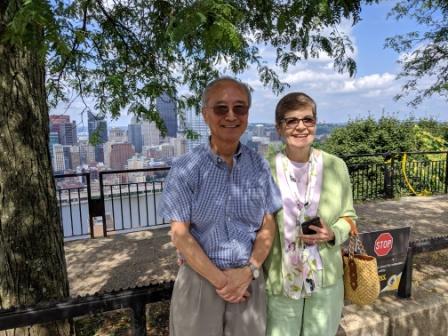
2021 Remembrance Week Events  

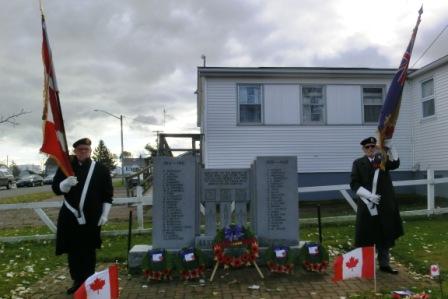
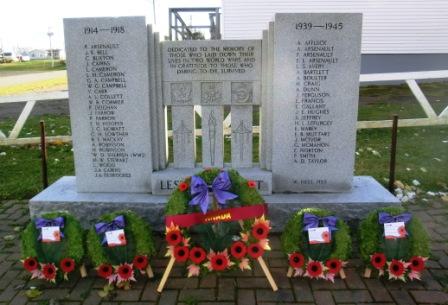
CIMG5423 Nov 11 2021 wreaths at Cenotaph Borden Carleton

Wreaths by the Cenotaph outside the Borden-Carleton Legion.  (Photo credit: Daria Valkenburg)

November 14, 2021.  Remembrance Week is always busy at our place. This year, with the easing of some restrictions, we were able to be out and about in the community more than last year.

One of the events we attended was at the Tryon Cenotaph in Tryon, Prince Edward Island.

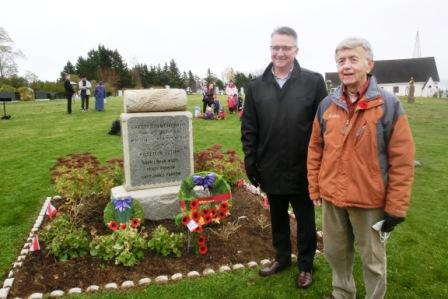
CIMG5373 Nov 10 2021 Tryon Cenotaph Remembrance Service (1)

The Honourable Heath MacDonald, MP for Malpeque, with Pieter at the Tryon Cenotaph following the Remembrance Ceremony on November 9, 2021. (Photo credit: Daria Valkenburg)

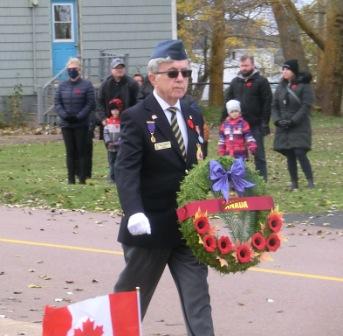
November 11, 2021 was a cold and crisp day, with the Remembrance Day service at the Legion in Borden-Carleton, Prince Edward Island, held outdoors. Pieter had been asked by the Member of Parliament for Malpeque to lay a wreath on behalf of the Government of Canada during the Remembrance Day Ceremony in Borden-Carleton.  This year, there was a change in MP with the retirement of Wayne Easter, and the election of Heath MacDonald.

CIMG5391 Nov 11 2021 Pieter walks with Govt of Canada wreath Borden Carleton

Pieter with the Government of Canada wreath to be placed on behalf of The Honourable Heath MacDonald, MP for Malpeque.  (Photo credit: Daria Valkenburg)

CIMG5381 Nov 11 2021 Pieter salutes after placing wreath Borden Carleton

Pieter salutes after placing Government of Canada wreath on behalf of The Honourable Heath MacDonald, MP for Malpeque.  (Photo credit: Daria Valkenburg)

CIMG5392 Nov 11 2021 Pieter salutes Borden Carleton

Pieter salutes after placing Government of Canada wreath on behalf of The Honourable Heath MacDonald, MP for Malpeque.  (Photo credit: Daria Valkenburg)

CIMG5401 Nov 11 2021 Roger and Arthur Borden Carleton

Roger Leboeuf (left) and Arthur Ranahan (right) by the Cenotaph outside the Borden-Carleton Legion.  (Photo credit: Daria Valkenburg)

It was a meaningful and well-organized ceremony.  In the afternoon, members of the Legion attended the ceremony in Kinkora.

Remembrance Day may be over for another year, but Pieter’s research work continues.  If you have photos and information to share about Canadian soldiers, please contact Pieter at memorialtrail@gmail.com, comment on the blog, or send a tweet to @researchmemori1.

..Want to follow our research?….

If you are reading this posting, but aren’t following the blog, you are welcome to do so.  See https://bordencarletonresearchproject.wordpress.com or email me at memorialtrail@gmail.com and ask for an invitation to the blog.

Screenshot_2021-02-27 On The War Memorial Trail With Pieter Valkenburg

You are also invited to subscribe to our YouTube Channel: On The War Memorial Trail With Pieter Valkenburg: https://www.youtube.com/channel/UCJ591TyjSheOR-Cb_Gs_5Kw.

© Daria Valkenburg

On The War Memorial Trail….. Linking The Past With The Present

November 10, 2021. Recently our friend Annie Lee MacDonald sent an email to say that she and her husband had been sent a story by their friend Jim, “about his Father and brothers. We didn’t know any of this. Shows the important contribution you two are making of taking the past and sharing it with the present…” (See https://onthewarmemorialtrail.com/2021/10/20/on-the-war-memorial-trail-the-ww2-pilot-from-pei-who-flew-40-missions-overseas-and-returned-home//)

We loved her phrase of ‘taking the past and sharing it with the present’ as that is what we are doing in telling these stories.  Many of the postings and articles have had a ripple effect, leading to more remembrances, information, and stories. This posting shares some of these ….

In May 2021, a 4 part series entitled ‘A Tragic Drowning On The Leda River in Germany’ told the story of five Canadian soldiers from the North Nova Scotia Highlanders Regiment who drowned in a tragic accident in the Battle of Leer in Germany on April 28, 1945, one of the final actions to end WW2 in Europe.  All 5 men are buried in the Canadian War Cemetery in Holten.

…A series of coincidences ensures this niece will never forget…..

Joseph ‘Ambroise’ COMEAU of Saulnierville, Nova Scotia, was one of these men.  (See https://onthewarmemorialtrail.com/2021/05/17/on-the-war-memorial-trail-a-tragic-drowning-on-the-leda-river-in-germany-part-3/)
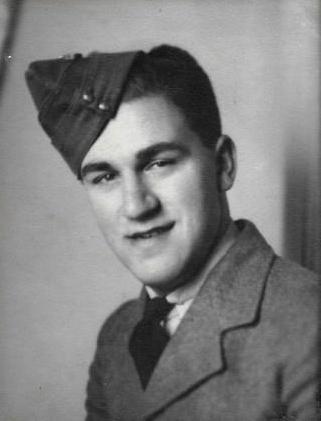
Joseph Ambroise Comeau from Simone

Joseph ‘Ambroise’ Comeau.  (Photo courtesy of niece Simone Comeau)

His nieces have never forgotten him. Jacqueline Comeau shared how she found her uncle’s gravesite at the Canadian War Cemetery in Holten in 1990 while on a school band trip with her son.

….In 1990 I visited The Netherlands with my older son on a high school band trip. To say we had a marvelous time and were so warmly greeted everywhere we went is an understatement. Thankfully we were taken to the Holten War Cemetery and, purely by accident, while walking the grounds, I spotted my uncle’s grave. To that moment, my mother’s family believed he was buried in Germany, perhaps because he died on German land.

This was a momentous event for myself as we were at the cemetery on the 45th anniversary of his death, I was 45 years old and I then discovered that he had a memorial service in his home village on the day I was born (June 3, 1945) …

Ambroise had indeed initially been buried in Germany, and then was reburied in the Canadian War Cemetery in Holten afterwards.  Jacqueline shared her story in a French language newspaper, Le Courrier….
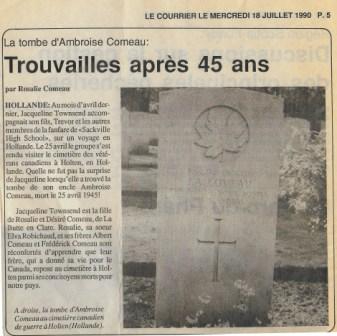
article about Jacqueline Comeau visit to Holten

Newspaper article submitted by Jacqueline Comeau. The headline reads ‘Found after 45 years’.

…The discovery of my uncle’s grave in 1990, with the coincidences of dates, such as the date of his death is the date I discovered his grave; a memorial service was held in his honor in his home parish of Saulnierville on the day I was born, June 3, 1945 is unique…

…A telegram one niece will never forget…..
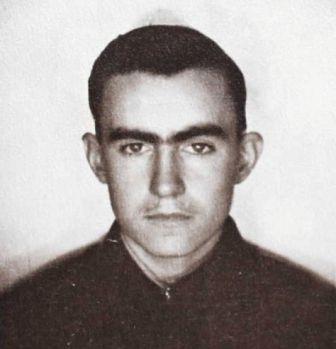
Photo Lewis Marsh

Lewis Wilkieson Marsh. (Photo source:  Canadian Virtual War Memorial)

Lewis Wilkieson MARSH, of Sydney Mines, Nova Scotia, was another casualty of the drowning in the Leda River. (See https://onthewarmemorialtrail.com/2021/05/18/on-the-war-memorial-trail-a-tragic-drowning-on-the-leda-river-in-germany-part-4/)

Burnie Reynaert wrote to say that “My Uncle Lewis Wilkieson Marsh died on April 28, 1945. I was with my Nana when she received the first telegram that he was believed drowned.  I remember I was standing on the last step near front door when this boy gave her the telegram….

Burnie shared the telegram she was witness to.  One can just feel the horror and fear that her grandmother must have felt upon receiving it.
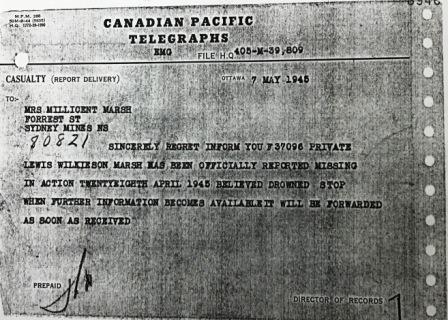
Telegram advising Marsh is missing

First telegram advising that Lewis Marsh was missing and believed drowned.  (Document courtesy of Burnie Reynaert)

Worse news was to come, as a second telegram confirmed that Lewis had lost his life.
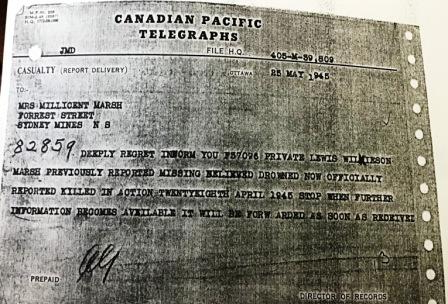
Telegram advising Marsh is KIA

Second telegram advising that Lewis Marsh was killed in action.  (Document courtesy of Burnie Reynaert)

Burnie went on to say “…Thank you so much for your research, I never thought I would see his name and the others that died with him.  I want to thank you both. I am so emotional with love and gratitude for all you have done. I am finally feeling some closure.

My uncle was born November 14, 1925 in Sydney Mines, Cape Breton, Nova Scotia. He had 8 siblings and his father died in 1934. Nana raised them, and had me to raise.

Uncle Lewis worked in Princess Collieries in Sydney Mines for thirteen months. He would be seventeen. I recall Nana and my mom arguing with Lewis that he was not old enough to join. Maybe she had to sign papers? He enlisted on May 26 1944, embarked from Halifax on December 1944, and embarked from UK on December 25 1944….”

…A niece now knows what happened to her uncle …..

Charles Borden Tuplin

Charles Borden Tuplin. (Photo submitted by Gary Richard Perry)

As part of the Atlantic Canada Remembers series of postings, we did a story in March 2021 on Charles ‘Charlie’ Borden TUPLIN of Indian River, Prince Edward Island, who lost his life on December 7, 1944 while serving with the Black Watch.  While crossing a bridge on the Maas River in The Netherlands, Charlie was shot while trying to retrieve the body of Lt Thomas Wilson MacKenzie.  (See https://onthewarmemorialtrail.com/2021/03/29/on-the-war-memorial-trail-the-ww2-soldier-from-indian-river/

Charlie was wounded and taken by the Germans, but died very shortly afterwards.  He’s buried in the Canadian War Cemetery in Holten. Months after the story about Tuplin was posted on our blog, Lt MacKenzie’s niece, Judy Hopkins, got in contact to say that until she read the story that arose out of Pieter’s research, no one in the family knew how Lt MacKenzie had died.  This is probably right as MacKenzie’s service file had multiple letters from his parents asking for this information.

Judy wrote that “I am responding to your article of March 29, 2021, about Charles B. Tuplin. My uncle was Lieutenant Thomas Wilson MacKenzie of No. 1 Black Watch of Canada RHR, mentioned in the article.  And what astonishment to see and read this account of the raid on the front line that took both these men’s lives.

I have just recently been researching this event, as I am writing a life story for the ‘Faces to Graves’ project involving the soldiers buried at Groesbeek Canadian War Cemetery. So, it was with intense interest that I read this article.

My uncle was ‘Missing in Action’ for several months, causing great concern to his family in Calgary, Alberta. When the regiment moved forward in February, no graves were located for Tuplin or MacKenzie, leaving them to believe that they may have been taken POW.

It was never explained to my grandmother where her son’s remains were found….just that after some months, a body had been identified as his.

In the article, it stated: ‘MacKenzie’s body was later found buried in a temporary cemetery, near where he lost his life.’ And so these two men were together at the end of their lives; Tuplin was taken prisoner, and my uncle likely died at the site of his injury.

After all these years, it is still incredible that new information is learned, and also that people such as yourself are providing a space to honor these men’s memories. Thank you for this. ..

Thomas_MacKenzie-GAV

Thomas Wilson MacKenzie. (Photo submitted by Judy Hopkins)

…He was the much beloved son of Christine MacKenzie, a widow, and brother to my mother, Margaret.  In his letters home, which I still have, he writes about the great bunch of men under his command, and speaks highly of all of them…

…A street in The Netherlands may be named for one soldier …..
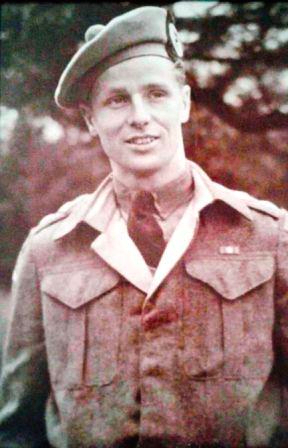
Lt. Percy Dexter Higgins

Percy Dexter Higgins.  (Photo courtesy of the Higgins Family)

In a January 2021 posting in the Atlantic Canada Remembers series, we wrote a story about Percy Dexter HIGGINS of Stellarton, Nova Scotia, who was serving with the North Nova Scotia Highlanders when he lost his life during the Battle of Warnsveld on April 4, 1945.  He’s buried in the Canadian War Cemetery in Holten. (See https://onthewarmemorialtrail.com/2021/01/16/on-the-war-memorial-trail-atlantic-canada-remembers-part-3/)

Shortly afterwards, we received an email from Harm Kuijper in The Netherlands, who explained that there was “…a proposed plan to name a street for Lt Percy Dexter Higgins in the city of Zutphen, Netherlands in the new Looer Enk Subdivision….”  The Higgins family was notified of this proposal and we look forward to hearing more on the street naming as plans progress.

…Two WWI soldiers from Prince Edward Island are buried in France …..

In 2017, we visited the Manitoba Cemetery in Caix, France, to place flags by the grave of WWI soldier James CAIRNS of Kinkora, Prince Edward Island, who lost his life on August 9, 1918 during the Battle of Amiens.  James had moved to Manitoba and was serving with what is now the Royal Winnipeg Rifles.  (See https://onthewarmemorialtrail.com/2017/09/30/the-search-for-manitoba-cemetery/)

We weren’t surprised to see soldiers from the Prairie Provinces in the cemetery, but when we signed the Guest Register Book, we were astonished to find that the previous visitors had come to honour their great-uncle and great-great uncle Theodore (Ted) ARSENAULT from Abrams Village, Prince Edward Island.

Although this posting dates back to 2017, it wasn’t until a few days ago that Colleen Arsenault wrote us.  “Hi there, in doing a bit of internet research on my Great Great Uncle Ted (Theodore Arsenault) to prepare my kids for Canadian Remembrance Day here in Toronto, I came across this post. I instantly recognized my mother Debi and sister Melanie’s handwriting above your entry in the guest book at Manitoba Cemetery. It is so lovely for our family to know that you had put an additional decoration up for our Uncle Ted. Sometimes the internet can truly be a wonderful place! The Arsenault family thanks you….

A mystery was solved!  The Arsenault family sent us a picture of Theodore.  Unfortunately, up to now, no photo has ever been found for James Cairns.
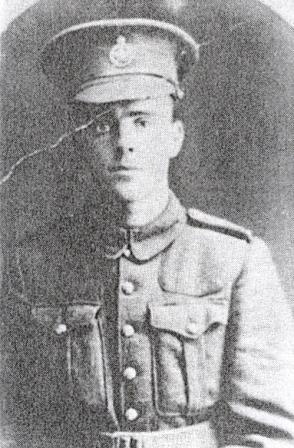
Pte Theodore Arsenault (Great great uncle)

Theodore Arsenault. (Photo submitted by Stephen Arsenault)

Thank you to Colleen Arsenault, Jacqueline Comeau, Judy Hopkins, Harm Kuijper, and Burnie Reynaert for sharing photos and anecdotes. We very much appreciate hearing from readers and having them share their stories.

If you have photos and information to share about Canadian soldiers, please contact Pieter at memorialtrail@gmail.com, comment on the blog, or send a tweet to @researchmemori1.

© Daria Valkenburg
Rememberance-Day-2020-Canada-5

..Want to follow our research?….

If you are reading this posting, but aren’t following our research, you are welcome to do so.  Our blog address: https://onthewarmemorialtrail.com/
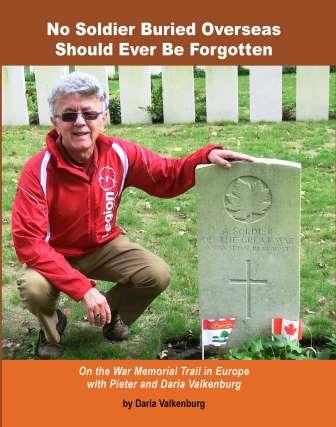
Front cover OnTheWarMememorialTrailinEurope4 countries, 6 weeks, 7,000 km – an unforgettable war memorial journey in Europe…. Daria’s book ‘No Soldier Buried Overseas Should Ever Be Forgotten‘ is available in print and e-book formats.  Net proceeds of book sales help support research costs and the cost of maintaining this blog. For more information see https://nosoldierforgotten.com/ 

Screenshot_2021-02-27 On The War Memorial Trail With Pieter Valkenburg

You are also invited to subscribe to our YouTube Channel: On The War Memorial Trail With Pieter Valkenburg: https://www.youtube.com/channel/UCJ591TyjSheOR-Cb_Gs_5Kw.

Never miss a posting!  Subscribe below to have each new story from the war memorial trail delivered to your inbox.

On The War Memorial Trail….. Remembering WWII Soldier Ronald Sidney Waterhouse

November 3, 2021.  Recently, Cheryl Topping of Nova Scotia wrote to Pieter about a WWII soldier on the photo wish list from the Canadian War Cemetery in Bergen Op Zoom, saying that she was “…a descendant of Ronald Sidney Waterhouse. He was my grandmother’s brother….”  Cheryl followed up with photos and contacted Ronald Sidney’s daughter, Merrilyn O’Brien.

Ronald Sidney Waterhouse frame

Ronald Sidney Waterhouse.  (Photo courtesy Cheryl Topping Family Collection)

Ronald Sidney WATERHOUSE was born March 21, 1913 in Toronto, Ontario, the son of Harold Victor and Ellen Elizabeth (nee Payne) Waterhouse.

…A young father enlists….

When he enlisted with the No. 6 District on August 24, 1942 in Sydney, Nova Scotia, he was already married, to Nina Meredith MacLeod, and the father of Merrilyn Ronalda, who was born July 18, 1942 in Sydney.

Nina and baby Merrilyn Waterhouse-1

Nina Waterhouse with daughter Merrilyn. (Photo courtesy Cheryl Topping Family Collection)

His enlistment record indicated that he played softball and rugby, and had been a travelling salesman.  Both his father and brother Harold Henry were in the police force in Toronto, with his father identified as a detective.

In September 1942 Ronald was sent to #61 Canadian Army Basic Training Centre in New Glasgow, Nova Scotia, and then in November 1942 to the Canadian Armoured Corps Advanced Training Centre (CACATC) in Borden, Ontario.

In a January 29, 1943 interview, it was noted that Ronald had completed Basic and Advanced CAC training and that he wished to apply to the Canadian Provost Corps. He was described as having a “...good appearance, straight forward manner...” It noted that he was a “…strong, healthy normal man in all respects...” with a “…sound practical education…” and a “…good position in civilian life…

In March 1943 he was transferred to #3 CACRU (Canadian Armoured Corps Reinforcement Unit) to go overseas, arriving in the United Kingdom on March 17. Over a year later, on August 11, 1944, he was transferred to the Canadian Fusiliers Regiment.  On September 18, 1944, he was in France with the Regiment, part of the Canadian Infantry Corps.

…The Lincoln and Welland Regiment was in the Battle of the Scheldt….

On September 29, 1944, Ronald was transferred to the Lincoln and Welland Regiment.  Unfortunately, on November 2, 1944 he was killed in action during the Battle of the Scheldt. This was a series of military operations that took place between October 2 and November 8, 1944, to open up the port of Antwerp, Belgium and fought in northern Belgium and southwestern Netherlands. (See https://www.veterans.gc.ca/eng/remembrance/history/second-world-war/scheldt)

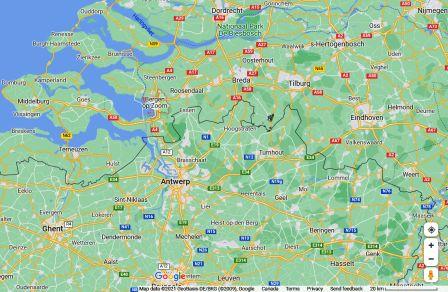
Map Bergen op Zoom · Netherlands

Map showing location of Antwerp, Bergen Op Zoom, and Steenbergen.  (Map source: Google)

The war diary for the Lincoln and Welland Regiment for November 2, 1944 indicates the Regiment was in Bergen Op Zoom, The Netherlands, and that it was a bright and warm day….

… 17:00 …final orders were issued.  The general plan being that the Lincoln & Welland Regiment on the left and the Algonquin Regiment on the right would attack and hold positions along the road…”  This was to provide protective cover for troops advancing towards Steenbergen.

…20:05… A Company reached their objective… and were under semi-automatic and shell fire. They suffered heavy casualties...” One of the casualties was Ronald Sidney Waterhouse.

A short video featuring old newsreel coverage of the Battle of the Scheldt can be seen here:

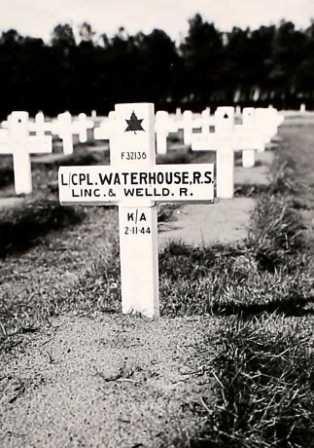
Ronald Sidney was initially buried in Bergen Op Zoom, and later received a permanent headstone at the Canadian War Cemetery there.

temporary grave marker from service file

Initial grave marker in Bergen Op Zoom for Ronald Sidney Waterhouse.  (Photo source:  military service file)

…A daughter’s reflections….

His daughter Merrilyn wrote to explain that “…I was only 2 years old when my Dad died so I never really knew him….  My Mother said that my Dad was a great guy and he seemed to be happy (always smiling) in a lot of old pictures that I have.  He worked for Lever Brothers….

Merrilyn went on to explain what happened after her father left to go overseas.  “…My Mother and I lived for the first 8 years of my life with my maternal grandparents in Sydney.  When I was 8 years old my Mother married Herman F. Slade. My half-brother, Barry James, was born in 1955.  We moved to Yarmouth, Nova Scotia in 1955.  Barry presently lives in Guelph, Ontario.  My Mother and Barry moved to Guelph to be closer to her brother, Rev. Merrill MacLeod….”  

Nina died in 1982.  Merrilyn now lives in Massachusetts, USA.   

Thank you to Merrilyn O’Brien and Cheryl Topping for sharing photos of Ronald Sidney Waterhouse.  If you have photos and information to share about Canadian soldiers buried in The Netherlands, please contact Pieter at memorialtrail@gmail.com, or comment on the blog. 

© Daria Valkenburg

…Want to follow our research?….

If you are reading this posting, but aren’t following our research, you are welcome to do so.  Our blog address: https://onthewarmemorialtrail.com/

4 countries, 6 weeks, 7,000 km – an unforgettable war memorial journey in Europe…. Daria’s book ‘No Soldier Buried Overseas Should Ever Be Forgotten‘ is available in print and e-book formats.  Net proceeds of book sales help support research costs and the cost of maintaining this blog. For more information see https://nosoldierforgotten.com/

Screenshot_2021-02-27 On The War Memorial Trail With Pieter Valkenburg

Subscribe to our YouTube Channel: On The War Memorial Trail With Pieter Valkenburg: https://www.youtube.com/channel/UCJ591TyjSheOR-Cb_Gs_5Kw

Never miss a posting!  Subscribe below to have each new story from the war memorial trail delivered to your inbox.
On The War Memorial Trail…..The WWII Pilot From PEI Who Flew 40 Missions Overseas …. And Returned Home

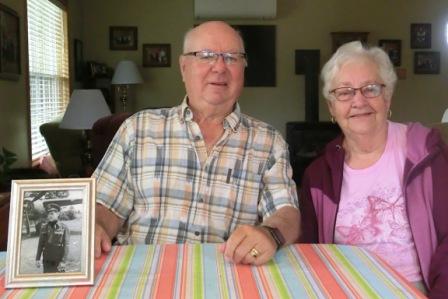
October 20, 2021.  Recently, we heard from Jim MacFarlane of Fernwood, Prince Edward Island.  “ I have been reading with interest your war time stories and thought you may be interested in my family’s participation in the Second World War. My father, as well as my two oldest brothers, all served in the war at that same time. All are now deceased

Jim went on to explain that “My father, Herman, was an LAC in the air force and my oldest brother, F/L Lorne, was a Mitchell bomber pilot who flew 40 missions overseas. My second oldest brother George was in the navy and was just about to be shipped overseas when the ended…” LAC refers to ‘leading aircraft man’ and Herman, an air engine mechanic, was stationed at the air base in Summerside.

F/L refers to Flight Lieutenant.  We visited Jim and his wife Fernande to learn more about Lorne, who survived 40 overseas missions.

CIMG5292 Aug 31 2021 Jim & Fernande MacFarlane

Jim and Fernande MacMacFarlane.  (Photo credit:  Daria Valkenburg)

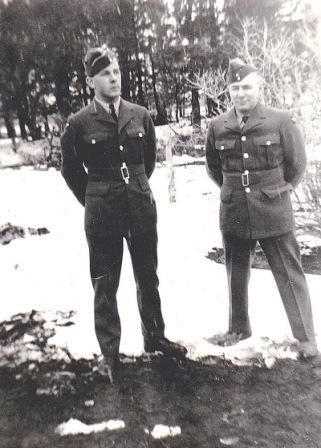
Lorne MACFARLANE was born May 23, 1923 in Fernwood, Prince Edward Island, son of Herman and Belle (nee Williams) MacFarlane.  “…When he was 18 years old, after graduating from Prince of Wales College in Charlottetown, Lorne enlisted with the RCAF…” Jim explained.  Lorne arrived at Manning Depot in Toronto on August 2, 1941. “…He was then posted to Trenton as a security guard and did mostly night duty for 5 to 6 weeks…”  RCAF is the Royal Canadian Air Force.

….Lorne began pilot training….

From Trenton, Lorne was posted to the #1 Initial Training School in Toronto for initial training, and then sent for pilot training at No 22 Elementary Flying Training School at Ancienne Lorette outside of Quebec City.   “…You needed to be able to distinguish certain colours to be a pilot….” Jim said.

….Lorne’s wings were presented by his father….

From Quebec, Lorne was posted to the No 9 Summerside Flying Training School in Summerside, Prince Edward Island where he learned to fly a Harvard plane.  “…My father was also stationed in Summerside, and when Lorne received his wings in May 1942, they allowed my father to present it to him…

IMG_0698 Lorne and Herman MacFarlane in Fernwood

Lorne MacFarlane with his father Herman at their home in Fernwood. (Photo courtesy of Jim MacFarlane Collection)

Lorne was now 19 years old, and two weeks after receiving his wings he was posted back to Trenton.  But before he left, Jim chuckled as he recalled that “…Lorne did spins and acrobatics over our house in Fernwood.  My mother was pregnant with me at the time….

Lorne became a flying instructor in Trenton, and then at No 5 Service Flying Training School in Brantford, where he met his future wife, June Turner.  From Brantford, Lorne was sent to complete his Operational Training Unit at #34 Pennfield Ridge in New Brunswick.  “…While in New Brunswick, Lorne flew over the Island and threw rocks out the window near our home, but up to now, no one has found them….

In 1943, Lorne went by train to New York City and then travelled to Great Britain aboard the Queen Mary, which had been converted to a troop ship.  “…Lorne told me that there were no escort ships, so they were all on watch duty…” Jim said.

Although he had his wings, Lorne was sent to various flight training schools in England to learn skills such as how to fly in smog, and then to #13 Operational Training Unit Finmere Bucks, where he learned to fly the B-25 Mitchell plane. (See https://en.wikipedia.org/wiki/North_American_B-25_Mitchell)

….The first of 40 missions began in May 1944….

He then was assigned to #98 Squadron, Royal Air Force (RAF) in Dunsfold. (See https://en.m.wikipedia.org/wiki/No._98_Squadron_RAF)  Lorne’s written account of his service noted that “…My first Operation was on May 19, 1944 as 2nd Pilot…. when we flew a daylight raid on gun positions at Houlgatte.  No Flak was encountered…” Houlgatte is in Normany, France.

He was the Captain on his second mission, a day later.  This time, and in most of his subsequent flights, he and his crew encountered ‘flak’ – anti-aircraft fire.

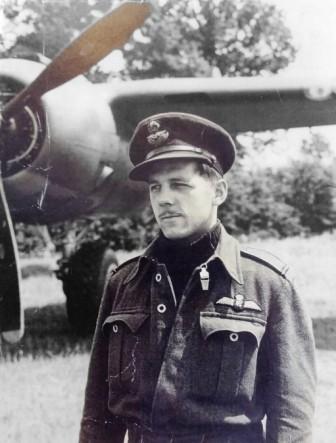
20210831_101655~2 Lorne MacFarlane

Lorne MacFarlane by his B-25 Mitchell II in Dunsfold, England in 1944. (Photo courtesy of Jim MacFarlane Collection)

 ….A night mission coincided with D-Day!….

The first 13 missions were flown during the day.  His 14th mission, the first done at night, coincided with D-Day – although he and his crew were unaware of it at the time.  Lorne’s account recorded that at 2 am on June 6, 1944, with a news reporter identified as Cpl Fairbairn plus eight 500-pound bombs on board,  “…our target is a bridge south of Caen over the River Orne.  Our flight is two hours and we ran into heavy accurate to light flak at Caen…”  Caen is in Normandy, France.

Long after the event, Lorne recounted what happened on that fateful night, and the lucky escape the crew had.  “…Our mission was completed and as we crossed the coast on the way back, the enemy seemed to throw everything they had at us. We didn’t even realize it was D-Day – but as we crossed the Channel we could see through breaks in the cloud the wakes of hundreds of ships – so we knew something big was up….

 ….Lorne was transferred to Belgium….

Lorne’s next flight was on June 7, so he was not part of the air support for D-Day.  He completed his 40th mission on August 12, 1944, and given a much needed leave before his next posting, which began on September 15, 1944 in London, at RAF Station Northolt. From there he was sent to “…2nd Tactical Air Force Communication Squadron, Brussels.  We were the first air force to be located here…”  The Squadron was based at ‘Evere’, now Haren Airport. (See https://en.wikipedia.org/wiki/Haren_Airport)

Lorne flew a variety of planes and noted that “…our duty was to fly passengers to England, take mail, either pick-up or deliver personnel to the Front Lines – Colonels, Generals, or what have you….

Among the dignitaries Lorne transported, Pieter found it interesting that Lorne flew Prince Bernhard of The Netherlands to Antwerp.  At the time Prince Bernhard was Commander of the Dutch Armed Forces.  (See https://en.wikipedia.org/wiki/Prince_Bernhard_of_Lippe-Biesterfeld#Second_World_War)

Lorne was not dropping bombs any longer, but war was still nearby, as per his account of what happened on January 1, 1945.  “…While stationed at Evere I experienced the ‘Battle of the Bulge’ for on New Year’s Day our Station was attacked…by the Germans’ last ‘Hurrah’.  They attacked our Airfield with many planes and destroyed about everything on the ground. We had a ‘Fighter Squadron’ located on our field and only very few….Spitfires got off the ground – some were shot down as they were taking off…”  (See https://en.wikipedia.org/wiki/Battle_of_the_Bulge)

During his time in Brussels, Lorne caught what was believed to be a cold and was hospitalized for a week.  When he later was diagnosed with tuberculosis after returning to Canada, he wondered if that hospital stay was where he caught it.

….A new posting in Canada took Lorne back to the Island….

On February 15, 1945 Lorne learned he was on his way back to Canada.  “…We sailed on the ‘Louis Pasteur’, arriving in Lachine, Quebec.  During my leave I was married….on April 28, 1945, then my posting was to RCAF No 1 Radio and Navigation School in Summerside…

Between May and October 1945, Lorne was the Officer in Charge.  Jim found it ironic that now that Lorne was in charge “…Dad reported to him!…

Lorne wrote that “…While here I had the chance to take my father on flights as he was in Maintenance and in reality had to check out his own work…

Lorne was discharged from the RCAF on October 10, 1945 and moved to Ontario, where he and June lived in Burlington.  Lorne went into the insurance business.  He passed away on February 3, 2004.

Thank you to Jim MacFarlane for contacting us about his brother Lorne, and for sharing photos and stories about his brother’s war service.

Remembrance-Day-2019-Images-1024x520

With Remembrance Week coming up, please take a look through your photo albums and in your attics in case you have a photo or information to share about Canadian soldiers.  There are many more stories still to be told!

Pieter encourages blog readers to contact him if they have a story to share about Canadians who served. You can email him at memorialtrail@gmail.com, comment on the blog, or send a tweet to @researchmemori1.

© Daria Valkenburg

….Want to follow our research?….

If you are reading this posting, but aren’t following our research, you are welcome to do so.  Our blog address: https://onthewarmemorialtrail.com/

Front cover OnTheWarMememorialTrailinEurope4 countries, 6 weeks, 7,000 km – an unforgettable war memorial journey in Europe…. Daria’s book ‘No Soldier Buried Overseas Should Ever Be Forgotten‘ is available in print and e-book formats.  Net proceeds of book sales help support research costs and the cost of maintaining this blog. For more information see https://nosoldierforgotten.com/ 

Screenshot_2021-02-27 On The War Memorial Trail With Pieter Valkenburg

You are also invited to subscribe to our YouTube Channel: On The War Memorial Trail With Pieter Valkenburg: https://www.youtube.com/channel/UCJ591TyjSheOR-Cb_Gs_5Kw.

Never miss a posting!  Subscribe below to have each new story from the war memorial trail delivered to your inbox.
On The War Memorial Trail….. An Update On The Story Of WWII Soldier Alphonse Robert

October 12, 2021.   In April 2021, in Part 9 of the Atlantic Canada Remembers series, the story of Alphonse ROBERT of Caraquet, New Brunswick, was briefly told.  His service file had very little information on the circumstances of his death and noted that he died on March 30, 1945 in Germany while serving with Les Fusiliers Mont-Royal, and was buried in Germany. (See https://onthewarmemorialtrail.com/2021/04/15/on-the-war-memorial-trail-atlantic-canada-remembers-part-9/)

Alphonse Robert

Alphonse Robert.  (Photo courtesy of the Robert Family)

Recently we received an email from Maarten Koudijs, who wrote that Alphonse Robert died during an attack on Gendringen, The Netherlands, and was initially buried in Megchelen, The Netherlands, just across the border with Germany.  After additional research to verify what Maarten told us, we have more information on what happened on March 30, 1945.

…Was Alphonse Robert buried in The Netherlands or Germany?….

Map Megchelen

The first question we had was whether Alphonse Robert had been initially buried in Germany, as stated in the service file, or in The Netherlands.  Megchelen is a small village on a tiny hook of land surrounded on three sides by the German border.  It’s easy to understand how a mistake could have been made in the official records, but was Megchelen the correct location?

We contacted Alice van Bekkum, Chair of the Groesbeek Faces to Graves Committee, and asked if she could check the cemetery record and see where Alphonse Robert had been originally buried.

Alice confirmed it was Megchelen.  “I have a list from CWGC with the coordinates of the temporary burial site where the body was exhumed when it was transferred to Groesbeek. It says Megchelen…”  (CWGC refers to Commonwealth War Graves Commission.)  The service file record was incorrect.

…How 5 members of Les Fusiliers Mont-Royal lost their lives….

How did Alphonse Robert lose his life?  Maarten explained that “…during the attack on Gendringen, a number of infantrymen were following a tank. A German shell exploded behind the tank and 5 infantry soldiers were killed.   

The soldiers who immediately lost their lives were Roland Alfred Barry, Edmond Coulombe, Jacques Fortin, and Alphonse Robert. They were temporarily buried, next to each other, in a field grave in Megchelen.  

Bernard Gaston Pilon was seriously injured and was transferred to Bedburg Military Hospital, where he died and was also temporarily buried there….”  Bedburg is in Germany.

All 5 infantrymen from Les Fusiliers Mont-Royal were later reburied in the Canadian War Cemetery in Groesbeek.

Pieter then looked at the War Diary for Les Fusiliers Mont-Royal. On March 29, 1945, the diarist recorded being in the Reichswald Forest.  …Battalion with its F Echelon vehicles crosses the Rhine at night without incident...

On March 30, 1945, the diarist wrote the location as Germany.  “…In the morning troops proceed to positions…Light opposition with intermittent shelling and mortaring...

On March 31, 1945, the diarist still wrote Germany as the location.  “…Battalion sweeps north again against stiffening resistance this time.  Mortaring and shelling. The attack was supported by tanks.  Gendringen was entered…”   Gendringen is in The Netherlands, near Megchelen.

…Two eye-witnesses saw what happened….

In an interview in ‘De Ganzenveer’ (‘The Quill’), Hans Bresser and Rudie Grin, witnesses to the attack, stated that “…At Wieskamp’s house, between Striekwold and Giezen, a Canadian tank was firing. There were also a number of infantrymen. A German shell exploded in between, possibly killing five or more Canadian soldiers. The grenade was…fired from somewhere from the Pol near Ulft. The fallen soldiers were given a field grave in Megchelen on Friesen’s land on the Nieuweweg...”  (Account translated from the original Dutch)

…The other members of Les Fusiliers Mont-Royal who lost their lives….

  • Roland Alfred BARRY, son of Horace and Rose Alma Barry of Montreal, Quebec, died March 30, 1945, aged 20.
  • Edmond COULOMBE, son of Ulric and Yvonne Coulombe, of Pine Falls, Manitoba, died March 30, 1945, aged 22.
  • Jacques FORTIN, son of Henri and Yvonne Fortin, of Chicoutimi, Quebec, died March 30, 1945, aged 21.
  • Bernard Gaston PILON, son of Emile and Emilie Pilon, of Rockland East, Ontario, died March 30, 1945, aged 19.

Thank you to Maarten Koudijs for contacting us with the additional information on Alphonse Robert, and to Alice van Bekkum for verifying that he was previously buried in Megchelen, The Netherlands.

If you have further information to share about Alphonse Robert or the other Canadian soldiers mentioned here, please contact Pieter at memorialtrail@gmail.com or comment on the blog.

Remembrance-Day-2019-Images-1024x520

With Remembrance Week coming up, please take a look through your photo albums and in your attics in case you have a photo or information to share about Canadian soldiers.

© Daria Valkenburg

…..Want to follow our research?….

If you are reading this posting, but aren’t following our research, you are welcome to do so.  Our blog address: https://onthewarmemorialtrail.com/

4 countries, 6 weeks, 7,000 km – an unforgettable war memorial journey in Europe…. Daria’s book ‘No Soldier Buried Overseas Should Ever Be Forgotten‘ is available in print and e-book formats.  Net proceeds of book sales help support research costs and the cost of maintaining this blog. For more information see https://nosoldierforgotten.com/ 

Screenshot_2021-02-27 On The War Memorial Trail With Pieter Valkenburg

You are also invited to subscribe to our YouTube Channel: On The War Memorial Trail With Pieter Valkenburg: https://www.youtube.com/channel/UCJ591TyjSheOR-Cb_Gs_5Kw

Never miss a posting!  Subscribe below to have each new story from the war memorial trail delivered to your inbox.
A Headstone For WWII Veteran Alexander Deans

October 8, 2021. When Alexander McGregor DEANS died on April 28, 2010, his estate was able to pay for his burial at the Tryon People’s Cemetery in Tryon, Prince Edward Island.  Unfortunately, there were insufficient funds for a headstone, and no family or friends stepped up to help pay for one. 

The lack of a gravestone bothered Jack Sorensen, Chair of the Tryon Peoples Cemetery Inc.  Jack had met Deans as both attended the same church.  He remembered that Deans had requested that a Canadian flag be draped over his coffin, and then later recalled being told that Deans, who had lived in Crapaud, had been a veteran.

In 2020, Jack contacted Pieter, in his role as Public Relations Officer at the Borden-Carleton Legion, and asked if the Legion would cover the cost of a headstone for a veteran.  Pieter knew that the Last Post Fund, administered by Veterans Affairs, could fund a headstone for eligible veterans in unmarked graves, but it was unknown if Deans was a veteran. Proof of military service was one of the requirements. (See https://www.lastpostfund.ca/unmarked-grave-program/)

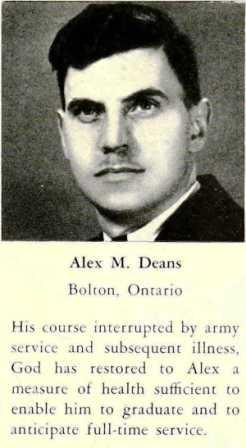
After Pieter started researching Deans, the estate’s lawyer was able to find a Veterans Affairs client number, indicating he had been a veteran.  Pieter also found a 1949 yearbook entry from Tyndale University College and Seminary in Toronto, stating that Deans, from Bolton, Ontario, had graduated after his studies had been interrupted due to war service. Deans was a WWII veteran!

Yearbook_full_record_image 1949 Deans

Entry from 1949 yearbook of Tyndale University College and Seminary.

With these two pieces of information, Pieter turned the file over to Marilyn Letts, Service Officer at PEI Command.  As the Provincial Service Officer, she was able to verify the information with Veterans Affairs and make the application for a headstone.

The application was approved, and on September 28, 2021, Paul Cyr of Brunswick Monuments Ltd in Grand Falls, New Brunswick, installed the headstone. 

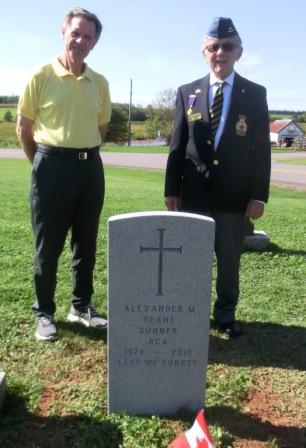
CIMG5345 Sep 28 2021 Gravestone for Alexander Deans

Jack Sorensen, left, with Pieter Valkenburg, right, by the grave of Alexander M. Deans.  (Photo credit: Daria Valkenburg)

Jack and Pieter commemorated the headstone by placing a Canadian flag at his grave.  11 years after his death, Alexander Deans no longer lies in an unmarked grave.

Jack, Pieter, and Marilyn are to be commended for the effort they made into ensuring that this WWII veteran was not forgotten. 

With Remembrance Week coming up, please take a look through your photo albums and in your attics in case you have a photo or information to share about Canadian soldiers.  You can email us at memorialtrail@gmail.com, or comment on the blog.  

© Daria Valkenburg

holidays-1-e1460375295631

…..Want to follow our research?….

f you are reading this posting, but aren’t following our research, you are welcome to do so.  Our blog address: https://onthewarmemorialtrail.com/

4 countries, 6 weeks, 7,000 km – an unforgettable war memorial journey in Europe…. Daria’s book ‘No Soldier Buried Overseas Should Ever Be Forgotten‘ is available in print and e-book formats.  Net proceeds of book sales help support research costs and the cost of maintaining this blog. For more information see https://nosoldierforgotten.com/

Screenshot_2021-02-27 On The War Memorial Trail With Pieter Valkenburg

You are also invited to subscribe to our YouTube Channel: On The War Memorial Trail With Pieter Valkenburg: https://www.youtube.com/channel/UCJ591TyjSheOR-Cb_Gs_5Kw

Never miss a posting!  Subscribe below to have each new story from the war memorial trail delivered to your inbox.

On The War Memorial Trail….. Remembering WWII Soldier Thomas Beresford Big Canoe

October 7, 2021. After an interview about the photo quest for soldiers buried in the Canadian War Cemeteries in The Netherlands ran on APTN, Pieter was contacted by Pat Stewart about Thomas Beresford BIG CANOE of Georgina Island, Ontario, who is buried in the Canadian War Cemetery in Groesbeek, The Netherlands.

(To read the APTN article, see https://www.aptnnews.ca/national-news/dutch-born-p-e-i-man-on-a-mission-to-find-photos-of-first-nations-soldiers-killed-overseas-in-wwii/)

Pat wrote “I live in southwest Saskatchewan now but came from Ontario 20 years ago. I worked as a journalist for the Georgina Advocate back then. Thank you for what you are doing. It is so very important to remember….” In 1999, Pat had written an article about a Dutch couple, Bill and Ellie Gertzen, who had adopted the grave of Thomas Big Canoe.  Bill had been an interpreter for the Canadian and American armies during WWII.

Thomas Beresford Big Canoe from Cdn Virtual War Memorial

Thomas Beresford Big Canoe.  (Photo source: Canadian Virtual War Memorial)

….Thomas was a member of the Chippewas Georgina Island First Nation….

Thomas Beresford BIG CANOE was born on Georgina Island, Ontario on October 13, 1925, the son of Thomas and Hannah (nee Porte) Big Canoe.  Georgina Island, located on Lake Simcoe, is an Indigenous reserve of the Chippewas Georgina Island First Nation, an Ojibwa (or Anishinaabeg) band.  (See https://en.wikipedia.org/wiki/Chippewas_of_Georgina_Island_First_Nation)

Thomas had begun work as a labourer at T.A. Wilson Lumber Company in Denbigh, Ontario when he enlisted at the #2 District Depot in Toronto on June 12, 1944.

He had keen eyesight and his medical exam noted he had 20/20 vision.  He was sent to the #26 Canadian Armoured Corps Basic Training Centre (CACBTC) in Orillia, Ontario.  On October 6, 1944 he was transferred to the A-10 Canadian Infantry Training Centre (CITC) in Camp Borden, Ontario.

After his basic training, and once he  turned 19 years old (the minimum age for overseas service), Thomas left for United Kingdom just before Christmas 1944. He remained in the United Kingdom until February 9, 1945, after which he was sent to Northwest Europe as part of the contingent of troops needed for the Battle of the Rhineland. The goal of this battle? Occupy the Rhineland and cross the Rhine River.

Thomas was assigned to the Royal Hamilton Light Infantry, where he was a member of the Scout Platoon.  The Scout Platoon’s role was to gain information on German activity through advance patrols, quite often behind enemy lines.

….Thomas lost his life during Operation Blockbuster….

In the push for the Battle of the Rhineland, Thomas was in the midst of Operation Blockbuster, which aimed to clear the Rhine River in Xanten, Germany, a battle that was fought between February 8 and March 10, 1945, and followed Operation Veritable.  These two Operations took 31 days.  (See https://en.wikipedia.org/wiki/Operation_Blockbuster)

On March 8, 1945, Phase II of Operation Blockbuster began. According to the war diary of the 2nd Canadian Infantry Division, of which the Royal Hamilton Light Infantry was part of, “…At 0530 this morning Op BLOCKBUSTER II began, designed to capture XANTEN and the ground to the SE. By last light 4 Cdn Inf Bde had reached all their objectives, after some very heavy fighting...” (Source: https://map.project44.ca/)

Operation Blockbuster II

It was dark that early in the morning, and raining heavily.  In Pat Stewart’s article, she quotes Bill Gertzen as explaining that on the morning of March 8, 1945, Thomas and his group from the Royal Hamilton Light Infantry had been “…directed to shape a bridgehead over the Rhine…But the Germans were expecting them and, in the battle that followed, there were only 26 survivors out of a company of 200….

Although we don’t know exactly what happened, Thomas unfortunately lost his life at some point in the March 8, 1945 battle.  He was only 19 years old.

Thomas was temporarily buried in Xanten, Germany before being reburied in the Canadian War Cemetery in Groesbeek, The Netherlands.

IMG_8567-AVB Grave of Thomas Big Canoe in Groesbeek

Grave of Thomas Beresford Big Canoe at the Canadian War Cemetery in Groesbeek.  (Photo credit: Ad Scheepers)

Thank you to Pat Stewart for contacting us about Thomas Beresford Big Canoe, and to Ad Scheepers for taking the photo of Thomas’s grave at the cemetery.  If you have information to share about Thomas Beresford Big Canoe or other Canadian soldiers, please contact Pieter at memorialtrail@gmail.com, comment on the blog, or send a tweet to @researchmemori1.

© Daria Valkenburg

…Want to follow our research?….

If you are reading this posting, but aren’t following our research, you are welcome to do so.  Our blog address: https://onthewarmemorialtrail.com/

Front cover OnTheWarMememorialTrailinEurope4 countries, 6 weeks, 7,000 km – an unforgettable war memorial journey in Europe…. Daria’s book ‘No Soldier Buried Overseas Should Ever Be Forgotten‘ is available in print and e-book formats.  Net proceeds of book sales help support research costs and the cost of maintaining this blog. For more information see https://nosoldierforgotten.com/

Screenshot_2021-02-27 On The War Memorial Trail With Pieter Valkenburg

You are also invited to subscribe to our YouTube Channel: On The War Memorial Trail With Pieter Valkenburg: https://www.youtube.com/channel/UCJ591TyjSheOR-Cb_Gs_5Kw.

Never miss a posting!  Subscribe below to have each new story from the war memorial trail delivered to your inbox.
On The War Memorial Trail….. Part 3 – Charlie Choi’s Childhood Memories of the Korean War

20190224_165811 Susan and Charlie Choi

Retired engineer Charlie (Chi-Yong) Choi with his wife Susan.  (Photo credit: Brien Robertson)

October 2, 2021.  In Part 1 of the childhood wartime memories of Charlie Choi, who was 4 years old when the Korean War started in June 1950, his father had disappeared, leaving his mother to cope with 3 pre-schoolers and their maid.  As the situation worsened, the family left Seoul for the farm owned by her parents-in-law in Onyang, south of Seoul.  (See https://bordencarletonresearchproject.wordpress.com/2021/09/30/on-the-war-memorial-trail-part-1-charlie-chois-childhood-memories-of-the-korean-war/)

In Part 2, after a harrowing journey, they safely reached the farm. A few weeks later, however, soldiers from the North Korean Army arrived at the farm and announced that 21 members of the family were to be executed, including Charlie’s baby sister. (See https://bordencarletonresearchproject.wordpress.com/2021/10/01/on-the-war-memorial-trail-part-2-charlie-chois-childhood-memories-of-the-korean-war/)

Now for the conclusion to Charlie Choi’s story….

… ‘Mr. Kim and the villagers decided our fate’ ….

It’s funny how you remember the smallest details in times of great stress.  Charlie recalled that it “… was drizzling and we were all getting wet.  I was standing right next to my grandfather in front of the North Korean firing squad, waiting to be executed.  Their purpose was to kill large landowners and their families and then take over their assets.  The Captain asked my grandfather if there was anything that he wanted to say before the execution. My grandfather saw Mr. Kim standing behind the Captain.…

Charlie explained that “…Mr. Kim’s family had been long time farm caretakers on my grandfather’s farm.  Mr. Kim was the supervisor of all the farm caretakers and was a very knowledgeable man in many aspects of this region. He was hired by the North Korean Army as an informer/advisor and he joined the Communist party…

The story continued.  “… ‘Yes, Captain’ my grandfather replied. ‘I would like to have a few minutes with your Mr. Kim who is standing behind you.’  The Captain told Mr. Kim to hear what my grandfather wanted to say…. 

…My grandfather said to Mr. Kim ‘we took care of you and your family for many years.  You know that we shared our crops with the village people.  Ask the Captain to have us go through a ‘village trial’.  Let the people decide if we should be executed.’  Mr. Kim conveyed my grandfather’s wish to the Captain and he agreed.  The Captain ordered his soldiers to gather all the villagers in the front yard outside the farm gate house.  About 200 people gathered. 

 The Captain announced the purpose of the gathering and gave the people 3 choices:

  1. Execute all the family members on their list (total 21) and divide their entire assets among the village people.
  2. Let them live and keep this farm house only, dividing their other assets among the village people.
  3. Leave them alone…

I was surprised that the tribunal was allowed and that the villagers were allowed to decide the fate of the Chois.  Charlie continued.  “They all clapped very loudly as the Captain was announcing the third option.  We were saved, thanks to Mr. Kim and the people of the village.  The North Korean soldiers withdrew completely from the farm right away.  However, the Captain returned several hours later with 4 empty trucks and asked my grandfather for rice, wheat, corn, soap and some cash…..etc. …”  

… ‘Mother no longer felt safe at the farm’ ….

The family was spared but who knew how long before something else happened?  “…My mother no longer felt safe at the farm since the North Korean Army was further into the south. She wanted everyone to flee the area further into the south.  My grandparents wanted to stay put on their farm.  My mother decided to move us to Daejun City, just south of the farm.  It did not quite work out there either and we finally moved to Daegu City, the temporary location of the Central Government Center.  We were able to rent a small four room shack just across the street from the UN Military Headquarters in Daegu City….

Throughout their journey, Charlie’s father was missing, his whereabouts unknown.  “… We still did not have any information about my father.  He had told my mother to go to my grandfather’s farm when he fled our house in Seoul. He probably was searching for us and wondering what happened to us.  My mother finally got a break through the UN headquarters in Daegu City.  They conveyed our relevant information to the Korean military headquarters.  It took some time but somehow it got to my father….

… ‘My father is found’ ….

Charlie’s father found them.  “…One cold afternoon (probably early spring of 1951) a jeep with a trailer pulled up the very small and narrow alley where our rental shack was located.  A uniformed jeep driver asked me for my name and for my mother’s name, and then he went back to the jeep.  My father came out of the jeep and we were finally reunited.  He brought a trailer full of food items like K-rations, canned spam, canned beans, and Vienna sausage….etc.  I still love these foods to this day….” 

20210928_140907 1952 Charlie and his father

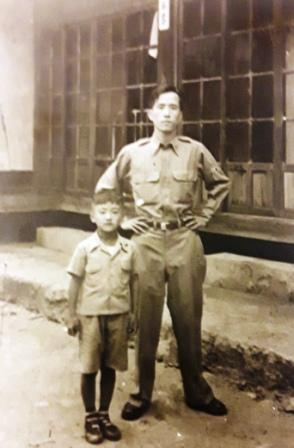
Circa 1952. Charlie with his father, Jae-Jin Choi, in the uniform of the Korean Air Force, at Charlie’s grandfather’s farm after the area was recaptured by the Allied Forces. (Photo courtesy Choi Family Collection)

At last the family found out what had happened to Charlie’s father.  “… When my father fled our home in June 1950 he joined a team of government officials to be trained in an accelerated program by the US Air Force to become Korean Air Force Officers.….

… What goes around comes around ….

Charlie’s family was spared, but his story had another chapter after South Korea was recaptured by Allied Forces.  “…Our Mr. Kim was one of the informers to be prosecuted. Needless to say, my family came to his aid because of what he did to save the 21 members of my family at my grandfather’s farm in August 1950.  He was saved and continued to work for my grandfather and later for my father.  He had a long and good life.  This story of Mr. Kim always reminds me of my grandfather’s favorite saying ‘What goes around comes around’. My grandfather always told us: be creditable, share your fortune, and always be fair.  I still miss him greatly….”  

… Traumatic childhood experiences stay forever in the mind ….

Charlie’s childhood experience was seared into his memory, and even at his very young age.  Susan explained that “…Charlie has experienced triggers which produce stress/anxiety since the war.  The sound of low flying planes and even the hum of lawn mowers and sometimes other similar noises could produce the feeling he had as a child of bombings and danger.  He also found the sound of crying babies another trigger.  It always reminded him of the bomb shelters, where, of course, the babies cried as the bombs fell.  These triggers have never gone away but have only recently eased slightly as a 75 year old man….”  As someone whose father lived through World War Two as a child, I know that the trauma experienced never fully goes away. 

Charlie ended his account by saying that “…I will be forever grateful to the Allied forces for their help and sacrifices. As regrettable as the war and the division of Korea has been, I’m so glad that the south was aligned with the US led UN forces. The help of these nations and the wartime sacrifices made it possible to lay the foundation for the ‘Miracle of the Han River’ which led to today’s Republic of Korea (South Korea)….

Charlie immigrated to the USA, where he became an engineer, and met his wife Susan.  It was not easy for him to relive his childhood experience in wartime Korea, and we thank him for doing so. 

holidays-1-e1460375295631

With Remembrance Week a month away, please take a look through your photo albums and in your attics in case you have a photo or information to share about Canadian soldiers.  You can email us at dariadv@yahoo.ca, comment on the blog, or send a tweet to @researchmemori1.  

…..Want to follow our research?….

If you are reading this posting, but aren’t following the blog, you are welcome to do so.  See https://bordencarletonresearchproject.wordpress.com or email me at dariadv@yahoo.ca and ask for an invitation to the blog. 

Screenshot_2021-02-27 On The War Memorial Trail With Pieter Valkenburg

You are also invited to subscribe to our YouTube Channel: On The War Memorial Trail With Pieter Valkenburg: https://www.youtube.com/channel/UCJ591TyjSheOR-Cb_Gs_5Kw

© Daria Valkenburg

On The War Memorial Trail….. Part 2 – Charlie Choi’s Childhood Memories of the Korean War

We meet with retired engineer Charlie (Chi-Yong) Choi and his wife Susan.  (Photo courtesy of Valkenburg Family)

October 1, 2021. In Part 1 of the childhood wartime memories of Charlie Choi, who was 4 years old when the Korean War started in June 1950, his father had disappeared, leaving his mother to cope with 3 pre-schoolers and their maid.  As the situation worsened, his mother made the difficult decision to leave Seoul and seek safety at the farm owned by her parents-in-law in Onyang, south of Seoul.  (See https://bordencarletonresearchproject.wordpress.com/2021/09/30/on-the-war-memorial-trail-part-1-charlie-chois-childhood-memories-of-the-korean-war/)

At the southern edge of Seoul, they ran into their first obstacle – a bridge over the Han River that had been destroyed in an attempt to stop the southern advance of the North Korean Army.  The river had to be crossed in order to get to the farm, and Charlie’s mother had to find a solution if they were to reach safety…..

… A farmer helped them cross the river and continue their journey….

Luckily, Charlie’s mother was able to keep a cool head.  “…In order to cross the river we literally ran for our lives under continual bombing.  We ran on the hot sandy river banks, searching for a way to cross the river.  Mother managed to get us all safely across by negotiating with a local melon farmer who had a small row boat and a cart for his melons.  The farmer was traveling with his young son.  The farmer and his son could no longer make a living by selling melons.  Mother negotiated with them to help us get to my grandfather’s farm….

The most harrowing part of the journey was just beginning. “….It took us 3 days and 2 nights to get to the farm.  We walked through mountain paths, bombed and damaged dirt roads, and narrow rice paddy banks.  We slept for a few hours when we were able to take shelter in a bomb-damaged shack that we ran into along the way….

… ‘I saw people getting shot’….

The journey got harder.  “… For the first time I saw people getting shot and killed, and for the first time I saw humans of a different race other than my own black haired Asians.  I saw blond and brown haired Americans during this journey.  We had two very close calls on the way to the farm.  One was on a flat stretch of dirt road….” 

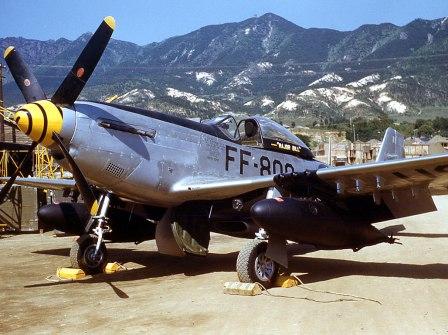
 …All of a sudden two fighter jets, Mustangs, appeared from nowhere and started shooting at people heading south.  My mother and the maid, with my baby sister, ran and took cover inside the road drain pipe.  The farmer and his son who pushed and pulled the cart that my brother and I were riding in also ran to take cover, leaving us in the cart.  I was able to get out of the cart but my brother was unable to get out.  We were crying for help.  I was trying to get him out but was unable to….

… ‘Mustang pilots spared my brother and me’….

That might have been the end of Charlie’s story, but then, “…the Mustang pilots saw two young boys struggling, crying, and scared to death.  They circled and came down very low many times to assess the situation and then finally flew away.  They circled around us so low that I could see their faces and they were not black haired Koreans….

Charlie later found out how lucky he and his brother were that the pilots didn’t see any adults by the cart.  “…. Much later we learned that the fighter jet pilots were ordered to shoot people dressed as civilians who were heading south, because the North Korean Army was infiltrating the south, disguised as civilians….” 

It was a challenge for UN pilots to distinguish friend from foe in these situations, and unfortunately there was collateral damage.  “…The other close call was near the final stretch to the farm.  The road split, onto a regular dirt road where the cart could go, but it was a longer distance.  The other route was a shortcut through rice paddy banks that were not wide enough for the cart.  Mother decided to take the shortcut with us only and told the farmer and his son to take the regular road and rejoin us where the two roads meet near the farm….

… Not all refugees were spared….

Disaster struck.  “…We were on our way through the banks of the rice paddy when we heard bicycle bells from behind.  5 or 6 men on bikes told my mother to take cover, yelling ‘here come the Mustangs’ as they were passing by us.  Sure enough, very soon we heard the Mustangs………..pop pop pop pop…….all the cyclists were shot and fell like dominoes into the rice fields….

….My mother was very calm.  She held our hands and said ‘this is it’, ‘don’t cry or be scared’, ‘just stay calm’ and then she closed her eyes and appeared to be praying.  Two Mustangs circled us a few times at a very low elevation, and once again they spared us and flew away….

The family finally made it to the farm “…in the late afternoon in early August 1950.  My grandparents, their maid and the farm workers, were so relieved to see us since there wasn’t any way to communicate during the war.  My grandfather thanked the melon farmer and his son and made the payment my mother had negotiated with them.  They stayed overnight and left the farm the next day.  We do not know what happened to them….

… ‘We were on the North Korean Army’s execution list’….

Unfortunately, the family’s safety was soon compromised.  “…Our joyful life at the farm did not last long.  The North Korean Army captured this area about 2 or 3 weeks after we arrived.  One rainy day in the early morning in August 1950 a truckload of North Korean soldiers came and ordered us to line up in the courtyard of the farm house…. 

…The Captain had a list of all our family members who were at the farm house.  He told us we were on the list of the shooting squad. When the names were read out, the list even included my baby sister….” 21 members of Charlie’s family were on the North Korean Army’s execution list. 

In Part 3, Charlie’s story continues as the family members await their fate….. 

Thank you to Charlie Choi for his courage in relating his childhood experience in wartime Korea.  If you have a story to share, please email us at dariadv@yahoo.ca, comment on the blog, or send a tweet to @researchmemori1.  

…..Want to follow our research?….

If you are reading this posting, but aren’t following the blog, you are welcome to do so.  See https://bordencarletonresearchproject.wordpress.com or email me at dariadv@yahoo.ca and ask for an invitation to the blog. 

You are also invited to subscribe to our YouTube Channel: On The War Memorial Trail With Pieter Valkenburg: https://www.youtube.com/channel/UCJ591TyjSheOR-Cb_Gs_5Kw

© Daria Valkenburg

On The War Memorial Trail….. Part 1 – Charlie Choi’s Childhood Memories of the Korean War

Charlie and Susan Choi

Retired engineer Charlie (Chi-Yong) Choi with his wife Susan.  (Photo credit: Brien Robertson)

September 30, 2021. Over the past years, Pieter has been researching the stories of Canadian soldiers.  It’s an honour to learn of their service and the hardships and sacrifices they endured. But, as we know from current news events, war also impacts civilians. 

Until we met our good friend Charlie (Chi-Yong) Choi, a retired engineer, most of what I knew about the Korean War came from watching M*A*S*H (see https://en.wikipedia.org/wiki/M*A*S*H_(TV_series)), and even then I must admit I wasn’t sure when or why the war took place.  But when Charlie, who was born in Korea, talked about how he and his family were impacted by the war, it was an eye-opener.

I was surprised to learn that more than 26,000 Canadians served on land, at sea, and in the air during this conflict as part of the United Nations Allied Forces. 516 died during the war. (See https://www.veterans.gc.ca/eng/remembrance/wars-and-conflicts/korean-war)

After reading about the recent Korean War Veterans Luncheon on Korean Thanksgiving, Charlie agreed to share his childhood memories of that traumatic period.  His wife Susan wrote that “A few tears were shed by both of us as he put his memories on paper….”  Once you read what he and his family endured, you’ll understand why.  (See https://bordencarletonresearchproject.wordpress.com/2021/09/24/pei-korean-war-veterans-luncheon-hosted-by-the-embassy-of-the-republic-of-korea/)

Charlie set the scene with some background information.  “…The war erupted on 6/25/1950 and ended with a cease fire under the ‘Korean Armistice Agreement’ on 7/27/1953.  This agreement created the ‘DMZ’ – a border dividing South and North Korea….”  DMZ refers to Demilitarized Zone.

Before the war began in 1950, 4 year old Charlie “…lived in a two story western style house with my parents, my 2 years and 6 month old brother, my 6 1/2 month old sister and a house maid.  We lived in the northern part of Seoul City just east of the capitol and the Presidential Palace known as the Blue House.  I remember being very happy and enjoyed daily tricycle rides with my younger brother in our neighborhood with my mother strolling behind us.  It was a very peaceful and comfortable life….

… Life as we knew it changed on June 25, 1950….

Then everything changed.  “…We woke up early on the morning of 6/25/1950 to earthquake-like vibrations and loud ground thumping noises.  We realized that the North Korean Army was coming down.  They were just north of the mountains behind our house.  There were explosions from tank artillery and bombardment that became louder and louder as they got closer….” 

That was scary enough, but then the situation worsened.  “…A few hours later, we heard a banging at the front gate of our house, yelling for us to open the gate.  About 10 uniformed North Korean soldiers with machine guns rushed into the house, looking for my father, who worked for the government.  Fortunately, my father had fled the house, to an unknown location, hours earlier.  The soldiers searched the house and the yard for several hours before retreating…

The family caught a lucky break, but then it was decision time.  Flee or stay?  Charlie’s mother was responsible for 3 pre-schoolers and a maid.  “…My mother decided to stay in our house in Seoul, hoping that the North Koreans would be pushed back soon.  About a month went by, but the situation got worse.  The North Korean Army was infiltrating more and more into the south.  Roads and bridges were being destroyed by bombs.  Grocery stores and vendors were disappearing, etc.  It was getting harder and harder to buy groceries…

….The agonizing decision was made to flee south…

Charlie’s mother decided it was time to flee.  “…Our destination was my paternal grandfather’s farm, where he had moved after retiring.  My grandparents had lived in Seoul until around 1939 when they moved to the farm.  The farm was south of Onyang, a hot springs resort region which was about 50 miles south of our house in Seoul….

Map Seoul to Onyang

The long and dangerous journey from Seoul to Onyang.  (Map source: http://www.mapquest.com)

Now refugees, the Chois began the journey to his grandfather’s farm in late July 1950.  “…We did not know how we would get to my grandfather’s, but just followed my mother’s lead.  Mother packed a few small bags for us to carry and the five of us (mother, brother, baby sister, maid and me) started our journey on foot….

They soon encountered their first obstacle.  “…When we arrived at the Han River bridge at the southern tip of Seoul City, the bridge had been destroyed by a bomb in order to stop the North Korean Army’s advance into the south.  Crossing the river was a must to get to the farm.  This was the first of many difficult hurdles we would have to overcome…” 

to be continued

In Part 2, Charlie’s story continues as his mother searches for a way to cross the Han River….. 

Thank you to Charlie Choi for his courage in relating his childhood experience in wartime Korea.  Do you have information to share about Canadian soldiers, please email us at memorialtrail@gmail.com, comment on the blog, or send a tweet to @researchmemori1.  

© Daria Valkenburg

…..Want to follow our research?….

If you are reading this posting, but aren’t following the blog, you are welcome to do so.  Our blog address: https://onthewarmemorialtrail.com/

Front cover OnTheWarMememorialTrailinEurope4 countries, 6 weeks, 7,000 km – an unforgettable war memorial journey in Europe…. Daria’s book ‘No Soldier Buried Overseas Should Ever Be Forgotten‘ is available in print and e-book formats.  Net proceeds of book sales help support research costs and the cost of maintaining this blog. For more information see https://nosoldierforgotten.com/ 

Screenshot_2021-02-27 On The War Memorial Trail With Pieter Valkenburg

You are also invited to subscribe to our YouTube Channel: On The War Memorial Trail With Pieter Valkenburg: https://www.youtube.com/channel/UCJ591TyjSheOR-Cb_Gs_5Kw

Never miss a posting!  Subscribe below to have each new story from the war memorial trail delivered to your inbox.