The Halifax L9561 Crew Remembered In Wons

speldje bevrijding

May 15, 2020.  On October 12, 2019 a memorial panel to honour the crew of Halifax L9561 was placed in Wons, near the crash site where Flight Sgt Elmer Bagnall MUTTART lost his life. (See On The War Memorial Trail…..The Memorial Panel In Wons Is Unveiled!)

IMG_0655 Oct 12 2019 unveiling of memorial panel in Wons

The memorial panel to honour the crew of Halifax L9561 in Wons was unveiled on October 12, 2019. (Photo courtesy of http://www.dorpwons.nl)

On May 4, 2020, the village of Wons remembered the victims of WW2 in their community.  Due to the coronavirus (Covid-19) restrictions on social gatherings, it was not a public ceremony.

cc0b5104-e875-4f98-bb39-b34e24e78baf May 4 2020 Wons Photo van den berg

Memorial panel in Wons on May 4, 2020. (Photo credit: Dooitze van den Berg)

Bottje Tilstra, the village secretary, was kind enough to send a video taken of the memorial ceremony in Wons.  You can watch the ceremony by the memorial panel at this link:  http://www.dorpwons.nl/assets/img/gallerij/2020/VID-20200513-WA0000.mp4. People in the video are:

  • Knilles Elgersma (presenting bouquet), Chair of the village council
  • Bugler is Boukje Elgersma, 1st trumpeter of the village music ensemble Hosanna
  • Dirk Stoffels (with beard) – member of the May 4 Committee
  • Dooitze van den Berg – photographer
812dc531-6925-4ea3-b2a3-28ab0c88707a May 4 2020 Wons Photo van den berg

May 4, 2020 ceremony at the memorial panel in Wons. Left to right: Dirk Stoffels, Knilles Elgersma, Boukje Elgersma. (Photo credit: Dooitze van den Berg)

ec1d4c36-ec2d-4992-b4cf-959db802fc04 May 4 2020 Wons Photo van den berg

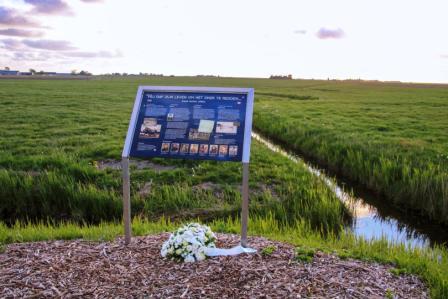
May 4, 2020. Memorial panel overlooks the site of the plane crash on October 12, 1941. (Photo credit: Dooitze van den Berg)

How wonderful that the village included the Halifax L9561 memorial panel in their annual May 4 Remembrance of the War Dead ceremonies! (For more information on this annual event in The Netherlands see   https://en.wikipedia.org/wiki/Remembrance_of_the_Dead.)

If you haven’t seen our video about Halifax L9561, “He Died That We Might Live“, you can watch it here:

Pieter is still busy with researching Canadian soldiers.  If you have photos or information to share, please contact him at dariadv@yahoo.ca or comment on the blog.

The WWII Mariner From Kinkora Whose Ship Was Torpedoed In The Caribbean

February 20, 2020. On the Cenotaph outside the Borden-Carleton Legion there are 3 men who lost their lives due to being on ships that were torpedoed.  Two of these stories have already been told….

In WWI, mariner James Graham FARROW (FARRAR) lost his life when the ship he was working on was torpedoed in the English Channel on March 19, 1916.  The steamer, ‘Port Dalhousie, had been ferrying needed supplies from Britain to troops in France, while using the cover of being a fishing vessel. (See https://onthewarmemorialtrail.com/2019/01/20/the-mariner-whose-ship-was-torpedoed-in-the-english-channel/)

In WWII, Everett Samuel FRANCIS had the misfortune of being a passenger on the ferry S.S. Caribou when it was torpedoed off the coast of Newfoundland on Wednesday, October 14, 1942.  He was on his way back to his unit in Gander, and to meet his three week old daughter Greta, after being in Ontario for weapons training. Unfortunately, he was not one of the survivors. (See https://bordencarletonresearchproject.wordpress.com/2018/03/25/the-face-of-everett-samuel-francis/)

color photo Hughes, James Emmet

James Emmet Hughes. (Photo credit: courtesy “Around Kinkora Area” by G.K. Farmer.  Photo colourization by Pieter Valkenburg.)

Like James Graham FARROW (FARRAR), James Emmet HUGHES was a seaman in the Canadian Merchant Navy, not in the military.  Born in Kinkora on April 7, 1911, he was the son of Emmet Hughes and Mary Ann McKenna.

After joining the Waterman Steamship Agency of Mobile, Alabama, he was a trimmer aboard the Panamanian registered S.S. Ramapo, travelling between North America and England with badly needed supplies.  A trimmer works in the engine room on a coal-fired ship, such as the steamship Ramapo, responsible for loading of coal into the ship and delivering coal to the stoker or fireman. (See https://en.wikipedia.org/wiki/Coal_trimmer)

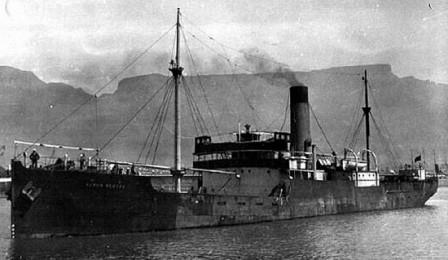
SS Ramapo under her former name Baron Wemyss.Courtesu of naviearmatori.net

S.S. Ramapo under her original name of Baron Wemyss. (Photo courtesy of http://www.naviearmatori.net)

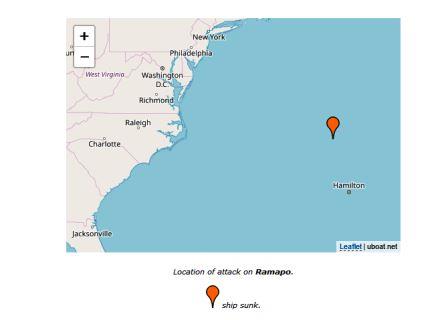
Hughes made two successful runs to England but then on a routing of London-Bermuda-Philadelphia, it was torpedoed by German U-Boat 108, captained by Klaus SCHOLTZ, 180 miles north of Bermuda. While Canadian Merchant Navy records list the event as having occurred on ‘approximately February 12, 1942’, the date it had arrived in Bermuda, German records of ships torpedoed by U-boats record the date as being February 16, 1942.

According to German records, as transcribed into English on https://www.uboat.net/allies/merchants/ship/1338.html, the ship had an international crew complement of 40, none of whom survived. “At 15.56 hours on 16 February 1942 the unescorted Ramapo (Master Johan Magnus Ørn Lorentzen) was hit on port side amidships by one G7e torpedo from U-108, broke in two after a boiler explosion and sank 11 minutes later about 180 miles north of Bermuda. The U-boat surfaced and questioned 34 men in lifeboats, but the survivors were never found. The master, 37 crew members and two gunners were lost.

Screenshot_2020-02-18 Ramapo (Panamanian Steam merchant) - Ships hit by German U-boats during WWII - uboat net

Map showing location of sinking of Ramapo.  (Map courtesy of http://www.uboat.net)

As you can imagine, in that time period, it was a long time before families learned that something had gone wrong.  On March 31, 1942, six weeks after the incident, The Guardian reported that the Hughes family had received a message from the steamship company, advising that it believed the ship had been sunk and all hands lost.

J.E. Hughes Guardian 31 march 1942 page 1

Source: Page 1 article in the March 31, 1942 edition of The Guardian.

Aboard the S.S. Ramapo on February 16, 1942 were the following crew members, per www.uboat.net:

Nationality Name Age Position
Greek Artavanis, Marios, Merchant Marine 29 Oiler
British Bailey, Mills Sandilands, Merchant Marine 44 Third Engineer
British Birch, John, Merchant Marine 50 Trimmer
Canadian Boyd, Fred, Merchant Marine 35 Messman
Canadian Boyer, Clarence, Merchant Marine 41 Fireman/Wiper
Canadian Brackenbury, Walter, Merchant Marine 22 Fireman/Wiper
Canadian Courville, Roland, Merchant Marine 18 Trimmer
Chilean Delano, Miguel, Merchant Marine 31 Second Mate
British Finch, Thomas, Merchant Marine 20 Messman
Dutch Glimmerveen, Albertus, Merchant Marine 38 Chief Cook
Canadian Green, William, Merchant Marine 29 Oiler
Norwegian Gustavsen, Karl Gustav, Merchant Marine 50 Chief Steward
Swedish Haggberg, Eric, Merchant Marine 22 Able Seaman
Norwegian Hansen, Bernhard, Merchant Marine 23 Fireman/Wiper
British Harris, William John, RN 24 Able Seaman (DEMS gunner)
Norwegian Helmers, Thorleif Gärtner, Merchant Marine 43 Chief Mate
British Hendry, Frederick William, Merchant Marine 52 First Engineer
Argentinian Hernandes, P., Merchant Marine 26 Fireman/Wiper
Canadian Hughes, James Emmet, Merchant Marine 31 Trimmer
Norwegian Kjennerud, Jul, Merchant Marine 24 Able Seaman
Canadian Knickle, Fred, Merchant Marine 39 Able Seaman
Norwegian Kristensen, Toralf, Merchant Marine 21 Able Seaman
Canadian Lalonde, Germain, Merchant Marine 20 Able Seaman
French Lawrence, Felix, Merchant Marine 30 Messman
British Leary, Vincent, Merchant Marine 35 Second Engineer
Norwegian Lie, Hans Kristian Jensen, Merchant Marine 20 Able Seamn
Canadian Lord, Ian McLean, Merchant Marine 18 Radio Operator
Norwegian Lorentzen, Johan Magnus Ørn, Merchant Marine 35 Master
Canadian Manoff, Paul, Merchant Marine 23 Ordinary Seaman
American McAdoo, John Cornelius, Merchant Marine 37 Messman
Canadian McDonald, Charlie, Merchant Marine 25 Fireman/Wiper
British Nicholson, William, Merchant Marine 36 Boatswain (Bosun)
Norwegian Olsen, Andreas, Merchant Marine 50 Chief Engineer
Irish Reynolds, William, Merchant Marine 28 Fireman/Wiper
British Sinclair, Leslie, Merchant Marine 20 Ordinary Seaman
Norwegian Vesterhus, Nils Andreas, Merchant Marine 38 Third Mate
American Vitalis, Vasilios, Merchant Marine 29 Cook
Canadian Waddell, Wesley, Merchant Marine 23 Oiler
Canadian Wilson, Edgar John, Merchant Marine 23 Ordinary Seaman
British Winder, Harry, Royal Navy 22 Able Seaman (DEMS gunner)
       

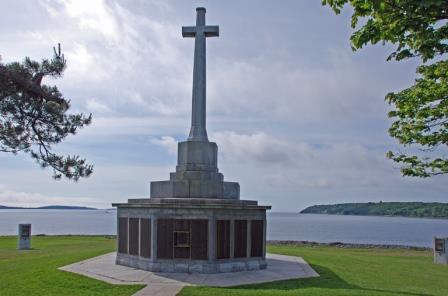
James Emmet Hughes is listed on the Halifax Memorial in Point Pleasant Park in Halifax, Nova Scotia, along with other Canadian mariners whose bodies were never recovered.

Halifax Memorial

Halifax Memorial in Point Pleasant Park in Halifax, Nova Scotia. (Photo credit: Pieter Valkenburg)

Research continues on this and other stories.  If you have information or photos to share about James Emmet Hughes, the sinking of the Ramapo, or any of the crew members, please contact Pieter at memorialtrail@gmail.com or comment on the blog.

© Daria Valkenburg

….Want to follow our research?….

If you are reading this posting, but aren’t following our research, you are welcome to do so.  Our blog address: https://onthewarmemorialtrail.com/
4 countries, 6 weeks, 7,000 km – an unforgettable war memorial journey in Europe…. Daria’s book ‘No Soldier Buried Overseas Should Ever Be Forgotten‘ is available in print and e-book formats.  Net proceeds of book sales help support research costs and the cost of maintaining this blog. For more information see https://nosoldierforgotten.com/

You are also invited to subscribe to our YouTube Channel: On The War Memorial Trail With Pieter Valkenburg: https://www.youtube.com/channel/UCJ591TyjSheOR-Cb_Gs_5Kw

Never miss a posting!  Subscribe below to have each new story from the war memorial trail delivered to your inbox.

On The War Memorial Trail…..Media Coverage On The Memorial Panel In Wons

November 28, 2019. On October 12, 2019, the memorial panel in The Netherlands to honour the crew of Halifax L9561 was unveiled.  (See On The War Memorial Trail…..The Memorial Panel In Wons Is Unveiled!) Two regional Dutch newspapers reported on the event in their October 16, 2019 publications: ‘Bolswarder Niewsblad’ and ‘Makkumer Belboei’.

Pieter has provided a translation of both articles:

goo-translate-widget

Bolswarder Niewsblad’  (See a PDF of the article in Dutch Bolswarder Nieuwsblad – 16-10-2019-1)

Unveiling of a Panel about a Plane Crash Near Wons

Wons.  On Saturday, October 12, 2019, it was 78 years ago that a witness in the area of Wons saw the Halifax L9561, which was ‘on fire, come gliding and zigzagging though the clouds.’ The bomber, with a crew of 8, had departed one and a half hours earlier from the English airport, Middleton Saint George, for a bombing mission on the port city of Bremen, but it never reached its target. On Saturday, an information panel was unveiled at the site of the crash. 

The plane had been spotted above the North Sea by the German radar station ‘Tiger’ at Terschelling.  A short time later, the experienced fighter pilot, Leopold ‘Poldi’ Fellerer, succeeded in shooting down the Halifax.  The plane crashed near the Weersterweg, just outside Wons, at 22 hours 17 minutes.

The next morning, it became clear that the 23 year old pilot, Elmer Bagnall Muttart, did not survive the crash. Later, co-pilot Norman Trayler said about Muttart that ‘He was a gallant captain and he died that we might live’.  The fact that the pilot was able to control the damaged plane long enough gave the remaining 7 crew members the chance to escape out of the burning bomber.  All survivors ended up in German prisoner of war camps and got their freedom back in 1945.

Exceptional is the story of rear gunner John Duffield of Oxford, who was hospitalized with severe injuries in the German section of the Boniface Hospital in Leeuwarden.  He was regularly visited by Poldi Fellerer and his gunner, Georg Lotze.  In 1955, 14 years after the crash of L9561, Lotze made an attempt from Germany to get in touch again with Duffield.

In his homeland, the deceased pilot Elmer Muttart has never been forgotten.  His name is mentioned on the Borden-Carleton Cenotaph, a monument close to his birthplace of Cape Traverse on Prince Edward Island.  For a long time, the exact story behind Muttart’s death was not known.  In Canada, Dutchman Pieter Valkenburg, who resides there, has delved into the history of all the deceased names on the monument, and as of 2016 also researched the life of Sgt Muttart.  Very quickly, collaboration began with the Frisian Stichting Missing Airmen Memorial Foundation (SMAMF), which has done research into the aerial war above the province since the 1970s. 

The idea of Valkenburg and SMAMF to honour, in perpetuity, Muttart’s last flight with an information panel at the crash site was realized on the 12th of October, thanks to the cooperation of Dorpsbelang Wons and financial support from within and outside The Netherlands.

About 30 relatives were present, as well as Deputy Mayor Maarten Offinga. Before the unveiling there was a reception at the museum Het Hannemahuis in Harlingen, where a short presentation about the history of Halifax L9561 was given.

goo-translate-widget

Makkumer Belboei’ (See a PDF of the article in Dutch Makkumer Belboei – 16-10-2019-1) by Sjoukje Steinhouden.

Information Panel on 1941 Crash Unveiled

On the evening of the 12th of October 1941, the Canadian pilot Elmer Muttart, with 7 British crew members, was on his way in Halifax L9561 towards Bremen, Germany, to take part in an aerial attack.  However, over Harlingen, they were shot at and hit by a German nightfighter and the plane caught fire.  Muttart quickly came to the conclusion that he couldn’t save the plane, and while holding the plane level, he ordered his crew out.  Thanks to him, they survived the crash.  The plane crashed just outside Wons and the 23 year old pilot was killed by the crash.  One of his crew members later said ‘he gave his life so that we might live’.

Exactly 78 years later, there again were Canadians and British in and around Wons.  This time they were relatives of the afore-mentioned crew.  They were invited for the unveiling of an information panel on the Weersterweg that will ensure that this event will never be forgotten.  The idea for this panel was made possible by collaboration between the Frisian Stichting Missing Airmen Memorial Foundation (SMAMF, see https://www.luchtoorlogfriesland.nl/) and Pieter Valkenburg, a Dutchman residing in Canada.  Already for years he has been doing research on Canadians who were killed during the Second World War. 

Under the billowing flags of Canada, Great Britain, and The Netherlands, Councillor Offinga from Súdwest Fryslân, Mr. Elgersma from Dorpsbelang Wons, and Mr. Pieter Valkenburg unveiled the panel with information about what happened on that autumn evening in 1941.  After that, the ‘Last Post’ was played, followed by a respectful minute of silence.  Wreaths and flowers were laid by local and international organizations, such as the Canadian and British embassies in The Netherlands.  Families were then invited to be the first to view the panel.  A daughter-in-law and grandson of one of the crew members reacted with the words ‘You know the stories about what happened.  Now it’s become real.’

After everybody had taken in the information and surroundings, the group left for Wons and stopped, for a few moments, at the war memorial there.  The SMAMF had put together a nice, informative program for them.  Earlier that day, they visited Het Hannemahuis in Harlingen where, according to one guest, a great presentation was given.  Of course, they also had visited the grave of the deceased Elmer Muttart in Harlingen. According to Sietse Kuiper of the SMAMF, ‘They were honoured that we have remembered, and therefore they made the trip’.

CIMG3634 Nov 6 2019 With Matt Rainie at CBC

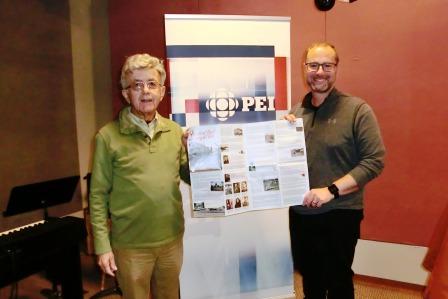
Pieter (left) with CBC PEI’s Matt Rainnie at the CBC studio in Charlottetown. They are holding up a copy of the English language transcript of the “He Died That We Might Live’ booklet. (Photo credit: Daria Valkenburg)

Pieter was interviewed by Jonna Brewer of CBC Moncton for the special regional Maritime Remembrance Day broadcast on November 11, 2019.  The interview about the events in Wons was suggested and organized by Matt Rainnie of CBC PEI and was done in the CBC studio in Charlottetown.  You can listen to this interview here: https://drive.google.com/file/d/1ho24lfnzhfhyjxmpW4qUo00p1IjyiwJ-/view?usp=sharing

A big thank you to Pieter for taking the time to translate the articles!  Thank you also to the Missing Airmen Memorial Foundation for sending us the articles, to Matt Rainnie and Jonna Brewer for featuring the Halifax L9561 story and memorial panel for the Remembrance Day broadcast, and thank you to Jane Scott for converting the MP3 file that CBC sent us into a link for this blog.  If you know of any more media stories, or have stories or photos to share about the crew or the events of October 12, 2019, please contact Pieter at dariadv@yahoo.ca or comment on the blog.

© Daria Valkenburg

On The War Memorial Trail…..The Memorial Panel In Wons Is Unveiled!

November 18, 2019. On October 12, 2019, the day of the unveiling of the memorial panel in The Netherlands to honour the crew of Halifax L9561 finally arrived, with a series of events organized by the Stichting Missing Airmen Memorial Foundation, a non-profit volunteer organization based in the province of Friesland. In the last posting about the events, we had a brief introduction to the crew members of Halifax L9561 at Het Hannemahuis Museum in Harlingen (See On The War Memorial Trail…..The Halifax L9561 Crew).

When we walked out of the Het Hannemahuis Museum in Harlingen, the dry but cloudy skies we had at the Harlingen General Cemetery had changed to rain.  Out came the umbrellas as we made the long walk to the bus for the trip to Wons.   We were keeping our fingers crossed that this was just a shower, but it wasn’t to be.  Instead it rained even harder, meaning the memorial panel was to be unveiled in the rain.  It didn’t dampen anyone’s spirits though.

IMG_6364 Oct 12 2019 Memorial plaque Wons

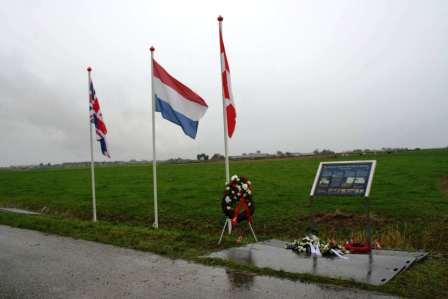
Waiting for the unveiling of the memorial plaque in Wons. You can see the flags of the United Kingdom, The Netherlands, and Canada flying. (Photo credit: Sikko Drijver)

IMG_6355 Oct 12 2019 Memorial plaque Wons flag of Wons

The memorial panel was hidden from view by the flag of Wons when we first arrived. (Photo credit: Sikko Drijver)

The memorial panel is located along a bicycle path and overlooking a field on the Politiek farm where Halifax L9561 came down.  In addition to our Canadian and British group and volunteers from the Missing Airmen Memorial Foundation, we were joined by dignitaries and citizens from the village of Wons and nearby communities.

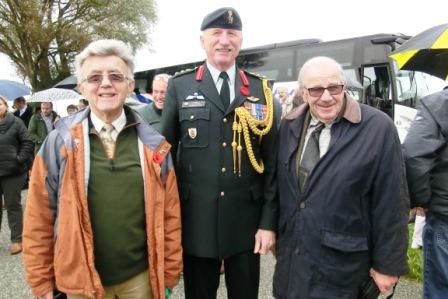
One of the dignitaries was Colonel Timothy Young, Canadian Defence Attaché to The Netherlands, Belgium, and Luxembourg, based at the Canadian Embassy in The Hague, who attended the day’s events with his wife Michelle.

CIMG3484 Oct 12 2019 Pieter Col Young Elmer in Wons

Three proud Canadians… Pieter Valkenburg, Colonel Timothy Young, Elmer MacDonald. (Photo credit: Daria Valkenburg)

Finally the moment to unveil the memorial panel arrived, and the unveilers represented organizations that had provided funding towards the memorial panel.  The unveilers were:

  • Knilles Elgersma, on behalf of Dorpsbelang Wons
  • Maarten Offinga, on behalf of the municipality of Súdwest Fryslân (Southwest Friesland)
  • Pieter Valkenburg, on behalf of the Tryon & Area Historical Society
  • Hans Groeneweg, on behalf of the Missing Airmen Memorial Foundation

CIMG3489 Oct 12 2019 Wons

Unveiling of the memorial panel. Left to right: Maarten Offinga, Knilles Elgersma, Hans Groeneweg, Pieter Valkenburg. (Photo credit: Daria Valkenburg)

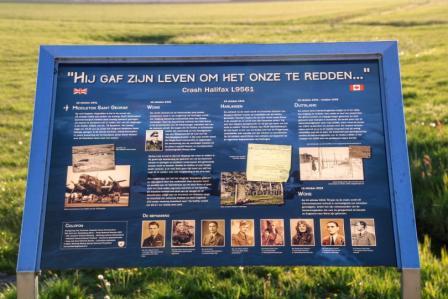
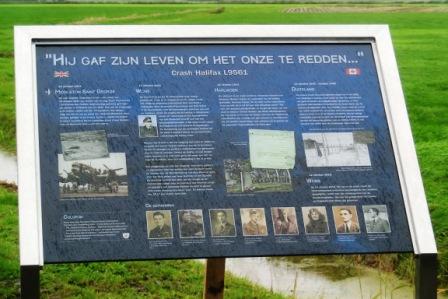
The memorial panel was highly anticipated and didn’t disappoint.  The title was a quote from Halifax L9561 Co-Pilot Norman Frank Trayler “He died that we might live”.  The story of Flight Halifax L9561 on October 12, 1941 was briefly told, from when it left Middleton St. George airbase, how it was attacked by a German nightfighter, the burial of Elmer Muttart in Harlingen General Cemetery on October 16, 1941, the fate of the rest of the crew in POW camps in Germany, and ends with the unveiling of the memorial panel in Wons on October 12, 2019.  At the bottom of the panel are photos of each crew member.

CIMG3496 Oct 12 2019 Wons

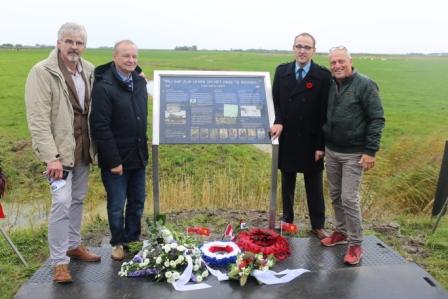
The memorial panel in Wons, overlooking the field on the Politiek farm where Halifax L9561 came down. The title translates to “He died that we might live…”, a quote from co-pilot Norman Frank Trayler. (Photo credit: Daria Valkenburg)

The memorial panel unveiled, the remembrance ceremony began, with the playing of the Last Post by Sgt Major Piet Bergsma of the Dutch Air Force, followed by a minute of silence and then the playing of the Reveille.  Next came the laying of wreaths by:

  • Maarten Offinga, on behalf of the municipality of Súdwest Fryslân (Southwest Friesland).
  • Cor Politiek, grandson of eyewitness to the crash Cor Politiek, on behalf of Dorpsbelang Wons.
  • Colonel Timothy Young, Canadian Defence Attaché to The Netherlands, Belgium, and Luxembourg, on behalf of the Government of Canada. He was accompanied by Elmer MacDonald.
  • Shane Aldridge, grandson of Halifax L9561 crew member David Cotsell, on behalf of the Embassy of Great Britain.
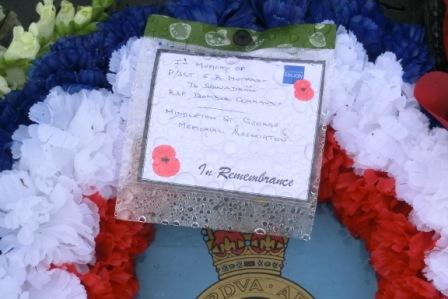
  • Fred Jackson, on behalf of the Middleton Saint George Memorial Association.
  • Douwe Drijver and Alexander Tuinhout, on behalf of the Stichting Missing Airmen Memorial Foundation.

20191012_154132 Oct 12 2019 Wreath laid by Canada

Wreath laid by Colonel Timothy Young, Canadian Defence Attaché to The Netherlands, Belgium, and Luxembourg. (Photo credit: François Breugelmans)

IMG_6397 Oct 12 2019 Memorial plaque Wons

Colonel Timothy Young, left, who laid the wreath on behalf of the Government of Canada. On the right, Shane Aldridge, grandson of David Cotsell, laid a wreath on behalf of the Embassy of Great Britain. (Photo credit: Sikko Drijver)

CIMG3509 Oct 12 2019 Wons

Some of the wreaths and flags laid by the memorial panel in Wons. (Photo credit: Daria Valkenburg)

CIMG3553 Oct 13 2019 Memorial panel in Wons message from Middleton St George

Card with the wreath placed by the Middleton Saint George Memorial Association. (Photo credit: Daria Valkenburg)

After the official ceremony was finished, family members were invited to get a closer look at the memorial panel.

20191012_154121 Oct 12 2019 Memorial plaque Wons

Pam Alexander, daughter of Halifax L9561 Navigator Reg Alexander, at the memorial panel. (Photo credit: François Breugelmans)

The Missing Airmen Memorial Foundation volunteers are commended for the wonderful job they did in designing the memorial panel.

IMG_6402 Oct 12 2019 Memorial plaque Wons

Members of the Missing Airmen Memorial Foundation by the memorial panel in Wons. Left to right: Hans Groeneweg, Douwe Drijver, Alexander Tuinhout, Sietse Kuiper. (Photo credit: Sikko Drijver)

CIMG3565 Oct 13 2019 Pieter by memorial panel

A remembrance project that has come full circle for Pieter with the permanent recognition given to the crew of Halifax L9561. (Photo credit: Daria Valkenburg)

Once everyone had a chance to see the memorial panel, we were invited to the community hall in Wons for a small reception.  Back on the bus we went!

Thank you to François Breugelmans and Sikko Drijver for sharing their photos.  If you have stories or photos to share about the crew or the events of October 12, 2019, please contact Pieter at dariadv@yahoo.ca or comment on the blog.

© Daria Valkenburg

Remembrance Day On The Island

holidays-1-e1460375295631

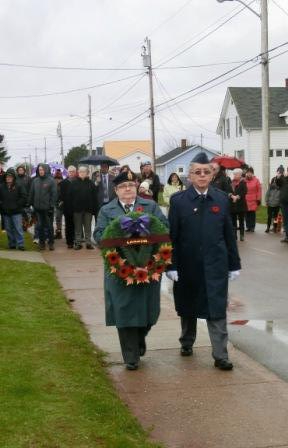
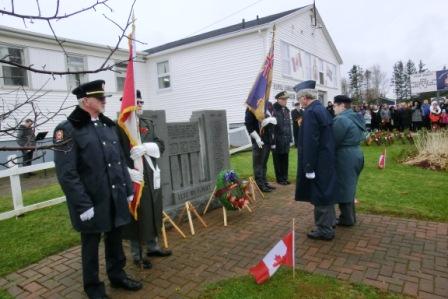
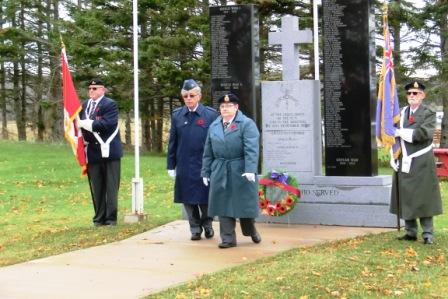
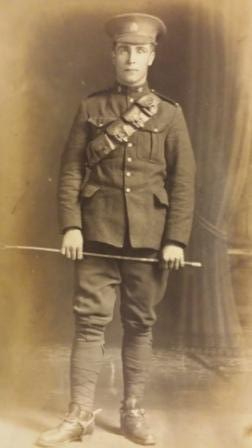
November 12, 2019. It was at a Remembrance Day service several years ago that Pieter realized that he was laying a wreath at the Cenotaph outside the Borden-Carleton Legion, and he had no idea who the names listed were.  This started him on the quest to put a face and story to each name and was the beginning of the Borden-Carleton Cenotaph Research Project. So it seems only fitting that a few photos from Remembrance Day 2019 are featured in this blog.

CIMG3636 Nov 11 2019 Borden Legion Pieter & Daria

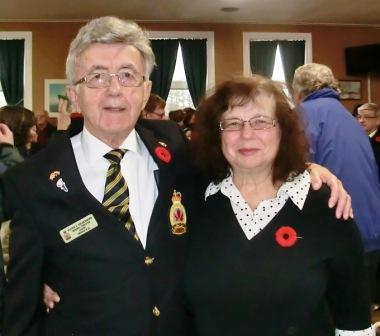
Pieter and Daria following the inter-faith service at the Borden-Carleton Legion. (Photo credit: Brenda Graves)

The Borden-Carleton Legion does two services on November 11.  The first one is at the Legion at 11 am, with wreaths laid at the Cenotaph.  The other service is in Kinkora, with wreaths laid at the Cenotaph there.

CIMG3641 Nov 11 2019 Borden Legion Remembrance Service

Waiting for the wreath laying to begin by the Cenotaph outside the Borden-Carleton Legion. Two members of the Borden-Carleton Fire Department beside Legion member Arthur Ranahan (hidden behind the Canada flag) and Legion member Carl Payne. In the background are members of the Kinkora Regional High School Band. (Photo credit: Daria Valkenburg)

CIMG3642 Nov 11 2019 Borden Legion Remembrance Service Pieter & Kathy Henry

Kathy Henry carrying the wreath that Pieter laid on behalf of the Government Canada at the request of Malpeque MP Wayne Easter. (Photo credit: Daria Valkenburg)

CIMG3644 Nov 11 2019 Borden Legion Remembrance Service Pieter & Kathy Henry

A moment of reflection after the wreath was laid at the Cenotaph outside the Borden-Carleton Legion. (Photo credit: Daria Valkenburg)

CIMG3647Nov 11 2019 Kinkora Remembrance Service George Palmer Pieter Kathy Henry

Waiting for the service to begin in Kinkora. Left to right: George Palmer, Pieter Valkenburg, Kathy Henry. (Photo credit: Daria Valkenburg)

CIMG3659 Nov 11 2019 Kinkora Remembrance Service

After laying the wreath for the Government of Canada at the Cenotaph in Kinkora, Pieter and Kathy Henry leave. Flag bearers are Carl Payne (Canada flag) and Arthur Ranahan. (Photo credit: Daria Valkenburg)

November 11 tends to be a day with inclement weather, but cold and rain never stops people from coming out to remember.  May we never forget!

If you have stories or photos to share about the names on the Cenotaph outside the Borden-Carleton Legion, please contact Pieter at dariadv@yahoo.ca or comment on the blog.

© Daria Valkenburg

On The War Memorial Trail….The Mariner Whose Ship Was Torpedoed In The English Channel

January 20, 2019….Researching the names on the Cenotaph outside the Borden-Carleton Legion continually brings some surprises as we unlock the stories behind the names.  It’s well documented that there was a merchant navy in WWII, and there are many stories about the infamous U-boats used by the Nazis during WWII.  But, did you know that there was a merchant navy in WWI?……And did you know that there were German U-boats in WWI?…….

In researching what happened to James Graham FARROW (FARRAR), we learned that he was NOT a soldier, but served as Second Mate in WWI’s Merchant Navy aboard the SS Port Dalhousie, ferrying needed supplies from England to allied soldiers in France.

Farrow was born April 4, 1856 in Argyle Shore, the son of Henry Farrow and Mary Jane Gouldrup.  In 1897, he married Mary Jane Howatt and they had 4 children.  Mary Jane also had a son William from her first husband, John Morrell, and was the sister of Harold Keith HOWATT who served in the same regiment as William Galen CAMPBELL. Campbell is also listed on the Cenotaph outside the Borden-Carleton Legion.  (See Christmas At The Front During WW1)

A mariner, Farrow received his Captain’s papers by 1903.  He owned a schooner named ‘Eva May’, but sold it in 1906 and moved to a homestead in Saskatchewan.  However, by 1912 the family was back on Prince Edward Island, where, according to ‘Seafarers of the Atlantic Provinces, 1789-1935’, he was the owner and operator of a schooner registered on PEI, named ‘Howard L’.  (Source: Ancestry.com. Canada, Seafarers of the Atlantic Provinces, 1789-1935)

In a February 19, 1916 letter to his son Welton, who was living in Portland, Maine with his mother and siblings, Farrow explains that that he gave up the schooner and on December 27, 1915 he accepted a position as second mate aboard a steamer, and was currently sailing between France and England.  “I am here in France.  I had charge of a schooner and when I laid her up in Pictou, I got a job in this steamer as second mate. It is a good job with a little more wages than on the schooner.  I got $50 a month on the schooner and $55 a month here.  (Source: www.islandregister.com/letters/james farrow 1916.html)

Farrow explained that the steamer intended to return to Canada in July, but had decided to stay in Europe.  If he wanted to return to Canada, his way would be paid back after 6 months, but as he was paid promptly each month, he thought he would stay with the steamer.

Unfortunately, by the time that Welton Farrow received that letter, his father was dead.  On March 19, 1916, U-Boat 10 torpedoed the steamer Port Dalhousie, the ship he was on, and it sank in the English Channel.

From the New York Times, page 2, column 6:

U-BOAT ATTACKS FISHERMEN”

“Sinks two trawlers off Northeast Coast of England. London July 13 – Following the attack by a German submarine on the British port of Seaham Harbor on Tuesday night, a submarine raid on fishing near the English coast was reported by Lloyd’s today.   A German submarine attacked a British fishing fleet off the northeastern coast and sank the trawlers Florence and Dalhousie and several smaller vessels.” (Source: www.islandregister.com/letters/james farrow 1916.html )

Fake news isn’t a new phenomenon!  The story about Port Dalhousie being a fishing boat, as reported in a New York Times article, was a cover the boat used. When it sank, the cargo manifest said it was transporting steel billets.  Farrow and 18 other crew members perished, their bodies lost to the sea.

Farrow’s wife, Mary Jane, stayed in Maine.  In 1930 she moved to Waterville, where she lived until her death on May 15, 1956, when she was buried in the Tryon Peoples’ Cemetery in Tryon.

Service and duty were legacies of Farrow as his sons Ralph, Harold, and Welton also served in WWI.  Ralph and Harold enlisted in the Canadian Overseas Expeditionary Force in July 1917.  Welton served in the US Army.  Ralph’s son joined the US Air Force and served in WWII, but after the war he met an untimely death when his plane crashed in Florida during an exercise.  He’s buried in Arlington National Cemetery in Virginia.

With no body to bury, James Farrow is remembered on the memorial stone at the Tryon People’s Cemetery in Tryon and on the Halifax Memorial in Point Pleasant Park in Halifax.

memorial stone tpc pieter valkenbrg

Photo: Memorial stone at Tryon Peoples Cemetery in Tryon, PEI. Photo credit: Pieter Valkenburg

Photos: Halifax Memorial at Point Pleasant Park in Halifax. Photo credits: Pieter Valkenburg

Besides Farrow, two additional names from this Cenotaph Research Project are listed on the Halifax Memorial:

Although we know a lot about James Farrow’s life, we do NOT have a photo of him.  If anyone has photos or information to share, please let us know. You can send an email to memorialtrail@gmail.com or comment on this blog.

© Daria Valkenburg

….Want to follow our research?….

If you are reading this posting, but aren’t following our research, you are welcome to do so.  Our blog address: https://onthewarmemorialtrail.com/

4 countries, 6 weeks, 7,000 km – an unforgettable war memorial journey in Europe…. Daria’s book ‘No Soldier Buried Overseas Should Ever Be Forgotten‘ is available in print and e-book formats.  Net proceeds of book sales help support research costs and the cost of maintaining this blog. For more information see https://nosoldierforgotten.com/

You are also invited to subscribe to our YouTube Channel: On The War Memorial Trail With Pieter Valkenburg: https://www.youtube.com/channel/UCJ591TyjSheOR-Cb_Gs_5Kw

Never miss a posting!  Subscribe below to have each new story from the war memorial trail delivered to your inbox.

On the War Memorial Trail …..Christmas At The Front During WWI

December 13, 2018.  Researching names on the Cenotaph outside the Borden-Carleton Legion at this time of year gets one to think about what it might have been like for the soldiers, especially during WWI.  They were far from home, by this time they would have lost friends and fellow soldiers, and might be wondering if they themselves would survive another hour, let alone another day.  So when we receive some postcards or letters that tell us what they may be experiencing at holiday time, it’s very special.

A few years ago, we received a photo of George Albert CAMPBELL from his nephew, Gerald Tingley, putting a face to that name.  (Campbell’s story was told in a posting last year – see Two Campbell Brothers in WW1)

George Albert Campbell from Gerald Tingley

Private George Albert Campbell. (Photo courtesy of Gerald Tingley family collection)

Known as Albert, Campbell was born on July 8, 1895 in Wellington, PEI, the son of John George Campbell and Grace Emma, nee Barlow.  A fisherman and farmer before enlisting on April 6, 1915 with the 6th Canadian Mounted Rifles, he later transferred to the 5th Canadian Mounted Rifles.

CIMG2669 Oct 9 2018 meet with Gerald Tingley in Salisbury

Gerald Tingley, left, with Pieter. (Photo credit: Daria Valkenburg)

Recently we had a chance to meet Gerald Tingley in person.  He arrived with a binder of WWI letters from his uncle that had been written to Gerald’s mother, and Albert’s sister, Sophie.

One excerpt was really special.  In a December 1915 letter to his sister Sophie, he wrote:  “We got a big box of cake and candy from Bedeque the other day and it was great for a change.  It was meant for Xmas but we ate it all as soon as we got it...

This excerpt about receiving cake and candy from someone in Bedeque really showed how food was always on a soldier’s mind, particularly something delicious from home.  And there was no way a soldier was going to wait for a particular day to have that taste of home.

It was the last Christmas that Campbell experienced.  During the Battle of Mount Sorrel in Belgium, he was killed in action in the vicinity of Maple Copse on June 2, 1916.  He has no known grave, and his name is listed on the Menin Gate Memorial in Ypres.

Xmas card from Harold Howatt

Christmas card with a piece of embroidered handkerchief sent by Harold Howatt, wishing his family a ‘Merry Xmas and a Happy New Year’. (Photo courtesy of H. Howatt collection)

Campbell’s brother, William Galen CAMPBELL, born June 16, 1897 in Wellington, was poisoned by a mustard gas shell in France on May 28, 1918.  He was in the same unit, the 8th Canadian Siege Battery, as Harold Keith HOWATT of Augustine Cove.

Howatt kept an active correspondence and journal, and two Christmas entries survive.  In 1917, he was stationed in Lille, France and recorded the following on December 24:  “Route march this morning, then after we came back we had to carry planks for the hut which is being put up for Christmas dinner.  In the late afternoon Dawson and I went into Lille and had a bath at a convent.  Afterwards we went to a concert in the YMCA hut….

If you ever wondered about the saying that ‘soldiers march on their stomachs’, then you will see why food is important in reading Howatt’s detailed description of the Christmas meal of December 25, 1917.  “Church parade this morning, but I did not go as Mr. Freeman wanted me to help him get ready for the Xmas dinner.  We had a great dinner, duck and chicken, applesauce, vegetables, plum pudding, apples and nuts.  The officers bought everything except the plum pudding, pretty good of them.  After dinner was over we gave ‘three cheers and a tiger’ for them…

By December 1918 the war was over, but troops were still in Europe.  Howatt’s unit was assigned to Germany.  On December 25, he made the following terse entry from Mehlem, on the Rhine: “We had no Christmas dinner as the turkey did not arrive...” 

On January 1, 1919 he gave a happier update in his journal:  “Last evening we had our Xmas dinner, which had been postponed owing to the non-arrival of the turkey.  We sat down at 8 o’clock to a good meal: turkey and vegetables, plum pudding, and nuts and apples.  There was also lots of beer, ginger ale, and also some scotch…

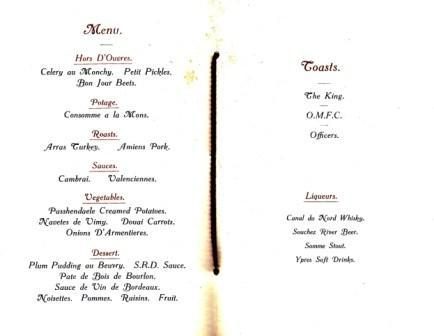
1918 xmas menu

1918 Xmas menu for the 8th Canadian Siege Battery. Notice that each dish had a name that represented where the unit was in France and Belgium! (Photo courtesy of H. Howatt collection)

Unlike George Albert Campbell, both William Galen Campbell and Harold Keith Howatt returned home from WWI.  Surprisingly, no photo of William Galen Campbell has been found.  If you have photos or information to share, please let us know. Send an email to memorialtrail@gmail.com, comment on the blog, or tweet to @researchmemori1.

© Daria Valkenburg

….Want to follow our research?….

If you are reading this posting, but aren’t following our research, you are welcome to do so.  Our blog address: https://onthewarmemorialtrail.com/

Front cover OnTheWarMememorialTrailinEurope4 countries, 6 weeks, 7,000 km – an unforgettable war memorial journey in Europe…. Daria’s book ‘No Soldier Buried Overseas Should Ever Be Forgotten‘ is available in print and e-book formats.  Net proceeds of book sales help support research costs and the cost of maintaining this blog. For more information see https://nosoldierforgotten.com/ 

You are also invited to subscribe to our YouTube Channel: On The War Memorial Trail With Pieter Valkenburg: https://www.youtube.com/channel/UCJ591TyjSheOR-Cb_Gs_5Kw

Never miss a posting! Subscribe below to have each new story from the war memorial trail delivered to your inbox.

On the War Memorial Trail …..Desecration of Halifax Memorial

October 10, 2018.  In the quest to honour the names of those listed on the Cenotaph outside the Borden-Carleton Memorial, the memorial trail journey has taken us to Europe and several cemeteries and memorials here in Canada.  One of those journeys was to the Halifax Memorial in Point Pleasant Park in Halifax, which honours those who lost their lives at sea in wartime and have no known grave.

Halifax Memorial in Point Pleasant Park

Halifax Memorial at Point Pleasant Park in Halifax. (Photo credit: Pieter Valkenburg)

CIMG7670

Inscription on Halifax Memorial in Point Pleasant Park in Halifax. (Photo credit: Pieter Valkenburg)

Three names from the Cenotaph Research Project are listed on this monument:

  • Elmer Allistair MABEY, whose story was told in an earlier posting. (See: https://onthewarmemorialtrail.com/2018/06/27/the-wwii-sailor-who-died-in-an-accidental-explosion-and-fire/)
  • James Graham FARROW, whose ship was torpedoed by a U-boat in the English Channel during WWI.  Farrow was not in the military, but in the merchant ‘navy’, delivering crucial supplies from England to troops in France.
  • James Emmett HUGHES, whose ship was torpedoed in the Caribbean during WWII.  Like Farrow, he was not in the military, but in the merchant ‘navy’.

Three names from one monument from Prince Edward Island….  You can imagine our dismay….and disgust…. to read this morning that the monument was defaced.  (See https://www.cbc.ca/news/canada/nova-scotia/halifax-war-memorial-defaced-1.4854588)

This was a disrespectful act towards those who served their country in time of war, and who do not even have a grave that families can visit.  This memorial is a substitute for their grave, just as is the Vimy Memorial in France and the Menin Gate Memorial in Belgium, among many others.

It is especially sad that this desecration has happened as we near the 100th anniversary of the end of WWI.

UPCOMING PRESENTATION: Pieter will speak about the Cenotaph Research Project at South Shore United Church in Tryon, 7 pm on Friday, November 2, 2018.  This event is co-hosted by South Shore United Church and Tryon & Area Historical Society.  Note: this venue is equipped with a hearing loop for the benefit of those with hearing loss.  You are invited to bring photos and information on the men listed on the Cenotaph, or on any Canadian soldier buried in The Netherlands.  Email memorialtrail@gmail.com for more information.

© Daria Valkenburg

….Want to follow our research?….

If you are reading this posting, but aren’t following our research, you are welcome to do so.  Our blog address: https://onthewarmemorialtrail.com/

Front cover OnTheWarMememorialTrailinEurope4 countries, 6 weeks, 7,000 km – an unforgettable war memorial journey in Europe…. Daria’s book ‘No Soldier Buried Overseas Should Ever Be Forgotten‘ is available in print and e-book formats.  Net proceeds of book sales help support research costs and the cost of maintaining this blog. For more information see https://nosoldierforgotten.com/ 

You are also invited to subscribe to our YouTube Channel: On The War Memorial Trail With Pieter Valkenburg: https://www.youtube.com/channel/UCJ591TyjSheOR-Cb_Gs_5Kw

Never miss a posting!  Subscribe below to have each new story from the war memorial trail delivered to your inbox.

On The War Memorial Trail….. Luck and Humanity During the Battle of Vimy Ridge

September 29, 2018.  Over the past few years, as the stories of the men on the Cenotaph outside the Borden-Carleton Legion are researched by Pieter, the level of death, destruction, and hatred from war is incomprehensible.  If you travel through any of the WWI and WWII sites in Europe, you see memorials and cemeteries.  In Normandy, France it seems as though there is a reminder of the war dead around every corner.

In a kill or be killed environment of war, survival was a luck of the draw.  In April 2017, the County Line Courier published ‘Two Unsung Heroes of Vimy Ridge’, a story about two soldiers on the Cenotaph whose names are listed on the Vimy National Memorial in France, Patrick Raymond ARSENAULT and John ‘Lymon’ WOOD. (See Learning About The Two Names On The Vimy Memorial) After this article was published, we were contacted by Ralf Gräfenstein of Berlin, Germany, who is helping the son of a WWI German soldier determine what happened at Vimy Ridge.

photo of Ernesto

Ernesto Brucker of Buenos Aires, Argentina.

Ernesto Ricardo Brucker, now in his 80s, who lives in Buenos Aires, Argentina, is hoping to find the Canadians who took his father prisoner during the Battle of Vimy Ridge, so he could thank them for saving his father’s life and not killing him when he surrendered.

Because of the actions of two unknown ‘tall’ Canadians, Brucker survived the Battle of Vimy Ridge and spent the remainder of the war in a Prisoner of War camp in Skipton, England.  According to the Skipton documents, he was taken prisoner between Thélus and Bailleul-Sir –Berthoult, 4.4 km south-east of Thelus.

Jorge Brucker Skipton

Georg (Jorge) Brucker at Skipton POW Camp in England. (Photo courtesy of E. Brucker)

Not only were 3,400 Germans were taken prisoner on April 9, 1917, but there were 4 Canadian Divisions involved in the battle. Could we find out how Brucker became a prisoner of war?

Georg (later known as Jorge) BRUCKER was born November 2, 1896 in Erlangen, Germany, and 18 years old when WWI started.  He joined the army and was sent to Poland, then to France.  During the Battle of Vimy Ridge, he was the Lieutenant in charge of a platoon in Machine Gun Company 1 of the Royal Bavarian Reserve Infantry Regiment I in Thélus.  They had been in the Arras area since October 1914 and held the villages of Thélus, Bailleul and the southern slope of the ridge.

On April 9, 1917, the 1st Canadian Division, under the command of Major General Arthur Currie, faced the 1st Bavarian Reserve Division, under the command of General of the Infantry Karl von Fassbender, halfway between the villages of Thélus and Bailleul-Sir –Berthoult. The 1st Canadian Division was stretched along a front of about two kilometres, with six battalions. The furthest from Vimy Ridge, they had some four kilometres of battlefield to cross in order to reach it!

Initial attack by 1st Cdn Division

Initial attack by the 1st Canadian Division (Source: http://www.webmatters.net/txtpat/index.php?id=1497)

The 13th Machine Gun Company was attached to the 1st Canadian Division in order to support the Infantry Brigades.  This is the unit that Patrick Raymond ARSENAULT was in. Was it a twist of irony that both Arsenault and Brucker were in Machine Gun Companies – on opposing sides?  Unlike Brucker, Arsenault lost his life in a shell attack on April 9, sometime around 7 am.  His body was never recovered.  Either he was buried in an unknown grave, or the shell attack scattered his body parts, making identification impossible.

John ‘Lymon’ WOOD was also in the 1st Canadian Division, as a member of the 2nd Canadian Battalion (Eastern Ontario Regiment), which was part of the 1st Canadian Infantry Brigade during the Battle of Vimy Ridge.  Wood survived the Battle of Vimy Ridge, but his luck ran out on May 3, 1917, when he was killed in action during the Battle of Arras.

Left: Patrick Raymond Arsenault in 1916 in Summerside.  (Photo courtesy of Paul Arsenault collection)  Right: John Lyman Wood shortly after enlistment in October 1915.  (Photo courtesy of Gene Rogerson collection)

Dr. Jack Sheldon researched and translated German reports from the battle.  In his 2008 book “The German Army on Vimy Ridge 1914-1917”, he recorded a description made by Brucker’s Commanding Officer, Major Meyer of the 1st Battalion Reserve Infantry Regiment:

“…At 5:30 am on 9 April enemy drum fire, supplemented by machine gun fire, came down.  It was impossible to make out the position and in fact it was almost impossible to make out signal flares amidst the clouds of smoke and dirt thrown up by the shells.  At 6:30 am heavy small arms fire could be heard and, at that moment, a message was sent by light signal to the rear.  ‘Heavy enemy attack.’  About half an hour later the wounded Muketier Hangemann happened to pass Battalion Headquarters, reporting that the British (meaning the Canadians) had overrun the right flank of 1st Bavarian Reserve Division and had then attacked our battalion in great strength from the left and rear….

In the final attack, the 1st Brigade, which John ‘Lymon’ Wood was part of, passed through the other two Brigades while the artillery dropped thousands of rounds.  As the attack began again, the wind started to turn, blowing snow and smoke from the burning village of Thélus into the faces of the Bavarians. This helped to hide the approaching Canadians, who encountered little resistance. By 1 pm the battle was over.

It’s not clear at which point Brucker was taken prisoner, but most likely it happened by 11:30 am at the latest, based on reports by Major Meyer, as recorded in Dr. Jack Sheldon’s book “The German Army on Vimy Ridge 1914-1917”:  “…Not until 11:30 am, when all the grenades had been thrown and there was no longer any prospect of timely relief, did the remainder of the garrison decide, reluctantly, to surrender...

In the book, ‘The History of the 2nd Canadian Battalion (East. Ontario Regiment) Canadian Expeditionary Force in the Great War 1914-1919’ by Colonel W. W. Murray, he records an account of the capture of German machine gunners in the morning.  “The Scouts found considerable work.  Ptes I. F. Wismer and J.F. Harrison performed a particularly daring feat near the Loen Weg.  Working in advance of No. 1 Company, they observed an enemy machine gun coming into action against the Fourth.  Pushing forward, they secured the gunner, an officer.  The pair then descended into an adjacent dug-out and forced the surrender of three more officers and four men, together with the gun…”  Were these the two Canadians who captured Georg Brucker?  It’s unlikely we’ll ever know.

At the end of the day, the 1st Division had crossed four kms of battlefield, captured 2,500 prisoners, 40 machine guns and 27 cannons at a cost of 2,500 of their own men killed or injured.  Wood survived, Arsenault died, and Brucker was taken prisoner.

Many people today may be wondering why so many German prisoners of war were allowed to surrender during the battle, and not simply killed.  In his 1986 book ‘Vimy’, author Pierre Berton gives a reason why not every Canadian soldier saw the German army as ‘the enemy’:  “…Letters and wartime reminiscences suggest that the Canadians often resented their own brass more than they disliked the grey-clad German.  You shot at him because he was shooting at you, but it wasn’t a personal matter.  He too was walling in the mud, only a few yards away….

Today, a memorial to the 1st Canadian Division sits in a farmer’s field, marking the Canadian and German front lines on April 9, 1917, on the road between Thélus and Bailleul-Sir –Berthoult.  Somewhere along this line is the spot where Brucker’s last moments of WWI before becoming a prisoner of war played out.

CIMG8314 Sep 5 2017 Pieter by sign directing you to Memorial to 1st Cdn Division

Line in farmer’s field, halfway between Thélus and Bailleul-Sir –Berthoul, marks the front line where German and Canadian troops faced each other on April 9, 1917. (Photo credit: Daria Valkenburg)

CIMG8318 Sep 5 2017 Memorial to 1st Cdn Division halfway betwen Thelus & Bailleul

Memorial honouring the 1st Canadian Division in farmer’s field, halfway between Thélus and Bailleul-Sir –Berthoul, along the line where German and Canadian troops faced each other on April 9, 1917. (Photo credit: Daria Valkenburg)

After two years in Skipton, Brucker was sent to a Military Camp in Lockstedt, Germany in October 1919, and went on to work in a bank in Bavaria. He was sent on a secondment for one year to Argentina, where he met his wife.  They married in 1923 and he stayed in Argentina until his death on December 26, 1984.

Although we were unable to give Ernesto a complete answer of who to thank for saving his father’s life, we did find out the approximate area where he became a prisoner of war, surrendering to a regiment of the 1st Canadian Division (For a list of the regiments in the 1st Canadian Division see https://en.wikipedia.org/wiki/Battle_of_Vimy_Ridge_order_of_battle.) Georg Brucker was very lucky to have surrendered to soldiers who showed humanity, not revenge.

If you can add to this story, have photos or information to share on soldiers from the Cenotaph outside the Borden-Carleton Legion, or soldiers buried in The Netherlands, please let us know. You can share them by sending an email to memorialtrail@gmail.com or by commenting on this blog.

© Daria Valkenburg

….Want to follow our research?….

If you are reading this posting, but aren’t following our research, you are welcome to do so.  Our blog address: https://onthewarmemorialtrail.com/

Front cover OnTheWarMememorialTrailinEurope4 countries, 6 weeks, 7,000 km – an unforgettable war memorial journey in Europe…. Daria’s book ‘No Soldier Buried Overseas Should Ever Be Forgotten‘ is available in print and e-book formats.  Net proceeds of book sales help support research costs and the cost of maintaining this blog. For more information see https://nosoldierforgotten.com/ 

You are also invited to subscribe to our YouTube Channel: On The War Memorial Trail With Pieter Valkenburg: https://www.youtube.com/channel/UCJ591TyjSheOR-Cb_Gs_5Kw

Never miss a posting!  Subscribe below to have each new story from the war memorial trail delivered to your inbox.

On the War Memorial Trail…..In Prince County, Prince Edward Island

September 11, 2018.  Not all war memorials are located overseas.  In researching the names on the Cenotaph outside the Borden-Carleton Legion, we’ve visited memorials and cemeteries in Europe and Canada, and met with family members of these soldiers.  Recently, with a group of friends from the British Motoring Association of PEI (BMAPEI), we did a special war memorial driving tour, in our iconic British vehicles, in Prince County, right here on Prince Edward Island.
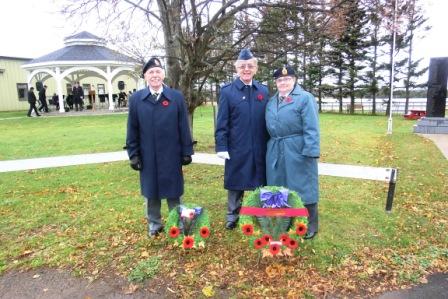
The driving tour began, naturally, at the Cenotaph that Pieter is researching.

CIMG2574 Sep 8 2018 BMAPEI memorial runcenotaph outside Borden Carleton Legion

Members of the British Motoring Association of PEI by the Cenotaph outside Borden-Carleton Legion. (Photo credit: Daria Valkenburg)

First stop was a photo op at St. Peter’s Roman Catholic Church in Seven Mile Bay, which has a great view of the Confederation Bridge.

CIMG2575 Sep 8 2018 BMAPEI memorial run 7 Mile Bay

At Seven Mile Bay, with the Confederation Bridge in the background. (Photo credit: Pieter Valkenburg)

From Seven Mile Bay our convoy of cars travelled to Notre Dame du Mont-Carmel (Our Lady of Mount Carmel) Roman Catholic Church in Mont Carmel. Volunteer guide Antoine Richard explained that this beautiful church was built in 1898 for $75,000 and consists of 450,000 bricks, which were paid for by parishioners at 5 cents a brick!  The land for the church, rectory, and cemetery had been donated by Mr. Richard’s great-grandparents Thomas Richard and Susan Aucoin in 1820.

IMG_8575 Sep 8 2018 BMAPEI memorial run Mont Carmel - Heidi

Convoy arrives in Mont Carmel. (Photo credit: Heidi Litke)

A group photo was taken at the memorial to honour WWI and WWII soldiers at the entrance to the cemetery.

CIMG2585 Sep 8 2018 BMAPEI memorial run Mont Carmel

Mont Carmel memorial to WW1 and WW2 soldiers. (Photo credit: Daria Valkenburg)

Next on the list was the Bottle Houses at Cap Egmont, which is a memorial to one man’s ingenuity and talent.

Bottle Houses - Heidi Litke

Inside one of the Bottle Houses. (Photo credit: Heidi Litke)

CIMG2590 Sep 8 2018 BMAPEI memorial run Bottle Houses Heidi & Rob in chapel

Heidi and Rob Litke in the Bottle Houses chapel. (Photo credit: Daria Valkenburg)

From the Bottle Houses, we travelled to the Memorial Park in Cap Egmont that honours WWI and WWII Acadian and other Canadian soldiers.  The park is built on the spot of a former church, and has several memorials, as well as benches in a park-like setting.

CIMG2605 Sep 8 2018 BMAPEI memorial run Memorial Park Cap Egmont

At the Memorial Park in Cap Egmont. (Photo credit: Daria Valkenburg)

CIMG2456 Aug 22 2018 prep for car tour Memorial Park in Cap Egmont

Entrance to the Memorial Park in Cap Egmont. (Photo credit: Daria Valkenburg)

Just before lunch, we stopped at the #10 Bombing and Gunnery School Monument, located at the Visitor Information Centre in Mount Pleasant.  During WWII, this area was used to train pilots slated for bombing and gunnery runs.  During the period of operation, 22 lost their lives in various accidents, and a monument sits on the spot of the former airport used for the school.

CIMG2608 Sep 8 2018 BMAPEI memorial run #10 Bombing Gunnery School Monument in Mt Pleasant

At #10 Bombing & Gunnery School Monument in Mount Pleasant. (Photo credit: Pieter Valkenburg)

Our last stop was for a very late, but well deserved lunch at The Catch in West Point, where a brief reflection on the day was made. Bill Glen was struck by the arches we’d seen at Mont Carmel and the Memorial Park in Cap Egmont.  “You never think of arches for a monument…” he said.  Sandy Bentley noted how young the soldiers were and how so many had lied about their age in order to serve, especially in WWI.

Heidi Litke wondered if there were any memorials to animals that served in the war.  She explained that her grandfather, Harold Fryer, served with a German shepherd, Sgt Rex, in the 1st Battalion Dufferin and Haldimand Rifles.  Fryer survived, Rex was killed on duty on September 7, 1943.  “I always think about the animals…,” Heidi said.  Good point.  None of us were aware of any memorials to serving animals on the island.

CIMG2611 Sep 8 2018 BMAPEI memorial run

Lunch at The Catch in West Point.

One more memorial reminder occurred when Stewart Gillcash of O’Leary came to the restaurant to meet Pieter.  Last fall, Pieter had placed flags on the grave of Stewart’s uncle, Carman GILLCASH, who is buried at the Canadian War Cemetery in Holten.  The Gillcash family had provided photos and a brief story about Stewart’s uncle for the Faces To Graves Project in The Netherlands.  Everyone was delighted to meet him.

CIMG2610 Sep 8 2018 Pieter with Stewart Gillcash at The Catch

Pieter Valkenburg with Stewart Gillcash. (Photo credit: Daria Valkenburg)

Rob Litke summed up the day.  “…You don’t have to go far.  Every community has a monument of the people they lost in war….

If you have photos or information to share on soldiers from the Cenotaph outside the Borden-Carleton Legion, or soldiers buried in The Netherlands, please email him at memorialtrail@gmail.com. Comments or stories?  You can share them by email or by commenting on this blog.

© Daria Valkenburg

….Want to follow our research?….

If you are reading this posting, but aren’t following our research, you are welcome to do so.  Our blog address: https://onthewarmemorialtrail.com/

Front cover OnTheWarMememorialTrailinEurope4 countries, 6 weeks, 7,000 km – an unforgettable war memorial journey in Europe…. Daria’s book ‘No Soldier Buried Overseas Should Ever Be Forgotten‘ is available in print and e-book formats.  Net proceeds of book sales help support research costs and the cost of maintaining this blog. For more information see https://nosoldierforgotten.com/ 

You are also invited to subscribe to our YouTube Channel: On The War Memorial Trail With Pieter Valkenburg: https://www.youtube.com/channel/UCJ591TyjSheOR-Cb_Gs_5Kw

Never miss a posting!  Subscribe below to have each new story from the war memorial trail delivered to your inbox.