On The War Memorial Trail….. The WWII Soldier Killed By Mortar Fire When His Brother Was Two Years Old

November 29, 2023.  After posting a photo search request for WWII soldier James ‘Jim’ Andrew MACLEOD on a Restigouche Facebook page, Pieter was contacted by Sheila Braun, who wrote that “…his brother Earle lives on Prince Edward Island…” and she let Earle know about the request. 

Very quickly Pieter and Earle were in touch with each other and we met him and his wife Nancy at their home in Little Sands. “…I was only 2 years old when my brother died...” Earle explained.

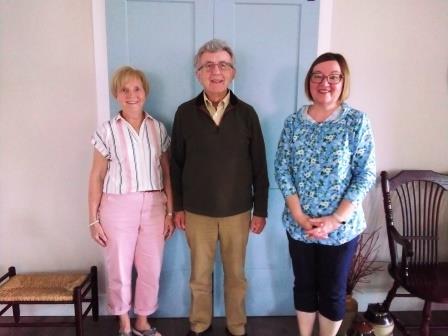
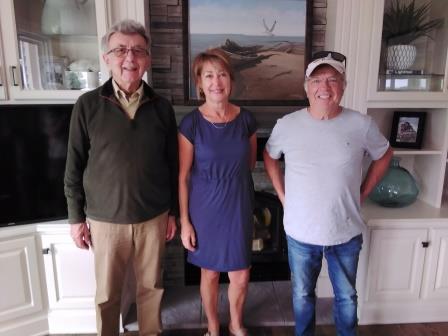
CIMG6667 Nov 17 2023 Pieter with Nancy & Earl MacLeod

Pieter with Nancy and Earle MacLeod. (Photo credit: Daria Valkenburg)

… Jim altered his birth year in order to enlist…

Born in Campbelltown, New Brunswick, James ‘Jim’ Andrew MacLeod was the son of John Earle and Christina MacLeod.  According to his Attestation form and Militia documents, he was born on December 19, 1924, but Earl and Nancy explained that he lied about his age and he was actually a year younger.  This matches what was filled out by his mother on the Estate Form, listing his date of birth as December 19, 1925.

When Jim enlisted with the No. 7 District Depot in Fredericton, New Brunswick on July 16, 1943, he had already been in the 2nd Battalion, 103rd Battery Non-Permanent Militia since October 25, 1941.  He also had a full time position as a watchman at Fraser Company, a pulp and paper mill in Campbelltown. 

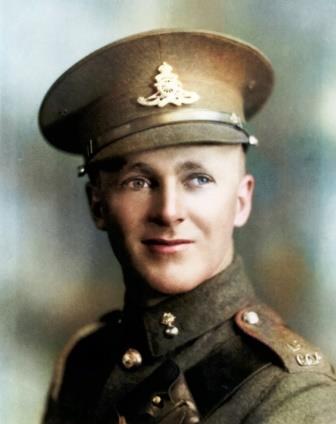
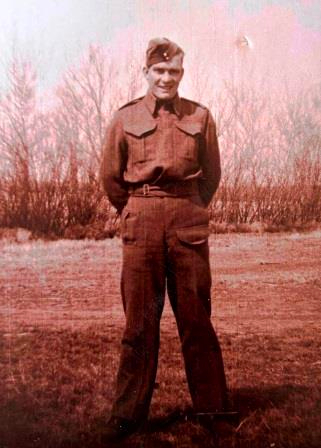
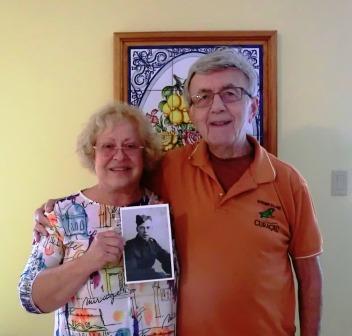
Jim MacLeod coulourized photo2

James ‘Jim’ Andrew MacLeod. (Photo courtesy of Earle and Nancy MacLeod on behalf of the MacLeod Family.  Photo colourization: Pieter Valkenburg)

The interviewer for his Canadian Army Personnel Selection Record noted that Jim enjoyed “…hockey, swimming, fishing….” and wanted to be in the “…infantry so as to take Basic and Advanced Training in New Brunswick with friends…

On August 5, 1943, Jim was sent to No. 70 Canadian Army Basic Training Centre (CA(B)TC) in Fredericton for basic training.  On September 28, 1943, his Personnel Selection Record was updated, stating that Jim “…is not satisfied with Infantry.  He had training in the Royal Canadian Artillery Reserve and desires an allocation to that arm…..He had some experience as a truck driver and as a mechanic’s helper. Could be used as a driver i/c …

On October 8, 1943 he was posted to the A-30 Canadian Infantry Training Centre at Camp Utopia, located northeast of St. George, New Brunswick.  After his 5th week of training, his Personnel Selection Record was updated. “…Very good progress in Advanced training (Infantry)….Good stability, well disciplined….Outstanding in platoon….

… Jim became a driver mechanic…

On December 5, 1943, Jim was sent to Woodstock, Ontario for a Driver Course i/c course at the S-5 Canadian Driving and Maintenance School (CD & M School).  He successfully completed this on January 21, 1944 and was qualified as a Driver i/c Class III.  (The term ‘Driver i/c’ refers to ‘Driver, internal combustion’.  Class III meant he was qualified to drive heavy trucks and armoured cars.)

Jim remained in Woodstock to take a Driver Mechanic Course, and on March 15, 1944 was qualified as a Driver Mechanic Class I.

On March 18, 1944, Jim returned to the A-30 Canadian Infantry Training Centre at Camp Utopia in preparation for overseas service.  He received two weeks of embarkation leave, from April 14 to 27, 1944, the last time he would see his family.

The last day at home

James ‘Jim’ Andrew MacLeod on his last day at home.  (Photo courtesy of Earle and Nancy MacLeod on behalf of the MacLeod Family.)

… Jim left Canada for overseas service in May 1944…

On May 1, 1944 Jim left Canada for the United Kingdom.  Upon arriving on May 7, 1944 he was assigned to No 4 Canadian Infantry Reinforcement Unit (CIRU).

While in the United Kingdom, Jim continued his training, completing a First Aid Course shortly after his arrival, and then qualifying as a Driver i/c (T) Q2 in July 1944.

On September 10, 1944 he was sent to France with the X-L infantry reinforcement troops of the 21st Army Group.

… Jim joined the Algonquin Regiment in Belgium…

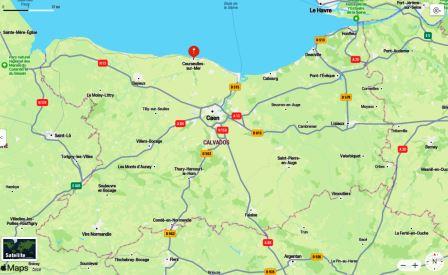
Screenshot 2023-11-28 at 11-59-28 Assenede · Belgium with arrows

James ‘Jim’ Andrew MacLeod joined the Algonquin Regiment in Assenade, Belgium, as they travelled towards Brasschaat.  (Map source: Google maps)

On September 19, 1944 he was assigned to the Algonquin Regiment, joining them in Assenade, Belgium, located not far from the Dutch border.  The Regiment had suffered heavy losses during the battles to capture the canals around Moerkerke and needed reinforcements as they slowly advanced towards the Scheldt and the need to liberate the port of Antwerp.

By October 18, 1944, the Regiment was near Westmaele, north-east of Antwerp.  In ‘Warpath The Story of the Algonquin Regiment 1939-1945’, author Major G. L. Cassidy wrote that “… on October 19th, a battalion reconnaissance party went north to Camp de Brasschaet for a look at the terrain where the next day’s battle was to be fought…..” 

… Jim was hit by a mortar shell while on patrol…

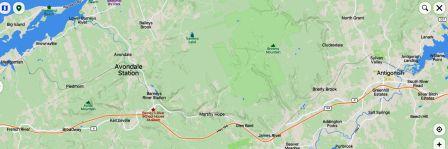
Screenshot 2023-11-26 at 13-48-12 Where is Esschen in Belgium

Map shows the location of Essen, Belgium, where James ‘Jim’ Andrew MacLeod lost his life.  (Map source: Google)

That night, orders came to “…advance and capture the town of Esschen, moving along two centre lines in two brigade groups….

While the Algonquin Regiment was in Esschen (Essen in English), Belgium, the October 23, 1944 War Diary entry recorded that “…patrols were sent out during the night.  An ‘A’ Company patrol which went out to recce a bridge east of town came under heavy mortar fire and one man was killed and two wounded…

Warpath’ provided a bit more clarity. “….An ‘A’ Company patrol, sent out to recce a bridge to the east, came under a mortar concentration and lost two men wounded, Ptes J.  Burant and J. Bordignon, and one man killed, Pte J. A. MacLeod….”  Jim was only 18 years old.

… Jim is buried in the Canadian War Cemetery in Bergen Op Zoom…

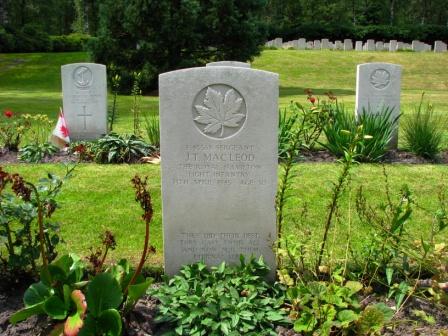
Grave of Jim MacLeod in BOZ from Find A Grave

Grave of James ‘Jim’ Andrew MacLeod at the Canadian War Cemetery in Bergen Op Zoom. (Photo source: http://www.findagrave.com)

Jim was initially buried in Brasschaat, Belgium, along a road at the entrance to the Sanatorium, before being reburied the following year in the Canadian War Cemetery in Bergen Op Zoom, The Netherlands.

Earle remembers that “…my mother would never put up the Christmas tree before December 19 after Jim died.  That was the first official Christmas day….” Needless to say, this is a family that never forgot the loss of a beloved son and brother.

Thank you to Earle and Nancy MacLeod for providing photos and information.  Thank you also to Sheila Braun for help with contacting family. Do you have a story to tell? Email Pieter at memorialtrail@gmail.com, comment on the blog, or send a tweet to @researchmemori1.  

© Daria Valkenburg

….Want to follow our research?….

If you are reading this posting, but aren’t following our research, you are welcome to do so.  Our blog address: https://onthewarmemorialtrail.com/

Front cover OnTheWarMememorialTrailinEurope4 countries, 6 weeks, 7,000 km – an unforgettable war memorial journey in Europe…. Daria’s book ‘No Soldier Buried Overseas Should Ever Be Forgotten‘ is available in print and e-book formats.  Net proceeds of book sales help support research costs and the cost of maintaining this blog. For more information see https://nosoldierforgotten.com/ 

You are also invited to subscribe to our YouTube Channel: On The War Memorial Trail With Pieter Valkenburg: https://www.youtube.com/channel/UCJ591TyjSheOR-Cb_Gs_5Kw

Never miss a posting!  Subscribe below to have each new story from the war memorial trail delivered to your inbox.

On The War Memorial Trail….. The WWII Soldier From Moncton Who Lost His Life During The Battle of Walcheren Causeway

November 20, 2023. When Pieter began his research into WWII soldier Leonard William PORTER of Moncton, New Brunswick, he discovered they had something in common, as he wrote to Leonard’s son, Peter Porter.  “…I noticed that he was born on the same day as myself but 26 years earlier, on the 25th of March 1918….” 

This was a promising start to the research, which continued after he quickly received a photo of Leonard after reaching out to Peter, and then we were able to meet Peter and his son Shane.  Asked how he felt about being approached for a photo, Peter said “…I think this is wonderful…

CIMG6567 Oct 23 2023 Shane Peter Pieter

Shane and Peter Porter with Pieter.  (Photo credit: Daria Valkenburg)

Born March 25, 1918 in Moncton, New Brunswick, Leonard was the son of Andrew and Ella Elizabeth (nee Beers) Porter. 

At the time of his marriage to Kathryn Doris Meaghan on December 6, 1941 in Moncton, Leonard listed his occupation as Sergeant in the New Brunswick Regiment (Tanks), a non-Permanent Active Militia unit.  He didn’t mention that he was also employed by the T. Eaton Company.

….Leonard was in the militia for several years….

Leonard had joined the militia on March 12, 1939, and qualified as a Sergeant on June 20, 1940.  He served in Borden, Ontario, St John, New Brunswick, and Shediac, New Brunswick. As of August 11, 1940 he had been appointed as an Instructor with A & T Staff 19th (Reserve) Army  Tank Regiment.

Leonard William Porter from Peter Porter

Leonard William Porter while serving with the New Brunswick Regiment (Tank) militia.  (Photo courtesy of Peter Porter)

He qualified as a Driver i/c Class III on June 4, 1942, after successfully completing a 6 week driving course at the S-5 Canadian Driving and Maintenance School (CD & M School) in Woodstock, Ontario. This meant he was qualified to drive heavy trucks and armoured cars. 

On June 10, 1942, Leonard was promoted to Squadron Sgt-Major Warrant Officer II (SSM (WOII)). 

On October 3, 1942, he was sent to the A-30 Canadian Infantry Training Centre at Camp Utopia, located northeast of St. George, New Brunswick to attend a Mortar and Grenade course.

On January 13, 1943, he was sent to Buctouche, New Brunswick.  While posted there he took a Browning Machine Gun course. 

Leonard and Kathryn’s son Peter James was born on February 19, 1943 in Moncton, New Brunswick.

From March to August 1943 Leonard served in Richibucto and Sussex, then from September until November 15, 1943 he was in Tracadie and Fredericton, all in New Brunswick. 

While he was in the Militia, with the New Brunswick Regiment (Tanks), Leonard also held a full time position for 5 years as a grocery clerk with the T. Eaton Company, a department store, in Moncton.

….Leonard enlisted for active service in the Canadian Army….

On November 16, 1943, he enlisted in the active service force at the No. 7 District Depot in Fredericton, New Brunswick.  In the interview for his Personnel Selection Record, it was noted that Leonard was “...fond of bowling. Does some hunting and fishing. Reads Esquire, Readers Digest, and fiction….”  Peter Porter mentioned that his father also “….played a piano-accordion...

Although Leonard had spent several years in the Militia, he was still sent for basic training, like any new recruit.  On December 7, 1943, he reported to No. 70 Canadian Army Basic Training Centre (CA(B)TC) in Fredericton. But, he was given a 5 day pass for Christmas leave, from December 23 to 28, the last Christmas he would spend with his family.

On February 15, 1944, Leonard returned to the A-30 Canadian Infantry Training Centre at Camp Utopia, located northeast of St. George, New Brunswick.  After his 5th week of training, his Personnel Selection Record was updated.  “….Leadership ability is apparent, exerts influence over his fellows. Quiet, steady, confident… Interested and ambitious…..Watch for promotions….

Leonard was selected for the 3 inch mortar training course, which ran from April 10 to April 29, 1944.  After receiving his qualification in this course, on May 4, 1944 he was sent to Woodstock, Ontario for a Carrier Driver Course at the S-5 Canadian Driving and Maintenance School (CD & M School).  He had been there in 1942 while with the militia.

On June 14, 1944, he received his qualification as a Driver i/c Class III (Wheeled) (3 inch Mortarman). The term ‘Driver i/c’ refers to ‘Driver, internal combustion’.  Class III meant he was qualified to drive heavy trucks and armoured cars. Wheeled refers to wheeled vehicles.  As a mortarman,  Leonard could not only drive vehicles containing bombs, but also be part of the mortar crew firing them. (See https://www.canadiansoldiers.com/weapons/lightweapons/mortars/3inchmortar.htm)

On June 24, 1944, Leonard returned to the A-30 Canadian Infantry Training Centre at Camp Utopia in preparation for overseas service.  He received two weeks of embarkation leave, from June 29 to July 12, 1944, the last time he would see his family.

… Leonard left Canada for overseas service in July 1944…

On July 20, 1944, Leonard left Canada for the United Kingdom.  Upon arriving on July 27, 1944 he was assigned to No 4 Canadian Infantry Reinforcement Unit (CIRU). 

His stay in the United Kingdom was short, as on September 1, 1944 he was sent to France with the X-L infantry reinforcement troops of the 21st Army Group.

Screenshot 2023-11-19 at 12-54-37 Loon-Plage · 59279 France

Leonard joined the Calgary Highlanders in Loon Plage, France.  (Map source: Google maps)

On September 12, 1944, he was transferred to the Calgary Highlanders, joining them in Loon Plage, France, not that far from the Belgian border.   The Regiment, part of the Canadian 5th Infantry Brigade, was engaged in patrolling operations and needed to be constantly on the alert from the heavily fortified Dunkirk (Dunkerque in French).

The War Diary entry for September 12, 1944 for the Calgary Highlanders reported that “…. during the evening, heavy bombers were heard roaring out toward German territory and heavy shelling and mortaring were heard coming from the direction of Dunkerque….” The situation intensified in the days that followed.  On September 14, 1944, the War Diary entry recorded that “…forty-four other ranks arrived as reinforcements to the Battalion...”  Leonard would have been one of these men.

… The Regiment was in the Battle of the Scheldt…

By September 18, 1944 the Calgary Highlanders had crossed into Belgium and were temporarily based in Wommelgem, just outside Antwerp, while the Regiment was engaged in the preparations for and participation in the Battle of the Scheldt, which began officially on October 2 and lasted until November 8, 1944.

The Battle of the Scheldt’s objective was to free up the way to the Port of Antwerp in Belgium for supply purposes. Canadians suffered almost 8,000 casualties (wounded and dead) in what turned out to be the battle with the most Canadian casualties in The Netherlands. (See https://www.veterans.gc.ca/eng/remembrance/history/second-world-war/scheldt)

During their stay in the Wommelgem area, several members of the Calgary Highlanders lost their lives, and were temporarily buried there, before being reburied in the Canadian War Cemetery in Bergen Op Zoom.  (See https://onthewarmemorialtrail.com/2021/02/13/on-the-war-memorial-trail-the-search-for-soldiers-who-died-in-wommelgem-belgium-in-fall-1944/)

On October 7, 1944, the Regiment left Belgium and arrived in The Netherlands in the early morning, with the War Diary recording that “…at 05:50 hours the group crossed the border into Holland…” and was based at Jansen Farm.

On October 11, 1944, the Regiment moved again, to De Geest, then on October 15, 1944 to Hinkelenrood and based at Van De Maegdenburg’s Farm.  Their task was mainly recce patrol.  On October 22, 1944 the Regiment arrived in Ossendrecht.   Then, on October 26, 1944, the Regiment arrived in Woensdrecht.

… The Regiment was involved in the Battle of Walcheren Causeway…

The stay in Woensdrecht was short, as on October 28, 1944 the Regiment made its way across the isthmus towards South Beveland.  By October 31, 1944, the Calgary Highlanders were to cross the Sloe Channel in assault boats towards the German-held Walcheren Island. 

The original plan to cross the Sloe Channel failed, as the Black Watch of Canada, the troops of the 5th Canadian Brigade that were in the lead, found that assault boats were useless in the deep mud of the channel.

The only route open was the Walcheren Causeway (known as Sloedam in Dutch), a land bridge from South Beveland to the Island. The Causeway was a dyke – 1,600 metres (1 mile) long and just 45 metres (40 yards) in width.

Walcheren2

Map showing troops at the beginning of the Battle of Walcheren Causeway.  (Map source: Wikipedia)

In what became known as the Battle of Walcheren Causeway, part of the larger Battle of the Scheldt, the struggle to cross the Causeway was hampered.  A deep crater on the causeway had been blown by German engineers as an anti-tank obstacle and the surrounding landscape was severely damaged by bombing.

After the Black Watch of Canada suffered heavy losses during the crossing on the evening of October 31, 1944, the Calgary Highlanders sent two companies over in succession, one close to midnight on the 31st and the other just before dawn on November 1. The first attack, on October 31, stalled just past the bomb crater on the Causeway.

In the November 1 early morning attack, carried out under artillery fire, Canadian troops reached the other side of the dam and opened up a bridgehead on the island. The Germans continued to fire upon troops, and it wasn’t until that evening that Canadian survivors succeeded in getting back to the Beveland side.

The November 1, 1944 War Diary entry for the Calgary Highlanders starkly summed up what happened. “…Fighting along the Causeway had been terrific for the last 40 hours and words are inadequate to express all the difficulties that had to be surmounted to make an advance along the ….narrow Causeway.  The memory of it will live long in the minds of the Calgary Highlanders….

(For more information, see https://en.m.wikipedia.org/wiki/Battle_of_Walcheren_Causeway and https://www.canadiansoldiers.com/history/battlehonours/northwesteurope/walcherencauseway.htm)

… Leonard lost his life in the Battle of Walcheren Causeway…

Location Lewedorp on google maps

Leonard was initially buried in Lewedorp.  (Map source: Google maps)

64 members of the Calgary Highlanders were either killed or wounded in this battle.  One of them was Leonard, who died on November 1, 1944, aged 26.  He was initially buried on Walcheren Island in Lewedorp, behind the Roman Catholic Church.

Lewedorp,_de_Rooms_Katholieke_kerk_in_straatzicht_foto4_2015-09-29_17.19 from Wikimedia

The Roman Catholic Church in Lewedorp.  (Photo source: Wikipedia)

The Germans surrendered the area on November 5, 1944.  Today, the Causeway that caused so many casualties no longer exists. Land on both sides of the dyke has been reclaimed and the Sloe Channel is now farmland. However, remnants of German concrete fortifications still exist both on Walcheren Island and South Beveland.

… Leonard is buried in the Canadian War Cemetery in Bergen Op Zoom…

Leonard was reburied in the Canadian War Cemetery in Bergen Op Zoom, The Netherlands in 1946.

Grave of Leonard Porter from Findagrave

Grave of Leonard William Porter at the Canadian War Cemetery in Bergen Op Zoom. (Photo source: Find A Grave)

Leonard’s widow never remarried.  Her son Peter explained that “….my mother was a hairdresser, and owned her own business.  She became president of the Ladies Auxiliary of the Royal Canadian Legion and was involved in the Poppy Campaign.  She also used to send money to people in The Netherlands who were adopting graves…

Peter reflected that being involved in the Legion was his mother’s “…way to commemorate.  Every September until November 11, she was busy….” 

Thank you to Peter Porter for providing a photo and information about his parents. Do you have a story to tell? Email Pieter at memorialtrail@gmail.com, comment on the blog, or send a tweet to @researchmemori1.  

© Daria Valkenburg

….Want to follow our research?….

If you are reading this posting, but aren’t following our research, you are welcome to do so.  Our blog address: https://onthewarmemorialtrail.com/

Front cover OnTheWarMememorialTrailinEurope4 countries, 6 weeks, 7,000 km – an unforgettable war memorial journey in Europe…. Daria’s book ‘No Soldier Buried Overseas Should Ever Be Forgotten‘ is available in print and e-book formats.  Net proceeds of book sales help support research costs and the cost of maintaining this blog. For more information see https://nosoldierforgotten.com/ 

You are also invited to subscribe to our YouTube Channel: On The War Memorial Trail With Pieter Valkenburg: https://www.youtube.com/channel/UCJ591TyjSheOR-Cb_Gs_5Kw

Never miss a posting!  Subscribe below to have each new story from the war memorial trail delivered to your inbox.

On The War Memorial Trail…..Remembrance Week 2023 – Updates To Previous Stories

1200x600-remembrance-day-1-1024x512

November 10, 2023.  When we write a story on the blog, we often receive additional information.  As we reflect on the service and sacrifices made by those who’ve served, it’s a good time to provide updates on previous stories and share our visit to the beautiful Springhill Cenotaph in Springhill, Nova Scotia.

…Update to the story about WWII pilot Jack MacKenzie….

After reading the story about WWII pilot Jack MacKenzie, from Winnipeg, Manitoba, who died at the controls of his plane, Halifax DT630, after being attacked on February 3, 1943 over The Netherlands, Yannic Wethley, a board member for the Air Research Drenthe Foundation (Stichting Luchtoorlog Onderzoek Drenthe) contacted us.

Memorial panel Halifax DT630

Memorial panel honouring the crew of Halifax DT630.  (Photo courtesy of Stichting Luchtoorlog Onderzoek Drenthe – http://www.slodrenthe.nl)

The Foundation, which began in 2015, had installed a memorial panel for the crew of Halifax DT-630 near the crash site, and to explain the circumstances of what happened.  (See Halifax Mk.II DT630 VR-T – Stichting Luchtoorlog Onderzoek Drenthe.)

You can read Jack’s story at https://onthewarmemorialtrail.com/2023/02/19/on-the-war-memorial-trail-the-wwii-pilot-killed-at-the-controls-of-his-halifax-bomber/ and about the 2022 Christmas Eve candle lighting ceremony at Sleen General Ceremony, where Jack is buried, at https://onthewarmemorialtrail.com/2022/12/26/2022-christmas-eve-candle-lighting-in-the-netherlands/

Several photos of crew members were missing, and Yannic explained that the panel would be updated once pictures of all crew members were found.  “…We are still searching for the pictures of Warrant Officer Second Class Raymond Hepton ‘Ray’ Hill and Sergeant Eric Raymond Marquand...

Hill was from Montreal, Quebec, and Marquand was from Winnipeg, Manitoba, and we offered to help the Foundation in their photo search quest.  A newspaper photo of Hill was subsequently found.  Jamie Nelson-Dixon, the granddaughter of Eric ‘Raymond’ MARQUAND’s sister Louisa, provided a photo of her great-uncle.

Eric Raymond Marquand

Eric ‘Raymond’ Marquand.  (Photo courtesy of Jamie Nelson-Dixon)

With all the photos of the crew members of Halifax DT630 now found, the memorial panel will be updated, likely in 2024.

…Update to the story about WWII soldier Adam Klein….

After we did a story about WWII soldier Adam KLEIN, from Disley, Saskatchewan, who died in The Netherlands while crossing the Maas River in January 1945, , and is buried in the Canadian War Cemetery in Bergen Op Zoom, The Netherlands, we heard from Peter-Willem Langebeeke of the War Museum in Veen, The Netherlands.

Nice to read your story about Adam Klein. We also have contact with the family, two sisters and their daughters…. Adam’s story is also an important part of our battlefield tour….” Peter-Willem wrote. (Translation from the original Dutch) 

We asked if tours were available in English as well as Dutch, and the answer was yes.  It’s on our ‘must visit’ list for our next trip to The Netherlands! For more information, please visit their website: www.oorlogsmuseumveen.nl or send an email to oorlogsmuseumveen@gmail.com.

Adam’s story was told in this posting: https://onthewarmemorialtrail.com/2023/07/20/on-the-war-memorial-trail-the-wwii-soldier-from-disley-who-lost-his-life-while-swimming-across-the-maas-river/  

His story was close to home as Pieter and I are very familiar with the location where he lost his life.  Many of Pieter’s ancestors are from this area and we have been there many times over the decades in tracing his family history. 

Adam’s great-nephew Mike Wilson wrote on behalf of himself and his mother Joyce: “…Thank you so much or including Adam Klein in your project and blog. We are very honoured and moved by your work…

…Family member of WWII soldier Robert Theodore Cole contacted us….

We love hearing from family members and very much appreciated it when Susan (Cole) Getson contacted us through our blog about Robert Theodore COLE of Coles Island, New Brunswick.  Robert’s story was briefly told as part of the Atlantic Canada Remembers series we did in 2021 (see https://onthewarmemorialtrail.com/2021/01/27/on-the-war-memorial-trail-atlantic-canada-remembers-part-5/).  He’s buried in the Canadian War Cemetery in Holten, The Netherlands.

…I sincerely appreciate all the hard work you do. Mr. Robert Theodore Cole which you have listed is my great uncle. My father was only 8 when his uncle died but the stories of Uncle Robert have lived on. I have his medals and his military records which I cherish. My own grandchildren know of their 3x great uncle and his sacrifice and as a family, we go to the monument in our area which lists his name and place flags and poppies for him and other relatives who served. Thank you so much for your hard work, I for one truly appreciate it....

…Family members of WWII soldier Sanford Saulis visited Holten….

We were delighted to hear from Conrad Saulis, nephew of WWII soldier Sanford Steven SAULIS of Maliseet, New Brunswick, who is buried in the Canadian War Cemetery in Holten, The Netherlands.  (See https://onthewarmemorialtrail.com/2023/02/27/on-the-war-memorial-trail-remembering-sanford-steven-saulis/)

358120622_10168075551440442_8702984731432200329_n grave of Sanford Saulis

The Saulis family at the grave of Sanford Steven Saulis in Holten. (Photo courtesy of Conrad Saulis.)

Conrad wrote us, saying “Woliwon. I’m sending you some pics from a trip I made this July to the Netherlands, in particular to visit my Uncle Sanford’s grave. It was very emotional for sure. I thought about my dad as we stood at Sanford’s grave playing a Wolastoqey honour song…

Crew at Holten welcome centre

The Saulis family at the Holten Canadian Cemetery Information Centre. (Photo courtesy of Conrad Saulis)

We had good talks with the folks from the Welcome Centre in the ‘Crew’ pic.  (L to R) Robert (a volunteer for the Centre) – my sister Vickie, her hubby Terry, their daughter (my niece) Torie, Jan (from the Centre), me and my son Garrett. The folks from the Centre were so welcoming to us and helped us in so many ways including Robert’s wife Rosa…” 

…We visited the Springhill Cenotaph….

Every year we try to visit a memorial or monument honouring a soldier or airman whose story we told.  This past summer we visited Springhill, Nova Scotia, home of the Anne Murray Centre.

CIMG6421 Jul 8 2023 Pieter by Anne Murray Centre

Pieter outside the Anne Murray Centre. The singer is a favourite of his! (Photo credit:  Daria Valkenburg)

Down the street from the Anne Murray Centre is the Springhill Cenotaph. (See https://www.veterans.gc.ca/eng/remembrance/memorials/national-inventory-canadian-memorials/details/467)

CIMG6423 Jul 8 2023 Pieter by Springhill monument

Pieter by the Springhill Cenotaph. (Photo credit:  Daria Valkenburg)

We were there to pay our respects to Lt Donald Charles MACKENZIE of Springhill, Nova Scotia, who lost his life on April 22, 1945, during the Battle of the Delfzijl Pocket, while serving with the Royal Winnipeg Rifles.   Donald was initially buried in Loppersum General Cemetery in Groningen, before being reburied in the Canadian War Cemetery in Holten, The Netherlands. 

For more information on Donald, please see:

Jul 8 2023 Pieter by Springhill monument with MacKenzie name

Pieter by the listing for Donald Charles MacKenzie on the Springhill Cenotaph.  (Photo credit: Daria Valkenburg)

…Looking for a photo of one name listed on the Springhill Cenotaph….

WWII soldier Logan Elwood LESLIE is also listed on the Springhill Cenotaph, but unfortunately no photo for him has been found to date.  He was born in Oxford, Nova Scotia, the son of John J. and Georgie Mary Leslie who moved to Moncton, New Brunswick.  Logan died April 9, 1945, while serving with the Royal Hamilton Light Infantry, and is buried in the Canadian War Cemetery in Holten, The Netherlands.  

Thank you to Yannic Wethley of the Air Research Drenthe Foundation for letting us know about the memorial panel for the crew of Halifax DT630.  Thank you to Jamie Nelson-Dixon for sharing a photo of her great-uncle, Eric ‘Raymond’ Marquand.

Thank you to Peter-Willem Langebeeke of the War Museum in Veen, The Netherlands for letting us know that Adam Klein is remembered in the battlefield tours.  Thank you also to Adam’s great-nephew Mike Wilson. 

Thank you to Susan (Cole) Getson for contacting us about Robert Theodore Cole.  Thank you to Conrad Saulis, nephew of Sanford Steven Saulis, for sharing photos of his family’s visit to Holten.

If you can help with the photo search for Logan Elwood Leslie, or have a story to tell, please let Pieter know. You can email him at memorialtrail@gmail.com, comment on the blog, or send a tweet to @researchmemori1.  

© Daria Valkenburg

….Want to follow our research?….

If you are reading this posting, but aren’t following our research, you are welcome to do so.  Our blog address: https://onthewarmemorialtrail.com/

Front cover OnTheWarMememorialTrailinEurope4 countries, 6 weeks, 7,000 km – an unforgettable war memorial journey in Europe…. Daria’s book ‘No Soldier Buried Overseas Should Ever Be Forgotten‘ is available in print and e-book formats.  Net proceeds of book sales help support research costs and the cost of maintaining this blog. For more information see https://nosoldierforgotten.com/ 

You are also invited to subscribe to our YouTube Channel: On The War Memorial Trail With Pieter Valkenburg: https://www.youtube.com/channel/UCJ591TyjSheOR-Cb_Gs_5Kw

Never miss a posting!  Subscribe below to have each new story from the war memorial trail delivered to your inbox.

On The War Memorial Trail….. Presentation ‘Up Close With A Halifax Bomber’

Crapaud Hall Nov 7 2023 Presentation title page

November 9, 2023.  On November 7, 2023, we gave a presentation at Crapaud Hall in Crapaud, Prince Edward Island: ‘Up Close With A Halifax Bomber’ about our tour of a Halifax bomber and a summary of two Island airmen who lost their lives in one: Elmer Bagnall MUTTART and Rowan ‘Bunky’ Charles FITZGERALD.

70% of Canadians in Bomber Command flew in a Halifax bomber, which explained why so many of the casualties that Pieter has researched over the years were in a Halifax.  It was one of the reasons why Pieter was so interested in touring a Halifax bomber at the National Air Force Museum of Canada in Trenton, Ontario.  (See https://onthewarmemorialtrail.com/2023/09/23/on-the-war-memorial-trail-if-only-it-still-flew/)

When Connie MacKinnon asked if we would do a presentation at Crapaud Hall in Crapaud, Prince Edward Island, giving an overview of our tour was what we chose as the topic.

image_6487327 Nov 7 2023 Daria presenting at Crapaud Hall

Daria was the presenter for ‘Up Close With A Halifax Bomber’.  (Photo credit: Connie MacKinnon)

Elmert Muttart

Elmer Bagnall MUTTART was the pilot aboard Halifax L9561 when it was shot down on October 12, 1941 just outside the village of Wons, The Netherlands.  He was the sole fatality. You can read about him here: https://onthewarmemorialtrail.com/2020/01/31/he-died-that-we-might-live-video-is-now-on-youtube/

Bunky FitzGerald

Rowan ‘Bunky’ Charles FITZGERALD was the navigator aboard Halifax W1175 when was hit by shellfire and crashed into a sandbank in the Wadden Sea, off the Dutch coast, on June 28, 1942.  There were no survivors. You can read about him here: https://onthewarmemorialtrail.com/2022/10/12/on-the-war-memorial-trail-well-never-forget-uncle-bunky/

Nov 7 2023 Pieter and Daria answer questions at Crapaud Hall

Pieter joined Daria during the question and answer period following the presentation.  (Photo credit: Connie MacKinnon)

A lively question and answer period followed the presentation, with several attendees also sharing stories. It was an enjoyable experience for all of us!

CIMG6616 Nov 7 2023 Daria & Pieter With Edison Smith photo Kathy Henry

Daria and Pieter with Edison Smith.  (Photo credit: Kathy Henry)

Among the attendees was Edison Smith, grandson of WWII soldier Edison Alexander SMITH, who lost his life on March 25, 1945 during the Battle of Bienen in Germany. We very much appreciated the opportunity to meet him in person.  (You can read Edison Smith’s story at https://onthewarmemorialtrail.com/2023/03/04/on-the-war-memorial-trail-the-battle-of-bienen-part-1-the-wwii-soldier-whose-body-shielded-a-wounded-major/)

Do you have a story to share?  Please contact Pieter at memorialtrail@gmail.com, comment on the blog, or send a tweet to @researchmemori1

© Daria Valkenburg

….Want to follow our research?….

If you are reading this posting, but aren’t following our research, you are welcome to do so.  Our blog address: https://onthewarmemorialtrail.com/

Front cover OnTheWarMememorialTrailinEurope4 countries, 6 weeks, 7,000 km – an unforgettable war memorial journey in Europe…. Daria’s book ‘No Soldier Buried Overseas Should Ever Be Forgotten‘ is available in print and e-book formats.  Net proceeds of book sales help support research costs and the cost of maintaining this blog. For more information see https://nosoldierforgotten.com/ 

You are also invited to subscribe to our YouTube Channel: On The War Memorial Trail With Pieter Valkenburg: https://www.youtube.com/channel/UCJ591TyjSheOR-Cb_Gs_5Kw

Never miss a posting!  Subscribe below to have each new story from the war memorial trail delivered to your inbox.

On The War Memorial Trail….. A Monument In St Claude Led To A Photo Of A WWII Soldier

November 8, 2023.  Sometimes Pieter needs a break from extensive research. This past winter he decided to help the Canadian War Cemetery in Groesbeek, The Netherlands find photos of a few soldiers for which research had already been done, but no photo could be found.  It seemed like a relatively simple project, but there was a reason no photos were available – they were hard to find!

One of the soldiers whose photo search he undertook was that of Norman Victor Holgate BUCHANAN of Miami, Manitoba.  Born October 25, 1914, Norman was the son of Elizabeth ‘Lizzie’ Oakes and his birth certificate was registered with the surname Oakes. He received the surname Buchanan after Lizzie married Jim Buchanan, who adopted him. (You can read Norman’s story here: https://www.facestograves.nl/LifeStories/BUCHANAN%20Norman%20Victor%20Holgate-JLE-bio-EN.pdf)

N. Buchanan 3 from Gordon Warren

Grave of Norman Victor Holgate Buchanan at the Canadian War Cemetery in Groesbeek. (Photo courtesy of Gordon Warren)

….The search for a photo of Norman Buchanan had many roadblocks….

Norman had many half-siblings – Jeff, Archie, Cliff, Tom, Barney, and Hazel – and it was a reasonable assumption that somewhere in that extensive family a photo of Norman would be found.  Unfortunately, every descendant of Norman’s family that was contacted did not have a photo. 

Pieter then began to look at Norman’s wife, Lillian Warren, from St Claude, Manitoba.  They had married on Christmas Eve in 1941, while Norman was on furlough.  They were not long together as Norman left Manitoba in March 1942 for further training, and then, following a brief leave in November, was sent to the United Kingdom for overseas service in December 1942. 

While serving with the Royal Winnipeg Rifles, Norman lost his life on February 16, 1945, after receiving a gunshot to his head during the Battle of Moyland Wood in Germany. (See https://legionmagazine.com/clearing-moyland-wood/

Lillian and Norman had no children, and research showed that Lillian never remarried.  Pieter was at a standstill where to look next and so we asked Judie Klassen, who has helped with really tough cases in the past, if she could take a look. 

…. A monument in St Claude led to a photo….

Judie ran into the same roadblocks, but did find a poor resolution photo of Norman from a March 3, 1945 Winnipeg Free Press announcement of his death. But Judie didn’t give up!  She let us know that she had “….contacted the St. Claude library about a photo for Norman Buchanan, wondering if they could connect me to a museum/historian in the area….

She received a note from Robert De Smet of the Societe Historique St Claude.  “…I am a member of the St Claude Historical society, which also cares for our veterans monument here. We unfortunately don’t have any photo of Norman. In fact we were not even aware that Norman had lived in St Claude. Norman’s story is quite remarkable, all the way from losing his father at 2, assumedly a Mr Brissenden, all the way up to his heroic service  during the war.….

He went on to explain that “….Lillian was well known in St Claude, and that Norman and Lillian were married on Christmas Eve, 1941 in Rathwell, Manitoba while he was on furlough….”  He explained that Lillian had a son. “….Gordon Warren was born in 1936…” 

Then Robert continued, saying “…I have worked with Gordon Warren at the veterans monument in St Claude…

I called Robert De Smet, who said he would speak with Gordon Warren and ask if there was a wedding photo, or perhaps other photos, of Norman Buchanan.  He explained that Gordon was the contractor who had renovated the war memorial in St Claude! (See http://www.mhs.mb.ca/docs/sites/stclaudewarmemorial.shtml)

 “…Gordon is still working (at 86 years) with his son at Portage Memorials in Portage la Prairie…” Robert noted.  (See https://portagememorials.ca/about/)  He visited Gordon, who did have a photo! Success! 

N. Buchanan 2 from Gordon Warren

Norman Victor Holgate Buchanan. (Photo courtesy of Gordon Warren)

We invited Gordon to also send a photo of himself, which he kindly did.

Gordon Warren

Gordon Warren.  (Photo courtesy of Gordon Warren)

Thank you to Judie Klassen and Robert De Smet for helping in the search for a photo.  Many thanks go to Gordon Warren for sharing photos. Norman’s photo will be included in the 2025 Faces of Groesbeek Exhibition, where for 3 weeks in May photos of soldiers are placed by their graves.

Do you have a story to share?  Please contact Pieter at memorialtrail@gmail.com, or comment on the blog. 

© Daria Valkenburg

….Previous story about a soldier who lost his life during the Battle of Moyland Wood….

Another soldier who lost his life during the Battle of Moyland Wood, and whose story was previously told on this blog, was Alfred Louis PITAWANAKWAT (PITWANAKWAT).  You can read his story at: https://onthewarmemorialtrail.com/2021/09/06/on-the-war-memorial-trail-remembering-ww2-soldier-alfred-louis-pitawanakwat-pitwanakwat/

….Want to follow our research?….

If you are reading this posting, but aren’t following our research, you are welcome to do so.  Our blog address: https://onthewarmemorialtrail.com/

Front cover OnTheWarMememorialTrailinEurope4 countries, 6 weeks, 7,000 km – an unforgettable war memorial journey in Europe…. Daria’s book ‘No Soldier Buried Overseas Should Ever Be Forgotten‘ is available in print and e-book formats.  Net proceeds of book sales help support research costs and the cost of maintaining this blog. For more information see https://nosoldierforgotten.com/ 

You are also invited to subscribe to our YouTube Channel: On The War Memorial Trail With Pieter Valkenburg: https://www.youtube.com/channel/UCJ591TyjSheOR-Cb_Gs_5Kw

Never miss a posting!  Subscribe below to have each new story from the war memorial trail delivered to your inbox.

In Memoriam To John Robinson and Donald Moore

In_memoriam

November 4, 2023. Over the past years, the On The War Memorial Trail Research Project has been telling stories of those who have served our country.  This isn’t done in isolation but with the help of many families who contributed photos and personal recollections.

..John Robinson was the nephew of WWI soldier Arthur Clinton Robinson…

This week, we received word that Arthur ‘John’ Robinson, nephew of Arthur Clinton ROBINSON, a WWI soldier with the 26th (New Brunswick) Battalion, from Tryon, Prince Edward Island, who is buried in Belgium, passed away. (See https://www.saltwire.com/prince-edward-island/obituaries/arthur-john-cm-robinson-94002/)

IMG_3466 Hazel and John Robinson

Hazel and John Robinson. (Photo courtesy of the Robinson Family)

We visited Arthur’s grave in La Laiterie Military Cemetery in 2017.  Up to now, however, neither we nor the family have been able to find a photo of this WWI soldier, who is listed on the Cenotaph outside the Borden-Carleton Legion in Borden-Carleton, Prince Edward Island.

For more information on Arthur Clinton ROBINSON, see:

…Donald Moore was the nephew of WWII soldier Archie McLean…

Today we learned that Donald Allan Shadrach Moore, nephew of WWII soldier Archibald Phillip ‘Archie’ MCLEAN of Edmundston, New Brunswick, passed away. (See https://www.saltwire.com/prince-edward-island/obituaries/donald-allan-shadrach-moore-94043/)

CIMG6452 Aug 29 2023 Pieter Don Moore Tina Mundy

Pieter with Donald Moore and Tina Mundy.  (Photo credit: Daria Valkenburg)

Archie, who was serving with the Carleton & York Regiment at the time of his death on April 17, 1945, is buried in the Canadian War Cemetery in Holten, The Netherlands. You can read his story here: https://onthewarmemorialtrail.com/2023/09/13/on-the-war-memorial-trail-archie-was-a-good-guy/

Our deepest condolences go to the families of John Robinson and Donald Moore. 

If you are able to help with a photo of Arthur Clinton Robinson, please let us know.  You can email us at memorialtrail@gmail.com, comment on the blog, or tweet to @researchmemori1.    

© Daria Valkenburg

…Previous In Memoriams….

…Want to follow our research?…

If you are reading this posting, but aren’t following our research, you are welcome to do so.  Our blog address: https://onthewarmemorialtrail.com/

Front cover OnTheWarMememorialTrailinEurope4 countries, 6 weeks, 7,000 km – an unforgettable war memorial journey in Europe…. Daria’s book ‘No Soldier Buried Overseas Should Ever Be Forgotten‘ is available in print and e-book formats.  Net proceeds of book sales help support research costs and the cost of maintaining this blog. For more information see https://nosoldierforgotten.com/

Subscribe to our YouTube Channel: On The War Memorial Trail With Pieter Valkenburg: https://www.youtube.com/channel/UCJ591TyjSheOR-Cb_Gs_5Kw

Never miss a posting!  Subscribe below to have each new story from the war memorial trail delivered to your inbox.

New Book About Soldiers Buried In The Canadian War Cemetery In Holten, The Netherlands

Book cover front

Holten Heroes’ by Jan Braakman, translated by Pieter and Daria Valkenburg

November 1, 2023. A new book, published in English on October 27, 2023 was translated by us – Daria and Pieter Valkenburg.  ‘Holten Heroes: Stories from a Canadian Field of Honour’ by Jan Braakman, was translated from the original Dutch book that Jan wrote: ‘Holtense Canadezen’.

Here is an excerpt from the media release:

Holten Heroes: Stories from a Canadian Field of Honour

– A book that pays tribute to Canadian soldiers

Tucked away in the rolling hills of the Dutch province of Overijssel is the Holten field of honour for Canadian soldiers who lost their lives in World War II.

For the first time since the cemetery was established, the buried soldiers are being honoured in a book: Holten Heroes: Stories from a Canadian Field of Honour.  Holten Heroes describes the genesis of the Commonwealth War Graves Commission cemetery in Holten and tells stories of the soldiers buried there.

In 155 pages, the book takes you through the incredible journey Canadian soldiers made from Dieppe to German prisoner-of-war camps, you learn about the hardships they lived under, you read about the opposition they encountered during the liberation of The Netherlands and you become part of the grief felt by those left behind. 

The book about the Holten cemetery marks the connection between Canada and The Netherlands since Canadian soldiers liberated the country from the Nazis in the spring of 1945.

The liberation of The Netherlands brought joy and sorrow. The Dutch people were delirious with joy when Canadian heroes gave them back their freedom. But that did not come without the sacrifice of thousands of lives Canadian young men who still had a bright future ahead.

They are the heroes to whom the book Holten Heroes pays tribute. The names of all of them are mentioned in Holten Heroes, many of them with a photo from the collection of the Canadian Cemetery Information Centre (ICB) in Holten. The book is a valuable gem for all bereaved Canadians.

The book’s sales will benefit the work of the Canadian Cemetery Information Centre (ICB) in Holten.

…..A bit about the author and translators….

Author Jan Braakman

Jan Braakman. (Photo credit: Paulus Maessen)

The Author: Jan Braakman (b. 1960) is a Dutch investigative journalist, and the author of several books in Dutch.

In 2012, his book The War in the Corner was published in Canada. During his research he discovered the truth behind the arrest that led to the death of his grandfather in 1944 in the concentration camp, Neuengamme, near Hamburg.

He has been working as a volunteer researcher for the Information Centre Canadian War Cemetery in Holten since 2014. In 2019, he produced the documentary Lest We Forget featuring Canadian bereaved families, who told of their loved ones buried in Holten (with Sander Jongsma, RTV Oost).

daria-and-pieter

Daria and Pieter Valkenburg (Photo credit: Karen McKay)

The Translators: Canadian born Daria Valkenburg is a retired accountant, adult education instructor, and writer whose work has been published in several newspapers and journals. The Netherlands born Pieter Valkenburg served in the Dutch Air Force before going on to a career in the Dutch Foreign Service and 10 postings around the world.  Pieter has been a volunteer researcher for the Information Centre Canadian War Cemetery in Holten since the fall of 2014.

Daria and Pieter’s research into Canadian soldiers is documented on this blog and in the ‘On The War Memorial Trail’ column in the ‘County Line Courier’, a newspaper on Prince Edward Island. Daria is also the author of ‘No Soldier Buried Overseas Should Ever Be Forgotten(https://nosoldierforgotten.com/).

…..Where is the book available?….

Holten Heroes: Stories from a Canadian Field of Honour’ is available through Amazon, and at the Cemetery’s Information Centre. 

Please see the Amazon Canada entry for more information: https://www.amazon.ca/Holten-Heroes-Stories-Canadian-Honour/dp/B0CM25LRD3/ref=sr_1_1?crid=QEQCI0LBFLPK&keywords=holten+heroes&qid=1698840141&sprefix=holten+heroes%2Caps%2C207&sr=8-1

Do you have a story to tell? Email Pieter at memorialtrail@gmail.com, or comment on the blog.  

© Daria Valkenburg

…Want to follow our research?….

If you are reading this posting, but aren’t following the blog, you are welcome to do so.  Our blog address: https://onthewarmemorialtrail.com/

Front cover OnTheWarMememorialTrailinEurope4 countries, 6 weeks, 7,000 km – an unforgettable war memorial journey in Europe…. Daria’s book ‘No Soldier Buried Overseas Should Ever Be Forgotten‘ is available in print and e-book formats.  Net proceeds of book sales help support research costs and the cost of maintaining this blog. For more information on the book, please see https://nosoldierforgotten.com/

You are also invited to subscribe to our YouTube Channel: On The War Memorial Trail With Pieter Valkenburg: https://www.youtube.com/channel/UCJ591TyjSheOR-Cb_Gs_5Kw

Never miss a posting!  Subscribe below to have each new story from the war memorial trail delivered to your inbox.

On The War Memorial Trail… An Island Airman In Stalag Luft III Part 2: Escape From The POW Camp

October 30, 2023. In Part 1, Pieter’s research revealed how a small postcard-sized letter, written in September 1942 from POW camp Stalag Luft III, impacted two families from Prince Edward Island. (See https://onthewarmemorialtrail.com/2023/10/23/on-the-war-memorial-trail-an-island-airman-in-stalag-luft-iii-part-1-2-families-connected-by-1-letter-from-a-pow-camp/)

The letter was found by Don Coutts, nephew of WWII pilot Elmer Bagnall MUTTART of Cape Traverse, who lost his life on October 12, 1941.  It was written by John ‘Hubert’ HALL of Summerside, the pilot aboard Wellington Z1203, which crashed in The Netherlands near Mijdrecht on the night of March 28/29, 1942. 

The camp was near the town of Sagan, Lower Silesia, in what was then Nazi Germany (but now Żagań, Poland), 160 kilometres (100 miles) south-east of Berlin.  The movie ‘The Great Escape’ was based on an incident that happened in this camp in 1944. (See https://en.wikipedia.org/wiki/Stalag_Luft_III)

CIMG6475 Hubert Hall with mustache cropped and sharpened

John ‘Hubert’ Hall. (Photo courtesy of the Hall Family)

After meeting Hubert’s son, Robert ‘Bob’ Hall, and his wife Joanne Sheen, we came away with a wealth of information about Hubert, who sadly died young, at the age of 39.

CIMG6521 Oct 14 2023 Daria with Joanne Sheen & Bob Hall

Left to right: Joanne Sheen, Bob Hall, Daria Valkenburg (Photo credit: Pieter Valkenburg)

Now, in Part 2, more on Hubert’s story and his long march to freedom after leaving Stalag Luft III…..

Hubert was born January 4, 1915 in Summerside, Prince Edward Island, the son of Franklin and Marion (nee Howatt) Hall.  As a child, he and his brother Paddy went with their parents to Western Canada, and he attended school in Camrose, Alberta. Unfortunately, the family’s hope for a better economic future was disrupted by the Depression, and Mrs Hall returned to the Island with her sons.  Then, after WWII began, both sons enlisted in the RCAF.

Hubert enlisted at the RCAF Recruiting Centre in Moncton on June 26, 1940.  He took his initial flight training at No. 11 Elementary Flying Training School (EFTS) RCAF Station Cap de la Madeleine, in Trois-Rivières, Quebec.  He received primary pilot training, including solo flying of a basic training aircraft, and graduated on December 9, 1940.

In December 1940, he was sent to No. 2 Service Flying Training School (SFTS) RCAF Station Uplands in Ottawa, Ontario for continued pilot training on an advanced single or multi engine training aircraft.

CIMG6471 Print of Wellington bomber

Print of a Wellington bomber displayed in Bob Hall’s home office.  (Photo credit: D Valkenburg)

After receiving his wings, he left Canada for the United Kingdom and by May 1941 was training on a Wellington bomber at No. 12 Operational Training Unit (OTU) at RAF Benson, England.  

On June 19, 1941, Hubert began flying while attached to 142 Squadron of the RAF.  He was second pilot for 10 operations, and then pilot for 7 operations.  Wellington Z1203 turned out to be his 7th and final operation…..

…The air crew aboard the last flight of Wellington Z1203….

  • Pilot – Pilot Officer John ‘Hubert’ HALL, of the RCAF
  • Second Pilot – Flight Sgt Lawrence Hugh HOUGHTON, of the RAF
  • Navigator – Flight Sgt John Edward HARRITT, of the RAF
  • Wireless Operator/Air Gunner – Flight Sgt Arthur Richard TIDDER, of the RAF
  • Front Gunner – Sgt Geoffrey Peter WADSWORTH, of the RAF
  • Rear Gunner – Sgt Ernest Joseph PETTITT, of the RAF

….The last flight of Wellington Z1203….

GrimsbytoLubecktoMidrechtREV

Map shows the plane’s path from England towards Lübeck.  On the return to England, the plane was hit by flak near Kiel and diverted to The Netherlands where it crashed near Mijdrecht.  (Map prepared by Wendy Nattress)

According to the records, Wellington Z1203 departed RAF Grimsby at 21:28 pm on March 28, 1942 on a bombing operation to Lübeck, Germany. During the return to base in the early hours of March 29, the plane was hit by German flak as it crossed the coast near Kiel.  A fuel line was damaged, causing fuel loss. With insufficient fuel to return to England, the pilot – Hubert Hall – diverted the plane, turning inwards towards The Netherlands.

All six crew members were able to bail out and became prisoners of war for the duration of the war. The airplane dove into the ground and crashed in Mijdrecht, near Amsterdam Schiphol Airport.

…The long march to freedom….

According to Hubert’s Liberated Prisoner of War form, following the crash, he was first taken to Frankfurt, Germany, to Dulag Luft Frankfurt, a POW transit camp, for interrogation.  He was there from April 1, 1942 to May 7, 1942.  (See https://en.wikipedia.org/wiki/Dulag_Luft)

Hubert then was sent to POW camp Stalag Luft III in Sagan, Lower Silesia (Żagań, Poland).  He was there from May 9, 1942 until January 27, 1945.

As Russian forces advanced to less than 20 kilometres (12.4 miles) of Stalag Luft III, the POWs felt that liberation was only a matter of days away. Their hopes were dashed as on the evening of January 27, 1945, word came that Hitler had ordered the immediate evacuation of the camp. The POWs in all six compounds were instructed to prepare to march that very night. (See https://www.stalagluft3.com/long-march/)

The march began in the early hours of January 28, 1945, with the POWs trudging through heavy snow, cold weather, and even a blizzard.

march_map from Stalag Luft III

The long march from Stalag Luft III to Tarmstedt in the winter of 1945. (Map source: https://www.stalagluft3.com/long-march/)

Stuart Bruce Keith ‘Brack’ BRACKENBURY, an RCAF pilot from Ontario, was Hubert’s roommate in the Stalag, according to an account his daughter Ana Brickley gave to the Hall family. Brack was the pilot aboard the last flight of Hampden P1165, on an operation to Hüls, Germany, which was shot down and crashed at Winterswijk, Gelderland, The Netherlands on December 28, 1941. He was the only survivor of that crash.

Per her father’s recollection, Ana explained that they “…marched west away from the Russians and walked to a glass factory halfway to Hamburg, and stayed there a few months as they were too weak to walk further….”  This may be Marlag und Milag Nord in Tarmstedt, Germany, as Hubert’s Liberated Prisoner of War form stated he was there from February 4, 1945 until April 10, 1945.

marlag_und_milag_nord

Marlag und Milag Nord in Tarmstedt, Germany.  (Photo source: https://www.stalagluft3.com/long-march/)

Ana’s account noted that the men later “...went into boxcars….” by train “…to Hamburg and then walked to the Baltic Sea…”  They were eventually “…liberated in Lübeck... which is a Baltic port.  Hubert’s Liberated Prisoner of War Form noted that they were liberated on May 2, 1945 in Trenthorst, a small settlement on the estate of German business magnate Philipp F. Reemtsma.

Their ordeal wasn’t quite over as Ana recounted that “…the army was going to drive the liberated men in trucks back to France.  They objected. Winston Churchill heard about it and said ‘they flew in, and they’ll fly out’.  And they did…..

Hubert received his official discharge on July 27, 1945 in Halifax, Nova Scotia.

….Back on Prince Edward Island….

During his time as a POW, Hubert had contracted tuberculosis, and when he returned back to the Island, he …was in the sanatorium in Charlottetown…” Bob explained. 

Once he left the sanatorium, Hubert worked at Hall Manufacturing, and then became the Sheriff of Prince County on July 15, 1947.  In Canada, a sheriff is a law enforcement officer, but not a police officer, as in the USA.  Sheriffs’ offices in Canada are primarily concerned with court services such as security in and around the courts, post-arrest prisoner transfer, serving legal processes, fine collection.

Bob explained that his father met his mother, Audrey ‘Forrona’ England when he became Sheriff.  “…She worked at the Bank of Nova Scotia in Summerside, and most likely that’s where they met…” 

Bob shared a story about his parents’ first date.  “…My father had a gorgeous black Rover with red leather seats.  On their first date, they went for a drive. When they stopped, my mother opened the door, and a heavy wind gust blew the door off!...

Unfortunately, Hubert died in December 1954, leaving behind his wife Forrona and their two sons, Robert and Brenton. He’s buried at the People’s Cemetery in Summerside, Prince Edward Island, alongside his wife Forrona, who died in 2009.

Joanne Sheen wrote us, saying “….thank you so much for your visit. The tireless work and passion you both have for your project is amazing….Bob and I were very touched by the conversation….the visit brought Hubert to life.  Sad that it was a life cut short but Hubert was luckier than many in that he did get to return home and for a time, a happy life with his wife Forrona and two little boys….” 

Thank you to Bob Hall and Joanne Sheen for providing information about Hubert Hall. Thank you to Wendy Nattress, who prepared the map showing the flight path for Wellington Z1203, and to Yannic Wethly for sending Hubert’s Liberated Prisoner Of War Form.

Do you have a story to tell? Email Pieter Valkenburg at memorialtrail@gmail.com, comment on the blog, or send a tweet to @researchmemori1.  

© Daria Valkenburg

…Want to follow our research?….

If you are reading this posting, but aren’t following the blog, you are welcome to do so.  Our blog address: https://onthewarmemorialtrail.com/

Front cover OnTheWarMememorialTrailinEurope4 countries, 6 weeks, 7,000 km – an unforgettable war memorial journey in Europe…. Daria’s book ‘No Soldier Buried Overseas Should Ever Be Forgotten‘ is available in print and e-book formats.  Net proceeds of book sales help support research costs and the cost of maintaining this blog. For more information on the book, please see https://nosoldierforgotten.com/

You are also invited to subscribe to our YouTube Channel: On The War Memorial Trail With Pieter Valkenburg: https://www.youtube.com/channel/UCJ591TyjSheOR-Cb_Gs_5Kw

Never miss a posting!  Subscribe below to have each new story from the war memorial trail delivered to your inbox.

On The War Memorial Trail….. The WWII Soldier From Meteghan Killed During The Battle Of Five Woods

October 18, 2023.  Last fall we visited the war memorial in Saulnierville, Nova Scotia, as two soldiers that Pieter had researched are listed on this monument.  Coincidentally, both are buried in the Canadian War Cemetery in Holten.  At the time of our visit, we’d told the story of one of the soldiers, but not the other.  (See https://onthewarmemorialtrail.com/2022/11/09/on-the-war-memorial-trail-the-importance-of-remembrance/)

This second soldier was Joseph ‘Edmond’ ROBICHEAU, from Meteghan, Nova Scotia, who lost his life on April 14, 1945 near Deventer, The Netherlands, while serving with the Royal 22e Regiment. 

Born November 16, 1923 in Meteghan, Edmond was the son of Césaire and Vitaline Robicheau.  When he enlisted at the No. 6 National Resources Mobilization Act (NRMA) Clearing Depot in Halifax, Nova Scotia, on August 18, 1943, he noted that he had worked as a fisherman for 2 years and had served in the 2nd Battalion West Nova Scotia Infantry (Reserve) since October 1942.  (See https://en.wikipedia.org/wiki/National_Resources_Mobilization_Act)

…A photo of Edmond was found in Saulnierville…

Although Edmond had 3 brothers and 4 sisters, Pieter was not able to find any family members during the photo search.  This unfortunately happens more often than you’d think.  A photo was found through a nearby resident, Ann Louise Doucet, who explained that “the photo is located at the Clare Veterans Association…” in Saulnierville, Nova Scotia, “ so I would credit them as there is no name on the photo…

IMG_3047v Joseph Robicheau

Joseph ‘Edmond’ Robicheau. (Photo source: Clare Veterans Association)

… Edmond served in the Coast Battery and home defence…

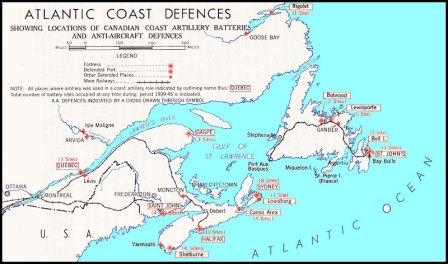
On September 17, 1943, Edmond was sent to No. 61 Canadian Army Basic Training Centre (CABTC) in New Glasgow, Nova Scotia for training as a gunner.  After completing his basic training, he was attached to A23 Training Centre in Halifax, Nova Scotia on November 16, 1943. A23 was a Coast and Anti-Aircraft Artillery Training Centre established to train coast and anti-aircraft gunners.

On March 11, 1944, Edmond was transferred to the 16th (C) Regiment of the Royal Canadian Artillery and sent to Sydney, Nova Scotia. Not long afterwards, on April 26, 1944, he was assigned to the 104th Coast Battery of the Royal Canadian Artillery and posted to Shelburne, Nova Scotia.

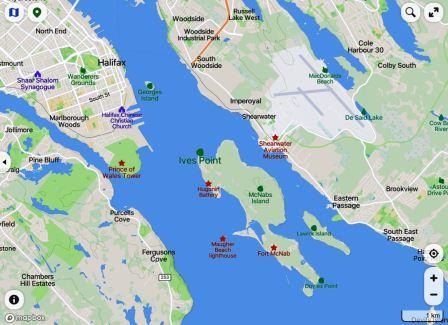
The 104th Coast Battery was garrisoned at Fort McNutt on McNutt’s Island, as coastal defence to protect the port of Shelburne. The threat of German submarine activity was a concern.  This is why Shelburne had been designated as an alternate port to Halifax Harbour during the war.

On September 7, 1944, Edmond transferred to the Royal Regiment of Canada, and sent for a 4 day tactical training course at the Special Infantry Training Camp in Vernon, British Columbia on September 27, 1944.

On October 1, 1944, Edmond was attached to the 1st Battalion Oxford Rifles, part of the Royal Regiment of Canada, which served in Canada in a home defence role as part of the 16th Infantry Brigade, 8th Canadian Division.

… Edmond left Canada for overseas service in January 1945…

On January 2, 1945, Edmond was among the soldiers of the 1st Battalion Oxford Rifles who left Canada for the United Kingdom, arriving on January 8, 1945.  The Battalion was disbanded on January 10, 1945 to provide reinforcements for the First Canadian Army. 

Edmond was assigned to No. 6 Canadian Infantry Training Regiment (CITR) upon arrival, for further training, then to No. 4 Canadian Infantry Training Regiment (CITR) on February 4, 1945.

Screenshot 2023-10-09 at 11-44-19 Putte · 2580 Belgium

Putte, Belgium is near the Dutch border.  (Map source: Google maps)

On March 9, 1945 he was sent to North West Europe as part of the X-4 reinforcement troops of the 21st Army Group.  Then, on April 2, 1945 he was transferred to the Royal 22e Regiment (also known as the Van Doos), joining them while they were in Putte, Belgium.

In the Regimental history, ‘The Royal 22e Regiment’, author Serge Bernier records that “…on April 4, the regiment made an incursion into the Reichswald, near Clèves, which the Canadians had recently liberated at considerable cost...”  Clèves (Kleve in English) is just over the Dutch border in Germany.

After a few days, the Regiment made its way back into The Netherlands. “…On the 10th the Royal 22e left the sector, passing through Clèves and Emmerich, before moving into eastern Holland, and stopping near Zutphen.  On the 13th it crossed the Yssel to take up a position in a bridgehead that the 3rd Brigade would use as a base to attack the town of Appeldoorn....”  Yssel refers to the IJssel River in The Netherlands.

… Edmond lost his life during the Battle of the Five Woods…

Screenshot Deventer Google Maps

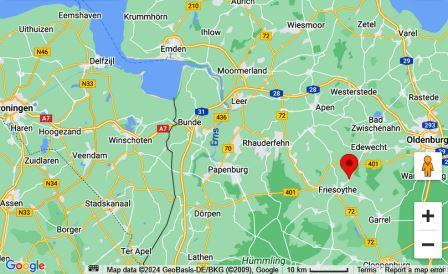
The locations in The Netherlands where the Royal 22e Regiment for April 1945, where Robicheau was initially buried and where he is permanently buried. (Map source: Google maps)

The next day, April 14, 1945, the Regiment received a change in plans.  “… The WNSR and the CYR were the first to leave, closely followed by the Royal 22e, but at 7:30 am the regiment received orders to capture a well-defended wooded area....”  WNSR refers to West Nova Scotia Regiment.  CYR refers to Carleton & York Regiment.

This was the Battle of the Five Woods.  “…Assisted by tanks, the companies performed mopping-up operations in the sector for 24 hours.  The assignment proved costly: 11 men were reported killed, 19 wounded and two missing…” Among those who lost their lives that day was Edmond Robicheau.

…Edmond is buried in the Canadian War Cemetery in Holten…

He was initially buried in a temporary cemetery near Deventer, before being reburied in the Canadian War Cemetery in Holten, The Netherlands in 1946.

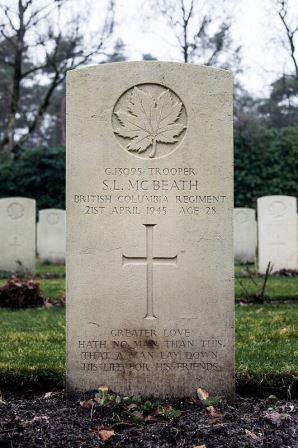
Grave of Joseph Robicheau from CVWM

Grave of Joseph ‘Edmond’ Robicheau.  (Photo source: Canadian Virtual War Memorial)

Thank you to Ann Louise Doucet for sending a photo of Joseph Robicheau.  Thank you also to David (dryan67) from the WW2Talk Forum for sharing information from the Royal 22e Regimental history. If you have a story to tell, please let Pieter know. You can email him at memorialtrail@gmail.com, comment on the blog, or send a tweet to @researchmemori1.  

© Daria Valkenburg

…Want to follow our research?….

If you are reading this posting, but aren’t following the blog, you are welcome to do so.  Our blog address: https://onthewarmemorialtrail.com/

Front cover OnTheWarMememorialTrailinEurope4 countries, 6 weeks, 7,000 km – an unforgettable war memorial journey in Europe…. Daria’s book ‘No Soldier Buried Overseas Should Ever Be Forgotten‘ is available in print and e-book formats.  Net proceeds of book sales help support research costs and the cost of maintaining this blog. For more information on the book, please see https://nosoldierforgotten.com/

You are also invited to subscribe to our YouTube Channel: On The War Memorial Trail With Pieter Valkenburg: https://www.youtube.com/channel/UCJ591TyjSheOR-Cb_Gs_5Kw

Never miss a posting!  Subscribe below to have each new story from the war memorial trail delivered to your inbox.

On The War Memorial Trail…..The WWII Soldier From Burk’s Falls Killed During The Liberation Of Deventer

October 7, 2023. A few months ago, Edwin van der Wolf, one of the research volunteers at the Canadian War Cemetery in Holten, The Netherlands, asked for help in finding a photo of “Sgt Clive Gerow, who unfortunately fell on April 10, 1945 near Deventer….

We’d been to Deventer and the surrounding area with Edwin, so we were familiar with the area where Clive Gerow lost his life.  Naturally, Pieter agreed to help with the photo search request.

CIMG9315 Sep 25 2017 Pieter & Edwin walking on road in Deventer

Pieter and Edwin van der Wolf (right) walked along the route near Schalkhaar that Canadian troops took before  they liberated Deventer in April 1945.  (Photo credit: Daria Valkenburg)

… The search for a photo of Clive was successful…

Edwin provided some basic information.  Clive Elbert Steele GEROW was “born on January 29, 1915 in Burk’s Falls, Ontario to John Gerow (who died in 1943) and Minnie Gerow, nee Magar. His mother died in 1920 when Clive was 5 years old. His sister was Thelma Beatrice Gerow (died 1941) and from his father’s second marriage he later had two half-sisters: Hope Francis and Laura May Gerow….

In a sheer stroke of good fortune, a few days after Edwin’s initial request, Pieter found a photo on www.ancestry.ca, posted by Brynne Campbell.  He contacted Brynne and explained about the photo search request, and provided a link to our On The War Memorial Trail Research blog.   Brynne explained that “Clive would have been my great-uncle…” Her grandmother, Hope Francis, is Clive’s half-sister.

Screenshot 2023-03-25 at 09-55-15 Family Portrait Gerow - Copy

Family portrait, circa 1928.  Standing, left to right: John Gerow, unknown, Clive Gerow, Elizabeth May Travis.  Front, left to right: Thelma Gerow, Mrs Douglas, Charlotte E. Travis, Laura May Gerow, Edith Gerow. (Photo courtesy of the Gerow Family)

Edwin noted that “…Clive left school at the age of 17, having completed 11 years of education. After school he worked on his parents’ farm for 5 years and the last two and a half years, before enlisting in the army, as a mechanic at the Beaver House Lake Gold Mine…” near the Ontario town of Kirkland Lake, 285.41 km (177.35 miles) from his hometown.

Screenshot 2023-08-27 at 16-56-21 distance between burks falls ontario and kirkland lake ontario - Google Search

Map shows location of Burk’s Falls and Kirkland Lake.  (Source: Google maps)

… Clive enlisted in 1939…

Clive enlisted with the Three Rivers Tank Regiment on November 2, 1939 in Trois-Rivières, Quebec.   He would remain with this Regiment for much of his military service, with the Regiment undergoing several name changes.  It was known as the 12th Armoured Regiment (Three Rivers Regiment) as of March 1, 1941. On May 15, 1942 it was designated the 12th Canadian Army Tank Regiment.  On August 26, 1943, it became the 12th Canadian Armoured Regiment.

photo of Clive Gerow

Clive Elbert Steele Gerow. (Photo courtesy of the Gerow Family)

In ‘War Chronicles 1939-1945 Three Rivers Regiment (Tank)’, author Charles Prieur noted that basic training began in Trois-Rivières before moving to Montreal, Quebec to “Westmount’s M.A.A. (Montreal Athletic Association) Grounds on Montreal Island…” on March 26, 1940. 

On March 28, 1940, “Tank training begins without tanks. Drill features troops of men marching to semaphore signals. A Rypa simulator, with an electric motor, is also used to simulate a tank in motion. Courses multiply as able instructors are found with expertise in Vickers machine guns, radio transmission, electricity, mechanics, and Morse code…

On June 23, 1940, the Regiment moved to Mount Bruno (23 km (14 mi) east of downtown Montreal) but quickly moved again, this time to Coteau Barracks in Trois-Rivières

However, instead of the expected tank training, the Regiment was ordered “…to guard the 400 odd prisoners of war….”  Troops also dealt with “…some 700 internees, in large part … refugees. Our Nazi prisoners consist almost exclusively of captured members of the Luftwaffe, merchant navy, submarine corps, and paratroop units…”  Guard duty lasted until July 28, 1940, when “…No. 4 Company of the Veterans Home Guard… arrived to take over….

On August 3, 1940, the Regiment was ordered to “…move to Camp Borden for actual tank training…” Clive was among those who were transferred to Borden, Ontario.

… Clive married shortly before going overseas…

On April 28, 1941, Clive married Elsie Mae Dickinson, who lived in Trois-Rivières.  The couple were not together long as Clive and his Regiment were about to leave Canada for the United Kingdom.

Edith and Elsie Gerow

Elsie Gerow (right) with Clive’s stepmother Edith Gerow (left).  (Photo courtesy of the Gerow Family)

… Clive left Canada for service overseas…

Prieur noted that the Regiment left Camp Borden on June 17, 1941, expecting to “…detrain in Quebec City tomorrow –for a march through the outskirts of Limoilou, and arrive in Halifax on June 18…” 

On June 19, 1941, the Regiment boarded the S.S. Windsor Castle.  At midnight on June 21, 1941, the ship left Halifax for “…the United Kingdom, escorted by the battleship ‘Ramillies’, the battle cruiser ‘Repulse’ and six British destroyers….

On June 30, 1941, “…at 0800 hrs, both the ‘Britannic’ and the ‘Windsor Castle’ drop anchor in the Clyde River near Gourock, Scotland…

The next day, the Regiment left “… Gourock Station at 2000 hrs and travels through the night southwards to Lavington Down….” in Wiltshire, England.  Preliminary training took up the next few months.

On October 7, 1941, Clive and his Regiment left for “…the Tank Firing Range at Linney Head, Wales…” for “…practice at the firing range” 

In January 1942 the Regiment moved to their winter quarters in Worthing, West Sussex, England. “…Except for ‘C’ Squadron in the Abbey, our billets here are clean modern cottages, with all conveniences — by far the best so far….”  The Abbey was in nearby Sompting Abbott.

Clive was busy with training, receiving his Driver Operator Class ‘C’ qualification on March 1, 1942.  From June 16 to July 2, 1942 Clive was attached to the Armoured Fighting Vehicle (AFV) Recovery Training Centre.  Exercises and ongoing training with the Regiment continued.

On November 27, 1942 the Regiment moved to Brighton, England.  Training began with Infantry Regiments, in preparation for battle.

Then from February 3, to March 31, 1943, he was sent for a Gunnery Instructor’s Course.  Meanwhile the Regiment moved from Brighton back to Worthing.

On April 30, 1943, the Regiment moved “…to Hoddom Castle, in Annan, Scotland…and issued Sherman tanks.  “…These 30-tonners can reach a speed of 30 m.p.h, and are equipped with a confidence-building 75mm cannon and two Browning machine guns….

… Clive left the United Kingdom for Sicily…

On June 15, 1943, the Regiment moved “…to the Port of Embarkation at Gourock on the Clyde in Scotland…” The following day the Regiment set sail for Sicily, Italy,  “…crammed into 6 LSTs of the U.S. Navy. Its effective strength at this time is 37 officers and 550 non-commissioned officers and men, including 36 American and 18 British citizens….”  An LST is a tank landing ship.  (See https://en.wikipedia.org/wiki/Landing_Ship,_Tank)

During the month long journey from Scotland to Sicily, the convoy stopped at Gibraltar on June 30, 1943. “…At 1100 hrs, the cat is finally let out of the bag: the 1st Canadian Infantry Division and the 1st Canadian Tank Brigade are to join up with the Allied Forces. Indeed, we become an integral part of the famous Eighth Army under General Bernard Montgomery…

From Gibraltar the convoy sailed along the north coast of Africa.  On July 5, 1943, the convoy came under fire.  “…At 1645 hrs, a huge explosion galvanizes the escorting destroyers into action. A Liberty ship has been torpedoed, catches fire, settles by the stern and sinks out of sight at 1700 hrs….

… Clive participated in Operation Husky…

On July 10, 1943, they reached Pachino Bay in Sicily and ‘Operation Husky’ – the invasion of Sicily – began. “…The first Shermans of the Three Rivers Regiment rolled off  L.S.T.s on the left flank of the 1st (Infantry) Brigade’s beach about 0900 hrs, and at 1015 hrs the unit reported one squadron ready for action…” (See https://www.canadahistoryproject.ca/1939-45/1939-45-10-operation-husky.html)

Over the next weeks, whatever brigade of the 1st Canadian Infantry Division was engaged, it was always with the support of the tanks of the Three Rivers Regiment. 

On August 17, 1943 Prieur recorded that “… Sicily is finally cleared of the enemy…”  Between September 12 and 24, 1943, “…the Three Rivers Regiment, now finally in reserve after its grueling solo support of the First Canadian Infantry Division and the 231st (Malta) Brigade throughout the Sicilian invasion, moves from Sicily and concentrates at Taranto, Italy….

On October 5, 1943, “…the Three Rivers Regiment, which had moved overland from Foggia, arrived on the scene in time to bring its squadrons into action in support of the infantry brigades….” for the Battle of Termoli. (See https://www.canadiansoldiers.com/history/battlehonours/italiancampaign/termoli.htm)

On October 21, 1943, Clive was sent to No. 7 Casualty Clearing Centre and spent the next months in several hospitals and convalescent centres, and sent back to the United Kingdom.  We could not find a record of why he was hospitalized for so long, but hospital records in Sicily indicate that there was a severe malaria epidemic.

Clive returned back to active duty on May 9, 1944, when he was transferred to No. 2 Canadian Armoured Corps Reinforcement Unit (CACRU), and sent for more training.

On September 3, 1944 Clive was transferred to No. 3 Canadian Armoured Corps Reinforcement Unit (CACRU).  On September 8, 1944 Clive left the United Kingdom for northwest Europe. On October 8, 1944 he was transferred to the 27th Armoured Regiment (Sherbrooke Fusiliers Regiment), joining them near Maerle, Belgium.

Over the next months, Clive took part in the further advance through Belgium and The Netherlands, with the Regiment.

… Clive lost his life during the liberation of Deventer…

CIMG9313 Sep 25 2017 Pieter and Edwin in Deventer looking at map of attack

Edwin van der Wolf (left) and Pieter in Deventer, looking at a map of the attack that led to its liberation.  (Photo credit: Daria Valkenburg)

On April 10, 1945, the Regiment was involved in the liberation of Deventer, a town lying on the right bank of the IJssel River.  With the approaches protected by a maze of waterways, it was necessary to attack from the east.  

The village of Schalkhaar was liberated without much difficulty, but three German tanks appeared on the morning of April 10 as the liberation of Deventer began. One tank was destroyed by ‘B’ Squadron of the 27th Armoured Regiment, while the other escaped. (See https://www.canadiansoldiers.com/history/battlehonours/northwesteurope/deventer.htm)

The war diary for April 10, 1945 provided a narrative of what happened.  “…On our left flank ‘B’ Squadron west and enemy SPs were reported on our left flank.  The ground was very open so a mad dash was made to the wood and protective positions were taken up to support SD&Gs who had ‘A’ Company across the canal at that point….”  SP refers to self-propelled artillery.  SD&G refers to the Stormont, Dundas and Glengarry Highlanders Regiment.

….The SD&Gs worked straight north along the canal supported by 3 and 4 Tps while the NNSH went northwest supported by 1 and 2 Tps, finally reaching position, where they were stopped by a report of an SP…Sgt Gerow was killed by mortar fire and Lt Fraser took over No 2 Tp….”  Tps refers to troops.  NNSH refers to the North Nova Scotia Highlanders Regiment.

… Clive is buried in the Canadian War Cemetery in Holten…

Edwin explained that Clive “…was temporarily buried at the Roman Catholic Church in Schalkhaar before being reburied on April 9, 1946 in the Canadian War Cemetery in Holten….
Grave of Clive Gerow from CVWM

Grave of Clive Elbert Steele Gerow at the Canadian War Cemetery in Holten. (Photo source: Canadian Virtual War Memorial)

Thank you to Brynne Campbell for sharing photos of Clive Gerow.  If you have a story to tell, please let Pieter know. You can email him at memorialtrail@gmail.com, or comment on the blog.  

© Daria Valkenburg

…Want to follow our research?….

If you are reading this posting, but aren’t following the blog, you are welcome to do so.  Our blog address: https://onthewarmemorialtrail.com/
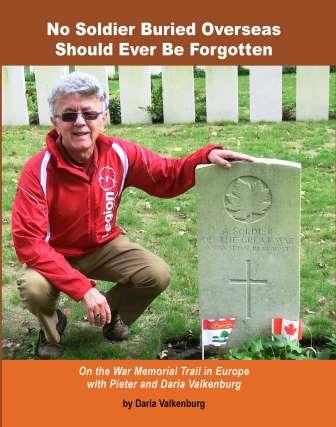
Front cover OnTheWarMememorialTrailinEurope4 countries, 6 weeks, 7,000 km – an unforgettable war memorial journey in Europe…. Daria’s book ‘No Soldier Buried Overseas Should Ever Be Forgotten‘ is available in print and e-book formats.  Net proceeds of book sales help support research costs and the cost of maintaining this blog. For more information on the book, please see https://nosoldierforgotten.com/

You are also invited to subscribe to our YouTube Channel: On The War Memorial Trail With Pieter Valkenburg: https://www.youtube.com/channel/UCJ591TyjSheOR-Cb_Gs_5Kw

Never miss a posting!  Subscribe below to have each new story from the war memorial trail delivered to your inbox.