On The War Memorial Trail….. The WWII Pilot Killed At The Controls Of His Halifax Bomber

February 19, 2023. Whenever Pieter is interviewed, we are delighted when we hear from viewers or readers.  After an interview with Kevin Rollason ran in the Winnipeg Free Press, Craig MacKenzie contacted us about his uncle.

On reading the Saturday Free Press article on your quest to learn about Canadian soldiers who gave their lives during WW II and who were laid to rest in The Netherlands I thought that you might be interested in a story I put together about my uncle, P/O Douglas Mackenzie….”  Of course we were interested.  Pieter set to work to learn more.

Jack ‘Douglas’ MACKENZIE was born in Winnipeg, Manitoba on April 27, 1921, the son of Charles Bellamy and Annie Elizabeth (nee Acheson) MacKenzie.  After graduating from high school in 1937, and attending Success Business College, Douglas worked as a clerk in Winnipeg at the T. Eaton Company Department Store, then at the Canadian Wheat Board, and lastly at the #7 Equipment Department of the Royal Canadian Air Force (RCAF).

He left his last position on May 9, 1941 when he enlisted in the RCAF in Winnipeg, stressing his interest in flying duties and in becoming a pilot.

Douglas listed a number of sports he played – hockey, swimming, basketball, rugby, baseball, skiing, and handball.

….Douglas trained as an RCAF pilot….

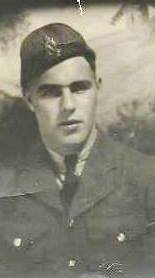
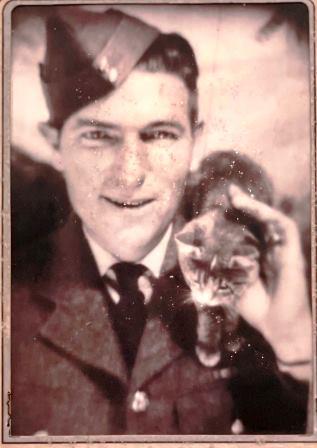
POJDMACKENZIESilverCross from Craig MacKenzie

Jack ‘Douglas’ MacKenzie. (Photo courtesy of Craig MacKenzie)

After a few weeks basic training at No. 2 Manning Depot in Brandon, Manitoba, Douglas was sent to the No. 1 Service Flying Training School in Yorkton, Saskatchewan.  He was then sent to No. 4 Initial Flying School (ITS) in Edmonton, Alberta for 4 weeks of training in navigation, theory of flight, meteorology, duties of an officer, air force administration, algebra, and trigonometry, plus tests that included physical and psychological exams, a session in a decompression chamber, and a simulated flight.

After passing the initial training, on July 27, 1941 he was sent to No. 18 Elementary Flying Training School in Boundary Bay, British Columbia, where he was given 50 hours of basic flying instruction over the next two months.

On September 12, 1941 Douglas was placed as a trainee in the bomber, coastal or transport pilot stream and sent to No. 15 Service Flying Training School in Claresholm, Alberta, for training on an Avro Anson.    (For more information on flight training schools, see https://en.wikipedia.org/wiki/List_of_British_Commonwealth_Air_Training_Plan_facilities_in_Canada)

….Douglas was posted overseas in 1942….

On December 5, 1941 Douglas received his Pilots Flying Badge.  A few days later he was posted to No. 1 ‘Y’ Depot in Halifax, Nova Scotia, an embarkation depot for Air Force personnel soon heading overseas.

Douglas left Canada on February 9, 1942 and posted to No. 3 Personnel Reception Centre in Bournemouth, England.   (See https://www.birtwistlewiki.com.au/wiki/No._3_Personnel_Reception_Centre_RAF)

On April 27, 1942 he was transferred to 14 Advanced Flying Unit for training in different aircraft such as Wellingtons.  The next stage came on June 7, 1942, when Douglas was sent to No. 22 Operational Training Unit (OTU) at RAF Wellesbourne Mountford. This was part of No. 6 Group RAF Bomber Command to train night bomber crews with the Vickers Wellington.

On September 9, 1942 he joined No. 419 (Moose) Squadron RCAF, which was based at Leeming until the end of September, and then at Croft until November 9, 1942, followed by its final move during the war to Middleton St. George.

Formed in December 1941, No. 419 Squadron was the third RCAF overseas bomber squadron.  It was originally in No. 3 Group of Bomber Command, but became part of No. 6 (RCAF) Group when it was formed on January 1, 1943.

….The last flight of Halifax DT630….

Halifax-mk3(1)

Halifax Mark 3 bomber.  Photo source: http://www.raf.mod.uk Public Domain, https://commons.wikimedia.org/w/index.php?curid=751869)

On February 3, 1943, Douglas was the pilot of Halifax DT630 (call sign VR-T), one of 8 heavy Halifax bombers sent on a night raid to Hamburg, Germany.  They took off at 6:34 pm from the airbase at Middleton St. George, England. (See https://aviation-safety.net/wikibase/52181)

LeedstoHamburgviaNoordSleen

Map shows the plane’s path from England towards Hamburg.  It was shot down over The Netherlands before reaching its target.  (Map prepared by Wendy Nattress)

Craig MacKenzie documented what happened that night in ‘A Jump In The Night’, the title and story adapted from a March 28, 1970 Dutch article ‘Een sprong in de nacht’ by A. Jansen, originally published in the newspaper Drentsche en Asser Courant.

…Flying conditions were less than ideal. There was a strong wind from the southwest and, in spite of the protection of the low clouds, they encountered severe icing as they crossed the North Sea.  This made the Halifax difficult to keep airborne. Ice accumulated on the wings and fuselage, adding to weight and reducing the lift of the wings.

The crew had discussed turning back, but as they had aborted their previous mission, they decided against it.  They arrived at the Dutch coast ten minutes behind the main bomber stream and as a result had lost the protection of the surrounding bombers….

An account on the website http://www.419squadron.com/DT630.html states that “Being late and behind the main force was not the only problem that was facing the pilot.  He had lost contact with the rear gunner. The whole intercom system had stopped working. MacKenzie had to make a decision to turn back or keep going a little further to see if the intercom would return to normal.

Now some twenty-five minutes from the target area the Halifax was attacked … from astern and slightly below.  The turns to escape the attacking fighter did not help.  The whole length of the aircraft’s fuselage was racked by cannon fire, killing MacKenzie, and most likely Sgt. Gonnett in the Middle Upper turret. The heavy cannon shells also set off the incendiaries in the bomb-bay, severing lines to engines and other vital controls.

Sgt. Duthie worked at putting the fire out but was unable to because of the nature of the incendiary devices. The Navigator would later report he gave the bail out command via a pre-arranged call light series of flashes.….

….Guests at a Dutch birthday party were eyewitnesses….

Craig MacKenzie’s article included what was observed on the ground on the Cremers farm near Nord Sleen, The Netherlands.  “…It was the third year of the war, yet some rare spirits had been hoarded for special occasions…”  The Netherlands had been under Nazi occupation since May 1940.

On the evening of February 3, 1943, the Cremers family had planned a birthday celebration. “…The first drinks were about to be shared when the family and their guests heard the sound of an airplane, an airplane that was in trouble. A few peeked out the darkened windows. Others went to the doorway.  Several lightning like flashes appeared in the distance. These were soon followed by a ball of fire that plummeted from the heavens.  A deafening explosion accompanied another blinding flash.  It was 7:30 pm…” This was the end for Halifax DT630.

According to the Aviation Safety Network Wikibase report on Occurrence # 52181, the Halifax bomber was shot down by night fighter pilot Oberfeldwebel Karl-Heinz Scherfling of the 10./NJG 1, flying a Bf 110 F-4 from Leeuwarden airfield.  Leeuwarden is in the province of Friesland in The Netherlands.

….Four died, three survived….

Sgt. Marquand was first out, followed by Garnett, who took time to check what was happening to the others in the crew in the front section. He noted that Sgt. Hill was still at his Wireless position and Sgt. Duthie still at the F/E position, but both were preparing to leave the out of control aircraft. At this point the enemy fighter returned and attacked the falling Halifax.

It is unknown for sure what happened to WOII Hill and Sgt. Duthie and why they did not escape. The second pass of the fighter may have caught them both before they had time to leave the aircraft….

In the end “…only Sgt. Marquand, Sgt. Garnett, and F/S Milton managed to bail out. All were captured and became PoWs…”  The other 4 crew members were buried in Sleen General Cemetery.

Dec 24 2022 J.D Mackenzie Begraafplaats Sleen (Drenthe) Hans Buis

Candle placed at the grave of Jack ‘Douglas’ MacKenzie. (Photo credit: Hans Buis)

On December 24, 2022, during the Christmas Eve Candle Lighting Ceremony, candles were placed at the graves of these 4 airmen, with photos sent to us by Hans Buls.  (See https://onthewarmemorialtrail.com/2022/12/26/2022-christmas-eve-candle-lighting-in-the-netherlands/)

In a February 14, 1943 letter to Douglas’ mother, No. 419 Squadron’s Wing Commander, Mervyn Matthew FLEMING, wrote that her son “…was a pilot of such qualities that the Service as a whole and this Squadron in particular can ill-afford to lose him.  He was exceptionally keen and capable at all times, and his loss is a blow to his comrades, with whom he was at all times popular…

….The crew of Halifax DT630….

  • Pilot P/O Jack Douglas MACKENZIE of Winnipeg, Manitoba, RCAF, killed
  • Flight Engineer Sgt. William Peter DUTHIE of Winnipeg, Manitoba, RCAF, killed
  • Navigator Sgt. William Nelson GARNETT, RCAF, survived
  • Bomb Aimer Sgt. Eric Raymond MARQUAND, RCAF, survived
  • Air Gunner W/O II Raymond Hepton HILL of Montreal, Quebec, RCAF, killed
  • Rear Air Gunner F/Sgt. Alexander Henry MILTON, RAF, survived
  • Air Gunner W/O II Lennox Alwin GONNETT of Westmount, Quebec, RCAF, killed

Thank you to Craig MacKenzie for sharing information about his uncle. Craig’s father was a navigator with Bomber Command and survived the war.  “‘Dumb Luck’ was a term that my Dad had used for why he had survived. Congratulate your husband on his valuable work”  Craig has posted a short musical tribute to Bomber Command, which you can watch:

Thank you also to Wendy Nattress for preparing the map showing the flight path for Halifax DT630. If you have a story to share, please contact Pieter at memorialtrail@gmail.com, comment on the blog, or tweet to @researchmemori1.

© Daria Valkenburg

…Want to follow our research?….

If you are reading this posting, but aren’t following the blog, you are welcome to do so. Our blog address: https://onthewarmemorialtrail.com/

Front cover OnTheWarMememorialTrailinEurope4 countries, 6 weeks, 7,000 km – an unforgettable war memorial journey in Europe…. Daria’s book ‘No Soldier Buried Overseas Should Ever Be Forgotten’ is available in print and e-book formats.  Net proceeds of book sales help support research costs and the cost of maintaining this blog. For more information on the book, please see https://nosoldierforgotten.com/

You are also invited to subscribe to our YouTube Channel: On The War Memorial Trail With Pieter Valkenburg: https://www.youtube.com/channel/UCJ591TyjSheOR-Cb_Gs_5Kw.

Never miss a posting!  Subscribe below to have each new story from the war memorial trail delivered to your inbox.

On The War Memorial Trail….. The WWII Soldier Remembered By His Daughter’s Friend

February 11, 2023.  Burnie Reynaert’s uncle, Lewis Wilkieson MARSH, of Sydney Mines, Nova Scotia, was one of 5 soldiers from the North Nova Scotia Highlanders Regiment who drowned in a tragic accident on the Leda River during the Battle of Leer in Germany on April 28, 1945. (See https://onthewarmemorialtrail.com/2021/05/18/on-the-war-memorial-trail-a-tragic-drowning-on-the-leda-river-in-germany-part-4/)

Recently, Burnie wrote to let us know that “my best friend’s father, Pte. Harold Edward Martin, served in the army with the Essex Scottish Regiment, and is buried in The Netherlands…

Burnie explained further, saying “I have known June Anne Martin most of my life – in public school, high school. I was her maid of honour when she married Jack Andrews. She was my confidant and best friend. June Anne died November 25, 2002. She was so young….

June Anne and Jack had three sons.  ….Harold’s grandchildren do not have any information on his service…” Burnie said.  Would Pieter add Harold to his research list?

Pieter’s initial investigation determined that Harold died on October 14, 1944 and is buried in the Canadian War Cemetery in Bergen op Zoom, The Netherlands.  The search was on!

The son of Herbert Edward and Harriet Jane (nee Leavesley) Martin, Harold Edward Roy MARTIN was born November 13, 1912 in Caradoc, Ontario, a rural area about 35 kms (21.75 miles) west of London, Ontario.

On April 15, 1939 he married Tilly Frances Dolney in Leamington, Ontario.  Tilly had been born in Yorkton, Saskatchewan.

…Harold enlisted in 1940….

When he enlisted on July 28, 1940 with the No. 1 District Depot in London, Ontario, he stated in his Soldiers Qualification Card that he had been employed as a truck driver with Longfield Lumber Company in Mount Bridges, Ontario, and that his family owned the Martin’s Fruit Company in Leamington, Ontario.  He expected to have his own fruit business after his military service.  He also noted that he played hockey, in the position of goalie.

On August 21, 1940 he was transferred from No. 1 District Depot to join his unit of the Royal Canadian Engineers at the Thames Valley Camp in London, Ontario.  At the beginning of 1941 he was assigned to the 9th Field Company.

On April 30, 1941 he was entitled to draw additional Trades Pay as a Carpenter Class ‘B’, and then on May 2, 1941 was transferred to #1 Canadian Base Units Construction Company (CBUCC) of the Royal Canadian Engineers in Petawawa, Ontario.

…Harold and Tilly welcome the birth of their daughter in 1941….

Tilly and Harold’s daughter June Anne was born July 3, 1941.  Burnie submitted a photo of the new family unit, explaining that June Anne’s “son Brad and his brother Jack found this amazing picture of her and her parents….

IMG-0945 Harold and Tillie with baby

Harold and Tilly Martin with new born daughter June Anne.  (Photo courtesy of the Andrews family)

 …Harold was sent overseas shortly after his daughter’s birth….

Harold didn’t have much time with his daughter, as he was on his way overseas with the No. 1 Canadian Base Units Construction Company, Royal Canadian Engineers, arriving in the United Kingdom on July 19, 1941.  He was stationed in Bramshott, as a Carpenter and Joiner Class ‘B’.

On May 1, 1942 the name of his unit was changed to 5 CCC (Canadian Construction Company), Royal Canadian Engineers.  Important work was done by units such as 5 CCC, such as building defences that included beach obstacles, pill-boxes, anti-tank ditches, and minefields. They also improved British roadways to improve the movement of military traffic, constructed military and air bases, and even built the Canadian wing of the Queen Elizabeth Hospital in East Grinstead.

On July 28, 1942, Harold was awarded a Good Conduct Badge, and then on August 21, 1942, he received a permanent grade of Sapper.

On May 1, 1944, Harold was transferred to #1 Canadian Engineer Reinforcement Unit (CERU).  Then on August 25, 1944 he was assigned to the Winnipeg Grenadiers for a few weeks, before leaving for France on September 28, 1944, and being reassigned to the Canadian Infantry Corps the next day.

…Harold’s Regiment fought in the Battle of the Scheldt….

On October 10, 1944 Harold was transferred to the Essex Scottish Regiment, which had moved steadily from Antwerp, Belgium at the beginning of October into The Netherlands.  The Regiment had positions on both sides of the border for the Battle of the Scheldt. (See https://www.thecanadianencyclopedia.ca/en/article/canada-and-the-battle-of-the-scheldt and https://www.holland.com/global/tourism/holland-stories/liberation-route/the-battle-of-the-scheldt.htm)

To have an idea of what was faced by Canadian troops, you can watch a short, but excellent, YouTube video explaining about the Battle of the Scheldt (just under 13 minutes):

According to the war diary for the Essex Scottish Regiment for October 14, 1944, the Battalion was in position at Hoogerheide. “…The enemy continued to be fairly aggressive and some of the positions reported heavy mortaring…”  At some point during the day, Harold Martin lost his life.

Harold Martin Scheldt Estuary

…Harold is buried in the Canadian War Cemetery in Bergen Op Zoom….

Harold was initially buried at the Ossendrecht Roman Catholic Civil Cemetery in Ossendrecht, before being reburied in the Canadian War Cemetery in Bergen Op Zoom in March 1946.

12724585_137285083670 Grave of Harold Martin

Grave of Harold Edward Martin at the Canadian War Cemetery in Bergen Op Zoom, The Netherlands. (Photo source http://www.findagrave.com)

Thank you to Burnie Reynaert for telling us about Harold Edward Martin and to the sons of June Anne Andrews for sharing a family photo.  If you have a story to tell, please let Pieter know. Email him at memorialtrail@gmail.com, or comment on the blog.

© Daria Valkenburg

…Want to follow our research?….

If you are reading this posting, but aren’t following the blog, you are welcome to do so. Our blog address: https://onthewarmemorialtrail.com/

Front cover OnTheWarMememorialTrailinEurope4 countries, 6 weeks, 7,000 km – an unforgettable war memorial journey in Europe…. Daria’s book ‘No Soldier Buried Overseas Should Ever Be Forgotten‘ is available in print and e-book formats.  For more information see https://nosoldierforgotten.com/

You are also invited to subscribe to our YouTube Channel: On The War Memorial Trail With Pieter Valkenburg: https://www.youtube.com/channel/UCJ591TyjSheOR-Cb_Gs_5Kw.

Never miss a posting!  Subscribe below to have each new story from the war memorial trail delivered to your inbox.

On The War Memorial Trail….. Remembering WWII Sapper John Culbertson

February 4, 2023.  After reading ‘Forgotten Soldiers’ by Fred Gaffen, Pieter came across the name John CULBERTSON, listed as a Sapper with the Royal Canadian Engineers, who lost his life on April 30, 1945.

The date of death triggered Pieter’s interest and he wondered if he had been killed in or near The Netherlands. When he learned that John Culbertson was buried in the Canadian War Cemetery in Holten, The Netherlands, he decided to research the service file and see if a family member could be found.

He was soon directed to John’s granddaughter, Diane McQueston (Culbertson).  …My grandmother kept his memory alive…” Diane explained.  We were delighted to have the chance to meet Diane and her husband Rob.

CIMG5792 Sep 11 2022 Diane and Rob McQueston with Pieter

Pieter with Diane and Rob McQueston in Dartmouth. (Photo credit: Daria Valkenburg)

…John was raised on the Tyendinaga Mohawk Territory …..

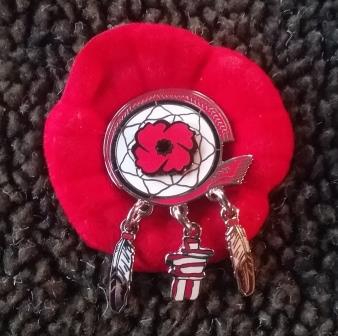
20221108_070012 poppy with indigenous pinBorn on November 21, 1911 in Oshawa, Ontario, John was the son of George Albert and Mary Ann (nee Smoke) Culbertson.  His parents were from the Tyendinaga Mohawk Territory near Belleville, Ontario, and this is where John lived as a child.  (See https://en.wikipedia.org/wiki/Tyendinaga_Mohawk_Territory)

…Mary Ann Smoke passed away at age 26 when John was 5 years old and his brother Gilbert was 3….” Diane noted.  John’s father remarried.  “…Mary Ann Pelling was George’s second wife and they had 4 children… John looked at Mary Ann Pelling as his Mom….

CIMG5786 Wedding photo John and Mabel Culbertson

June 14, 1930 wedding photo of John and Mabel Culbertson, married in Belleville, Ontario.  (Photo courtesy of the Culbertson Family)

After leaving school, John worked as a brass moulder at Corbin Lock in Belleville, Ontario for 10 years before enlisting.

Diane told us that “…my grandparents met at a dance in Belleville and married in 1930, when my grandfather was 19, and my grandmother was 18.  My grandmother, Mabel Florence Brown, was from Middlesex, England.  She never remarried.  My father was their only child….”  Diane’s father, John Harry, was born January 29, 1932.

…John enlisted with the Royal Canadian Engineers…

improved_photo co;ourized4

John Culbertson. (Photo courtesy of the Culbertson Family. Photo colourization by Pieter Valkenburg)

John enlisted with the Royal Canadian Engineers at No. 3-A District Depot in Kingston, Ontario on June 14, 1944, and was sent to the Canadian Engineer Training Centre (CETC) in Petawawa, Ontario. He qualified as a Moulder Group B on October 27, 1944 and was entitled to draw an additional Trades Pay.

CIMG5783 4 generations Culbertsons

John with his son, grandmother, and father in 1944. Left to right:  John Harry Culbertson, Margaret Culbertson, John Culbertson, George Albert Culbertson.  (Photo courtesy of the Culbertson Family.)

On November 29, 1944, John left Canada for the United Kingdom, arriving on December 9, 1944, where he was assigned to the Canadian Engineer Reinforcement Unit (CERU).  After undertaking further training, he qualified as a Driver Class III on March 24, 1945. This meant he was qualified to drive heavy trucks and armoured cars.
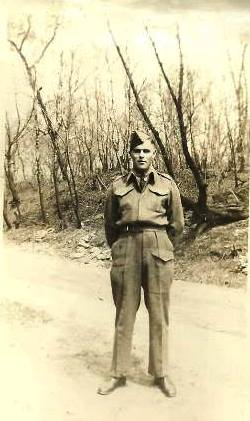
On April 11, 1945, John was sent to North West Europe, and then transferred to the 8th Canadian Field Squadron on April 18, 1845.

…John lost his life during the Battle of Edewecht…

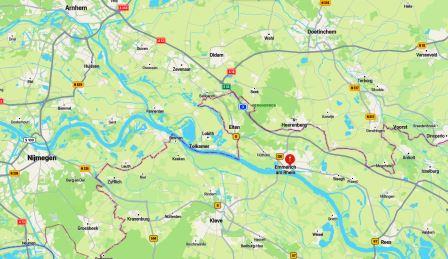
Map showing Edewecht, Germany where John Culbertson

On April 30, 1945, the 8th Canadian Field Squadron was in Edewecht, Germany, the scene of severe fighting during the last weeks of the Second World War. During the Battle of Edewecht, Canadian troops experienced fierce house-by-house fighting against fanatic German paratroopers and other soldiers.

In A Souvenir War History – 8th Canadian Field Squadron Royal Canadian Engineers 1941-1945 by Cpl John Kerr, the author noted that …While maintaining a diversion, Spr Culbertson was killed….”  Ironically, April 30, 1945 was the same day that Hitler committed suicide in Berlin.

…John was buried in the Canadian War Cemetery in Holten…

grave of John Culbertson

Grave of John Culbertson at the Canadian War Cemetery, Holten.  (Photo courtesy Information Centre, Canadian Cemetery Holten)

John was temporarily buried in Ostercheps, Germany before being reburied on March 7, 1946 in the Canadian War Cemetery in Holten, The Netherlands.

In March 1948, Tini Veldman of Ommen, The Netherlands sent a letter to the Department of Veterans Affairs, asking that it be forwarded to the next of kin.  She wanted the family to know that she had adopted the grave, a volunteer program that was organized by the Netherlands War Graves Committee. A note in the file advised that her letter was forwarded to John’s widow on March 31, 1948.

This was not an unusual occurrence. Many family members of soldiers that we have met over the years have been in contact with Dutch citizens whose families adopted a grave in the early post-war years.

John’s son, John Harry, followed in his father’s footsteps in serving his country, enlisting in the Royal Canadian Navy in 1954, retiring as an aviation technician 25 years later.

Thank you to Diane McQueston (Culbertson) for sharing photos and information about her grandfather, and to Shawn Rainville for searching through newspapers to help Pieter find family members.  If you have a story to tell, please let Pieter know. Email him at memorialtrail@gmail.com, or comment on the blog.

© Daria Valkenburg

…Want to follow our research?….

If you are reading this posting, but aren’t following the blog, you are welcome to do so. Our blog address: https://onthewarmemorialtrail.com/

Front cover OnTheWarMememorialTrailinEurope4 countries, 6 weeks, 7,000 km – an unforgettable war memorial journey in Europe…. Daria’s book ‘No Soldier Buried Overseas Should Ever Be Forgotten‘ is available in print and e-book formats.  Net proceeds of book sales help support research costs and the cost of maintaining this blog. For more information see https://nosoldierforgotten.com/

You are also invited to subscribe to our YouTube Channel: On The War Memorial Trail With Pieter Valkenburg: https://www.youtube.com/channel/UCJ591TyjSheOR-Cb_Gs_5Kw.

Never miss a posting!  Subscribe below to have each new story from the war memorial trail delivered to your inbox.

On The War Memorial Trail…..The WWII Pilot Whose Spitfire Ran Out Of Fuel

January 25, 2023.  After seeing an interview on CTV National News about Pieter’s research into WWII soldiers and airmen buried in The Netherlands, Pieter received an email from Dave Montgomery.  

Dave Montgomery 1

Dave Montgomery, whose father’s best friend was RCAF Pilot George Glenn Millar. (Photo courtesy of Dave Montgomery)

Dave wrote that “…I became aware of your project of identifying Canadians killed in WW2 to liberate Holland when I saw your interview with CTV News recently.  

My father’s best friend, George Glenn Millar, nicknamed ‘Dusty’, was killed on September 28, 1944 in combat while flying a Spitfire Mark IX over Nijmegen, Holland.  He is buried at the Uden War Cemetery in North Brabant, Holland. He was from Winnipeg, Manitoba and was serving with 442 Squadron of the RCAF when killed. …  My father survived the war and lived a full life back in Canada and passed away in January 2013.  He never forgot his friend…

20220911_161454 Miller and Montgomery

George Glenn ‘Dusty’ Millar, left, with Thomas Richard Montgomery. (Photo courtesy of Dave Montgomery)

Dave included a photo, explaining that “… G. G. Millar is on the left.  My father, Thomas Richard Montgomery, is on the right….

….George Glenn attended university for one year before enlistment….

Millar G.G. foto 2

George Glenn ‘Dusty’ Millar.  (Photo courtesy of the Information Centre, Holten)

Born November 21, 1921 in Winnipeg, Manitoba, George Glenn MILLAR was the son of George Sawers and Janet Smith (nee Wilson) Millar. While a first-year student at the University of Manitoba, George joined the University’s Canadian Officers’ Training Corps (COTC) on April 7, 1941, part of the Non-Permanent Active Militia. In his attestation form, he stated that he had served 110 hours in the University of Manitoba Training Unit (UMTU). (See https://en.wikipedia.org/wiki/Canadian_Officers%27_Training_Corps)

In July 1941, he enlisted in the Royal Canadian Air Force (RCAF) in Winnipeg.  Asked about hobbies and sports, he wrote that he played golf extensively, occasionally played hockey, rugby, and baseball.  He was very clear in his goal – he wanted to enlist for flying duties and to be a pilot.

….George Glenn realized his goal of becoming a pilot….

In October 1941 he was sent to Edmonton, Alberta and then a few weeks later to Calgary, Alberta to #3 Service Flying Training School for flight training.  On December 12, 1941 he was sent back to Edmonton, to #16 Flight Training School, where he remained until April 25, 1942.  By the time he left he had put in 73 hours and 35 minutes into flying a Tiger Moth.

He was next posted to #1 Service Flying Training School in Camp Borden, Ontario on April 26, 1942, receiving his Pilot Flying Badge on August 14, 1942.   He had also learned to fly a Yale and a Harvard MK II.

In August 1942 he was posted to No. 133 (F) Squadron in Lethbridge, Alberta, where he gained more experience in flying a Harvard MK II and learned to fly a Hurricane II B.  The Squadron moved to Boundary Bay, British Columbia at the beginning of October 1942.  (Note: the ‘F’ stood for ‘Fighter’)

Map RCAF Boundary Bay

Patrol path of No. 133 (F) Squadron included the Canadian section [orange] and the area in the United States from Bellingham to Tacoma, Washington, [yellow]. (Map source: https://clarencesimonsen.wordpress.com/category/rcaf-133-squadron/)

On October 5, 1942, George Glenn received a promotion to Pilot Officer, and then another promotion, to Flight Officer, on February 13, 1943. He remained with No. 133 (F) Squadron until May 15, 1943, when he was sent to No. 111 Squadron in Anchorage, Alaska.

Don Smith, an Associate Historian with the RCAF, explained that George Glenn “….arrived at No. 111 Squadron as a replacement pilot.  Millar was at No. 111 Squadron to get checked out in a new (for him) fighter type, the Curtis P-40K Kittyhawk.  He had been flying the Hawker Hurricane with No. 133 Squadron….

P-40 Kittyhawk Aircraft

P-40 Kittyhawk. (Photo credit: Department of National Defence (DND) PGB-1436)

….George Glenn’s Squadron participates in the Aleutian Islands Campaign in 1943 ….

Don went on to explain that “Millar did not remain long with No. 111 Squadron after he soloed in the Kittyhawk in late May 1943. By the end of August he was flying with No. 14 Squadron at Umnak Island, in the Aleutians, where he spent a one-week rotation at the forward assembly airfield on Amchitka Island the same month…

Dave Montgomery had done some research on George’s time in Alaska, and explained that “…. No. 14 Squadron and No. 111 Squadron were ordered to Alaska in 1943 to fight alongside the Americans fighting the Japanese who had landed at Kiska and Attu Islands in the Aleutian Islands of Alaska in June of 1942.   

These RCAF squadrons served at Anchorage, Kodiak Island, and Umnak Island bases with short postings to Adak Island and Amchitka Island when flying missions against the Japanese, who were dug in on Kiska Island. 

Several were killed there as the weather was atrocious, especially in the Aleutians.  Weather was the biggest killer of pilots in Alaska, not enemy guns.   

G.G. Millar flew with both 111 Squadron (briefly) and then 14 Squadron and flew missions with the US fliers to Kiska Island bombing and strafing the Japanese there  under overall command of Jack Chennault, the son of Claire Chennault who was the US Colonel (later General) who commanded the famous Flying Tigers in China!

No. 14 and 111 Squadrons returned to Patricia Bay in September of 1943 after the 5,000 Japanese on Kiska Island managed to escape under cover of fog and darkness in late July 1943 on Japanese naval destroyers sent there to evacuate them after the defeat of the Japanese forces on Attu Island by the US…..”   RCAF Patricia Bay was in Victoria, British Columbia.  (For more information on the Aleutian Islands Campaign, see https://en.wikipedia.org/wiki/Aleutian_Islands_campaign)

Don Smith explained that “Millar remained with No. 14 Squadron, going overseas with them, where the Squadron was renumbered from No. 14 Squadron to No. 442 (F) Squadron…

Dave Montgomery noted that “….No. 14 and 111 Squadrons sailed to England between January 20 to 27, 1944 on the SS Pasteur (a French passenger liner completed in 1939 and converted to a fast troop ship).  The Pasteur made the crossing alone rather than in a convoy since she could sail at up to 26 Knots.

On February 8, 1944, No. 14 Squadron was renumbered as 442 Squadron (equipped with Spitfire Mark IX fighters) and No. 111 Squadron was renumbered as No. 440 Squadron (equipped with Hawker Typhoon fighter bombers)….

Spitfire Mk. IX

Spitfire Mark  IX.  (Photo source: Google image, from ‘Spitfire Mk IX Performance Testing, Aeroplane and Armament Experimental Establishment, Boscombe Down, 21 October, 1942.’)

….George Glenn’s Spitfire failed to return from a patrol near Nijmegen….

On August 14, 1944, George Glenn received his final promotion, to Flight Lieutenant.  Just over a month later, he had his final flight.  Don Smith explained that from September 20 to October 1, 1944, Base 68 at Le Culot/Beauvechain in Belgium “was occupied by 126 Wing, Group 83, 2nd Tactical Air Force (Canadian Fighter Wing), to provide air cover over the Arnhem/Nijmegen areas for Operation Market Garden….

NOTE: Operation Market Garden was an Allied military operation, from September 17 to 27, 1944, that succeeded in liberating Nijmegen and Eindhoven but failed in liberating the last bridge held in Arnhem, which would enable troops to the Rhine into Germany.  The movie ‘A Bridge Too Far’ dramatized this event. (See https://en.wikipedia.org/wiki/A_Bridge_Too_Far_(film))

It was from Base 68 at Le Culot/Beauvechain that George Glenn’s Squadron operated during that period. “….On September 28, 1944, while on a patrol over enemy territory in Spitfire PL490, his aircraft apparently ran out of fuel. F/L Millar was last seen over Nijmegen, Holland. While the record indicates F/L Millar’s aircraft ran out of fuel, the record for Spitfire PL490 suggests on 28 September, 1944, this aircraft, flown by F/L G.G. Millar, RCAF, was in aerial combat with Fw190s of the German Luftwaffe before the fuel shortage was reported….

This summary was similar to what was written in a September 30, 1944 letter to George Glenn’s mother by his Commanding Officer in No. 442 Squadron, Flight Lieutenant W A Olmstead.  “…On the morning of September 28th, Glen took off with the Squadron on a Patrol over enemy territory in Holland.  During this operation the Squadron were chasing some German aircraft when Glen reported on his radio that he was getting low in fuel and would have to return to friendly territory which he started out to do.

Later during the operation, Flight Lieutenant W.A. Olmstead, who was leading the Squadron, heard Glen on his radio saying that his engine was cutting and he would have to bail out or crash land. He was not seen at this point by any member of the Squadron, but it is believed he bailed out or crash landed somewhere in Holland at approximately 0945 hours….

The aircraft crashed 3 km (1.86 miles) southeast of Weibosch near Schijndel, in the Dutch province of Noord-Brabant.

….Why did the plane run out of fuel?….

We asked Don Smith why the Spitfire would have run out of fuel.  He said that although it was possible that the Spitfire “…PL490 suffered battle damage if involved in aerial combat with Fw190s, this cannot be confirmed…

Don went on to explain that ….the Merlin-powered Spitfire Mk IX was also known to have problems with vapour-lock in the fuel system, especially if the aircraft had been sitting in the sun prior to take-off. If the Spitfire PL490 was carrying an external belly-mounted auxiliary fuel tank at the time of its loss, this could create failure of the engine when switching from main tanks to external, or from external back to the main fuel tanks. The latter was more serious, since this would usually take place over enemy territory, as was the case on September 28, 1944.

As an example of this particular problem, No. 401 Squadron (RCAF) reported almost one quarter of pilots lost were due to this cause. These incidents were not mentioned as ‘tank problems’, but referred to such incidents as ‘engine failure’ or ‘engine trouble’.  

The actual cause of the loss of Spitfire PL490 will probably never be known. The Spitfire Mk IX had two tanks in front of the cockpit, one upper and one lower. Later models had another fuel tank added behind the cockpit. It is possible that the lower front tank could have been holed in combat, or the rear tank, depending on the age of PL490. In either case, F/L Millar would not have noticed the fuel leak….

….George Glenn Millar was buried in Uden War Cemetery….

Edwin van der Wolf, a volunteer researcher at the Canadian War Cemetery in Holten, wrote that George Glenn was temporarily buried in Weibosch before being reburied on July 23, 1946 at Uden War Cemetery in Uden, The Netherlands.  (See https://www.cwgc.org/visit-us/find-cemeteries-memorials/cemetery-details/2082100/uden-war-cemetery/)

Millar G.G. graffoto

George Glen Millar is buried in Uden War Cemetery.  (Photo courtesy Information Centre, Canadian Cemetery Holten)

Thank you to Dave Montgomery for sharing information about his father’s best friend, George Glenn Millar.  He is not forgotten!  Thank you to Don Smith for help with the aviation specifics and history, and to Edwin van der Wolf for sending photos and confirming burial information. If you have a story to share, please contact Pieter at memorialtrail@gmail.com, or comment on the blog.

© Daria Valkenburg

…Want to follow our research?….

If you are reading this posting, but aren’t following the blog, you are welcome to do so. Our blog address: https://onthewarmemorialtrail.com/.
Front cover OnTheWarMememorialTrailinEurope4 countries, 6 weeks, 7,000 km – an unforgettable war memorial journey in Europe…. Daria’s book ‘No Soldier Buried Overseas Should Ever Be Forgotten’ is available in print and e-book formats.  Net proceeds of book sales help support research costs and the cost of maintaining this blog. For more information on the book, please see https://nosoldierforgotten.com/

You are also invited to subscribe to our YouTube Channel: On The War Memorial Trail With Pieter Valkenburg: https://www.youtube.com/channel/UCJ591TyjSheOR-Cb_Gs_5Kw.

Never miss a posting!  Subscribe below to have each new story from the war memorial trail delivered to your inbox.
On The War Memorial Trail…..Honouring Two CanScots Buried In Adegem By Adopting Their Graves

January 17, 2023.  Edwin van der Wolf, a volunteer researcher at the Canadian War Cemetery in Holten, The Netherlands, has a particular area of interest into soldiers from the Canadian Scottish Regiment, and since 2020 has a website on the Regiment. (See https://bordencarletonresearchproject.wordpress.com/2020/05/04/new-website-on-canadian-scottish-regiment-during-ww2/)

He informed us that 38 soldiers from the Canadian Scottish Regiment are buried in the Canadian War Cemetery in Adegem, Belgium. In 2021 the Van der Wolf family participated in a grave adoption program for two of these soldiers.  “…If you adopt a grave at the Adegem Canadian War Cemetery you receive a certificate of this adoption during a yearly ceremony in May…  (See https://onthewarmemorialtrail.com/2021/08/29/on-the-war-memorial-trail-adopting-a-grave-in-adegem/)

P1370320(1) Edwin

Edwin van der Wolf, far right, received grave adoption certificates from the Canadian War Cemetery in Adegem. (Photo courtesy Edwin van der Wolf)

In 2022, the family adopted the graves of Ronald ‘Ronnie’ Stuart Walter HOOLE and David ‘Dave’ Stinson HENDERSON, both from the Canadian Scottish Regiment.  He then asked if we could possibly find families and photos of these two men. Of course, we agreed to investigate.

….Ronnie Hoole lost his life trying to save a friend…

Ronald ‘Ronnie’ Stuart Walter HOOLE was born October 22, 1923 in Ganges on Salt Spring Island, British Columbia, the son of Sidney Walter and Gertrude Agnes (nee Snow) Hoole.

2008001010 Ronald Hoole

Ronald Hoole.  (Photo found at https://saltspringarchives.com/Legion_Branch_92/)

A labourer before enlisting, at the age of 16, on June 26, 1940 in Victoria, British Columbia, he was sent overseas to the United Kingdom on August 23 1941. With his Regiment he arrived in Normandy for the D-Day landings on June 6, 1944 and was one of the survivors.

Battle of Scheldt map showing Eede

Map showing the Breskens Pocket. (Map source: http://www.canadiansoldiers.com)

By October 1944, the Regiment was in The Netherlands, along the Belgium border, involved in the Battle of the Breskens Pocket, an action fought south of the Scheldt Estuary as part of the Battle of the Scheldt.  The Scheldt Estuary, the waterway leading from the sea into the port of Antwerp, Belgium, was not available to Allied shipping because German coastal batteries on Walcheren Island defended the approaches.

As part of the 7th Canadian Infantry Brigade, along with the Royal Winnipeg Rifles and the Regina Rifles, the Canadian Scottish worked to clear the Breskens Pocket. (See https://www.canadiansoldiers.com/history/battlehonours/northwesteurope/breskenspocket.htm and https://en.wikipedia.org/wiki/Battle_of_the_Scheldt)

On October 27, 1944, the entry in the War Diary for the Canadian Scottish noted that this was not an easy task.  “…Plans were laid during the early morning for ‘A’ and ‘D’ Companies to move forward…. and to go after enemy positions…. The companies began what was to prove to be a very difficult day…. ‘A’ Company…were enduring painfully heavy shelling….

‘A’ Company “…launched its final assault of the day with 9 Platoon leading…. All went well until suddenly 9 Platoon found itself fired on by machine guns at point-blank range.  They were travelling along a road at the foot of a dyke and were met by a hail of fire from all sides. The enemy had allowed them to pass through and had then closed in….

It was a bloody battle that ‘A’ Company could not win.  “…Their ammunition was soon exhausted and their position in the open below the muzzles of the German machine guns was untenable.  Only 12 men of ‘A’ Company escaped being overwhelmed in the action…

Ronnie Hoole was one of the casualties on that day, losing his life while trying to save a friend’s life. He was temporarily buried in Hoofdplaat, The Netherlands, before being reburied in the Canadian War Cemetery in Adegem, Belgium on June 12, 1945.

Edwin explained that Ronnie Hoole’s “…grave was adopted on May 14, 2022 by my son, Keje van der Wolf…

Unfortunately, up to now, while we have not been able to find family of Ronnie Hoole, we were fortunate to find a photo of him online.

….Dave Henderson lost his life when a German luger accidentally went off …

The search for family of David ‘Dave’ Stinson HENDERSON was successful when his great-niece, Bonnie Wilson, contacted Pieter.  “I so appreciate you reaching out.  I think it is so important to keep memories of the fallen alive. What a cool thing that you and your wife are doing.  Very impressive!…

Bonnie had a photo and an account of her great-uncle from a book ‘So Young They Were – Armstrong’s Fallen Of The Second World War’ by Leonard J. Gamble.

IMG_2266 David Henderson

David ‘Dave’ Stinson Henderson.  (Photo courtesy of Bonnie Wilson)

Dave was born on August 30, 1919 in Belfast, Northern Ireland, the son of William and Rachel (nee Stinson) Henderson. In 1926, the family immigrated to Canada and settled near Armstrong, British Columbia.

Prior to being called up in March 1941 under the National Resources Mobilization Act, he worked in the Armstrong Sawmill. After completing basic training in Vernon, British Columbia, Dave served in various positions in the province before actively enlisting on December 16, 1943 in Prince Rupert, British Columbia.

He remained in Prince Rupert until April 1944 when he took a demotion to private so that he could serve overseas.  He left Canada, arriving in the United Kingdom on June 2, 1944. At the end of July he was sent to France as part of a reinforcement draft for the Regina Rifles, but transferred to the Canadian Scottish Regiment on August 5, 1944.  He wanted to be in the same Regiment as his brother Alf.

Battle of Leopold Canal map

Map showing the movement of troops as they crossed the Leopold Canal.  (Map source: http://www.canadiansoldiers.com)

Dave survived the crossing of the Leopold Canal in Belgium on October 6, 1944.  In ‘So Young They Were – Armstrong’s Fallen Of The Second World War’, the author explained that “…On October 16, the CanScots launched a further attack that captured the small town of Eede in Holland….. During the bitter fighting, Dave picked up a discarded German luger. The gun discharged, severing an artery in his groin and he bled to death before help could reach him….” His death was officially recorded as October 17, 1944.

Eede is in the Dutch province of Zeeland, near the Belgian border. He was temporarily buried in Maldegem, Belgium before being reburied in the Canadian War Cemetery in Adegem on July 17, 1945.

Edwin noted that Dave Henderson’s “grave was adopted on May 14 by my daughter-in-law Manon van der Wolf nee Bruggeman…

Edwin van der Wolf and Bonnie Wilson were put in contact with each other after Bonnie asked Pieter if “there is any way to get any info on the Dutch person who has adopted his grave? My family would love any information.  My Grandmother Muriel, David’s sister, did go over and see his grave with my Grandfather Henry on their travels to Europe in the 1970’.  They have since passed away.  I do hope to one day go and visit it myself….

Thank you to Edwin van der Wolf for letting us know of the two additional graves at the Canadian War Cemetery in Adegem that his family adopted, and to Bonnie Wilson for sharing photos and information about her great-uncle David Henderson.

Do you have a story to tell? Email Pieter at memorialtrail@gmail.com, comment on the blog, or tweet to @researchmemori1.

© Daria Valkenburg

…Want to follow our research?….

If you are reading this posting, but aren’t following the blog, you are welcome to do so. Our blog address: https://onthewarmemorialtrail.com/.

Front cover OnTheWarMememorialTrailinEurope4 countries, 6 weeks, 7,000 km – an unforgettable war memorial journey in Europe…. Daria’s book ‘No Soldier Buried Overseas Should Ever Be Forgotten‘ is available in print and e-book formats.  For more information see https://nosoldierforgotten.com/

You are also invited to subscribe to our YouTube Channel: On The War Memorial Trail With Pieter Valkenburg: https://www.youtube.com/channel/UCJ591TyjSheOR-Cb_Gs_5Kw.

Never miss a posting!  Subscribe below to have each new story from the war memorial trail delivered to your inbox.
On The War Memorial Trail….. A WWII Letter From ‘Somewhere In North Russia’

January 14, 2023.  Several years ago, when Pieter was researching the names listed on the Cenotaph outside the Borden-Carleton Legion, the story of WWII Flight Officer Joseph “Joe” Charles MCIVER of Kinkora, Prince Edward Island, was told.

Joe was posted to RAF Coastal Command, a formation with the Royal Air Force (RAF), which had a mandate to protect convoys from German U-boats and Allied shipping from aerial threats from the German Air Forces.  Squadrons operated from various bases, including in the Arctic Circle.

Joseph Charles McIver

Joseph Charles McIver. (Photo: The Canadian Virtual War Memorial – Veterans Affairs Canada)

Joe’s nephew, Alan A. McIvor, wrote a book on his uncle called ‘United In Effort…Flying Officer Joseph Charles McIver…Royal Canadian Air Force…1940-1944’. One of the documents in the book was a letter Joe wrote to his wife Helen from the far north of the Soviet Union (now Russia) on September 23, 1942.  Joe’s actual location in the letter was erased by censors, but his heading ‘Somewhere In North Russia’ was left intact.

We were reminded of the letter when we met Lorna Johnston, Alan’s cousin, and she gave us a copy of the same letter.

…Joe McIver’s Squadron participates in Operation Orator ….

1024px-Barents_Sea_map

Map shows the location of the Barents Sea north of Russia and Norway, and the surrounding seas and islands. (Map created by Norman Einstein, 2005. Courtesy of https://en.wikipedia.org/wiki/Operation_Orator#/media/File:Barents_Sea_map.png)

On September 4, 1942, Joe McIver was in the Royal Australian Air Force’s (RAAF) 455 Squadron with a group flying to the Soviet Union as part of ‘Operation Orator, a search and strike force to operate over the Barents Sea.  The plan was to fly on a course to reach Norway, cross the mountains in the dark, overfly northern Sweden and Finland, and land at Afrikanda air base, at the southern end of Murmansk Oblast (an oblast is similar to a province). (See https://en.wikipedia.org/wiki/Operation_Orator for more information on Operation Orator and https://en.wikipedia.org/wiki/Afrikanda_(air_base) for more information on Afrikanda.)

…Joe’s plane ran out of fuel and crashed ….

As Joe explained in his September 23, 1942 letter “…we were at 8,000 feet and below us were solid clouds and not a break in them. We couldn’t come down for fear of crashing into a mountain.  So we decided to fly to the White Sea and follow it up, which we did, and finally came to our destination….but there was no aerodome in sight...

Then they realized they were running out of fuel! “…Our fuel was getting very low and we started to look for a half decent paddy to set down on.  We spotted a marshy field and were running up to it when both motors cut out of gas, and down we went in a woods…

All five crew members got out safely, thankful that the plane “…didn’t go up in flames as we expected…Nobody said much for five minutes….

They were soon met by 15 Soviet soldiers who at first mistook them for Germans.  “…This was the first time I was scared, knowing we were close to the front line and that they couldn’t understand us. It was the first time for me to put my hands up while I was being searched and I put them up good and high!…

After establishing that they were Allied airmen, the Soviets “…got a truck and took us to a Military Camp and gave us a bang up dinner…”  After dinner, they were taken to where the rest of the Squadron were housed.

They stayed for a few days and were allowed to look for their personal belongings on the downed plane.  Then, with the aid of an interpreter, they travelled by train and truck “…for the drome from which we are going to operate.  We have no aircraft so there’ll be no operations for us unless somebody gets sick or hurt….

Their journey took them 190 km to Vayenga, located on the coast of the Barents Sea along the Kola Bay 25 kilometers (16 miles) northeast of Murmansk.

Vayenga, now called Severomorsk, is the main administrative base of the Russian Northern Fleet.  During WWII, a naval airfield built in a neighbouring bay was used by the British, namely No. 151 Wing RAF, to protect the Arctic.

…Joe’s letter from the Arctic Circle ….

Joe’s Squadron was in Vayenga for just over a month. In his letter, he included his impressions of life in the far north.  “…Up here we are eating RAF supplies and not Russian food.  We spend most of our time reading, cutting wood.  We’re in the Arctic Circle and it’s getting fairly cool!…

Joe hoped they would be sent back to England soon.  “…We expect to get back soon.  If we don’t soon go, I think I’ll get into a dugout.  I’ll be glad to get back to get some letters, English papers, radio, etc.  Everybody’s in uniform here! No leave until Victory!….

Although they got an allowance from the Soviets, “…there’s absolutely nothing to buy.  One can spend a few roubles for a shave now and again…

Of course, no trip to the Soviet Union would be complete without trying what their Soviet colleagues drank to keep warm. “…I’ve had one drink of vodka and it’s sudden death!  Summerside’s screech is mild compared to it….” Vodka’s high alcohol content can warm the body, helpful when temperatures are below freezing point!

Joe and his Squadron may have been in the far north, but they were still subject to enemy attacks.  “…I have spent quite a few hours in the air raid shelters.  I never thought I could run so fast.  I can pass anybody on the way to the shelter…

The day before he wrote his letter, he noted that “…during a dog fight yesterday over the aerodome, an aircraft was shot up.  The pilot bailed out and the aircraft came down and crashed in the building. There were no people in it at the time.  Lots of excitement every day!…

Joe summarized the trip by saying “…this trip has been a great experience, one that I wouldn’t have missed for the world, but I wouldn’t want to do it again.  That crash landing, the first meeting with the Ruskies, and the first Russian meal are incidents I’ll always remember…

…Joe did not survive WWII….

In October 1942 Joe’s Squadron returned to England, but it wasn’t long before Joe found himself back in the Arctic Circle.  On November 18, 1944, Joe was part of the crew of Liberator MK VA EV-895, which took off on anti-submarine patrol looking for a suspected U-boat off Gardskagi, Iceland.

Unfortunately, the plane disappeared over the Arctic Ocean and was never seen again.  (See https://onthewarmemorialtrail.com/2019/08/17/the-ww2-flight-officer-whose-plane-went-down-while-on-patrol-near-the-arctic-circle/)

Thank you to the Alan McIvor and Lorna Johnston for sharing Joe McIver’s letter from Russia, which provided a glimpse into what he experienced in his own words. If you have a story to share, please contact Pieter at memorialtrail@gmail.com, comment on the blog, or tweet to @researchmemori1.

© Daria Valkenburg

…Want to follow our research?….

If you are reading this posting, but aren’t following the blog, you are welcome to do so. Our blog address: https://onthewarmemorialtrail.com/.

Front cover OnTheWarMememorialTrailinEurope4 countries, 6 weeks, 7,000 km – an unforgettable war memorial journey in Europe…. Daria’s book ‘No Soldier Buried Overseas Should Ever Be Forgotten‘ is available in print and e-book formats.  Net proceeds of book sales help support research costs and the cost of maintaining this blog. For more information on the book, please see https://nosoldierforgotten.com/

You are also invited to subscribe to our YouTube Channel: On The War Memorial Trail With Pieter Valkenburg: https://www.youtube.com/channel/UCJ591TyjSheOR-Cb_Gs_5Kw.

Never miss a posting!  Subscribe below to have each new story from the war memorial trail delivered to your inbox.

On The War Memorial Trail….. The WWI Soldier From Tryon Buried With A Message In A Bottle

CIMG8651 Sep 9 2017 Pieter at the grave of Arthur Clinton Robinson in La Laiterie cemetery

September 2017. Pieter by the grave of Arthur Clinton Robinson, La Laiterie Military Cemetery in Belgium.  (Photo credit: Daria Valkenburg)

January 10, 2023.   In 2017, we visited La Laiterie Military Cemetery in Belgium, where WW1 soldier Arthur Clinton ROBINSON is buried. Born July 20, 1896 in the USA, but moved as a child to Tryon, Prince Edward Island, Arthur enlisted in the 26th (New Brunswick) Battalion on November 20, 1914 and remained with the Regiment until his death.

…Arthur lost his life on the first day of the Actions of St Eloi Craters Battle….

On March 27, 1916, he was killed in action during the Actions of St Eloi Craters when shell fire hit the trenches southeast of Kemmel. The battle lasted from March 27 until April 16, 1916. Sint-Elooi (the French St Eloi is also used in English) is a village about 5 km (3.1 miles) south of Ypres in Belgium.

1919 photo of St Eloi Craters

The British had dug tunnels in No Man’s Land, then placed large explosive charges under the German defences, and blew them at 4:15 a.m. on March 27. The plan was for the 2nd Canadian Division, which Arthur’s Battalion was part of, to take over and hold the line.  (NOTE: ‘No Man’s Land’ was a WWI term used to describe the area between opposing armies and trench lines.)

The plan was a disaster as Canadian troops were sent to the battlefield before they had time to prepare for the attack. (For more information, see https://www.thecanadianencyclopedia.ca/en/article/battle-of-st-eloi-craters and https://en.wikipedia.org/wiki/Actions_of_St_Eloi_Craters)

St_Eloi_near_Ypres_-_mine_plan_27_March_1916

Map of St Eloi with the six mines fired on 27 March 1916. (Map Source: By ViennaUK – Own work, CC BY-SA 4.0, https://commons.wikimedia.org/w/index.php?curid=53210386)

In ‘A Family Of Brothers’, author J. Brent Wilson explains that “…during the German retaliation for the attack, the 26th faced a heavy pounding that killed seven men and wounded another eighteen…”  One of these casualties was Arthur.

…. La Laiterie Military Cemetery was chosen by the Battalion…

After visiting La Laiterie Military Cemetery, it was interesting to read in ‘A Family Of Brothers’ that a section of the cemetery was chosen by soldiers in the 26th (New Brunswick) Battalion as a “…. focus for their remembrance….”  The section set aside for the Battalion’s 67 burials was “…marked by a large board bearing the battalion’s name….

The cemetery is located “…about a kilometre behind the front trenches on the road between Kemmel and Vierstraat.  The area surrounding the cemetery had once featured groves of trees and fine residences, but since had been blasted by shellfire….

…. The Battalion didn’t want the identity of a buried soldier to be lost…

One of the most intriguing things read in ‘A Family Of Brothers’ was the care taken with burials, with one soldier buried per grave, with  “…. small white crosses at the head of each burial mound…”  On each cross was “…nailed an aluminum metal plate with the name, number, and battalion…” of the deceased.

But the Battalion went further, a smart move in a war where battlefront cemeteries could come under crossfire.  “…To ensure that the identity of the soldier in the grave was not lost if something happened to the cross, the man’s name was inserted into bottles that were placed at the head of the grave and beneath the body….” It would be interesting to know if that bottle is still there!

….Previous stories about Arthur Clinton Robinson…

Arthur Clinton Robinson is one of the names listed on the Cenotaph outside the Borden-Carleton Legion.  Unfortunately, a photo of him has yet to be found by either us, or his family.  Can you help put a face to this name?  Do you have a story to tell? Email Pieter at memorialtrail@gmail.com, comment on the blog, or tweet to @researchmemori1.

© Daria Valkenburg

…Want to follow our research?….

If you are reading this posting, but aren’t following the blog, you are welcome to do so. Our blog address: https://onthewarmemorialtrail.com/.

Front cover OnTheWarMememorialTrailinEurope4 countries, 6 weeks, 7,000 km – an unforgettable war memorial journey in Europe…. Daria’s book ‘No Soldier Buried Overseas Should Ever Be Forgotten‘ is available in print and e-book formats.  Net proceeds of book sales help support research costs and the cost of maintaining this blog. For more information see https://nosoldierforgotten.com/

You are also invited to subscribe to our YouTube Channel: On The War Memorial Trail With Pieter Valkenburg: https://www.youtube.com/channel/UCJ591TyjSheOR-Cb_Gs_5Kw.

Never miss a posting!  Subscribe below to have each new story from the war memorial trail delivered to your inbox.

On The War Memorial Trail….. Update On Portrait Of WWI Soldier From Barton

improved_photo(4) shortliff

Photo of WWI soldier Lloyd Shortliff.  (Photo restoration: Pieter Valkenburg)

January 7, 2023.   In a previous posting, we told the story of how a photo of WWI soldier Lloyd Clifton SHORTLIFF of Barton, Nova Scotia was rescued when veteran Mario Henry purchased the picture at an auction.

Lloyd’s body was never recovered from the French battlefields following his death on September 17, 1916, and his name is listed on the Canadian National Vimy Memorial.  (See https://onthewarmemorialtrail.com/2022/07/31/the-ww1-soldier-from-barton-whose-body-was-never-recovered/)

google maps digby NS to Barton NS

Barton is 14.9 km away from Digby.  (Map source: Google)

The Royal Canadian Legion in Weymouth, Nova Scotia expressed an interest in the picture after learning it existed from Nova Scotia Command of the Royal Canadian Legion.  On a September 2022 trip to Nova Scotia, we brought over the portrait and handed it over to Sandra Lent of the Weymouth Legion in Barton, located between Digby and Weymouth.  (See https://en.wikipedia.org/wiki/Barton,_Nova_Scotia)

Barton is very small and the war memorial is located on one side of the highway, in front of a cemetery, and set back from the road. Not being close to the road helps protect it from car exhaust and snow clearing on the very busy Hwy 101.

….The picture of Lloyd Shortliff briefly sat at the Barton War Memorial….

It seemed only fitting that before Sandra Lent took the picture of Lloyd Shortliff to the Weymouth Legion that a photo be taken of the picture on the side of the Barton War Memorial with his name.

CIMG5802 Sep 12 2022 Barton Memorial Pieter and Sandra Lent

Pieter and Sandra Lent with the picture of Lloyd Shortliff at the Barton War Memorial.  (Photo credit: Daria Valkenburg)

….An unexpected turn of events…..

A few days after we met with Sandra Lent we asked if the portrait had been hung up in the Weymouth Legion.  The reply was that it might be hung up within the day, but then came an unexpected twist.  “Apparently the Shortliff name was common in Barton, and I thought the Digby Legion might be interested in having it….” Sandra wrote. 

That was a surprise to us as when Nova Scotia Command had initially asked Legion branches in the area who might be interested in the picture, the only response came from Sandra on behalf of the Weymouth Legion.

The Zone Commander for Weymouth Legion subsequently reported to Sandra that he had taken the portrait to Digby Legion and that “….the president took the picture and informed me she would hang it on a wall …

That was in September 2022.  Up to now, Digby Legion has not responded to any inquiries about the portrait, although Pieter has left phone messages, sent emails, and even tried to contact them via their Facebook page.  We do not know what happened to the portrait, but the lack of response suggests it was never hung up.

Had we known that neither Legion branch was going to hang the portrait of Lloyd Shortliff, we would never have brought it over.  It is a disappointing ending to a story that began so positively, with the rescue of a portrait of a WWI soldier, who gave his life in France and has no known grave.  Mario Henry and Pieter only wanted to ensure that Lloyd Shortliff’s portrait had a place of honour in his home province. 

….Other names listed on the Barton Memorial…..

  • WW1 soldier Harold Pryor ALMON, born March 27, 1894, died July 31, 1917, buried in Belgian Battery Corner Cemetery in Ypres, Belgium
  • WW1 soldier Kenneth Ensley COSMAN, born February 13, 1894, died June 9, 1917, buried Glasgow Western Necropolis in Glasgow, Scotland
  • WW1 soldier Edward Wyatt HAIGHT, born September 2, 1891, died September 16, 1916, listed on the Canadian National Vimy Memorial in Vimy, France
  • WW1 soldier Harley MELANSON, born April 8, 1893, died August 11, 1917, buried in Maroc British Cemetery in Nord, France
  • WW2 Pilot officer William Dakin MULLEN (MULLIN), born June 23, 1922, died June 8, 1944, buried in Blévy Communal Cemetery in Blévy, France
  • WW1 soldier Benjamin Murray SABEAN, born May 11, 1897, died September 29, 1917, buried in Birmingham (Lodge Hill) Cemetery in Warwickshire, United Kingdom
  • WW1 soldier Roger Lent SPECHT, born August 1, 1897, died February 3, 1919, buried in Bramshott (St. Mary) Churchyard in Hampshire, United Kingdom
  • WW1 soldier Walter James URQUHART, born August 10, 1879, died October 13, 1916, buried in Regina Trench Cemetery in Somme, France

Thank you again to Mario Henry for saving the photo which gave us a chance to tell Lloyd Shortliff’s story. Perhaps one day we will have a more positive update.

Do you have a story to tell? Email Pieter at memorialtrail@gmail.com, comment on the blog, or tweet to @researchmemori1

© Daria Valkenburg

…Want to follow our research?….

If you are reading this posting, but aren’t following the blog, you are welcome to do so. Our blog address: https://onthewarmemorialtrail.com/.

Front cover OnTheWarMememorialTrailinEurope4 countries, 6 weeks, 7,000 km – an unforgettable war memorial journey in Europe…. Daria’s book ‘No Soldier Buried Overseas Should Ever Be Forgotten‘ is available in print and e-book formats.  For more information see https://nosoldierforgotten.com/

You are also invited to subscribe to our YouTube Channel: On The War Memorial Trail With Pieter Valkenburg: https://www.youtube.com/channel/UCJ591TyjSheOR-Cb_Gs_5Kw

Never miss a posting!  Subscribe below to have each new story from the war memorial trail delivered to your inbox.
2022 Christmas Eve Candle Lighting In The Netherlands

Dec 24 2022 Makkum overview candles Robin de Jong

Candles were placed at the graves of airmen buried in the Donia Protestant Church Cemetery in Makkum.  (Photo credit: Robin de Jong)

December 26, 2022.  A Christmas Eve tradition to light candles by the graves of Allied soldiers and Dutch resistance fighters who are buried in one of the War Cemeteries or in a municipal cemetery continued this year.

This year, we include photos from three municipal cemeteries and one memorial:  Donia Protestant Church Cemetery in Makkum, the Halifax L9451 memorial panel in Wons, Harlingen General Cemetery in Harlingen, and Sleen General Cemetery in Sleen.

….Donia Protestant Church Cemetery in Makkum….

Remko de Jong, a resident of Makkum, coordinates the candle lighting ceremony in his village. Candles were placed at the graves at 38 airmen who are buried in the Donia Protestant Church Cemetery in Makkum, located by Lake Ijsselmeer in the province of Friesland.

Dec 24 2022 Makkum foto`s gemaakt door Lin Struiving

Candles were placed at the graves of airmen buried in the Donia Protestant Church Cemetery in Makkum.  (Photo credit: Lin Struiving)

Dec 24 2022 Makkum Tabor Robin de Jong

Candle placed at the grave of John Francis Edward Tabor. (Photo credit: Robin de Jong)

One of the airmen buried in Makkum is RCAF Flying Officer John Francis Edward TABOR of Ottawa, Ontario, who lost his life when the plane he was in, Halifax LK 879 crashed at sea on the night of December 16, 1944 into December 17, 1944.

20211224_170919 Dec 24 2022 Makkum Nisbet Robin de Jong

Candle placed at the grave of George David Nisbet. (Photo credit: Robin de Jong)

Another of the airmen buried in Makkum is RCAF Air Gunner Sgt George David NISBET of Conquest, Saskatchewan, whose body was recovered from the sea on June 7, 1944, after being reported missing on May 24, 1944.

…The Halifax L9561 memorial panel in Wons…

The De Jong family travelled to Wons, also in the province of Friesland, to place a candle at the Halifax L9561 memorial panel.  This memorial, unveiled in October 2019, honours the crew of Halifax L9561.  WW2 pilot Elmer Bagnall MUTTART of Cape Traverse, Prince Edward Island lost his life on October 12, 1941, but the rest of the crew were able to safely bail out of the burning plane.  (For a short documentary on the unveiling of the memorial panel and the crew of Halifax L9561, see https://www.youtube.com/watch?v=71Rzg07kPw0&list=PLaJcEVojJra-ZwR6rvb-THj8Zr2QbUXLT&index=2

20221224_130222 Dec 24 2022 Candle by memorial panel in Wons Robin de Jong

Candle placed at the memorial panel in Wons, honouring the crew of Halifax L9561. (Photo credit: Robin de Jong)

…Harlingen General Cemetery in Harlingen…

20221225_163618 Dec 24 2022 Harlingen

Candles placed at graves of Allied airmen in Harlingen General Cemetery.  (Photo credit: Willem Visser)

Willem Visser sent photos taken during the candle lighting in Harlingen General Cemetery in Harlingen, in the province of Friesland.

In the photo above, RCAF Flight Sgt Elmer Bagnall MUTTART of Cape Traverse, Prince Edward Island, who is commemorated on the memorial panel in Wons, is buried at the very far right in the front row.

The second row, on the left, contains the graves of Murray Ralph KLEISDORFF of Australia and three unknown airmen, all from Halifax W1175 LQ-Q of the 405th Vancouver Squadron RCAF, which came down into the Wadden Sea on June 28, 1942.  Perhaps one of these unknown graves contains the remains of RCAF Warrant Officer Class II Rowan Charles FITZGERALD of Charlottetown, Prince Edward Island, who was the navigator aboard the flight. (See https://onthewarmemorialtrail.com/2022/10/12/on-the-war-memorial-trail-well-never-forget-uncle-bunky/)

DSC_0049Dec 24 2022 Harlingen Muttart

Candle placed at the grave of Elmer Bagnall Muttart. (Photo credit: Willem Visser)

DSC_0055 Dec 24 2022 Harlingen Kleisdorff and maybe FitzGerald

Candles placed at the graves of Murray Ralph Kleisdorff and unknown graves from the same flight. (Photo credit: Willem Visser)

…Sleen General Cemetery in Sleen…

Harlingen, Makkum, and Wons are all in the province of Friesland.  Sleen is a village in the province of Drenthe.  An upcoming story in 2023 will be about RCAF Flight Sgt John Douglas ‘Jack’ MACKENZIE of Winnipeg, Manitoba, who lost his life on February 4, 1943 when the plane he was piloting, Halifax DU 630-T, was hit by artillery fire.

When asked by Remko de Jong, Hans Buls sent photos of the candles lit for Jack MacKenzie and three of his crewmates: William Peter DUTHIE of Winnipeg, Manitoba; Lennox Alwin GONNETT of Westmount, Quebec; Raymond Hepton HILL of Montreal, Quebec.

Dec 24 2022 fotos lichtjes oorlogsgraven 2022 Begraafplaats Sleen (Drenthe) Hans Buis

List of Allied airmen buried in Sleen General Cemetery.  (Photo credit: Hans Buls)

Dec 24 2022 J.D Mackenzie Begraafplaats Sleen (Drenthe) Hans Buis

Candle placed at the grave of John Douglas ‘Jack’ MacKenzie. (Photo credit: Hans Buls)

Dec 24 2022 W.P Duthie Begraafplaats Sleen (Drenthe) Hans Buis

Candle placed at the grave of William Peter Duthie. (Photo credit: Hans Buls)

Dec 24 2022 L.A.J Gonnett Begraafplaats Sleen (Drenthe) Hans Bais

Candle placed at the grave of Lennox Alwin Gonnett. (Photo credit: Hans Buls)

Dec 24 2022 R.H Hill Begraafplaats Sleen (Drenthe) Hans Buis

Candle placed at the grave of Raymond Hepton Hill. (Photo credit: Hans Buls)

….Over 7,600 Canadian soldiers are buried in The Netherlands!…

Kudos to the Dutch, who never forget the sacrifices made by Allied soldiers! Over 7,600 Canadian soldiers are buried in The Netherlands and they are not forgotten.  Thank you to Remko de Jong for sharing photos from Makkum and Wons taken by Lin Struiving and his son Robin, to Hans Buls for sharing photos from Sleen (check out the Hans Buls Photography Facebook page), and to Willem Visser for sharing photos from Harlingen.

If you have a story or photo to share about Canadian military personnel buried in The Netherlands, please contact Pieter at memorialtrail@gmail.com, comment on the blog, or tweet to @researchmemori1.

© Daria Valkenburg

…Previous postings about Christmas Eve Candle Lighting…

…Want to follow our research?….

If you are reading this posting, but aren’t following our research, you are welcome to do so.  Our blog address: https://onthewarmemorialtrail.com/

Front cover OnTheWarMememorialTrailinEurope4 countries, 6 weeks, 7,000 km – an unforgettable war memorial journey in Europe…. Daria’s book ‘No Soldier Buried Overseas Should Ever Be Forgotten‘ is available in print and e-book formats.  Net proceeds of book sales help support research costs and the cost of maintaining this blog. For more information see https://nosoldierforgotten.com/

You are also invited to subscribe to our YouTube Channel: On The War Memorial Trail With Pieter Valkenburg: https://www.youtube.com/channel/UCJ591TyjSheOR-Cb_Gs_5Kw.

Never miss a posting!  Subscribe below to have each new story from the war memorial trail delivered to your inbox.
Happy Holidays From The Valkenburgs – And Our Year In Review!

header

December 24, 2022.  It’s hard to believe how quickly 2022 has raced by.  It seems like only yesterday that Pieter was preparing his research plan for the year, and I was working on the final chapters of a book.

It’s been a busy year.  Several long-standing searches for photos were successful, meaning Pieter could complete his files for those soldiers.  New research files were added, such as the request to find photos and family for 4 soldiers of Ukrainian descent, and Pieter was able to finish his research for many of the unfinished files from 2021.  There is a lag between him completing his work and me getting a chance to document his research, but that is on my ‘to do’ list for this winter.

While we didn’t get to travel as much as we had hoped, we were able to meet several families, which we very much appreciated.  We were able to able much with the help of media, and the many families that came forward to share photos and information.  What follows in the rest of this posting is a summary of what happened in 2022 with this research project.

…Book ‘No Soldier Buried Overseas Should Ever Be Forgotten’….

In February 2022 a book Daria wrote about our 2017 war memorial tour in Europe through 4 countries was published, and is available in print and e-book formats.  See www.nosoldierforgotten.com for more information.

OnTheWarMememorialTrailinEurope_Barcode

…Pieter Honoured With PEI Senior Islander of the Year Award….

On October 21, 2022, Pieter Valkenburg received the PEI Senior Islander of the Year Award, for his ongoing research to uncover the stories and photos of those who served in WWI and WWII, and sharing his research findings with the public.

The certificate was presented by the Hon. Matthew Mackay, Minister for the Department of Social Development and Housing, and Audrey Morris, Chairperson, PEI Seniors Secretariat, in a ceremony at the Loyalist Inn in Summerside.   (See https://onthewarmemorialtrail.com/2022/10/23/pieter-receives-pei-senior-islander-of-the-year-award/)

…. Soldiers Listed On The Cenotaph Outside Borden-Carleton Legion …….

This year we added more information on soldiers whose stories had previously been told:

  • After a 7 year search we received a photo for WWI soldier James CAIRNS of Kinkora, Prince Edward Island, who died during the Battle of Amiens and is buried in France.
  • After another 7 year search we received a photo for WWII soldier Leonard Stephen AVERY of Bedeque, Prince Edward Island, who died after he was accidentally shot through the head while examining a rifle. He’s buried on Prince Edward Island.

 … WWI Related Stories….

  • We explained what a Field Post Card was and shared more observations from WWI soldier Harold Keith HOWATT, giving a comparison of what went into the Field Post Card and what he actually experienced that didn’t go into the card.
  • We shared the story of how a photo of WWI soldier Lloyd Clifton SHORTLIFF of Barton, Nova Scotia, whose named is inscribed on the Vimy Memorial in France, was saved when a Legion member bought it at an auction. A Legion in Nova Scotia will be taking possession of this picture.

 … WWII Related Stories….

  • We shared a story about the 2021 candle lighting at graves of Canadian soldiers in The Netherlands.
  • We shared on update on a 2020 posting about Ralph Gordon MCCUTCHEON, a WWII flight student at the No. 9 Service Flying Training School RCAF in Summerside, Prince Edward Island, who died in a plane crash in North Tryon, Prince Edward Island.
  • We shared a visit that Pieter made to Coffeen Nature Preserve in Santa Rosa Beach, Florida, site of a WWII era JB-2 missile launching test site. The JB-2 flying robot bombs were the American version of the German V1 flying bombs.
  • We shared a story about the 2022 commemoration of 8 Carleton and York Regiment soldiers who lost their lives during the liberation of the village of Posterenk in The Netherlands on April 13, 1945.
  • We shared a story about the May 6, 2022 unveiling of the Monument in Gendringen, The Netherlands to commemorate those who lost their lives, including 41 Canadian soldiers and airmen.
  • We shared the story of the successful outcome of a photo search for WWII soldier Allan ‘Gordon’ COUTTS of the North Nova Scotia Highlanders, who is buried in the Canadian War Cemetery in Holten, The Netherlands.
  • We shared a story of the tribute to 27 Ukrainian-Canadian soldiers at the Canadian War Cemetery in Holten, The Netherlands.
  • We shared a story about the search for WWII soldier Wilfred GIROUX who was in Gilze Rijen, The Netherlands in December 1944 and befriended a Dutch couple, and whose daughter wished to repatriate a photo and two Christmas cards to the Giroux family.
  • We shared the heart-warming story about how WWII soldier Frank MACEWEN and his friends made Christmas 1944 in England memorable for the Pearce family.

…Indigenous Soldiers….

We were able to tell the stories of the service by these WWII Indigenous soldiers:

  • WWII Indigenous soldier Philip LAFORTE from Manitoba, who was killed in The Netherlands.
  • WWII Indigenous soldier John ‘Jack’ Richard MARACLE from Ontario, who was killed in Germany.
  • WWII Indigenous soldier Stanley Owen JONES from British Columbia, who drowned on September 8, 1945 in Germany when the carrier he was in overturned in a ditch.

…. Stories About Servicemen From The Maritimes…

We also featured stories about servicemen from The Maritimes:

  • WWI soldier Theodore (Ted) Francis ARSENAULT from Prince Edward Island, who lost his life during the Battle of Amiens in France.
  • WWII soldier Bruce Wilbur CHURCHILL from Nova Scotia, who was accidentally killed in The Netherlands when a bullet from a Bren Gun ricocheted and hit him.
  • WWII airman Rowan Charles ‘Bunky’ FITZGERALD from Prince Edward Island, who was on the last flight of Halifax W1175 of the 405th Squadron when it was hit by shellfire and crashed onto a sandbank in the Wadden Sea off the Dutch coast.
  • WWII soldier Carman Edward GILLCASH from Prince Edward Island, who lost his life during the Battle of the Delfzijl Pocket in The Netherlands.
  • WWI soldier George Stanley HENNESSEY from Prince Edward Island, who was in the 1st Canadian Engineers Battalion and survived the war.
  • WWI soldier Chesley William HOWATT from Prince Edward Island, who was in the 50th Battalion Canadian Expeditionary Force, and survived the war.
  • WWII soldier Richard Lea HOWATT from Prince Edward Island, who was a despatch rider and scout and survived the war.
  • WWI soldier John David MACDONALD from Prince Edward Island, who was in the 26th Battalion (New Brunswick Regiment) and survived the war.
  • WWII soldier Donald Charles MACKENZIE, from Nova Scotia, who was killed in The Netherlands.
  • WWII soldier George ‘Ivan’ MACKINNON, from Prince Edward Island, who was killed in The Netherlands during the defence of the Nijmegen Salient.
  • WWII soldier Michael Joseph ‘Joe’ MCKENNA, from Prince Edward Island, who was killed in The Netherlands during the Battle of Rha.
  • WWII soldier James ‘Frank’ MOSSEY, from Prince Edward Island, who was killed in The Netherlands while serving in the Carleton & York Regiment.
  • WWII soldier Harold Gordon SABEAN, from Nova Scotia, who was killed in The Netherlands while serving in the Carleton & York Regiment.
  • WWI soldier William ‘James’ SEAMAN from Prince Edward Island, who was in the 105th Overseas Battalion and survived the war.

…. Stories About Servicemen From Outside The Maritimes…

  • WWII soldier Elie ANTONYSZYN, from Manitoba, who died on July 15, 1945 in The Netherlands.
  • WWII soldier Albert Joseph COTE, born in Quebec but grew up in Ontario, who died on October 5, 1944, of wounds received during the Battle of the Leopold Canal in a prisoner of war field hospital in Germany,
  • WWII soldier Cecil Edward GOODREAU, from Ontario, who was killed in Germany during the Battle of Keppeln on February 26, 1945.
  • WWII soldier Andrew KERELCHUK, born in Manitoba but who moved to Ontario, and who was killed in Germany on April 19, 1945, during the Battle of the Küsten Canal.
  • WWII soldier Sam MATVICHUK, born in Saskatchewan but lived in Alberta, who was killed in The Netherlands on April 14, 1945 during the Battle of Groningen.
  • WWII soldier Neville William NESBIT, from Manitoba, who was killed in Germany on May 2, 1945 following the Battle for Bad Zwischenahn.
  • WWII soldier Anthony PETTA, from Ontario, who was killed in Germany during the Battle of Hochwald Gap on March 2, 1945, but whose death is recorded as March 3, 1945.
  • WWII soldier John RUSNAK, from Manitoba, who died in Germany on November 22, 1945 following a collision between his despatch motorcycle and a farm wagon.
  • WWII soldier John ‘Jack’ Langford WALKER, from Ontario, who was killed in Bad Zwischenahn, Germany on May 1, 1945.

…In Conversation And More….

  • We shared a few adventures that we had in North Bay in May, including people we met, a visit to the North Bay Cenotaph, and an Author Talk at the North Bay Public Library.
  • We wrote about the Author Talk at the Victoria Playhouse in Victoria-By-The-Sea in August.
  • We wrote about the Remembrance Day ceremonies we attended in Borden-Carleton and Kinkora, two Prince Edward Island communities.

…. Interviews To Highlight Search For Photos….

Pieter did several interviews:

  • On Friday, November 11, 2022, Pieter was interviewed by Todd van der Heyden of CTV news in a feature entitled Military researcher identifies 200 fallen soldiers | CTV News.
  • Charlotte MacAulay of the Eastern Graphic wrote about the successful photo search for WWII soldier George ‘Ivan’ MACKINNON, who is buried in The Netherlands. The article, ‘Sturgeon soldier’s photo discovered in church’, ran in the newspaper on November 9, 2022.
  • On Monday, November 7, 2022, Pieter was interviewed by Ceilidh Millar of CTV Atlantic News At 5 about the search for 4 soldiers of the North Nova Scotia Highlanders Regiment who died during the Battle of Bienen on March 25, 1945. You can read the article and watch the video.  See P.E.I. man identifying Canadian soldiers in the Netherlands | CTV News https://www.ctvnews.ca/atlantic/article/maritime-man-appeals-to-public-for-help-in-identifying-lost-canadian-soldiers-overseas/
  • Kevin Rollason of the Winnipeg Free Press wrote about Pieter’s search for photos and featured the story of WWII Indigenous soldier Thomas CHASKE, then listed the names of several other soldiers from Manitoba who are buried in The Netherlands.  The article, ‘A name without a face’, ran online on November 4, 2022 and in the print edition on November 5, 2022.  See https://www.winnipegfreepress.com/local/2022/11/04/a-name-without-a-face
  • Charlotte MacAulay of the Eastern Graphic wrote about the photo search for WWII soldier George ‘Ivan’ MACKINNON, who is buried in The Netherlands. The article, Researcher seeking photo of Second World War soldier, ran in the newspaper on September 21, 2022.  This search was successful.
  • Pieter was interviewed by Charlotte MacAulay of the Eastern Graphic, about the photo search for WWII soldier James Frank MOSSEY, who is buried in The Netherlands.  The article, Researcher seeks photo of Souris soldier from Second World War, ran in the newspaper on June 1, 2022.  This search was successful.
  • Pieter and Daria were interviewed by Peter J. Wilson of the North Bay Nugget, about their research into soldiers buried in The Netherlands.  The article Couple devoted to telling fallen soldiers’ stories | North Bay Nugget ran in the online version on May 19, 2022 and in the print version on May 20, 2022.  See https://www.nugget.ca/news/couple-devoted-to-telling-fallen-soldiers-stories
  • Pieter was interviewed by Marcel Vink of De Telegraaf, a newspaper in The Netherlands, about his research into Canadian soldiers buried in The Netherlands.  The article Zoektocht naar gezichten (Quest For Faces) ran in the newspaper on May 4, 2022 – Remembrance Day in The Netherlands. See https://onthewarmemorialtrail.com/2022/05/04/article-in-de-telegraaf-quest-for-faces-zoektocht-naar-gezichten/
  • Pieter was interviewed by Charlotte MacAulay of the Eastern Graphic, about the successful photo search for WWII soldier Barney McGuigan, who is buried in The Netherlands.  The article Search for teen soldier’s photo is successful, ran in the newspaper on January 13, 2022.  See https://www.peicanada.com/eastern_graphic/search-for-teen-soldier-s-photo-is-successful/article_eaee52fa-72e6-11ec-b539-d33f425bb7c3.html

…. Letters To The Editor For Photo Searches….

Letters to the editor in various newspapers were written in the quest for a photo for:

… Successful Search For Photos …..

Many WWII soldiers are buried in cemeteries in Europe.  Pieter continues to work with photo wish lists from Canadian War Cemeteries for WWII soldiers buried in The Netherlands.  This year we also received photos and information on soldiers buried in Belgium.

Photos of soldiers buried in Dutch cemeteries were forwarded to researchers there for their digital archive. Whenever possible, stories are featured on the blog but there is a backlog due to the success of Pieter’s research.  I can’t keep up! This year, photos were found for:

Buried in Holten Canadian War Cemetery in The Netherlands:

  1. Elie ANTONYSZYN
  2. William Eben BROWN
  3. Albert Joseph COTE
  4. John CULBERTSON
  5. Theodor ‘Ted’ HENSCHEL
  6. Andrew KERELCHUK
  7. Amil Adolph LARSON
  8. Donald Charles MACKENZIE
  9. Sam MATVICHUK
  10. Neville William NISBET
  11. Joseph Edmond ROBICHEAU
  12. John RUSNAK
  13. Harold Gordon SABEAN
  14. John Langford ‘Jack’ WALKER
  15. William Henry ‘Barney’ WEBB

 Buried in Groesbeek Canadian War Cemetery in The Netherlands:

  1. Clifford BATEMAN
  2. John Joseph BOHON (BOHONKO)
  3. Charles ‘Marshall’ CARSON
  4. James Edward DUFFY
  5. Cecil Edward GOODREAU
  6. James Edward ‘Eddy’ DUFFY
  7. Marven Glenroy HARVEY
  8. Kitchener ‘Kitty’ LANGILLE
  9. John Richard ‘Jack’ MARACLE
  10. George ‘Ivan’ MACKINNON
  11. Marvin William MCGREGOR
  12. Laurie Douglas PAGE
  13. Wilfred Joseph ‘Willy’ POWER
  14. Anthony PETTA
  15. Louis Allan SEXTON

 Buried in Bergen Op Zoom Canadian War Cemetery in The Netherlands:

  1. Milton Evangeline LIVINGSTONE
  2. Robert K. VIDITTO

 Buried in an unmarked grave in The Netherlands following an aircrash:

  1. Rowan Charles ‘Bunky’ FITZGERALD

 Buried in Adegem Canadian War Cemetery in Belgium:

  1. David ‘Dave’ Stinson HENDERSON
  2. Ronald ‘Ronnie’ Sidney HOOLE

The YouTube Channel….

In 2022 the following videos were posted on the YouTube channel:  On The War Memorial Trail With Pieter Valkenburg: https://www.youtube.com/channel/UCJ591TyjSheOR-Cb_Gs_5Kw

  • S3E1 Book Trailer for ‘No Soldier Buried Overseas Should Ever Be Forgotten’
  • S3E2 Photo Search-WW2 Soldier Austin Havelock Munroe

…Thank you for your support and encouragement of this research project!…

As 2022 comes to an end, we would like to thank all who helped with researching these stories and contributed photos. We also thank readers of this blog, and the On The War Memorial Trail column in The County Line Courier, who suggested some of stories you’ve read.  A big thank you goes to Mike and Isabel Smith, owners of The County Line Courier.

Thank you to all the families that contributed photos and stories. Thank you to Judie Klassen and Shawn Rainville who volunteered their time to help find families of soldiers through newspaper and online searches. Thank you to Don Smith for answering any aircraft and military flight questions we’ve had.

Thank you to the media who helped publicize the search for photos and information – Bay Today, CBC Radio’s Mainstreet PEI, CTV News, CTV Atlantic News, Dauphin Herald, De Telegraaf, Eastern Graphic, North Bay Nugget, The Guardian, and the Winnipeg Free Press.

Last, but not least, the YouTube channel and videos would not be possible without the invaluable support of post-production editor Wendy Nattress.  Wendy also designed and manages the book website.

….Happy Holidays

Pieter and I wish you all the best for the holidays and in 2023. May we never forget those who gave their lives for our freedom.

Xmas 2022 photo

Pieter’s research work continues. If you have photos or information to share, please email Pieter at memorialtrail@gmail.com, comment on the blog, or send a tweet to @researchmemori1.

© Daria Valkenburg

…Want to follow our research?….

If you are reading this posting, but aren’t following the blog, you are welcome to do so.  Our blog address: https://onthewarmemorialtrail.com/

Front cover OnTheWarMememorialTrailinEurope4 countries, 6 weeks, 7,000 km – an unforgettable war memorial journey in Europe…. Daria’s book ‘No Soldier Buried Overseas Should Ever Be Forgotten‘ is available in print and e-book formats.  Net proceeds of book sales help support research costs and the cost of maintaining this blog. For more information see https://nosoldierforgotten.com/

You are also invited to subscribe to our YouTube Channel: On The War Memorial Trail With Pieter Valkenburg: https://www.youtube.com/channel/UCJ591TyjSheOR-Cb_Gs_5Kw

Never miss a posting!  Subscribe below to have each new story from the war memorial trail delivered to your inbox.