
Headline of an October 1945 article from ‘The Times Transcript’
November 6, 2025. While searching for a photo of WWII soldier Eric John CRUE of Moncton, New Brunswick, who lost his life on April 6, 1945 while serving with the Algonquin Regiment, Pieter found an October 1945 newspaper article from ‘The Times Transcript’ about a memorial service in the First United Baptist Church in Moncton to honour the memories of Crue, John Edward COLEMAN of the Royal Canadian Electrical and Mechanical Engineers, George Temple DOYLE of the RCAF, and David ‘Lloyd’ George HOPE of the Royal Canadian Engineers…. all from Moncton.
Pieter knew that Coleman was on a photo wish list from the Canadian War Cemetery in Groesbeek, but Doyle and Hope were unknown to him. He began an investigation and quickly found that no photo was available for Hope, who is buried in Rhenen General Cemetery in Rhenen, The Netherlands. There was a photo available for Doyle, and a newspaper photo was found for Coleman by Etienne Gaudet. No photo was ever found for Crue, who is now on our Cold Case List. (See https://onthewarmemorialtrail.com/our-cold-cases/)
Pieter began the search for a photo of Hope….
….A family member got in contact…
Pieter made contact with Susan ‘Sue’ Hope through Ancestry and she explained that the soldier, who went by ‘Lloyd’, was one of three brothers who served during WWII. “….Russell, Douglas, and DLG Hope were my grandfather’s cousins. My grandfather was Wesley William Hope. David Lloyd, Douglas, and Russell Hope were brothers. They were all from Moncton, their parents were Frank D. Hope and Lottie F Jones…” Both of Lloyd’s parents died in the early 1930s. In addition to his brothers, he also had three sisters: Kay, Mildred Greta, and Marguerite.
Born June 30, 1919 in Moncton, New Brunswick, Lloyd worked as an iron moulder at an iron foundry, Record Stove and Furnace Company prior to enlisting in the militia on October 9, 1940 under the National Resources Mobilization Act (NRMA) and began basic infantry training at No. 70 Non-Permanent Active Militia (NPAM) Centre in Fredericton, New Brunswick. After completing that course on November 7, 1940, he was assigned to the New Brunswick Regiment. (See https://en.wikipedia.org/wiki/National_Resources_Mobilization_Act)
….Lloyd enlisted in the Active Army in August 1941…
He enlisted in the Active Army on August 8, 1941 at No. 7 District Depot in Moncton, stating in an interview that his reason for joining the army was for “….adventure…” He expressed an interest in taking a blacksmiths course. He was described as “…cheerful, neat, with good conduct and military efficiency….” While his mechanical knowledge was listed as “…below average….” it was remarked that his skill on the rifle range was “…above average…” He had written that he enjoyed hunting, fishing, and swimming, so skill with a gun would not have been a surprise.
Lloyd returned to No. 70 Canadian Army (Basic) Training Centre in Fredericton for his basic training, which was completed on October 2, 1941. He was transferred to No. 7 District Depot in Moncton on October 20, 1941, and began a Fitters Course the following day, returning to No. 70 Canadian Army (Basic) Training Centre on February 6, 1942.
On April 8, 1942, Lloyd was transferred to A5 Canadian Engineer Training Centre (CETC) in Camp Petawawa, Ontario for Engineer Training. After completing his training on May 13, 1942, he was given embarkation leave, for what turned out to be the last chance he would have to see his family.
….Lloyd left Canada for overseas service….
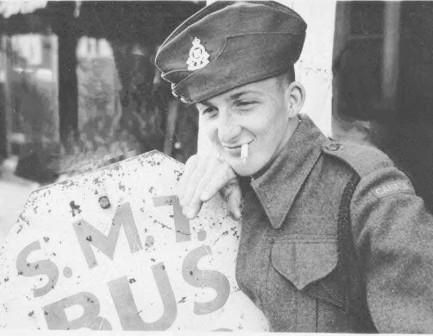
David ‘Lloyd’ George Hope. (Photo courtesy of Susan Hope)
On June 3, 1942, Lloyd sailed from Halifax, Nova Scotia to the United Kingdom, arriving in Liverpool, England on June, 1942. Upon arrival, he was assigned to No. 1 Canadian Engineers Reinforcement Unit (CERU).
While in the United Kingdom, Lloyd’s training continued. On September 29, 1942, he was transferred to No. 1 Canadian Ordnance Reinforcement Unit (CORU), qualifying as a Pioneer ‘C’ on October 19, 1942.
On December 4, 1942, Lloyd was transferred to the Royal Canadian Engineers, 18th Field Company. While remaining with the 18th Field Company, he was attached, for all purposes, to the Headquarters of the Royal Canadian Engineers, 3rd Canadian Division, from February 19, 1943 until August 13, 1943.
Then, on December 14, 1943, he was transferred to the Royal Canadian Engineers, 23rd Field Company. In ‘The Twenty-Third Story’ by Major Michael Lovett TUCKER, the entry for December 19, 1943 explained that training was ongoing. “…We are doing considerable practice in night convoy work…” using old trucks. “…We are still working on Bailey Bridge training on Headley Common….” and “….today we start work on a 110 foot T.T. bridge with one storey underslung….” T.T. refers to Tracked-Transport. Bridge load effects and capacity ratings needed to be evaluated to determine appropriate load factors for military vehicles crossing various bridges.
….Lloyd and the 23rd Field Company left the UK for France…..
On July 6, 1944, Lloyd and the 23rd Field Company boarded a ship that was to leave the United Kingdom for France, part of the 21st Army Group. The July 7, 1944 entry in ‘The Twenty-Third Story’ recorded that “…we sail from Tilbury at six-thirty in the morning and anchor off Southend, where we lie for the balance of the day. Then at ten o’clock the following evening we fall in with the other thirty-three ships in our convoy, and head down the Thames Estuary to the English Channel…”
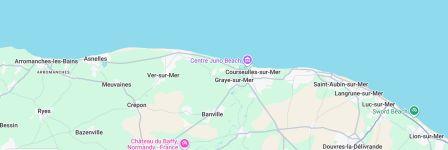
Map showing the location of Graye-sur-Mer and Juno Beach. (Map source: Google maps)
The entry for July 9, 1944 noted their arrival off the coast of France. “…Late in the afternoon we come in sight of the Normandy coast, and shortly before midnight come to anchor off Juno Beach, off Graye-sur-Mer. There are so many ships that it is difficult to find a suitable anchorage…”
….Lloyd and his brother Douglas help to clear up debris in Caen…..
Troops left the ship the following day, and by July 13, 1944 had moved to their new bivouac area in a orchard near Cairon. Their immediate task was to “…clear debris and open streets in Caen…” as stated in the July 14, 1944 entry. “…In the centre of town, every street is choked with rubble, and in many places it’s impossible to tell where streets have been. The Germans are mortaring and shelling steadily….”
Work continued, in spite of German activity, and by July 25, 1944, an entry recorded that “… an entirely new street is run from Boulevard des Allies to the river through the ruins of demolished buildings. It is named ‘Andy’s Alley’….”
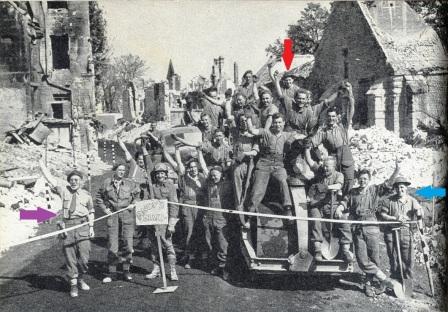
Opening of Andy’s Alley in Caen, July 1944. Lloyd Hope identified by red arrow. His brother Douglas Hope is identified by blue arrow. The purple arrow identifies Major M. L. Tucker, author of ‘The Twenty-Third Story’. (Photo courtesy of Alice van Bekkum Collection)
The opening of Andy’s Alley was captured in a photo, with the caption noting that the road was ‘a half-mile long’ (.8 km), and that the proud Canadian engineers posed by the steamroller breaking the tape for supplies to move forward. The source of the photo and the magazine in which it was published is unknown, and was provided by Alice van Bekkum, Chair of the Faces To Graves Foundation. Both Lloyd and his brother Douglas are in this iconic photo!
….The 23rd Field Company made its way into The Netherlands….
After painstakingly working their way through France and Belgium to clear roads and build bridges, the 23rd Field Company received new orders. The September 16, 1944 entry in ‘The Twenty-Third Story’ recorded that “…something is in the air! Our advance is moving very fast through Belgium up into Holland…”
Operation Market Garden was an Allied military operation, from September 17-25, 1944 that succeeded in liberating Nijmegen and Eindhoven, but failed in liberating the last bridge held in Arnhem, which would enable troops to the Rhine into Germany. If you’ve seen the movie ‘A Bridge Too Far’ (See https://en.wikipedia.org/wiki/A_Bridge_Too_Far_(film)), then you may be familiar with what happened. (For an idea of the gliders used, see https://onthewarmemorialtrail.com/2018/01/06/on-the-war-memorial-trail-the-liberation-route/)
There was excitement in the September 18, 1944 entry. “…We hear that Airborne troops have landed in Northern Holland and have captured the bridges at Grave, Nijmegen and Arnhem over the Maas, Waal and Neder Rijn rivers, respectively….We are the only Canadian troops taking part in the push into Holland….but our ground troops are having difficulty getting beyond Nijmegen and so are unable to join up with the Airborne troops in Arnhem…” This description was about Operation Market Garden, which failed to capture the bridge at Arnhem, as was noted two days later in the September 20, 1944 entry.
While British troops got across the river at Nijmegen and were able to hold the bridge, they had “…difficulty in getting on to Arnhem, and 1st British Airborne is having a very sticky time there. The Germans have retaken the bridge….”
….The 23 Field Company was tasked with rescuing the 1st British Airborne during Operation Berlin….
The 23rd Field Company was “….ordered forward to Nijmegen...” On September 24, 1944, the entry recorded that they were to help rescue the 1st British Airborne, using storm boats to ferry survivors from the German held side of the Neder Rijn River (Lower Rhine River in English) to Allied safety. Operation Berlin was the rescue attempt to save survivors of the British 1st Airborne after the disastrous Operation Market Garden and at the end of the Battle of Arnhem/Oosterbeek.

Example of a storm boat: Storm boats manned by the 34th Field Company, R.C.E., carry Regina Rifles Regiment’s 7th Brigade over the Seine River in 1944. (Photo Credit: Donald I. Grant/Canada. Dept. of National Defence/Library and Archives Canada/PA-136016)
The following day “…at six o’clock we learn that we are to operate from a site on the river, just east of Driel. We are to have fourteen boats, and these will be off-loaded in an orchard which comes up to the back of the winter dyke...”
The first storm boat was launched at 9:30 pm, but as it had been damaged while being pushed down the bank into the water, it started to leak and had to be abandoned. A second boat was readied. “….Corporal Ryan, W.D., and Sappers Magnusson, H.C., and Roherty, L.J., are the crew…It is pitch dark and pouring rain….Lt Martin asks to go with this boat so that he may contact our friends and lend a hand in organizing the loading of boats for them…..”
It set off at 9:45 pm, closely followed by “…another, which has Corporal Smith, S. F., and Sappers Hope, D.L.G., and Thompson, N.A. as crew. Neither of these boats returns. One is seen to receive a direct mortar hit. There is a direct flash from the explosion, and then nothing can be seen in the darkness …”
The boat with Ryan, Magnusson, Roherty, and Martin was hit by mortar fire. None of the men survived.
….Lloyd was in the storm boat that capsized during Operation Berlin….
The boat with Smith, Hope, and Thompson was on its way back after picking up survivors, but was “…heavily overloaded with Airborne survivors…” The boat “….went under when a mortar fell close beside it and everyone instinctively threw himself to the other side of the boat and capsized it...”
Of the crew, only Corporal Smith survived. He recorded in a report on the incident that he was riding in the bow to help land the boat. While heading for the south (home) shore, the boat was swamped and sank about 46 metres (50 yards) from the north shore. As his “…greatcoat was open it helped me to float, and although I am not a swimmer I reached shore on the north side of the river along with four of the British Airborne men. I was taken back to the home side of the river in an assault boat…”
….Lloyd is buried in Rhenen General Cemetery…
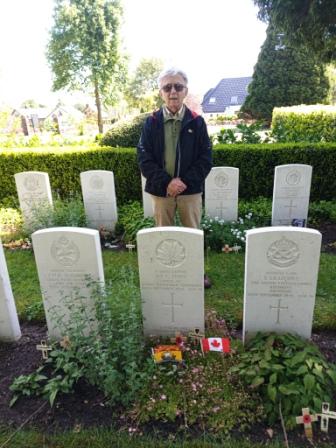
Pieter by the grave of David ‘Lloyd’ George Hope. (Photo credit: Daria Valkenburg)
25 year old Lloyd lost his life due to drowning on September 26, 1944, when the storm boat he was in capsized. He was buried in Rhenen General Cemetery, which we visited this past May. Pieter placed a Canadian and New Brunswick flag at Lloyd’s grave. (See https://onthewarmemorialtrail.com/2025/11/03/on-the-war-memorial-trail-a-visit-to-rhenen-general-cemetery/)
Although 7 men from the 23rd Field Company lost their lives during Operation Berlin, it was a success. The Royal Canadian Engineers rescued most of the 2,400 evacuees in one night, using storm boats propelled by 50 horse power outboard motors! (See https://www.strijdbewijs.nl/donald/operation.htm)
….A visit with Sue Hope…
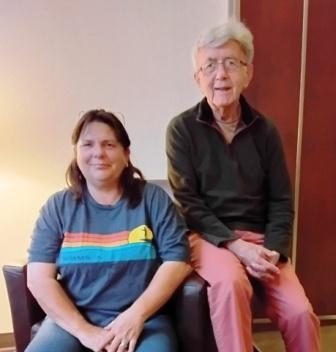
Susan ‘Sue’ Hope and Pieter. (Photo credit: Daria Valkenburg)
We were delighted to have a chance to meet Sue Hope in Moncton after we returned from our 2025 European War Memorial Tour. “….Thank you for the project you are doing to preserve history of all these young men!…” she wrote.

The flags placed at the graves for David ‘Lloyd’ George Hope were donated. Our thanks go to:
- Alan Waddell, Constituent Assistant, on behalf of Heath MacDonald, MP for Malpeque, for the Canadian flags.
- Jean-Claude D’Amours, MLA for Edmundston-Madawaska Centre, Minister responsible for Military Affairs, with the help of Cécile LePage, Province of New Brunswick, for the New Brunswick flag.
Thank you to Sue Hope for providing photos and information about her grandfather’s cousin, and to Alice van Bekkum for providing information on the 23rd Field Company and Major Tucker’s book, as well as the photograph taken at Andy’s Alley. Thank you to John Sliz, author of ‘Storm Boat Kings’, for sharing the storm boat photo.
Our adventures continue as we share the highlights of our adventures on the 2025 European War Memorial Tour.
If you have a story or photo to share, please contact Pieter at memorialtrail@gmail.com or comment on the blog.
© Daria Valkenburg
….Want to follow our research?…
If you are reading this posting, but aren’t following our research, you are welcome to do so. Our blog address: https://onthewarmemorialtrail.com/
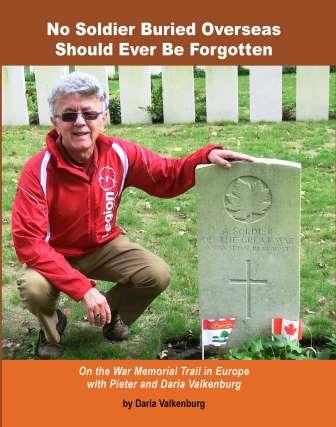 4 countries, 6 weeks, 7,000 km – an unforgettable war memorial journey in Europe…. Daria’s book ‘No Soldier Buried Overseas Should Ever Be Forgotten‘ is available in print and e-book formats. Net proceeds of book sales help support research costs and the cost of maintaining this blog. For more information see https://nosoldierforgotten.com/
Subscribe to our YouTube Channel: On The War Memorial Trail With Pieter Valkenburg: https://www.youtube.com/channel/UCJ591TyjSheOR-Cb_Gs_5Kw.
Never miss a posting! Subscribe below to have each new story from the war memorial trail delivered to your inbox.
 On The War Memorial Trail Research Project........ with Pieter and Daria Valkenburg