On The War Memorial Trail….. Two Researchers Meet WWII Veteran Lois Brown

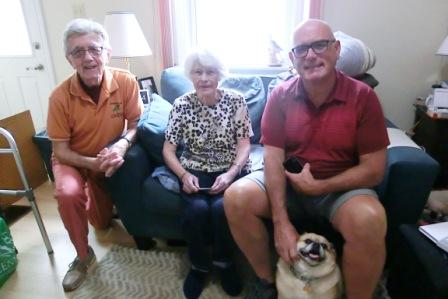
CIMG6889 Jul 23 2024 Pieter Lois Brown Scott Masters

Left to right: Pieter Valkenburg, Lois Brown, Scott Masters, and Bear.  (Photo credit: Daria Valkenburg)

July 28, 2024.  Over the past 10 years, Pieter has researched the stories behind the names on the Cenotaph outside the Borden-Carleton Legion in Prince Edward Island.  As well, he’s researched the stories of other Island soldiers and veterans, and Canadian soldiers buried in The Netherlands and Belgium…and continues to do so.  “…It’s important to tell each individual story…” he says. 

But, with 80 years since the end of WWII and over 100 years since the end of WWI it can be difficult to find families and photos of these soldiers.  Success quite often depends on help from other researchers, libraries, archivists, and genealogists who have taken an interest in the On The War Memorial Trail research project.

….A request to meet WWII veterans from the Island….

We also get requests from other researchers looking for help.  Recently, we were contacted by Scott Masters, Director of the Crestwood Oral History Project at Crestwood Preparatory College in Toronto, Ontario.  (See https://crestwood.on.ca/ohp.) Scott explained that he would be on the Island, and, as a history teacher, he was looking to interview veterans.

 …I do these interviews with and for my students, and we find it is something that creates a great legacy for the vets and their families….”  Masters wrote. “…I am hoping that you might be able to connect me to a veteran.  I always think it would be great for the kids to hear from another veteran – and the students would see these once I am back at school.  I am especially interested in WWII vets – while the chance is still there.  Our program has won both the Governor-General’s and Prime Minister’s awards….

The Crestwood Oral History Project is compatible with the work done by Pieter in the On The War Memorial Trail research project.  Scott noted that the aim of his school’s project is to “…help to illuminate the past and expose students to points of view and specific memories that they would not necessarily find in textbooks….

After consulting with Royal Canadian Legion members Duane MacEwen and John Yeo, two WWII veterans were suggested for Scott to interview:  Lois Brown of Kensington and Jean MacLean of Meadowbank.  Both women agreed to be interviewed.

….We met WWII veteran Lois Brown…

Lois Brown in uniform

Lois Brown in uniform. (Photo courtesy of Lois Brown)

We had a chance to meet Scott Masters at the home of Lois Maud (nee Wall) BROWN and her Pomeranian-pug Bear.  Born August 26, 1924 in Princetown, Prince Edward Island, the daughter of Everett and Ella (Morrison) Wall, Lois is approaching her 100th birthday.  “…I enlisted with the Canadian Women’s Army Corps in 1943 and worked as a telephone operator for 1 ½ years in the Gunnery Operations Room at Barrack Green in St. John, New Brunswick…” she told us. (See https://en.wikipedia.org/wiki/Canadian_Women%27s_Army_Corps)

Lois received the Minister of Veterans Affairs Commendation in 2012 and is still on the Executive of Branch 9 of the Royal Canadian Legion in Kensington, Prince Edward Island.

We enjoyed meeting Scott Masters and Lois Brown and thank them for helping to ensure that our Canadian military history is not forgotten.   You can watch Scott’s interview with Lois Brown at https://crestwood.on.ca/ohp/brown-lois/.

Do you have photos or information to share? Email Pieter at memorialtrail@gmail.com, comment on the blog, or tweet to @researchmemori1.

© Daria Valkenburg

….Want to follow our research?….

If you are reading this posting, but aren’t following our research, you are welcome to do so.  Our blog address: https://onthewarmemorialtrail.com/

Front cover OnTheWarMememorialTrailinEurope4 countries, 6 weeks, 7,000 km – an unforgettable war memorial journey in Europe…. Daria’s book ‘No Soldier Buried Overseas Should Ever Be Forgotten‘ is available in print and e-book formats.  Net proceeds of book sales help support research costs and the cost of maintaining this blog. For more information see https://nosoldierforgotten.com/ 

You are also invited to subscribe to our YouTube Channel: On The War Memorial Trail With Pieter Valkenburg: https://www.youtube.com/channel/UCJ591TyjSheOR-Cb_Gs_5Kw

Never miss a posting!  Subscribe below to have each new story from the war memorial trail delivered to your inbox.

On The War Memorial Trail….. The WWII Soldier From Hallowel Grant Who Lost His Life During The Battle For The North Shore Of The Scheldt

July 24, 2024.  On November 7, 2022, Pieter was interviewed by Ceilidh Millar of CTV Atlantic News At 5 about the search for 4 soldiers of the North Nova Scotia Highlanders Regiment who died during the Battle of Bienen on March 25, 1945.  (You can read the article and watch the video.  See P.E.I. man identifying Canadian soldiers in the Netherlands | CTV News https://atlantic.ctvnews.ca/maritime-man-appealing-to-public-for-help-identifying-lost-canadian-soldiers-1.6143236)

Following the broadcast, several people got in contact to help with the photo search request, and to let him know about other soldiers buried in The Netherlands or Belgium. Among these was Martin Sullivan, who emailed Pieter, saying “My uncle Edward died October 20, 1944 near Brasschaet. Buried in Bergen Op Zoom.  He was in the Algonquin Regiment, C Company. Thank you to the Dutch people for taking care of Pte E. D. Chisholm’s grave and doing this research….

It took a while, but we eventually had a chance to meet Martin and look at the treasure trove of information and photos he had about his uncle, Edward ‘Ed’ Dalton CHISHOLM.

20230918_150701 Sep 18 2023 Pieter with Martin Sullivan in Cap Pele

Pieter with Martin Sullivan. (Photo credit: Daria Valkenburg)

Born November 5, 1924 in Hallowell Grant, Antigonish County, Nova Scotia, Ed was the son of Willliam John and Annie Jane Chisholm. He had 7 brothers and 5 sisters. Martin explained that his mother Josephine was one of Ed’s older sisters.

Ed Chisholm with siblings

A young Edward Chisholm and his older brother John William Chisholm identified in ‘Limbs’ by Lewis B. Chisholm.  (Photo courtesy of Martin Sullivan)

… Ed first enlisted in the Royal Canadian Naval Volunteer Reserve…

After leaving school at age 15, Ed worked on his parents’ farm, and then on a dairy farm, before going on to work as a stevedore for Scotia Stevedore Company in Halifax, Nova Scotia.  (A stevedore works at a dock to load and unload cargo from ships.)  

On March 22, 1943, at the age of 17, Ed left his employer and enlisted in the Royal Canadian Naval Volunteer Reserve as an ordinary seaman.  However, he was discharged as ‘medically unfit’ on May 12, 1943 due to being colour-blind. 

… Ed enlisted in the Canadian Army in 1944…
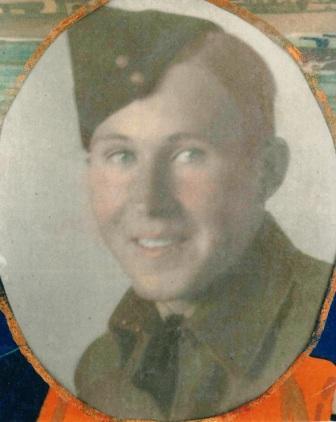
Ed Chisholm from Martin Sullivan

Edward ‘Ed’ Dalton Chisholm. (Photo courtesy of Martin Sullivan)

Ed returned to work as a stevedore in Halifax, this time with Cunard White Star Ltd, until January 4, 1944, when he enlisted at the No. 6 District Depot of the Canadian Army in Halifax, Nova Scotia.

His Personnel Selection Record noted that red-haired Ed had “…considerable experience in hockey and other sports. Attends dances ….” and reads “….popular fiction magazines and follows the news…”  His height of 6 feet 1 inch (1.85 metres) was remarked upon, and he was described as having “…a fine physique and a steady, calm, well balanced spirit…General characteristics point to suitability for vigorous activity along general combatant lines….

On January 14, 1944, Ed was sent to No. 60 Canadian Infantry Basic Training Centre (CIBTC) in Yarmouth, Nova Scotia.  After completing his basic training, Ed was transferred to A14 Canadian Infantry Training Centre (CITC) in Aldershot, Nova Scotia on March 12, 1944.

Next, Ed was attached to S-5 Canadian Driving and Maintenance School (CD & M School) in Woodstock, Ontario on May 5, 1944, for a Driver Course. He successfully completed this on June 29, 1944 and was qualified as a Driver i/c Class III (W).  (The term ‘Driver i/c’ refers to ‘Driver, internal combustion’.  Class III meant he was qualified to drive heavy trucks and armoured cars. ‘W’ refers to ‘Wheeled’.)

He was reassigned back to A14 CITC in Aldershot in preparation for overseas service, and granted two weeks embarkation leave, from July 7 to 20, 1944, the last chance he had to see his family.

… Ed left Canada for overseas service in August 1944…

On August 4, 1944, Ed left Canada for the United Kingdom.  Upon arriving on August 10, 1944 he was assigned to No. 4 Canadian Infantry Reinforcement Unit (CIRU).

On September 2, 1944 he was sent to France with the X-L infantry reinforcement troops of the 21st Army Group.

… Ed joined the Algonquin Regiment in Belgium…
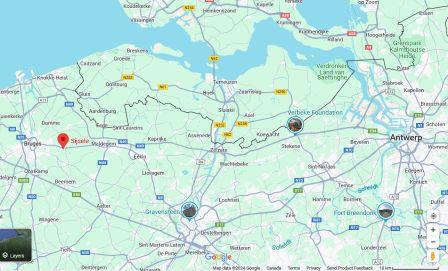
Screenshot 2024-07-20 at 12-30-12 Sijsele · 8340 Damme Belgium

Edward ‘Ed’ Dalton Chisholm joined the Algonquin Regiment in Sijsele, Belgium, as they travelled eastward. (Map source: Google maps)

On September 15, 1944 he was assigned to the Algonquin Regiment, joining them in Sijsele, Belgium, located not far from the Dutch border.  The Regiment had suffered heavy losses during the battles to capture the canals around Moerkerke and needed reinforcements as they slowly advanced towards the Scheldt and the need to liberate the port of Antwerp.

By October 18, 1944, the Regiment was near Westmaele, north-east of Antwerp.  In ‘Warpath The Story of the Algonquin Regiment 1939-1945’, author Major G. L. Cassidy wrote that “… on October 19th, a battalion reconnaissance party went north to Camp de Brasschaet for a look at the terrain where the next day’s battle was to be fought…..” This was the Battle for the North Shore of the Scheldt.

The Algonquin Regiment war diary for October 19, 1944 stated that “…at 13:15 hours, the battalion left on its journey north, arriving at our destination, a badly bombed sanitarium, about 16:30 hours.  Here the men were briefed on the forthcoming operation and after digging in, settled down to spend another quiet night…

The ‘Warpath’ entry for that day stated that when the orders were issued on the evening of October 19, the “…divisional plan was to advance and capture the town of Esschen, moving along two centre lines in two brigade groups…

….The Battle for the North Shore Of The Scheldt was fatal for Ed….

The Battle for the North Shore of the Scheldt began on October 20, 1944 at 7:30 am, with “… ‘B’ Company leading, ‘A’ Company on the right, and ‘D’ Company on the left...” according to the Algonquin Regiment’s war diary for that day.

Ed Chisholm was in ‘C’ Company, which didn’t go into position until later in the morning, as noted in the war diary.  “…At 11:30 hours, ‘C’ Company was placed under command of 28 Canadian Armoured Regiment, and with ‘C’ Squadron of that unit, made a flanking attack and captured the cross roads.  During this operation, one ‘C’ Company man was killed, and one tank was knocked out with one man killed and one officer wounded. Twenty one prisoners of war were captured….

The ‘C’ Company man killed was Ed, as was confirmed in ‘Warpath’. “… ‘C’ Company suffered only one fatal casualty, Pte E.D. Chisholm….”  He was 19 years old, only two weeks away from his 20th birthday.

Martin Sullivan had been given an eyewitness account by Stanley Cameron with a bit more information on what happened to his Uncle Edward. Stanley, from Grande Prairie, Alberta, was with the Royal Canadian Engineers 2nd Division.  “…When a German 30 mm cannon took out the tank, Edward was hit by tank shrapnel and was pushed into a ditch until taken to hospital.  He died in a field hospital, with a priest who gave him his last confession…” 
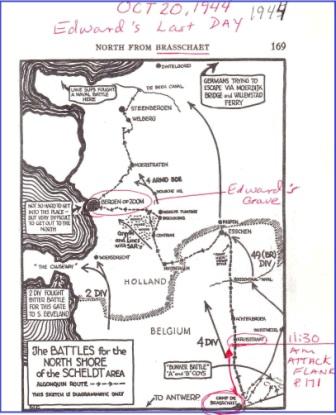
Map page 169 Warpath - Algonquin Regt Oct 20 1944 Chisholm_Page_3

Notes made by Martin Sullivan about Ed Chisholm’s last battle. (Map source: ‘Warpath The Story of the Algonquin Regiment 1939-1945’)

….Ed is buried in Bergen Op Zoom….

Screenshot 2023-09-17 at 21-00-01 kalmthout belgie at DuckDuckGo

Edward ‘Ed’ Dalton Chisholm was temporarily buried in Kalmthout, Belgium. (Map source: DuckDuckGo)

On October 21, 1944, Ed was temporarily buried “…in a field opposite the house of Joseph Goosenaerts…” in the village of Kalmthout, Belgium, before being reburied in the Canadian War Cemetery in Bergen Op Zoom, The Netherlands.

grave Chisholm from Find A Grave

Grave of Edward ‘Ed’ Dalton Chisholm in the Canadian War Cemetery in Bergen Op Zoom, The Netherlands. (Photo courtesy of Find A Grave)

….A family was left to grieve their son….

Martin wrote in his copy of ‘Warpath’ that when his grandmother (Momma) learned about her son’s death, she “…went to church and Edward appeared in her hands to tell her he was in heaven…”  When asked if this anecdote could be shared, Martin agreed.

Martin explained that upon hearing such devastating news about their son “….our grandfather Billy John Chisholm (PaPa) went to the woods to cry, and then hitched up the team of horses to take Momma to church in town….

His grandmother’s faith helped her to cope with the loss of a beloved son.  “…After several days of living in town and going to church all day, PaPa and the children were worried that their Momma would never be coming home. Momma prayed for her son to the Blessed Virgin and St. Joseph. Then one day they smiled down on her. Her prayers were answered.  There in her open hands was Edward’s face saying ‘Thank you Momma, I’m in heaven and you don’t have to worry about me anymore’. Her boy’s soul had been received into heaven and Momma went home to take care of the remaining twelve children. Thanks be to God….” 

Thank you to Martin Sullivan for sharing photos and information.  Do you have photos or information to share? Email Pieter at memorialtrail@gmail.com, comment on the blog, or tweet to @researchmemori1.

© Daria Valkenburg

….Want to follow our research?….

If you are reading this posting, but aren’t following our research, you are welcome to do so.  Our blog address: https://onthewarmemorialtrail.com/
Front cover OnTheWarMememorialTrailinEurope4 countries, 6 weeks, 7,000 km – an unforgettable war memorial journey in Europe…. Daria’s book ‘No Soldier Buried Overseas Should Ever Be Forgotten‘ is available in print and e-book formats.  Net proceeds of book sales help support research costs and the cost of maintaining this blog. For more information see https://nosoldierforgotten.com/ 

You are also invited to subscribe to our YouTube Channel: On The War Memorial Trail With Pieter Valkenburg: https://www.youtube.com/channel/UCJ591TyjSheOR-Cb_Gs_5Kw

Never miss a posting!  Subscribe below to have each new story from the war memorial trail delivered to your inbox.
On The War Memorial Trail……75th NATO Anniversary Commemoration At Seacow Head Lighthouse

Screenshot_20240402_185133_Facebook

NATO flag flying at Seacow Head Lighthouse this past spring. (Photo courtesy of Liz Hubert)

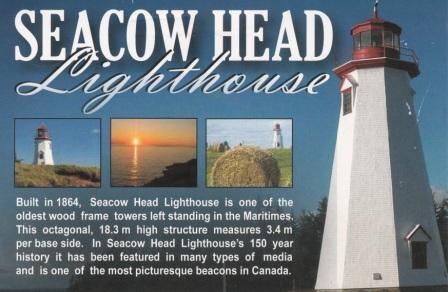
July 15, 2024. On July 10, 2024, a 75th NATO Anniversary Commemoration was held at Seacow Head Lighthouse in Fernwood, Prince Edward Island, as part of the official opening ceremonies for the Lighthouse as a museum.  The lighthouse itself has been in existence since 1864, standing beside Fernwood’s red cliffs.

Seacow Head Lighthouse postcard

Postcard of Seacow Head Lighthouse.

It has been featured in the Road To Avonlea TV series, based on the Anne of Green Gables books by Lucy Maud Montgomery, which I grew up reading.  When Pieter was asked to be one of the guest speakers at the 75th NATO Anniversary Commemoration at this beautiful location, I was really hoping he’d say ‘yes’. 

maxresdefault

Seacow Head Lighthouse was featured in the Road To Avonlea TV series.  (Photo source: YouTube)

 ….Pieter shared his experience at a NATO base in Germany….

Rheine tile with frame

Rheine tile. (Photo courtesy of Pieter Valkenburg)

Pieter did agree to speak briefly about his deployment at a NATO base in Rheine, Germany, as a NIKE Missile Tracking Operator, while he was serving with the Royal Netherlands Air Force during the Cold War. He reminded us of how alert the base had to be in case of an attack – when the NIKE guided nuclear missiles would be used as an anti-aircraft surface to air system.

May 25, 2006. Rheine. Pieter at a street map. Where did I live?

Pieter in Rheine in 2006, looking at the map to see where the NATO base had been located.  (Photo credit: Daria Valkenburg)

….Pieter was surprised to see an old Soviet early warning system in Ukraine ….

IMG_0075 May 21 2007 Daria and Pieter in Bolechiw

Daria and Pieter at the outskirts of Bolekhiv, Ukraine in 2007.  (Photo courtesy of Valkenburg Family)

He explained that “…luckily, during my deployment, the missiles were never activated. It didn’t really hit home for me the dangerous position we were in until decades later when my wife and I were in Ukraine in 2007.  Near the town of Zolichev in Western Ukraine, we saw the remnants of an early warning system aimed at Western Europe.  Yes…. it was an anti-aircraft defence station similar to where I had worked in Rheine, but operated by the Soviets….” 

Of course we stopped to take another look, as Pieter recounted in his presentation.  “…It was no longer in use and locals had stripped all the usable materials from the inside, like electrical wiring and valuable metals.  All that was left was the shell and the round radars….

IMG_0134 May 22 2007 Anti aircraft defence station near Zolichev

The anti-aircraft defence station near Zolichev had not been dismantled in 2007.  (Photo credit: Daria Valkenburg)

Pieter’s anecdote was a reminder that geopolitics can bring long-forgotten conflicts into today’s world.  “…The station in Rheine had been completely dismantled, and was a meadow when we last visited there in 2006.  So I asked Slav, our Ukrainian driver, why the Russians didn’t dismantle their station when they left.  The answer?  Slav believed that the Russians were hoping to use it again in the future – once Ukraine got over ‘this silly notion of independence’ – as he put it. A chilling comment that now seems prophetic….

 …. ‘May we never forget those who have been affected by war’ ….

Pieter’s presentation ended with him saying that “….I was proud to serve in Rheine as a member of NATO so many years ago, doing my small part in keeping peace during the Cold War.  May we never forget those who have been affected by war.  Thank you….

Among the NATO representatives present on July 10, 2024 were John Yeo, Atlantic Regional Director for NATO Veterans of Canada; guest speaker Pieter Valkenburg, Public Relations Officer for Borden-Carleton Legion; and keynote speaker Clare Hutchinson, former NATO Secretary General’s Special Representative for Women, Peace, and Security.

CIMG6887 Jul 10 2024 John Pieter Clare Seacow Head Lighthouse Ceremony

Left to right:  John Yeo, Pieter Valkenburg, Clare Hutchinson.  (Photo credit: Daria Valkenburg)

It was fitting that NATO, seen as a beacon of hope and peace to many, had its 75th anniversary commemorated beside a lighthouse in a beautiful and peaceful landscape.  Thank you to The Friends of Seacow Head Lighthouse organizing committee – Dr. Elisabeth Hubert, PhD, Tom Sherry, and Jim MacFarlane – for inviting Pieter to speak. 

Do you have photos or information to share? Email Pieter at memorialtrail@gmail.com, comment on the blog, or tweet to @researchmemori1.

© Daria Valkenburg

….Want to follow our research?….

If you are reading this posting, but aren’t following our research, you are welcome to do so.  Our blog address: https://onthewarmemorialtrail.com/

Front cover OnTheWarMememorialTrailinEurope4 countries, 6 weeks, 7,000 km – an unforgettable war memorial journey in Europe…. Daria’s book ‘No Soldier Buried Overseas Should Ever Be Forgotten‘ is available in print and e-book formats.  Net proceeds of book sales help support research costs and the cost of maintaining this blog. For more information see https://nosoldierforgotten.com/ 

You are also invited to subscribe to our YouTube Channel: On The War Memorial Trail With Pieter Valkenburg: https://www.youtube.com/channel/UCJ591TyjSheOR-Cb_Gs_5Kw

Never miss a posting!  Subscribe below to have each new story from the war memorial trail delivered to your inbox.

On The War Memorial Trail…… The WWII Soldier From Donaldston Who Died In A Vehicle Accident In The Netherlands

July 13, 2024.  In the 11 part Atlantic Canada Remembers series that ran in 2021, photos submitted about Atlantic Canadian soldiers buried overseas were featured. Pieter ensured that photos of soldiers who are buried in The Netherlands were forwarded to the appropriate cemetery for their digital archives. 

In Part 2 of the Atlantic Canada Remembers series, Helen O’Connell submitted a photo of her uncle, Francis ‘Frank’ Ivan DOUGAN.  She wrote that he “….was born in November 12, 1919 to Florence and John Dougan from Donaldston, Prince Edward Island.  He was the 2nd of 12 boys born in that family – no girls.  Frank left school at age of 15 and went to work to help his family.  He worked in Debert, Nova Scotia as a labourer and mechanic.  In 1941, he and 3 of his brothers enlisted….”  (See https://onthewarmemorialtrail.com/2021/01/13/on-the-war-memorial-trail-atlantic-canada-remembers-part-2/)

Screenshot 2024-07-03 at 11-24-35 Donaldston · Prince Edward Island C0A 1T0

Donaldston is located in central Prince Edward Island. (Map source: Google maps)

…..Frank enlisted under the NRMA in 1941….

Frank originally enlisted under the National Resources Mobilization Act (NRMA) in Charlottetown, Prince Edward Island on October 2, 1941 and underwent basic training at No. 62 Canadian Army Basic Training Centre (CABTC). (See https://en.wikipedia.org/wiki/National_Resources_Mobilization_Act)

After completing his basic training, Frank was sent for 62 days of advanced training at No. A19 Canadian Army Service Corps Training Centre (CASCTC) at Camp Borden in Borden, Ontario.  

From there, he was transferred to the 6th Division Ammunition Company of the Royal Canadian Army Service Corps (RCASC) in Valcartier, Quebec on April 7, 1942.

Frank would remain with the Royal Canadian Army Service Corps (RCASC), an administrative and transport corps of the Canadian Army.  Their role was to provide support to Canadian soldiers wherever they went, moving supplies from the rear areas to the front-lines. They delivered all rations, ammunition, petroleum products, and all other essentials, using vehicles ranging from three- to ten-ton trucks, and forty-ton tank transporters. (For more information, see https://en.wikipedia.org/wiki/Royal_Canadian_Army_Service_Corps)

….Frank enlisted for active service…..

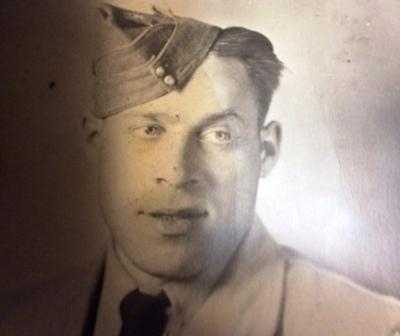
Francis Ivan Dougan

Francis ‘Frank’ Ivan Dougan. (Photo courtesy of Helen O’Connell)

On June 1, 1942, Frank transferred from the non-active militia to active service in the Canadian Army, remaining with the 6th Division Ammunition Company in Valcartier.   

On July 7, 1942, Frank was sent to the Canadian Army Trades School in Hamilton, Ontario for a Motor Mechanics Course, which lasted 6 months. On January 20, 1943, Frank was attached to the Headquarters of the 6th Division Ammunition Company at Hastings Military Park in Vancouver, British Columbia.

On March 9, 1943, he was sent to the Headquarters of the 6th Division Company in Victoria, British Columbia.  Then, on September 2, 1943, he was transferred to the 28th Transport Company in Duncan, British Columbia, but sent on assignment with the Royal Rifles of Canada to Wainwright, Alberta, where he remained until October 19, 1943, when he returned to Duncan. 

Frank next was transferred to No. XI District Depot in Vancouver, British Columbia on February 4, 1944 for a short period before being sent, on February 16, 1944, to No. 1 Training Brigade in Debert, Nova Scotia, in preparation for overseas service. 

….Frank left Canada for overseas service….

On April 11, 1944, Frank left Canada, arriving in the United Kingdom on April 19, 1944, where he was assigned to the Canadian Army Service Corps Reinforcement Unit (CASCRU).

Frank was transferred to the 12th Battalion of the Royal Canadian Army Service Corps (RCASC), part of the 10th Canadian Infantry Brigade (CIB) on May 1, 1944, qualifying as a Driver i/c on May 8, 1944.  (The term ‘Driver i/c’ refers to ‘Driver, internal combustion’.) 

Helen had written that while overseas Frank “… worked as a driver in the war, mainly in the UK….”  This turned out to be incorrect, as Frank was in the United Kingdom for only a few short months – until July 25, 1944, when he, and the 10th Canadian Infantry Brigade (CIB), arrived in France as part of the 21st Army Group.  He was with the Brigade until after WWII officially ended.

….Frank remained in Europe after the war ended….

On July 6, 1945, as a driver, Frank was assigned to the 4th Armoured Division Transport Company of the Royal Canadian Army Service Corps (RCASC), joining them in Almelo, The Netherlands.  He remained with the 4th Armoured Division until November 10, 1945, when he was reassigned to the 2/9 Canadian Infantry Brigade (CIB).

On April 7, 1946, Frank was transferred to the 48th Canadian General Transport Company of the Royal Canadian Army Service Corps (RCASC), part of the Canadian Army Occupation Force (CAOF) in Germany. 

….Frank lost his life in a vehicle accident….

Helen wrote that “….after the war Frank decided to work in peacekeeping as a Canadian soldier in Oldenburg, Germany.  On May 16, 1946, he was involved in road accident and was killed.  He was buried in Holland and was awarded the France and Germany Star 1939-1945….

According to his service file, Frank died in a hospital in Nijmegen following a road accident during very bad weather in Nijmegen, while he was on his way from Grave, The Netherlands to Oldenburg, Germany. Mechanical failure in the steering mechanism led to the accident.  Frank was a passenger in the rear of the vehicle along with 2 others, plus the driver. 

There were two fatalities: Frank Dougan and another soldier who was also in the rear, Charles Ernest Edwin CRIDLAND, who had been born in England, but was from Vancouver, British Columbia.

….Frank is buried in Holten….

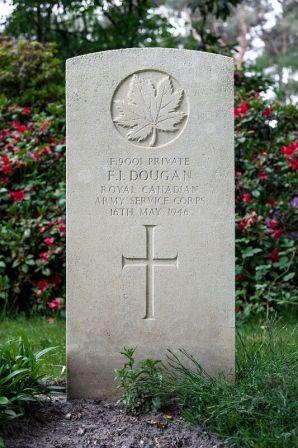
2227155_1 Grave of Frank Ivan Dougan CVWM

Grave of Francis ‘Frank’ Ivan Dougan in the Canadian War Cemetery in Holten, The Netherlands. (Photo courtesy of Canadian Virtual War Memorial)

Frank was initially buried in the Canadian Cemetery in Groesbeek, near Nijmegen, before being reburied, on July 16 1946, in the Canadian War Cemetery in Holten, The Netherlands.

Helen was able to visit The Netherlands and the Canadian War Cemetery in Holten.  “…My husband and I were very fortunate to visit his grave in 2016.  I was so proud and honoured to be there.  I will not forget.  This graveyard seemed almost like a sacred place for these solders who gave their life for us and since my visit I really appreciate that….

In 1948, Frank’s grave was adopted by a family from Delden – jeweller Jan A. Zengerink and his wife Ria.  An English translation of the letter that they wrote to Frank’s family informing them of the grave adoption was forwarded to Frank’s mother by the Department of Defence.

Thank you to Helen O’Connell for submitting a photo and information on her uncle. Do you have photos or information to share? Email Pieter at memorialtrail@gmail.com, or comment on the blog.

© Daria Valkenburg

…..The Atlantic Canada Remembers series….

Missed the Atlantic Canada Remembers series? See:

….Want to follow our research?….

If you are reading this posting, but aren’t following our research, you are welcome to do so.  Our blog address: https://onthewarmemorialtrail.com/

Front cover OnTheWarMememorialTrailinEurope4 countries, 6 weeks, 7,000 km – an unforgettable war memorial journey in Europe…. Daria’s book ‘No Soldier Buried Overseas Should Ever Be Forgotten‘ is available in print and e-book formats.  Net proceeds of book sales help support research costs and the cost of maintaining this blog. For more information see https://nosoldierforgotten.com/ 

You are also invited to subscribe to our YouTube Channel: On The War Memorial Trail With Pieter Valkenburg: https://www.youtube.com/channel/UCJ591TyjSheOR-Cb_Gs_5Kw

Never miss a posting!  Subscribe below to have each new story from the war memorial trail delivered to your inbox.

On The War Memorial Trail…… The WWII Soldier From St. Nicholas Who Lost His Life During The Battle of Hochwald Gap

July 6, 2024.  Back in 2015, Pieter received a photo of WWII soldier Edward Gabriel PERRY, whose name was on a photo wish list from the Canadian War Cemetery in Groesbeek, The Netherlands. 

Edward was born in St. Nicholas, a small community west of Summerside, Prince Edward Island, on October 6, 1924, the son of John F. and Zelia Perry. He was one of 11 children, with 5 brothers, three of whom also served overseas during WWII, and 5 sisters.

….Edward enlisted at age 18….

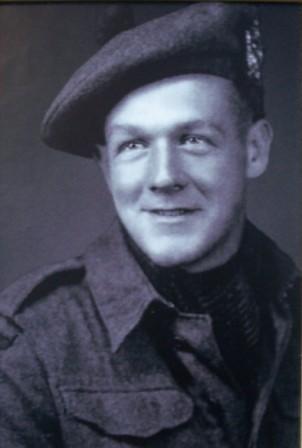
PERRY Edward Gabriel

Edward Gabriel Perry.

When he enlisted at the No. 6 District Depot in Charlottetown, Prince Edward Island, on February 25, 1943, he was only 18 years old, too young to be sent into an active combat zone.  At the time, he stated that he grew up on a farm, but had spent the past two months working as a carpenter for Fred Cameron of Saint John, New Brunswick, who had a lumber business.

Edward’s Personnel Selection Record noted that he “…plays hockey…” and that his “…chief diversion is reading….”  It went on to describe him as “…reserved, determined…” and concluded that he would “…make an efficient soldier…

From Charlottetown, Edward was sent to Halifax, Nova Scotia, and from there to No. 61 Canadian Army (Basic) Training Centre (CABTC) in New Glasgow, Nova Scotia on March 13, 1943. 

After completing his basic training, Edward was sent to the A1 Canadian Artillery Training Centre in Petawawa, Ontario on May 12, 1943 to be trained as a gunner. 

On June 14, 1943, he was assigned to the 23rd Anti-Aircraft Regiment of the 50th Anti-Aircraft Battery of the Royal Canadian Artillery.  Edward’s new assignment was coastal defence in Sydney, Nova Scotia.  During WWII, Sydney was the second-most-important port for convoy formation after Halifax.

He remained in Sydney until March 23, 1944 when he was transferred to No. 1 Transit Camp in Windsor, Nova Scotia, in preparation for overseas service. Then, on May 15, 1944, he was reallocated to the Training Brigade Group in Debert, Nova Scotia for further training.

….Edward left Canada for overseas service….

On July 19, 1944 Edward left Canada, arriving in the United Kingdom on July 27, 1944, where he was assigned to No. 3 Canadian Infantry Reinforcement Unit (CIRU).

A month later, on August 29, 1944, he was sent to France, and then transferred to the Argyll & Sutherland Highlanders (Princess Louise’s), part of the 21st Army Group, on September 2, 1944. On December 10, 1944, he was promoted to Lance Corporal.

….The Battle of Hochward Gap was deadly….

ASH Can map1

Map shows plan for the Battle of Hochwald Gap.  Note: Kanten on map should read Xanten.  (Map source: ‘The Argyll & Sutherland Highlanders of Canada (Princess Louise’s) 1928-1953, edited by Lt-Col H. M. Jackson)

The end of February 1945 saw the Regiment in Germany for the Battle of Hochwald Gap, part of Operation Blockbuster, the final push towards the Rhine River, along with several other Canadian Regiments.  This offensive began on February 28, 1945 to clear the Germans from the Reichswald, a heavily forested area between the Maas and the Rhine Rivers, driving them back over the Rhine, taking the fight well into German territory for a full-scale invasion of Berlin.  (For more information, see https://canadianbattlefieldtours.ca/operation-blockbuster/ and https://civilianmilitaryintelligencegroup.com/10742/the-battle-of-hochwald-gap-one-of-the-largest-armor-engagements-you-probably-have-never-heard-of)

Troops faced a battlefield that was cold, wet, and muddy, and a ferocious fight by desperate Germans who recognized that they were about to lose the war. On March 1, 1945, Edward was badly wounded during the battle, and brought to a field hospital just after 6 pm “…in very poor condition…” and given “…1 pint of plasma….” 

He was sent on an urgent basis to No. 3 Casualty Clearing Centre, arriving at 9 pm. The medical report noted that he had “…shell fragment wounds with compound fracture of the right femur, injury of the femoral vessels, and multiple lacerations of both legs, and a penetrating wound to the abdomen…”  Edward was rushed into surgery, but died at 5:15 am on March 2, 1945. 

….Edward is buried in the Canadian War Cemetery in Groesbeek….

CIMG3330 Oct 5 2019 grave Groesbeek Edward Perry from daria

Grave of Edward Gabriel Perry in the Canadian War Cemetery in Groesbeek, The Netherlands. (Photo credit: Daria Valkenburg)

Edward was initially buried in the Canadian Military Cemetery in Bedburg, Germany, before being reburied in the Canadian War Cemetery in Groesbeek, The Netherlands. 

Do you have photos or information to share? Email Pieter at memorialtrail@gmail.com, or comment on the blog.

© Daria Valkenburg

 ….Previous postings about soldiers who died during the Battle of Hochwald Gap….

….Want to follow our research?….

If you are reading this posting, but aren’t following our research, you are welcome to do so.  Our blog address: https://onthewarmemorialtrail.com/

Front cover OnTheWarMememorialTrailinEurope4 countries, 6 weeks, 7,000 km – an unforgettable war memorial journey in Europe…. Daria’s book ‘No Soldier Buried Overseas Should Ever Be Forgotten‘ is available in print and e-book formats.  Net proceeds of book sales help support research costs and the cost of maintaining this blog. For more information see https://nosoldierforgotten.com/ 

You are also invited to subscribe to our YouTube Channel: On The War Memorial Trail With Pieter Valkenburg: https://www.youtube.com/channel/UCJ591TyjSheOR-Cb_Gs_5Kw

Never miss a posting!  Subscribe below to have each new story from the war memorial trail delivered to your inbox.