June 30, 2024. In 2017, Pieter and I visited the village of Posterenk in The Netherlands with Edwin van der Wolf, one of the research volunteers at the Canadian War Cemetery in Holten.

Windmill in Posterenk, which has a memorial stone inscribed on the wall. (Photo credit: Daria Valkenburg)

Translation of memorial stone on the windmill: Posterenk freed by the Carleton & York Regiment of Canada on April 13, 1945. (Photo credit: Daria Valkenburg)
….The Island connection to Posterenk…..
Edwin wanted us to visit the village because it had an Island connection. François ‘Frank’ GALLANT, son of Antoine and Eleanor (nee Poirier) Gallant of Mount Carmel, Prince Edward Island, died there on April 13, 1945, while serving with the Carleton & York Regiment.

Edwin van der Wolf (left) and Pieter in Posterenk. (Photo credit: Daria Valkenburg)
The village had a list of 6 soldiers to commemorate from the Carleton & York Regiment, who had all been buried in the area. Unfortunately, not all soldiers who died are included on this list, but Edwin worked towards including two more, who were not buried near Posterenk, but “…were temporarily buried in Lochem because they had previously died in a Canadian hospital there…”
In total, out of the 8 soldiers, three were from Prince Edward Island! The stories of Daniel Peter MACKENZIE and James ‘Frank’ MOSSEY were previously told. In this posting, we feature the story of Frank GALLANT, the reason we were in Posterenk back in 2017!

François ‘Frank’ Gallant. (Photo courtesy of the Information Centre Canadian Cemetery Holten)
….Three Gallant brothers served…..
Born November 24, 1914, Frank originally enlisted under the National Resources Mobilization Act (NRMA) in Charlottetown, Prince Edward Island on August 13, 1942 and underwent basic training at No. 62 Canadian Army Basic Training Centre (CABTC), which he completed on October 12, 1942. (See https://en.wikipedia.org/wiki/National_Resources_Mobilization_Act)
His Personnel Information Record noted that he could speak both French and English, and came from a rural farming background, which likely accounted for him having only a Grade 4 education. In addition to farming, Frank had experience in carpentry work, and had worked in a lumber mill. He could drive a vehicle, and played baseball and hockey. Two of his brothers, Georges and Simon, were also in the army.
With his basic training successfully completed, Frank was transferred to A5 Canadian Engineer Training Camp (CETC) in Petawawa, Ontario for advanced training on October 13, 1942. Upon completion of that training, he remained in Petawawa for an additional two months, doing general repair work.
On January 28, 1943, Frank was transferred to No. 2 Engineer Services and Works Company (ES&W Company) of the Royal Canadian Engineers, where his task was to fire and repair boilers at No. 2 District Depot in Toronto, Ontario. He was with ‘D’ Wing, a ‘supernumerary to establishment’ reserve unit, while a decision about the direction his army career was to take was made.
Frank had expressed interest in being considered in the Tradesman category as a fireman or maintenance man, but it was determined that since his occupation background was “… erratic….” with no “…special training…” and he was considered very fit, in the “…A-1 category…”, he should be reallocated to “…Infantry (Non-Tradesman)…” and receive infantry training.
Frank received special leave to return home to Prince Edward Island to help with the family’s farm operation on August 29, 1943, after which he returned to Toronto on November 1, 1943.
….Frank transferred to the Infantry…..
As a result of the assessment that he be assigned to an Infantry Unit, Frank was transferred to the 1st Battalion Victoria Rifles of Canada on November 10, 1943 and sent the following day to Stratford, Ontario to be re-mustered as a rifleman.
Frank remained in Stratford for training until February 18, 1944, when he was sent to Niagara-on-the-Lake, Ontario.
On August 24, 1944, Frank transferred from the non-active militia to active service in the Canadian Army, remaining with the 1st Battalion Victoria Rifles of Canada in Niagara-on-the-Lake.
….Frank left Canada for overseas service…..
On November 21, 1944, Frank left for Great Britain with the 1st Battalion, to provide reinforcements to the Canadian Army in the field. Upon arrival on November 28, 1944, he was assigned to No. 3 Canadian Infantry Training Regiment (CITR).
He continued receiving further training until January 23, 1945, when he left the United Kingdom for Italy, as part of the X-4 Reinforcements, arriving on February 7, 1945. On February 13, 1945 he was transferred to the Carleton & York Regiment, joining them north of Rossi (Russi), part of a group of reinforcements, at the tail end of the Italian Campaign. (See https://en.m.wikipedia.org/wiki/Italian_campaign_(World_War_II))
He joined the Carleton & York Regiment at the same time as Archibald Phillip ‘Archie’ MCLEAN of Edmundston, New Brunswick. Archie’s story was previously told on this blog. (See https://onthewarmemorialtrail.com/2023/09/13/on-the-war-memorial-trail-archie-was-a-good-guy/)

The Carleton & York Regiment was north of Russi on February 13, 1945. (Map source: http://www.gosur.com)
On March 17, 1945, he left Italy as part of Operation Goldflake, arriving in Marseilles, France three days later. Operation Goldflake was the codename for moving troops from Italy to North-West Europe. (See https://en.wikipedia.org/wiki/Operation_Goldflake)
The Carleton & York Regiment was now part of the 21st Army Group. From France, troops were moved up to the Belgian front, into The Netherlands, through the Reichswald Forest in Germany, and then back into The Netherlands.
…The Liberation of Posterenk…
On April 12, 1945 the Regiment was part of Operation Cannonshot, which led to the crossing of the IJssel River between the villages of Gorssel and Wilp in the eastern part of The Netherlands. (See https://www.liberationroute.com/stories/190/operation-cannonshot)

According to the April 12, 1945 war diary entry of the Carleton & York Regiment, they “…moved across the Ijssel River at 14:30 hours….” to relieve the Seaforth Highlanders of Canada.
On April 13, 1945, the war diary entry noted that “…‘D’ Company’s objective is Posterenk…” The Regiment didn’t expect much opposition, but they “… met with stiff resistance just after starting at 11:25 hrs…”
In ‘Invicta – The Carleton and York Regiment in the Second World War’ author Robert Tooley explained that “…on the CYR front D Company was to lead off towards its first objective, the village of Posterenk: the opposition was expected to be light, and the company was instructed to continue to move forward until strong opposition was encountered. The battalion now had in support a troop of M10 SP anti-tank guns, a troop of tanks, a platoon of medium machine guns, and a platoon of 4.2 inch mortars. D Company pushed off at 10:50 am….. Contrary to expectations, D Company met stiff resistance and suffered several casualties from small arms fire….”
At some point during that day, Frank lost his life.
…Frank is buried in Holten…
Frank was one of 6 soldiers initially buried along the main road to Posterenk, a village near Zutphen, before being reburied in the Canadian War Cemetery in Holten.
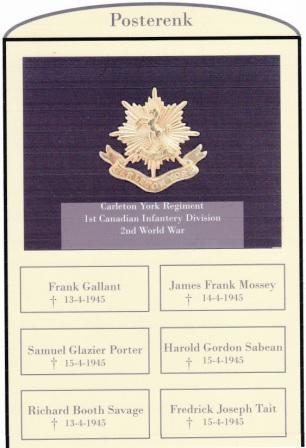
The 6 soldiers buried near Posterenk.

Grave of François ‘Frank’ Gallant at the Canadian War Cemetery in Holten. (Photo credit: Daria Valkenburg)
…Frank is remembered on the war memorial in Wellington…
In May 2024, we visited the war memorial in Wellington, Prince Edward Island, where Frank’s name is listed.

François ‘Frank’ Gallant is remembered on the war memorial in Wellington, Prince Edward Island. (Photo credit: Pieter Valkenburg)
…Previous stories about soldiers commemorated in Posterenk….
- Daniel Peter MACKENZIE: https://onthewarmemorialtrail.com/2023/06/29/on-the-war-memorial-trail-the-wwii-soldier-from-victoria-cross-fatally-wounded-during-the-liberation-of-posterenk/
- James ‘Frank’ MOSSEY: https://onthewarmemorialtrail.com/2022/08/09/on-the-war-memorial-trail-the-wwii-soldier-from-souris-killed-during-the-liberation-of-posterenk/
- Goldwin Marven POLLICK: https://onthewarmemorialtrail.com/2021/01/07/on-the-war-memorial-trail-atlantic-canada-remembers-part-1/
- Samuel Glazier PORTER: https://onthewarmemorialtrail.com/2021/11/28/on-the-war-memorial-trail-atlantic-canada-remembers-part-11/
- Harold Gordon SABEAN: https://onthewarmemorialtrail.com/2022/10/08/on-the-war-memorial-trail-the-wwii-soldier-from-port-lorne-who-lost-his-life-during-the-advance-to-the-apeldoorn-canal/
- Frederick Joseph TAIT: https://onthewarmemorialtrail.com/2021/03/16/on-the-war-memorial-trail-atlantic-canada-remembers-part-8/
- 8 soldiers were commemorated in Posterenk in April 2022: https://onthewarmemorialtrail.com/2022/04/17/on-the-war-memorial-trail-posterenk-commemorates-its-liberation-by-the-carleton-and-york-regiment/
Do you have photos or information to share? Email Pieter at memorialtrail@gmail.com, comment on the blog, or tweet to @researchmemori1.
© Daria Valkenburg
….Want to follow our research?….
If you are reading this posting, but aren’t following our research, you are welcome to do so. Our blog address: https://onthewarmemorialtrail.com/
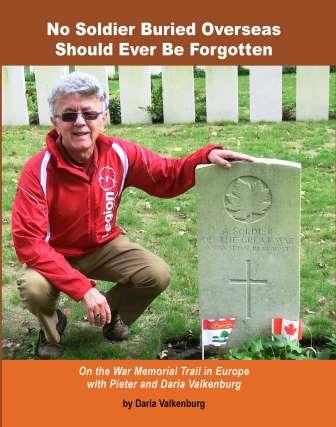 4 countries, 6 weeks, 7,000 km – an unforgettable war memorial journey in Europe…. Daria’s book ‘No Soldier Buried Overseas Should Ever Be Forgotten‘ is available in print and e-book formats. Net proceeds of book sales help support research costs and the cost of maintaining this blog. For more information see https://nosoldierforgotten.com/
You are also invited to subscribe to our YouTube Channel: On The War Memorial Trail With Pieter Valkenburg: https://www.youtube.com/channel/UCJ591TyjSheOR-Cb_Gs_5Kw.
Never miss a posting! Subscribe below to have each new story from the war memorial trail delivered to your inbox.
 On The War Memorial Trail Research Project........ with Pieter and Daria Valkenburg