February 18, 2024. A few years ago, we translated ‘Holtense Canadezen’, Jan Braakman’s book about some of the soldiers buried in the Canadian War Cemetery in Holten, The Netherlands, which was published in English in October 2023 as ‘Holten Heroes: Stories from a Canadian Field of Honour’. (See https://onthewarmemorialtrail.com/2023/11/01/new-book-about-soldiers-buried-in-the-canadian-war-cemetery-in-holten-the-netherlands/)
One very sad story related how 6 newly liberated prisoners of war – 5 Canadians, 1 Australian – died after accepting what turned out to be alcohol containing methanol from liberated Soviet prisoners of war.
The story resonated as my father, who had been in a displaced persons camp in Post-WWII Germany, had told me of similar stories. Refugees who had survived the war, many under brutal conditions, died or became blind after drinking alcohol that contained methanol (methyl alcohol) or alcohol made in containers that had once held gasoline, oil, and other substances. Only a few sips could result in death or permanent disability.
One of the six soldiers, whose story was not told in ‘Holtense Canadezen’, was on the photo wish list from Holten – James ‘Jimmy’ Oliver THOMAS, born July 4, 1912 in St. Peters, Manitoba, the son of Henry ‘Harry’ Curtis James and Margaret Thomas.
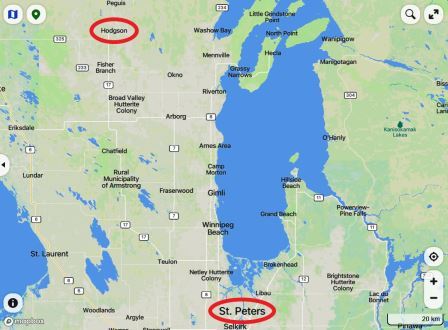
Map shows location of St. Peters and Hodgson in Manitoba. (Map source: http://www.mapcarta.com)
St. Peters was an area familiar to me as childhood summers were spent in Grand Beach on Lake Winnipeg and we travelled often in that direction from Winnipeg, which was just a bit further south.
Jimmy’s parents left St. Peters in the fall of 1912 and moved to Hodgson, where Jimmy grew up with his siblings – 7 brothers and 1 sister.
The Peguis First Nation, whose members are of Ojibway (Saulteaux) and Swampy Cree (Maškēkowak) descent, is nearby, and the Thomas family has its roots here. (See https://en.wikipedia.org/wiki/Peguis_First_Nation)
….Jimmy’s niece provided a photo….

James ‘Jimmy’ Oliver Thomas. (Photo courtesy of the Thomas Family)
In the search for a photo, Pieter was in contact with Theresa Cooper, daughter of Jimmy’s brother, Rodney Thomas, one of two brothers who also served in the Canadian Army during WWII in addition to Jimmy. The photo was emailed to us by Theresa’s son, Rodd Cooper. “…Thank you for your work and recognition in honouring him and the other Canadian soldiers….” Rodd wrote.
….Jimmy was hard-working and versatile….
After his father died in 1925, Jimmy left school at the age of thirteen to help out at home. He spent 6 years working on the family farm, 2 years as a mechanic in a garage in Virden, Manitoba, 6 years in a hard rock quarry in Ontario and Manitoba, plus casual labour wherever he could find work. In his Estate Form, his mother noted that he “…would look for a job anywhere he could make good money…”
By the time Jimmy enlisted at the No. XI District Depot in Vancouver, British Columbia on May 21, 1943, he was working as a plumber’s helper for a plumbing and heating company based in Prince Rupert, British Columbia, in a wartime housing project.
The interviewer for Jimmy’s Personnel Selection Record noted that he had “…above average learning ability….” and that his “…occupational background indicates versatility and adaptability. Has been farmer, garage mechanic, fisherman, and latterly miner…”
The Record went on to describe Jimmy as having a “….robust appearance…” and that he was “…of quiet nature but self-confident and unhurried…”
Among his hobbies and interests, Jimmy “…played hockey. Enjoys hunting and fishing. Can swim. Doesn’t dance. Reads true detective stories. Attends movies…”
….Jimmy’s military career began in British Columbia….
On June 3, 1943, Jimmy was sent for basic training at No. 110 Canadian Army Basic Training Camp (CABTC) in Vernon, British Columbia. After completing basic training, he was transferred to A16 Canadian Infantry Training Camp (CITC) in Calgary, Alberta on August 4, 1943.
At the beginning of October 1943, Jimmy was given a week’s embarkation leave, the last chance he had to visit his family before being sent overseas.
On November 3, 1943, he left Calgary when he was transferred to No. 1 Training Brigade in Debert, Nova Scotia.
On December 15, 1943, Jimmy left Canada for the United Kingdom, arriving on December 21, 1943. He most likely had been on the same ship as Eli Ambrose SNAKE. (See https://onthewarmemorialtrail.com/2021/12/13/on-the-war-memorial-trail-remembering-ww2-soldier-eli-ambrose-snake/) While Jimmy was assigned to No. 1 Canadian Infantry Reinforcement Unit (CIRU), Eli was sent to No. 3 CIRU.
…Jimmy joined the Seaforth Highlanders of Canada in Italy….
On February 19, 1943, Jimmy was sent to Italy as part of the Allied Armies In Italy (AAI) and assigned to the 2 Battalion X-4 Reinforcement. Then, on May 5, 1944, he was transferred to the Seaforth Highlanders of Canada.
The Regiment had finished in Ortona and continued to move north, fighting through the Liri Valley. Next, the Regiment received orders to work with other Regiments to break through the Hitler Line, the Germans’ second defensive line. (See https://en.m.wikipedia.org/wiki/Hitler_Line and https://liri-valley.project44.ca/)
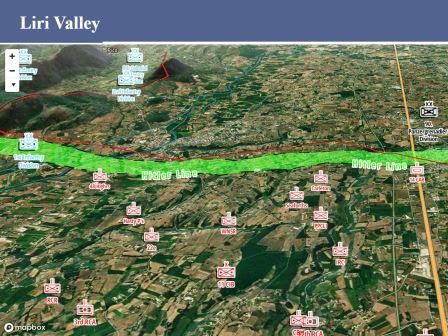
Placement of troops for breaching the Hitler Line on May 23, 1944. (Map source: https://liri-valley.project44.ca/)
On May 22, 1943, the War Diary for the Seaforth Highlanders of Canada recorded that at 4 pm, “…the Commanding Officer received orders from 2 Canadian Infantry Brigade that Seaforth Highlanders of Canada would attack the Adolph Hitler Line… The attack was ordered for 0600 hours 23 May 1944. The PPCLI to attack on right, Seaforths on left, Edmonton Regiment reserve to exploit through PPCLI….” (PPCLI refers to Princess Patricia Canadian Light Infantry.)
A fierce battle occurred the following day. The War Diary recorded that by 7:30 pm “…it was now apparent that the Adolph Hitler Line had been broken. The enemy were in full retreat, jamming the roads with his transport, which provided a good target for our Air Force…”
…Jimmy became a POW during the breaking of the Hitler Line….
The war diary noted that there were many casualties: 51 killed, 110 wounded, and 72 missing. Among the missing was Jimmy Thomas, who became a prisoner of war and taken to Stalag VII-A in Moosburg, Germany, where he was recorded as POW number 131885. (See https://en.wikipedia.org/wiki/Stalag_VII-A and https://www.pegasusarchive.org/pow/S7A/cSt_7A_Description.htm)
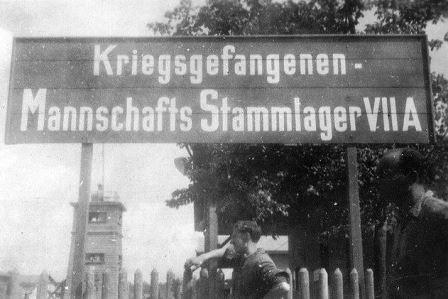
Entrance to Stalag VII-A. (Photo source: Moosburg Online)
Stalag VII-A was captured on April 29, 1945 by Combat Command A of the 14th Armored Division of the US Army. (See https://www.moosburg.org/info/stalag/14theng.html) Jimmy and his fellow POWs couldn’t believe how lucky they were, after all the hardships they had experienced. Reports stated that 110,000 Allied POWs were freed from that camp alone.
The POWs were now free, but with the war still ongoing, it was impossible to evacuate all of them immediately. They were instead moved west in large groups and placed in temporary transit camps while they waited impatiently to be transported out of Germany.
Unfortunately, there were not enough planes to quickly transport them to Reims, France, and from there to England. So they waited for their turn.
…A drink containing methanol proved fatal….
On May 1, 1945, Jimmy was in a temporary camp in Ettringen, Bavaria, Germany, along with other former prisoners of war. A translated excerpt from Jan Braakman’s ‘Holtense Canadezen’ related what happened that day. “…Canadians John Decoine, Robert Consterdine, Joe Giguire, Steven Motkaluk, James Thomas, and Australian Joe Brydon could not believe their luck when they were liberated by the Americans ….. The six met a group of Russian prisoners of war near Ettringen (Bavaria), who apparently had a large amount of liquor at their disposal….”
The men were unaware that they were being offered liquor that contained methanol, which was fatal for all six. “…Captain C.T. Sutherland wrote a report for the Department of National Defence about the incident …. According to him, on May 1, on the street in Ettringen, the Canadians had been given alcohol by members of a Russian labour command. (The prisoner of war camp had numerous labour commands, consisting of prisoners of war of different nationalities)….”
Most likely, the Russians were not aware that the alcohol had been poisoned. “…British prisoner of war Tom Tate, who was captured in Germany in early 1945 after his Royal Air Force bomber was downed, said that Russian prisoners of war had found and binged on methylated spirits on the estate (Ost-Ettringen). He recalled two Russian prisoners of war who died of it and more who had severe symptoms of poisoning….”
…Jimmy died on May 2, 1945….
Captain Sutherland’s report did not include the names of Steve Motkaluk and James ‘Jimmy’ Oliver Thomas, who had both been in Stalag VII-A in Moosburg. They had been taken to the US Hospital in Thannhausen, Germany. Both men died on May 2, 1945.
A medical report for Steven Motkaluk stated that the amount of alcohol he’d drunk was only 1 pint (2 cups). Likely Jimmy had drunk the same amount or less.
The other 4 men had been under the care of British physician John “Sandy” Rutherford, a former prisoner of war himself.
It was a sad ending to soldiers who had endured so much during the war and their time in a POW camp. During the investigation into this incident and others involving the poisoning of Allied soldiers, the Canadian Intelligence Service “…managed to obtain an October 1944 document from the Kriminaltechnisches Institut der Sicherheitspolizei (Forensic Institute of the Security Police), describing the various possibilities of deliberate poisoning. One of these was the addition of methyl alcohol (methanol) to bottled drinks. It is conceivable that the prisoners of war were victims of this practice….”
…The other 5 victims of methanol poisoning….
In addition to Jimmy, the other 5 victims of methanol poisoning were:
· Robert James CONSTERDINE of Vancouver, British Columbia, died May 2, 1945
· John DECOINE of Wabaska, Alberta, died May 1, 1945
· Joseph ‘Joe’ August GIGUIRE of Conklin, Alberta, died May 3, 1945
· Steven MOTKALUK, of Toronto, Ontario, but born in Lviv, Ukraine, died May 2, 1945
· Joseph ‘Joe’ William BRYDON of Tenterfield, New South Wales, Australia, died May 2, 1945
….Jimmy is buried in the Canadian War Cemetery in Holten….
Along with Steven Motkaluk, Jimmy was initially buried in the US Military Cemetery in Reutti, Germany, before being reburied in the British Military Cemetery in Durnbach, Germany. Then, on June 4, 1948, they were reburied in the Canadian War Cemetery in Holten, The Netherlands.

Grave of James ‘Jimmy’ Oliver Thomas in the Canadian War Cemetery in Holten, The Netherlands. (Photo source: Canadian Virtual War Memorial)
…..Jimmy is listed on the National Métis Veterans Memorial Monument….
Jimmy is listed on the National Métis Veterans Memorial Monument just outside of Batoche, Saskatchewan. (See https://www.metismuseum.ca/metisveteransmonument/)
His name can be found on Column 8 on the outside, Row 67. (https://www.metismuseum.ca/metisveteransmonument/column.php?v=XCHRVC)
….Thomas Esker in northern Manitoba is named in Jimmy’s honour…..

Thomas Esker is named in honour of James ‘Jimmy Oliver Thomas. (Map source: http://www.mapcarta.com)
Thomas Esker in northern Manitoba, east of Tadoule Lake, was named after Jimmy in 1995. This mountain has an elevation of 246 metres (807 feet). (See https://mapcarta.com/24676318)
Thank you to Theresa and Rodd Cooper for providing a photo of James ‘Jimmy’ Oliver Thomas, to Shawn Rainville for helping with the initial newspaper search for family and information, to Judie Klassen for finding the geographic commemoration in ‘A Place Of Honour’, and to Jan Braakman for researching the May 1, 1945 incident in which 6 men lost their lives.
Do you have photos or information to share? Email Pieter at memorialtrail@gmail.com, or comment on the blog.
© Daria Valkenburg
….Want to follow our research?….
If you are reading this posting, but aren’t following our research, you are welcome to do so. Our blog address: https://onthewarmemorialtrail.com/
 4 countries, 6 weeks, 7,000 km – an unforgettable war memorial journey in Europe…. Daria’s book ‘No Soldier Buried Overseas Should Ever Be Forgotten‘ is available in print and e-book formats. Net proceeds of book sales help support research costs and the cost of maintaining this blog. For more information see https://nosoldierforgotten.com/
You are also invited to subscribe to our YouTube Channel: On The War Memorial Trail With Pieter Valkenburg: https://www.youtube.com/channel/UCJ591TyjSheOR-Cb_Gs_5Kw.
Never miss a posting! Subscribe below to have each new story from the war memorial trail delivered to your inbox.


Daria,
Your true stories are simultaneously heartwarming and disconcerting. You are doing great work. I cannot commend you enough to continue with it!
LikeLike
Thank you for your kind words, Jan. You made my day! Daria
LikeLike
How terribly sad for these men and their families.
LikeLike
It was indeed a tragedy, after surviving the war and being on the brink of returning safely home. Daria and Pieter
LikeLike