September 23, 2023. After researching the story of WWII pilot Elmer Bagnall MUTTART of Cape Traverse, who sacrificed his life in order to save his crew and the Dutch village of Wons after his Halifax bomber was fatally targeted by a nightfighter on October 12, 1941, seeing an actual Halifax bomber plane was on Pieter’s bucket list.
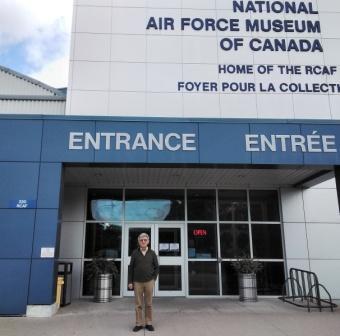
Pieter outside the National Air Force Museum of Canada in Trenton, Ontario. (Photo credit: Daria Valkenburg)
…Pieter crossed an item off his bucket wish list!…
Pieter’s wish became a reality earlier this month when we travelled to the National Air Force Museum of Canada in Trenton, Ontario. Elmer Muttart and his crew of Halifax L9561 were among the first to fly in the new Halifax bomber, Mark I. The one in Trenton was a Mark VII, which had many modifications to make it safer.

Pieter by the Mark VII Halifax bomber. (Photo credit: Daria Valkenburg)
…The Halifax bomber was very versatile, once the initial design flaws were corrected…
Although designed during WWII, the original Halifax was intended for daytime flights – a foolish decision on the part of the British Ministry of Defence, given that there was nothing wrong with the eyesight of German pilots.
It quickly became clear that sorties needed to be done at night. However, flames from the exhaust emitted a red glow, making the bombers easy to spot by German pilots. A cost-cutting measure by the Ministry of Defence resulted in using engines that were NOT recommended for the heavy Halifax bomber. This meant that the bombers were slower than other planes, such as the Lancaster, and could not reach higher altitudes. They were ‘sitting ducks’ and there were many losses of planes and airmen that could have been avoided had the safety of airmen been top of mind.
Later models of the bomber, such as the Mark VII we toured, had these issues corrected, and our tour guide, Tim Whitehouse, an RCAF veteran, explained that the Halifax was beloved by the RCAF. “…5,797 were built over the years, along with 7,374 Lancasters...”
The RCAF found that the Halifax bomber was very versatile. “…They were flown by Bomber Command, Coastal Command, and 100 Group…” We’d not heard of 100 Group before. “…This was the electronic countermeasures group. For example, they jammed German radar….”
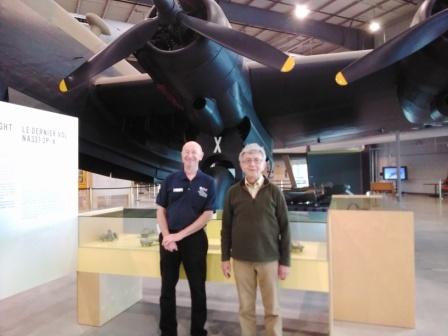
Pieter with our guide, Tim Whitehouse, beside the Halifax Bomber we toured. (Photo credit: Daria Valkenburg)
…The outside of the plane was huge …
We didn’t know what to expect, but the overwhelming sense we got was just how BIG the Halifax bomber was when we saw it inside the museum building. Huge on the outside, it was quite cramped and narrow once you got inside.

The tail turret in the foreground, but take a look at the step-stool, which shows where we entered the plane, and the small entry way. Can you imagine doing that while carrying a parachute and in a flight suit? (Photo credit: Daria Valkenburg)
…Getting into the plane required agility …
Getting into the plane was a challenge. How air crew did it in woolen flight suits and carrying their parachutes and other gear is a testament to their agility! There was a tiny entrance near the bottom of the plane which we had to crawl through.
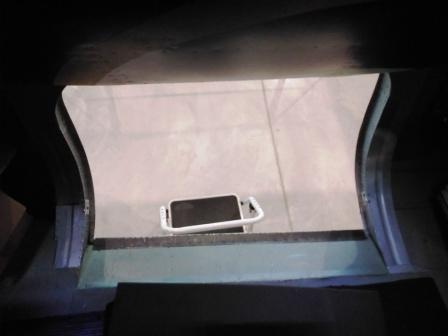
This is the small space from which we entered and exited the plane. (Photo credit: Daria Valkenburg)
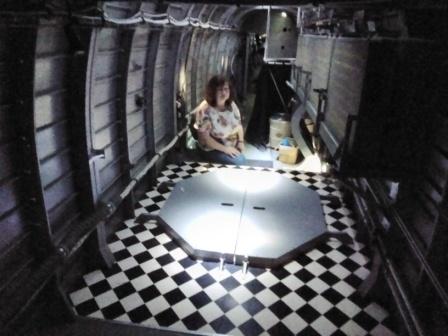
Once I got into the plane, I found that I was not agile enough to tour the cockpit or the rear gunner areas. The flash of light at the bottom right is the entrance! The hexagonal shape was used to drop off secret agents behind the front. (Photo credit: Tim Whitehouse)
With help, I was able to get into the plane, but was unable to manage the steep step up to get into the cockpit area. So I sat in the belly of the plane and had a nice rest. We asked Tim what the hexagonal shape was, as it looked like an escape hatch.
Tim explained that this feature was not in the early versions of the Halifax bomber, but was added later. It wasn’t an escape hatch like we thought, but we weren’t too far wrong. It was an exit out of the plane, used to drop off secret agents behind the front!
…Pieter in the pilot’s seat was a dream come true …
While I sat, Pieter and Tim continued the tour, beginning with the cockpit area.
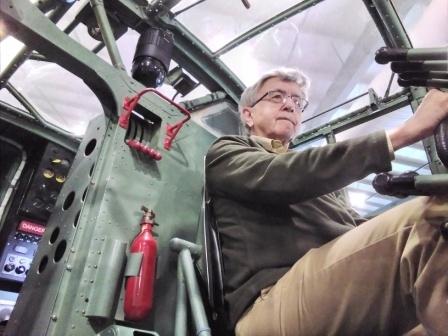
Pieter in the pilot’s seat of a Halifax bomber! (Photo credit: Tim Whitehouse)
It was an emotional moment when Pieter sat in the pilot’s seat. “…I was overwhelmed by the instruments and how complex it was to operate this heavy plane with no computers….”
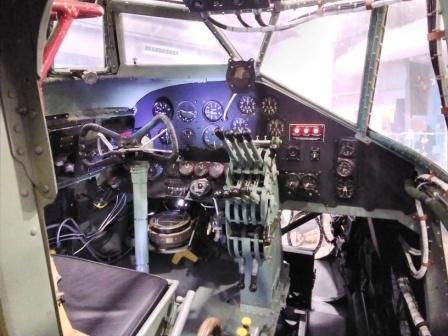
The pilot’s control panel in the Halifax bomber. (Photo credit: Tim Whitehouse)
He kept thinking about the young men that flew these planes. “…45% made the ultimate sacrifice in the first years of the war...” he told me. But oh, how he wished that the plane still flew! Luckily, the tour was the next best thing.
… ‘Where’s the ignition switch?’I asked …
After seeing what the control panel looked like, I asked him where the pilot turned the key into the ignition, as I didn’t see one. OK, obviously I’ve never been in the cockpit of a plane, as I soon learned there is no key! Starting a plane as complex as a Halifax bomber was not an easy task, and required each engine to be started separately, with a lot of steps that had to occur before that.
For a sense of what is involved, you can watch this short video on the Halifax Bomber – Engine Start Sequence:
… Several crew members sat BELOW the pilot …
Pieter next toured the area BELOW the pilot where the navigator had his table and charts. The wireless operator sat directly under the pilot. The flight engineer sat behind the pilot and the bomb aimer also sat below past the navigator in the nose of the plane.

The small window at the top was where the pilot sat. The windows below indicate where other crew members sat. (Photo credit: Daria Valkenburg)
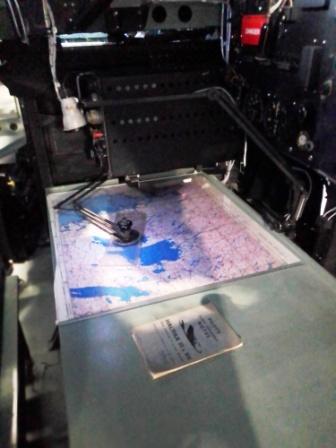
The table used by the navigator, in the level below where the pilot and co-pilot sat. (Photo credit: Pieter Valkenburg)
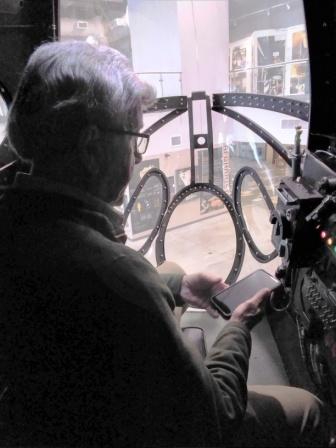
The bomb aimer also sat in the level below the pilot and co-pilot. This ‘bomb aimer’ got distracted! (Photo credit: Tim Whitehouse)
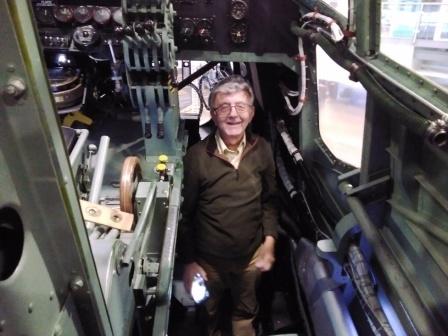
Pieter coming out of the bomb aimer’s position. The pilot’s seat is to the left. (Photo credit: Tim Whitehouse)
… The rear gunner sat in the tail turret …
After touring the front of the plane, Pieter moved to the back of the plane where the rear gunner sat in the tail turret, with the guns in front of him.

The rear gunner control panel. (Photo credit: Tim Whitehouse)

Pieter in the rear gunner’s seat. (Photo credit: Tim Whitehouse)
… There were no ejection seats if you needed to quickly exit the plane …
We could only wonder at the bravery of the aircrew and marvel at Elmer Muttart’s piloting skills that he was able to keep a burning plane steady enough for the crew to safely exit on October 12, 1941– at night and while under attack. There were no ejection seats! There were several escape hatches on the plane, but normally the crew left the same way we did – through that little trap door! The rear gunner had an alternate escape hatch through the window of the tail turret.
We were reluctant to leave the plane, but all good things come to an end, and our adventure as Halifax bomber crew members left us with an even deeper respect for those brave men who flew during the war.
Thank you to our excellent tour guide, Tim Whitehouse, for making the experience so memorable, and to the National Air Force Museum of Canada for allowing tours of the plane.
Do you have a story to tell? Pieter encourages you to email him at memorialtrail@gmail.com, comment on the blog, or tweet to @researchmemori1.
© Daria Valkenburg
…Previous stories about aircrew who lost their lives in a Halifax bomber….
- Rowan Charles FITZGERALD of Halifax W1175: https://onthewarmemorialtrail.com/2022/10/12/on-the-war-memorial-trail-well-never-forget-uncle-bunky/
- William Andrew HOOD of Halifax JD215: https://onthewarmemorialtrail.com/2023/09/19/on-the-war-memorial-trail-the-wwii-airman-from-bras-dor-who-was-aboard-the-last-flight-of-halifax-jd215/
- Jack ‘Douglas’ MACKENZIE of Halifax DT630: https://onthewarmemorialtrail.com/2023/02/19/on-the-war-memorial-trail-the-wwii-pilot-killed-at-the-controls-of-his-halifax-bomber/
- Elmer Bagnall MUTTART of Halifax L9561: https://onthewarmemorialtrail.com/2017/07/28/the-elmer-bagnall-muttart-story/ and https://onthewarmemorialtrail.com/2019/11/18/on-the-war-memorial-trail-the-memorial-panel-in-wons-is-unveiled/) and https://onthewarmemorialtrail.com/2020/01/31/he-died-that-we-might-live-video-is-now-on-youtube/ and https://onthewarmemorialtrail.com/2019/10/15/on-the-war-memorial-trail-the-visit-to-harlingen-general-cemetery/
…Want to follow our research?…
If you are reading this posting, but aren’t following our research, you are welcome to do so. Our blog address: https://onthewarmemorialtrail.com/
 4 countries, 6 weeks, 7,000 km – an unforgettable war memorial journey in Europe…. Daria’s book ‘No Soldier Buried Overseas Should Ever Be Forgotten‘ is available in print and e-book formats. Net proceeds of book sales help support research costs and the cost of maintaining this blog. For more information see https://nosoldierforgotten.com/
Subscribe to our YouTube Channel: On The War Memorial Trail With Pieter Valkenburg: https://www.youtube.com/channel/UCJ591TyjSheOR-Cb_Gs_5Kw.
Never miss a posting! Subscribe below to have each new story from the war memorial trail delivered to your inbox.
 On The War Memorial Trail Research Project........ with Pieter and Daria Valkenburg
Keep up the great work, Pieter and Daria! Your passion for researching our fallen and maintaining this blog is inspiring.
LikeLike
Thank you for your kind words, Jim. The more we learn, the deeper our respect and gratitude to those who have served and continue to serve. …Pieter and Daria
LikeLike
Daria and Pieter,
I loved this post.
LikeLike
We’re glad you enjoyed the post, Mary Ann. It was a humbling experience to think of all those who willingly flew during the war, never knowing if they would safely return to base. … Daria and Pieter
LikeLike