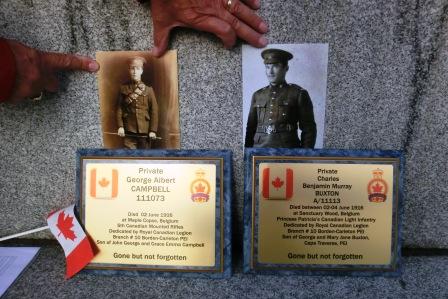
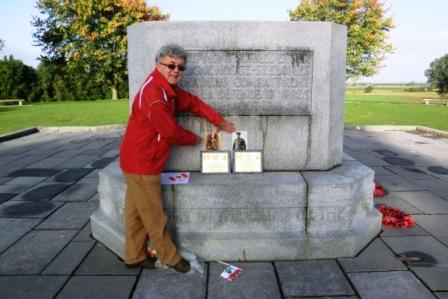
December 8, 2017. After visiting the Sanctuary Wood Cemetery, we stopped at the Battle of Mount Sorrel Monument, honouring the 15th Canadian Infantry at Observatory Ridge. We had noticed this monument only because of a torn Canadian flag beside it! We learned that the plaque was unveiled on October 22, 2011 before Canadian and Belgian dignitaries by members of the 15th Battalion Memorial Project.

Battle of Mount Sorrel Monument, honouring the 15th Canadian Infantry at Observatory Ridge. (Photo credit: Pieter Valkenburg)
While no one on the Cenotaph outside the Borden-Carleton Legion was in the 15th Canadian Infantry, these soldiers were in the thick of things during the Battle of Mount Sorrel, in which George Albert Campbell and Charles Benjamin Murray Buxton lost their lives.
Buxton’s story was told in previous blog entries, and this blog entry is to tell what little we know about George ‘Albert’ CAMPBELL and how he lost his life.

Private George Albert Campbell. (Photo courtesy of Gerald Tingley family collection)
Albert was born on July 8, 1895 in Wellington, PEI, the son of John George Campbell and Grace Emma, nee Barlow. A fisherman and farmer before enlisting on April 6, 1915 with the 6th Canadian Mounted Rifles, he later transferred to the 5th Canadian Mounted Rifles.
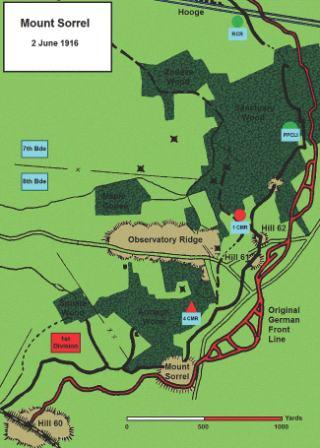
During the Battle of Mount Sorrel, the 5th Canadian Mounted Rifles were in a supporting position, occupying the strongpoint, dugouts, and trenches in Maple Copse and Zillebeke area, as noted in ‘With The Patricia’s In Flanders 1914-1918 Then & Now’ by Stephen K. Newman.
Newman goes on to explain in his book that “….the 5th Canadian Mounted Rifles in Maple Copse held on despite heavy shelling that flattened the entire wood and made their old trenches untenable. They waited for the reinforcements from 2nd Canadian Mounted Rifles and the 9th Brigade. The two eighteen pounder sacrifice guns of the 5th Battery Canadian Field Artillery hidden in the southern part of Sanctuary Wood did their job to the last man and were overrun. The German success depended on their bulling through the Patricia line and moving the 5th Canadian Mounted Rifles out of Maple Copse….”
Albert was in the midst of this battle, as a member of the 5th Canadian Mounted Rifles. According to the Canadian War Graves Register Circumstances of Death, he was killed in action in the vicinity of Maple Copse.
The War Diary of the unit for June 2, 1916 notes: “…A red letter day in the history of the battalion ever to be remembered by those who lived through it. The battalion went into the line in the night of the 31st of May /1st of June occupying a position in Brigade support at Maple Copse.
‘A’ company and two platoons of ‘B’ company at Maple Copse. Nothing of importance occurred until the morning of the 2nd of June when at about at 8.30 a.m., the enemy began a very heavy bombardment of the frontline and all the ground at Maple Copse and vicinity. Heavy bombardments continued till noon on the 3rd and continued again after 6 p.m…”
Unfortunately, Albert has no known grave, and his name is therefore listed on the Menin Gate Memorial. It’s quite likely, however, that he might be buried in Maple Copse Cemetery in an unknown grave.
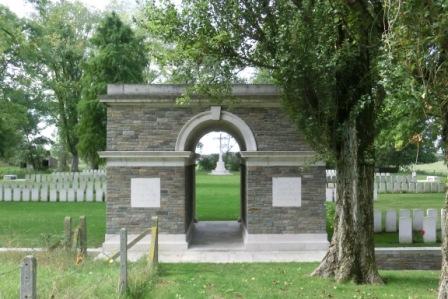
Entrance to Maple Copse Cemetery. (Photo credit: Pieter Valkenburg)
Maple Copse was the name used by the British Army for a small plantation east of Zillebeke and just west of Sanctuary Wood. It was used by medical staff as a dressing station, and burials took place here both before and after the Battle of Mount Sorrel.
The cemetery was destroyed by shellfire during the Battle of Mount Sorrel and when fighting resumed afterwards, with the gravestones destroyed and ending up in the rubble. Of 256 named graves that were known to exist, only 26 could be definitely located. Perhaps Albert is in one of these. Of the 256 graves, 114 had soldiers from the United Kingdom and 142 from Canada.
Like he did with Buxton at the Sanctuary Wood Cemetery, Pieter put Canadian flags on 4 unknown graves from a Canadian Regiment, and then placed a PEI flag on one of these in memory of George ‘Albert’ Campbell.
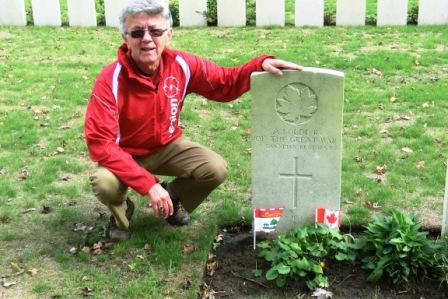
Pieter by the grave of an unknown soldier from a Canadian regiment at Maple Copse Cemetery. (Photo credit: Daria Valkenburg)
With the advances in DNA research, perhaps one day there will be the possibility to find out who the unknown soldiers are in Maple Copse and Sanctuary Wood cemeteries. Wouldn’t that be a genealogical project to get involved with?
Unfortunately, we have very little information about his life prior to enlistment, but are grateful for the photo of Albert sent by a distant relative, Gerald Tingley. If anyone has more information or photos, please help us honour Albert’s memory by sharing them. (For previous blog entries that have mentioned Albert, see A Daytime Visit To Menin Gate Memorial in Ypres and A Visit To Sanctuary Wood.)
There are two Campbells on the Cenotaph outside the Borden-Carleton Legion, one who died and one who survived, but with injuries. George ‘Albert’ Campbell had a younger brother, William Galen CAMPBELL, born June 16, 1897 in Wellington, who enlisted on April 22, 1916 with the 5th Siege Battery as a gunner, shortly before his older brother died. He later transferred to the 8th Siege Battery of the 3rd Brigade Canadian Garrison Artillery, and was poisoned by a mustard gas shell, during action near Lievin (Pas de Calais) in France on May 28, 1918.
The war diary of the 8th Siege Battery tersely noted what happened to the unit:
“27 May 1918: Intense gas bombardment on Lievin and many gas shells fell around Thelus and vicinity.
28 May 1918: Twenty nine other ranks of Lievin section admitted to hospital, gassed.
29 May 1918: Capt. Cunningham, Lt Messeray and 39 other ranks of Lievin section to hospital, gassed.”
Unlike his brother Albert, William Galen survived and married Ida May McNally on January 5, 1919. On April 14, 1919 he was discharged from military service. He passed away on April 24, 1954 in Charlottetown and is buried in the cemetery at the Free Church of Scotland in Cape Traverse. We have no photo or further information on William Galen Campbell.

Grave of William Galen Campbell in the cemetery of the Free Church of Scotland in Cape Traverse. (Photo credit: Pieter Valkenburg)
While our visit to Maple Copse Cemetery ended our Belgian visit to graves and memorials for the names on the Cenotaph outside the Borden-Carleton Legion, we were interested in visiting some of the other memorials in the area. So, in the next blog entry, we will continue on the war memorial trail in Belgium.
Comments or stories? You can share them by emailing us at memorialtrail@gmail.com or by commenting on this blog.
© Daria Valkenburg
….Want to follow our research?….
If you are reading this posting, but aren’t following our research, you are welcome to do so. Our blog address: https://onthewarmemorialtrail.com/
 4 countries, 6 weeks, 7,000 km – an unforgettable war memorial journey in Europe…. Daria’s book ‘No Soldier Buried Overseas Should Ever Be Forgotten‘ is available in print and e-book formats. Net proceeds of book sales help support research costs and the cost of maintaining this blog. For more information see https://nosoldierforgotten.com/
You are also invited to subscribe to our YouTube Channel: On The War Memorial Trail With Pieter Valkenburg: https://www.youtube.com/channel/UCJ591TyjSheOR-Cb_Gs_5Kw.
Never miss a posting! Subscribe below to have each new story from the war memorial trail delivered to your inbox.


 On The War Memorial Trail Research Project........ with Pieter and Daria Valkenburg