On The War Memorial Trail….2025 Faces of Holten Exhibition Part 5: Indigenous Soldiers

September 10, 2025.  Pieter Valkenburg has been involved in finding photos of Canadians who are buried in all three Canadian War Cemeteries in The Netherlands since 2014, with stories of many soldiers told on this blog. 

While in The Netherlands and Belgium for the 80th Anniversary of Liberation Commemoration events, he placed flags at the graves of 383 soldiers in 14 cemeteries. At the Canadian War Cemetery in Holten, The Netherlands, flags were placed at 156 graves. Our visit coincided with The 2025 Faces Of Holten Exhibition, which ran for three weeks in May.

—-Recap…..

In Part 1, the graves and photos of soldiers who were killed near Posterenk in April 1945 were featured. (See https://onthewarmemorialtrail.com/2025/08/24/on-the-war-memorial-trail-2025-faces-of-holten-exhibition-part-1-soldiers-killed-near-posterenk/)

In Part 2, the graves and photos of two soldiers whose names are listed on the Cenotaph outside the Borden-Carleton Legion were featured. (See https://onthewarmemorialtrail.com/2025/08/29/on-the-war-memorial-trail-2025-faces-of-holten-exhibition-part-2-the-soldiers-listed-on-the-cenotaph-in-borden-carleton/)

In Part 3, the graves and photos of soldiers killed in vehicle accidents were featured. (See https://onthewarmemorialtrail.com/2025/09/01/on-the-war-memorial-trail-2025-faces-of-holten-exhibition-part-3-soldiers-killed-while-travelling-in-vehicles/)

In Part 4, the graves and photos of soldiers who lost their lives in the Battle of Leer during Operation Duck were featured. (See https://onthewarmemorialtrail.com/2025/09/04/on-the-war-memorial-trail-2025-faces-of-holten-exhibition-part-4-soldiers-who-drowned-during-operation-duck/)

…8 Indigenous soldiers are commemorated…

Now, in Part 5, the graves and photos of 8 Indigenous soldiers, whose stories have previously been told on this blog, are featured.

Grave of John Culbertson. (Photo credit: Daria Valkenburg)

John CULBERTSON was born in Oshawa, Ontario, and grew up on the Tyendinaga Mohawk Territory near Belleville, Ontario. While serving with the Royal Canadian Engineers, he was killed in Germany on April 30, 1944 during the Battle of Edewecht, aged 33. You can read his story at https://onthewarmemorialtrail.com/2023/02/04/on-the-war-memorial-trail-remembering-ww2-sapper-john-culbertson/

Grave of William ‘Willie’ Daniels.  (Photo credit: Daria Valkenburg)

William ‘Willie’ DANIELS, from the Big River Reserve in Depton, Saskatchewan, was serving with the Royal Winnipeg Rifles when he was killed, aged 20, on April 22, 1945 as troops moved through Appingedam in The Netherlands at the very beginning of the Battle of the Delfzijl Pocket. You can read his story at https://onthewarmemorialtrail.com/2021/07/23/on-the-war-memorial-trail-remembering-ww2-soldier-william-willie-daniels/
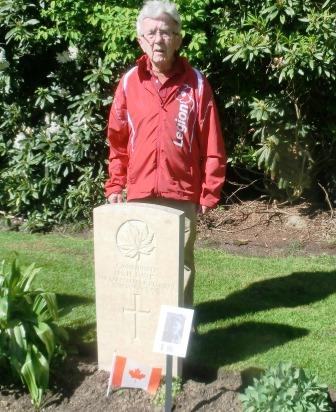
Pieter by the grave of Harry Henry Davis. (Photo credit: Daria Valkenburg)

Harry Henry DAVIS, from Selkirk, Yukon Territory, was serving with the Lake Superior Regiment (Motor) when he died in The Netherlands, aged 23, on January 15, 1945 from wounds received the day before after being shot while on patrol east of Kerkdriel.  You can read his story at https://onthewarmemorialtrail.com/2023/09/30/on-the-war-memorial-trail-the-only-yukon-territory-soldier-buried-in-holten/

Grave of Stanley Owen Jones. (Photo credit: Daria Valkenburg)

Stanley Owen JONES, from Massett, British Columbia, drowned on September 8, 1945 in Germany when the carrier he was in overturned in a ditch, while serving with the Canadian Scottish Regiment, aged 20. You can read his story at https://onthewarmemorialtrail.com/2022/09/05/on-the-war-memorial-trail-remembering-wwii-soldier-stanley-owen-jones/

Grave of Philip Laforte. (Photo credit: Daria Valkenburg)

Philip LAFORTE, born in Lac du Bonnet, Manitoba, was serving with the Royal Winnipeg Rifles when he was killed on April 7, 1945 in The Netherlands, aged 33, as the Regiment crossed the Schipbeek, in order to establish a bridgehead as preparation for an assault on the city of Deventer by the 7th Canadian Brigade. You can read his story at https://onthewarmemorialtrail.com/2022/03/22/on-the-war-memorial-trail-remembering-ww2-soldier-philip-laforte/

Grave of Sanford Steven Saulis.  (Photo credit: Pieter Valkenburg)

Sanford Steven SAULIS, from Maliseet, New Brunswick, died of a brain hemorrhage in The Netherlands on August 10, 1945, aged 30, while serving with the 16th Field Company of the Royal Canadian Engineers. You can read his story at https://onthewarmemorialtrail.com/2023/02/27/on-the-war-memorial-trail-remembering-sanford-steven-saulis/
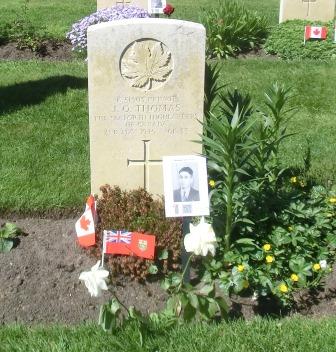
Grave of James ‘Jimmy’ Oliver Thomas. (Photo credit: Daria Valkenburg)

James ‘Jimmy’ Oliver THOMAS, born in St. Peters, Manitoba, died in Germany on May 2, 1945, aged 33, a few days after being liberated from the Stalag VII-A POW Camp in Moosburg, Germany. He had been taken prisoner of war on May 22, 1943, while serving with the Seaforth Highlanders of Canada, during the breaking of the Hitler Line. You can read his story at https://onthewarmemorialtrail.com/2024/02/18/on-the-war-memorial-trail-the-wwii-soldier-from-manitoba-who-died-shortly-after-being-liberated-from-stalag-vii-a/

After sending photos of the grave to Rodd Cooper, great-nephew of Jimmy Thomas, he wrote us to say “  I just wanted to express my infinite gratitude to you and your family on behalf of myself and my family for the work and the time you have invested in gathering the information not only for my resting family member but for the numerous others as well. 

The honour and respect you have brought and given to these men cannot be measured.  The gift that you have given my family and I is profound and we truly can’t thank you enough.  

Because of your work and dedication, my family and the future generations of my family, will be able to pay the respect to my Great Uncle Jimmy for his service and sacrifice by remembering him and telling his story.  

The gift you have given us is immeasurable.

On behalf of myself and the Thomas Family, Thank You….” 

We were immeasurably touched by his kind words. Pieter replied, saying that “…it’s important that we never forget the soldiers….and the families… who sacrificed so much for our ongoing freedom.  I’m grateful that the country of my birth continues to remember and honour their Allied liberators….” 
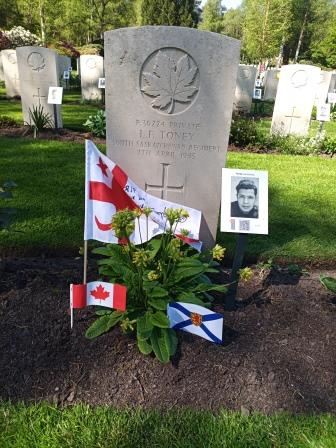
Grave of Leo Francis Toney. (Photo credit: Pieter Valkenburg)

Leo Francis TONEY, born in Wolfville, Nova Scotia, was serving with the South Saskatchewan Regiment, when he was killed on Saturday, April 7, 1945, aged 21, while trying to cross the Schipbeek in The Netherlands at  a bridgehead that had been formed at a weir on the border of the municipalities of Bathmen and Holten. You can read his story at https://onthewarmemorialtrail.com/2021/05/22/on-the-war-memorial-trail-remembering-ww2-soldier-leo-francis-toney/

After sending a photo of the grave to Della Maguire, niece of Leo Toney, she wrote to say “…thank you so much, I looked at that picture all day. I am so grateful…

Pieter holds onto the personalized Lnu flag from the Toney family at the grave of Leo Francis Toney. (Photo credit: Daria Valkenburg)

….All of the flags placed at graves were donated…

All of the flags placed at graves were donated.  Our thanks go to: 

  • Alan Waddell, Constituent Assistant, on behalf of Heath MacDonald, MP for Malpeque, for the Canadian flags.
  • Armel ‘Mel’ Lanteigne, President of the Caraquet Legion in New Brunswick for the New Brunswick flag.
  • Kyle Graham, Research Officer, Military Relations, Nova Scotia Intergovernmental Affairs, on behalf of Premier Tim Houston, Province of Nova Scotia, for the Nova Scotia flag.
  • Don Coutts on behalf of the Muttart and Coutts families in memory of Flight Sergeant Elmer Bagnall Muttart for the Ontario flag.
  • Wayne Ewasko, MLA for Lac Du Bonnet, Manitoba, Interim Leader of the Official Opposition, Province of Manitoba, for the Manitoba flag.
  • Della Maguire on behalf of the Toney/Smith Family in memory of Pte Leo Toney for the Lnu (Mi’kmaw) flag.
  • Conrad Saulis in memory of Sapper Sanford Steven Saulis, courtesy of Grand Chief Ron Tremblay, for the Wolastoqey Nation flag

Thank you to Rodd Cooper and Della Maguire for their heartfelt and kind words.  The comments we’ve received from families as we’ve shared photos showing how their loved ones were honoured during the commemoration events made all the hard work of visiting the cemeteries and placing flags worthwhile.

The 2025 Faces of Holten Exhibition concludes with Part 6, where the graves of a few of the many soldiers killed in The Netherlands and Germany will be featured as we continue with our 2025 European War Memorial Tour.

Pieter encourages readers with photos to come forward so that eventually all the known graves of Canadians buried in Holten will have a photo displayed by their grave. Email him at memorialtrail@gmail.com.

© Daria Valkenburg

….Want to follow our research?…

If you are reading this posting, but aren’t following our research, you are welcome to do so.  Our blog address: https://onthewarmemorialtrail.com/
4 countries, 6 weeks, 7,000 km – an unforgettable war memorial journey in Europe…. Daria’s book ‘No Soldier Buried Overseas Should Ever Be Forgotten‘ is available in print and e-book formats.  Net proceeds of book sales help support research costs and the cost of maintaining this blog. For more information see https://nosoldierforgotten.com/

Subscribe to our YouTube Channel: On The War Memorial Trail With Pieter Valkenburg: https://www.youtube.com/channel/UCJ591TyjSheOR-Cb_Gs_5Kw

Never miss a posting!  Subscribe below to have each new story from the war memorial trail delivered to your inbox.
On The War Memorial Trail….. The WWII Soldier From Barney’s River Who Lost His Life During The Battle of Groningen

April 12, 2024.  One of the biases faced by many soldiers during the war was the perception that an excellent education would result in an intelligent and capable leader of those in battle.  This was not always the case, unfortunately, and often an otherwise obvious candidate for promotion into an officer rank was not chosen, solely based on his early educational background.

In researching the story of Joseph Taylor MACLEOD of Barney’s River, Nova Scotia, Pieter encountered a well-respected, capable, and intelligent man, who was rightfully promoted several times.  However, due to having left school after completing Grade 5, he did not rise as high in rank as he might have if he had been a high school graduate.  What he did achieve during his military service is a testament to what can happen when promotions are based on merit.

….Joseph enlisted with The Pictou Highlanders….

Screenshot 2024-03-22 at 12-32-28 Avondale Station

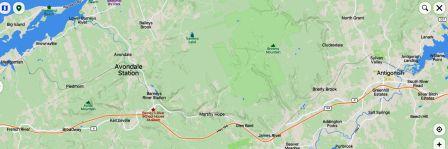
Map shows Avondale Station, Nova Scotia, where Joseph Taylor MacLeod was born.  (Map source: http://www.mapcarta.com)

Born November 11, 1914 in Avondale Station, Pictou County, Nova Scotia, Joseph Taylor MACLEOD was the son of Robert and Ella Margaret MacLeod. He was the youngest in his family and had 5 brothers and 1 sister.  Two of his brothers also served during WWII.

When Joseph enlisted with The Pictou Highlanders in Mulgrave, Nova Scotia on August 5, 1940, he was married and living in Barney’s River, Nova Scotia.  He had left school at age 13, after completing Grade 5, and was working as a tallyman in a sawmill for Robert Gillis.  He’d also worked as a truck driver for his father, a butcher, for several years.

His Personnel Selection Record noted that Joseph enjoyed playing baseball, hockey, and softball, and liked to read about history.

….Joseph’s son Cyril provided a photo….

On September 10, 1935, Joseph had married Irene Elizabeth McGregor and they had 4 children.  One son, Cyril Raymond, kindly provided a photo of his father when Pieter contacted him.

Joseph Taylor MacLeod van zoon Cyril MacLeod

Joseph Taylor MacLeod.  (Photo courtesy of Cyril MacLeod)

….Joseph was in the Intelligence Section of The Pictou Highlanders….

After completing basic training, Joseph took advantage of training opportunities, such as a chemical warfare course in January 1941 in Long Branch, Nova Scotia. He qualified as a Motorcyclist Class III on May 5, 1941.  On October 6, 1941, he was promoted to Lance Corporal, and was assigned to the Intelligence Section under Major Manning, Intelligence Officer for The Pictou Highlanders, in Dartmouth, Nova Scotia.

A month later, he was promoted to Lance Corporal, and then, in April 1942 to Corporal.  On June 1, 1942 he was promoted again, to Lance Sergeant.  All this time he worked in the Intelligence Section of The Pictou Highlanders.

….Joseph was temporarily assigned overseas….

On June 2, 1942, Joseph was sent overseas as a NCO (Non-Commissioned Officer), serving as Acting Platoon Sergeant with the Seaforth Highlanders of Canada until September 21, 1942.  He was then posted to the NETC (Non-Effective Transit Depot) until October 7, 1942, when he was transferred back to Canada.

On November 1, 1942, he returned to The Pictou Highlanders and was sent to the No. 6 District Depot in Halifax, Nova Scotia, before being transferred to Sussex Camp in Sussex, New Brunswick.

On March 16, 1943, he was sent to Newfoundland as Acting Platoon Sergeant.  He continued taking training, completing a Junior Leaders Course in Gander from May to June 1943.

Joseph’s lack of higher education, which was attributed to the distance he lived from school, would eventually hinder his chances at further promotion.  While in Newfoundland he was recommended for a commission – which would mean he would become an officer – but his education level “…spoiled his chances…” according to his Personnel Selection Record.

On August 22, 1943, he returned from Newfoundland and was assigned to Debert, Nova Scotia.  Upon his return, Joseph had been told that his rank as Acting Platoon Sergeant was to be confirmed, but then bad luck intervened when the 7th Division was disbanded. 

On October 1, 1943, Joseph was sent to No. 1 Transit Camp in Windsor, Nova Scotia, in preparation for overseas service.

….Joseph left Canada for overseas service….

On November 26, 1943, Joseph left Canada for the United Kingdom, arriving on December 1, 1943, and assigned to No. 7 Canadian Infantry Reinforcement Unit (CIRU).  He arrived in the United Kingdom as Lance Sergeant, but was then reduced to Corporal.

In a December 14, 1943 interview to update his Personnel Selection Record, the interviewer noted that Joseph felt “…somewhat let down by the non-confirming of his rank in Canada, in view of his long and varied service and qualifications, but has decided to take it philosophically…

A listing of qualifications noted that Joseph qualified as a Driver I/C (Driver, internal combustion), and Motorcyclist Class III (MCIII), Assistant Quartermaster Instructor (AIQI), and Chemical Warfare Q2.

The Personnel Selection Record continued by recording that Joseph “…liked his work with Intelligence Section Pictou Highlanders, but could not carry rank of Lance Sergeant there, so was obliged to become Acting Platoon Sergeant…

On March 22, 1944, with the rank of Corporal, Joseph was transferred to the North Nova Scotia Highlanders.  In May 1944, he requested to revert to the rank of Private. 

Joseph remained with the North Novies in the United Kingdom until July 24, 1944, when he was sent to France as part of the 21st Army Group.  Now a Private, he was transferred to the Royal Hamilton Light Infantry (nicknamed The Rileys) on July 27, 1944.

….Joseph was wounded during the Battle for Clair Tizon….

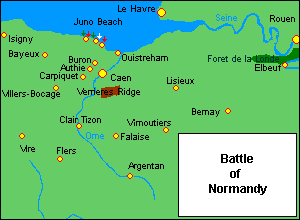
Clair Tizon

Map with location of Clair Tizon. (Map source: http://www.canadiansoldiers.com)

On August 12, 1944, the Royal Hamilton Light Infantry was ordered to advance towards Clair Tizon, France. At a small crossroads near the abandoned hamlet of Barbery, they encountered fierce German resistance as they moved through wheat fields.

The German counterattacks were an attempt to hold the Falaise pocket, but by dusk the Germans withdrew.  The Canadians had won, but at a cost of 20 soldiers killed and 100 wounded. (See http://canadiansoldiers.com/history/battlehonours/northwesteurope/clairtison.htm)

Among the wounded was Joseph.  He was admitted to the 43rd Battalion General Hospital, and then the 110th Battalion General Hospital.  He didn’t return to his Regiment until October 2, 1944. 

On October 18, 1944, he was promoted to Lance Sergeant.  On January 7, 1945, he received what would be his final promotion – to Acting Sergeant.

….As the Rileys travelled towards Groningen they were attacked by the Dutch SS guarding a concentration camp….

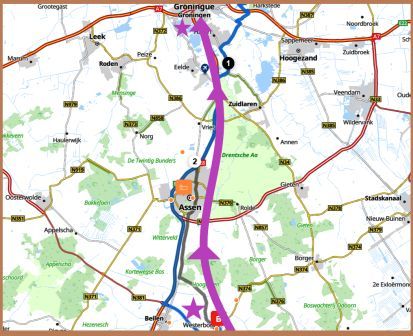
Screenshot 2024-03-20 at 11-47-11 Groningen - Westerbork route planner - journey distance time and costs – ViaMichelin

Map shows route taken by the RHLI as they moved from Westerbork towards Groningen.  (Map source: http://www.viamichelin.co.uk)

An excerpt from Semper Paratus: The History of the Royal Hamilton Light Infantry (Wentworth Regiment) 1862-1977 by Kingsley Brown, Sr, Kingsley Brown, Jr, and Brereton Greenhous, recorded that “…the RHLI crossed the Ijeselson Canal by a small foot bridge on April 10 and, moving quickly on tanks and Kangaroos, reached the outskirts of Groningen within two days.  At this point the battalion again became the spearhead for 4th Brigade and 2nd Division…

A description of the fight that followed noted that “…. ‘it took more than a day for the Battalion to fight its way into Groningen’ John Lisson recalled. ‘The Germans were not only firing light arms, but blasting us with four-barreled flak guns. They had developed a nasty technique of firing at the glazed tile roofs of the buildings and bringing them crashing down on top of us. The tiles would fly off in sharp fragments just like shrapnel’….

As if this wasn’t enough to deal with, the Rileys had encountered members of the Dutch SS who had been guarding the Westerbork concentration camp, who “…were fighting desperately because they had nothing to expect but the firing squad if they were caught…”  (See https://en.wikipedia.org/wiki/Westerbork_transit_camp)

….Joseph was killed by sniper fire during the Battle of Groningen….

After travelling from Westerbork to Assen and then on towards Groningen, the War Diary for the Royal Hamilton Light Infantry for April 13, 1945 stated that by 4 pm they had arrived “…approximately one mile from Groningen, our final objective.  Tactical Headquarters was set up in a farm house while the Companies continued to their objective in the town.  The opposition in this sector was increasing, consisting mainly of medium machine gun and small arms fire…

The Battle of Groningen would not be an easy victory.   (See https://www.canadiansoldiers.com/history/battlehonours/northwesteurope/groningen.htm and https://library.mcmaster.ca/battle-groningen-april-1945)

Conditions had deteriorated by the evening of April 13.  “…Word was received that the forward elements are meeting serious resistance in the form of small arms fire, road blocks, and mines….” 

At the same time as over 100 prisoners of war began surrendering, sniper fire continued.  By 8:30 pm, the War Diary entry stated that “…we have suffered several fatal casualties from snipers…” Among the casualties was Joseph.

….Joseph is buried in the Canadian War Cemetery in Holten….

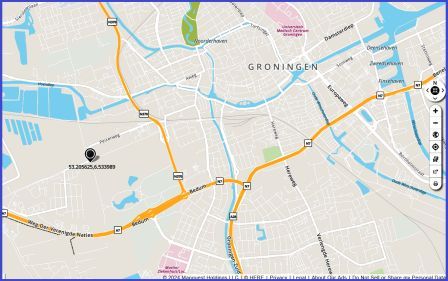
Screenshot 2024-03-20 at 16-29-08 53.205625168048 6.5339885049894 156A Peizerweg Groningen GR - MapQuest

According to the GPS coordinates provided at the time, Joseph was initially buried beside what is today the Peizerweg in Groningen. The black circle marks the spot.  (Map source:  Mapquest)

On April 15, 1945, Joseph was initially buried beside a road in Groningen, before being reburied the following year in the Canadian War Cemetery in Holten, The Netherlands.  

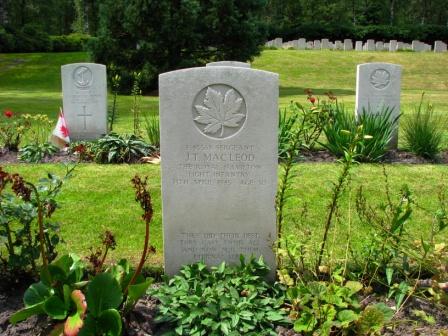
macleod, joseph taylor from Holten

Grave of Joseph Taylor MacLeod in the Canadian War Cemetery in Holten, The Netherlands.  (Photo courtesy of the Information Centre Canadian Cemetery Holten)

….Sam Matvichuk also died during the Battle of Groningen….

Sam MATVICHUK, whose story was previously told, also lost his life during the Battle of Groningen, while serving with the Royal Regiment of Canada.  You can read his story here: https://onthewarmemorialtrail.com/2022/08/19/on-the-war-memorial-trail-the-wwii-soldier-born-in-broadacres-who-died-during-the-battle-of-groningen/

Thank you to Cyril MacLeod for sharing a photo of his father, Henk Vincent for sharing the Royal Hamilton Light Infantry War Diary for April 1945, and to David Ryan for sharing an excerpt from Semper Paratus: The History of the Royal Hamilton Light Infantry (Wentworth Regiment) 1862-1977.

Do you have photos or information to share? Email Pieter at memorialtrail@gmail.com, comment on the blog, or tweet to @researchmemori1.

© Daria Valkenburg

….Want to follow our research?….

If you are reading this posting, but aren’t following our research, you are welcome to do so.  Our blog address: https://onthewarmemorialtrail.com/

Front cover OnTheWarMememorialTrailinEurope4 countries, 6 weeks, 7,000 km – an unforgettable war memorial journey in Europe…. Daria’s book ‘No Soldier Buried Overseas Should Ever Be Forgotten‘ is available in print and e-book formats.  Net proceeds of book sales help support research costs and the cost of maintaining this blog. For more information see https://nosoldierforgotten.com/ 

You are also invited to subscribe to our YouTube Channel: On The War Memorial Trail With Pieter Valkenburg: https://www.youtube.com/channel/UCJ591TyjSheOR-Cb_Gs_5Kw

Never miss a posting!  Subscribe below to have each new story from the war memorial trail delivered to your inbox.

On The War Memorial Trail….. The WWII Soldier From Manitoba Who Died Shortly After Being Liberated From Stalag VII-A

February 18, 2024.  A few years ago, we translated ‘Holtense Canadezen’, Jan Braakman’s book about some of the soldiers buried in the Canadian War Cemetery in Holten, The Netherlands, which was published in English in October 2023 as  ‘Holten Heroes: Stories from a Canadian Field of Honour’.  (See https://onthewarmemorialtrail.com/2023/11/01/new-book-about-soldiers-buried-in-the-canadian-war-cemetery-in-holten-the-netherlands/)

One very sad story related how 6 newly liberated prisoners of war – 5 Canadians, 1 Australian – died after accepting what turned out to be alcohol containing methanol from liberated Soviet prisoners of war.

The story resonated as my father, who had been in a displaced persons camp in Post-WWII Germany, had told me of similar stories. Refugees who had survived the war, many under brutal conditions, died or became blind after drinking alcohol that contained methanol (methyl alcohol) or alcohol made in containers that had once held gasoline, oil, and other substances.  Only a few sips could result in death or permanent disability.

One of the six soldiers, whose story was not told in ‘Holtense Canadezen’, was on the photo wish list from Holten James ‘Jimmy’ Oliver THOMAS, born July 4, 1912 in St. Peters, Manitoba, the son of Henry ‘Harry’ Curtis James and Margaret Thomas.

Screenshot 2024-02-15 at 12-28-03 St. Peters

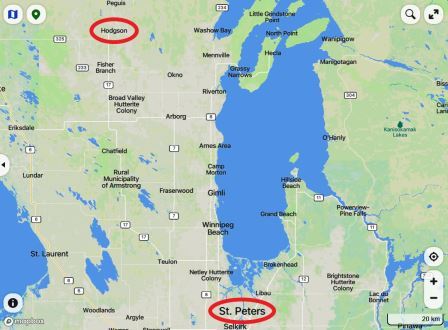
Map shows location of St. Peters and Hodgson in Manitoba.  (Map source: http://www.mapcarta.com)

St. Peters was an area familiar to me as childhood summers were spent in Grand Beach on Lake Winnipeg and we travelled often in that direction from Winnipeg, which was just a bit further south.

Jimmy’s parents left St. Peters in the fall of 1912 and moved to Hodgson, where Jimmy grew up with his siblings – 7 brothers and 1 sister.

The Peguis First Nation, whose members are of Ojibway (Saulteaux) and Swampy Cree (Maškēkowak) descent, is nearby, and the Thomas family has its roots here. (See https://en.wikipedia.org/wiki/Peguis_First_Nation)

….Jimmy’s niece provided a photo….

James Oliver Thomas

James ‘Jimmy’ Oliver Thomas. (Photo courtesy of the Thomas Family)

In the search for a photo, Pieter was in contact with Theresa Cooper, daughter of Jimmy’s brother, Rodney Thomas, one of two brothers who also served in the Canadian Army during WWII in addition to Jimmy.  The photo was emailed to us by Theresa’s son, Rodd Cooper. “Thank you for your work and recognition in honouring him and the other Canadian soldiers….” Rodd wrote.

….Jimmy was hard-working and versatile….

After his father died in 1925, Jimmy left school at the age of thirteen to help out at home.  He spent 6 years working on the family farm, 2 years as a mechanic in a garage in Virden, Manitoba, 6 years in a hard rock quarry in Ontario and Manitoba, plus casual labour wherever he could find work.  In his Estate Form, his mother noted that he “…would look for a job anywhere he could make good money…

By the time Jimmy enlisted at the No. XI District Depot in Vancouver, British Columbia on May 21, 1943, he was working as a plumber’s helper for a plumbing and heating company based in Prince Rupert, British Columbia, in a wartime housing project.

The interviewer for Jimmy’s Personnel Selection Record noted that he had “…above average learning ability….” and that his “…occupational background indicates versatility and adaptability.  Has been farmer, garage mechanic, fisherman, and latterly miner…

The Record went on to describe Jimmy as having a “….robust appearance…” and that he was “…of quiet nature but self-confident and unhurried…

Among his hobbies and interests, Jimmy “…played hockey.  Enjoys hunting and fishing.  Can swim.  Doesn’t dance.  Reads true detective stories. Attends movies…

….Jimmy’s military career began in British Columbia….

On June 3, 1943, Jimmy was sent for basic training at No. 110 Canadian Army Basic Training Camp (CABTC) in Vernon, British Columbia.   After completing basic training, he was transferred to A16 Canadian Infantry Training Camp (CITC) in Calgary, Alberta on August 4, 1943.

At the beginning of October 1943, Jimmy was given a week’s embarkation leave, the last chance he had to visit his family before being sent overseas.

On November 3, 1943, he left Calgary when he was transferred to No. 1 Training Brigade in Debert, Nova Scotia.

On December 15, 1943, Jimmy left Canada for the United Kingdom, arriving on December 21, 1943.  He most likely had been on the same ship as Eli Ambrose SNAKE. (See https://onthewarmemorialtrail.com/2021/12/13/on-the-war-memorial-trail-remembering-ww2-soldier-eli-ambrose-snake/)  While Jimmy was assigned to No. 1 Canadian Infantry Reinforcement Unit (CIRU), Eli was sent to No. 3 CIRU. 

…Jimmy joined the Seaforth Highlanders of Canada in Italy….

On February 19, 1943, Jimmy was sent to Italy as part of the Allied Armies In Italy (AAI) and assigned to the 2 Battalion X-4 Reinforcement.  Then, on May 5, 1944, he was transferred to the Seaforth Highlanders of Canada.

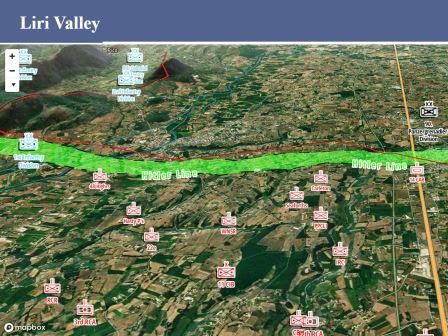
The Regiment had finished in Ortona and continued to move north, fighting through the Liri Valley.  Next, the Regiment received orders to work with other Regiments to break through the Hitler Line, the Germans’ second defensive line.  (See https://en.m.wikipedia.org/wiki/Hitler_Line and https://liri-valley.project44.ca/)

Screenshot 2024-02-18 at 09-56-04 Liri Valley

Placement of troops for breaching the Hitler Line on May 23, 1944. (Map source: https://liri-valley.project44.ca/)

On May 22, 1943, the War Diary for the Seaforth Highlanders of Canada recorded that at 4 pm, “…the Commanding Officer received orders from 2 Canadian Infantry Brigade that Seaforth Highlanders of Canada would attack the Adolph Hitler Line… The attack was ordered for 0600 hours 23 May 1944.  The PPCLI to attack on right, Seaforths on left, Edmonton Regiment reserve to exploit through PPCLI….”  (PPCLI refers to Princess Patricia Canadian Light Infantry.) 

A fierce battle occurred the following day.  The War Diary recorded that by 7:30 pm “…it was now apparent that the Adolph Hitler Line had been broken. The enemy were in full retreat, jamming the roads with his transport, which provided a good target for our Air Force…”   

…Jimmy became a POW during the breaking of the Hitler Line….

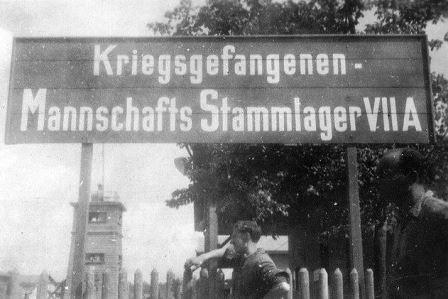
The war diary noted that there were many casualties: 51 killed, 110 wounded, and 72 missing.   Among the missing was Jimmy Thomas, who became a prisoner of war and taken to Stalag VII-A in Moosburg, Germany, where he was recorded as POW number 131885. (See https://en.wikipedia.org/wiki/Stalag_VII-A and https://www.pegasusarchive.org/pow/S7A/cSt_7A_Description.htm)

32898f4eaba6b4904152e84b63f6f18e--bavaria-vii

Entrance to Stalag VII-A.  (Photo source: Moosburg Online)

Stalag VII-A was captured on April 29, 1945 by Combat Command A of the 14th Armored Division of the US Army. (See https://www.moosburg.org/info/stalag/14theng.html)  Jimmy and his fellow POWs couldn’t believe how lucky they were, after all the hardships they had experienced.  Reports stated that 110,000 Allied POWs were freed from that camp alone.

The POWs were now free, but with the war still ongoing, it was impossible to evacuate all of them immediately.  They were instead moved west in large groups and placed in temporary transit camps while they waited impatiently to be transported out of Germany. 

Unfortunately, there were not enough planes to quickly transport them to Reims, France, and from there to England.  So they waited for their turn.

…A drink containing methanol proved fatal….

On May 1, 1945, Jimmy was in a temporary camp in Ettringen, Bavaria, Germany, along with other former prisoners of war.   A translated excerpt from Jan Braakman’s ‘Holtense Canadezen’ related what happened that day.  “Canadians John Decoine, Robert Consterdine, Joe Giguire, Steven Motkaluk, James Thomas, and Australian Joe Brydon could not believe their luck when they were liberated by the Americans ….. The six met a group of Russian prisoners of war near Ettringen (Bavaria), who apparently had a large amount of liquor at their disposal…. 

The men were unaware that they were being offered liquor that contained methanol, which was fatal for all six.  “…Captain C.T. Sutherland wrote a report for the Department of National Defence about the incident …. According to him, on May 1, on the street in Ettringen, the Canadians had been given alcohol by members of a Russian labour command. (The prisoner of war camp had numerous labour commands, consisting of prisoners of war of different nationalities)…. 

Most likely, the Russians were not aware that the alcohol had been poisoned. “…British prisoner of war Tom Tate, who was captured in Germany in early 1945 after his Royal Air Force bomber was downed, said that Russian prisoners of war had found and binged on methylated spirits on the estate (Ost-Ettringen). He recalled two Russian prisoners of war who died of it and more who had severe symptoms of poisoning….

…Jimmy died on May 2, 1945….

Captain Sutherland’s report did not include the names of Steve Motkaluk and James ‘Jimmy’ Oliver Thomas, who had both been in Stalag VII-A in Moosburg.  They had been taken to the US Hospital in Thannhausen, Germany.  Both men died on May 2, 1945.  

A medical report for Steven Motkaluk stated that the amount of alcohol he’d drunk was only 1 pint (2 cups).  Likely Jimmy had drunk the same amount or less. 

The other 4 men had been under the care of British physician John “Sandy” Rutherford, a former prisoner of war himself. 

It was a sad ending to soldiers who had endured so much during the war and their time in a POW camp. During the investigation into this incident and others involving the poisoning of Allied soldiers, the Canadian Intelligence Service …managed to obtain an October 1944 document from the Kriminaltechnisches Institut der Sicherheitspolizei (Forensic Institute of the Security Police), describing the various possibilities of deliberate poisoning. One of these was the addition of methyl alcohol (methanol) to bottled drinks. It is conceivable that the prisoners of war were victims of this practice….

…The other 5 victims of methanol poisoning….

In addition to Jimmy, the other 5 victims of methanol poisoning were: 

·         Robert James CONSTERDINE of Vancouver, British Columbia, died May 2, 1945

·         John DECOINE of Wabaska, Alberta, died May 1, 1945

·         Joseph ‘Joe’ August GIGUIRE of Conklin, Alberta, died May 3, 1945

·         Steven MOTKALUK, of Toronto, Ontario, but born in Lviv, Ukraine, died May 2, 1945

·         Joseph ‘Joe’ William BRYDON of Tenterfield, New South Wales, Australia, died May 2, 1945 

….Jimmy is buried in the Canadian War Cemetery in Holten….

Along with Steven Motkaluk, Jimmy was initially buried in the US Military Cemetery in Reutti, Germany, before being reburied in the British Military Cemetery in Durnbach, Germany.  Then, on June 4, 1948, they were reburied in the Canadian War Cemetery in Holten, The Netherlands.

Thomas JO James Oliver K51503

Grave of James ‘Jimmy’ Oliver Thomas in the Canadian War Cemetery in Holten, The Netherlands.  (Photo source: Canadian Virtual War Memorial)

…..Jimmy is listed on the National Métis Veterans Memorial Monument….

Jimmy is listed on the National Métis Veterans Memorial Monument just outside of Batoche, Saskatchewan.  (See https://www.metismuseum.ca/metisveteransmonument/)

His name can be found on Column 8 on the outside, Row 67. (https://www.metismuseum.ca/metisveteransmonument/column.php?v=XCHRVC)

….Thomas Esker in northern Manitoba is named in Jimmy’s honour…..

Screenshot 2024-02-21 at 08-38-47 Thomas Esker

Thomas Esker is named in honour of James ‘Jimmy Oliver Thomas. (Map source: http://www.mapcarta.com)

Thomas Esker in northern Manitoba, east of Tadoule Lake, was named after Jimmy in 1995.  This mountain has an elevation of 246 metres (807 feet).  (See https://mapcarta.com/24676318)

Thank you to Theresa and Rodd Cooper for providing a photo of James ‘Jimmy’ Oliver Thomas, to Shawn Rainville for helping with the initial newspaper search for family and information, to Judie Klassen for finding the geographic commemoration in ‘A Place Of Honour’, and to Jan Braakman for researching the May 1, 1945 incident in which 6 men lost their lives. 

Do you have photos or information to share? Email Pieter at memorialtrail@gmail.com, or comment on the blog.

© Daria Valkenburg

….Want to follow our research?….

If you are reading this posting, but aren’t following our research, you are welcome to do so.  Our blog address: https://onthewarmemorialtrail.com/

Front cover OnTheWarMememorialTrailinEurope4 countries, 6 weeks, 7,000 km – an unforgettable war memorial journey in Europe…. Daria’s book ‘No Soldier Buried Overseas Should Ever Be Forgotten‘ is available in print and e-book formats.  Net proceeds of book sales help support research costs and the cost of maintaining this blog. For more information see https://nosoldierforgotten.com/ 

You are also invited to subscribe to our YouTube Channel: On The War Memorial Trail With Pieter Valkenburg: https://www.youtube.com/channel/UCJ591TyjSheOR-Cb_Gs_5Kw

Never miss a posting! Subscribe below to have each new story from the war memorial trail delivered to your inbox.