On The War Memorial Trail……The Stordy Brothers Part 2 – The WWII Airman From Brookvale Who Lost His Life On The Last Flight Of Halifax JB-920

February 16, 2026. During WWII, the Stordy family of Brookvale, Prince Edward Island, lost  two sons:  first, John ‘Lawrence’ STORDY, who is buried in the Reichswald Forest War Cemetery in Kleve, Germany, and then, shortly after the war in Europe ended, Michael ‘Cecil’ STORDY, who is buried in Kelly’s Cross (St. Joseph) Parish Cemetery in Kelly’s Cross, Prince Edward Island.

….Two brothers gave their lives in WWII…
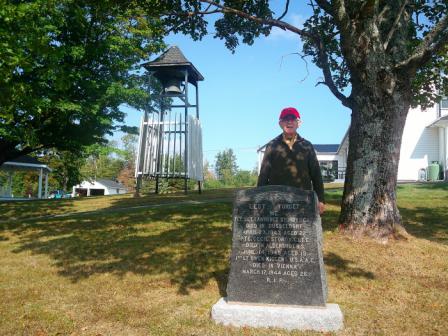
Two Stordy brothers are listed on the memorial outside St. Joseph’s Roman Catholic Church in Kelly’s Cross, behind which Pieter is standing. (Photo credit: Daria Valkenburg)

In Part 1 of this two-part series, we began with Cecil’s story, as the Stordy family became known to Pieter when he was assigned Cecil’s grave after he became a volunteer under the National Volunteer Program for the Commonwealth War Graves Commission (CWGC).  (See https://onthewarmemorialtrail.com/2026/02/11/on-the-war-memorial-trailthe-stordy-brothers-part-1-the-wwii-soldier-from-brookvale-who-drowned-during-a-swimming-exercise-in-nova-scotia/

Now, in Part 2, we tell the story of JohnLawrence’ STORDY, who lost his life in Germany on April 27, 1943, aged 22,  two years earlier than his younger brother Cecil.

….Lawrence enlisted in the RCAF in July 1941 …

Born May 31, 1921 in Brookvale, Prince Edward Island, Lawrence was the son of John ‘Anthony’ and Mary ‘Ermina’ (nee Duffy) Stordy.  When he enlisted at the Royal Canadian Air Force (RCAF) Recruiting Centre in Halifax, Nova Scotia on July 17, 1941, he stated that he had completed Grade 10 and was employed at Schwartz & Sons.  Before that he had worked as a farm labourer for D. D. MacDonald on Prince Edward Island for 4 months, then on a dairy farm for B. Baxter in Truro, Nova Scotia.

In 1940, he left the dairy farm for a better job with Nova Scotia Light and Power in Halifax, Nova Scotia, remaining there until he was laid off in 1941, after which he went to work for Schwartz & Sons, a spice and food company, as an assistant shipper.  

Asked what special qualifications or hobbies would be useful to the RCAF, he wrote down that he knew how to fish, hunt, and skate, and occasionally played baseball.

After taking his basic training in Halifax, Lawrence was sent to No. 4 Air Manning Section (AMS) in Valcartier, Quebec on September 13, 1941 and to No. 5 Manning Depot in Lachine, Quebec.  Manning Depots were reception and training centres for new RCAF recruits, serving as the initial entry point for the British Commonwealth Air Training Plan (BCATP). Recruits received uniforms, 4–5 weeks of basic military training, drills, and aptitude testing.  Upon completion, trainees were designated as ‘aircraftsmen 2’ and moved on to further specialized training schools.

Lawrence remained there until March 29, 1942, when he was sent to No. 1 Wireless School (WS) in Montreal, Quebec.  This BCATP facility for training wireless air gunners was located in the former Nazareth School for the Blind. On April 30, 1942, he was designated as Leading Aircraftman (LAC).

On June 7, 1942 he went to Composite Training School (KTS) in Trenton, Ontario for a four-week course in astro-navigation.

On July 5, 1942 he was sent to No. 9 Bombing and Gunnery (B&G) School in Mont-Joli, Quebec, where he received instruction in the techniques of bomb aiming and aerial machine gunnery.  Bombing and Gunnery schools required a large area to accommodate their bombing and gunnery ranges, and were often located near water. The Avro Anson, Fairey Battle, Bristol Bolingbroke, and Westland Lysander were the standard aircraft used.
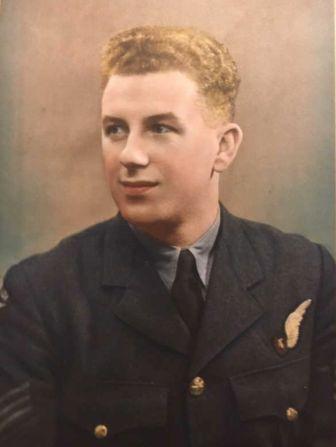
John ‘Lawrence’ Stordy. The 3 chevrons on his right arm indicate his promotion to T1 Sergeant. (Photo source: Canadian Virtual War Memorial)

While at No. 9 B&G, Lawrence was awarded his Air Gunner’s badge on August 14, 1942, and a promotion to T1 Sergeant.  (The ‘T’ stands for Technician.) His Commanding Officer at the School noted that he was “…a hard worker and applied himself diligently…

On September 11, 1942, he was sent to No. 34 Operational Training Unit (OTU) in Pennfield Ridge, New Brunswick.  An OTU was the last stop for aircrew trainees before going overseas. 

….Lawrence left Canada for overseas service …

Lawrence was only in Pennfield Ridge for a few days before being transferred to the RCAF’s No. 1 ‘Y’ Embarkation Depot in Halifax, Nova Scotia.  (See https://rcaf.info/rcaf-stations/nova-scotia-rcaf-stations/rcaf-station-halifax/)
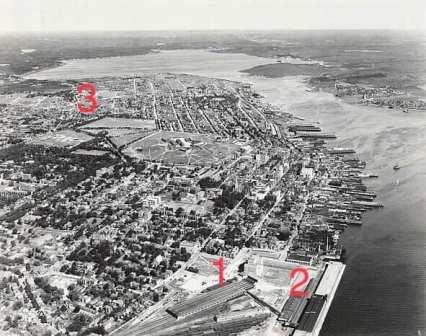
Aerial view of Halifax showing the location of the Canadian National Railroad Station (red # 1) , Pier 21 Ocean Terminals (red # 2) and No. 1 “Y” Embarkation Depot (red # 3). Halifax Harbour is foreground and right with the Bedford Basin in background. (Source: Library and Archives Canada Collections website)

Things moved quickly after that, as on September 24, 1942, Lawrence was placed in the Royal Air Force (RAF) Trainee Pool and arrived at No. 3 Personnel Reception Centre (PRC) in Bournemouth, England on October 9, 1942. This was the arrival point for thousands of Commonwealth aircrew after training in Canada. 

Lawrence would have been at No. 3 PRC at the same time as Donald David MacKenzie TAYLOR, who arrived there two days earlier, and whose story was previously told.  (See https://onthewarmemorialtrail.com/2025/12/27/on-the-war-memorial-trail-the-wwii-soldier-born-in-manitoba-who-lost-his-life-when-lst-420-hit-a-mine-in-the-harbour-outside-ostend/)

….Lawrence joined No. 405 Pathfinder Squadron…

On October 28, 1942, he was transferred to No. 405’s 1659 Conversion Fleet, the main training unit for No. 405 (Vancouver) Squadron, and based at RAF Leeming and Topcliffe in Yorkshire.  No. 405 was the only RCAF Pathfinder Squadron. Formed in April 1941, No. 405 had flown Wellingtons until April 1942, when it converted to Halifax bombers, and prepared crews for the Handley Page Halifax bomber.
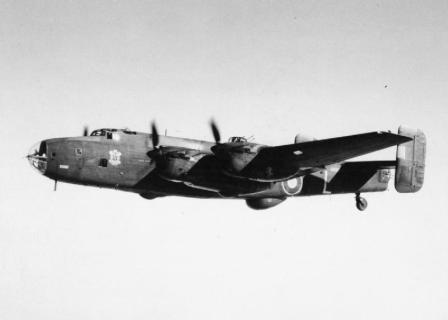
Halifax B Mk II bomber photo.  (Photo source: Royal Air Force official photographer – https://commons.wikimedia.org/w/index.php?curid=24454971)

Pathfinder Squadrons were target-marking squadrons that flew ahead of the main bombing crews to mark targets with slow falling, colour-coded parachute flares and very bright photo flash bombs that were on the centre of the target.  This helped bombing crews to increase the accuracy of their bombing.

Pathfinders didn’t immediately leave, but stayed around the target, to keep dropping markers on target, to keep second and third waves of bombers from ‘target creep’.  RAF and RCAF bombers were strung out like cars on the interstate, one behind the other, NOT in formation. Each individual aircraft had to navigate, get to the target, drop their bombs, and return to base – in the dark.  Pathfinders would remain until after the bombers had left to take photos of the damage inflicted.

On January 15, 1943, his training completed, Lawrence was assigned to No. 405 Squadron, based at RAF Beaulieu in Hampshire. At the time he joined, No. 405 had been detached to Coastal Command since October 1942. Coastal Command’s role was defensive, mainly protecting convoys from German U-boats(See https://en.wikipedia.org/wiki/RAF_Coastal_Command_during_World_War_II)

On March 1, 1943, No. 405 Squadron was reassigned back to Bomber Command as part of No. 6 (RCAF) Group, selected to be part of No. 8 Pathfinder Group on March 18, 1943, and based at RAF Gransden Lodge, located 16.3 km (10.1 miles) west of Cambridge, England. They were to be participants in a bombing campaign in the industrial heart of Germany.

….No. 405 Squadron was involved in the Battle of the Ruhr…

The Battle of the Ruhr was a strategic bombing campaign carried out by Bomber Command against the Ruhr Valley Area in Germany from March 5 to July 31, 1943.  Why Ruhr? Responsible for 60% of Germany’s industrial output, it was the main centre of German heavy industry with coke plants, steelworks, armaments factories and ten synthetic oil plants. (Coke is a coal-based fuel with a high carbon content, used mainly in the smelting of iron ore, steelworks, armaments factories and ten synthetic oil plants.)  (See https://en.wikipedia.org/wiki/Battle_of_the_Ruhr and https://www.worldhistory.org/article/2429/battle-of-the-ruhr/)

The Ruhr Valley was protected by about 200 flak batteries, each consisting of six or eight 88-mm (3.5 in) guns, many with radar capability. Some guns were even mounted on trains to follow the bombers. Due to this dense network of anti-aircraft guns and countless searchlights, Allied bombers soon gave the Ruhr the ironic nickname of ‘Happy Valley’.

In addition to anti-aircraft guns, smog was a big problem.  The Ruhr Valley was so heavily industrialized that constant smog in the skies above it not only impeded the bomb aimers, but also made it difficult for the navigators to find their target areas.

….The last flight of Halifax JB-920…

On the night of April 26 into 27, 1943, Bomber Command sent 561 bombers (215 Lancasters, 135 Wellingtons, 119 Halifaxes, 78 Stirlings, 14 Mosquitos) to Duisburg, Germany.  Duisburg had important railway yards, which connected the Ruhr to other parts of Germany, and the Thyssen steelworks.

In total, 17 planes were lost that night – 7 Halifaxes, 5 Wellingtons, 3 Lancasters, 2 Stirlings. German records show 130–207 people killed, 300 buildings destroyed and six other cities hit by bombs.
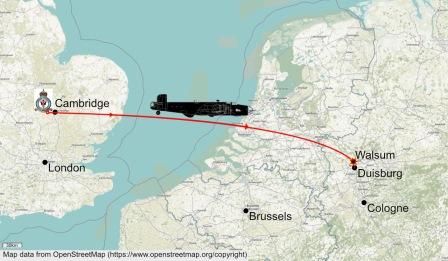
Map shows the plane’s path from England towards Duisburg.  It was shot down by German flak and crashed in Walsum, 11 km north northwest of its target of Duisburg.  (Map prepared by Wendy Nattress)

This operation was No. 405 Squadron’s first operation as a Pathfinder unit. Out of 11 Halifax aircraft dispatched, 1 was lost – Halifax JB-920.  Hit by German light and heavy flak, it was shot down as it approached the target area of Duisburg, and crashed in Walsum, 11 km (6.8 miles) north northwest of Duisburg. All eight crew members were killed, including Lawrence, who was one of the two air gunners on that flight.

….The other crew members on the last flight of Halifax JB-920…

On the last flight of Halifax JB-920, in addition to Flight Sgt John ‘Lawrence’ STORDY, the other crew members were:

  • Pilot : Pilot Officer David Edward CROCKATT of Vancouver, British Columbia
  • 2nd Pilot : RCAF Pilot Officer Chester Brockie DIXON of Maple Creek, Saskatchewan
  • Flight Engineer : RCAF Sergeant Isaac Abraham PENNER of Nipawin, Saskatchewan
  • Navigator : RCAF Pilot Officer John Robert MARRIOTT of Ottawa, Ontario
  • Navigator : RCAF Warrant Officer Class II Stewart SLEETH of Detroit, Michigan, USA
  • Wireless Operator / Air Gunner : RAF Pilot Officer Francis Edward O’HARE of the United Kingdom
  • Air Gunner : RCAF Warrant Officer Class II Thomas Lloyd BENTLEY of Moose Jaw, Saskatchewan

….Lawrence is buried in Reichswald Forest War Cemetery in Kleve…

The airmen were temporarily buried at North Cemetery in Dusseldorf, Germany, before being reburied in Reichswald Forest War Cemetery in Kleve, Germany.
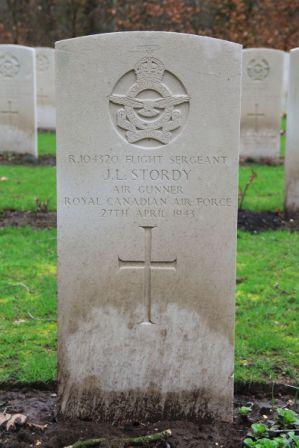
Grave of John ‘Lawrence’ Stordy in the Reichswald Forest War Cemetery in Kleve, Germany.  (Photo source: Find A Grave)

I had wondered why the men were reburied in Reichswald Forest War Cemetery, another cemetery in Germany, instead of in The Netherlands. Yannic Wethly, a volunteer with the Air Drenthe Research Foundation (Stichting Luchtoorlog Onderzoek Drenthe),  explained that “….almost all  RAF/RCAF/RAAF etc personnel who died in the German provinces that border to The Netherlands were reburied at Reichswald Forest. This explains the vast geospatial spread in the crash locations, and also why there are more than 7500 graves there….

Patti W Noonan, daughter-in-law of the late Bernadette ‘Bernie’ Stordy Noonan, the youngest sister of Cecil and Lawrence, wrote us that “….the family is very proud of the sacrifice by Lawrence and Cecil…” and rightly so.

Thank you to Wendy Nattress, who prepared the map showing the flight path for Halifax JB-920.

This concludes the 2 part series on the Stordy Brothers. Do you have a story to tell? Email Pieter at memorialtrail@gmail.com or comment on the blog. 

© Daria Valkenburg

….Want to follow our research?…

If you are reading this posting, but aren’t following our research, you are welcome to do so.  Our blog address: https://onthewarmemorialtrail.com/
4 countries, 6 weeks, 7,000 km – an unforgettable war memorial journey in Europe…. Daria’s book ‘No Soldier Buried Overseas Should Ever Be Forgotten‘ is available in print and e-book formats.  Net proceeds of book sales help support research costs and the cost of maintaining this blog. For more information see https://nosoldierforgotten.com/

Subscribe to our YouTube Channel: On The War Memorial Trail With Pieter Valkenburg: https://www.youtube.com/channel/UCJ591TyjSheOR-Cb_Gs_5Kw

Never miss a posting!  Subscribe below to have each new story from the war memorial trail delivered to your inbox.
On The War Memorial Trail…..The WWII Soldier Born In Manitoba Who Lost His Life When LST-420 Hit A Mine In The Harbour Outside Ostend

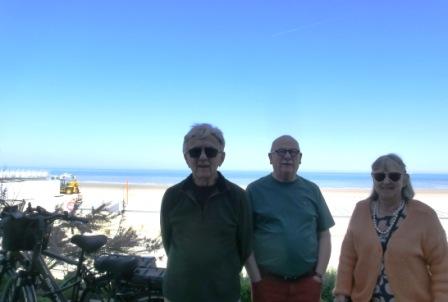
Pieter with François Breugelmans and Mieke de Bie on the boardwalk in Westeinde, Belgium, by the North Sea. (Photo credit: Daria Valkenburg)

December 27, 2025.  While in Belgium during our 2025 European War Memorial Tour, we were joined by Pieter’s cousin François Breugelmans and his wife Mieke de Bie.  We visited Zonnebeke and were successful in finding the location of the original burial of WWI soldier Vincent Earl CARR of Prince Edward Island who was killed during the Battle of Passchendaele in October 1917.  (See https://onthewarmemorialtrail.com/2025/12/22/on-the-war-memorial-trail-the-search-for-the-trench-where-wwi-soldier-vincent-carr-was-originally-buried/)

Our fearless foursome continued on the Belgian portion of our trip, this time to honour a Manitoba-born WWII soldier…..

….Request from a Belgian researcher…

In September 2024, Belgian researcher Patrick Michiels had written us, asking for help in finding a photo of Donald David MacKenzie TAYLOR. Patrick explained that “…Corporal Taylor, of the Royal Canadian Air Force, died on 7th November 1944 whilst the ship he was on, LST-420, hit a mine near the harbour of Ostend (Belgium).  Donald is buried in the Ostende New Communal Cemetery and was 26 when he died….”  LST refers to Landing Ship, Tank. (See https://en.m.wikipedia.org/wiki/Landing_Ship,_Tank)  

….I’m taking care of the adoption in the Ostende New Communal Cemetery of the graves of WWI and WWII…” soldiers, and he explained that, in addition to Taylor, there were 9 more Canadians buried in this cemetery.   

Pieter agreed to try and find a family member who might have a photo.  The research began….

….A photo was found through a nephew and great-niece…

Born February 4, 1918 in Winnipeg, Manitoba, Donald was the son of James and Mary (nee MacKenzie) Taylor, who were both born in Scotland.  Donald’s father was an RCMP officer and the family moved to Saskatchewan five months after his birth.

Donald had a brother James, and a sister Mary Christina, who married Harold Emerson Reesor.  It was through Mary’s son Ronald and Ronald’s daughter Alyna that a photo of Donald was provided.

Donald David MacKenzie Taylor.  (Photo courtesy of the Reesor Family)

….Donald trained as a radio mechanic with the RCAF…

At the time of his enlistment on September 30, 1941 with the Royal Canadian Air Force (RCAF) in Regina, Saskatchewan, Donald had already been serving in the militia, as a rifleman with the Regina Rifles Reserve since July 1940.  He was a high school graduate and was employed as a statistician with the Provincial Government of Saskatchewan.  Donald noted that he enjoyed swimming, and occasionally played baseball and tennis. He stated that he had tried to enlist in the Royal Canadian Navy Volunteer Reserve (RCNVR), but had been considered medically unfit due to ‘defective vision’. 

A trades test during his initial interview with the RCAF found him suitable for a Radio Mechanic.  As an Air Craftsman 2nd Class, he was sent to No. 3 Manning Depot in Edmonton, Alberta for his initial training. 

On December 29, 1941, Donald was next sent to the RCAF Detachment of the University of Saskatchewan in Saskatoon, Saskatchewan, for courses in Fundamental Radio Theory and Applied Radio Theory, which he successfully completed on April 15, 1942.

Promoted to Leading Air Craftsman (LAC), Donald next was sent to No. 1 Toronto Manning Depot in Toronto, Ontario for a few days before being posted to No. 31 Radio School, Royal Air Force, in Clinton, Ontario for further training. 

….Donald continued his training in Clinton …

On April 27, 1942, Donald began several written and practical courses in Radio Mechanics in Clinton.  The innocuous sounding Radio School was also called the RDF School, and was a secret high-tech school. RDF was the acronym for Radio Direction Finding, but in reality Clinton was training its students in the new technology of Radar (RAdio Direction And Ranging).  Radar had already been used in the United Kingdom to track German aircraft during the London Blitz in the winter of 1941‑42.  Students at Clinton learned the principles of radar and were given hands‑on training.

After successfully completing his courses on June 5, 1942, it was recommended that Donald be “…retained to take a further course of Radio Mechanic Training with a view to being Commissioned, if technically suitable…”  He remained in Clinton until August 9, 1942.

….Donald left Canada for overseas service….

Donald was scheduled to take another course in Clinton, which was to begin on August 6, 1942, but a note in his service file stated that this was cancelled.  Instead he was given embarkation leave, the last time he would see his family before going overseas.

After his leave ended on August 26, 1942, he was posted to No. 31 Personnel Depot (PD) Moncton, a holding station just outside Moncton, New Brunswick, for personnel who were being posted elsewhere. The RCAF Moncton site is now the Greater Moncton Romeo LeBlanc International Airport, which we have flown out of several times over the years! 

Donald left Moncton on September 23, 1942 for the journey to United Kingdom, where he arrived on October 7, 1942.  He was immediately posted to No. 3 Personnel Reception Centre (PRC) in Bournemouth, the main transit hub for incoming Royal Canadian Air Force (RCAF) crew.

….Donald received intensive training in radar….

Once he had a chance to get oriented in England, his training continued.  He was first sent to No 75 Signals Wing at Biggin Hill on August 28, 1942, a Royal Air Force (RAF) unit that focused on radar and signals intelligence. It was part of No. 60 Group, which specialized in airborne interception (AI) radar and signals for night fighters. 

On March 3, 1943, Donald was posted to White Waltham Airfield in Berkshire, the headquarters for the Air Transport Auxiliary (ATA), a civilian organization that ferried thousands of RAF warplanes between factories and front lines.

A few weeks later, he was sent on a short detachment to Renscombe Down, near Swanage in Dorset, a site that provided radar training and operations. It was a training ground for the mobile radar units that would play a critical role in the D-Day landings and later in Northwest Europe.

Donald received another promotion on April 1, 1943, to Technical Corporal (T/Cpl). 

On April 12, 1943, Donald was posted to RAF Chigwell in Essex, which was used in testing and training of communication equipment.  While at Chigwell, he was sent to No. 9 Radio School at the Royal Air Force Yatesbury for additional radar training.  His training continued at several more bases, including the radar station in Ventnor on the Isle of Wight, and Great Malvern which specialized in radar research.

….A decision was made to move No. 1 BSRU from England to Belgium….

On April 24, 1944, Donald was transferred to No. 1 Base Signals and Radar Unit (BSRU), a unit responsible for the maintenance and repair of the vital radar installations used for air defence and operations. With personnel that had been extensively trained, No. 1 BSRU remained in Essex, England as Allied forces advanced through France and into Belgium, until a more permanent base of operations could be established closer to the front lines in North West Europe.  Instead, smaller Mobile Signals Servicing Units (MSSU) handled maintenance after the D-Day landings. 

After Ghent, Belgium was liberated on September 6, 1944, a decision was made to move No. 1 BSRU from Essex to Ghent and to set up workshops for repairing radar equipment in the field. It proved to be a fatal decision.

….An ill-fated crossing on November 7, 1944 turned into a disaster….

On November 7, 1944, a small convoy of landing ship tanks (LSTs) carrying No.1 BSRU personnel, vehicles, and equipment crossed the English Channel during terrible weather conditions.  However, when the convoy reached the Belgian coast along the North Sea, authorities refused permission to enter the port at Ostend due to a rising storm and fears of blocking the crucial supply line.

The convoy altered course back towards England, planning to shelter overnight in the Thames Estuary before returning to Ostend on the following day.  However, the bow section of LST-420, which Donald was on, struck a German mine near the harbour.  It tore a large hole in the ship’s hull, causing it to break into two pieces. The ship’s galley fires were lit at the time due to the evening meal being prepared and petrol from damaged fuel tanks of the vehicles being transported caught fire, enveloping the stern section of the ship in flames.

The ship sank rapidly, and rescue efforts were hampered as, due to heavy seas, only larger vessels were able to attempt to rescue survivors in the water. This resulted in a massive loss of life, with over 200 men from the RAF and RCAF attached to No. 1 BSRU lost, many of whose bodies were never recovered.  Just over 30 were rescued. (See https://en.wikipedia.org/wiki/HM_LST-420)

…. Donald was buried at Ostende New Communal Cemetery ….

Donald was one of the men who drowned on November 7, 1944, aged 26. Unlike so many of the casualties, Donald’s body was found.  A November 25, 1944 letter to his father from Wing Commander G. W. EMEERY explained that “…the greater part of the company, including the Commanding Officer, was lost. Your son’s body was washed ashore on the Continent, where it was taken to Ostend and buried with military honours in the Communal Cemetery, Rue Dernier, Ostend…

…. We visited Ostende New Communal Cemetery….

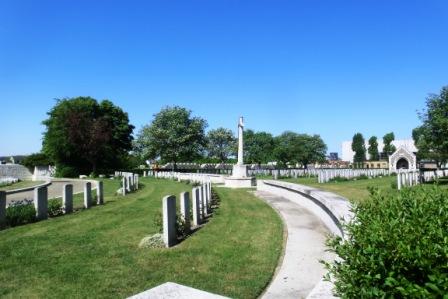
A small portion of Ostende New Communal Cemetery.  (Photo credit: Daria Valkenburg)

During our 2025 European War Memorial Tour, we visited Donald’s grave at Ostende New Communal Cemetery, and Pieter placed flags of Canada and Manitoba at his grave.

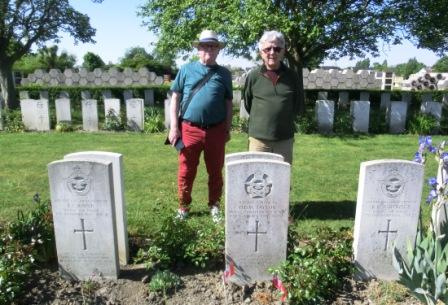
François Breugelmans and Pieter behind the grave of Donald David MacKenzie Taylor.  (Photo credit: Daria Valkenburg)

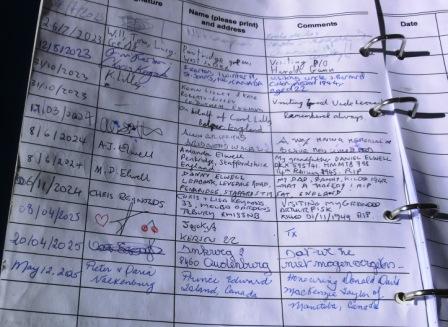
As always, we wrote a message in the visitors book. (Photo credit: Daria Valkenburg)

 …. We visited the North Sea coastline near Ostend….

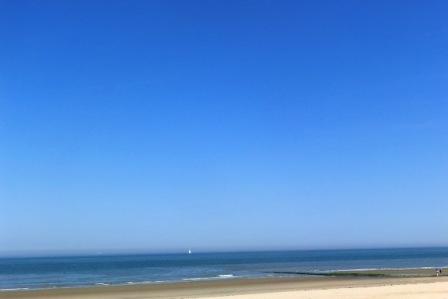
From the cemetery we drove towards the coast to take a photo of the North Sea.  The beaches in Ostend weren’t accessible so we went a bit further to Westeinde where there was a pedestrian walking area on the Koning Ridderdijk boardwalk, as well as rows of beach huts.  It was very built up and not at all like it would have looked on November 7, 1944, but the North Sea still looks the same.  It was a calm day, unlike what Donald and the No. 1 BSRU convoy would have faced on that fatal day.

The North Sea, as seen from Westeinde, Belgium.  (Photo credit: Daria Valkenburg)

….Other Canadian soldiers buried in Ostende New Communal Cemetery…

Also buried in Ostende New Communal Cemetery are 7 WWII soldiers and 2 WWI Canadian soldiers…

  • John Clarence BRUSH, son of John A. L. and Ethel Brush, of Windsor, Ontario, died February 14, 1945, age 18, while serving with the Royal Canadian Naval Volunteer Reserve as an Ordinary Telegraphist aboard HM Canadian Motor Torpedo Boat 465 (WWII)
  • Albert James CROSS, son of Minnie Cross, of Yorkton, Saskatchewan, died February 14, 1945, age 19,  while serving with the Royal Canadian Naval Volunteer Reserve as an Able Seaman aboard HM Canadian Motor Torpedo Boat 465 (WWII)
  • George Walter DOVE, son of George and Gladys E. Dove, husband of Orma M. Dove, of Toronto, Ontario, died April 5, 1945, while serving with the Royal Canadian Naval Volunteer Reserve as a Stoker 1st Class aboard H.M.C.S. Niobe (WWII)
  • Gordon Leroy ELLSWORTH, son of Roy Mac. Ellsworth and Marietta Ellsworth, of Port Colborne, Ontario, died September 10, 1942, age 22, while serving as Flight Sergeant in 158 (R.A.F.) Squadron with the Royal Canadian Air Force (WWII)
  • Ralph Reginald MACRAE, son of Major Herbert Hudson and Sarah Maria MacRae, of Campbellton, New Brunswick, died February 14, 1945, age 21, while serving with the Royal Canadian Naval Volunteer Reserve as a Leading Seaman aboard HM Canadian Motor Torpedo Boat 461 (WWII)
  • William James MARSHALL, son of Thomas and Catherine (nee Fraser) Marshall, aged 21, of Vancouver, British Columbia, died November 7, 1944, while serving as Sergeant with the Royal Canadian Air Force (WWII)
  • Eldon Sydney STEWARDSON, son of Gordon and Margaret T. Stewardson, of Prince Albert, Saskatchewan, died November 1, 1944, age 22, while serving as Sergeant with the Royal Canadian Armoured Corps (WWII)
  • Curtis Matthew DE ROCHIE, son of Mr Curtis and Mrs De Rochie, of Cornwall, Ontario, died July 14, 1917, age 31, while serving as 2nd Lieutenant with the Royal Flying Corps 27th Squadron (WWI)
  • George Gordon MACLENNAN, son of Reverend Alexander and Catherine MacLennan of Owen Sound, Ontario, died July 21, 1917, age 30, while serving as Flight Commodore with the Royal Naval Air Service (WWI)

Thank you to Ron Reesor and Alyna Reesor for submitting a photo of their uncle and grand-uncle, to Shawn Rainville for helping to find family members through newspaper searches, and to James Reesor for providing family history information. Thank you also to François Breugelmans and Mieke de Bie for joining us on the Belgian portion of our visit.

The flags placed at Donald’s grave were donated.  Our thanks go to:  

  • Alan Waddell, Constituent Assistant, on behalf of Heath MacDonald, MP for Malpeque, for the Canadian flag.
  • Wayne Ewasko, MLA for Lac Du Bonnet, Manitoba, Interim Leader of the Official Opposition, Province of Manitoba, who donated the Manitoba flag.

Our adventures continue as we share the highlights of our 2025 European War Memorial Tour. 

If you have a story or photo to share, please contact Pieter at memorialtrail@gmail.com or comment on the blog. 

© Daria Valkenburg

….Want to follow our research?…

If you are reading this posting, but aren’t following our research, you are welcome to do so.  Our blog address: https://onthewarmemorialtrail.com/

4 countries, 6 weeks, 7,000 km – an unforgettable war memorial journey in Europe…. Daria’s book ‘No Soldier Buried Overseas Should Ever Be Forgotten‘ is available in print and e-book formats.  Net proceeds of book sales help support research costs and the cost of maintaining this blog. For more information see https://nosoldierforgotten.com/

Subscribe to our YouTube Channel: On The War Memorial Trail With Pieter Valkenburg: https://www.youtube.com/channel/UCJ591TyjSheOR-Cb_Gs_5Kw

Never miss a posting!  Subscribe below to have each new story from the war memorial trail delivered to your inbox.

On The War Memorial Trail…..Our Visit To 4 Cemeteries In Friesland

July 23, 2025.  On a scorching hot sunny day, we travelled 2 hours to the province of Friesland, where we had planned to place flags at 4 cemeteries and to meet with Remko de Jong, a resident of Makkum, who coordinates the Christmas Eve Candle Lighting ceremony in his village and has shared photos with us for several years. (See https://onthewarmemorialtrail.com/2023/12/31/2023-christmas-eve-candle-lighting-in-the-netherlands/)

….Flags placed at 11 graves in Harlingen General Cemetery…

Our first stop on the war memorial trail in Friesland was at Harlingen General Cemetery in Harlingen, where we placed flags at 11 graves, 9 of them the graves of Canadian airmen. 

Daria at Harlingen General Cemetery.  (Photo credit: Pieter Valkenburg)

Pieter snapped the above photo of me at Harlingen General Cemetery, one of the 4 small cemeteries we visited today in the province of Friesland.  You can see me with a clipboard with names of the men and the provinces they came from so we knew which graves to visit and which provincial flags to place.

Pieter placing flags of Canada and Prince Edward Island at the grave of Elmer Bagnall Muttart. (Photo credit: Daria Valkenburg)

Our main reason for the trip to this cemetery was to place flags at the grave of RCAF Flight Sergeant Elmer Bagnall MUTTART of Cape Traverse, Prince Edward Island, who died on the night of October 12, 1941, at the age of 23, when the plane he was piloting was attacked by German nightfighters, and crashed near the village of Wons.  Elmer’s story has been well documented on this blog over the past years. (See https://onthewarmemorialtrail.com/2017/07/28/the-elmer-bagnall-muttart-story/)

Grave of Elmer Bagnall Muttart.  (Photo credit: Pieter Valkenburg)

We also placed flags at the grave of an unknown airman, in tribute to Rowan Charles ‘Bunky’ FITZGERALD of Charlottetown, Prince Edward Island, who lost his life on June 28, 1942, when the plane he was on was attacked and crashed into the sea.  His body has never been identified.  It’s not known if he’s buried in an unknown grave in this cemetery, but we lay flags there as one crew member from Australia was identified and is buried in the row behind Elmer Muttart. (See https://onthewarmemorialtrail.com/2022/10/12/on-the-war-memorial-trail-well-never-forget-uncle-bunky/)

We placed flags of Canada and Prince Edward Island at this unknown grave in honour of Rowan Charles ‘Bunky’ FitzGerald.  (Photo credit: Pieter Valkenburg)

In addition to visiting these two graves, we also placed flags at the graves of:

  • William Raymond James BROWN of Vancouver, British Columbia, died September 29, 1941 while serving in the RCAF
  • Donald Edward CAMPBELL of Rouleau, Saskatchewan, died June 26, 1943 while serving in the RCAF
  • Francis Arthur DAVIEAUX of Sioux Ste Marie, Ontario, died July 14, 1945 while serving in the Ontario Regiment
  • James MCDOWELL of Port Arthur (now part of Thunder Bay), Ontario, died May 16, 1943 while serving in the RCAF
  • Murray Hudley NESBITT of Toronto, Ontario, died May 13, 1943 while serving in the RCAF
  • John Beverley PLEASENCE of Chatham, Ontario, died July 22, 1942 while serving in the RCAF
  • William Maurice POPPLESTONE of Pilot Mound, Manitoba, died March 26, 1942 while serving in the RCAF
  • Thomas ‘Tommy’ Clayton REID of Toronto, Ontario, died July 22, 1945 while serving in the Sherbrooke Fusiliers
  • Robert WISHART of Hamilton, Ontario, died July 22, 1942 while serving in the RCAF

From Harlingen, we went towards Makkum, stopping at the Halifax L9561 Memorial Panel in Wons to place flags of Canada and Prince Edward Island in honour of the flight’s pilot and sole fatality, Elmer Bagnall MUTTART. (See https://onthewarmemorialtrail.com/2019/11/18/on-the-war-memorial-trail-the-memorial-panel-in-wons-is-unveiled/)

Pieter at the Memorial Panel in Wons, honouring the crew of the last flight of Halifax L9561.  (Photo credit: Daria Valkenburg)

…..Flags placed at two graves in Makkum…

In Makkum we met with Remko de Jong for lunch, and he joined us in visiting the next 3 cemeteries.  First up was the Donia Protestant Church Cemetery (also known as Wonseradeel (Makkum) Protestant Churchyard) in Makkum.

38 airmen are buried in this cemetery, which is located by Lake Ijsselmeer in the province of Friesland.  Most of the airmen’s bodies were recovered from the foot of the dikes surrounding Makkum, pushed there from the sea by winds blowing in from the southwest. Others were recovered by fishermen from Makkum who brought the corpses to their home port for burial.  (See https://www.zzairwar.nl/dossiers/954.html for more information.)

One of the airmen buried in Makkum is RCAF Flying Officer John Francis Edward TABOR of Ottawa, Ontario, who lost his life when the plane he was in, Halifax LK879 crashed at sea on the night of December 16, 1944 into December 17, 1944.  Remko mentioned that he had a very poor quality photo of this airman and asked for help in finding a better photo.  Pieter will have to add this request to his research list!

Another of the Canadian airmen buried in Makkum is RCAF Air Gunner Sgt George David NISBET of Conquest, Saskatchewan, whose body was recovered from the sea on June 7, 1944, after being reported missing on May 24.  He was aboard flight Halifax W1217 which was shot down by a nightfighter.

….We placed flags at one grave in Witmarsum…

Remko de Jong and Pieter at the grave of Stanley Adolfson Bishop. (Photo credit: Daria Valkenburg)

From Makkum we travelled to the village of Witmarsum. Our destination was the Wonseradeel (Witmarsum) Protestant Churchyard, where we placed flags at the grave of Stanley Adolfson BISHOP of Quebec, an RCAF Flying Officer serving with 100 Squadron of the Royal Air Force, died May 28, 1943, aged 26, when Lancaster III ED821 HW-A was shot down over The Netherlands by a night fighter. Six of the crew perished, with one survivor who became a prisoner of war.

…..Flags placed at two graves in Kimswerd…

Pieter outside Laurentiuskerk, where the cemetery in Kimswerd is located.  (Photo credit: Daria Valkenburg)

Our last cemetery stop was in the village of Kimswerd, to place flags at the graves of two airmen from 101 (RAF) Squadron, buried in the poorly maintained Wonseradeel (Kimswerd) Protestant Churchyard.  Both men were aboard Wellington III X3654 SR-K, in which all 6 crew members lost their lives.  

Thomas MCBRIDE of British Columbia, an RCAF Warrant Officer serving with 101 Squadron of the Royal Air Force, died August 18, 1942, aged 33.

Pieter and Remko de Jong by the grave of Earl Herbert Brown. To the left is the grave of Thomas McBride. (Photo credit: Daria Valkenburg)

Earl Herbert BROWN of Ontario, an RCAF Pilot Officer serving with 101 Squadron of the Royal Air Force, also died August 18, 1942, aged 26.

This concluded our visit to the 4 cemeteries in Friesland, but the day was not yet over! The three of us next travelled to De Tiid (The Times) Museum in Bolswerd, to look at an engine part belonging to the last flight of Halifax L9561, found at the crash site where Elmer Bagnall MUTTART lost his life. 

Over the next postings, we’ll continue to share the highlights of our adventures on the 2025 European War Memorial Trail on our journey of remembrance.  Next up – the visit to Bolsward.

The research work continues for Pieter. If you have photos or information to share about soldiers buried in The Netherlands or Belgium, or can contribute a photo of John Francis Edward TABOR, please email him at memorialtrail@gmail.com, or comment on the blog.    

© Daria Valkenburg

….Want to follow our research?…

If you are reading this posting, but aren’t following our research, you are welcome to do so.  Our blog address: https://onthewarmemorialtrail.com/

4 countries, 6 weeks, 7,000 km – an unforgettable war memorial journey in Europe…. Daria’s book ‘No Soldier Buried Overseas Should Ever Be Forgotten‘ is available in print and e-book formats.  Net proceeds of book sales help support research costs and the cost of maintaining this blog. For more information see https://nosoldierforgotten.com/

Subscribe to our YouTube Channel: On The War Memorial Trail With Pieter Valkenburg: https://www.youtube.com/channel/UCJ591TyjSheOR-Cb_Gs_5Kw

Never miss a posting!  Subscribe below to have each new story from the war memorial trail delivered to your inbox.