On The War Memorial Trail….The WWII Soldier From Winnipeg Who Was Recognized For His Heroism During The Dieppe Raid But Died During The Battle Of The Scheldt

January 21, 2026. For the past several years, in the week before Remembrance Day, the Winnipeg Free Press newspaper features a soldier on one of the photo search lists that Pieter gets from the Canadian War Cemeteries in The Netherlands.  For the November 2025 feature, journalist Kevin Rollason asked if Pieter had a soldier on his list from Winnipeg, my home town.

Pieter said yes, and asked if Kevin would feature a soldier, buried in the Canadian War Cemetery in Bergen Op Zoom, The Netherlands, who overcame a traumatic childhood and was recognized for ‘gallant and distinguished service’ during the Dieppe Raid (Operation Jubilee) on August 19, 1942, before losing his life on October 27, 1944, aged 22, during the Battle of the Scheldt. The search for a photo of the soldier was still active when Kevin’s story ‘Searching For A Hero’ was published on November 10, 2025.  (See Searching for a hero by Kevin Rollason)

Charles ‘Gordon’ ERICKSON was born July 27, 1922 in Winnipeg, Manitoba, the son of Frank and Helen (Ellen) Gordon (nee Grant) Erickson. According to their marriage record, Frank was born in USA, and Helen in Scotland. Gordon was the middle child, with an older sister, Hazel Francis, and a younger sister, Barbara ‘Nancy’.

….Gordon and his sister Nancy ended up in the care of the Children’s Aid Society…

It’s unclear exactly what happened, but before Gordon turned 5, the family had fractured.  A  Free Press Evening Bulletin notice from July 5, 1927 stated that Gordon and Nancy would be put into care of the Children’s Aid Society as of July 27, 1927.  The two children had been adopted by two different families. Unfortunately, both adoptions failed, putting them into care.

In the end, the two were separated from each other and didn’t reconnect until both were in service during WWII. The fate of their older sister Hazel was unknown to them.

Shortly after the Winnipeg Free Press article was published, Nancy’s son, Gordon Barker, contacted Pieter.  He explained that Frank “….worked on railroad and abandoned his wife and children, and it was believed that he returned to the USA.  Helen travelled to Minneapolis to look for him, had a nervous breakdown, and ended up in a mental institution, where she is thought to have died, circa 1966…. 

…. Gordon lied about his age upon enlistment…

Life was not easy for Gordon during his childhood.  When he enlisted on January 2, 1940 with the No. 5 General Hospital, Royal Canadian Army Medical Corps (RCAMC), Canadian Active Service Force (CASF), he wrote that he was born in 1918.  This was later changed to 1919, which was still incorrect as he was born in 1922.

His next of kin was originally listed as his father, but this was then changed to his Children’s Aid Society Guardian, Joseph Dumas. When asked if he had ever worked before enlistment, he stated that, from 1932 up to the date of enlistment, he had worked as a farmhand at the Smallicombe farm in Holland, Manitoba, receiving a weekly wage of $6 and his ‘keep’ (food and a place to sleep).  He had finished Grade 8 and listed soccer, swimming, and softball as sports he enjoyed.

….Gordon left Canada for overseas service…

Gordon worked as a medical orderly at No. 5 General Hospital in Winnipeg for almost the entire month of January.  On January 29, 1940, he boarded a ship in Halifax, Nova Scotia, and with other members of his unit, left Canada for the United Kingdom on January 30, 1940, sailing from Halifax, and disembarking in Gourock, Scotland on February 9, 1940. 

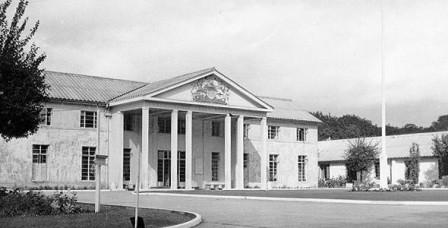
No. 5 Canadian General Hospital in Taplow.  (Photo source: Eton Wick History)

Once in Great Britain, Gordon continued as a medical orderly, at the 600 bed No. 5 Canadian General Hospital in Taplow, Buckinghamshire, until March 28, 1941. This wartime hospital, which looked after wounded soldiers, was established by the Canadian Red Cross in 1940 and had been built on land donated by the Astor family at their Cliveden Estate.

….Gordon was transferred to the Queen’s Own Cameron Highlanders of Canada…

On March 28, 1941, Gordon was transferred to the Queen’s Own Cameron Highlanders of Canada and sent for advanced infantry training. Then, on January 15, 1942, he was assigned to No. 2 Division Infantry Reinforcement Unit (DIRU) for additional training in preparation for the upcoming Dieppe Raid.  On May 1, 1942, he returned to the Queen’s Own Cameron Highlanders of Canada. 

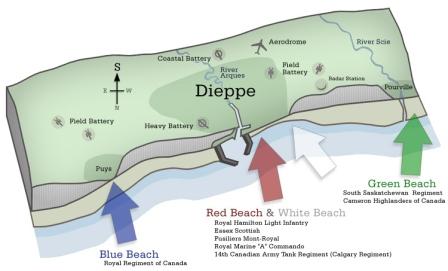
Map showing the Dieppe Raid. (Map source: https://cbf-fccb.ca/)

On August 18, 1942, Gordon travelled to France with the Regiment, and was part of the combined attack for the Dieppe Raid, known as Operation Jubilee, on August 19, 1942.  This was a disastrous Allied amphibious attack on the German-occupied port of Dieppe in northern France. (See https://www.veterans.gc.ca/en/remembrance/military-history/second-world-war/dieppe-raid and https://thecanadianencyclopedia.ca/en/article/dieppe-raid)

In the battle plan, the South Saskatchewan Regiment was to land in the first wave of the attack on Green Beach to secure the beach at Pourville, the right flank of the operation. The Queen’s Own Cameron Highlanders of Canada would then land in the second wave and move inland along the eastern bank of the Scie River to meet up with the tanks of the Calgary Regiment coming from Dieppe and capture the airfield at Saint-Aubin-sur-Scie. They would then clear the Hitler Battery and attack the suspected German divisional headquarters.

Things didn’t go as planned.  While the attack began on time (at 04:50 am) the South Saskatchewan Regiment landed west of the river, instead of in front of it. This didn’t pose a problem for the force aiming to clear the village and attack the cliffs to the west, but for the other force it meant they had to move through the village, cross the exposed bridge over the river before attempting to get on the high ground to the east.

The resulting delay gave the Germans had time to react and deploy, just as the Queen’s Own Cameron Highlanders of Canada came along in their landing craft as the second wave to attack on Green Beach.  As they reached 910 metres (1000 yards) off Green Beach, German shore batteries, machine guns, and mortars opened fire.  

….Gordon was wounded during the Dieppe Raid…

The main landing at Dieppe had been unsuccessful, and the failure of tanks to arrive made it impossible for the Regiment to gain its objectives. With increased German opposition and no communication with headquarters, the Regiment, which had advanced once reaching the beach, began to fight back to Pourville, carrying their wounded. They made it back and re-established contact with the South Saskatchewan Regiment, only to learn that there was an hour’s wait for the landing craft to return for re-embarkation.

Both the Queen’s Own Cameron Highlanders of Canada and the South Saskatchewan Regiment fought desperately during the wait, but there were too many casualties. At 11:00 am the landing craft began to arrive, taking grievous losses on the approach into the beach. More men were killed and wounded as they tried to board the landing craft under enemy fire. Five landing craft and one tank landing craft managed to rescue men from the shallows and cleared the beach with full loads, but within half an hour, no further rescues were possible.

Of 503 Queen’s Own Cameron Highlanders of Canada who participated in the raid, 346 were casualties: 60 were killed in action, 8 died of wounds after evacuation, and 167 became prisoners of war (with 8 POWs dying from their wounds). 268 returned to England, 103 of them wounded.

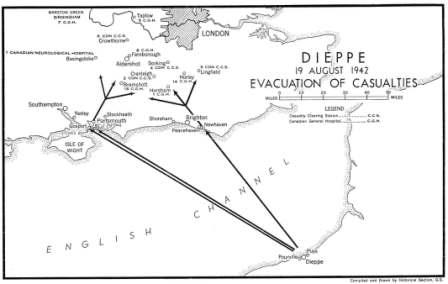
Evacuation of casualties from Dieppe to England on August 19, 1942.  (Map source: ‘Official History Of The Canadian Medical Services 1939-1945’)

Gordon was one of the men wounded during re-embarkation.  He was evacuated to No. 15 Canadian General Hospital in Bramshott, United Kingdom, with a shrapnel wound to his left ear. According to his hospital file the “….wound penetrated to the bone….” with “…some slight retraction of eardrum… Probably slight concussion as result of artillery fire….”  He remained in hospital until August 31, 1942, when the wound healed, and he was able to return to duty.

For his actions during the Dieppe Raid, King George VI was “…graciously pleased to approve that ….”  Gordon “…be mentioned in recognition of gallant and distinguished services in the combined attack on Dieppe…”  On December 8, 1942, Gordon was promoted to Lance Corporal, remaining in the United Kingdom for further training.

…. Nancy’s son Gordon had a photo of his uncle…

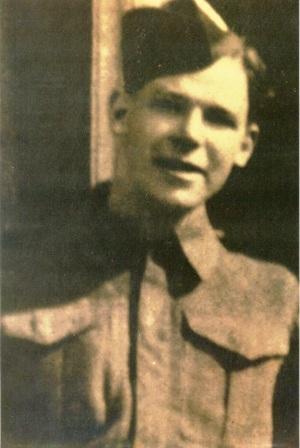
Charles ‘Gordon’ Erickson.  (Photo courtesy of Gordon Barker)

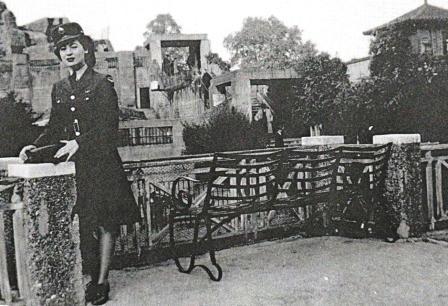
Gordon and his sister Nancy were reunited while both were serving in England.  Her son Gordon explained that his mother had joined the Royal Canadian Air Force (RCAF) on August 14, 1942, and served as a secretary for the military in London, England during the war, working on soldiers’ duty assignments and other administrative tasks. He had photos of both his mother and his uncle, who he was named after.

Nancy Erickson in England in 1942.  (Photo courtesy of Gordon Barker)

….Gordon was very highly regarded…

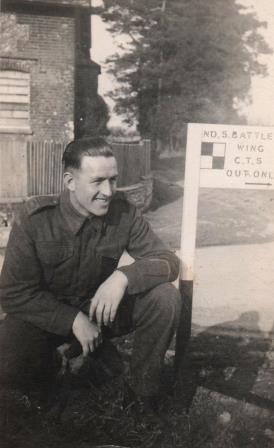
Gordon quickly received another promotion, to Corporal, on January 31, 1943.  In June 1943, he was sent to No. 5 (Battle) Wing Canadian Training School at Rowland’s Castle, Hampshire, England, for a 4 week Battle Drill course which trained Canadian soldiers in how to react when coming under enemy fire. (See https://www.southdowns.gov.uk/wp-content/uploads/2017/01/The-Canadian-Army-Battle-Drill-School-Stansted-Park-1942.pdf)

The course tried to mimic combat conditions, using obstacle courses and simulated battlefields, live rounds fired over the heads of students, controlled explosions, target practice, and dummies to bayonet.

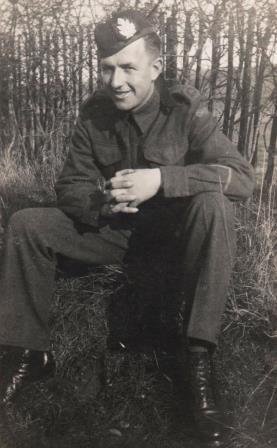
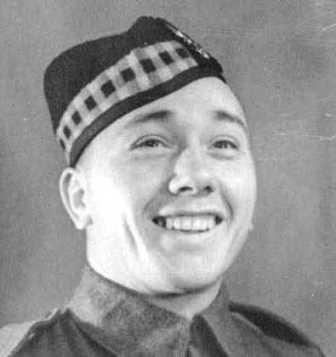
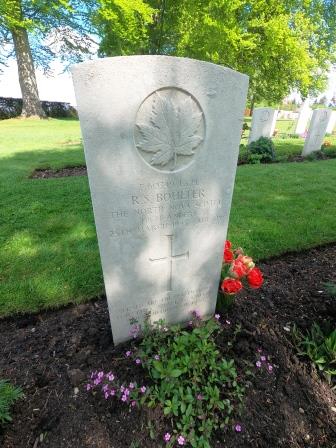
One of Gordon’s instructors may have been Ralph Schurman BOULTER, whose story was previously told on this blog. (See https://onthewarmemorialtrail.com/2023/03/07/on-the-war-memorial-trail-the-battle-of-bienen-part-2-the-wwii-battle-drill-instructor-from-oleary/)

A September 21, 1943 interviewer wrote in Gordon’s service file that he had “….very high learning ability, a good appearance, and a pleasant personality….”  It further noted that Gordon requested “…any courses on supporting infantry weapons…

….Gordon and the Queen’s Own Cameron Highlanders of Canada arrived in France in July 1944….

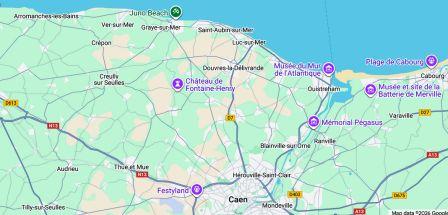
The Queen’s Own Cameron Highlanders of Canada Regiment disembarked in Graye-sur-Mer and made their way towards Caen.  (Map source: Google maps)

Gordon and the Queen’s Own Cameron Highlanders of Canada Regiment continued training while in the United Kingdom, but on July 5, 1944, a month after D-Day, they left aboard USOS ‘Will Rogers’ from Newhaven, Sussex for Normandy, as part of the as part of the 6th Canadian Infantry Brigade, 2nd Canadian Infantry Division, arriving in Graye-sur-Mer, Calvados, France 2 days later. 

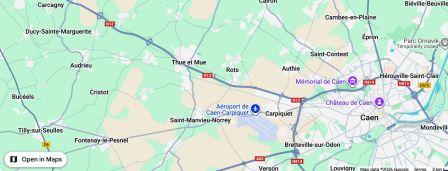
By July 12, 1944, Battalion headquarters was based in an orchard near Rots, France, and the troops were dispersed outside of Caen, with the Queen’s Own Cameron Highlanders of Canada sent to Carpiquet. The war diary for that day noted that “…the town was completely demolished. Battalion takes up defence position…

The Queen’s Own Cameron Highlanders of Canada Regiment were west of Caen in Carpiquet.  (Map source: Google maps)

….Gordon was injured during the Battle of Saint André-sur-Orne….

The Battalion was ordered to capture the village of Saint André-sur-Orne, located south-west of Caen. They reached it on July 20, 1944, with rain hindering operations. The Allies faced stiff resistance as they began Operation Spring, a major bombardment that took place on the night of July 24-25, to capture the heights of Verrières Ridge, which overlooks the area between Caen and Falaise. (See https://www.canadiansoldiers.com/history/battlehonours/northwesteurope/verrieresridge.htm)

Part of Operation Spring was the Battle of Saint André-sur-Orne, a village on the starting line of the offensive.  It was captured by the Queen’s Own Cameron Highlanders of Canada (6th Infantry Brigade, 2nd Infantry Division) Canadians to the north.

At some point during the battle, Gordon was wounded and evacuated to the United Kingdom for treatment.  He remained in the United Kingdom from July 26 to September 23, 1944, after which he returned to his Regiment on September 24, 1944.  By now, the Regiment had left France and was in the vicinity of Sint-Job-in-‘t-Goor, in the province of Antwerp, Belgium.

Gordon arrived just after a failed offensive, where Canadian and British troops had tried to secure an undamaged bridge over the Turnhout-Schoten Canal on September 23, 1944. Due to fierce German resistance Allied troops were unable to prevent the enemy from blowing up the bridge.

….The Queen’s Own Cameron Highlanders of Canada were involved in the Battle of the Scheldt….

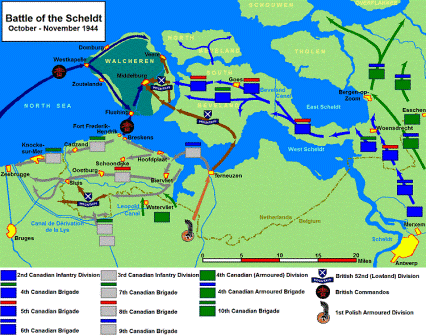
The Regiment next began preparing to participate in the upcoming Battle of the Scheldt, which began officially on October 2 and lasted until November 8, 1944.  The Battle of the Scheldt’s objective was to free up the way to the Port of Antwerp in Belgium for supply purposes. Canadians suffered almost 8,000 casualties (wounded and dead) in what turned out to be the battle with the most Canadian casualties in The Netherlands. (See https://www.veterans.gc.ca/eng/remembrance/history/second-world-war/scheldt)

Map shows location of South Beveland and Walcheren Island  in The Netherlands.  (Map source: http://www.canadiansoldiers.com)

The War Diary for October 25, 1944 stated that at 9 pm they were ordered to move the next day to an area “…in the Beveland Causeway…” 

The Beveland Causeway, also known as the Sloedam, was a narrow land link between South Beveland and Walcheren Island in The Netherlands, crucial for gaining access to the port of Antwerp, and the site of brutal, costly battles in 1944 as Canadian forces fought to secure it against German defenders. This narrow strip, bracketed by marshes, was a heavily defended bottleneck, becoming the focus of fierce assaults. 

The War Diary for October 26, 1944 described the challenges faced as they moved into position and were attacked by 88 mm German guns.  “…Enemy 88 mm lays direct fire on crossroads as Battalion embusses…..”  There were no casualties at this point, but one vehicle was damaged.  However, as they moved along the road onto the Beveland Causeway, the convoy was “…mortared as it proceeded…” resulting in a few non-fatal casualties.  At 3 pm they were ordered to reverse direction towards the village of Yerseke.

….Gordon lost his life during the Battle of the Scheldt….

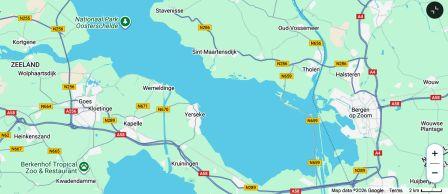
The Queen’s Own Cameron Highlanders of Canada moved back from the Beveland Causeway towards Yerseke. (Map source: Google maps)

The War Diary for October 27, 1944 continued to document the struggles faced by the Battalion as they entered Yerseke and took up positions north of the village.  The day was “…overcast, visibility poor, light mist, light rain….Battalion enters Yerseke at first light…”  They were ordered to cross the canal at a “…small footbridge one company at a time…” The plan was for “…two companies to form bridgehead while two companies push out to take Wemeldinge…

Things didn’t go according to plan.  “…It was found impossible to cross footbridge due to mortars and one 88 mm gun….”  At 6:30 pm, Plan B called for “…companies to take up positions along canal bank.  Battalion will try crossing by assault boat at 2100 hours…

While waiting for the assault boats, the men were hit by “…enemy mortars and shells….6 wounded, 2 killed…”  The crossing by assault boats didn’t go well, as the 10:30 pm report in the War Diary recorded. “…Battalion attack across canal repulsed by enemy mortar and heavy machine gun fire.  Two companies landed on island … All boats but one sunk, that one boat retired two companies to East bank under heavy fire…

22 year old Gordon was among the fatalities that day, likely one of the two men killed while waiting for the assault boats to arrive.  

….Gordon is buried in Bergen Op Zoom…

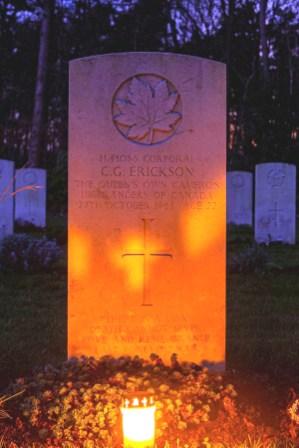
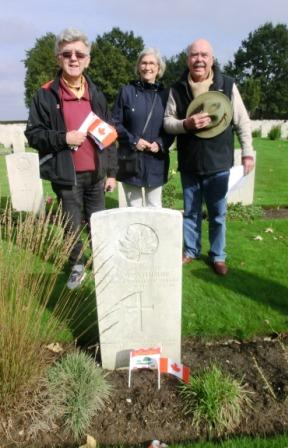
Grave of Charles ‘Gordon’ Erickson in the Canadian War Cemetery in Bergen Op Zoom, The Netherlands with a Christmas Eve candle.  (Photo courtesy of Caroline Raaijmakers)

Gordon was temporarily buried on October 31, 1944 in the cemetery in Sint-Maartensdijk, before being reburied in the Canadian War Cemetery in Bergen Op Zoom, The Netherlands on September 5, 1945. 

Gordon’s younger sister, Nancy Erickson Vincent, survived the war, had two sons, and lived in Espanola, Ontario until her death in 2014.  His older sister, Hazel Francis Erickson Kerr, lived in St Thomas, Ontario, but had died by the time she was found by Nancy’s son Gordon Barker in 2006.

By then, Nancy had fallen ill with dementia. “….I didn’t tell her that I found her sister because her sister had already passed away by that time….” he said. “…With the dementia and everything going on, I didn’t want to cause her any more pain…” 

Thank you to Shawn Rainville for newspaper searches, and to Judy Noon of the Royal Canadian Legion Branch 39 in Espanola, Ontario for contacting Gordon Barker.  A big thank you goes to Gordon Barker for providing photos and information, and to Kevin Rollason for writing a newspaper article highlighting the search for a photo. 

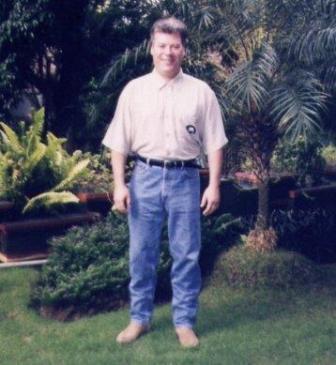
Gordon Barker in Bogor, Indonesia. (Photo courtesy of Gordon Barker)

If you have photos or information to share about soldiers buried in The Netherlands or Belgium, please email him at memorialtrail@gmail.com, or comment on the blog.    

© Daria Valkenburg

….Want to follow our research?…

If you are reading this posting, but aren’t following our research, you are welcome to do so.  Our blog address: https://onthewarmemorialtrail.com/
4 countries, 6 weeks, 7,000 km – an unforgettable war memorial journey in Europe…. Daria’s book ‘No Soldier Buried Overseas Should Ever Be Forgotten‘ is available in print and e-book formats.  Net proceeds of book sales help support research costs and the cost of maintaining this blog. For more information see https://nosoldierforgotten.com/

Subscribe to our YouTube Channel: On The War Memorial Trail With Pieter Valkenburg: https://www.youtube.com/channel/UCJ591TyjSheOR-Cb_Gs_5Kw

Never miss a posting!  Subscribe below to have each new story from the war memorial trail delivered to your inbox.
On The War Memorial Trail…. The Faces Of Groesbeek Exhibition Part 1: The Soldiers From Prince Edward Island

CIMG6201 Apr 27 2023 Dutch flag by garage

The Dutch flag flew proudly at the Valkenburg household on Liberation Day.   (Photo credit: Pieter Valkenburg)

May 16, 2023.  One of the events planned for the 75th Anniversary of the Liberation of The Netherlands in May 2020 was to place photos by the graves of soldiers at the Canadian War Cemetery in Groesbeek, The Netherlands.  Unfortunately, due to social distancing measures from Covid, this was postponed for a year.

In 2021, photos were placed at more than 1,600 graves for three weeks.  The event was so successful that the Commonwealth War Graves Commission, which oversees the cemetery, gave permission for photos to be placed by the graves every two years.

…The Faces Of Groesbeek Exhibition 2023 includes almost 2,000 photos…

This year, The Faces Of Groesbeek Exhibition runs from April 30 to May 21, 2023, with almost 2,000 photos, just over 350 more than 2 years ago!  Photos are printed onto an aluminum backing, making them impervious to rain, and reusable.

CIMG8927 Sep 15 2017 Entrance to Groesbeek cemetery

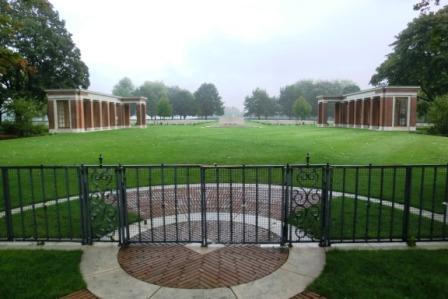
View as you enter the Canadian War Cemetery in Groesbeek – before the photo exhibition.  (Photo credit: Daria Valkenburg)

Volunteers from Faces To Graves Foundation Groesbeek, of which Alice van Bekkum is the Chair, worked tirelessly to make this exhibition possible, and to organize the Liberation Day commemoration events.

Pieter has been involved in finding photos of Canadians who are buried in all three Canadian War Cemeteries in The Netherlands since 2014, with many of their stories told on this blog.

…5 Islanders Commemorated…

In this posting, the graves and photos of five soldiers from Prince Edward Island, whose stories have previously been told, are featured.

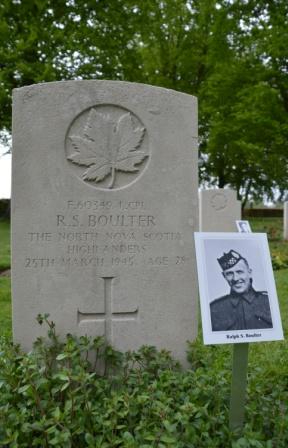
BOULTER Ralph Schurman - XIX C 01(1)

Ralph Schurman Boulter. (Photo courtesy of Faces To Graves Groesbeek)

Ralph Schurman BOULTER of O’Leary was serving with the North Nova Scotia Highlanders when he was killed on March 25, 1945, during the Battle of Bienen in Germany, at the age of 27. You can read his story at https://onthewarmemorialtrail.com/2023/03/07/on-the-war-memorial-trail-the-battle-of-bienen-part-2-the-wwii-battle-drill-instructor-from-oleary/

IMG_8925 George Ivan MacKinnon

Grave of George ‘Ivan’ MacKinnon.  (Photo courtesy of Ad Scheepers)

George ‘Ivan’ MACKINNON of Albion was serving with the North Nova Scotia Highlanders when he was killed on December 4, 1944, during the defence of the Nijmegen Salient in The Netherlands, at the age of 27. You can read his story at https://onthewarmemorialtrail.com/2022/11/02/on-the-war-memorial-trail-the-wwii-soldier-from-albion-who-died-during-the-defence-of-the-nijmegen-salient/

IMG_8941 Barney McGuigan

Grave of Bernard ‘Barney’ Reuben McGuigan.  (Photo courtesy of Alice van Bekkum)

Bernard ‘Barney’ Reuben MCGUIGAN of Sturgeon was serving with the North Shore (New Brunswick) Regiment when he was killed on February 26, 1945, during Operation Blockbuster in Germany, at the age of 16. You can read his story at https://onthewarmemorialtrail.com/2020/08/07/on-the-war-memorial-trail-the-search-for-barney-reuben-mcguigan/ and https://onthewarmemorialtrail.com/2021/12/23/on-the-war-memorial-trail-the-photo-search-for-barney-mcguigan-is-successful/

IMG_8935 John Clifford Rogers

Grave of John ‘Clifford’ Rogers. (Photo courtesy of Alice van Bekkum)

John ‘Clifford’ ROGERS of Hope River was a sapper with the North Shore (New Brunswick) Regiment when he and six other soldiers died on March 3, 1945 in the Balburger Wald, Germany.  He was 19 years old.  You can read his story at https://onthewarmemorialtrail.com/2021/08/24/on-the-war-memorial-trail-the-search-for-a-photo-of-john-clifford-rogers-is-successful/

SMITH Edison Alexander - V H 13

Edison Alexander Smith. (Photo courtesy of Faces To Graves Groesbeek)

Edison Alexander SMITH of West Point was serving with the North Nova Scotia Highlanders when he was killed on March 25, 1945, during the Battle of Bienen in Germany, at the age of 32. You can read his story at https://onthewarmemorialtrail.com/2023/03/04/on-the-war-memorial-trail-the-battle-of-bienen-part-1-the-wwii-soldier-whose-body-shielded-a-wounded-major/

…The search for photos continues…

What is striking is how many photos have been found! Out of 2,619 graves in the cemetery, 2,338 are Canadian, with 103 in graves marked ‘unknown’.  Wouldn’t it be wonderful if photos for all of the known graves of Canadians buried in Groesbeek will be found for The Faces Of Groesbeek Exhibition in 2025?

Thank you to Alice van Bekkum and Ad and Noor Scheepers for taking these photos. The Dutch continue to stress the importance of remembrance to the next generation so they can continue to remember those who lost their lives in WWII.

In Part 2, the graves and photos of Indigenous soldiers whose families contacted us will be featured.

If you have a photo of a soldier buried at the Canadian War Cemetery in Groesbeek or one of the other cemeteries in The Netherlands, Pieter encourages you to email him at memorialtrail@gmail.com, or comment on the blog.

© Daria Valkenburg

…Previous postings about The Faces Of Groesbeek Exhibition at the Canadian War Cemetery in Groesbeek…

…Want to follow our research?…

Follow our blog

If you are reading this posting, but aren’t following the blog, you are welcome to do so. Our blog address: https://onthewarmemorialtrail.com/.

Front cover OnTheWarMememorialTrailinEurope4 countries, 6 weeks, 7,000 km – an unforgettable war memorial journey in Europe…. Daria’s book ‘No Soldier Buried Overseas Should Ever Be Forgotten‘ is available in print and e-book formats.  Net proceeds of book sales help support research costs and the cost of maintaining this blog. For more information see https://nosoldierforgotten.com/

You are also invited to subscribe to our YouTube Channel: On The War Memorial Trail With Pieter Valkenburg: https://www.youtube.com/channel/UCJ591TyjSheOR-Cb_Gs_5Kw.

Never miss a posting!  Subscribe below to have each new story from the war memorial trail delivered to your inbox.
On The War Memorial Trail….. The Battle of Bienen – Part 2: The WWII Battle Drill Instructor From O’Leary

March 7, 2023. After Alice van Bekkum, Chair of the Groesbeek Cemetery Faces To Graves Foundation, sent Pieter a list of 39 soldiers from the North Nova Scotia Highlanders Regiment who were killed during the Battle of Bienen in Germany on March 25, 1945, we realized that we had attended a graveside commemoration at the Canadian War Cemetery in Groesbeek, The Netherlands in 2017 for two soldiers from this list:  Ralph Schurman BOULTER and Edison Alexander SMITH, both from Prince Edward Island.

CIMG9004 Sep 15 2017 sign giving directions to Groesbeek Cemetery

Directional sign to the Canadian War Cemetery in Groesbeek, The Netherlands. (Photo credit: Daria Valkenburg)

….The 2017 Commemoration at Groesbeek…..

On September 15, 2017, we were invited by Alice van Bekkum to be present when Nova Scotia resident Harriet Jenereux, the daughter of Smith, came to visit her father’s grave plus the grave of Boulter, her mother’s brother.   We accepted the invitation and made sure we placed flags at the graves of both men, as well as on the graves of several men who were on our list. (See the original posting at https://onthewarmemorialtrail.com/2017/12/25/on-the-war-memorial-trail-at-the-canadian-war-cemetery-in-groesbeek/)

CIMG8944 Sep 15 2017 Groesbeek cemetery grave of Ralph Schurman Boulter

Grave of Ralph Schurman Boulter at Groesbeek Canadian War Cemetery. (Photo credit: Daria Valkenburg)

….Ralph enlisted with the PEI Highlanders in 1940…..

A Christmas baby, Ralph Schurman BOULTER was born December 25, 1917 in O’Leary, Prince Edward Island, the son of Mcneil ‘Neil’ Amos and Ella May (nee Schurman) Boulter.  When he enlisted with the PEI Highlanders in Charlottetown, Prince Edward Island on July 10, 1940, he stated he was born in 1917. 

However, upon his death, his mother stated he was born in 1918 in the Estate Form.  This would be incorrect, as when Ralph married Mary Catherine MacEachern in Armdale, Nova Scotia on February 7, 1942, he was 24 years old – consistent with a birth year of 1917.

Boulter from CVMM

Ralph Schurman Boulter.  (Photo courtesy of Canadian Virtual War Memorial)

After enlisting, Ralph remained with the PEI Highlanders for basic training, before being transferred to No. 6 Depot in Halifax, Nova Scotia on October 15, 1941. 

He applied for permission to marry, which was granted.  Unfortunately, the couple didn’t have a long time together, as Ralph was sent overseas two months later, leaving Halifax on April 9, 1942 and arriving in the United Kingdom on April 19, 1942.

….Ralph was a Battle Drill instructor in the UK…..

Upon arrival in the United Kingdom he was allocated to the Cape Breton Highlanders for a week, before transferring to No. 5 Canadian Infantry Reinforcement Unit (CIRU) Armoured Division. 

Boulter from Van Virt war mem

Ralph at No. 5 (Battle) Wing Canadian Training School in the UK.  ((Photo courtesy of Canadian Virtual War Memorial)

On May 1, 1942 he was seconded as a Battle Drill instructor to No. 5 (Battle) Wing Canadian Training School at Rowland’s Castle, Hampshire, England, which trained Canadian soldiers in Battle Drill, a course which taught men how to react when coming under enemy fire.

The course tried to mimic combat conditions, using obstacle courses and simulated battlefields, live rounds fired over the heads of students, controlled explosions, target practice, and dummies to bayonet.

a132776-v6 Battle WIng drill

Unidentified infantrymen taking part in a training exercise, No.5 (Battle) Wing, Canadian Training School (Canadian Army Training Centres and Schools), Rowland’s Castle, England, 8 June 1943. (Photo source:  Library and Archives Canada/Department of National Defence fonds/a132776)

Ralph remained there until November 9, 1944, when he was transferred to No. 3 Canadian Infantry Training Regiment (CITR). 

….Ralph went from Battle Drill instructor to actual combat…..

He left the United Kingdom for Northwest Europe on December 31, 1944, arriving the following day.  On February 13, 1945 he was transferred to the North Nova Scotia Highlanders, joining the Regiment in Germany, where he would have been reunited with his brother-in-law, Edison Alexander Smith.

On February 12, the Regiment had reached Kellen, Germany near Kleve, just on the other side of the border with The Netherlands.  On February 14, using amphibious vehicles, the North Novies evacuated Warbergen as they made their way to Emmerich.

Next, the Regiment participated in Operation Blockbuster.  (See https://en.wikipedia.org/wiki/Operation_Blockbuster). 

On March 6, 1945, Ralph received a promotion to Lance Corporal.  Meanwhile, the Regiment prepared for Operation Plunder, which began March 21, 1945 and ended April 1, 1945, and involved the crossing of the Rhine River to the north of the Ruhr industrial region in western Germany. With aerial and military support, this took place on the night of March 23, 1945 near Rees, a town situated on the right bank of the Rhine River, approximately 20 km (12.4 miles) east of Kleve. (See https://en.wikipedia.org/wiki/Operation_Plunder)

…Ralph lost his life in the Battle of Bienen ….

On the next afternoon, March 24, 1945, they encountered fierce German resistance near the village of Bienen. On March 25, 1945, the North Nova Scotia Highlanders were in Bienen, Germany for the climax of 9 Canadian Infantry Brigade’s role in Operation Plunder. The one day battle proved devastating in terms of casualties, both dead and wounded, as they fought in a deadly battle on open ground.  

Plunder 015 Aerial of Bienen from 23 March 45, just prior to the Rhine Crossing (Courtesy Becker) ww2talk

Aerial view of Bienen taken on March 23, 1945, just prior to the Rhine Crossing (Map source: http://www.WW2Talk.com and identified as ‘Courtesy Becker’)

It was Palm Sunday, one week before Easter.  The war diary for March 25, 1945 noted the challenges the North Novies faced.  “….The weather – sunny and clear.  The day of the battle, 25 March 1945. …. The battalion objective was to be the town of BIENEN… code name ASTOR, which was formerly the objective of the 7th Argyll and Sutherland Highlanders. They had penetrated as far as farm buildings … but had had two attacks on BIENEN beaten off with heavy casualties.

BIENEN was of tremendous importance to the Germans because it was the focal point of a narrow bottleneck controlling two main roads, the one to EMMERICH… and the other to MILLINGEN.  Secondly, it was of extreme importance that the narrow bridgehead was expanded quickly North and North-East to protect it from enemy mortaring and shelling and allow bridging to be put up.

The enemy were strongly dug in around and in BIENEN itself. They were fresh troops of the 115 Panzer Grenadier Regiment, and fighting fanatically to hold this vital objective. The approach was over 300 yards of flat open country with only a dyke running from the Start Line up the left hand edge of the town….

Right from the start, troops were pinned down, …suffering heavy casualties…”  Worse, in terms of communications, “….contact between platoons was next to impossible because of the murderous fire and heavy mortaring….

During the heavy fighting, Ralph lost his life.  He was temporarily buried the next day in the military cemetery in Rees, Germany before being reburied the following year in the Canadian War Cemetery in Groesbeek, The Netherlands.

Out of the 39 North Nova Scotia Highlanders killed on March 25, 1945 during the Battle of Bienen that are buried in Groesbeek, 12 were on a photo wish list. Pieter has been successfully working his way through this list and we hope to tell each of their stories in upcoming postings. Coming up in Part 3: Charles ‘Marshall’ Carson.

If you have a story to tell, please let Pieter know. Email him at memorialtrail@gmail.com, comment on the blog, or tweet to @researchmemori1

© Daria Valkenburg

….Previous stories about North Novies killed during the Battle of Bienen and buried in Groesbeek….

…Want to follow our research?….

If you are reading this posting, but aren’t following the blog, you are welcome to do so. Our blog address: https://onthewarmemorialtrail.com/

Front cover OnTheWarMememorialTrailinEurope4 countries, 6 weeks, 7,000 km – an unforgettable war memorial journey in Europe…. Daria’s book ‘No Soldier Buried Overseas Should Ever Be Forgotten‘ is available in print and e-book formats.  Net proceeds of book sales help support research costs and the cost of maintaining this blog. For more information see https://nosoldierforgotten.com/

You are also invited to subscribe to our YouTube Channel: On The War Memorial Trail With Pieter Valkenburg: https://www.youtube.com/channel/UCJ591TyjSheOR-Cb_Gs_5Kw

Never miss a posting!  Subscribe below to have each new story from the war memorial trail delivered to your inbox.
On The War Memorial Trail….. The Battle of Bienen – Part 1: The WWII Soldier Whose Body Shielded A Wounded Major

March 4, 2023. Last fall, Alice van Bekkum, Chair of the Groesbeek Cemetery Faces To Graves Foundation, sent Pieter a list of 39 soldiers from the North Nova Scotia Highlanders Regiment who were killed during the Battle of Bienen in Germany on March 25, 1945. Although there were more casualties from this battle, the list was of North Novies buried in the Canadian War Cemetery in Groesbeek, The Netherlands.

Not only were we were astonished at the number of casualties, but the date of the battle was very meaningful.  “…They died on my birthday! I was just one year old!…” Pieter exclaimed. 

In looking over the list, we realized that we had already briefly told the story of one – Harry William DOUCETTE of Yarmouth, Nova Scotia – and we had attended a graveside commemoration at the Canadian War Cemetery in Groesbeek, The Netherlands in 2017 for two other soldiers:  Ralph Schurman BOULTER and Edison Alexander SMITH, both from Prince Edward Island.

….The 2017 Commemoration at Groesbeek…..

On September 15, 2017, we were invited by Alice van Bekkum to be present at the commemoration for two soldiers from the Island.  The reason?  Nova Scotia resident Harriet Jenereux, the daughter of Smith, was coming to visit her father’s grave for the first time.  She would also visit the grave of Boulter, who was her mother’s brother.  

Harriet’s trip had been sponsored by Wish Of A Lifetime Canada (see https://wishofalifetime.ca/), an organization that fulfills seniors’ dreams and shares their stories to inspire those of all ages. Phillips was the sponsor for this program in The Netherlands. (See the original posting at https://onthewarmemorialtrail.com/2017/12/25/on-the-war-memorial-trail-at-the-canadian-war-cemetery-in-groesbeek/)

CIMG8961 Sep 15 2017 Groesbeek Cemetery grave of Edison Alexander Smith

Grave of Edison Alexander Smith in the Canadian War Cemetery in Groesbeek.  (Photo credit: Daria Valkenburg)

We had come earlier that day to place flags at graves, and of course included Smith and Boulter on the list.  Alice brought a photo of Edison Alexander Smith to place by his grave for the commemoration, as well as a candle for Harriet.

CIMG8950 Sep 15 2017 Groesbeek cemetery Harriet Jenereux at her fathers grave

Harriet Jenereaux kneels at her father’s grave. (Photo credit: Daria Valkenburg)

CIMG8953 Sep 15 2017 Groesbeek cemetery Harriet Jenereux and Pieter

Pieter chats with Harriet Jenereux after the commemoration. (Photo credit: Daria Valkenburg)

In 2017, we only knew that Smith, aged 32, and Boulter, aged 28, were in the North Nova Scotia Highlanders, and were both killed in battle in Germany on March 25, 1945. With the Battle of Bienen firmly on Pieter’s radar, he began his research.

…Edison Alexander Smith enlisted in 1940….

Born October 7, 1912 in West Point, Prince Edward Island to Samuel Dumville and Bertha Burrows (nee MacDonald) Smith, Edison Alexander SMITH was a fisherman before enlisting with the North Nova Scotia Highlanders on July 2, 1940 in Charlottetown, Prince Edward Island. 

In his Occupational History Form, he stated that he had worked as a lobster buyer for W. A. Broidy in Pictou, Nova Scotia for the past 13 years.  He also helped his father, a lobster fisherman, during the summer, and worked as a lumberman in the winter.

He had married Helen Angeline, nee Boulter, on April 10, 1940, a few months before his enlistment.  A few weeks after his enlistment, on July 20, 1940, their son Douglas Scott was born.

Edison A Smith from CVWM

Edison Alexander Smith.  (Photo courtesy of Canadian Virtual War Memorial)

After completing basic training in Amherst, Nova Scotia, he was sent to Debert, Nova Scotia in preparation for overseas service.

On July 20, 1941 he left Halifax, Nova Scotia for the United Kingdom, arriving in Avonmouth on July 31, 1941.   A few months later, on December 21, 1941, his daughter Harriet Elaine was born.

Edison was temporarily transferred to the Signals Relief Unit on August 28, 1942, before rejoining the North Nova Scotia Highlanders on December 18, 1942.

On June 6, 1944, he was with his Regiment for D-Day in France.  He was wounded on July 25, 1944 with a fractured right femur, and sent to 21 Canadian General Hospital in Bramshott, England.  He returned to duty in France a month later, on August 25, 1944.

While the Regiment was engaged in the Battle of the Scheldt, Edison ended up in hospital again on October 8, 1944, this time due to cellulitis on his leg, but was discharged on October 19, 1944.

He was again hospitalized on December 14, 1944, and discharged on January 7, 1945. 

On February 19, 1945 Edison was promoted to Acting Sergeant.  This was changed to Sergeant upon his death.

…Edison lost his life in the Battle of Bienen ….

By March 20, 1945, Allied troops were on the banks of the Rhine River for Operation Plunder, a military operation to cross the Rhine on the night of March 23, 1945. (See https://en.wikipedia.org/wiki/Operation_Plunder)

On March 25, 1945 the North Nova Scotia Highlanders were in Bienen, Germany for the climax of 9 Canadian Infantry Brigade’s role in that Operation. The one day battle proved devastating in terms of casualties, both dead and wounded.

Map Bienen Mar 25 1945 Project '44

Map shows position of North Novies on March 25, 1945, near Bienen.  (Map source: Project ’44)

In ‘No Retreating Footsteps’ by Will Bird, he reported that during the battle, Major Dave DICKSON and his platoon commanders, including Lt Lorne MONKLEY, “…arranged that the company would advance eastward beside the dyke which ran past the north side of the nearer buildings of the town…During the action, Major Dickson “…was struck down by a bullet at the climax of the dyke crossing….

In the article ‘Too Close To The Guns!’ in Canadian Military History, Volume 12, Numbers 1& 2, Winter/Spring 2003, pp.5-28, author Lee Windsor recorded that …One of Monkley’s section commanders, Sergeant Edison Smith, ran back over the dyke to contact the tanks and Wasps back at the … firebase. A mortar bomb exploded as he reached the top of the dyke, heaving his broken body on top of Dickson and then down the slope….” Edison lost his life, but his body shielded Major Dickson, who survived. 

He was temporarily buried in the Canadian Military Cemetery in Bedburg, Germany before being reburied in the Canadian War Cemetery in Groesbeek, The Netherlands in 1947.

…What happened to Edison’s photos?….

This would normally be the end of Edison’s story, except for a November 1, 1945 letter written to the Estates Branch of the Canadian Army by Edison’s widow.  She inquired about the photos she had sent over the years to her husband, which had not been returned with his effects.

In her letter she explained that her husband “…had a very close friend …. Sgt Johnson, also of ‘D’ Company. When my husband died, Lt Lorne Monkley of Summerside, PEI, wrote me, saying Sgt Johnson would write me as when my husband was wounded he had given Sgt Johnson mine and the childrens’ photos and snapshots and other articles to keep for him until he was back in the Unit again…”  She was aware that Sgt Johnson died shortly after her husband, and wondered if her husband’s effects had been sent to Sgt Johnson’s family.

Edison was wounded in July 1944, and his last hospitalization was in December 1944.  There is no record of any other hospitalizations or injuries recorded in his service file.  It seems unlikely that Sgt Johnson would still have Edison’s photos in March 1945.

In a remarkable coincidence, Pieter knew who Sgt Johnson was, as his story had been told in this blog in 2021. Sgt Gordon Frederick ‘Geordie’ JOHNSON, of Truro, Nova Scotia lost his life on April 8, 1945, two weeks after Edison died, and is buried in the Canadian War Cemetery in Holten, The Netherlands. (See https://onthewarmemorialtrail.com/2021/07/17/on-the-war-memorial-trail-the-search-for-a-photo-of-gordon-frederick-johnson-is-over/)

An inquiry has been made to the family of Geordie Johnson, inquiring if by some chance they knew of any ‘mystery’ photos that had been received with his effects.

Out of the 39 North Nova Scotia Highlanders killed on March 25, 1945 during the Battle of Bienen that are buried in Groesbeek, 12 were on a photo wish list. Pieter has been successfully working his way through this list and we hope to tell each of their stories in upcoming postings. Coming up in Part 2: Ralph Schurman Boulter.

If you have a story to tell, please let Pieter know. Email him at memorialtrail@gmail.com, comment on the blog, or tweet to @researchmemori1

© Daria Valkenburg

….Previous stories about North Novies killed during the Battle of Bienen and buried in Groesbeek….

…Want to follow our research?….

If you are reading this posting, but aren’t following the blog, you are welcome to do so. Our blog address: https://onthewarmemorialtrail.com/

Front cover OnTheWarMememorialTrailinEurope4 countries, 6 weeks, 7,000 km – an unforgettable war memorial journey in Europe…. Daria’s book ‘No Soldier Buried Overseas Should Ever Be Forgotten‘ is available in print and e-book formats.  Net proceeds of book sales help support research costs and the cost of maintaining this blog. For more information see https://nosoldierforgotten.com/

You are also invited to subscribe to our YouTube Channel: On The War Memorial Trail With Pieter Valkenburg: https://www.youtube.com/channel/UCJ591TyjSheOR-Cb_Gs_5Kw

Never miss a posting!  Subscribe below to have each new story from the war memorial trail delivered to your inbox.
Tulips Placed At Each Grave At The Canadian War Cemetery In Groesbeek

speldje bevrijding

May 5, 2020.  While events planned for the 75th Anniversary of the Liberation of The Netherlands were cancelled due to social distancing to prevent further outbreaks of coronavirus, organizations and individuals have found ways to mark the occasion.  One group from BC, the Dutch Canadian Liberation 2020 Society, planned many commemorative events.  (See https://www.dutchcanada2020.com/about-us/ )

When these had to be cancelled, the Society decided to pay for tulips to be placed at the graves at the Canadian War Cemetery in Groesbeek, The Netherlands.  Most of the soldiers buried in this cemetery fell during the fighting on the Lower Rhine between February 8 and March 26, 1945.  In addition, the names of 1,103 soldiers reported missing between August 1944 and May 1945 are listed on the Groesbeek Memorial, with only a few found since the memorial was put up.  The rest are still listed as MIA (Missing In Action).

The Cemetery was closed on the first two days in May while volunteers placed tulips in vases beside each grave.

Tulips arriving at groesbeek on may 1st spanjers

Tulips arrive at the Cemetery on May 1.  (Photo credit: Piet Spanjers)

close up of tulip by grave in groesbeek spanjers

Each grave had a vase of tulips placed by volunteers.  (Photo credit: Piet Spanjers)

Memorial Wall scheepers

Vases of tulips line the bench along the Memorial Wall.  (Photo credit:  Scheepers family)

DCIM100GOPROGOPR0102.JPG

Grave of L/Cpl Ralph Schurman BOULTER, North Nova Scotia Highlanders, from West Point. (Photo credit:  Scheepers family)

heneberry 1 scheepers

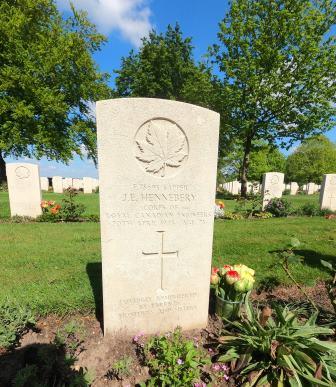
Grave of PEI soldier Sapper Joseph Edmond HENNEBERY, Corps of Royal Canadian Engineers, from Morrell. (Photo credit: Scheepers family)

DCIM100GOPROGOPR0100.JPG

Grave of L/Cpl Frank Edward MCGOVERN, North Shore Regiment, born in Chipman. (Photo credit:  Scheepers family)

Our thanks to Ad and Noor Scheepers for taking photos, including those of the graves of:

  • Ralph Schurman BOULTER, who came from West Point, Prince Edward Island
  • Joseph Edmond HENNEBERY, who came from Morrell, Prince Edward Island
  • Frank Edward MCGOVERN, born in Chipman, New Brunswick

You can read (or re-read!) about our 2019 and 2017 War Memorial tour visits to the cemetery here:

·       https://onthewarmemorialtrail.com/2019/12/04/on-the-war-memorial-trail-our-2019-visit-to-the-canadian-war-cemetery-in-groesbeek/

·     https://onthewarmemorialtrail.com/2017/12/30/on-the-war-memorial-trail-pei-soldiers-buried-in-the-canadian-war-cemetery-in-groesbeek/

·        https://onthewarmemorialtrail.com/2017/12/25/on-the-war-memorial-trail-at-the-canadian-war-cemetery-in-groesbeek/

In an unrelated commemorative gesture, a group of Dutch farmers used tractors to spell out ’75 Jaar Vrijheid’ (75 Years of Freedom) in the shape of a torch. They were given a citation by Dutch authorities for not respecting social distancing rules! (Watch them make this tribute in a 42 second video at https://www.nu.nl/280619/video/boeren-vormen-fakkel-met-trekkers-in-wei-en-ontsteken-vrijheidsvuur.html?jwsource=em)

No photos have yet been found for Joseph Edmond HENNEBERY and Frank Edward MCGOVERN. Can you help? If you have information to share about any Canadian soldiers buried in The Netherlands, please contact Pieter at memorialtrail@gmail.com or comment on the blog.  UPDATE:  A photo of Joseph Edmond Hennebery was subsequently submitted.

© Daria Valkenburg

….Want to follow our research?….

If you are reading this posting, but aren’t following our research, you are welcome to do so.  Our blog address: https://onthewarmemorialtrail.com/

Front cover OnTheWarMememorialTrailinEurope4 countries, 6 weeks, 7,000 km – an unforgettable war memorial journey in Europe…. Daria’s book ‘No Soldier Buried Overseas Should Ever Be Forgotten‘ is available in print and e-book formats.  Net proceeds of book sales help support research costs and the cost of maintaining this blog. For more information see https://nosoldierforgotten.com/ 

You are also invited to subscribe to our YouTube Channel: On The War Memorial Trail With Pieter Valkenburg: https://www.youtube.com/channel/UCJ591TyjSheOR-Cb_Gs_5Kw

Never miss a posting!  Subscribe below to have each new story from the war memorial trail delivered to your inbox.
On The War Memorial Trail…..Our 2019 Visit To The Canadian War Cemetery In Groesbeek

December 4, 2019.  While in The Netherlands this fall, we visited the three Canadian War Cemeteries and laid down flags of Canada and PEI for the names listed on the Cenotaph outside the Borden-Carleton Legion, as well as other Islanders who have been identified by Dutch researchers. The second Canadian War Cemetery we visited on the 2019 trip was in Groesbeek.  (See On the War Memorial Trail ….. At The Canadian War Cemetery in Groesbeek and On the War Memorial Trail ….. PEI Soldiers Buried In The Canadian War Cemetery in Groesbeek for accounts of our 2017 visit.)

CIMG3371 Oct 5 2019 Groesbeek

Pieter at the entrance to Groesbeek Canadian War Cemetery.  (Photo credit: Daria Valkenburg)

We visited the cemetery on a rare sunny and dry day during our time in The Netherlands…. it rained 19 out of 21 days! We hadn’t been as lucky when we went to Holten!  (See On The War Memorial Trail…..Our 2019 Visit To The Canadian War Cemetery In Holten)

As in 2017, we were joined by Pieter’s former colleague in the Dutch Foreign Service, Ad Scheepers, and his wife Noor, who live in Groesbeek.  Pieter and Ad served together in New Delhi and both are passionate in their gratitude to the Allied troops that liberated The Netherlands during WWII.

cimg3321-oct-5-2019-groesbeek-william-weatherbie.jpg

Pieter with Noor and Ad Scheepers by the grave of William Weatherbie.  (Photo credit: Daria Valkenburg)

Since our 2017 visit, no additional names of soldiers from PEI have been uncovered, so we placed flags at the graves of the same 17 Islanders.  Unlike in 2017, however, photos of several of these soldiers have now been provided by family members.  In alphabetical order, here are the known soldiers from PEI that are buried in the cemetery:

  • L/Cpl Ralph Schurman BOULTER, North Nova Scotia Highlanders, from West Point
  • Pte Lawrence BULGER, North Nova Scotia Highlanders, from Foxley River
  • Major John Weston CAMPBELL, North Nova Scotia Highlanders, from Clermont
  • Cpl Preston D. CAMPBELL, Algonquin Regiment, from Coleman
  • Rifleman William Alfred CANNON, Regina Rifle Regiment, from Pownal
  • Cpl Arthur GAUDET, Les Fusiliers Mont-Royal, from Mont Carmel
  • Sapper Joseph Edmond HENNEBERY, Corps of Royal Canadian Engineers, from Morrell
  • Cpl George Ivan MACKINNON, North Nova Scotia Highlanders, from Mt. Albion
  • Cpl Robert Bruce MACNEILLL, North Nova Scotia Highlanders, from Charlottetown
  • Pte Barney Ruben MCGUIGAN, North Shore Regiment, born in Souris
  • Cpl Stephen A. MCKINNON, Royal Hamilton Light Infantry, from St. Peter’s Bay
  • L/Cpl Edward Gabriel PERRY, Argyll & Sutherland Highlanders of Canada (Princess Louise), from St. Nicholas
  • Pte John Clifford ROGERS, North Shore Regiment, born in Hope River
  • Pte Ralph K. SILLIKER, Lake Superior Regiment, from O’Leary
  • Sgt Edison Alexander SMITH, North Nova Scotia Highlanders, from West Point
  • Pte George Preston SMITH, North Shore Regiment, from Kinkora
  • Pte William L. WEATHERBIE, Royal Regiment of Canada, from Charlottetown

We also placed a Canadian flag at the grave of one soldier from New Brunswick, the uncle of our neighbour Brenda Graves:

  • L/Cpl Frank Edward MCGOVERN, North Shore Regiment, born in Chipman

Photos have still not been found for:

  1. Joseph E. HENNEBERY, born in Morell, who died on April 20, 1945. (UPDATE: Photo has been found)
  2. Barney Ruben MCGUIGAN, born in St. Peter’s, son of Thomas and Sadie McGuigan, who died on February 26, 1945. (UPDATE: Photo has been found)
  3. Frank Edward MCGOVERN, born in Chipman, who died on February 26, 1945.

After placing the flags, we met with Alice van Bekkum and her husband Leendert at De Oude Molen (The Old Windmill) cafe.  Alice is the Chair of the Faces To Graves Project in The Netherlands, which is trying to find a photo for every Canadian soldier buried in one of the Dutch cemeteries for a digital archive.

CIMG3374 Oct 5 2019 Groesbeek De Oude Molen

At De Oude Molen, left to right: Ad Scheepers, Leendert van Bekkum, Alice van Bekkum, Pieter Valkenburg, Daria Valkenburg, Noor Scheepers.

During the 75th Anniversary of the Liberation of The Netherlands commemoration in May 2020, the Canadian War Cemetery in Groesbeek has received permission from the Commonwealth War Graves Commission to place photos of Canadian soldiers by their gravestones for two weeks.  Pieter is trying to ensure all of the Island soldiers have a photo, but as you can see above, there are 2 Islanders without photos, plus one from New Brunswick.

Thank you to Ad and Noor Scheepers for joining us on the memorial trail at the Canadian War Cemetery in Groesbeek!  If anyone has more information to share on any of the soldiers listed above, or know of more Islanders buried in the cemetery in Groesbeek, please contact Pieter at memorialtrail@gmail.com, comment on the blog, or tweet to @researchmemori1.    

© Daria Valkenburg

…Want to follow our research?…

If you are reading this posting, but aren’t following our research, you are welcome to do so.  Our blog address: https://onthewarmemorialtrail.com/

Front cover OnTheWarMememorialTrailinEurope4 countries, 6 weeks, 7,000 km – an unforgettable war memorial journey in Europe…. Daria’s book ‘No Soldier Buried Overseas Should Ever Be Forgotten‘ is available in print and e-book formats.  Net proceeds of book sales help support research costs and the cost of maintaining this blog. For more information see https://nosoldierforgotten.com/

Subscribe to our YouTube Channel: On The War Memorial Trail With Pieter Valkenburg: https://www.youtube.com/channel/UCJ591TyjSheOR-Cb_Gs_5Kw

Never miss a posting!  Subscribe below to have each new story from the war memorial trail delivered to your inbox.
On the War Memorial Trail ….. PEI Soldiers Buried In The Canadian War Cemetery in Groesbeek

December 30, 2017.  During our first visit to the Canadian War Cemetery in Groesbeek in The Netherlands, we were able to place flags at the graves of three PEI soldiers buried there.  In the last blog entry we told the story of George Preston SMITH of Kinkora, who was with the North Shore (New Brunswick) Regiment, and the accident in which he lost his life. (See On the War Memorial Trail ….. At The Canadian War Cemetery in Groesbeek)

Our thanks to Alice van Bekkum of the Faces to Graves Project, who shared an eye witness account that was recorded by Will Bird in his 1963 book about the North Shore (New Brunswick) Regiment. (See https://books.google.com/books/about North_Shore_New_Brunswick_Regiment.html?id=Iz7WAAAAMAAJ)

Will Bird account of what happened to George Preston Smith

Excerpt about George Preston Smith from Will Bird’s book about The North Shore (New Brunswick) Regiment.

Before returning to place flags at the rest of the known soldiers from PEI, we stopped by a memorial marking the route on February 8, 1945 where soldiers marched into Germany on their way from Groesbeek, as part of Operation Veritable.  This was the northern part of an Allied pincer movement that took place between February 8 and March 11, 1945 during the final stages of the Second World War.

The operation was conducted by Field Marshal Bernard Montgomery’s Anglo-Canadian 21st Army Group, primarily consisting of the First Canadian Army under Lieutenant-General Harry Crerar and the British XXX Corps under Lieutenant-General Brian Horrocks. Their objective was to clear German forces from the area between the Rhine and Maas rivers, east of the German/Dutch frontier, in the Rhineland.

CIMG8998 Sep 15 2017 Pieter by memorial showis where soldiers marched into Germany from Groesbeek operation veritable

Pieter at the memorial for Operation Veritable in Groesbeek. (Photo credit: Daria Valkenburg)

CIMG8996 Sep 15 2017 memorial shows where soldiers marched into Germany from Groesbeek operation veritable

Close-up view of the text on the memorial for Operation Veritable in Groesbeek. (Photo credit: Pieter Valkenburg)

On our second visit to the Canadian War Cemetery in Groesbeek we were joined by Pieter’s former colleague in the Dutch Foreign Service, Ad Scheepers, and his wife Noor, who live in Groesbeek.

CIMG9023 Sep 16 2017 Groesbeek Cemetery Ad & Noor Scheepers with Pieter by Gaudets grave

Ad and Noor Scheepers with Pieter by the grave of Cpl Arthur Gaudet. (Photo credit: Daria Valkenburg)

Ad was a fountain of information about the cemetery, and noted that it was along the Liberation Route, which one can take to visit the many monuments and memorials in this part of The Netherlands.  The cemetery, on a road called Zeven Heuvelenweg (Seven Hills Way), is the largest war cemetery of the Commonwealth Graves Commission in The Netherlands.

Most of the soldiers buried here fell during the fighting on the Lower Rhine between February 8 and March 26, 1945.  It’s called the Canadian War Cemetery and we’d always assumed all of the burials were Canadian, but it’s not true.  By number and nationality, the 2,617 soldiers buried here are from:

  • 2,399 from Canada
  • 267 from Great Britain
  • 3 from Belgium
  • 2 from Poland
  • 2 from Australia
  • 1 from New Zealand
  • 1 from Russia
  • 1 from Yugoslavia
  • 1 from The Netherlands

Inscribed on the Groesbeek Memorial in the cemetery are the names of 1,103 soldiers reported missing in action between August 1944 and May 1945. Only a few have been identified since the memorial was put up. Unfortunately, most are still listed as MIA (Missing In Action).

Ad told us he’d read that the Cross of Sacrifice in the cemetery was positioned where it was so it could be clearly seen from Germany, a stone’s throw away from the border.  It’s likely true, as one prerequisite that Canadian Officers had in selecting land for the cemetery was to have a view of Germany.

In a Dutch reference we read that construction on the cemetery began in 1945 by six Canadian soldiers. The location of the cemetery, on a hilltop, was chosen by Groesbeek Mayor Grotenhuis van Onstein for its view on the German border from the cemetery. The Cemetery was officially opened on May 4, 1947 by the Dutch Queen Wilhelmina. When the cemetery opened, the headstones were made from wood, as was the Cross of Sacrifice.  Later, the headstones were temporarily replaced by metal versions, and beginning in 1950 the headstones and Cross of Sacrifice were replaced by stone designs.

CIMG8945 Sep 15 2017 Groesbeek cemetery Pieter at Cross for remembrance

Pieter by the Cross of Sacrifice at the Canadian War Cemetery in Groesbeek. (Photo credit: Daria Valkenburg)

In alphabetical order, here are the known soldiers from PEI that are buried in the cemetery:

  • L/Cpl Ralph Schurman BOULTER, North Nova Scotia Highlanders, from West Point
  • Pte Lawrence BULGER, North Nova Scotia Highlanders, from Foxley River
  • Major John Weston CAMPBELL, North Nova Scotia Highlanders, from Clermont
  • Cpl Preston D. CAMPBELL, Algonquin Regiment, from Coleman
  • Rifleman William Alfred CANNON, Regina Rifle Regiment, from Pownal
  • Cpl Arthur GAUDET, Les Fusiliers Mont-Royal, from Mont Carmel
  • Sapper Joseph Edmond HENNEBERY, Corps of Royal Canadian Engineers, from Morrell
  • Cpl George Ivan MACKINNON, North Nova Scotia Highlanders, from Mt. Albion
  • Cpl Robert Bruce MACNEILLL, North Nova Scotia Highlanders, from Charlottetown
  • Pte Barney R. MCGUIGAN, North Shore (New Brunswick) Regiment, born in Souris
  • Cpl Stephen A. MCKINNON, Royal Hamilton Light Infantry, from St. Peter’s Bay
  • L/Cpl Edward Gabriel PERRY, Argyll & Sutherland Highlanders of Canada (Princess Louise), from St. Nicholas
  • Pte John Clifford ROGERS, North Shore (New Brunswick) Regiment, born in Hope River
  • Pte Ralph K. SILLIKER, Lake Superior Regiment, from O’Leary
  • Sgt Edison Alexander SMITH, North Nova Scotia Highlanders, from West Point
  • Pte George Preston SMITH, North Shore Regiment, from Kinkora
  • Pte William L. WEATHERBIE, Royal Regiment of Canada, from Charlottetown

Do you have photos or information on any of these soldiers?  If you know of other soldiers from PEI, please help the researchers at the Faces to Grave project by sharing that information. Photos and stories can be sent either through their website at http://facestograves.nl/index.html or by email to info@facestograves.nl.  Alternatively, you can contact us and we will forward your info for you.

Comments or stories?  You can share them by emailing us at memorialtrail@gmail.com, commenting on the blog, or tweet to @researchmemori1.    

© Daria Valkenburg

…Want to follow our research?…

If you are reading this posting, but aren’t following our research, you are welcome to do so.  Our blog address: https://onthewarmemorialtrail.com/

Front cover OnTheWarMememorialTrailinEurope4 countries, 6 weeks, 7,000 km – an unforgettable war memorial journey in Europe…. Daria’s book ‘No Soldier Buried Overseas Should Ever Be Forgotten‘ is available in print and e-book formats.  Net proceeds of book sales help support research costs and the cost of maintaining this blog. For more information see https://nosoldierforgotten.com/

Subscribe to our YouTube Channel: On The War Memorial Trail With Pieter Valkenburg: https://www.youtube.com/channel/UCJ591TyjSheOR-Cb_Gs_5Kw

Never miss a posting!  Subscribe below to have each new story from the war memorial trail delivered to your inbox.
On the War Memorial Trail ….. At The Canadian War Cemetery in Groesbeek
December 25, 2017.  During lunch with members of the Royal Canadian Legion in The Netherlands, we mentioned that we would be going to the Canadian War Cemetery in Groesbeek to lay flags at the graves of Prince Edward Island soldiers, and one from New Brunswick.  Although we had a list of 17 soldiers, only one was listed on the Cenotaph outside the Borden-Legion Carleton, George Preston SMITH of Kinkora, who was with the North Shore (New Brunswick) Regiment.

Placing flags at the grave of a soldier from New Brunswick was at the request of our friend, Brenda Graves of North Tryon, in memory of her uncle Frank Edward MCGOVERN. He also was from the North Shore (New Brunswick) Regiment, and died February 26, 1945 at the age of 19. Brenda, who is researching her family history, unfortunately has only a poor quality photo of her uncle.  Can anyone help put a face to this name?

Just outside the cemetery, by the parking lot, is a banner asking people for help in the Faces to Graves Foundation Groesbeek project.  The project was begun by members of the Royal Canadian Legion in The Netherlands to create a virtual memorial for all who are buried at the Groesbeek Canadian War Cemetery or listed on the Groesbeek Memorial.  2,338 soldiers are buried here.

CIMG8926 Sep 15 2017 faces to grave banner at Groesbeek cemetery

Faces to Graves Foundation banner. (Photo credit: Pieter Valkenburg)

Many of the war dead were brought to this cemetery from nearby Germany. Fallen Canadian soldiers from WWII, who were buried in German battlefields, were reinterred here (except for one who is buried in Reichswald Forest War Cemetery in Germany). General Harry Crerar, who commanded Canadian land forces in Europe, had ordered that Canadian dead were not to be buried on German soil.

CIMG8928 Sep 15 2017 Daria at Groesbeek cemetery

Daria at entrance to Groesbeek Canadian War Cemetery, with flowers to place at the grave of Frank Edward McGovern. (Photo credit: Pieter Valkenburg)

CIMG8937 Sep 15 2017 Groesbeek cemetery grave of Brendas uncle FE McGovern

Grave of Frank Edward McGovern at Groesbeek Canadian War Cemetery. (Photo credit: Daria Valkenburg)

George Preston Smith (2)

George Preston Smith. (Photo courtesy of Canadian Virtual War Memorial)

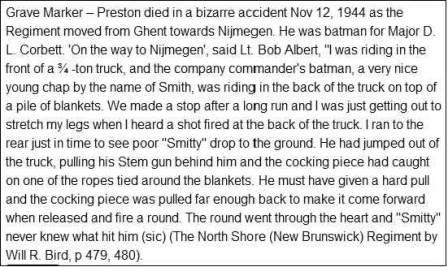
Private George Preston SMITH was born September 3, 1923 in Kinkora, the son of William Wilfred and Mabel Smith.  A store clerk before enlisting on April 1, 1943, he served in England, France, and Belgium, before meeting his death in Belgium in an unfortunate accident on November 12, 1944.  Smith was accidentally killed while trying to take his Stengun out of the back of a military truck. The gun was under a pile of greatcoats. He grabbed it by the muzzle and gave it a hard pull, causing the cocking piece to be pulled back far enough. When he let it go, the cocking piece went forward again with enough pressure to push a round into the chamber and fire it.

On November 15, 1944, he was buried in the Civil Cemetery in Malden, Belgium.  In 1946, his remains were exhumed and he was reburied in the Groesbeek Canadian War Cemetery.

CIMG8940 Sep 15 2017 Groesbeek cemetery Pieter at the grave of George Preston Smith

Pieter by the grave of Private George Preston Smith. (Photo credit: Daria Valkenburg)

After paying our respects to McGovern and Smith, Pieter placed flags on two more graves of PEI soldiers.  We had been invited by Alice van Bekkum, of the Faces to Graves Foundation, to participate in a special ceremony, along with members of the Royal Canadian Legion in The Netherlands.  Wish Of A Lifetime Canada (see https://wishofalifetime.ca/), an organization that fulfills seniors’ dreams and shares their stories to inspire those of all ages, had granted a wish that had a PEI connection.

Harriet Jenereaux, born in West Point, PEI, now living in Nova Scotia, wanted to see the grave of her father, Sgt Edison Alexander SMITH, who is buried in the cemetery in Groesbeek.  Harriet and her husband Keith were flown to The Netherlands, members of the Royal Canadian Legion provided a colour party, and Alice van Bekkum paid for a bugler to play The Last Post at the grave.   (See https://www.youtube.com/watch?v=BgXkld9BUIA)

CIMG8948 Sep 15 2017 Groesbeek cemetery bugler with Yvonne and Berry Swarthoff providing colour parade

Bugler with Royal Canadian Legion’s colour party of Yvonne and Berry Swarthoff at Groesbeek Canadian War Cemetery. (Photo credit: Daria Valkenburg)

Before Harriet arrived at the cemetery, Pieter made sure that Canadian and PEI flags were placed at her father’s grave, and that of her uncle, L/Cpl Ralph Schurman BOULTER, her mother’s brother.  Smith, aged 32, and Boulter, aged 28, were in the North Nova Scotia Highlanders, and were both killed in battle while crossing the Rhine on March 25, 1945.

CIMG8952 Sep 15 2017 Groesbeek cemetery Alice van Bekkum

Alice van Bekkum arranged for a photo of Smith to be placed by his grave. (Photo credit: Daria Valkenburg)

As Harriet neared her father’s grave, she called out to her husband Keith, “There’s Daddy!”  It was a poignant moment for us, the Dutch members of the Legion, an astonishing amount of reporters and press photographers, plus a representative of Phillips, the Dutch sponsor of Wish of a Lifetime.

CIMG8950 Sep 15 2017 Groesbeek cemetery Harriet Jenereux at her fathers grave

Harriet Jenereaux kneels at her father’s grave. (Photo credit: Daria Valkenburg)

After the ceremony and greeting Harriet, it was time for us to enjoy a cup of coffee and a piece of Dutch apple cake.  We’d return to place flags at the graves of the other 14 soldiers from PEI once all the commotion regarding Harriet’s visit had diminished.

Do you have relatives buried in Groesbeek Canadian War Cemetery?  If so, please consider participating in the Faces to Graves project by submitting photos and stories either through their website at http://facestograves.nl/index.html or by email to info@facestograves.nl.  Alternatively, you can contact us and we will forward your info for you.

Comments or stories?  You can share them by emailing us at memorialtrail@gmail.com, or commenting on the blog.

© Daria Valkenburg

…Want to follow our research?…

If you are reading this posting, but aren’t following our research, you are welcome to do so.  Our blog address: https://onthewarmemorialtrail.com/

Front cover OnTheWarMememorialTrailinEurope4 countries, 6 weeks, 7,000 km – an unforgettable war memorial journey in Europe…. Daria’s book ‘No Soldier Buried Overseas Should Ever Be Forgotten‘ is available in print and e-book formats.  Net proceeds of book sales help support research costs and the cost of maintaining this blog. For more information see https://nosoldierforgotten.com/

Subscribe to our YouTube Channel: On The War Memorial Trail With Pieter Valkenburg: https://www.youtube.com/channel/UCJ591TyjSheOR-Cb_Gs_5Kw.

Never miss a posting!  Subscribe below to have each new story from the war memorial trail delivered to your inbox.