On The War Memorial Trail…. Visit To Bathmen And The Schipbeek Canal

October 26, 2025. While in Europe this spring for the 80th Anniversary of Liberation Commemoration events, we visited 14 cemeteries to place flags at the graves of 383 soldiers that Pieter has researched since 2014, with the stories of many of these soldiers previously told on this blog. 

On our ‘wish list’ of places to see was the Schipbeek Canal, the location where several soldiers whose stories we told lost their lives.  The Schipbeek is a tributary of the IJssel River.

When I mentioned Schipbeek Canal to a few Dutch colleagues, I was kindly told that Schipbeek was a canal, that to add the word Canal was an oxymoron.  But, who outside of the Dutch would know that?  So, I continue to say Schipbeek Canal, which is located outside of the town of Bathmen, not too far from where we were staying near Holten.  We had been so busy that we never got there, and I’d regretfully crossed it off the list.

After the exhausting day on the Battlefield Tour with Joël Stoppels, all that was planned for the following day was rest, packing our suitcases for the move further south towards Belgium, and laundry.  Pieter had other ideas, however, just as I settled on the couch to read a book. “…Let’s go to Bathmen…” he said in mid-morning. 

…No!..” I said. Anyone who has met Pieter knows he doesn’t give up easily. 

...C’mon, let’s get it over with….”  I didn’t have the energy to argue, so just got dressed and, just like that, we were back on the war memorial trail!  Luckily, Bathmen was only a few exits down the highway from where we were staying.

….We arrived in Bathmen…
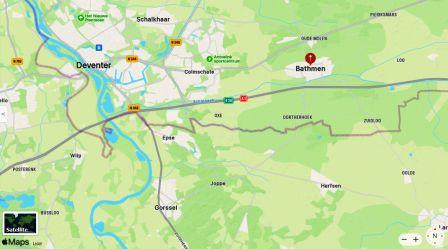
Map shows location of Bathmen and Gorssel. (Map source: DuckDuckGo)
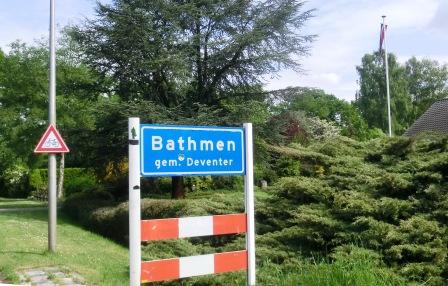
The village sign for Bathmen.  (Photo credit: Daria Valkenburg)

Once we arrived in Bathmen, it was to find that the Schipbeek Canal went through the village.  The challenge became to find where exactly the Canadians were as they fought to establish a bridgehead over the canal.  It wasn’t long before Pieter figured out that we needed to follow a road called Gorsselseweg!

…. Gorsselseweg was where the bridgehead over the Schipbeek was established…
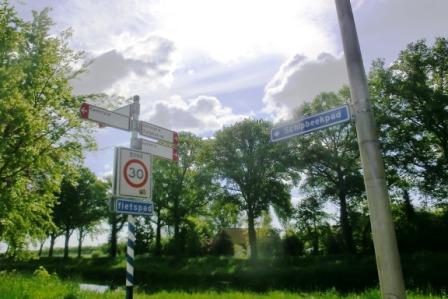
The South Saskatchewan Regiment marched 8 km from Gorssel towards Bathmen.  (Photo credit: Daria Valkenburg)

Troops from the South Saskatchewan Regiment, the Regiment in which Leo Francis TONEY was in, marched 8 km (5 miles) from Gorssel towards Bathmen on April 7, 1945, but had to cross the Schipbeek Canal before reaching the village. 

The bridge over the canal located on the Gorsselseweg was the scene of so much fighting, before a bridgehead was established by the North Nova Scotia Highlanders, who then went on to liberate Bathmen on April 8, 1945.
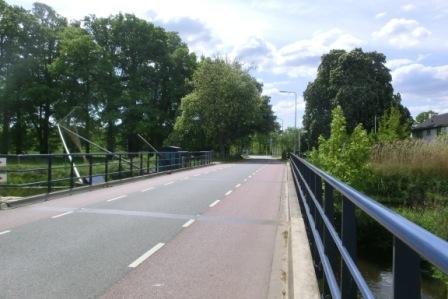
How the bridge over the Schipbeek Canal looks today on the Gorsselseweg.  (Photo credit: Daria Valkenburg)

Today, the bridge and the canal are peaceful and beautiful spots, and it’s difficult to imagine how hard troops had to fight back in April 1945.  Crossing the Schipbeek was difficult as the area was strongly defended by German troops.
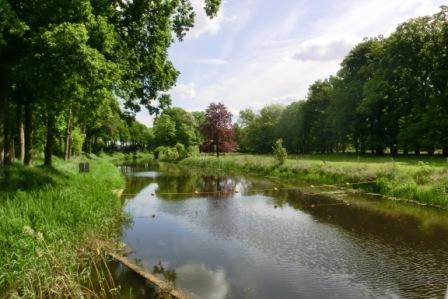
The Schipbeek Canal, as seen from the bridge on the Gorsselseweg.  (Photo credit: Daria Valkenburg)

The Schipbeek Canal, as seen from the bridge on the Gorsselseweg.  (Photo credit: Daria Valkenburg)
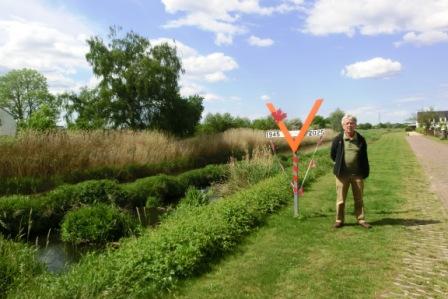
The maple leaf and V for Victory were present on the Gorsselseweg! (Photo credit: Daria Valkenburg)

….4 soldiers whose stories were previously told were at the Schipbeek…

Four soldiers, whose stories were previously told on this blog, were involved in the crossing of the Schipbeek and liberation of Bathmen…..

  • Philip LAFORTE, born in Lac du Bonnet, Manitoba, was serving with the Royal Winnipeg Rifles when he was killed on April 7, 1945 in The Netherlands, aged 33, as the Regiment crossed the Schipbeek, in order to establish a bridgehead as preparation for an assault on the city of Deventer by the 7th Canadian Brigade. You can read his story at https://onthewarmemorialtrail.com/2022/03/22/on-the-war-memorial-trail-remembering-ww2-soldier-philip-laforte/
  • Donald Charles MACKENZIE of Springhill, Nova Scotia, was serving with the Royal Winnipeg Rifles when they were ordered to cross the Schipbeek Canal on April 7, 1945, and establish a bridgehead as preparation for an assault on the city of Deventer by the 7th Canadian Brigade. He was in command of the unit Pioneers attached to ‘D’ Company, which had the responsibility of bridging the canal. In spite of heavy fire, he managed to crawl out onto the Bridge, dragging a couple of planks, which he placed in position, allowing the company to cross quickly and secure a solid bridgehead. He received a Military Medal for his actions.  Sadly, a few weeks later, he lost his life on April 22, 1945. He had been wounded during heavy fighting at the railway bridge near Appingedam, and placed in a house temporarily to rest. However, he was fatally hit by shrapnel by German shelling of the house.  You can read his story at https://onthewarmemorialtrail.com/2022/01/23/on-the-war-memorial-trail-the-ww2-soldier-from-springhill-who-received-a-memorial-cross/
  •  Richard Joseph RANEY, born in Point Michaud, Richmond County, Nova Scotia, was serving with the North Nova Scotia Highlanders, when he was killed on April 8, 1945, aged 18, during the fight to secure the bridge over the Schipbeek and enter the village of Bathmen. You can read his story at https://onthewarmemorialtrail.com/2021/01/16/on-the-war-memorial-trail-atlantic-canada-remembers-part-3/
  • Leo Francis TONEY, born in Wolfville, Nova Scotia, was serving with the South Saskatchewan Regiment, when he was killed on Saturday, April 7, 1945, aged 21, while trying to cross the Schipbeek in The Netherlands at  a bridgehead that had been formed at a weir on the border of the municipalities of Bathmen and Holten. You can read his story at https://onthewarmemorialtrail.com/2021/05/22/on-the-war-memorial-trail-remembering-ww2-soldier-leo-francis-toney/

….We learned that a solider from Prince Edward Island received a posthumous Dutch medal…

Pieter at an information panel beside the Schipbeek along the Gorsselseweg.  (Photo credit: Daria Valkenburg)

While we were taking photos of the Schipbeek Canal, we saw an information panel, and to our surprise, learned of a Prince Edward Island connection to what happened during the crossing of the Canal and the liberation of Bathmen!

Joseph William CAMPBELL, of Newport, Prince Edward Island, was serving with the North Nova Scotia Highlanders, was killed on April 8, 1945, aged 22, during the securing of the bridge over the Schipbeek. (See https://www.veterans.gc.ca/en/remembrance/memorials/canadian-virtual-war-memorial/detail/2226998?Joseph%20William%20Campbell)

On December 8, 1945, he was posthumously awarded the Knight of the Fourth Class, Military Willems Order by Queen Wilhelmina of The Netherlands. This honour is the oldest and highest honour of the Kingdom of The Netherlands. (See https://en.wikipedia.org/wiki/Military_Order_of_William)

….Two monuments in Bathmen…

From the Gorsselseweg we made our way into Bathmen itself, to a small area dedicated to honouring those who lost their lives in April 1945. 

There was a memorial stone honouring Joseph William Campbell, and Pieter made sure he placed flags of Canada and Prince Edward Island beside this marker.
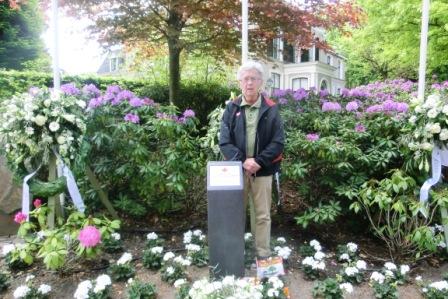
Pieter by the memorial stone honouring Joseph William Campbell from Newport, Prince Edward Island, after he’d placed flags of Canada and Prince Edward Island. (Photo credit: Daria Valkenburg)

Memorial stone honouring Joseph William Campbell from Newport, Prince Edward Island. (Photo credit: Daria Valkenburg)

Beside the memorial stone honouring Joseph William Campbell is a monument in memory of Bathmen’s liberation by the Canadians in April 1945. A plaque on a large stone says ‘In grateful memory of our Canadian liberators’ and was placed here in 1995, 50 years after Bathmen was liberated.
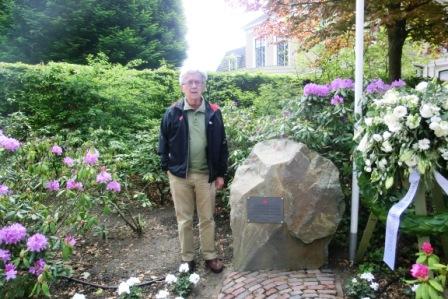
Pieter by the monument honouring the Canadians who liberated Bathmen. (Photo credit: Daria Valkenburg)

This ended our visit to Bathmen and Schipbeek.  Although it had been an effort to leave our cosy cottage, I’m glad that Pieter persisted, as we now had seen with our own eyes the Schipbeek Canal, which we had read so much about in war diaries. 
The flags placed at the memorial stone were donated.  Our thanks go to: 

  • Alan Waddell, Constituent Assistant, on behalf of Heath MacDonald, MP for Malpeque, for the Canadian flag.
  • Matt MacFarlane, MLA for District 19, Borden-Kinkora, for the Prince Edward Island flag. 

Our adventures continue as we share the highlights of our adventures on the 2025 European War Memorial Tour.  Coming up on our journey of remembrance is a visit to Uden War Cemetery.

If you have a story or photos to share, please contact Pieter at memorialtrail@gmail.com or comment on the blog. 

© Daria Valkenburg

….Want to follow our research?…

If you are reading this posting, but aren’t following our research, you are welcome to do so.  Our blog address: https://onthewarmemorialtrail.com/
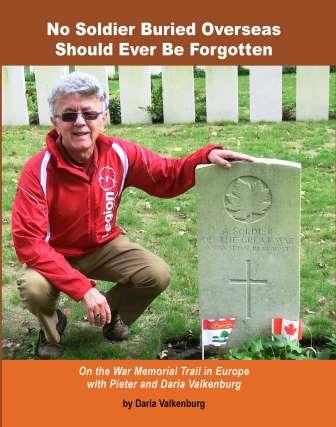
4 countries, 6 weeks, 7,000 km – an unforgettable war memorial journey in Europe…. Daria’s book ‘No Soldier Buried Overseas Should Ever Be Forgotten‘ is available in print and e-book formats.  Net proceeds of book sales help support research costs and the cost of maintaining this blog. For more information see https://nosoldierforgotten.com/

Subscribe to our YouTube Channel: On The War Memorial Trail With Pieter Valkenburg: https://www.youtube.com/channel/UCJ591TyjSheOR-Cb_Gs_5Kw

Never miss a posting!  Subscribe below to have each new story from the war memorial trail delivered to your inbox.

On The War Memorial Trail….2025 Faces of Holten Exhibition Part 5: Indigenous Soldiers

September 10, 2025.  Pieter Valkenburg has been involved in finding photos of Canadians who are buried in all three Canadian War Cemeteries in The Netherlands since 2014, with stories of many soldiers told on this blog. 

While in The Netherlands and Belgium for the 80th Anniversary of Liberation Commemoration events, he placed flags at the graves of 383 soldiers in 14 cemeteries. At the Canadian War Cemetery in Holten, The Netherlands, flags were placed at 156 graves. Our visit coincided with The 2025 Faces Of Holten Exhibition, which ran for three weeks in May.

—-Recap…..

In Part 1, the graves and photos of soldiers who were killed near Posterenk in April 1945 were featured. (See https://onthewarmemorialtrail.com/2025/08/24/on-the-war-memorial-trail-2025-faces-of-holten-exhibition-part-1-soldiers-killed-near-posterenk/)

In Part 2, the graves and photos of two soldiers whose names are listed on the Cenotaph outside the Borden-Carleton Legion were featured. (See https://onthewarmemorialtrail.com/2025/08/29/on-the-war-memorial-trail-2025-faces-of-holten-exhibition-part-2-the-soldiers-listed-on-the-cenotaph-in-borden-carleton/)

In Part 3, the graves and photos of soldiers killed in vehicle accidents were featured. (See https://onthewarmemorialtrail.com/2025/09/01/on-the-war-memorial-trail-2025-faces-of-holten-exhibition-part-3-soldiers-killed-while-travelling-in-vehicles/)

In Part 4, the graves and photos of soldiers who lost their lives in the Battle of Leer during Operation Duck were featured. (See https://onthewarmemorialtrail.com/2025/09/04/on-the-war-memorial-trail-2025-faces-of-holten-exhibition-part-4-soldiers-who-drowned-during-operation-duck/)

…8 Indigenous soldiers are commemorated…

Now, in Part 5, the graves and photos of 8 Indigenous soldiers, whose stories have previously been told on this blog, are featured.

Grave of John Culbertson. (Photo credit: Daria Valkenburg)

John CULBERTSON was born in Oshawa, Ontario, and grew up on the Tyendinaga Mohawk Territory near Belleville, Ontario. While serving with the Royal Canadian Engineers, he was killed in Germany on April 30, 1944 during the Battle of Edewecht, aged 33. You can read his story at https://onthewarmemorialtrail.com/2023/02/04/on-the-war-memorial-trail-remembering-ww2-sapper-john-culbertson/

Grave of William ‘Willie’ Daniels.  (Photo credit: Daria Valkenburg)

William ‘Willie’ DANIELS, from the Big River Reserve in Depton, Saskatchewan, was serving with the Royal Winnipeg Rifles when he was killed, aged 20, on April 22, 1945 as troops moved through Appingedam in The Netherlands at the very beginning of the Battle of the Delfzijl Pocket. You can read his story at https://onthewarmemorialtrail.com/2021/07/23/on-the-war-memorial-trail-remembering-ww2-soldier-william-willie-daniels/

Pieter by the grave of Harry Henry Davis. (Photo credit: Daria Valkenburg)

Harry Henry DAVIS, from Selkirk, Yukon Territory, was serving with the Lake Superior Regiment (Motor) when he died in The Netherlands, aged 23, on January 15, 1945 from wounds received the day before after being shot while on patrol east of Kerkdriel.  You can read his story at https://onthewarmemorialtrail.com/2023/09/30/on-the-war-memorial-trail-the-only-yukon-territory-soldier-buried-in-holten/

Grave of Stanley Owen Jones. (Photo credit: Daria Valkenburg)

Stanley Owen JONES, from Massett, British Columbia, drowned on September 8, 1945 in Germany when the carrier he was in overturned in a ditch, while serving with the Canadian Scottish Regiment, aged 20. You can read his story at https://onthewarmemorialtrail.com/2022/09/05/on-the-war-memorial-trail-remembering-wwii-soldier-stanley-owen-jones/

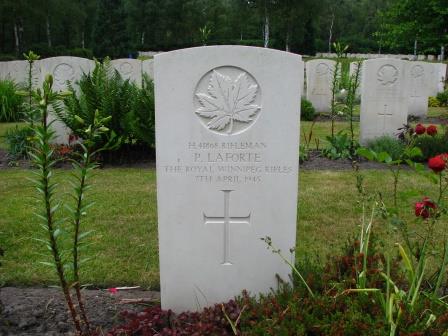
Grave of Philip Laforte. (Photo credit: Daria Valkenburg)

Philip LAFORTE, born in Lac du Bonnet, Manitoba, was serving with the Royal Winnipeg Rifles when he was killed on April 7, 1945 in The Netherlands, aged 33, as the Regiment crossed the Schipbeek, in order to establish a bridgehead as preparation for an assault on the city of Deventer by the 7th Canadian Brigade. You can read his story at https://onthewarmemorialtrail.com/2022/03/22/on-the-war-memorial-trail-remembering-ww2-soldier-philip-laforte/

Grave of Sanford Steven Saulis.  (Photo credit: Pieter Valkenburg)

Sanford Steven SAULIS, from Maliseet, New Brunswick, died of a brain hemorrhage in The Netherlands on August 10, 1945, aged 30, while serving with the 16th Field Company of the Royal Canadian Engineers. You can read his story at https://onthewarmemorialtrail.com/2023/02/27/on-the-war-memorial-trail-remembering-sanford-steven-saulis/

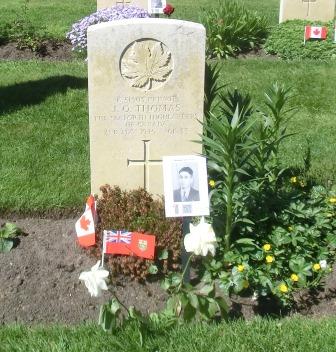
Grave of James ‘Jimmy’ Oliver Thomas. (Photo credit: Daria Valkenburg)

James ‘Jimmy’ Oliver THOMAS, born in St. Peters, Manitoba, died in Germany on May 2, 1945, aged 33, a few days after being liberated from the Stalag VII-A POW Camp in Moosburg, Germany. He had been taken prisoner of war on May 22, 1943, while serving with the Seaforth Highlanders of Canada, during the breaking of the Hitler Line. You can read his story at https://onthewarmemorialtrail.com/2024/02/18/on-the-war-memorial-trail-the-wwii-soldier-from-manitoba-who-died-shortly-after-being-liberated-from-stalag-vii-a/

After sending photos of the grave to Rodd Cooper, great-nephew of Jimmy Thomas, he wrote us to say “  I just wanted to express my infinite gratitude to you and your family on behalf of myself and my family for the work and the time you have invested in gathering the information not only for my resting family member but for the numerous others as well. 

The honour and respect you have brought and given to these men cannot be measured.  The gift that you have given my family and I is profound and we truly can’t thank you enough.  

Because of your work and dedication, my family and the future generations of my family, will be able to pay the respect to my Great Uncle Jimmy for his service and sacrifice by remembering him and telling his story.  

The gift you have given us is immeasurable.

On behalf of myself and the Thomas Family, Thank You….” 

We were immeasurably touched by his kind words. Pieter replied, saying that “…it’s important that we never forget the soldiers….and the families… who sacrificed so much for our ongoing freedom.  I’m grateful that the country of my birth continues to remember and honour their Allied liberators….” 

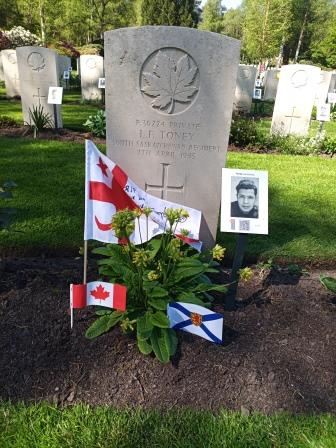
Grave of Leo Francis Toney. (Photo credit: Pieter Valkenburg)

Leo Francis TONEY, born in Wolfville, Nova Scotia, was serving with the South Saskatchewan Regiment, when he was killed on Saturday, April 7, 1945, aged 21, while trying to cross the Schipbeek in The Netherlands at  a bridgehead that had been formed at a weir on the border of the municipalities of Bathmen and Holten. You can read his story at https://onthewarmemorialtrail.com/2021/05/22/on-the-war-memorial-trail-remembering-ww2-soldier-leo-francis-toney/

After sending a photo of the grave to Della Maguire, niece of Leo Toney, she wrote to say “…thank you so much, I looked at that picture all day. I am so grateful…

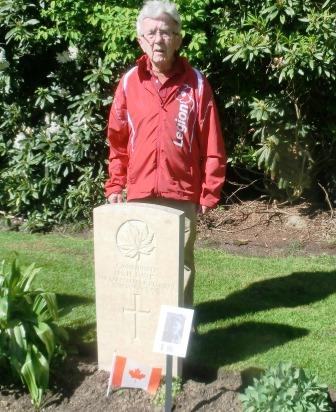
Pieter holds onto the personalized Lnu flag from the Toney family at the grave of Leo Francis Toney. (Photo credit: Daria Valkenburg)

….All of the flags placed at graves were donated…

All of the flags placed at graves were donated.  Our thanks go to: 

  • Alan Waddell, Constituent Assistant, on behalf of Heath MacDonald, MP for Malpeque, for the Canadian flags.
  • Armel ‘Mel’ Lanteigne, President of the Caraquet Legion in New Brunswick for the New Brunswick flag.
  • Kyle Graham, Research Officer, Military Relations, Nova Scotia Intergovernmental Affairs, on behalf of Premier Tim Houston, Province of Nova Scotia, for the Nova Scotia flag.
  • Don Coutts on behalf of the Muttart and Coutts families in memory of Flight Sergeant Elmer Bagnall Muttart for the Ontario flag.
  • Wayne Ewasko, MLA for Lac Du Bonnet, Manitoba, Interim Leader of the Official Opposition, Province of Manitoba, for the Manitoba flag.
  • Della Maguire on behalf of the Toney/Smith Family in memory of Pte Leo Toney for the Lnu (Mi’kmaw) flag.
  • Conrad Saulis in memory of Sapper Sanford Steven Saulis, courtesy of Grand Chief Ron Tremblay, for the Wolastoqey Nation flag

Thank you to Rodd Cooper and Della Maguire for their heartfelt and kind words.  The comments we’ve received from families as we’ve shared photos showing how their loved ones were honoured during the commemoration events made all the hard work of visiting the cemeteries and placing flags worthwhile.

The 2025 Faces of Holten Exhibition concludes with Part 6, where the graves of a few of the many soldiers killed in The Netherlands and Germany will be featured as we continue with our 2025 European War Memorial Tour.

Pieter encourages readers with photos to come forward so that eventually all the known graves of Canadians buried in Holten will have a photo displayed by their grave. Email him at memorialtrail@gmail.com.

© Daria Valkenburg

….Want to follow our research?…

If you are reading this posting, but aren’t following our research, you are welcome to do so.  Our blog address: https://onthewarmemorialtrail.com/

4 countries, 6 weeks, 7,000 km – an unforgettable war memorial journey in Europe…. Daria’s book ‘No Soldier Buried Overseas Should Ever Be Forgotten‘ is available in print and e-book formats.  Net proceeds of book sales help support research costs and the cost of maintaining this blog. For more information see https://nosoldierforgotten.com/

Subscribe to our YouTube Channel: On The War Memorial Trail With Pieter Valkenburg: https://www.youtube.com/channel/UCJ591TyjSheOR-Cb_Gs_5Kw

Never miss a posting!  Subscribe below to have each new story from the war memorial trail delivered to your inbox.

On The War Memorial Trail…. Remembrance Week 2024 – Reflections and Updates

1200x600-remembrance-day-1-1024x512

November 10, 2024.  When we write a story on the blog, we often receive additional information, sometimes about the soldiers we’ve written about, sometimes about other soldiers buried in the same cemetery or who served in the same unit. Occasionally we have a chance to meet families who’ve contributed photos and information on soldiers.  Each year we also try to visit a war memorial featuring a soldier. In this posting we feature a visit to the Sagkeeng War Memorial in Fort Alexander, Manitoba.

…Richard Reeves visited the grave of WWII soldier Everett Samuel Francis….

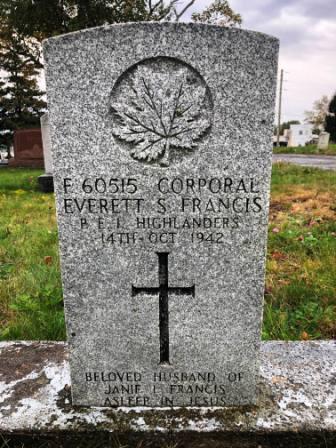
gravestone Everett Francis photo taken by Richard Reeves

Grave of Everett Samuel Francis in St. Matthew’s Presbyterian Cemetery in Grand Falls, Newfoundland.  (Photo credit: Richard Reeves)

One of the very first stories that Pieter researched of the names listed on the Cenotaph outside the Borden-Carleton Legion was that of WWII soldier Everett Samuel FRANCIS of Albany, Prince Edward Island.

On September 13, 1942, Everett was sent from Gander, Newfoundland, where his unit was based, to Long Branch, Ontario for a small arms training course.  He was on his way back to Gander aboard the railway ferry S.S. Caribou when it was torpedoed by German U-Boat 69 off the coast of Newfoundland on Wednesday, October 14, 1942.  101 survivors were rescued, but the captain, 30 crew, 57 service personnel, and 48 passengers were lost, including Everett. 

Everett and his wife, Janie Louise Mercer of Grand Falls, Newfoundland, were the parents of Greta, who had been born a few weeks earlier.  He was on his way home to meet his new-born daughter, who was to be christened in church on the Sunday after he was scheduled to return home, but never made it. He’s buried in St. Matthew’s Presbyterian Cemetery in Grand Falls, Newfoundland. 

In one of those interesting twists of fates, when Pieter was searching for a photo of Orville ‘Skip’ James REEVES, who was born in North Bay, Ontario, but was married to Mamie Thomas of Grand Falls, his nephew Richard Reeves not only provided a photo, but visited Everett’s grave on our behalf!  Watch for Skip’s story in a future posting.

You can read Everett’s story at:

….Nephew of WWII soldier Lt Arthur Affleck shared a memory of his last Sunday at church on Prince Edward Island…

Percy Affleck shared the following story about his uncle, Lt JamesArthur’ AFFLECK of Bedeque, Prince Edward Island:  “….The Affleck families of the Bedeque area were adherents of the United Church at Bedeque. (With a history dating back to the Methodist Church when part of the Affleck clan moved to Searletown from the Mt. Stewart area around 1858.)

According to Eldon Wright of Middleton, on his last Sunday at Church before shipping out for England, Arthur stood in full uniform on the church steps after the service and shook hands with everyone as they departed. At that era the Congregation would number in excess of 150 people and one can visualize the enthusiasm of the occasion, complete with good wishes. Arthur would have been fifth generation on the family tree dating to a marriage in Scotland in 1810…

Arthur was killed in action by artillery shells on September 17, 1944, during the first day of the Battle of Boulogne (Operation Wellhit), a 5 day battle to take the port of Boulogne from German control. He’s buried in the Calais Canadian War Cemetery in Leubringhen, France, 14 km from Calais.

You can read Arthur’s story at:

….Family of WWII Pilot Elmer Bagnall Muttart donated medals to the Borden-Carleton Legion…

20241022_185910 medals for Elmer Muttart at Borden-Carleton Legion

Shadow box with a photo of WWII Pilot Elmer Bagnall Muttart and his medals.  (Photo credit: Kathy Henry)

Don Coutts, nephew of WWII Pilot Elmer Bagnall MUTTART of Cape Traverse, Prince Edward Island wrote us, saying that his brother Peter  “has come across some of Elmer’s War Medals….” while going through their late mother’s boxes.  “…Do you think the Borden-Carleton Royal Canadian Legion would like them to display?…” 

The answer was yes, and a shadow box with a photo of Elmer and his medals is now on display on the Wall of Remembrance at the Borden-Carleton Legion.

Elmer was the pilot aboard Halifax L9561 when it was shot twice by German night fighters on October 12, 1941, while the plane was on its way to a bombing raid on Bremen, Germany.  After ordering the crew to bail out, Elmer managed to steer the burning plane away from the Dutch village of Wons, in the province of Friesland, before it crashed in a farmer’s field, just outside the village.  He was the only casualty and is buried in Harlingen General Cemetery in The Netherlands.

You can read Elmer’s story at:

….We visited the Sagkeeng War Memorial in Fort Alexander, Manitoba…

CIMG6783 May 9 2024 Pieter at Sagkeeng War Memorial re P Laforte

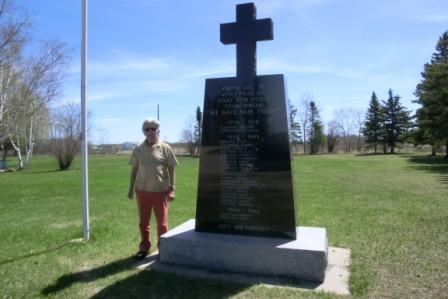
Pieter by the Sagkeeng War Memorial in Fort Alexander, Manitoba.  (Photo credit: Daria Valkenburg)

This past May we were in Winnipeg, and took a drive to the village of Fort Alexander on the Sagkeeng First Nation to visit the Sagkeeng War Memorial.  WWII Métis soldier Philip LAFORTE, who was born in Lac du Bonnet, Manitoba, is listed on this memorial.  

CIMG6785 May 9 2024 Sagkeeng War Memorial re P Laforte

WWII soldier Philip Laforte is listed on the Sagkeeng War Memorial in Fort Alexander, Manitoba.  (Photo credit: Daria Valkenburg)

While serving with the Royal Winnipeg Rifles, Philip lost his life on April 7, 1945 during the crossing of the Schipbeek Canal in The Netherlands.  He’s buried in the Canadian War Cemetery in Holten, The Netherlands.

You can read Philip’s story at:

…. A Remembrance Plaque for WWII soldier Gerald Reginald Kelly was placed outside his former home in Sarnia …

Within a few hours one day we received two emails, both with a Sarnia, Ontario connection.  First, Don Coutts let us know about a memorial project in Sarnia, where Remembrance Plaques of soldiers would be placed outside their former homes during Remembrance Week. 

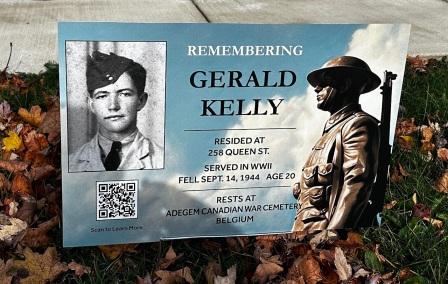
Then, Patrick Michiels of Belgium wrote to let us know that his family had adopted the grave of Private Gerald Reginald KELLY, who was from Sarnia, and is buried in the Canadian War Cemetery in Adegem, Belgium.  

What were the odds that this was a coincidence?  Since our friend Sandra Wallis lives in Sarnia, an email immediately went out to her, asking if she could find out if Gerald was one of the soldiers who had a Remembrance Plaque. 

IMG_8744 Gerald Kelly remembrance plaque in front of his house from Sandra

Remembrance Plaque honouring Gerald Kelly outside his former home in Sarnia. (Photo credit: Sandra Wallis)

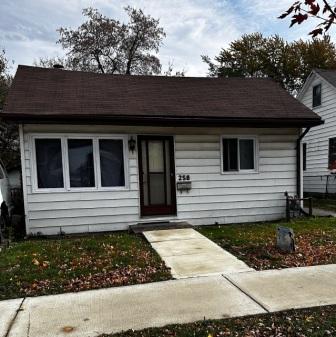
IMG_8743 Nov 4 2024 Kellys house in Sarnia from Sandra

Gerald Kelly’s former home in Sarnia. You can see the Remembrance Plaque on the right.  (Photo credit: Sandra Wallis)

Sandra got in contact with Tom Slater and Tom St. Amand, two retired teachers, who spearheaded the Remembrance Plaque project, and learned that a plaque had been made for Gerald. Once it was in place at his former residence, she took photos of the house and the plaque.  These photos were shared with Patrick, and the two retired teachers are now in contact with him.

Gerald was serving with the Algonquin Regiment when he lost his life on September 14, 1944 during the Battle of the Leopold Canal.  He was killed as he tried to re-cross the Leopold Canal while trying to rescue a wounded sergeant.

Here are two articles about Sarnia’s Remembrance Plaque project:

…. Meeting families of two airmen from Halifax DT630 …

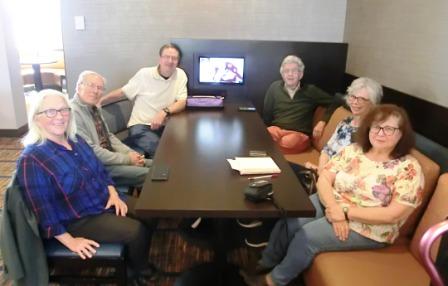
CIMG6764 May 8 2024 May 8 2024 Jamie Don Craig Pieter Sue Daria at Courtyard Marriott Winnipeg

Left to right: Jamie Nelson-Dixon, Don Dixon, Craig MacKenzie, Pieter, Sue MacKenzie, Daria. (Photo courtesy of Valkenburg Family)

After we wrote the story about Jack ‘Douglas’ MACKENZIE, of Winnipeg, Manitoba, the pilot of Halifax DT630 that was shot down by a night fighter over the province of Drenthe in The Netherlands on February 3, 1943, we were contacted by Yannic Wethly of Stichting Luchtoorlog Onderzoek Drenthe (Air Research Drenthe Foundation) in The Netherlands. “….We are still searching for the pictures of Warrant Officer Second Class Raymond Hepton ‘Ray’ Hill and Sergeant Eric ‘Raymond’ Marquand, both crew members of Halifax DT630….” he wrote.

Four men died when the plane went down, including Douglas and Ray, and all are buried in Sleen General Cemetery in The Netherlands. 

We were successful in finding a photo of Raymond Hepton ‘Ray’ HILL, who was from Montreal, Quebec, but did not find any surviving family. Both Ray and his brother died during WWII, there were no other siblings, and neither man was married. 

Like Douglas MacKenzie, Eric ‘Raymond’ MARQUAND, the bomb aimer on that flight, was from Winnipeg.  He had survived the crash and spent the remaining war years in prisoner of war camps before being liberated.  We were very happy when his niece, Jamie Nelson-Dixon, got in contact and provided a photo. 

When we were in Winnipeg this past May, we asked if Jamie, and Doug MacKenzie’s nephew, Craig MacKenzie, would like to meet us and each other.  They did, and we spent a wonderful afternoon together with Jamie’s husband Don and Craig’s wife Sue.

Raymond’s story will be coming up in a future posting, but you can read Douglas’ story at:

Thank you to Percy Affleck, Don Coutts, Don Dixon, Craig and Sue MacKenzie, Jamie Nelson-Dixon, Patrick Michiels, Richard Reeves, Tom Slater, and Sandra Wallis.  The work of remembrance of those who served continues. 

If you have a story to tell, please let Pieter know. You can email him at memorialtrail@gmail.com, or comment on the blog.  

© Daria Valkenburg

….Want to follow our research?….

If you are reading this posting, but aren’t following our research, you are welcome to do so.  Our blog address: https://onthewarmemorialtrail.com/

Front cover OnTheWarMememorialTrailinEurope4 countries, 6 weeks, 7,000 km – an unforgettable war memorial journey in Europe…. Daria’s book ‘No Soldier Buried Overseas Should Ever Be Forgotten‘ is available in print and e-book formats.  Net proceeds of book sales help support research costs and the cost of maintaining this blog. For more information see https://nosoldierforgotten.com/ 

You are also invited to subscribe to our YouTube Channel: On The War Memorial Trail With Pieter Valkenburg: https://www.youtube.com/channel/UCJ591TyjSheOR-Cb_Gs_5Kw

Never miss a posting!  Subscribe below to have each new story from the war memorial trail delivered to your inbox.
On The War Memorial Trail….. Remembering WWII Soldier Philip Laforte

March 22, 2022. Sometimes a story takes you in directions that you never expected.  After the success in finding a photo of WWII soldier Edmond COULOMBE of Manitoba (See https://onthewarmemorialtrail.com/2021/12/24/on-the-war-memorial-trail-the-successful-search-for-a-photo-of-ww2-soldier-edmond-coulombe/), we hoped to have similar success with a photo wish list of WW2 soldiers from Manitoba who are buried in the Canadian War Cemetery in Holten, The Netherlands.

One soldier, who came from an area near where Edmond Coloumbe lived, was Philip LAFORTE.  With the help Philip’s niece Michelle Wazny, Diane Dube of the Winnipeg River Heritage Museum in St.-Georges, and genealogy researcher Judie Klassen, a photo was found, as was information on his Métis roots.

Philip was born September 12, 1911 in Lac du Bonnet, Manitoba, the son of Napoleon and Rosalie (nee Mainville) LaForte.  His mother’s Métis status meant that Philip too was Métis.

A trapper before he enlisted in Winnipeg with the Royal Winnipeg Rifles on July 31, 1941, Philip was married to Eva Jane (nee Johnston) and they had one son, Felix Joseph.  Another son, Donald Philip, was born shortly after he enlisted. Philip had previously been married to Sarah Louise Bird, who had died of tuberculosis.  Their son Leon was brought up by his grandparents, Mr and Mrs Joseph Daniels, of Sagkeeng First Nation.

Philip Laforte 3

Philip Laforte. (Photo courtesy of the Laforte family)

Philip’s service file noted that he was fluent in English, French, and Cree, and had trapped furs for the Hudson’s Bay Company, and worked as a bush labourer for Brown and Rutherford.

As a new recruit, Philip was sent to Fort William (now part of Thunder Bay), Ontario for two months of basic training.  Then he was attached to the Infantry Advanced Training Centre (Rifle) in Winnipeg, Manitoba..

On December 12, 1941, he became part of the 3rd Division Infantry Reinforcement Unit (DIRU) as a Rifleman, and was on his way to the United Kingdom, arriving on December 23, 1941.

On May 28, 1942, Philip was transferred to the Royal Winnipeg Rifles.  Still in the United Kingdom, he was taken on strength to the #1 Educational Company on November 1, 1942, and stayed in that unit until February 1943, when he was transferred to the #2 Canadian Infantry Reinforcement Unit (CIRU).

…. Philip is involved in the liberation of North-West Europe….

On April 12, 1943, Philip was reassigned to the Royal Winnipeg Rifles. On September 1, 1944 he arrived in France as reinforcement for troops lost during the Battle of Caen and the Battle of Falaise Gap.

He participated in the fight to clear the Scheldt Estuary to allow the re-opening of the Antwerp harbour. (See https://en.wikipedia.org/wiki/Battle_of_the_Scheldt) By January 1945 the Royal Winnipeg Rifles were in The Netherlands, and spent the New Year in ‘s-Hertogenbosch.

On February 1, 1945, the war diary recorded that the Regiment was informed of the part that the men “…would play in Operation Veritable…” This would take them into Germany. (See https://en.wikipedia.org/wiki/Operation_Veritable)  The Regiment arrived in Millingen, Germany on February 9, 1945.

By February 16, 1945 the Regiment was based in Essen, Germany, as they cleared German positions in flooded areas of the Rhine flood plain and the Reichswald forest, which is close to the Dutch-German border.

On March 11, 1945 the Regiment began moving back towards ‘s-Hertogenbosch, The Netherlands and the greater battle towards liberating the country.

A short video produced by the Canadian Army gives an idea of what troops faced in this period:

….The battle for Deventer involved crossing the Schipbeek ….

CIMG9306 Sep 25 2017 map of Deventer liberation from Edwin

Movement of Canadian troops towards Deventer.  Note that all first had to cross the Schipbeek.  (Map provided by Edwin van der Wolf)

On April 7, 1945 the Royal Winnipeg Rifles were ordered to cross the Schipbeek and establish a bridgehead as preparation for an assault on the city of Deventer by the 7th Canadian Brigade.

Crossing the Schipbeek was vital to the success of the bridge operation, not an easy feat as the Bridge was strongly defended by the Germans.

Lt Donald Charles MACKENZIE of Springhill, Nova Scotia received a Military Cross for his actions in ensuring the bridgehead was secured.  The citation explained how the Regiment was surrounded by enemy troops and soldiers faced intense fire. (See https://onthewarmemorialtrail.com/2022/01/23/on-the-war-memorial-trail-the-ww2-soldier-from-springhill-who-received-a-memorial-cross/)

Unfortunately, one of the casualties during the events of April 7, 1945 was Philip Laforte, and it seems most likely that he lost his life during the crossing of the Schipbeek.

Along with 45 other soldiers, he was temporarily buried beside an estate in Oxe, which had been the site of the murder of Dutch resistance fighters.

On April 6, 1945, just before the Schipbeek, Royal Winnipeg Rifles troops arrived at an estate in Oxe (Oxerhof). This had been taken over as Gestapo Headquarters, but had been hastily vacated ahead of the Regiment.

To the horror of the Canadian soldier who first approached, he found the graves of ten Dutch resistance fighters, who had been shot just before the Gestapo withdrew. (For more information on De Oxerhof and the murder of 10 Dutch prisoners, see https://www.tracesofwar.com/articles/5041/Estate-The-Oxerhof-in-Deventer.htm and https://www.tracesofwar.com/sights/56914/Memorial-Execution-5-April-1945.htm)

In January 1946, all 46 Canadian soldiers were reburied in the Canadian War Cemetery in Holten, The Netherlands.

laforte, philip gravestone

Grave of Philip Laforte in the Canadian War Cemetery in Holten, The Netherlands. (Photo courtesy of the Information Centre Canadian Cemetery Holten)

…The Colmschate Memorial commemorates 46 Canadians….

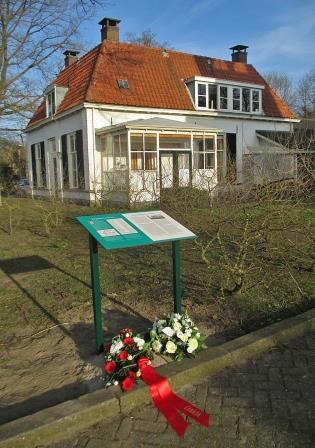
On April 8, 2015, a memorial was placed in Colmschate to commemorate the 46 Canadians who had been temporarily buried on the Oxe estate.

Gedenkbord Colmschate, 8-04-2015

Memorial in Colmschate, commemorating 46 Canadians, including Philip Laforte. (Photo courtesy of Edwin van der Wolf)

Memorial plaque placed Apr 8 2015 Colmschate

Text of Memorial in Colmschate, commemorating 46 Canadians, including Philip Laforte.  (Photo courtesy of Edwin van der Wolf)

Translation of the Dutch text was prepared by Pieter Valkenburg:

They Gave Their Lives

The liberation of Colmschate

During their advance from the Achterhoek, the Royal Winnipeg Rifles, the Regina Rifle Regiment, and the Canadian Scottish Regiment, led by Brigadier General T G Gibson reached the neighborhood of Oxe on Friday April 6, 1945. Next to the house on the Oxe estate (Oxerhof), the liberators discovered the bodies of ten Dutchmen who had been murdered in cold blood by the occupiers the day before. The Canadians passed the Schipbeek via a quickly struck bailey bridge, which replaced the destroyed Swormertoren Bridge.

Despite heavy German resistance, they continued north. Many farms went up in flames and houses were badly damaged. Many families sought refuge in the already liberated Oxe. Some residents lost their lives.

On April 8, 1945, the liberators captured (a small part of) the Snippeling, Colmschate, and the Bannink. Via the Vijfhoek they reached the Crödden Bridge over the Overijssels Canal. Schalkhaar and Deventer were then liberated and with the help of the Queen’s Own Rifles the remaining part of the Snippeling.

Many Canadians lost their lives in the battle in this area. In April 1945, the bodies of 46 fallen Canadians were buried in a temporary resting place opposite the Oxerhof house. In January 1946 they were transferred to the Canadian Cemetery in Holten (Plot I and II).

…..Philip is listed on the National Métis Veterans Memorial Monument….

Judie Klassen let us know that Philip is listed on the National Métis Veterans Memorial Monument just outside of Batoche, Saskatchewan.  (See https://www.metismuseum.ca/metisveteransmonument/)

His name can be found on Column 4 on the inside.  Row 58 https://www.metismuseum.ca/metisveteransmonument/column.php?c=4&s=i

Judie also noted that Philip and his father Napoleon (a WW1 veteran) are listed on the Sagkeeng First Nation website (see http://www.sagkeeng.ca/our-veterans/) and on their memorial in Fort Alexander (see http://www.mhs.mb.ca/docs/sites/sagkeengwarmemorial.shtml)

Thank you to Philip’s niece Michelle Wazny, Diane Dube of the Winnipeg River Heritage Museum in St.-Georges, and genealogy researcher Judie Klassen. It can be a challenge to find family and photos, and we appreciate the help we receive!  If you have photos or information to share, please let Pieter know. Email him at memorialtrail@gmail.com, or comment on the blog.

© Daria Valkenburg

…Want to follow our research?….

If you are reading this posting, but aren’t following the blog, you are welcome to do so.  Our blog address: https://onthewarmemorialtrail.com/

Front cover OnTheWarMememorialTrailinEurope

goodreads-badge-add-plus-71eae69ca0307d077df66a58ec0688984 countries, 6 weeks, 7,000 km – an unforgettable war memorial journey in Europe…. Daria’s book ‘No Soldier Buried Overseas Should Ever Be Forgotten‘ is available in print and e-book formats.  Net proceeds of book sales help support research costs and the cost of maintaining this blog. For more information see https://nosoldierforgotten.com/

You are also invited to subscribe to our YouTube Channel:On The War Memorial Trail With Pieter Valkenburg: https://www.youtube.com/channel/UCJ591TyjSheOR-Cb_Gs_5Kw.

Never miss a posting!  Subscribe below to have each new story from the war memorial trail delivered to your inbox.