On The War Memorial Trail….. The WWI Letters of Lawrence Ivy Marshall – Part 4: Back At The Front

March 21, 2024. In Part 1 of the WWI letters of Lawrence Ivy MARSHALL, of Covehead, Prince Edward Island, which had been shared by his granddaughter, Connie Birt Paynter, Lawrence was among the first Canadians to volunteer for WWI in 1914.  After his initial training in Valcartier, Quebec, he informed his family that he was about to go overseas. (See https://onthewarmemorialtrail.com/2024/03/02/on-the-war-memorial-trail-the-wwi-letters-of-lawrence-ivy-marshall-part-1-valcartier-camp/)

In Part 2, Lawrence described his experiences aboard one of the first troop ships to England. (See https://onthewarmemorialtrail.com/2024/03/08/on-the-war-memorial-trail-the-wwi-letters-of-lawrence-ivy-marshall-part-2-the-voyage-to-england/)

In Part 3, Lawrence was on the front lines in trenches in Belgium and France, when he dislocated his elbow and was sent back to England for treatment. (See https://onthewarmemorialtrail.com/2024/03/15/on-the-war-memorial-trail-the-wwi-letters-of-lawrence-ivy-marshall-part-3-in-the-trenches/)

Now, in Part 4, Lawrence spent weeks in England recuperating before returning to active service at the front.

….Lawrence was operated on to straighten his elbow….
f11d6ed5bab613c66a4153246aab798d--leicester-hospitals

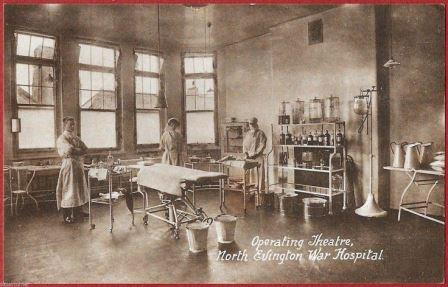
Postcard of the operating theatre at North Evington War Hospital.  Masks were not mandatory.

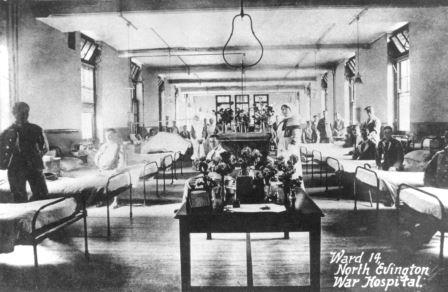
Lawrence remained at North Evington War Hospital in Leicester for 7 weeks.  On September 26, 1915, he gave an update to his father.  “…I am still in the hospital … and will be for a while, I think.  My arm is not any straighter yet.  I have to go to the operating room this morning.  They are going to try and straighten it. I have been under ether three times now. I am getting tired of it too.  If they can’t straighten it this time I will not go back to the front any more.  It doesn’t bother me.  I can use it as good as ever before and I can bend it….

bearwood_t_harden

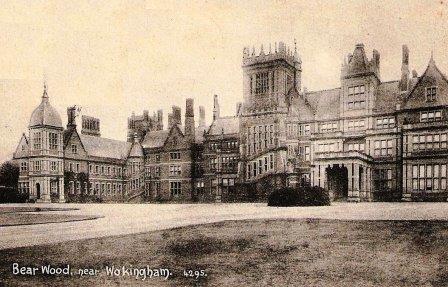
The Canadian Convalescent Hospital in Bear Wood.  (Photo source: http://www.arborfieldhistory.org.uk)

On October 23, 1915, Lawrence was transferred to the Canadian Convalescent Hospital in Monks Horton, then 3 days later to the Canadian Convalescent Hospital in Bear Wood, Wokingham, Berkshire, England. The hospital, which housed 900 Canadian soldiers, had been a private home with 90 bedrooms, belonging to Mrs. Walter, the widow of the Times newspaper owner.

From Bear Wood, Lawrence wrote his mother on October 30, 1915.  “…I am in a convalescent hospital in Berkshire. It is a very good place but awful lonesome.  We are away in the country here on a large estate…..About my arm. It is doing fine now.  It is almost as straight as ever but I cannot do any work with it yet.  There is no strength in it...

….Lawrence returned to duty….

On November 15, 1915, Lawrence was released from hospital and given a short furlough before being assigned to the 48th Highlanders Canada, 43rd Reserve Battalion. 

On November 27, 1915, in a letter to his father, written from East Sandling Kent, he noted that he was “…back with my battalion again… I guess I have to go back to France after Xmas, if not before, but I hope not.  There are a lot of our boys going back there Monday.  I very near got sent too only my arm is not quite right yet.  It still gets sore and stiff… in cold weather...

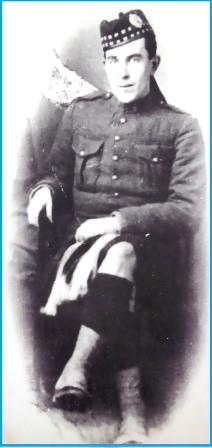
On January 16, 1916, Lawrence left for France, and assigned to the 15th Battalion before rejoining his unit on February 4, 1916.  On February 8, 1916, in a letter to his mother, Lawrence explained that he had taken a photo of himself in a kilt. “So you got the photo I had taken in kilts down in Salisbury, some Scotchman, eh….”  This is the photo of him that has survived for the past century.
20230530_100207 Laurie Marshall from Connie taken in 1916

Lawrence Ivy Marshall. (Photo courtesy of Connie Birt Paynter)

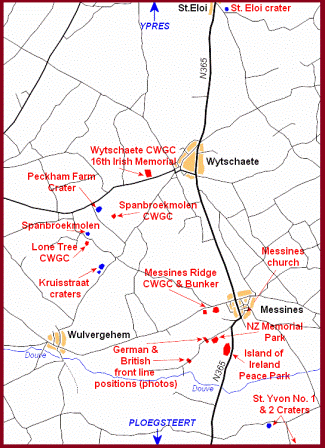
Lawrence kept in contact, explaining in a March 6, 1916 letter to his father, written from ‘somewhere in France’ that “… This is my second trip to the trenches since I came across this time, but am getting used of it again…”  According to the War Diary for the 15th Battalion, ‘somewhere in France’ was on the road between Messines and Wytschaete, along the border with Belgium.
messinesmap

Map showing the location of the road Messines to Wytschaete.  (Map source:  http://www.ww1battlefields.co.uk/flanders/messines/)

In an April 2, 1916 letter from Lawrence to his father, written from ‘somewhere in Belgium’ Lawrence described a near miss. “…I have been more lonesome this last week than I ever have been since I left home…Perhaps it is because I have had two close shaves lately.  I got a bullet right through my hat and stung by a shell bursting over me but am alright again now…. 

‘Somewhere in Belgium’ was near Poperinge, 12.5 km (8 miles) from Ypres, right in the line of fire, as Lawrence briefly mentions.  “And where we are now is awful, the last place was bad enough but this is real hell here…. The Germans tried an attack here the other night but we stopped them.  They were lying on the ground and in the barbed wire as thick as peas… I certainly made my old gun shoot for a while …

….Lawrence was injured in action….

In a June 2, 1916 letter from Lawrence to his father, written from Belgium: “…We are out of the trenches for twelve days rest, have been out for seven now, so expect to go back in again in five days.  Am glad that we are out just now as the Germans are pulling off something up the line this evening.  There are a big bombardment on just where we came out of. We are all standing to here waiting orders to go up if needed.  But none of us are very anxious to go up if we can get out of it.  We are having it pretty hot this summer.  We have a scrap with Fritz every time we are in.  We are only eighteen yards apart where we go in so you can guess what a time we have with each other…

The rest ended the same day that Lawrence wrote his letter, as the June 2, 1916 war diary noted that following an afternoon baseball game, the Battalion had left after 7:30 pm, arriving at “…a position at Zillebeke … at 2 am on June 3…” 

By 2:30 am they were attacked and among the casualties was Lawrence.  He was admitted to a Casualty Clearing Station, where his medical record noted that he had a gunshot wound in his right arm. He was sent to No. 4 General Hospital in Camiers, France. 

….Lawrence was sent to England for treatment….

On June 12, 1916, Lawrence was transferred to the 3rd Northern Hospital in Sheffield, Yorkshire, England, from where he wrote to his father 4 days later.  “…I have got across to England again.  I think I am pretty lucky in this war, don’t you?  I went through some pretty tight places this trip in the trenches and came back safe only for the wound I got.  It is doing fine now…. It was an explosive bullet that I got hit with.  They make a nasty hole where they come out of…

Lawrence explained why he felt lucky. “…We lost all our battalion but two hundred men. We had nine hundred and seventy men so you can see we had a few casualties.  Most of all my pals are gone under in the battle….

He then described how he was injured. “When I got wounded I had to lay for over two hours before I could get a bandage on my arm… It was awful laying on the field right in front of the Germans in daylight and not able to help yourself at all and if you moved the least bit they opened a machine gun on you. There were dead everywhere that you could see and mostly our boys with the kilts on…

Next he briefly mentioned the battle. … We made two charges at the Germans between nine and eleven o’clock in the morning but they drove us back both times. Then I got hit halfway back the second time … My rifle flew out of my hand…

In the letter’s conclusion, Lawrence wrote that he was “…marked for a convalescent hospital so expect to leave here.  It will be a month or more before I will be fit to go back to my base again …” He was correct as not long afterwards he was sent to Arnold Hospital, Doncaster, Yorkshire, England.

….Lawrence did not return to the front….

Lawrence did not go back to the front.  Instead, he spent the remainder of his service working at the Canadian Convalescent Hospital, Wood Cote Park, Epsom, Surrey, England. 

On November 6, 1916, in a letter to his mother, Lawrence explained that he was “…taking the Corporal’s place in the office while he is away on his sick furlough. …I suppose you have heard about poor Parker Crockett being killed.… Poor Parker, him and I came to the dressing station together, he shook hands with me and said that he hoped that I would get to England. He was not wounded enough to make England, so he had to go back and get killed…..” 

Parker Hooper CROCKETT died September 7, 1916 during the Battle of the Somme and is buried in Regina Trench Cemetery, Somme, France. Lawrence knew that had he not been sent to England for treatment, this could have been his fate.

While Lawrence recuperated, the war went on.  In Part 5, Lawrence’s story concludes as he meets with both happiness and tragedy before being one of the lucky Canadian soldiers who returned home after the war ended.

Thank you to Connie Paynter for providing photos and sharing letters written by her grandfather. Do you have photos or information to share? Email Pieter at memorialtrail@gmail.com, comment on the blog, or tweet to @researchmemori1.

© Daria Valkenburg

….Want to follow our research?….

If you are reading this posting, but aren’t following our research, you are welcome to do so.  Our blog address: https://onthewarmemorialtrail.com/
Front cover OnTheWarMememorialTrailinEurope4 countries, 6 weeks, 7,000 km – an unforgettable war memorial journey in Europe…. Daria’s book ‘No Soldier Buried Overseas Should Ever Be Forgotten‘ is available in print and e-book formats.  Net proceeds of book sales help support research costs and the cost of maintaining this blog. For more information see https://nosoldierforgotten.com/ 

You are also invited to subscribe to our YouTube Channel: On The War Memorial Trail With Pieter Valkenburg: https://www.youtube.com/channel/UCJ591TyjSheOR-Cb_Gs_5Kw

Never miss a posting!  Subscribe below to have each new story from the war memorial trail delivered to your inbox.
On The War Memorial Trail….. The WWI Letters of Lawrence Ivy Marshall – Part 3: In The Trenches

20230530_100207 Laurie Marshall from Connie taken in 1916

Lawrence Ivy Marshall. (Photo courtesy of Connie Birt Paynter)

March 15, 2024. In Part 1 of the WWI letters of Lawrence Ivy MARSHALL, of Covehead, Prince Edward Island, which had been shared by his granddaughter, Connie Birt Paynter, Lawrence was among the first Canadians to volunteer for WWI in 1914.  After his initial training in Valcartier, Quebec, he informed his family that he was about to go overseas. (See https://onthewarmemorialtrail.com/2024/03/02/on-the-war-memorial-trail-the-wwi-letters-of-lawrence-ivy-marshall-part-1-valcartier-camp/)

In Part 2, Lawrence described his experiences aboard one of the first troop ships to England. (See https://onthewarmemorialtrail.com/2024/03/08/on-the-war-memorial-trail-the-wwi-letters-of-lawrence-ivy-marshall-part-2-the-voyage-to-england/)

Now, in Part 3, Lawrence spent a cold and wet winter on the Salisbury Plain before being sent into battle in France and Belgium in the spring of 1915.

….A cold and wet winter on the Salisbury Plain….

After arriving in England in late October 1914, the first contingent of Canadian troops received basic training on the Salisbury Plain for the next months – during a cold and wet winter.  Much of the time the soldiers were mired in mud as England experienced one of its wettest winters in decades.

In the article ‘Evolution of Canada’s Shock Troops’, Tim Cook wrote that they “…marched, fired their Canadian-manufactured Ross rifles at targets, and practiced bayonet fighting against straw-filled dummies. And they did it during one of the most miserable winters in British history, when it rained 89 out of 120 days. The parade grounds were reduced to a muddy bog, but the Canadians kept up their spirits with beer, song, and camaraderie…”  (See www.thecanadianencyclopedia.ca/en/article/evolution-of-canadas-shock-troops)

…. “The Germans call us the ‘Women From Hell’…”….

The first Canadians went to France in February 1915, but Lawrence was still in England, waiting to be sent over.  In an April 27, 1915 letter to his father, he writes that “…things have taken a quick change around here in a few days.  They are sending us boys all off to the front in drafts now.  There were two lots went last night.  We are all on the next one.  That is all of the Island boys, but four or five.  We expect to leave any minute now.  We have all our ammunition ready, one hundred and fifty rounds per man. Jim is going on the same draft as I am and Parker Crockett too….”  Jim referred to James Lawrence MARSHALL.  Neither he nor Parker Hooper CROCKETT would return home.

… We are all in great cheer at going away.  You would think we are all going on a picnic to hear us when we got word of it.  We are good and tired of hanging around here now…

Screenshot 2024-02-28 at 16-21-40 Bailleul at DuckDuckGo

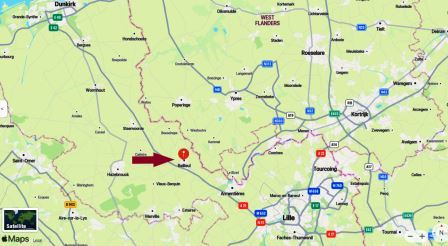
Lawrence joined the 15th Battery in Bailleul, France, just over the border with Belgium.  (Map source: Wikipedia)

A few days later, Lawrence arrived in France, assigned to No. 3 Canadian 15 Battery 3rd Brigade, First Canadian Expeditionary Force.  The Battery had just been moved near Bailleul, France after fighting in the Second Battle of Ypres in Belgium.  (See https://www.thecanadianencyclopedia.ca/en/article/battle-of-ypres)

The War Diary for May 4, 1915 noted that at 6:30 pm the Battalion “…paraded in full marching order and went into billets near Bailleul….”  They experienced heavy rain over the next several days.

On May 15, 1915 the Battalion moved further south to Robecq, France.  Two days later, they moved even further south, this time into trenches near Richebourg, France, in preparation for battle.

Lawrence missed this as he succumbed to dysentery and ended up in a field hospital, as he explained in a May 23, 1915 letter to his father.

 “…I have been in the hospital for over a week now.  It was from the effects of drinking bad water.  The water is awful here….. I expect to go back out of here any day now.  I have had a great rest while I have been in here and have been fed well.  The sisters are awful good to us here too…. The Germans did not get me yet.  I am going back to have another crack at the beggars soon…

After being discharged, Lawrence gave an update in a May 28, 1915 letter to his father.  “…Our Battery has been in action again since I left them, so I missed that.…” Lawrence missed a trench battle in Festubert, France. “…They will be about coming out of the trenches when I get back to them so I will be in with them the next time alright.  The Germans call us ‘The Women From Hell’ – some name ain’t it? …

…. Lawrence was on the front line in the trenches….

By July 1915, Lawrence was in Belgium, with the Battalion settled in a temporary camp called Camp Aldershot.  On July 13, 1915 Lawrence wrote to his mother that he was on guard duty.  “…Here I am in the second line of trenches and having a good time too.  Nothing to do but four hours guard out of twelve.  We were in the firing line four days and in here four days more so I think we are going out today for a while.  Everything is pretty quiet, only for a few shells and bullets that the Germans send over once in a while, but they don’t land very handy to us, and I am glad that they don’t either….

Lawrence gave a lighthearted account of what was happening for his mother’s peace of mind. “… We had a very good time in the front line of trenches.  We could not see the German trenches because there was a field of rye and clover between us but they were only two hundred yards away. We used to send an odd rifle shot over at them for fun to let them know we were there. They used to send a few over at us too but did not hit any of us. …

July 22, 1915 letter from Lawrence to his mother, written from France:  “…We just came out of the trenches last night.  We were in sixteen days.  This time we had quite a spell of it too.  We did not lose many men this time. We were pretty lucky.  We had it pretty wet and muddy for awhile.  ….  I was out one night putting up barbed wire in front of the firing line.  It rained all of the time we were out.  I had my overcoat on.  You could not tell what it was in the morning, an overcoat or mud …

…. Lawrence was injured playing football….

While with his unit in Messines, France, Lawrence was admitted to a field hospital in Etaples, France on August 24, 1915, with a dislocated elbow received while playing football.  On August 31, 1915, he was admitted to No. 3 General Hospital in Camiers, France, where it was decided to send him to England for further treatment.  On September 6, 1915, he was admitted to North Evington War Hospital in Leicester. 

North Evington War Hospital

North Evington War Hospital in Leicester, England. (Photo source: leicestermercury.co.uk)

Lawrence believed he was sent to England thanks to a nurse from Charlottetown, Prince Edward Island, as he explained in a September 7, 1915 letter to his father.  “…I am in the hospital in England and am doing well.  I can’t straighten my arm yet, but I hope to soon now.  It is pretty painful at times.  I dislocated and fractured the bone of my left elbow.  I never expected to get over to England with it, but I guess it was Miss McLeod the nurse who was in the hospital I was in, in France. She must have put a good word in for me…. She belongs to Charlottetown…

…. Lawrence had a ‘close shave’ at the front….

In his letter, Lawrence briefly wrote about his experiences at the front, since his letters were not censored while in England. “The letters don’t have to be censored over here so I suppose you would like to hear a little of what I have seen of this war….Them Germans are sure good shots and about them having no ammunition, that is all lies.  They certainly have lots of it…You should see them send over their big shells when they start. You should see some of the holes that they make when they explode. Some of the holes are forty feet across and ten feet deep….

He acknowledged his luck up to this point. “…  I have lived a charmed life through it so far but I have had some close shaves….  I remember one day …. some of us got out of the trenches to get some platforms for the trenches.  We were no sooner out than … they sent their shells over.  I was just in the act of putting one of the platforms on my back when six shells burst right over my head. The knocked me and the old platform down ….  I was just in the act of crawling away when I heard one of the boys shout God’s sake lay flat and keep still.  He had no sooner said it when the bugger opened their machine guns on us …  We laid there for half an hour with them going about six inches over our heads, some of them hitting the ground alongside of us.… The six of us that went out all managed to get back again.…

…. Lawrence was grateful to be out of the trenches….

In a September 10, 1915 letter to his mother, written while still in hospital, Lawrence shared more observations.  “…It is a treat to get away from the trenches and France.  I have seen all I want to of France. The trenches are getting pretty bad now. The last time we went in the water was above my knees.  When you get wet you have to stay wet until you dry and that is a good while….

Lawrence’s letter continued. “…  We don’t get all we want to eat either of course, when we are there we can’t write anything but that we get plenty to eat or they would not let the letters go home…..The officers don’t care how you do as long as they have plenty for themselves to eat… 

Like many soldiers, Lawrence felt that officers were not concerned about the safety of the men they were responsible for.  “…We are like a lot of prisoners more than soldiers.  It ain’t like a real war, it is more like murder.  Our officers will put us right into danger instead of keeping out of it. I remember one night our officers lined up fifty of us to take an orchard with about five hundred Germans in it.  We started across on the run with bayonets fixed but never got there.  The Germans turned their machine guns on us.  There was only twenty got back alive.  I thought my time had come but I got back alive.  The air was full of bullets…

Lawrence was safe in England, but faced a long recovery period before returning back to the front line.  In Part 4, Lawrence’s story continues as he found himself again on the front line and is wounded.

Thank you to Connie Paynter for providing photos and sharing letters written by her grandfather. Do you have photos or information to share? Email Pieter at memorialtrail@gmail.com, comment on the blog, or tweet to @researchmemori1.

© Daria Valkenburg

….Want to follow our research?….

If you are reading this posting, but aren’t following our research, you are welcome to do so.  Our blog address: https://onthewarmemorialtrail.com/

Front cover OnTheWarMememorialTrailinEurope4 countries, 6 weeks, 7,000 km – an unforgettable war memorial journey in Europe…. Daria’s book ‘No Soldier Buried Overseas Should Ever Be Forgotten‘ is available in print and e-book formats.  Net proceeds of book sales help support research costs and the cost of maintaining this blog. For more information see https://nosoldierforgotten.com/ 

You are also invited to subscribe to our YouTube Channel: On The War Memorial Trail With Pieter Valkenburg: https://www.youtube.com/channel/UCJ591TyjSheOR-Cb_Gs_5Kw

Never miss a posting!  Subscribe below to have each new story from the war memorial trail delivered to your inbox.