On The War Memorial Trail…..The WWII Sapper From Moncton Who Lost His Life During Operation Berlin

Headline of an October 1945 article from ‘The Times Transcript’

November 6, 2025.  While searching for a photo of WWII soldier Eric John CRUE of Moncton, New Brunswick, who lost his life on April 6, 1945 while serving with the Algonquin Regiment, Pieter found an October 1945 newspaper article from ‘The Times Transcript’ about a memorial service in the First United Baptist Church in Moncton to honour the memories of Crue, John Edward COLEMAN of the Royal Canadian Electrical and Mechanical Engineers, George Temple DOYLE of the RCAF, and David ‘Lloyd’ George HOPE of the Royal Canadian Engineers…. all from Moncton.

Pieter knew that Coleman was on a photo wish list from the Canadian War Cemetery in Groesbeek, but Doyle and Hope were unknown to him.  He began an investigation and quickly found that no photo was available for Hope, who is buried in Rhenen General Cemetery in Rhenen, The Netherlands.  There was a photo available for Doyle, and a newspaper photo was found for Coleman by Etienne Gaudet.  No photo was ever found for Crue, who is now on our Cold Case List. (See https://onthewarmemorialtrail.com/our-cold-cases/)

Pieter began the search for a photo of Hope….

….A family member got in contact…

Pieter made contact with Susan ‘Sue’ Hope through Ancestry and she explained that the soldier, who went by ‘Lloyd’, was one of three brothers who served during WWII.  “….Russell, Douglas, and DLG Hope were my grandfather’s cousins. My grandfather was Wesley William Hope.   David Lloyd, Douglas, and Russell Hope were brothers.  They were all from Moncton, their parents were Frank D. Hope and Lottie F Jones…”  Both of Lloyd’s parents died in the early 1930s.  In addition to his brothers, he also had three sisters: Kay, Mildred Greta, and Marguerite.

Born June 30, 1919 in Moncton, New Brunswick, Lloyd worked as an iron moulder at an iron foundry, Record Stove and Furnace Company prior to enlisting in the militia on October 9, 1940 under the National Resources Mobilization Act (NRMA) and began basic infantry training at No. 70 Non-Permanent Active Militia (NPAM) Centre in Fredericton, New Brunswick.  After completing that course on November 7, 1940, he was assigned to the New Brunswick Regiment. (See https://en.wikipedia.org/wiki/National_Resources_Mobilization_Act)

….Lloyd enlisted in the Active Army in August 1941…

He enlisted in the Active Army on August 8, 1941 at No. 7 District Depot in Moncton, stating in an interview that his reason for joining the army was for “….adventure…” He expressed an interest in taking a blacksmiths course. He was described as “…cheerful, neat, with good conduct and military efficiency….” While his mechanical knowledge was listed as “…below average….” it was remarked that his skill on the rifle range was “…above average…” He had written that he enjoyed hunting, fishing, and swimming, so skill with a gun would not have been a surprise.     

Lloyd returned to No. 70 Canadian Army (Basic) Training Centre in Fredericton for his basic training, which was completed on October 2, 1941.  He was transferred to No. 7 District Depot in Moncton on October 20, 1941, and began a Fitters Course the following day, returning to No. 70 Canadian Army (Basic) Training Centre on February 6, 1942. 

On April 8, 1942, Lloyd was transferred to A5 Canadian Engineer Training Centre (CETC) in Camp Petawawa, Ontario for Engineer Training.  After completing his training on May 13, 1942, he was given embarkation leave, for what turned out to be the last chance he would have to see his family.

….Lloyd left Canada for overseas service….
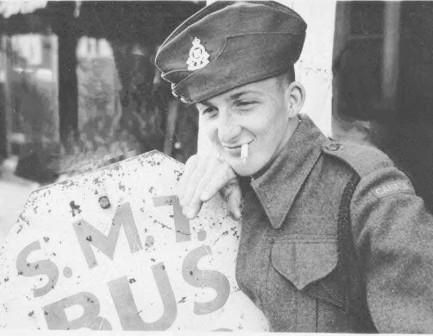
David ‘Lloyd’ George Hope. (Photo courtesy of Susan Hope)

On June 3, 1942, Lloyd sailed from Halifax, Nova Scotia to the United Kingdom, arriving in Liverpool, England on June, 1942. Upon arrival, he was assigned to No. 1 Canadian Engineers Reinforcement Unit (CERU). 

While in the United Kingdom, Lloyd’s training continued.  On September 29, 1942, he was transferred to No. 1 Canadian Ordnance Reinforcement Unit (CORU), qualifying as a Pioneer ‘C’ on October 19, 1942. 

On December 4, 1942, Lloyd was transferred to the Royal Canadian Engineers, 18th Field Company.  While remaining with the 18th Field Company, he was attached, for all purposes, to the Headquarters of the Royal Canadian Engineers, 3rd Canadian Division, from February 19, 1943 until August 13, 1943.

Then, on December 14, 1943, he was transferred to the Royal Canadian Engineers, 23rd Field Company.  In ‘The Twenty-Third Story’ by Major Michael Lovett TUCKER, the entry for December 19, 1943 explained that training was ongoing.  “…We are doing considerable practice in night convoy work…” using old trucks. …We are still working on Bailey Bridge training on Headley Common….” and “….today we start work on a 110 foot T.T. bridge with one storey underslung….”  T.T. refers to Tracked-Transport.  Bridge load effects and capacity ratings needed to be evaluated to determine appropriate load factors for military vehicles crossing various bridges.

….Lloyd and the 23rd Field Company left the UK for France…..

On July 6, 1944, Lloyd and the 23rd Field Company boarded a ship that was to leave the United Kingdom for France, part of the 21st Army Group.  The July 7, 1944 entry in ‘The Twenty-Third Story’ recorded that “…we sail from Tilbury at six-thirty in the morning and anchor off Southend, where we lie for the balance of the day.  Then at ten o’clock the following evening we fall in with the other thirty-three ships in our convoy, and head down the Thames Estuary to the English Channel…

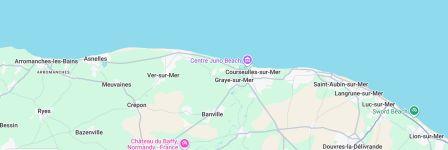
Map showing the location of Graye-sur-Mer and Juno Beach.  (Map source: Google maps)

The entry for July 9, 1944 noted their arrival off the coast of France. “…Late in the afternoon we come in sight of the Normandy coast, and shortly before midnight come to anchor off Juno Beach, off Graye-sur-Mer.  There are so many ships that it is difficult to find a suitable anchorage…

….Lloyd and his brother Douglas help to clear up debris in Caen…..

Troops left the ship the following day, and by July 13, 1944 had moved to their new bivouac area in a orchard near Cairon. Their immediate task was to “…clear debris and open streets in Caen…” as stated in the July 14, 1944 entry.  “…In the centre of town, every street is choked with rubble, and in many places it’s impossible to tell where streets have been. The Germans are mortaring and shelling steadily….”  

Work continued, in spite of German activity, and by July 25, 1944, an entry recorded that “… an entirely new street is run from Boulevard des Allies to the river through the ruins of demolished buildings.  It is named ‘Andy’s Alley’….” 
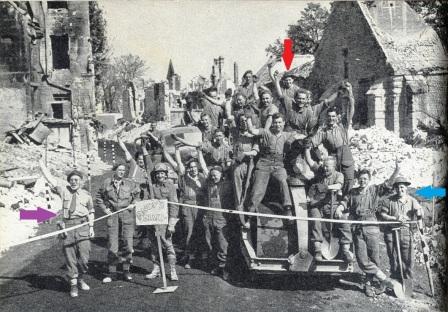
Opening of Andy’s Alley in Caen, July 1944. Lloyd Hope identified by red arrow. His brother Douglas Hope is identified by blue arrow.  The purple arrow identifies Major M. L. Tucker, author of ‘The Twenty-Third Story’. (Photo courtesy of Alice van Bekkum Collection)

The opening of Andy’s Alley was captured in a photo, with the caption noting that the road was ‘a half-mile long’ (.8 km), and that the proud Canadian engineers posed by the steamroller breaking the tape for supplies to move forward.  The source of the photo and the magazine in which it was published is unknown, and was provided by Alice van Bekkum, Chair of the Faces To Graves Foundation.  Both Lloyd and his brother Douglas are in this iconic photo!

….The 23rd Field Company made its way into The Netherlands….

After painstakingly working their way through France and Belgium to clear roads and build bridges, the 23rd Field Company received new orders. The September 16, 1944 entry in ‘The Twenty-Third Story’ recorded that “…something is in the air!  Our advance is moving very fast through Belgium up into Holland…

Operation Market Garden was an Allied military operation, from September 17-25, 1944 that succeeded in liberating Nijmegen and Eindhoven, but failed in liberating the last bridge held in Arnhem, which would enable troops to the Rhine into Germany.  If you’ve seen the movie ‘A Bridge Too Far’ (See https://en.wikipedia.org/wiki/A_Bridge_Too_Far_(film)), then you may be familiar with what happened.  (For an idea of the gliders used, see https://onthewarmemorialtrail.com/2018/01/06/on-the-war-memorial-trail-the-liberation-route/)

There was excitement in the September 18, 1944 entry.  “…We hear that Airborne troops have landed in Northern Holland and have captured the bridges at Grave, Nijmegen and Arnhem over the Maas, Waal and Neder Rijn rivers, respectively….We are the only Canadian troops taking part in the push into Holland….but our ground troops are having difficulty getting beyond Nijmegen and so are unable to join up with the Airborne troops in Arnhem…”  This description was about Operation Market Garden, which failed to capture the bridge at Arnhem, as was noted two days later in the September 20, 1944 entry.

While British troops got across the river at Nijmegen and were able to hold the bridge, they had “…difficulty in getting on to Arnhem, and 1st British Airborne is having a very sticky time there. The Germans have retaken the bridge….

….The 23 Field Company was tasked with rescuing the 1st British Airborne during Operation Berlin….

The 23rd Field Company was “….ordered forward to Nijmegen...”  On September 24, 1944, the entry recorded that they were to help rescue the 1st British Airborne, using storm boats to ferry survivors from the German held side of the Neder Rijn River (Lower Rhine River in English) to Allied safety. Operation Berlin was the rescue attempt to save survivors of the British 1st Airborne after the disastrous Operation Market Garden and at the end of the Battle of Arnhem/Oosterbeek

Example of a storm boat: Storm boats manned by the 34th Field Company, R.C.E., carry Regina Rifles Regiment’s 7th Brigade over the Seine River in 1944.  (Photo Credit: Donald I. Grant/Canada. Dept. of National Defence/Library and Archives Canada/PA-136016)

The following day “…at six o’clock we learn that we are to operate from a site on the river, just east of Driel.  We are to have fourteen boats, and these will be off-loaded in an orchard which comes up to the back of the winter dyke...

The first storm boat was launched at 9:30 pm, but as it had been damaged while being pushed down the bank into the water, it started to leak and had to be abandoned.  A second boat was readied. “….Corporal Ryan, W.D., and Sappers Magnusson, H.C., and Roherty, L.J., are the crew…It is pitch dark and pouring rain….Lt Martin asks to go with this boat so that he may contact our friends and lend a hand in organizing the loading of boats for them…..” 

 It set off at 9:45 pm, closely followed by “…another, which has Corporal Smith, S. F., and Sappers Hope, D.L.G., and Thompson, N.A. as crew.  Neither of these boats returns.  One is seen to receive a direct mortar hit. There is a direct flash from the explosion, and then nothing can be seen in the darkness …” 

The boat with Ryan, Magnusson, Roherty, and Martin was hit by mortar fire. None of the men survived.

….Lloyd was in the storm boat that capsized during Operation Berlin….

The boat with Smith, Hope, and Thompson was on its way back after picking up survivors, but was “…heavily overloaded with Airborne survivors…” The boat “….went under when a mortar fell close beside it and everyone instinctively threw himself to the other side of the boat and capsized it...” 

Of the crew, only Corporal Smith survived.  He recorded in a report on the incident that he was riding in the bow to help land the boat.  While heading for the south (home) shore, the boat was swamped and sank about 46 metres (50 yards) from the north shore.  As his “…greatcoat was open it helped me to float, and although I am not a swimmer I reached shore on the north side of the river along with four of the British Airborne men. I was taken back to the home side of the river in an assault boat…

….Lloyd is buried in Rhenen General Cemetery…

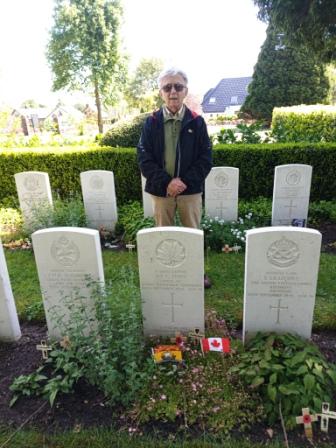
Pieter by the grave of David ‘Lloyd’ George Hope. (Photo credit: Daria Valkenburg)

25 year old Lloyd lost his life due to drowning on September 26, 1944, when the storm boat he was in capsized.  He was buried in Rhenen General Cemetery, which we visited this past May.  Pieter placed a Canadian and New Brunswick flag at Lloyd’s grave. (See https://onthewarmemorialtrail.com/2025/11/03/on-the-war-memorial-trail-a-visit-to-rhenen-general-cemetery/)

Although 7 men from the 23rd Field Company lost their lives during Operation Berlin, it was a success. The Royal Canadian Engineers rescued most of the 2,400 evacuees in one night, using storm boats propelled by 50 horse power outboard motors! (See https://www.strijdbewijs.nl/donald/operation.htm)

….A visit with Sue Hope…

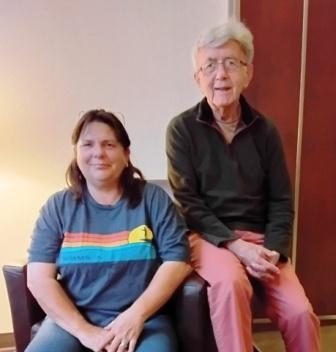
Susan ‘Sue’ Hope and Pieter.  (Photo credit: Daria Valkenburg)

We were delighted to have a chance to meet Sue Hope in Moncton after we returned from our 2025 European War Memorial Tour.  “….Thank you for the project you are doing to preserve history of all these young men!…” she wrote.

The flags placed at the graves for David ‘Lloyd’ George Hope were donated.  Our thanks go to: 

  • Alan Waddell, Constituent Assistant, on behalf of Heath MacDonald, MP for Malpeque, for the Canadian flags.
  • Jean-Claude D’Amours, MLA for Edmundston-Madawaska Centre, Minister responsible for Military Affairs, with the help of Cécile LePage, Province of New Brunswick, for the New Brunswick flag. 

Thank you to Sue Hope for providing photos and information about her grandfather’s cousin, and to Alice van Bekkum for providing information on the 23rd Field Company and Major Tucker’s book, as well as the photograph taken at Andy’s Alley.  Thank you to John Sliz, author of ‘Storm Boat Kings’, for sharing the storm boat photo.

Our adventures continue as we share the highlights of our adventures on the 2025 European War Memorial Tour.

If you have a story or photo to share, please contact Pieter at memorialtrail@gmail.com or comment on the blog. 

© Daria Valkenburg

….Want to follow our research?…

If you are reading this posting, but aren’t following our research, you are welcome to do so.  Our blog address: https://onthewarmemorialtrail.com/

4 countries, 6 weeks, 7,000 km – an unforgettable war memorial journey in Europe…. Daria’s book ‘No Soldier Buried Overseas Should Ever Be Forgotten‘ is available in print and e-book formats.  Net proceeds of book sales help support research costs and the cost of maintaining this blog. For more information see https://nosoldierforgotten.com/

Subscribe to our YouTube Channel: On The War Memorial Trail With Pieter Valkenburg: https://www.youtube.com/channel/UCJ591TyjSheOR-Cb_Gs_5Kw

Never miss a posting!  Subscribe below to have each new story from the war memorial trail delivered to your inbox.

On The War Memorial Trail….. A Visit To Rhenen General Cemetery

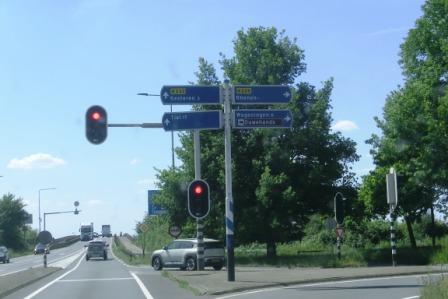
Sign directing us to Rhenen, The Netherlands.  (Photo credit: Daria Valkenburg)

November 3, 2025. While in Europe this spring for the 80th Anniversary of Liberation Commemoration events, we visited 14 cemeteries to place flags at the graves of 383 soldiers that Pieter has researched since 2014, with the stories of many of these soldiers previously told on this blog. 

On our way towards Zaltbommel for a family visit before going on to Belgium, we visited two cemeteries. The previous posting featured our visit to Uden War Cemetery, where George Glenn ‘Dusty’ MILLAR, of Winnipeg, Manitoba, is buried. (See https://onthewarmemorialtrail.com/2025/10/29/on-the-war-memorial-trail-paying-our-respects-to-spitfire-pilot-dusty-millar-at-uden-war-cemetery/)

This posting features our visit to Rhenen General Cemetery, where David ‘Lloyd’ George HOPE, of Moncton, New Brunswick, is buried.  The village of Rhenen is in the province of Utrecht, 26 kms (16 miles) from Arnhem and 47 kms (29 miles) from Utrecht.

….The Commonwealth War Graves were tucked away in a small section of the cemetery….

Pieter at the entrance to Rhenen General Cemetery.  (Photo credit: Daria Valkenburg)

This is a beautiful cemetery, with the Commonwealth War Graves in its own hedged section.  There are 23 WWII Commonwealth burials here, 3 of which are unidentified. In addition, there is 1 unidentified Polish soldier buried here.

The hedged area of Rhenen General Cemetery with the Commonwealth War Graves are located.  (Photo credit: Daria Valkenburg)

The war graves are located in a hedged part of Rhenen General Cemetery.  (Photo credit: Daria Valkenburg)

….Hope was one of 7 Royal Canadian Engineers from the 23rd Field Company killed during Operation Berlin….

Pieter by the grave of David ‘Lloyd’ George Hope. (Photo credit: Daria Valkenburg)

David ‘Lloyd’ George Hope was serving with the Royal Canadian Engineers, 23rd Field Company, when he lost his life on September 26, 1944, aged 25.  He had drowned while trying to save glider pilots during the disastrous Operation Market Garden, one of 7 men from the 23rd Field Company who lost their lives in Operation Berlin – the evacuation of survivors of the British 1st Airborne at the end of the Battle of Arnhem/Oosterbeek.  

Pieter placed a Canadian and New Brunswick flag at Lloyd’s grave, and reminded me that his story had to be told in an upcoming posting.

….Ryan was another Royal Canadian Engineer from the 23rd Field Company killed during Operation Berlin….

Grave of Daniel William Ryan.  Behind his grave you can see the Polish flag at the grave of the unknown Polish soldier. (Photo credit: Pieter Valkenburg)

While looking at the graves, most of them of airmen, we noticed another Canadian grave!  Daniel William RYAN was also from the Royal Canadian Engineers.  Of course we placed a Canadian flag at his grave, but it wasn’t until later that evening that we learned he was from Sydney Mines, Nova Scotia, and had also been in the 23rd Field Company. 

We wondered if he’d been in the same boat as Lloyd Hope, but he was in a different boat, and had died when the boat he was in was hit by mortar fire.

….Royal Canadian Engineers from 23rd Field Company who were killed during Operation Berlin….

The Royal Canadian Engineers rescued most of the 2,400 evacuees in one night, using storm boats propelled by 50 horse power outboard motors! Unfortunately, 7 men from the 23rd Field Company lost their lives during Operation Berlin. (See https://www.strijdbewijs.nl/donald/operation.htm)

Killed in Boat I:

  • James Russell MARTIN, of Kingston, Ontario, aged 26, buried in the Canadian War Cemetery in Holten  
  • Sapper Harold Cecil MAGNUSSON, of St. John, New Brunswick, aged 22, buried in Gorinchem General Cemetery  
  • L/ Sapper Leslie Joseph ROHERTY, of Belledune River, New Brunswick, aged 22, listed on the Missing Memorial at the Canadian War Cemetery in Groesbeek
  • Daniel William RYAN, of Sydney Mines, Nova Scotia, aged 27, buried in Rhenen General Cemetery

Killed in Boat III:

  • Sapper David ‘Lloyd’ George HOPE, of Moncton, New Brunswick, aged 25, buried in Rhenen General Cemetery
  • Sapper Neil Arthur THOMPSON, born in Halifax, Nova Scotia, aged 23, buried in the Canadian War Cemetery in Groesbeek                       

Killed In An Orchard:

  • Sapper Ronald Tracy ‘Buck’ MCKEE, of St. Martin’s, New Brunswick, aged 36, buried in Arnhem Oosterbeek War Cemetery

The flags placed at the graves for David ‘Lloyd’ George Hope and Daniel William Ryan were donated.  Our thanks go to: 

  • Alan Waddell, Constituent Assistant, on behalf of Heath MacDonald, MP for Malpeque, for the Canadian flags.
  • Jean-Claude D’Amours, MLA for Edmundston-Madawaska Centre, Minister responsible for Military Affairs, with the help of Cécile LePage, Province of New Brunswick, for the New Brunswick flag. 

Our adventures continue as we share the highlights of our adventures on the 2025 European War Memorial Tour.

If you have a story or photo to share, please contact Pieter at memorialtrail@gmail.com or comment on the blog. 

© Daria Valkenburg

….Want to follow our research?…

If you are reading this posting, but aren’t following our research, you are welcome to do so.  Our blog address: https://onthewarmemorialtrail.com/
4 countries, 6 weeks, 7,000 km – an unforgettable war memorial journey in Europe…. Daria’s book ‘No Soldier Buried Overseas Should Ever Be Forgotten‘ is available in print and e-book formats.  Net proceeds of book sales help support research costs and the cost of maintaining this blog. For more information see https://nosoldierforgotten.com/

Subscribe to our YouTube Channel: On The War Memorial Trail With Pieter Valkenburg: https://www.youtube.com/channel/UCJ591TyjSheOR-Cb_Gs_5Kw

Never miss a posting!  Subscribe below to have each new story from the war memorial trail delivered to your inbox.
On The War Memorial Trail…..The WWII Pilot Whose Spitfire Ran Out Of Fuel

January 25, 2023.  After seeing an interview on CTV National News about Pieter’s research into WWII soldiers and airmen buried in The Netherlands, Pieter received an email from Dave Montgomery.  

Dave Montgomery 1

Dave Montgomery, whose father’s best friend was RCAF Pilot George Glenn Millar. (Photo courtesy of Dave Montgomery)

Dave wrote that “…I became aware of your project of identifying Canadians killed in WW2 to liberate Holland when I saw your interview with CTV News recently.  

My father’s best friend, George Glenn Millar, nicknamed ‘Dusty’, was killed on September 28, 1944 in combat while flying a Spitfire Mark IX over Nijmegen, Holland.  He is buried at the Uden War Cemetery in North Brabant, Holland. He was from Winnipeg, Manitoba and was serving with 442 Squadron of the RCAF when killed. …  My father survived the war and lived a full life back in Canada and passed away in January 2013.  He never forgot his friend…

20220911_161454 Miller and Montgomery

George Glenn ‘Dusty’ Millar, left, with Thomas Richard Montgomery. (Photo courtesy of Dave Montgomery)

Dave included a photo, explaining that “… G. G. Millar is on the left.  My father, Thomas Richard Montgomery, is on the right….

….George Glenn attended university for one year before enlistment….

Millar G.G. foto 2

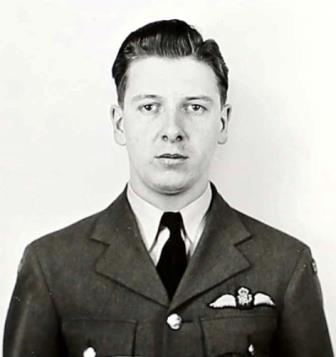
George Glenn ‘Dusty’ Millar.  (Photo courtesy of the Information Centre, Holten)

Born November 21, 1921 in Winnipeg, Manitoba, George Glenn MILLAR was the son of George Sawers and Janet Smith (nee Wilson) Millar. While a first-year student at the University of Manitoba, George joined the University’s Canadian Officers’ Training Corps (COTC) on April 7, 1941, part of the Non-Permanent Active Militia. In his attestation form, he stated that he had served 110 hours in the University of Manitoba Training Unit (UMTU). (See https://en.wikipedia.org/wiki/Canadian_Officers%27_Training_Corps)

In July 1941, he enlisted in the Royal Canadian Air Force (RCAF) in Winnipeg.  Asked about hobbies and sports, he wrote that he played golf extensively, occasionally played hockey, rugby, and baseball.  He was very clear in his goal – he wanted to enlist for flying duties and to be a pilot.

….George Glenn realized his goal of becoming a pilot….

In October 1941 he was sent to Edmonton, Alberta and then a few weeks later to Calgary, Alberta to #3 Service Flying Training School for flight training.  On December 12, 1941 he was sent back to Edmonton, to #16 Flight Training School, where he remained until April 25, 1942.  By the time he left he had put in 73 hours and 35 minutes into flying a Tiger Moth.

He was next posted to #1 Service Flying Training School in Camp Borden, Ontario on April 26, 1942, receiving his Pilot Flying Badge on August 14, 1942.   He had also learned to fly a Yale and a Harvard MK II.

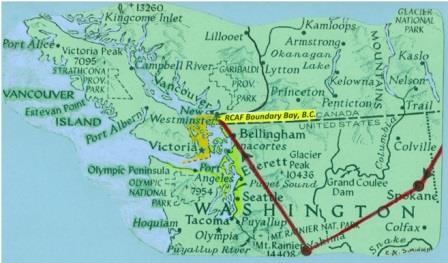
In August 1942 he was posted to No. 133 (F) Squadron in Lethbridge, Alberta, where he gained more experience in flying a Harvard MK II and learned to fly a Hurricane II B.  The Squadron moved to Boundary Bay, British Columbia at the beginning of October 1942.  (Note: the ‘F’ stood for ‘Fighter’)

Map RCAF Boundary Bay

Patrol path of No. 133 (F) Squadron included the Canadian section [orange] and the area in the United States from Bellingham to Tacoma, Washington, [yellow]. (Map source: https://clarencesimonsen.wordpress.com/category/rcaf-133-squadron/)

On October 5, 1942, George Glenn received a promotion to Pilot Officer, and then another promotion, to Flight Officer, on February 13, 1943. He remained with No. 133 (F) Squadron until May 15, 1943, when he was sent to No. 111 Squadron in Anchorage, Alaska.

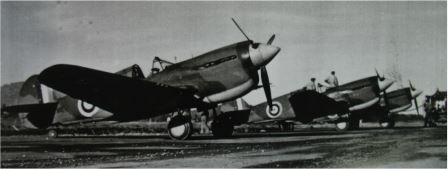
Don Smith, an Associate Historian with the RCAF, explained that George Glenn “….arrived at No. 111 Squadron as a replacement pilot.  Millar was at No. 111 Squadron to get checked out in a new (for him) fighter type, the Curtis P-40K Kittyhawk.  He had been flying the Hawker Hurricane with No. 133 Squadron….

P-40 Kittyhawk Aircraft

P-40 Kittyhawk. (Photo credit: Department of National Defence (DND) PGB-1436)

….George Glenn’s Squadron participates in the Aleutian Islands Campaign in 1943 ….

Don went on to explain that “Millar did not remain long with No. 111 Squadron after he soloed in the Kittyhawk in late May 1943. By the end of August he was flying with No. 14 Squadron at Umnak Island, in the Aleutians, where he spent a one-week rotation at the forward assembly airfield on Amchitka Island the same month…

Dave Montgomery had done some research on George’s time in Alaska, and explained that “…. No. 14 Squadron and No. 111 Squadron were ordered to Alaska in 1943 to fight alongside the Americans fighting the Japanese who had landed at Kiska and Attu Islands in the Aleutian Islands of Alaska in June of 1942.   

These RCAF squadrons served at Anchorage, Kodiak Island, and Umnak Island bases with short postings to Adak Island and Amchitka Island when flying missions against the Japanese, who were dug in on Kiska Island. 

Several were killed there as the weather was atrocious, especially in the Aleutians.  Weather was the biggest killer of pilots in Alaska, not enemy guns.   

G.G. Millar flew with both 111 Squadron (briefly) and then 14 Squadron and flew missions with the US fliers to Kiska Island bombing and strafing the Japanese there  under overall command of Jack Chennault, the son of Claire Chennault who was the US Colonel (later General) who commanded the famous Flying Tigers in China!

No. 14 and 111 Squadrons returned to Patricia Bay in September of 1943 after the 5,000 Japanese on Kiska Island managed to escape under cover of fog and darkness in late July 1943 on Japanese naval destroyers sent there to evacuate them after the defeat of the Japanese forces on Attu Island by the US…..”   RCAF Patricia Bay was in Victoria, British Columbia.  (For more information on the Aleutian Islands Campaign, see https://en.wikipedia.org/wiki/Aleutian_Islands_campaign)

Don Smith explained that “Millar remained with No. 14 Squadron, going overseas with them, where the Squadron was renumbered from No. 14 Squadron to No. 442 (F) Squadron…

Dave Montgomery noted that “….No. 14 and 111 Squadrons sailed to England between January 20 to 27, 1944 on the SS Pasteur (a French passenger liner completed in 1939 and converted to a fast troop ship).  The Pasteur made the crossing alone rather than in a convoy since she could sail at up to 26 Knots.

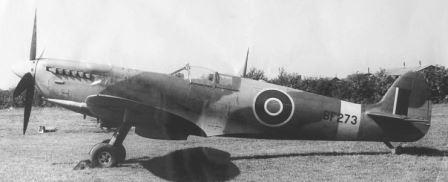
On February 8, 1944, No. 14 Squadron was renumbered as 442 Squadron (equipped with Spitfire Mark IX fighters) and No. 111 Squadron was renumbered as No. 440 Squadron (equipped with Hawker Typhoon fighter bombers)….

Spitfire Mk. IX

Spitfire Mark  IX.  (Photo source: Google image, from ‘Spitfire Mk IX Performance Testing, Aeroplane and Armament Experimental Establishment, Boscombe Down, 21 October, 1942.’)

….George Glenn’s Spitfire failed to return from a patrol near Nijmegen….

On August 14, 1944, George Glenn received his final promotion, to Flight Lieutenant.  Just over a month later, he had his final flight.  Don Smith explained that from September 20 to October 1, 1944, Base 68 at Le Culot/Beauvechain in Belgium “was occupied by 126 Wing, Group 83, 2nd Tactical Air Force (Canadian Fighter Wing), to provide air cover over the Arnhem/Nijmegen areas for Operation Market Garden….

NOTE: Operation Market Garden was an Allied military operation, from September 17 to 27, 1944, that succeeded in liberating Nijmegen and Eindhoven but failed in liberating the last bridge held in Arnhem, which would enable troops to the Rhine into Germany.  The movie ‘A Bridge Too Far’ dramatized this event. (See https://en.wikipedia.org/wiki/A_Bridge_Too_Far_(film))

It was from Base 68 at Le Culot/Beauvechain that George Glenn’s Squadron operated during that period. “….On September 28, 1944, while on a patrol over enemy territory in Spitfire PL490, his aircraft apparently ran out of fuel. F/L Millar was last seen over Nijmegen, Holland. While the record indicates F/L Millar’s aircraft ran out of fuel, the record for Spitfire PL490 suggests on 28 September, 1944, this aircraft, flown by F/L G.G. Millar, RCAF, was in aerial combat with Fw190s of the German Luftwaffe before the fuel shortage was reported….

This summary was similar to what was written in a September 30, 1944 letter to George Glenn’s mother by his Commanding Officer in No. 442 Squadron, Flight Lieutenant W A Olmstead.  “…On the morning of September 28th, Glen took off with the Squadron on a Patrol over enemy territory in Holland.  During this operation the Squadron were chasing some German aircraft when Glen reported on his radio that he was getting low in fuel and would have to return to friendly territory which he started out to do.

Later during the operation, Flight Lieutenant W.A. Olmstead, who was leading the Squadron, heard Glen on his radio saying that his engine was cutting and he would have to bail out or crash land. He was not seen at this point by any member of the Squadron, but it is believed he bailed out or crash landed somewhere in Holland at approximately 0945 hours….

The aircraft crashed 3 km (1.86 miles) southeast of Weibosch near Schijndel, in the Dutch province of Noord-Brabant.

….Why did the plane run out of fuel?….

We asked Don Smith why the Spitfire would have run out of fuel.  He said that although it was possible that the Spitfire “…PL490 suffered battle damage if involved in aerial combat with Fw190s, this cannot be confirmed…

Don went on to explain that ….the Merlin-powered Spitfire Mk IX was also known to have problems with vapour-lock in the fuel system, especially if the aircraft had been sitting in the sun prior to take-off. If the Spitfire PL490 was carrying an external belly-mounted auxiliary fuel tank at the time of its loss, this could create failure of the engine when switching from main tanks to external, or from external back to the main fuel tanks. The latter was more serious, since this would usually take place over enemy territory, as was the case on September 28, 1944.

As an example of this particular problem, No. 401 Squadron (RCAF) reported almost one quarter of pilots lost were due to this cause. These incidents were not mentioned as ‘tank problems’, but referred to such incidents as ‘engine failure’ or ‘engine trouble’.  

The actual cause of the loss of Spitfire PL490 will probably never be known. The Spitfire Mk IX had two tanks in front of the cockpit, one upper and one lower. Later models had another fuel tank added behind the cockpit. It is possible that the lower front tank could have been holed in combat, or the rear tank, depending on the age of PL490. In either case, F/L Millar would not have noticed the fuel leak….

….George Glenn Millar was buried in Uden War Cemetery….

Edwin van der Wolf, a volunteer researcher at the Canadian War Cemetery in Holten, wrote that George Glenn was temporarily buried in Weibosch before being reburied on July 23, 1946 at Uden War Cemetery in Uden, The Netherlands.  (See https://www.cwgc.org/visit-us/find-cemeteries-memorials/cemetery-details/2082100/uden-war-cemetery/)

Millar G.G. graffoto

George Glen Millar is buried in Uden War Cemetery.  (Photo courtesy Information Centre, Canadian Cemetery Holten)

Thank you to Dave Montgomery for sharing information about his father’s best friend, George Glenn Millar.  He is not forgotten!  Thank you to Don Smith for help with the aviation specifics and history, and to Edwin van der Wolf for sending photos and confirming burial information. If you have a story to share, please contact Pieter at memorialtrail@gmail.com, or comment on the blog.

© Daria Valkenburg

…Want to follow our research?….

If you are reading this posting, but aren’t following the blog, you are welcome to do so. Our blog address: https://onthewarmemorialtrail.com/.

Front cover OnTheWarMememorialTrailinEurope4 countries, 6 weeks, 7,000 km – an unforgettable war memorial journey in Europe…. Daria’s book ‘No Soldier Buried Overseas Should Ever Be Forgotten’ is available in print and e-book formats.  Net proceeds of book sales help support research costs and the cost of maintaining this blog. For more information on the book, please see https://nosoldierforgotten.com/

You are also invited to subscribe to our YouTube Channel: On The War Memorial Trail With Pieter Valkenburg: https://www.youtube.com/channel/UCJ591TyjSheOR-Cb_Gs_5Kw.

Never miss a posting!  Subscribe below to have each new story from the war memorial trail delivered to your inbox.

On the War Memorial Trail ….. The Liberation Route

January 6, 2018.  After flags were laid at the graves of the known soldiers from PEI at the Canadian War Cemetery in Groesbeek, we travelled along The Liberation Route with our friends Ad and Noor Scheepers.  History lives and breathes here, and if you are unaware of the past, you can take things at face value.

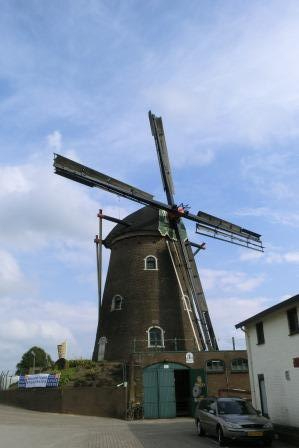
One example…I’m fascinated by windmills.  Not the ugly behemoths that we see now, but the older windmills that are still seen in Europe.  One of these is in Groesbeek, and is now a shop, and I wanted a photo of it.  Ad told us that during WWII the windmill had been used first as a reference point by the US 82nd Airborne Division and later as an observation point in 1944 in preparation for Operation Market Garden.  This was an Allied military operation, from September 17-25, 1944 that succeeded in liberating Nijmegen and Eindhoven, but failed in liberating the last bridge held in Arnhem, which would enable troops to the Rhine into Germany.  If you’ve seen the movie ‘A Bridge Too Far’ (See https://en.wikipedia.org/wiki/A_Bridge_Too_Far_(film)), then you may be familiar with what is discussed in this blog entry.

CIMG9038 Sep 16 2017 Windmill in Groesbeek that was a lookout post during WWII

Windmill in Groesbeek that was used as an observation post during WWII. (Photo credit: Pieter Valkenburg)

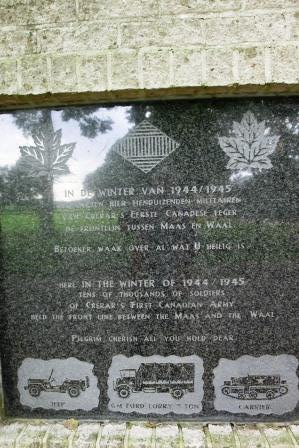
From Groesbeek, we followed the Liberation Route to Klein Amerika (Little America), a high spot near Groesbeek.  For some reason, Klein Amerika had this name long before WWII!  This was the area where parachutes and gliders landed in preparation for Operation Market Garden, to capture the bridges held by Germans during WWII.  In addition to the 505th of the US Army’s 82nd airborne division who landed here, the 1st Canadian Army guarded the area in the winter of 1944-1945.

CIMG9044 Sep 16 2017 Klein Amerika Monument 82nd Airborne Division and the 1st Canadian Army

Memorial at Klein Amerika honouring the 1st Canadian Army who guarded the area in the winter of 1944-45. (Photo credit: Daria Valkenburg)

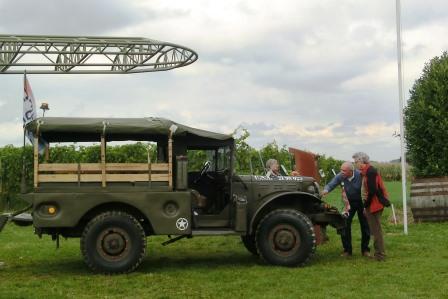
Today, Klein Amerika has a memorial park, complete with jeeps and a replica of a Waco glider, and an information panel that plays newsreels about the events of the battle and its preparation.

CIMG9041 Sep 16 2017 Klein Amerika Ad & Pieter inspect jeep while Noor reads info panel

Ad Scheepers and Pieter inspect a jeep, while Noor watches one of the newsreels on the information panel at Klein Amerika. (Photo credit: Daria Valkenburg)

CIMG9042 Sep 16 2017 Klein Amerika Pieter & Ad in the replica Waco glider

Ad and Pieter in the Waco glider replica at Klein Amerika. (Photo credit: Daria Valkenburg)

Ad told us a story he’d heard about a commander of the British Airborne Division who landed in Klein Amerika and sneaked across the border to Germany.  He came back safely and when asked where he’d been, said he’d gone to Germany to be the first Brit to “piss on the Germans”.  We’ve not been able to confirm this story, but with the border so close by, it could be true.

We followed the Liberation Route across the border into Germany and then ended the tour at a café in Milligen, where the Rhine and Waal Rivers meet. It was fascinating to see how much shipping is done by boat here!

CIMG9059 Sep 16 2017 boat near De Gelderse Poort Cafe in Milligan where Rhine and Waal meet

Shipping traffic in Milligen, where the Rhine and Waal Rivers meet. (Photo credit: Daria Valkenburg)

Now that we had a better idea of what troops faced in trying to liberate this part of The Netherlands, we were even more honoured to be working on this cenotaph research project.  In our next blog entry, we visit another Canadian War Cemetery, this time in Holten.

Comments or stories?  You can share them by emailing us at memorialtrail@gmail.com or by commenting on this blog.

© Daria Valkenburg

….Want to follow our research?….

If you are reading this posting, but aren’t following our research, you are welcome to do so.  Our blog address: https://onthewarmemorialtrail.com/

Front cover OnTheWarMememorialTrailinEurope4 countries, 6 weeks, 7,000 km – an unforgettable war memorial journey in Europe…. Daria’s book ‘No Soldier Buried Overseas Should Ever Be Forgotten‘ is available in print and e-book formats.  Net proceeds of book sales help support research costs and the cost of maintaining this blog. For more information see https://nosoldierforgotten.com/ 

You are also invited to subscribe to our YouTube Channel: On The War Memorial Trail With Pieter Valkenburg: https://www.youtube.com/channel/UCJ591TyjSheOR-Cb_Gs_5Kw

Never miss a posting!  Subscribe below to have each new story from the war memorial trail delivered to your inbox.