March 15, 2026. In going through the last few names on a photo wish list for soldiers from New Brunswick who are buried in the Canadian War Cemetery in Groesbeek, Pieter’s initial research found that one of the names was of a soldier from Prince Edward Island.
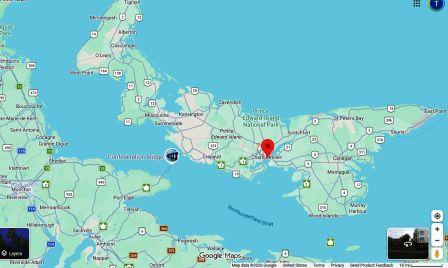
Charlottetown, the capital of Prince Edward Island, is on the east coast of Canada. (Map source: Google)
Alfred Edward Stanley FORD was born February 12, 1918 in Charlottetown, Prince Edward Island, son of Alvin Chester and Ethel Maud (nee Roebuck) Ford. He was one of two children in the family and Pieter at first thought it would be a challenge to find a photo.
However, an obituary for Alfred’s sister Marjorie led him to the Cummins family, and he was soon in contact with Marjorie’s son Dave, who wrote to Pieter, saying “….I greatly appreciate all the work you and your wife are doing on the memories of our fallen soldiers…” And yes, he did have a photo of his uncle.
….Alfred worked as a waiter and butler…
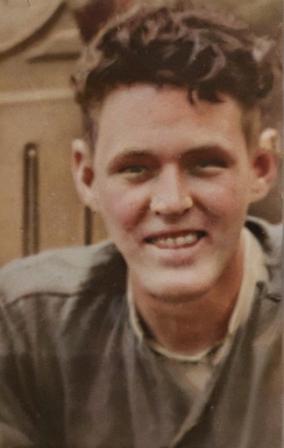
Alfred Edward Stanley Ford. (Photo courtesy of Cummins/Ford archives. Photo restoration and colourization by Pieter Valkenburg)
When Alfred enlisted at the No. 4 District Depot in Montreal, Quebec on December 3, 1941, he stated that he had served in the Reserve Formation of the Royal Canadian Corps of Signals (RCCS) in Prince Edward Island for 2 years, from July 1936 until July 1938.
After leaving school at aged 16, he’d worked as a waiter at various hotels between 1933 and 1936, and then was a butler for the Polish Consul-General, Dr. Sylwester Gruszka, in New York City between 1936 and 1939. (A career diplomat, Dr. Gruszka was the Consul-General from 1935–1940. For more information, see https://pl.wikipedia.org/wiki/Sylwester_Gruszka)
Alfred’s time working for the Consul-General resonated with us, as decades later Pieter worked in the Consulate in New York and later in the Embassy in Warsaw, Poland, during his career in the Dutch Foreign Service.
While working for Dr. Gruszka, Alfred took a short order-barman course and received a diploma for successfully completing a course at the Fanny Farmer School of Cooking in 1937.
From 1939 to 1941, Alfred worked as a barman and later as a waiter in New York.
….Alfred was drafted one country and enlisted in another….
On October 16, 1940, he was required to fill out a US Draft Card Registration. At the time, he was between jobs in New York City, and living with a friend. Although the USA didn’t officially enter World War II until December 8, 1941, after the attack on Pearl Harbor, Hawaii, US President Franklin Delano Roosevelt had signed into law in October 1940 the first peacetime selective service draft in US history because of rising world conflicts.
Since he was living in the USA, Alfred was required to register for the US Draft, but never joined the US Army as he subsequently moved to Montreal, Quebec and enlisted in the Canadian Army.
During his interview, Alfred expressed an interest in becoming a lineman with the Royal Canadian Corps of Signals, and it was noted that he played hockey as a sport. The interviewer described Alfred as “…respectful, cheerful, and neat in appearance...” and noted that 23 year old Alfred had “…done well in civilian life…”
….Alfred was trained as a Signalman….
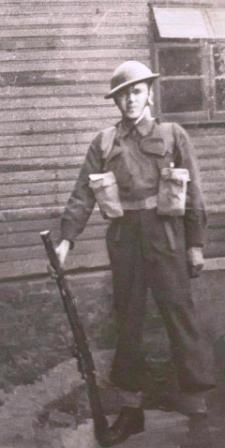
Alfred Edward Stanley Ford during basic training. (Photo courtesy of Cummins/Ford archives. Photo restoration by Pieter Valkenburg)
Alfred’s military career began when he was sent for basic training to No. 41 Canadian Army (Basic) Training Centre (CABTC) in Huntingdon, Quebec on December 8, 1941.
After completing his basic training, he was transferred to A7 Canadian Signal Corps Training Centre at Camp Barriefield, Ontario on March 12, 1942 for advanced training. He remained there until May 5, 1942 when he was posted to the 6th Light Anti-Aircraft (LAA) Regiment Signals Section, Royal Canadian Artillery, in Petawawa, Ontario as a Signalman.
As a Signalman, Alfred would have been trained to manage radio (wireless), telephone, and visual signaling, and to ensure that his Regiment received air raid warnings and to relay gun target information.
On November 2, 1942, Alfred was given embarkation leave until November 15, 1942, the last chance he had to see his family.
….Alfred left Canada for overseas service….
Shortly after returning from his embarkation leave, Alfred was on his way overseas, leaving Canada on December 12, 1942. Upon arriving in the United Kingdom on December 18, 1942, he was assigned to No. 1 Canadian Base Staging Camp (CBSC) in Colchester.
On March 6, 1943, Alfred was sent on an Operators Course at No. 1 Canadian Signals Reinforcement Unit (CSRU), located at the Blandford Camp in Cove, Farnborough, Hampshire.
Alfred was transferred to the Canadian Signals Reinforcement Unit (CSRU) on April 2, 1943. His training continued and on July 29, 1943, he qualified as a Lineman Group ‘C’ Class 3. A Lineman would be involved in constructing and repairing overhead telephone and telegraph lines to support military communications.
A month later, on August 26, 1943, he was transferred to the 1st Canadian Line of Communications Signals (L of C Sigs), a key unit within the Royal Canadian Corps of Signals (RC Sigs) during WWII. Formed in England, this unit was responsible for maintaining communications along the supply and transport routes (lines of communication) supporting the Canadian Army’s overseas operations in Europe.
As training and preparations began for Operation Overlord (the invasion of Normandy), which began on what we know as D-Day (June 6, 1944), Alfred was transferred to the 16th Canadian Anti-Aircraft (CAA) Operations Room Signal Section in Womenswold in Kent on May 2, 1944, along with another linesman. The war diary for May 2, 1944 noted that “…2 Line Detachments arrived today from L of C Signals….”
This unit provided communication and signaling support for anti-aircraft operations, and training and exercises continued ahead of being sent to France after D-Day. They would be part of the signals composition of the Canadian Army Overseas.
….Alfred and his unit were sent to France in August 1944…
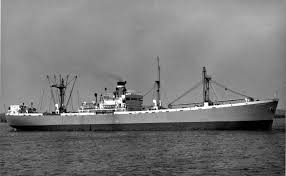
Liberty ship ‘Samarina’. (Photo source: Ships Nostalgia)
On August 1, 1944, Alfred and other members of the 16th Canadian Anti-Aircraft (CAA) Operations Room Signal Section travelled to London, for the move into France as part of the 21st Army Group. The following day they boarded the Liberty ship ‘Samarina’, along with their vehicles and equipment. They set sail for France on August 3, 1944.

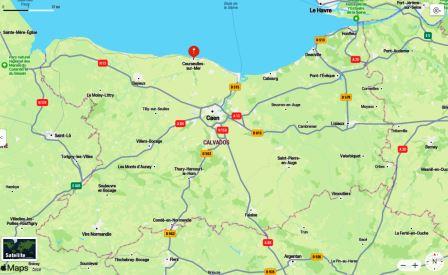
Map showing Courselles-sur-Mer on the coast of France, near Caen. ‘La Manche’ in French is what we call the ‘English Channel’. (Map source: https://www.viamichelin.fr)
Per the August 5, 1944 war diary, they arrived at 9:10 pm “…at the anchorage off Courcelles…” but had to wait until August 7 to disembark. On August 8, 1944, “…the unit arrived Bény-sur-Mer….” and “…established communications with Brigade HQ…” The unit arrived in the midst of Operation Totalize, fought between August 7-11, 1944, in an offensive designed to break through the German defences south of Caen and toward Falaise. (See https://en.wikipedia.org/wiki/Operation_Totalize)
They had their work cut out for them once they reached Caen and took over from 51 Anti-Aircraft Operations Room (AAOR). As recorded in the war diary for August 12, 1944, the unit “…controlled 16 AA guns in defence of Caen from 1800 hours today. Line communications are difficult as some of the line has been badly laid and not maintained. All broadcasts must go down to guns by line and upward intelligence must go up the same way. This is not satisfactory….”
On August 28, 1944, they were ordered to leave Caen and move to Lisieux. The war diary entry for August 29, 1944 recorded that at 8 am “…AAOR handed over to 152 and moved to concentration area at Lisieux….” However, by 6 pm that same day, there was a change. “… Unit was ordered to deploy from concentration area Lisieux for the defence of Brienne….”
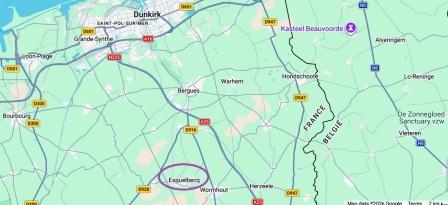
Map shows location of Esquelbecq (purple circle) in France, near the Belgian border. (Map source: Google maps)
By September they had moved up through France near the Belgian border, and were based in Esquelbecq, responsible for the Gun Operations Room (GOR) in the Dunkirk area. Linesmen like Alfred worked in difficult and dangerous conditions, as evidenced in just one line from the September 21, 1944 war diary. “…Linemen found that laying lines in the forward area became a bit tricky with snipers and machine gun fire near vicinity….”
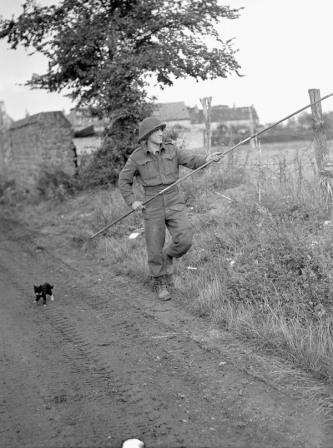
An unidentified lineman laying a telephone line in France in September 1944 gives an idea of what Alfred Ford did as a lineman. (Photo Credit: Lieut. Donald I. Grant / Canada. Dept. of National Defence / Library and Archives Canada / PA-174411)
Alfred was twice admitted to hospital, first from November 17 until December 18, 1944 at No. 16 Canadian General Hospital in Saint Omer, France, and then from January 6 to 18, 1945 at No. 2 Canadian General Hospital in Bruges, Belgium. The war diary reported that several men had been ill with colds and flu, and perhaps this is what happened to Alfred, as there was no report of an accident or being wounded by enemy action. He returned back to his unit, which was still in France, but now in Wormhout, just a short distance from Esquelbecq, on January 28, 1945.
On February 9, 1945, the unit moved to Desselgem, Belgium, located between Ypres and Ghent. They remained there until February 28, 1945 when they moved to Hallaar, not that far from the Dutch border, where the Operations Room for the unit would be temporarily based, during Operation Blockbuster. (See https://en.wikipedia.org/wiki/Operation_Blockbuster).
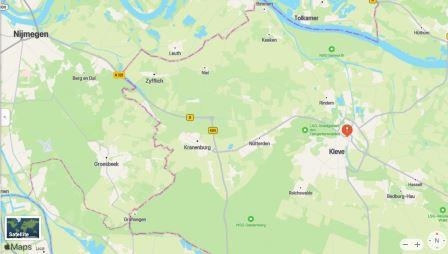
On March 12, 1945, the unit moved again, to Linden, The Netherlands, 10 kms (6 miles) south of Nijmegen, and near the German border. On March 13, 1945, the war diary recorded that “…as the Ops Room Section…is going to be deployed in the defence of Kleve, a Recce party went to that almost completed ruined city and found a site for the Ops Room, and billets in partially demolished houses nearby…” The unit moved to Kleve, Germany 10 days later.
On April 14, 1945, the war diary reported that “…line party across Rhine to lay line to Units under this Unit from proposed new location of AAOR…” Two days later, they moved to Oldenzaal, The Netherlands, near the German border.
On May 7, 1945, a day before the official end of WWII hostilities in Europe, the unit moved to Oldenburg, Germany, before being redirected to Wilhelmshaven on May 10, 1945, and placed on temporary guard duty. The war diary for May 24, 1945 noted another upcoming move. “…Guard commitments to be turned over by midnight of the 25 May 1945. This unit will move to Arnhem area where it will come under command 2 Canadian Heavy Anti-Aircraft Regiment…”
The move was delayed a few days. On May 26, 1945, the war diary recorded that “…we are to move at 0700 hours tomorrow to Otterlo in Holland where we come under Command of I-Corps and are attached to 2 Canadian Heavy Anti-Aircraft Regiment…” In Otterlo they camped in an old Dutch barracks in the woods.
The war diary summarized May 1945 by stating that “…except for four days the entire month has been spent in Germany with the unit personnel doing guard duties for a greater portion of that period….”
On June 7, 1945, Alfred was given 11 days leave to the United Kingdom, returning on June 18, 1945, just in time to learn, on June 19, 1945, that the 16th Canadian Anti-Aircraft (CAA) Operations Room Signal Section was to be disbanded immediately. The next few days were spent packing up all the equipment and vehicles.
On June 22, 1945, most of the unit moved to the Artillery Reallocation Centre 13 Canadian Base Reinforcement, located south of Nijmegen. However, the Signals detachment, which Alfred was part of, remained at Otterloo for the night, as they had been assigned to HQ 1st Canadian Army Signals for cross postings, and were scheduled to report there on June 23, 1945.
….Alfred died of injuries from a vehicle accident…
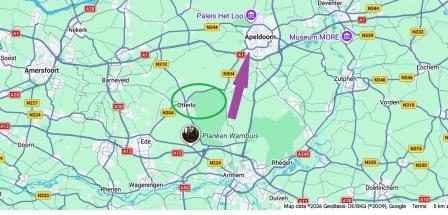
Alfred and the Signals Detachment were camped in a barracks in the woods outside Otterlo (green circle). The vehicle he was in was going in the direction of Apeldoorn (purple arrow). (Map source: Google maps)
However, Alfred never arrived at his next posting as he died in a vehicle accident on June 22, 1945. The circumstances of what happened are unclear. According to a witness, Lance Corporal R. A. MacDonald of the Canadian Provost Corps, who was on traffic patrol duty at the Arnhem-Apeldoorn Highway, around 9:15 pm a vehicle travelling in the direction of Apeldoorn approached him “…at a fast rate of speed. The vehicle was unsteady in its course, weaving as if out of control….”
As it neared the witness, the vehicle veered to the right, likely because the driver suddenly noticed him and lost control of the vehicle in trying to avoid an accident. Unfortunately, it crashed into a tree beside the road. The driver was 27 year old Alfred, who died from head injuries sustained in the crash. He was alone in the vehicle, and no one knew why he was driving a vehicle from another unit, as he was not assigned to be on duty at the time. A Court of Inquiry ruled it as an accidental death.
….Alfred is buried in Groesbeek….
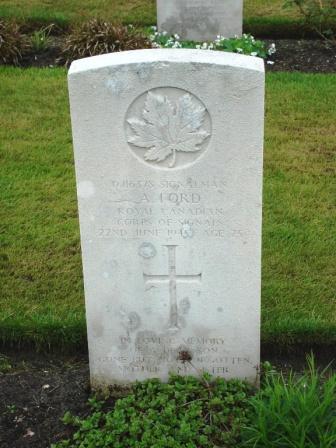
Grave of Alfred Edward Stanley Ford in the Canadian War Cemetery in Groesbeek, The Netherlands. (Photo source: Find A Grave)
Alfred was temporarily buried in Jonkerbos Cemetery in Nijmegen, The Netherlands, before being reburied in the Canadian War Cemetery in Groesbeek on August 2, 1945.
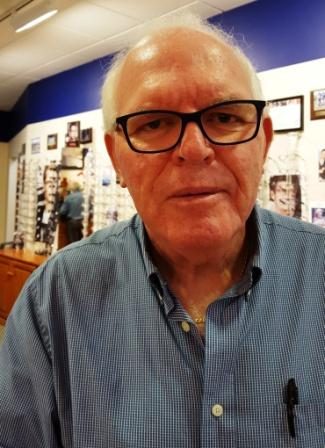
Dave Cummins provided photos of his uncle Alfred. (Photo courtesy of Dave Cummins)
Thank you to Dave Cummins for providing photos and information on his uncle, and to Chris Cummins for notifying Dave of the photo search request. “…Thank you Pieter, my family appreciates all you have done for Alfred…” Dave wrote. “…Keep up the good work….”
Pieter’s research efforts to find photos and families of soldiers continue, doing his part to ensure that each individual soldier is remembered. If you have photos or information to share about soldiers buried in The Netherlands or Belgium, please email him at memorialtrail@gmail.com, or comment on the blog.
© Daria Valkenburg
….Want to follow our research?…
If you are reading this posting, but aren’t following our research, you are welcome to do so. Our blog address: https://onthewarmemorialtrail.com/
 4 countries, 6 weeks, 7,000 km – an unforgettable war memorial journey in Europe…. Daria’s book ‘No Soldier Buried Overseas Should Ever Be Forgotten‘ is available in print and e-book formats. Net proceeds of book sales help support research costs and the cost of maintaining this blog. For more information see https://nosoldierforgotten.com/
Subscribe to our YouTube Channel: On The War Memorial Trail With Pieter Valkenburg: https://www.youtube.com/channel/UCJ591TyjSheOR-Cb_Gs_5Kw.
Never miss a posting! Subscribe below to have each new story from the war memorial trail delivered to your inbox.



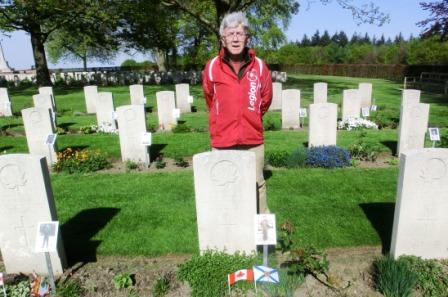


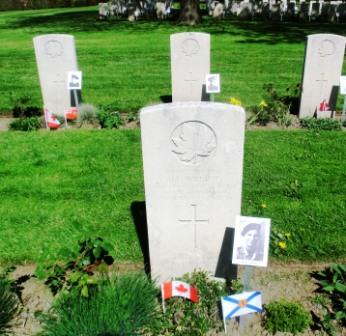
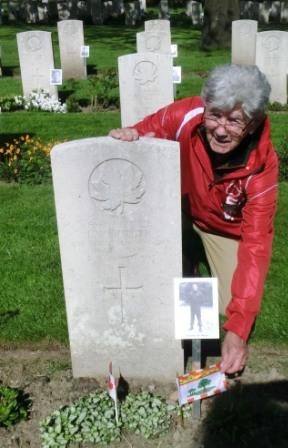

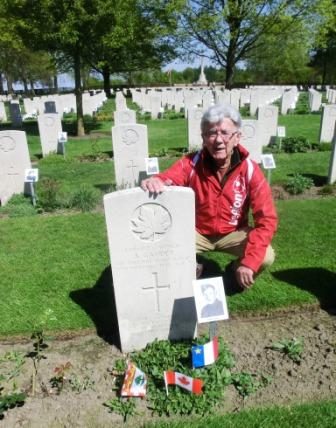
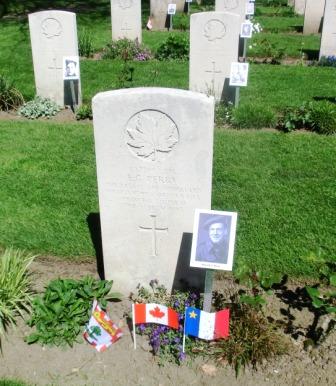
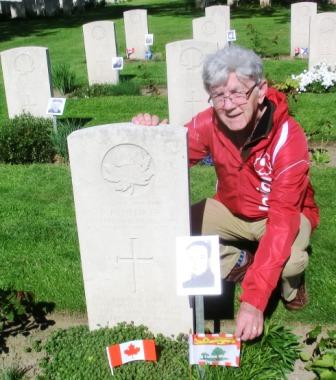




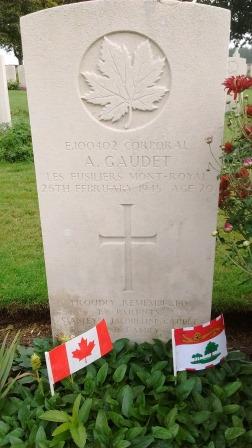


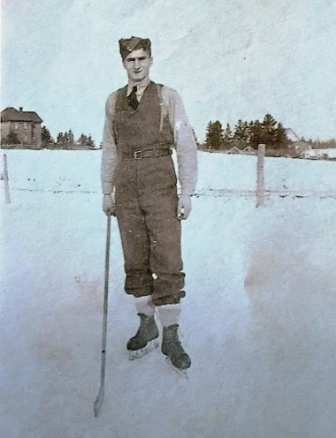


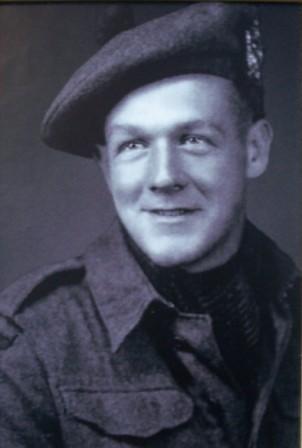


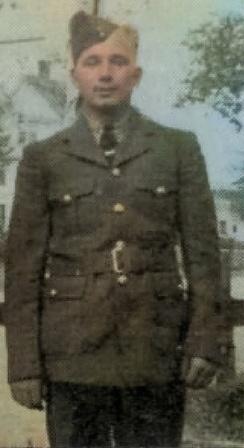
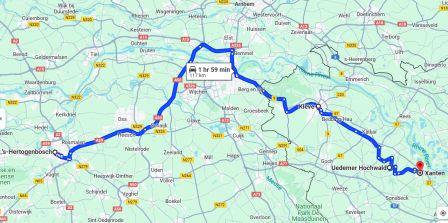
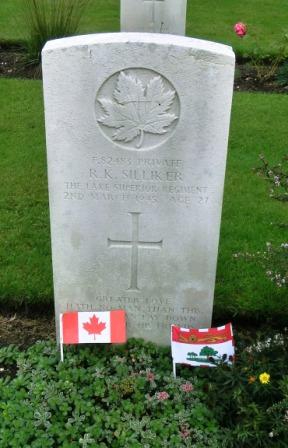


 August 24, 2022. When researchers at the Information Centre at the Canadian War Cemetery in Holten, The Netherlands honoured 27 soldiers of Ukrainian heritage that are buried in the cemetery, they didn’t have photos of 4 soldiers. Could Pieter help?



 On The War Memorial Trail Research Project........ with Pieter and Daria Valkenburg