January 20, 2025. When we were in Manitoba last year, we visited the Winnipeg River Heritage Museum, in the village of St.-Georges, in order thank Diane Dube in person for helping us with the photo searches of Edmond COULOMBE and Philip LAFORTE. (See https://onthewarmemorialtrail.com/2021/12/24/on-the-war-memorial-trail-the-successful-search-for-a-photo-of-ww2-soldier-edmond-coulombe/ and https://onthewarmemorialtrail.com/2022/03/22/on-the-war-memorial-trail-remembering-ww2-soldier-philip-laforte/)

Daria and Pieter with Diane Dube (centre) at the Winnipeg River Heritage Museum in St.-Georges, Manitoba. (Photo courtesy of Valkenburg family)
During our visit, Diane mentioned that she had a relative from the area who was buried in the Canadian War Cemetery in Holten, The Netherlands – Omer VINCENT. “…His father and my grandfather were brothers. He was first cousin to my father….”
 Diane wondered if the cemetery had a photo of him, and we assured her it did, as the researchers did not include him on their photo wish list for Manitoba soldiers. She sent us an excerpt about Omer from a book about the Vincent family, ‘Et la rivière coule toujours 1892-1992’ (‘And the river is still flowing 1892-1992’), published by Hector H. Vincent.
Born April 13, 1920 in St.-Georges, Manitoba, Omer was the son of Fortunat and Marie-Louise Vincent. He came from a large family, with 5 brothers and 5 sisters alive at the time of his death. Two brothers, Philippe and Wilfred, also served during WWII.
….Omer worked with his father and brothers prior to enlistment….
Omer’s brief biography in ‘Et la rivière coule toujours 1892-1992’ explained that he helped his father and older brothers “…with the farm work. He soon joined them cutting pulp wood during the winter and would also haul the wood by sleigh and horse team to Pine Falls…” There was a pulp and paper mill in nearby Pine Falls, Manitoba.

Omer with his horses. (Photo source: ‘Et la rivière coule toujours 1892-1992’)
The entry went on to say that Omer’s “…favourite pastime was hunting with his brothers. They kept the bush cutting camps well supplied with fresh meat during the winter…”
Omer had worked with his father for several years when he enlisted on October 29, 1941 in Winnipeg, Manitoba with the No. 10 District Depot Anti-Aircraft Artillery, Royal Canadian Artillery (RCA). Omer’s fluency in both English and French was noted on his Occupational History Form. It was also recorded that he could drive a vehicle, a motorcycle, and a tractor, and liked to play baseball.
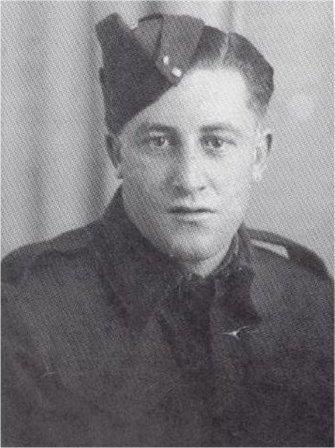
Omer Vincent. (Photo source: ‘Et la rivière coule toujours 1892-1992’)
On November 13, 1941, he was sent for basic training at No. 12 Canadian Army (Basic) Training Centre (CABTC) in Chatham, Ontario. After completing the course on February 3, 1942, he was transferred to A1 Canadian Artillery Training Centre (CATC) at Camp Petawawa in Ontario for advanced training as a gunner.
Omer was in Petawawa until April 4, 1942. While there, he received embarkation leave, the last time he would see his family. He returned briefly to Petawawa until April 29, 1942, when he travelled to Halifax, Nova Scotia, the port of embarkation to the United Kingdom.
….Omer left Canada for overseas service….
On May 4, 1942, Omer left Canada for the United Kingdom. Upon arriving on May 12, 1942 he was assigned to No. 2 Canadian Artillery Reinforcement Unit (CARU). He continued his training and then was transferred to the 7th Anti-Tank Regiment of the Royal Canadian Artillery on July 31, 1942.
Omer was reassigned to No. 2 Canadian Artillery Reinforcement Unit (CARU) on August 26, 1943 and sent for specialized training at the Canadian Military Headquarters in London, and then for a series of gun fitter courses at Stoke-On-Trent, where the Artillery Equipment section of the Royal College of Military Science was based during the war.
Upon completion of the courses, Omer was transferred to the X-4 reinforcement list of No. 2 Canadian Base Reinforcement Group (CBRG), part of the 21st Army Group, on August 16, 1944. The next day he was on his way to Normandy, France, disembarking on August 18, 1944.
A few days later, on August 23, 1944, he was assigned to the 3rd Anti-Tank Regiment of the Royal Canadian Artillery. The Regiment was responsible for coordinating anti-tank defences, with troops supporting the infantry as they fought their way across Boulogne and Calais in September 1944.
In October 1944, the Regiment moved into Belgium, under the command of the 10th Canadian Infantry Brigade. On November 10, 1944, the Regiment began moving from Ghent, Belgium towards Nijmegen, The Netherlands. On November 17, 1944, Omer was admitted to No. 12 Canadian General Hospital and remained there for a week before returning to his Regiment, now based in ‘s-Hertogenbosch, The Netherlands.
.….Omer’s Battery was tasked with holding the east bank of the IJssel River….

Map showing locations where Omer Vincent was in April 1945. (Map source: DuckDuck Go)
The April 5, 1945 war diary for the 3rd Anti-Tank Regiment reported that “…Lt JR Cameron of the 4th Battery contacted the QOR this morning and 4 Battery is to aid in holding the east bank of the IJssel between Zutphen and Doesburg…” QOR referred to Queen’s Own Rifles. Omer was part of the 4th Battery.
On April 8, 1945, the war diary for the Regiment recorded that 4 Battery was involved in “…was under command 8th Brigade for their part in the holding role from Zutphen to Doesburg….” as part of the “….defence system they are holding along the IJssel…..”
The following day, the war diary for the Regiment noted that 4 Battery’s new position was “…taken up in Steenderen….”
.….Omer lost his life on his 25th birthday….
On April 13, 1945, the municipality of Bronkhorst was liberated. However, Germans were still across the IJssel River by Brummen. The war diary for the 3rd Anti-Tank Regiment for that day recorded that “….4 Battery – had skirmish with enemy in barn. Battery suffered two men killed and shot up and burnt down buildings with a Valentine SP.….” A Valentine Self Propelled (SP) was a tank destroyer. For more information see https://en.wikipedia.org/wiki/Archer_(tank_destroyer)
Edwin van der Wolf, a volunteer at the Canadian War Cemetery in Holten, explained that “…On the ‘t Hammink farm, Mr. Buil, a farmhand, saw that night, through the basement window, that German soldiers were coming back and going in the back side of the farm. Farmhand Bruil went to a farm that was 1.5 km further, as he knew that Canadians were billeted there, and informed them about what he had seen….
…Then four Canadian soldiers with a tank went on patrol to ‘t Hammink. Two of them went to explore the farm, but were met by a barrage of bullets. Both were slain. The men were Gunners Omer Vincent and Leslie Temple. The ‘t Hammink farm was then set on fire….” Leslie Phillip Carl TEMPLE, from Regina, Saskatchewan, was 23 years old at the time of his death. Sadly, April 13, 1945 was Omer’s 25th birthday.
Edwin went on to write that “…Mr. Breukink, the owner of ‘t Hammink, had fled because he was a member of the NSB…” NSB was the acronym for Nationaal Socialistische Beweging (National Socialist Movement), whose members were Nazi collaborators. (See https://en.wikipedia.org/wiki/National_Socialist_Movement_(Netherlands))
.….Omer is buried in Holten….
Edwin’s account noted that “…the two Canadians killed were temporarily buried in the yard of the Half Welle…” Per Omer’s service file, this was in the vicinity of Baak, south of Zutphen and near Steenderen. On April 1, 1946, Omer was reburied in the Canadian War Cemetery in Holten, The Netherlands.

Grave of Omer Vincent in the Canadian War Cemetery in Holten, The Netherlands. (Photo courtesy of the Information Centre Canadian Cemetery Holten)
….Omer’s grave was adopted by a doctor from Gorssel ….
After his reburial in the Canadian War Cemetery in Holten, Omer’s grave was adopted by a Dr. B. H. Upmeijer of Gorssel. On April 6, 1947, he wrote to Omer’s family, saying that “…today we remember in our village the day of our liberation….”
He went on to explain that he and others from the village had gone to the Canadian War Cemetery in Holten, “…15 miles from the village of Gorssel and placed flowers on the graves of those who are fallen in the neighbourhood of Zutphen, Eefde, and Gorssel…”
Dr. Upmeijer noted that he had adopted Omer’s grave, and went on to share his own personal loss. “…The grave of my brother is in Burma… and for me it would have been reassuring, when I knew where and how he is laying exactly…” (Burma is now called Myanmar.)
….Vincent Island in northern Manitoba is named in Omer’s honour…..
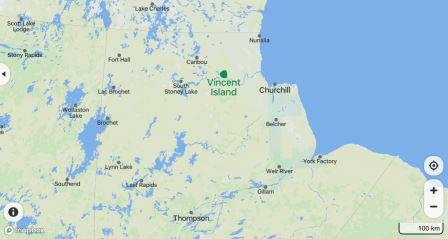
Vincent Island in Mullin Lake was named after Omer Vincent. (Map source: Mapcarta)
Vincent Island, located in Mullin Lake in northern Manitoba, west of Churchill, was named after Omer in 1995.
Thank you to Diane Dube for providing information on Omer Vincent, to Edwin van der Wolf for the account of what happened at the ‘t Hammink farm, and to Sheldrake of WW2Talk for information about the gun fitter course. If you have a story or photo to share, please contact Pieter at memorialtrail@gmail.com or comment on the blog.
© Daria Valkenburg
….Want to follow our research?….
If you are reading this posting, but aren’t following our research, you are welcome to do so. Our blog address: https://onthewarmemorialtrail.com/
 4 countries, 6 weeks, 7,000 km – an unforgettable war memorial journey in Europe…. Daria’s book ‘No Soldier Buried Overseas Should Ever Be Forgotten‘ is available in print and e-book formats. Net proceeds of book sales help support research costs and the cost of maintaining this blog. For more information see https://nosoldierforgotten.com/
You are also invited to subscribe to our YouTube Channel: On The War Memorial Trail With Pieter Valkenburg: https://www.youtube.com/channel/UCJ591TyjSheOR-Cb_Gs_5Kw.
Never miss a posting! Subscribe below to have each new story from the war memorial trail delivered to your inbox.
 On The War Memorial Trail Research Project........ with Pieter and Daria Valkenburg