
Daria (standing) with Liz Hubert. (Photo credit: Pieter Valkenburg)
February 23, 2025. In Part 1, the active WWI and WWII military service of Croatian-born Nikola ‘Nick’ OSTOJIC, grandfather of Bedeque resident Liz Hubert, ended when the Royal Yugoslav Army surrendered on April 17, 1941. Nikola became a prisoner of war in Germany and had a long road ahead of him before finally finding freedom and a new life in Prince Edward Island, and later Ontario, in Canada. (See https://onthewarmemorialtrail.com/2025/02/20/on-the-war-memorial-trail-the-pow-who-raised-horses-in-pei-part-1-the-serbian-colonel-who-was-a-pow-in-oflag-xiii-b/)
Now, in Part 2, Nikola spent 4 years in a prisoner of war (POW) camp until he was among the POWs liberated on April 6, 1945 by American troops.
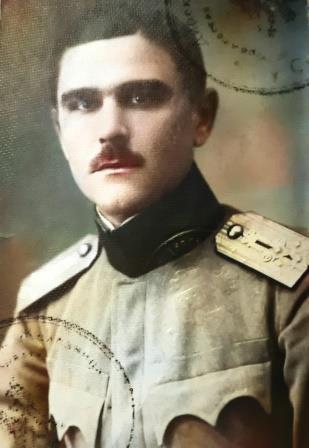
Nikola Ostojic. (Photo courtesy of the Nikola Ostojic Family. Photo colourization by Pieter Valkenburg)
….Nikola was a POW in Oflag XIII B in Germany….

Nikola (identified by red arrow) with a group of fellow POWs at the Oflag in Nuremberg. (Photo source: https://krijgsgevangen.nl)
Oflag XIII B, the prisoner of war camp where Nikola spent the remainder of the war years, was originally in the Langwasser district of Nuremberg, Germany.

Oflag XIII B in Nuremberg, Germany, with barracks on either side of the road. (Photo source: https://krijgsgevangen.nl)
Conditions inside the Oflag were not luxurious, as can be seen in the photo below from inside one of the barracks. The bunks were stacked 3 high, there was a small stove, and a wooden table.

Inside one of the barracks in Oflag XIII B in Nuremberg, Germany. (Photo source: https://krijgsgevangen.nl)
….Families of POWs generally received notification….
Liz explained that Nikola’s wife never knew that her husband was a POW. “…She was told he was dead!…” It may be that she had received word that he was ‘missing and presumed dead’ and never got an update. Perhaps, given that his homeland was occupied, Nikola did not feel it safe to contact his family.
Normally, families of POWs received a notice, in the language of the prisoner’s nationality, informing that they had been captured, and prisoners were allowed to write to their families. As an example, Maria Wilhelmina Siersema-van Erp, the wife of Klaas “Niek” Siersema, a Dutch POW in the same Oflag as Nikola, received several notices from her husband, including one dated May 15, 1942.
The front side of this Dutch notice provided instructions of what should be sent to her husband, including his uniform, hat, overcoat, shoes, underwear, etc., the weight limit accepted, the date it should be sent by, and how to address the parcel. The letter was signed by the prisoner (not shown in the sample below).
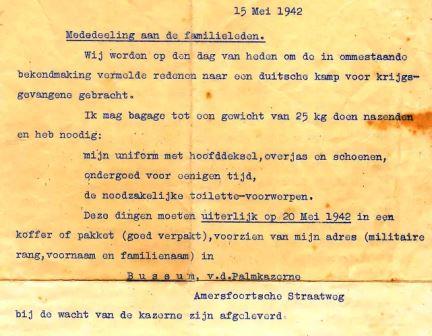
Notice to the family of Klaas Siersema on what would be allowed in a package to be sent to him. (Source: https://digitalkinblog.wordpress.com)
On the back side of the notice was an announcement that the Fuhrer of the German Empire had previously approved the release of officers in captivity, but that they were again being taken into custody because of their more recent actions against Nazi efforts.
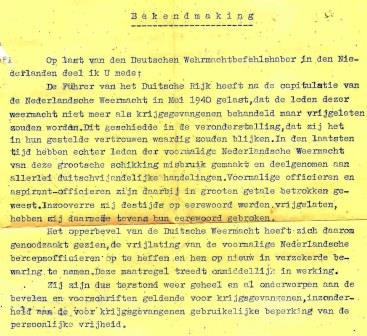
Announcement with the justification for not releasing captive officers. (Source: https://digitalkinblog.wordpress.com)
A May 29, 1942 postcard from Klaas Siersema, written in German and Dutch, informed his family that he was a POW at the camp, that he was in good health, and advised that mail was not being received on a regular basis due to a camp reorganization.
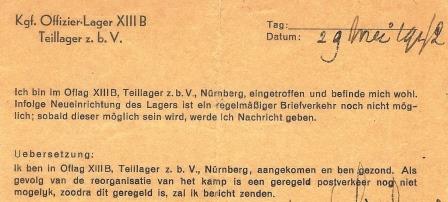
May 29, 1942 postcard from Klaas Siersema advising that he was a POW. (Source: https://digitalkinblog.wordpress.com)
…. Oflag XIII B moved from Nuremberg to Hammelburg in April 1943….
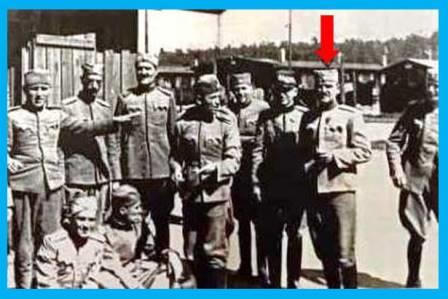
Nikola (identified by red arrow) with a group of fellow POWs. (Photo courtesy of the Nikola Ostojic Family.
In April 1943, about 3,000 officers, many who had been, like Nikola, members of the Yugoslavian General Staff, were moved to a site 3 km (1.9 miles) south of the town of Hammelburg, just north of Schweinfurt in Bavaria, Germany. (See https://en.wikipedia.org/wiki/Oflag_XIII-B)
Life in the POW camp was difficult, especially given the Nikola was 44 years old at the time of his imprisonment, and not a young man in his early 20s. His 1972 obituary in the ‘Voice of Canadian Serbs’ noted that he “…endured severe abuse that led to a physical and psychological breakdown. …”
A March 25, 1945 report on conditions in the camp, prepared after a debriefing of the Senior American Officer at the camp, described the food allowed to prisoners: “….The German ration…consisted of coffee for breakfast, soup for lunch, made from barley, oatmeal, meat stock or dried vegetables, and at night the POWs were fed boiled potatoes and 1/10th of a loaf of bread, with a bit of margarine. They received a weekly issue of 4 or 5 tablespoons of sugar, and a small amount of jam once a week. They were not issued any Red Cross parcels….”
…. Nikola was among the POWs liberated on April 6, 1945….
On April 6, 1945, Nikola was one of 1,300 prisoners of war liberated by the US Army’s 14th Armored Division, 19th Armored Infantry battalion, and tanks from the 47th Medium Tank Battalion, Combat Command B (CCB).
As troops approached the Oflag, they came under sporadic fire from German machine guns. Infantry from of the 19th found the prison gates and forced an opening into the Oflag where they found a large contingent of Serbian and American officer prisoners.
You can watch a short YouTube video on the liberation here:
While Nikola had suffered in the POW camp, Nikola’s wife and daughter, who remained at home in Serbia, found themselves in peril when Hungarian troops came to the farm in 1943, raided the farm of supplies, and abused his wife. It wasn’t until 1945 that they received a letter advising that Nikola had survived the war years.
After 4 years in a POW camp, Nikola had to make a decision once he was liberated – whether to return to Serbia, now part of Yugoslavia and under Communist rule – or refuse repatriation. In Part 3, Nikola’s story continues as, in a bid for freedom, he next ended up in a displaced persons camp in Austria, before finally immigrating to Canada.
Thank you to Liz Hubert for sharing photos and information on her grandfather, and translating his obituary into English. If you have a story or photo to share, please contact Pieter at memorialtrail@gmail.com or comment on the blog.
© Daria Valkenburg
….Want to follow our research?….
If you are reading this posting, but aren’t following our research, you are welcome to do so. Our blog address: https://onthewarmemorialtrail.com/
 4 countries, 6 weeks, 7,000 km – an unforgettable war memorial journey in Europe…. Daria’s book ‘No Soldier Buried Overseas Should Ever Be Forgotten‘ is available in print and e-book formats. Net proceeds of book sales help support research costs and the cost of maintaining this blog. For more information see https://nosoldierforgotten.com/
You are also invited to subscribe to our YouTube Channel: On The War Memorial Trail With Pieter Valkenburg: https://www.youtube.com/channel/UCJ591TyjSheOR-Cb_Gs_5Kw.
Never miss a posting! Subscribe below to have each new story from the war memorial trail delivered to your inbox.


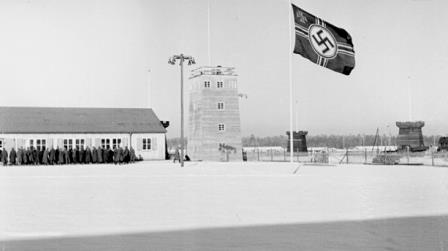
 On The War Memorial Trail Research Project........ with Pieter and Daria Valkenburg