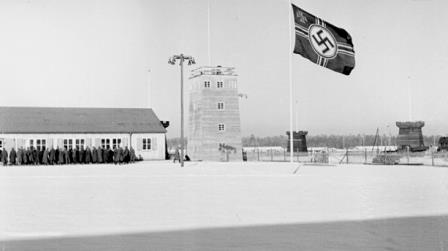
On The War Memorial Trail….. The POW Who Raised Horses In PEI Part 3….Three Years In A DP Camp Before Finally Finding Freedom

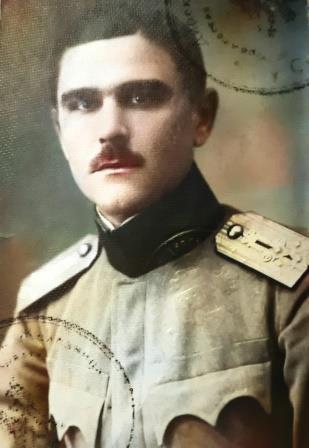
Nikola Ostojic. (Photo courtesy of the Nikola Ostojic Family.  Photo colourization by Pieter Valkenburg)

February 28, 2025. In Part 1, the active WWI and WWII military service of Croatian-born Nikola ‘Nick’ OSTOJIC, grandfather of Bedeque resident Liz Hubert, came to a halt when the Royal Yugoslav Army surrendered on April 17, 1941 and Nikola became a prisoner of war in Germany. (See https://onthewarmemorialtrail.com/2025/02/20/on-the-war-memorial-trail-the-pow-who-raised-horses-in-pei-part-1-the-serbian-colonel-who-was-a-pow-in-oflag-xiii-b/)

In Part 2, Nikola spent 4 years in a German POW camp until he was among the POWs liberated on April 6, 1945 by American troops. (See https://onthewarmemorialtrail.com/2025/02/23/on-the-war-memorial-trail-the-pow-who-raised-horses-in-pei-part-2-four-years-as-a-pow-in-oflag-xiii-b/)

Now, in Part 3, Nikola’s story concludes with the long road ahead of him before finally finding freedom and a new life in Prince Edward Island, and later Ontario, in Canada. 

….Nikola became a Displaced Person in Austria….

After 4 years in a POW camp, Nikola had to make a decision once he was liberated – whether to return to Serbia – now part of Yugoslavia and under Communist rule, or refuse repatriation.  Nikola refused to be repatriated. 

Map shows location of Hammelburg where Oflag XIII B was located, Moosburg, where the liberated POWs marched towards, and St Johann im Pongau, where Nikola lived in a DP camp.  (Map source: Google maps)

After being liberated from the POW Camp Oflag XIII B on April 6, 1945, it appears that he went his own way, as many former POWs did.  According to a report on the Liberation of Stalag 7A in Moosburg, written by Col. Paul Goode, the Senior American Officer at Oflag XIII B, after liberation, the group of freed POWs “….stayed at Hammelburg about a week, and then was marched to Stalag A, Moosburg.  It took 15 days to cover about 90 miles. There was no particular attempt at control, and escape was extremely easy, and many officers did escape, and many more just wandered off to live in the country and were ultimately picked up by the SS…

Liz believed that Nikola was among the officers who escaped “….with another officer and was then taken by the British Army….”  No record is left of what his plans were, but perhaps he had intentions of travelling towards Serbia to find his family.  If that was the case, he never got there.

On June 23, 1945 he entered Austria, and 2 days later became a resident of the UNDP-led Camp XVIII C in Markt-Pongau, now known as Sankt Johann im Pongau, a small town south of Salzburg.  According to the information provided when Nikola entered the camp, he spoke Serbo-Croatian, English, German, and Russian. 

As a displaced persons camp in the American Zone, Pongau had a large number of Jewish refugees, as well as former POWs, like Nikola, who didn’t want to be repatriated.  During WWII, it had been Stalag 18 C, a prisoner of war camp. 

The Markt-Pongau POW Camp in May 1945. (Photo source: http://www.stalag18a.org)

After WWII ended, the former Nazi territories had been divided into British, American, and French Zones.  (See https://en.wikipedia.org/wiki/Allied-occupied_Austria)

Post WWII Austria Occupation Zones. Pongau fell under Salzburg.  (Map source:  https://commons.wikimedia.org/w/index.php?curid=95563608)

….Nikola left Continental Europe….

Nikola remained in the camp in Pongau until April 21, 1948, when he was deemed eligible to immigrate to the United Kingdom.

Nikola arrived in Halifax aboard the ‘Neptunia’.  (Photo source: www. http://ssmaritime.com)

On May 24, 1952 he immigrated again, leaving Southampton, England aboard the Greek Line T.S.S. ‘Neptunia’, and arriving in Halifax, Nova Scotia, Canada.  He was 55 years old. 

He most likely had been sponsored by Pero Bulat, who had been born in the same province of Banija, but immigrated to Canada in 1926, and became the publisher of ‘The Voice of Canadian Serbs’. On April 22, 1947, he’d visited Ottawa with Bishop Dionisije Milivojević to ask Canadian authorities to permit 10,000 out of the 80,000 displaced Serbs in Western Europe to enter Canada.  (See https://wikitia.com/wiki/Pero_Bulat)

….Nikola found peace of mind while raising horses….

Nikola (identified by red arrow) in St Peters Bay, Prince Edward Island.  (Photo courtesy of the Nikola Ostojic Family)

Once in Canada, Nikola moved to Prince Edward Island, where he settled on a farm in St Peters Bay, and raised horses. Liz explained that the quieter Island life and working with horses helped him find peace of mind.

He had never forgotten his wife and daughter.  He had “connected with them only after he arrived to England. Once he got to PEI he sent for them. They traveled via boat to Canada….” said Liz.  “….My mother said they landed in Montreal by boat…

While Nikola found peace of mind on the Island, his wife Marija found it too quiet. The family moved to Windsor, Ontario, where Pero Bulat lived.  “In 1962 he was in Windsor.  Pero was very influential and a great supporter of my grandfather…

Liz recalled that Nikola worked as a bartender into his early 70s, probably at Europe Tavern, one of the many businesses owned by Pero Bulat. Unfortunately, Nikola’s PTSD never left him.  “…Both my grandmother and mother said that his screaming at night never ceased….” 

Nikola died on September 17, 1972 at Hotel Dieu Hospital in Windsor, Ontario, aged 76, and is buried in the Windsor Memorial Gardens.  His 1972 obituary in the ‘Voice of Canadian Serbs’ summed up how so many felt about Nikola.  “….Everyone who knew him, thought that his zest for life, vitality, and physical endurance and strength were invincibleAt the cemetery, final words to the Colonel were given by the famous Nationalist Pero Bulat with heartwarming words of the man who arrived in Canada and his lifework: ‘this is how we lost another unbeatable national fighter’….

….Reflections from Nikola’s granddaughter….

Daria (standing) with Liz Hubert. (Photo credit: Pieter Valkenburg)

Researching the story of Nikola Ostojic was done with the active assistance of Liz Hubert and her brother Alexander.  Liz’s reaction was similar to that of what Pieter and I experienced when we researched my father’s WWII story.  “It was so difficult to see, it’s so real now I feel like I’m living it….” 

As we came to the end of Nikola’s story, Liz expressed her “…reflecting thoughts on this experience with my grandfather….As a child, the towering presence of my Grandfather shone over me like a guiding beacon, inspiring awe and reverence. Throughout this process of discovery of the man he truly was, as an adult, I came to appreciate the complexity, struggles, triumphs, and passions of his life. Understanding him allowed me to understand myself, instilling a sense of responsibility, empathy, and gratitude…” 

Thank you to Liz Hubert for sharing photos and information on her grandfather, and translating his obituary into English. If you have a story or photo to share, please contact Pieter at memorialtrail@gmail.com or comment on the blog. 

© Daria Valkenburg

 ….Previous stories about WWII POWs….

To read previous stories about WWII POWs see:

 ….Want to follow our research?….

If you are reading this posting, but aren’t following our research, you are welcome to do so.  Our blog address: https://onthewarmemorialtrail.com/
4 countries, 6 weeks, 7,000 km – an unforgettable war memorial journey in Europe…. Daria’s book ‘No Soldier Buried Overseas Should Ever Be Forgotten‘ is available in print and e-book formats.  Net proceeds of book sales help support research costs and the cost of maintaining this blog. For more information see https://nosoldierforgotten.com/

You are also invited to subscribe to our YouTube Channel: On The War Memorial Trail With Pieter Valkenburg: https://www.youtube.com/channel/UCJ591TyjSheOR-Cb_Gs_5Kw

Never miss a posting!  Subscribe below to have each new story from the war memorial trail delivered to your inbox.

On The War Memorial Trail….. The POW Who Raised Horses In PEI Part 2….Four Years As A POW In Oflag XIII B

Daria (standing) with Liz Hubert. (Photo credit: Pieter Valkenburg)

February 23, 2025. In Part 1, the active WWI and WWII military service of Croatian-born Nikola ‘Nick’ OSTOJIC, grandfather of Bedeque resident Liz Hubert, ended when the Royal Yugoslav Army surrendered on April 17, 1941. Nikola became a prisoner of war in Germany and had a long road ahead of him before finally finding freedom and a new life in Prince Edward Island, and later Ontario, in Canada. (See https://onthewarmemorialtrail.com/2025/02/20/on-the-war-memorial-trail-the-pow-who-raised-horses-in-pei-part-1-the-serbian-colonel-who-was-a-pow-in-oflag-xiii-b/)

Now, in Part 2, Nikola spent 4 years in a prisoner of war (POW) camp until he was among the POWs liberated on April 6, 1945 by American troops.

Nikola Ostojic. (Photo courtesy of the Nikola Ostojic Family.  Photo colourization by Pieter Valkenburg)

 ….Nikola was a POW in Oflag XIII B in Germany….

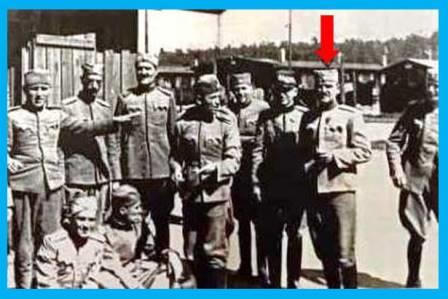
Nikola (identified by red arrow) with a group of fellow POWs at the Oflag in Nuremberg. (Photo source: https://krijgsgevangen.nl)

Oflag XIII B, the prisoner of war camp where Nikola spent the remainder of the war years, was originally in the Langwasser district of Nuremberg, Germany.

Oflag XIII B in Nuremberg, Germany, with barracks on either side of the road. (Photo source: https://krijgsgevangen.nl)

Conditions inside the Oflag were not luxurious, as can be seen in the photo below from inside one of the barracks.  The bunks were stacked 3 high, there was a small stove, and a wooden table. 

Inside one of the barracks in Oflag XIII B in Nuremberg, Germany.  (Photo source: https://krijgsgevangen.nl)

….Families of POWs generally received notification….

Liz explained that Nikola’s wife never knew that her husband was a POW.  “…She was told he was dead!…” It may be that she had received word that he was ‘missing and presumed dead’ and never got an update.  Perhaps, given that his homeland was occupied, Nikola did not feel it safe to contact his family.

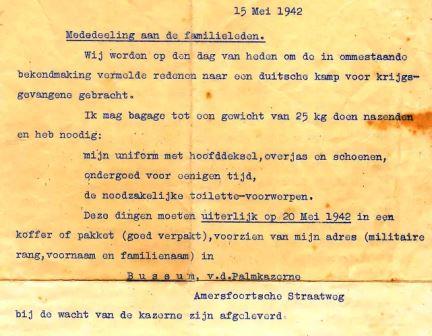
Normally, families of POWs received a notice, in the language of the prisoner’s nationality, informing that they had been captured, and prisoners were allowed to write to their families.  As an example, Maria Wilhelmina Siersema-van Erp, the wife of Klaas “Niek” Siersema, a Dutch POW in the same Oflag as Nikola, received several notices from her husband, including one dated May 15, 1942.   

The front side of this Dutch notice provided instructions of what should be sent to her husband, including his uniform, hat, overcoat, shoes, underwear, etc., the weight limit accepted, the date it should be sent by, and how to address the parcel. The letter was signed by the prisoner (not shown in the sample below).

Notice to the family of Klaas Siersema on what would be allowed in a package to be sent to him. (Source: https://digitalkinblog.wordpress.com)

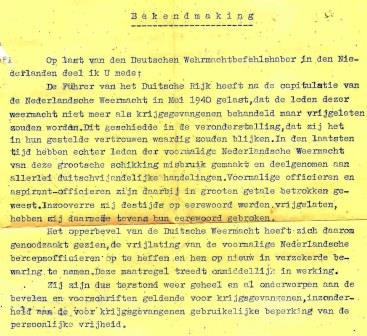
On the back side of the notice was an announcement that the Fuhrer of the German Empire had previously approved the release of officers in captivity, but that they were again being taken into custody because of their more recent actions against Nazi efforts.

Announcement with the justification for not releasing captive officers. (Source: https://digitalkinblog.wordpress.com)

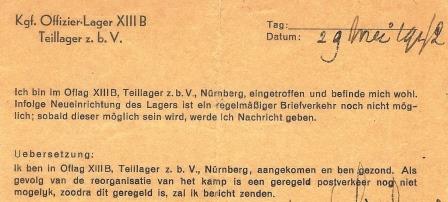
A May 29, 1942 postcard from Klaas Siersema, written in German and Dutch, informed his family that he was a POW at the camp, that he was in good health, and advised that mail was not being received on a regular basis due to a camp reorganization. 

May 29, 1942 postcard from Klaas Siersema advising that he was a POW. (Source: https://digitalkinblog.wordpress.com)

…. Oflag XIII B moved from Nuremberg to Hammelburg in April 1943….

Nikola (identified by red arrow) with a group of fellow POWs. (Photo courtesy of the Nikola Ostojic Family.

In April 1943, about 3,000 officers, many who had been, like Nikola, members of the Yugoslavian General Staff, were moved to a site 3 km (1.9 miles) south of the town of Hammelburg, just north of Schweinfurt in Bavaria, Germany.  (See https://en.wikipedia.org/wiki/Oflag_XIII-B)

Life in the POW camp was difficult, especially given the Nikola was 44 years old at the time of his imprisonment, and not a young man in his early 20s.  His 1972 obituary in the ‘Voice of Canadian Serbs’ noted that he “endured severe abuse that led to a physical and psychological breakdown. …

A March 25, 1945 report on conditions in the camp, prepared after a debriefing of the Senior American Officer at the camp, described the food allowed to prisoners: ….The German ration…consisted of coffee for breakfast, soup for lunch, made from barley, oatmeal, meat stock or dried vegetables, and at night the POWs were fed boiled potatoes and 1/10th of a loaf of bread, with a bit of margarine. They received a weekly issue of 4 or 5 tablespoons of sugar, and a small amount of jam once a week.  They were not issued any Red Cross parcels….

…. Nikola was among the POWs liberated on April 6, 1945….

On April 6, 1945, Nikola was one of 1,300 prisoners of war liberated by the US Army’s 14th Armored Division, 19th Armored Infantry battalion, and tanks from the 47th Medium Tank Battalion, Combat Command B (CCB). 

As troops approached the Oflag, they came under sporadic fire from German machine guns. Infantry from of the 19th found the prison gates and forced an opening into the Oflag where they found a large contingent of Serbian and American officer prisoners.

You can watch a short YouTube video on the liberation here: 

While Nikola had suffered in the POW camp, Nikola’s wife and daughter, who remained at home in Serbia, found themselves in peril when Hungarian troops came to the farm in 1943, raided the farm of supplies, and abused his wife.  It wasn’t until 1945 that they received a letter advising that Nikola had survived the war years.

After 4 years in a POW camp, Nikola had to make a decision once he was liberated – whether to return to Serbia, now part of Yugoslavia and under Communist rule – or refuse repatriation.  In Part 3, Nikola’s story continues as, in a bid for freedom, he next ended up in a displaced persons camp in Austria, before finally immigrating to Canada.

Thank you to Liz Hubert for sharing photos and information on her grandfather, and translating his obituary into English. If you have a story or photo to share, please contact Pieter at memorialtrail@gmail.com or comment on the blog. 

© Daria Valkenburg

….Want to follow our research?….

If you are reading this posting, but aren’t following our research, you are welcome to do so.  Our blog address: https://onthewarmemorialtrail.com/

4 countries, 6 weeks, 7,000 km – an unforgettable war memorial journey in Europe…. Daria’s book ‘No Soldier Buried Overseas Should Ever Be Forgotten‘ is available in print and e-book formats.  Net proceeds of book sales help support research costs and the cost of maintaining this blog. For more information see https://nosoldierforgotten.com/

You are also invited to subscribe to our YouTube Channel: On The War Memorial Trail With Pieter Valkenburg: https://www.youtube.com/channel/UCJ591TyjSheOR-Cb_Gs_5Kw

Never miss a posting!  Subscribe below to have each new story from the war memorial trail delivered to your inbox.

On The War Memorial Trail…..The POW Who Raised Horses In PEI Part 1….The Serbian Colonel Who Was A POW In Oflag XIII B

February 20, 2025. Living on Prince Edward Island, it’s unusual to not only meet someone who has a shared Eastern European heritage, but whose family history was impacted by WWII. My father was taken at age 14 from his home in Western Ukraine to work in Germany and over several years, Pieter and I ‘walked in his footsteps’ in an attempt to understand what he experienced, and documented our findings in a 4 part series that saw him go from Germany to England and then finally to Canada:

My father was in Germany at the same time as Nikola ‘Nick’ OSTOJIC, grandfather of Bedeque resident Liz Hubert. While my teenaged father was a labourer, Liz’s grandfather was a prisoner of war.  After WWII ended, both ended up in displaced persons’ camps before finally finding freedom and a new life in Canada….but neither man was ever freed of the memories of what they had experienced.  

Daria (standing) with Liz Hubert. (Photo credit: Pieter Valkenburg)

….Nikola was born in Croatia….

Zirovac (indicated by red marker) is in the Banija region of Croatia, not far from Bosnia and Herzegovina border. (Map source: DuckDuckGo)

Born in the Serbian village of Zirovac, in what is now Croatia, but was then part of Austria-Hungary, on November 1, 1896, Nikola was the son of Mladen and Maria (nee Momic) Ostojic.  His father was an Orthodox bishop and a senator in pre-WWI Croatia.  According to Nikola’s 1972 obituary in the publication ‘Voice of Canadian Serbs’, in a family that had “…produced priests for 300 years…Nikola was supposed to continue the episcopal tradition, but he loved medicine….” (Translation from the original Russian by Liz Hubert)

The oldest child, with 9 younger sisters, Nikola became the head of the family after his father died when he was 18, and his mother died a year later.  Liz proudly noted that her grandfather “…sent money home to his sisters after he joined the army…” and made sure that “…all of his sisters were educated…

….Nikola’s medical school training was interrupted by WWI….

The ‘Voice of Canadian Serbs’ obituary noted that 19 year old Nikola’s medical school training was interrupted in 1915 when he was “mobilized by the Austro-Hungarian military…” and sent to a “…school for Officers in the Reserves. Upon completion of training, he was immediately sent in 1916 to the Russian front.  He deserted the Austro-Hungarian Army in Russia and joined the volunteer corps in Odessa, destined for the Salonika Front….

Serbia had resisted the attacks of the Austro-Hungarian Army in the opening months of the First World War. But, in October 1915, the combined forces of Austria, Germany, and Bulgaria overwhelmed her armies and conquered the country.

As Serbia was an ally of Britain, a multi-national Allied force, under French command, with French, Serbian, British, Russian, and Italian troops, fought against the Bulgarians and their allies in what became known as The Salonika Campaign.

In 1918, when Nikola arrived in Salonika, he was “….deployed to the battle front. As a Major in the 6th division of the Drina Infantry, he participated in the breakthrough of the Salonika front, freeing his homeland…” 

Liz explained that Nikola received the Medal of Honour after being wounded during the rescue of soldiers trapped in trenches.   

The Salonika Campaign ended with an armistice signed by Bulgaria on September 28, 1918, and resulted in the defeat of Bulgaria, the liberation of Serbia and strategic exposure of Austria and Turkey. (For more information on The Salonika Campaign, see https://www.nam.ac.uk/explore/salonika-campaign)

Salonika, today known as Thessaloniki, is a port in the northern Greek region of Macedonia, and is a city I’d visited many decades ago after I graduated from university.

….Nikola remained in the military post WWI….

Nikola Ostojic. (Photo courtesy of the Nikola Ostojic Family.  Photo colourization by Pieter Valkenburg)

After WWI ended, Nikola remained in the military, in the Royal Yugoslav Army, which existed from the establishment of Yugoslavia in December 1918 until its surrender on April 17, 1941 to an invading force of Germans, Italians, and Hungarians. (See https://en.wikipedia.org/wiki/Royal_Yugoslav_Army#April_1941_Campaign)

Nikola Ostojic and Marija Lovas on their wedding day in 1938.  (Photo courtesy of the Nikola Ostojic Family)

Before that fateful day, Nikola had married Marija Lovas, who he’d met at a dance, in February 1938. Their daughter Radmilai, Liz’s mother, was born on July 28, 1939.  The family lived on a farm in Backi Petrovic in Serbia, near the Hungarian border.  Liz explained that the farm that Nikola grew up on had been sold prior to WWII after his sisters were no longer living there.

At the time of the surrender of the Royal Yugoslav Army, Nikola, now a Colonel, was, per the ‘Voice of Canadian Serbs’ obituary, on the “…main General Staff in Belgrade where he was serving as the head of a classified Intelligence unit…

….Nikola became a POW and was sent to Oflag XIII B….

Liz’s research unveiled a Red Cross document summarizing what happened to Nikola when the Royal Yugoslav Army surrendered.  “….The Red Cross filed my Grandfather as captured in Sarajevo on April 17, 1941 and sent to OFLAG XIII B, POW # 99104. At this time he ranked as Pukovnik, which translated into Colonel…. He was captured by the German-Italian Military in Sarajevo…” 

An Oflag was a Prisoner of War (POW) Camp for officers, as opposed to a Stalag, which held mostly enlisted men. Oflag XIII B, opened for Yugoslav officers, was originally in the Langwasser district of Nuremberg.

Oflag XIII B in Nuremberg, Germany. (Photo source: https://krijgsgevangen.nl)

In April 1943, about 3,000 officers, many who had been, like Nikola, members of the Yugoslavian General Staff, were moved to a site 3 km (1.9 miles) south of the town of Hammelburg, just north of Schweinfurt in Bavaria, Germany. (See https://en.wikipedia.org/wiki/Oflag_XIII-B)

Life in the POW camp was difficult, and one that Nikola endured for 4 years.  In Part 2, Nikola’s story continues with his time in the POW camp until the camp was liberated on April 6, 1945 by American troops.

Thank you to Liz Hubert for sharing photos and information on her grandfather, and translating his obituary into English.  If you have a story or photo to share, please contact Pieter at memorialtrail@gmail.com or comment on the blog. 

© Daria Valkenburg

….Want to follow our research?….

If you are reading this posting, but aren’t following our research, you are welcome to do so.  Our blog address: https://onthewarmemorialtrail.com/

4 countries, 6 weeks, 7,000 km – an unforgettable war memorial journey in Europe…. Daria’s book ‘No Soldier Buried Overseas Should Ever Be Forgotten‘ is available in print and e-book formats.  Net proceeds of book sales help support research costs and the cost of maintaining this blog. For more information see https://nosoldierforgotten.com/

You are also invited to subscribe to our YouTube Channel: On The War Memorial Trail With Pieter Valkenburg: https://www.youtube.com/channel/UCJ591TyjSheOR-Cb_Gs_5Kw

Never miss a posting!  Subscribe below to have each new story from the war memorial trail delivered to your inbox.