January 7, 2025. Several months ago, Pieter received a phone call from Carmen Ross, explaining that his granddaughter Lauren was doing a school project on his great-uncle, WWI soldier John Joseph FOY, who was born in Tryon, Prince Edward Island, very near to where we live. Could Pieter help with information about his great-uncle’s military service?
In 2021, we’d written about another WWI soldier from Tryon with the same surname, Maynard FOY. Was he a relative? Pieter asked. It turned out that the two families were distantly related. (See https://onthewarmemorialtrail.com/2021/04/24/on-the-war-memorial-trail-the-ww1-soldier-who-returned-to-tryon/)

Pieter with Carmen and Margaret Ross. (Photo credit: Daria Valkenburg)
Like Maynard, John Foy survived the war and returned to Canada. As one of the goals of the ‘On The War Memorial Trail’ research project is the opportunity to tell the stories of Islanders who survived their war service, Pieter not only helped provide information for Lauren’s school project, we also met with Carmen and his wife Margaret.
“…My grandfather, Alfred Foy, known as Allie, was John’s brother…” Carmen explained. He also recalled his mother Hilda telling him that John “…was such a nice man!…”
….John enlisted in 1915….
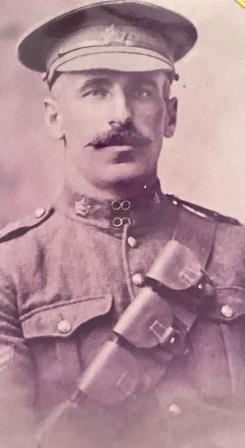
John Joseph Foy. (Photo courtesy of Carmen Ross)
Born on October 25, 1882, John was the son of Philip Morris Callbeck and Rachel (nee Bynon) Foy. A farmer at the time of his enlistment on September 25, 1915 in Charlottetown, Prince Edward Island, John had served in the No. 2 Heavy Battery Depot since July 1915, when it had been first organized in Prince Edward Island under the command of Major A. G. Peake, and which became No. 2 Overseas Battery, Canadian Siege Artillery, on September 29, 1915.
….John left Canada for overseas service shortly after enlistment….
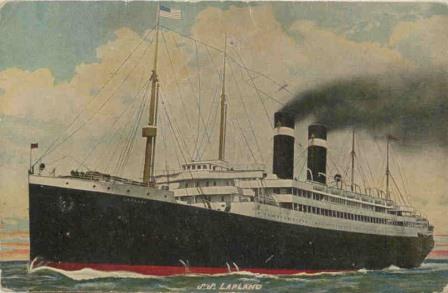
SS Lapland. (Photo source: https://www.wikitree.com)
With his Battery, John sailed aboard the SS Lapland, leaving Halifax, Nova Scotia on November 28, 1915, and arriving at Plymouth Sound, United Kingdom on December 7, 1915.
The Battery was housed at Raffey Camp, at Horsham Siege Artillery School, in West Sussex. As a gunner, John and the other members of his Battery underwent four months of training there. While in England, the Battery was re-designated as No. 98 (Canadian) Siege Battery, Canadian Siege Brigade.
He remained with No. 98 (Canadian) Siege Battery Artillery until January 19, 1916, when he was transferred to the 3rd Reserve Brigade, Canadian Field Artillery, which was at Shorncliffe, for further training, and as part of reinforcement troops.
….John was sent to France for the Battle of the Somme….
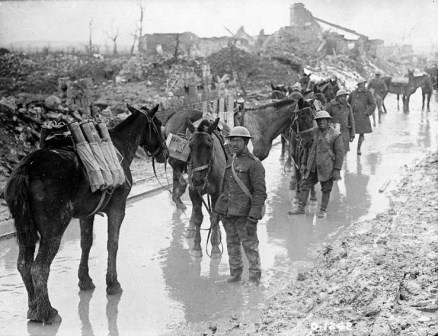
Ammunition Column Pack horses transporting ammunition to a brigade in France. (Photo source: Library and Archives Canada, MIKAN no. 3194763)
On August 25, 1916 he left for France and was assigned to the 1st Divisional Ammunition Column (DAC), whose role was to bring ammunition forward to the gun positions of the 1st Division batteries for the Battle of the Somme. (See https://en.m.wikipedia.org/wiki/Battle_of_the_Somme)
Ammunition was moved by motor and horse drawn transport, heavy and light rail, and tramways. From his service file, it appears that John worked in the stables and in the transport of ammunition by horses.
….John was reassigned to his artillery battery….
John remained with the 1st DAC until September 12, 1916, when he returned to the 2nd Brigade, and continued to work with horses, which were used in transporting the heavy guns and ammunition to the front lines, as the Battle of the Somme continued into the fall of 1916. The Brigade served continuously behind the United Kingdom’s 4th Army’s front until December 1916, when troops were ordered to dig their guns out of the mud and move northward.
In January 1917, the battery became part of the Canadian Corps Heavy Artillery and was renamed No. 2 Canadian Siege Battery, Canadian Garrison Artillery (CGA). On January 22, 1917, John was admitted to a field hospital in France with bronchitis and pneumonia, and remained there until January 27, 1917, when he rejoined his unit.
Preparations were underway for the Battle of Vimy Ridge, a three day battle from April 9 to 12, 1917, which John survived. (See https://en.m.wikipedia.org/wiki/Battle_of_Vimy_Ridge) Following Vimy Ridge, John’s unit was involved in the Battle of Hill 70, just east of Loos and north of Lens, which was fought between August 15 and 25, 1917. (See https://en.m.wikipedia.org/wiki/Battle_of_Hill_70)
On October 4, 1917, John was sent to a rest camp in Boulogne for 2 weeks, returning to his unit on October 19, 1917. A few weeks later he was sent to England on leave for a few weeks, returning on November 30, 1917, where he and his unit were assigned to the 48th Battery, Canadian Field Artillery.
….A handkerchief from Belgium remains in the family!….

Crew positioning a BL 6-inch howitzer. (Photo source: Library and Archives Canada MIKAN No. 3395353)
John’s battery was involved in the March 1918 German Spring Offensive in West Flanders, Belgium. (See https://en.m.wikipedia.org/wiki/German_spring_offensive) While in Belgium, he managed to buy an embroidered handkerchief, which was given to Carmen’s mother Hilda.
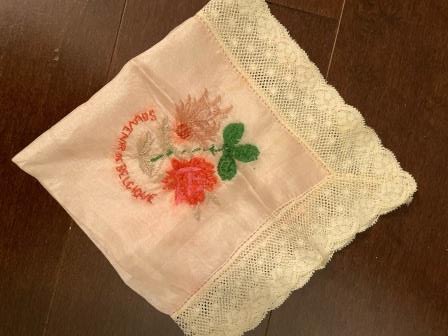
Embroidered handkerchief from Belgium that John Foy brought back to Canada. (Photo courtesy of Jen Huber)
As fighting continued, troops were involved in the Hundred Days Offensive, which began in August 1918 and continued until the end of the war. (See https://en.m.wikipedia.org/wiki/Hundred_Days_Offensive) They moved frequently, through the Hindenburg Line, and advancing north during the Battle of Cambrai in France, from October 8 to 10, 1918. (See https://en.m.wikipedia.org/wiki/Hundred_Days_Offensive)
In December 1918, the battery moved briefly into Germany, positioned on the west bank of the Rhine at Cologne to protect the crossing of the 1st Canadian Division on December 13, 1918. The battery returned to the United Kingdom, leaving France from Le Havre on March 30, 1919, and arriving in the United Kingdom at Weymouth.
….John was discharged from the army and returned to Canada….
By April 14, 1919, John was on his way back to Canada, leaving Southampton aboard the SS Olympic. He was discharged from service on April 30, 1919 in Charlottetown, aged 36.
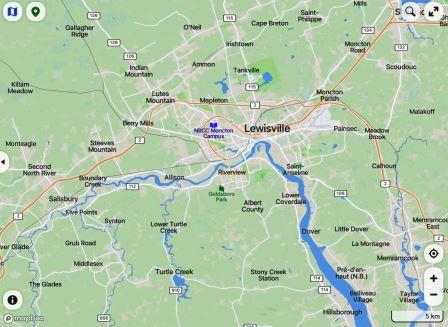
John Foy lived in Turtle Creek and was a mailman in rural Lewisville, now part of Moncton. (Map source: http://www.mapcarta.com)
John never married and moved to New Brunswick. He was involved in harness racing as a driver and worked as a rural mailman in Lewisville (now part of Moncton), while living in nearby Turtle Creek, before he retired due to ill health.
….John is buried in St. John, New Brunswick….
He died on July 1, 1964, aged 81, at the Lancaster Department of Veterans Affairs Hospital in Lancaster, New Brunswick, following a lengthy illness, and was buried in the Field of Honour at Cedar Hill Extension Cemetery in St. John.

Grave of John Joseph Foy in Cedar Hill Extension Cemetery in St. John, New Brunswick. (Photo courtesy of FindAGrave)
Thank you to Carmen and Margaret Ross, and Jen Huber, for sharing photos and information about John Foy, and to Shawn Rainville and Etienne Gaudet for newspaper research. If you have a story or photo to share, please contact Pieter at memorialtrail@gmail.com or comment on the blog.
© Daria Valkenburg
….Want to follow our research?….
If you are reading this posting, but aren’t following our research, you are welcome to do so. Our blog address: https://onthewarmemorialtrail.com/
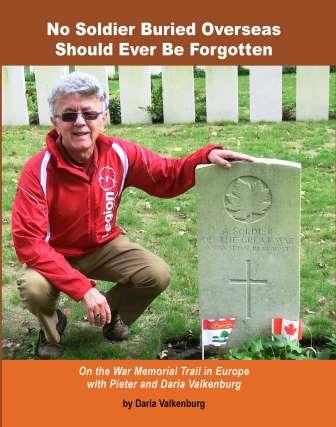 4 countries, 6 weeks, 7,000 km – an unforgettable war memorial journey in Europe…. Daria’s book ‘No Soldier Buried Overseas Should Ever Be Forgotten‘ is available in print and e-book formats. Net proceeds of book sales help support research costs and the cost of maintaining this blog. For more information see https://nosoldierforgotten.com/
You are also invited to subscribe to our YouTube Channel: On The War Memorial Trail With Pieter Valkenburg: https://www.youtube.com/channel/UCJ591TyjSheOR-Cb_Gs_5Kw.
Never miss a posting! Subscribe below to have each new story from the war memorial trail delivered to your inbox.



 On The War Memorial Trail Research Project........ with Pieter and Daria Valkenburg