On The War Memorial Trail In the Passchendaele Area

December 9, 2017.  After we finished placing flags in Belgium in memory of those names on the Cenotaph outside the Borden-Carleton Legion, we decided to visit some of the memorials in the Passchendaele area.  Anyone who has been here knows that it’s impossible to see everything in such a short time, but we did our best to see as many as we could.

After we left Maple Copse Cemetery, where it’s possible the George Albert Campbell is buried, we went to the 85th Canadian Infantry Battalion – Nova Scotia Highlanders Monument in Zonnebeke.  It was a small monument, located in a farmer’s field.  It was impossible to drive right up to it, so Pieter parked the car and went there alone.

cimg8866-sep-10-2017-info-sign-about-85th-nova-scotia-highlanders-monument.jpg

Information sign about the 85th Canadian Infantry Battalion – Nova Scotia Highlanders Monument in Zonnebeke. (Photo credit: Pieter Valkenburg)

The monument is in memory of the 85th Canadian Nova Scotia Battalion, which suffered heavy losses during the battle of Passchendaele at the end of October 1917.  One side of the monument has a black bronze plaque with the inscription: “85th Canadian Infantry Battalion (Nova Scotia Highlanders) BEF. This plaque was erected by the Battalion in memory of their valiant comrades who gave their lives in action before Passchendaele at Decline Copse and Vienna Cottage on 28 to 31 October 1917.” Below the inscription are listed the names of the 12 officers and 132 other ranks who died in these actions.

CIMG8868 Sep 10 2017 85th Nova Scotia Highlanders monument

85th Canadian Infantry Battalion – Nova Scotia Highlanders Monument in Zonnebeke. (Photo credit: Pieter Valkenburg)

From the photo above, you can notice that the sky was dark.  After a day of sunshine, it had started to rain.  But, since we weren’t made of sugar, we kept going.  Our destination was Kitchener’s Wood in Langemark, but along the way we saw a sign marking the location of the final battle of Passchendaele, right beside the Passchendaele New British Cemetery in Zonnebeke.  Of course we stopped to visit.
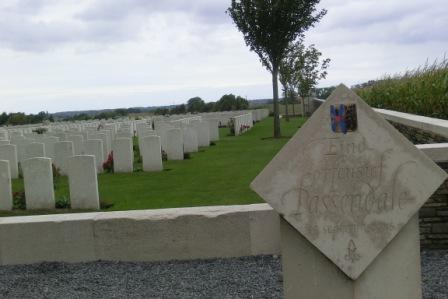
CIMG8869 Sep 10 2017 Sign marking final battle of Passchendaele beside New British Cemetery in Zonnebeke

Sign on the wall of the Passchendaele New British Cemetery in Zonnebeke says “end of the Passchendaele offensive 25 September 1918. (Photo credit: Daria Valkenburg)

CIMG8872 Sep 10 2017 New British Cemetery in Zonnebeke

Entrance to Passchendaele New British Cemetery in Zonnebeke. (Photo credit: Daria Valkenburg)

650 Canadians are buried in this cemetery, including Alexander Wuttenee DECOTEAU, Canada’s first Aboriginal-Canadian police officer.  A Cree born on the Red Pheasant Reserve in Saskatchewan in 1887, he enlisted in 1916 and was killed by a sniper during the Battle of Passchendaele on October 30, 1917, the same day and battle in which Vincent CARR, who is listed on the Cenotaph outside the Borden-Carleton Legion, lost his life.  After reading about Private Decoteau, we went and put a Canadian flag by his grave.

CIMG8874 Sep 10 2017 Pieter by grave of Alexander Decoteau New British Cemetery in Zonnebeke

Pieter by the grave of Private Alexander Decoteau in Passchendaele New British Cemetery in Zonnebeke. (Photo credit: Daria Valkenburg)

Our last war memorial trail stop for the day was at Kitchener’s Wood Memorial in Langemark-Poelkapelle.  This was harder to find than we expected, as the car’s GPS directed us to an empty field! A farm with what looked to be a house was across the field and we had a discussion whether to give up or knock on the door and ask directions.

Now, if you are a long-suffering wife, you know who was ready to give up rather than ask directions.  Yep, the guy who could speak the language sat in the car, while the Canadian with poor Dutch skills went and knocked on the door.  It was clear that the door was beside the kitchen as through the window I could see a group of young men around a large table, and one young man washing dishes by the sink.  The man washing dishes opened the door, and to my great relief very quickly found out he spoke as much Dutch as me.  It turned out that he and his companions were all from Poland, near where my maternal grandmother was born!

Obviously we weren’t the first to get tricked by the GPS system as he was familiar with the Kitchener’s Wood Memorial and explained that there was an error in the navigation system.  The memorial was 500 metres down the road right beside a house, on the side of the road opposite to where the GPS directed us to.

With the right directions, we found the memorial by a farmhouse.  The memorial was erected in memory of the soldiers of the 10th Canadian Battalion and the 16th Canadian Scottish Battalion, who were killed during a night attack at Kitchener’s Wood on April 22, 1915 during the first lethal chemical gas attack by the Germans.
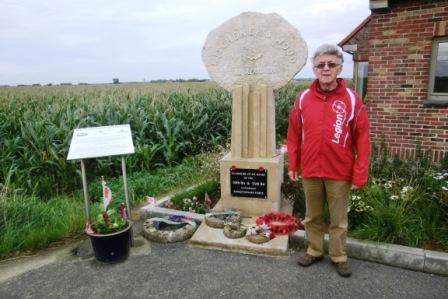
CIMG8883 Sep 10 2017 Pieter by Kitcheners Wood Memorial

Pieter by Kitchener’s Wood Memorial. (Photo credit; Daria Valkenburg)

French troops had fallen back, leaving a 6 km gap to the left of the Canadian sector.  During the night of April 22 into 23, the 10th Canadian and the 15th Canadian Scottish Battalion counter-attacked and captured a German held position at Kitchener’s Wood.  This prevented a German breakthrough to Ypres and beyond.
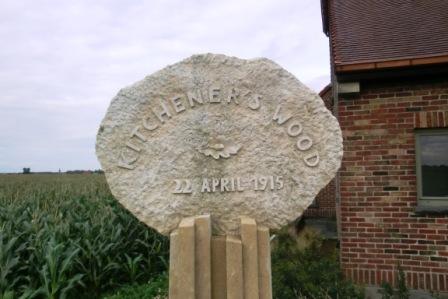
CIMG8880 Sep 10 2017 Kitcheners Wood Memorial close up of acorn

On a polished stone base is a roughly worked stone representing the mutilated oaks of the forest, with the inscription: “Kitchener’s Wood, 22 April 1915″ encircling an oak leaf with an acorn. (Photo credit: Daria Valkenburg)

This ended our war memorial tour in Belgium for this trip, and we went back to the hotel to relax.  One more stop in Belgium, at the In Flanders Museum in Ypres, and then on to The Netherlands where we will be visiting the graves of WWII soldiers.

Comments or stories?  You can share them by emailing us at memorialtrail@gmail.com or by commenting on this blog.

© Daria Valkenburg

….Want to follow our research?….

If you are reading this posting, but aren’t following our research, you are welcome to do so.  Our blog address: https://onthewarmemorialtrail.com/
Front cover OnTheWarMememorialTrailinEurope4 countries, 6 weeks, 7,000 km – an unforgettable war memorial journey in Europe…. Daria’s book ‘No Soldier Buried Overseas Should Ever Be Forgotten‘ is available in print and e-book formats.  Net proceeds of book sales help support research costs and the cost of maintaining this blog. For more information see https://nosoldierforgotten.com/ 

You are also invited to subscribe to our YouTube Channel: On The War Memorial Trail With Pieter Valkenburg: https://www.youtube.com/channel/UCJ591TyjSheOR-Cb_Gs_5Kw

Never miss a posting!  Subscribe below to have each new story from the war memorial trail delivered to your inbox.

On The War Memorial Trail….Two Campbell Brothers in WWI

December 8, 2017. After visiting the Sanctuary Wood Cemetery, we stopped at the Battle of Mount Sorrel Monument, honouring the 15th Canadian Infantry at Observatory Ridge.  We had noticed this monument only because of a torn Canadian flag beside it!  We learned that the plaque was unveiled on October 22, 2011 before Canadian and Belgian dignitaries by members of the 15th Battalion Memorial Project.

IMG_20170910_133239840_HDR Sep 10 2017 Batttle of Mount Sorrel Monument

Battle of Mount Sorrel Monument, honouring the 15th Canadian Infantry at Observatory Ridge. (Photo credit: Pieter Valkenburg)

While no one on the Cenotaph outside the Borden-Carleton Legion was in the 15th Canadian Infantry, these soldiers were in the thick of things during the Battle of Mount Sorrel, in which George Albert Campbell and Charles Benjamin Murray Buxton lost their lives.

Buxton’s story was told in previous blog entries, and this blog entry is to tell what little we know about George ‘Albert’ CAMPBELL and how he lost his life.

george-albert-campbell-from-gerald-tingley.jpg

Private George Albert Campbell. (Photo courtesy of Gerald Tingley family collection)

Albert was born on July 8, 1895 in Wellington, PEI, the son of John George Campbell and Grace Emma, nee Barlow.  A fisherman and farmer before enlisting on April 6, 1915 with the 6th Canadian Mounted Rifles, he later transferred to the 5th Canadian Mounted Rifles.

During the Battle of Mount Sorrel, the 5th Canadian Mounted Rifles were in a supporting position, occupying the strongpoint, dugouts, and trenches in Maple Copse and Zillebeke area, as noted in ‘With The Patricia’s In Flanders 1914-1918 Then & Now’ by Stephen K. Newman.

Newman goes on to explain in his book that “….the 5th Canadian Mounted Rifles in Maple Copse held on despite heavy shelling that flattened the entire wood and made their old trenches untenable.  They waited for the reinforcements from 2nd Canadian Mounted Rifles and the 9th Brigade.  The two eighteen pounder sacrifice guns of the 5th Battery Canadian Field Artillery hidden in the southern part of Sanctuary Wood did their job to the last man and were overrun.  The German success depended on their bulling through the Patricia line and moving the 5th Canadian Mounted Rifles out of Maple Copse….

Albert was in the midst of this battle, as a member of the 5th Canadian Mounted Rifles.  According to the Canadian War Graves Register Circumstances of Death, he was killed in action in the vicinity of Maple Copse.

The War Diary of the unit for June 2, 1916 notes: “A red letter day in the history of the battalion ever to be remembered by those who lived through it. The battalion went into the line in the night of the 31st of May /1st of June occupying a position in Brigade support at Maple Copse.

 ‘A’ company and two platoons of ‘B’ company at Maple Copse. Nothing of importance occurred until the morning of the 2nd of June when at about at 8.30 a.m., the enemy began a very heavy bombardment of the frontline and all the ground at Maple Copse and vicinity. Heavy bombardments continued till noon on the 3rd and continued again after 6 p.m

Unfortunately, Albert has no known grave, and his name is therefore listed on the Menin Gate Memorial.  It’s quite likely, however, that he might be buried in Maple Copse Cemetery in an unknown grave.

CIMG8858 Sep 10 2017 Maple Copse Cemetery

Entrance to Maple Copse Cemetery. (Photo credit: Pieter Valkenburg)

Maple Copse was the name used by the British Army for a small plantation east of Zillebeke and just west of Sanctuary Wood.  It was used by medical staff as a dressing station, and burials took place here both before and after the Battle of Mount Sorrel.

The cemetery was destroyed by shellfire during the Battle of Mount Sorrel and when fighting resumed afterwards, with the gravestones destroyed and ending up in the rubble.  Of 256 named graves that were known to exist, only 26 could be definitely located.  Perhaps Albert is in one of these.  Of the 256 graves, 114 had soldiers from the United Kingdom and 142 from Canada.

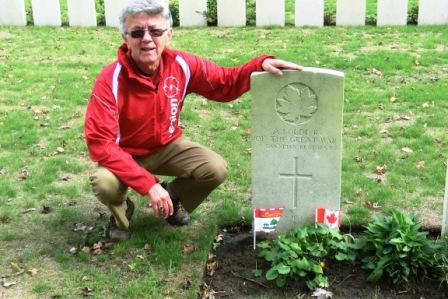
Like he did with Buxton at the Sanctuary Wood Cemetery, Pieter put Canadian flags on 4 unknown graves from a Canadian Regiment, and then placed a PEI flag on one of these in memory of George ‘Albert’ Campbell.

CIMG8864 Sep 10 2017 Pieter by grave of unknown soldier at Maple Copse Cemetery

Pieter by the grave of an unknown soldier from a Canadian regiment at Maple Copse Cemetery. (Photo credit: Daria Valkenburg)

With the advances in DNA research, perhaps one day there will be the possibility to find out who the unknown soldiers are in Maple Copse and Sanctuary Wood cemeteries.  Wouldn’t that be a genealogical project to get involved with?

Unfortunately, we have very little information about his life prior to enlistment, but are grateful for the photo of Albert sent by a distant relative, Gerald Tingley.  If anyone has more information or photos, please help us honour Albert’s memory by sharing them.  (For previous blog entries that have mentioned Albert, see A Daytime Visit To Menin Gate Memorial in Ypres and A Visit To Sanctuary Wood.)

There are two Campbells on the Cenotaph outside the Borden-Carleton Legion, one who died and one who survived, but with injuries.  George ‘Albert’ Campbell had a younger brother, William Galen CAMPBELL, born June 16, 1897 in Wellington, who enlisted on April 22, 1916 with the 5th Siege Battery as a gunner, shortly before his older brother died.  He later transferred to the 8th Siege Battery of the 3rd Brigade Canadian Garrison Artillery, and was poisoned by a mustard gas shell, during action near Lievin (Pas de Calais) in France on May 28, 1918.

The war diary of the 8th Siege Battery tersely noted what happened to the unit:

27 May 1918: Intense gas bombardment on Lievin and many gas shells fell around Thelus and vicinity.

28 May 1918: Twenty nine other ranks of Lievin section admitted to hospital, gassed.

29 May 1918: Capt. Cunningham, Lt Messeray and 39 other ranks of Lievin section to hospital, gassed.

Unlike his brother Albert, William Galen survived and married Ida May McNally on January 5, 1919.  On April 14, 1919 he was discharged from military service.  He passed away on April 24, 1954 in Charlottetown and is buried in the cemetery at the Free Church of Scotland in Cape Traverse.  We have no photo or further information on William Galen Campbell.

william-g-campbell-gravestone-free-church-of-scotland-cape-traverse.jpg

Grave of William Galen Campbell in the cemetery of the Free Church of Scotland in Cape Traverse. (Photo credit: Pieter Valkenburg)

While our visit to Maple Copse Cemetery ended our Belgian visit to graves and memorials for the names on the Cenotaph outside the Borden-Carleton Legion, we were interested in visiting some of the other memorials in the area.  So, in the next blog entry, we will continue on the war memorial trail in Belgium.

Comments or stories?  You can share them by emailing us at memorialtrail@gmail.com or by commenting on this blog.

© Daria Valkenburg

….Want to follow our research?….

If you are reading this posting, but aren’t following our research, you are welcome to do so.  Our blog address: https://onthewarmemorialtrail.com/

Front cover OnTheWarMememorialTrailinEurope4 countries, 6 weeks, 7,000 km – an unforgettable war memorial journey in Europe…. Daria’s book ‘No Soldier Buried Overseas Should Ever Be Forgotten‘ is available in print and e-book formats.  Net proceeds of book sales help support research costs and the cost of maintaining this blog. For more information see https://nosoldierforgotten.com/ 

You are also invited to subscribe to our YouTube Channel: On The War Memorial Trail With Pieter Valkenburg: https://www.youtube.com/channel/UCJ591TyjSheOR-Cb_Gs_5Kw

Never miss a posting!  Subscribe below to have each new story from the war memorial trail delivered to your inbox.

On The War Memorial Trail….A Visit To Sanctuary Wood

November 19, 2017.  After visiting the Princess Patricia’s Light Infantry Memorial in Zonnebeke, Belgium, we went to Sanctuary Wood in Zillebeke to the Hill 62 Monument overlooking Mount Sorrel.  This memorial commemorates Canadian forces who served in Ypres Salient, especially during the Battle of Mount Sorrel in June 1916.

CIMG8771 Sep 9 2017 Sign to Sanctuary Wood

Sign at the entrance to Hill 62 (Sanctuary Wood) Memorial. (Photo credit: Daria Valkenburg)

The road leading to the memorial, Canadalaan (literally Canada Avenue, but also known colloquially as Maple Avenue), once formed part of the Canadian front line.  After the war, the avenue was planted with maple trees as a mark of respect for the Canadian sacrifice.

Two of the men listed on the Cenotaph outside the Borden-Carleton Legion lost their lives here, during the Battle of Mount Sorrel: Charles ‘Charlie’ Benjamin BUXTON of the Princess Patricia’s Light Infantry, and George ‘Albert’ CAMPBELL of the 5th Canadian Mounted Rifles.  Both men have no known grave and are listed on the Menin Gate Memorial in Ypres. (See A Daytime Visit To Menin Gate Memorial in Ypres )

Before going to Sanctuary Wood Cemetery and Maple Copse Cemetery, places where perhaps our two soldiers are lying in an unmarked grave, we wanted to know more about what exactly happened here during the defence of Ypres in 1916.  The first thing that struck is was how close Ypres was.  We could see it clearly from the memorial!

CIMG8775 Sep 9 2017 Sanctuary Wood Ypres can be seen from Hill 62

The spires of buildings in Ypres can be clearly seen from Sanctuary Wood. (Photo credit: Daria Valkenburg)

Sanctuary Wood, also known as Hill 62, was the place where Canadian troops fought as a national unit for the first time.  During the battle, which was fought between June 2 and June 4, 1916, 8,430 soldiers were killed, wounded, or missing.

We were curious why it was called Hill 62, and a bit bemused to realize it was called that because the hill was 62 metres above sea level!

Hill 62 and nearby Mount Sorrel were the only places of a higher elevation that were not controlled by the Germans….and they wanted it.  Canadian troops were almost alone in defending this territory, having only the support of British artillery.  The rest of the British troops were preparing for the Battle on the Somme in July 1916.

So what happened?  On June 2, 1916, the Germans attacked the Canadian positions with artillery and the detonation of 4 large mines under Mount Sorrel.  You can imagine the deadly effect this had in the trenches.

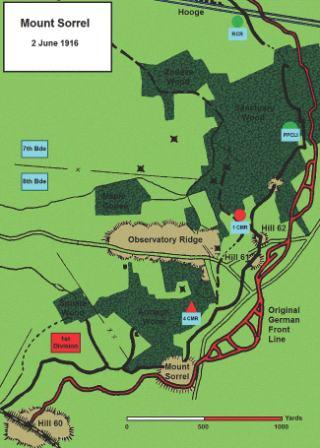
As per the map of the battle, Buxton’s unit (PPCLI) was at Sanctuary Wood, and suffered 400 losses.  Campbell’s unit was a support brigade at Maple Copse, and by the end of the day 59 were killed, 272 wounded, and 50 missing. Buxton and Campbell were among the casualties.

battle of mount sorrel map

Map of Battle of Mount Sorrel on June 2, 1916. (Credit: http://www.canadiansoldiers.com)

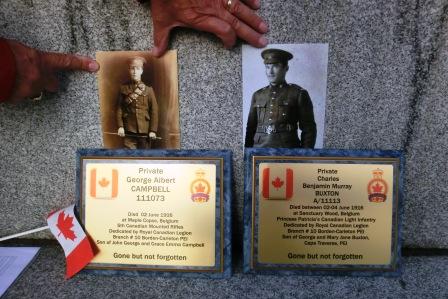
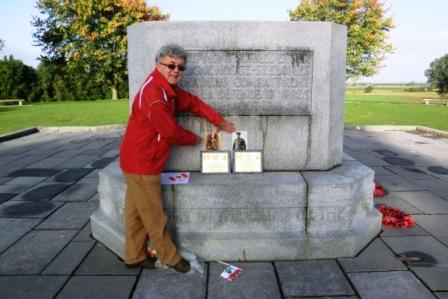
It only seemed right to place the photos and plaques we had of these men, which we’d taken to Menin Gate earlier in the day, here at Sanctuary Wood Memorial.

CIMG8897 Sep 11 2017 Photos & Plaques of Buxton & Campbell at Sanctuary Wood

Plaques and photos for George Albert Campbell and Charles Benjamin Buxton. (Photo credit: Daria Valkenburg)

CIMG8894 Sep 11 2017 Pieter at Sanctuary Wood with photos and plaques of Buxton & Campbell

Pieter holds the photos and plaques of Buxton and Campbell at the Sanctuary Wood Memorial. (Photo credit: Daria Valkenburg)

We decided we had to visit both Sanctuary Wood Cemetery and Maple Copse Cemetery and learn exactly what happened to each man, but that would have to wait for another day.  It was getting late, and we wanted to get to Ypres for the Last Post ceremony at Menin Gate.

Comments or stories?  You can share them by emailing us at memorialtrail@gmail.com or by commenting on this blog.

© Daria Valkenburg

….Want to follow our research?….

If you are reading this posting, but aren’t following our research, you are welcome to do so.  Our blog address: https://onthewarmemorialtrail.com/

Front cover OnTheWarMememorialTrailinEurope4 countries, 6 weeks, 7,000 km – an unforgettable war memorial journey in Europe…. Daria’s book ‘No Soldier Buried Overseas Should Ever Be Forgotten‘ is available in print and e-book formats.  Net proceeds of book sales help support research costs and the cost of maintaining this blog. For more information see https://nosoldierforgotten.com/ 

You are also invited to subscribe to our YouTube Channel: On The War Memorial Trail With Pieter Valkenburg: https://www.youtube.com/channel/UCJ591TyjSheOR-Cb_Gs_5Kw

Never miss a posting!  Subscribe below to have each new story from the war memorial trail delivered to your inbox.
On The War Memorial Trail….A Daytime Visit To Menin Gate Memorial in Ypres

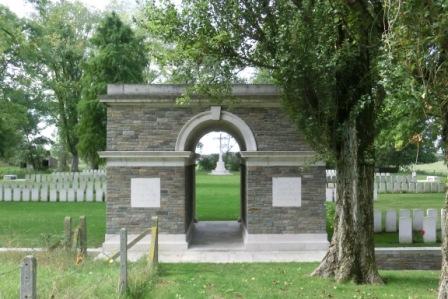
October 26, 2017.  Menin Gate (Menenpoort in Flemish) is a large archway, with a bridge over a moat that surrounds the city of Ypres. Between October 1914 and September 1918 hundreds of thousands of Commonwealth soldiers marched through it on their way to the battlefields.  300,000 of them died, and 90,000 have no known grave.

Ypres was at the centre of a road network and essential for the Germans to capture in order to take the English Channel ports through which British support came into France during World War I. For the Allies, Ypres was important as it became the last major Belgian town that remained out of German control.

Five major battles occurred around Ypres. During the First Battle of Ypres the German army’s advance to the east of the city was stopped.  Eventually, however, the Germans surrounded the city on three sides, bombarding it throughout much of the war. The Second Battle of Ypres was the second German attempt to take the city in April 1915. The third battle, which we know as the Battle of Passchendaele, occurred over five months in 1917. The fourth and fifth battles occurred during 1918.

Today, Menin Gate is a memorial to 54,616 Commonwealth soldiers who died before August 16, 1917 and have no known grave, about 6,983 of them Canadians.

CIMG8681 Sep 9 2017 Ypres Menin Gate Memorial

Menin Gate Memorial in Ypres. (Photo credit: Daria Valkenburg)

Two of those Canadians are listed on the Cenotaph outside the Borden-Carleton Legion: Charles Benjamin Murray BUXTON and George ‘Albert’ CAMPBELL.  So, of course, we went to find their names on the Menin Gate Memorial.

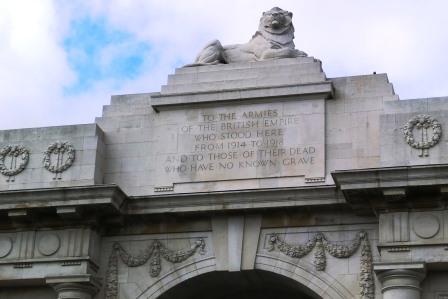
CIMG8683 Sep 9 2017 Ypres Inscription at entrance to Menin Gate Memorial

Inscription on the Menin Gate Memorial. (Photo credit: Daria Valkenburg)

Inside the archway is a Hall of Memory, with stairwells on either side of the archway, and panels listing the names of each of these soldiers.  One wall by the stairwall lists the names of Canadian soldiers, and we first found Charles Buxton, listed under the names of those from the Princess Patricia Canadian Light Infantry.  Pieter stood by the wall listing his name and held up Buxton’s photo and a plaque that he’d asked Kevin Peddle of Prince County Trophy and Awards in Summerside to make for him.

CIMG8688 Sep 9 2017 Ypres Pieter with plaque and photo of Buxton at Menin Gate Memorial

Pieter at Menin Gate Memorial, holding up a photo of Charles Buxton and a memorial plaque. (Photo credit: Daria Valkenburg)

OLYMPUS DIGITAL CAMERA

Memorial Plaque for Charles Buxton that Pieter had made. (Photo credit: Pieter Valkenburg)

Buxton - Cropped

Charles Buxton. (Photo: courtesy of John Marchbank Collection)

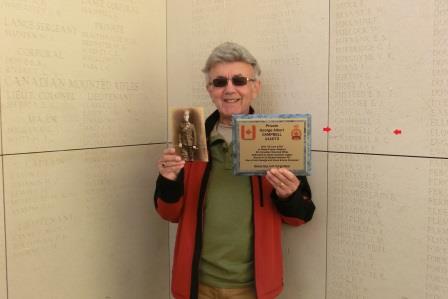
We then searched for the listing for George Albert Campbell under the Canadian Mounted Rifles, and repeated the procedure, holding up a picture of Campbell and a memorial plaque.

CIMG8703 Sep 9 2017 Ypres Pieter with plaque and photo of Campbell by name on Menin Gate

Pieter at Menin Gate Memorial, holding up a photo of George Albert Campbell and a memorial plaque. (Photo credit: Daria Valkenburg)

OLYMPUS DIGITAL CAMERA

Memorial Plaque for George Albert Campbell that Pieter had made. (Photo credit: Pieter Valkenburg)

George Albert Campbell - Cropped

George Albert Campbell. (Photo: courtesy of Gerald Tingley Collection)

If you were paying attention at the beginning of this entry, you read that 90,000 WWI Commonwealth soldiers have no known grave, but only 54,616 are listed on Menin Gate. Why?  When the memorial was completed, it was too small to contain all the names of the missing and unidentified soldiers, as had originally been planned. An arbitrary cut-off point of August 15, 1917 was chosen and the names of 34,984 British soldiers missing after this date were inscribed on the Tyne Cot Memorial to the Missing instead. The names of missing and unidentified soldiers from New Zealand and Newfoundland are listed on separate memorials.

With advances in DNA and stories about finding skeletons in various graves in fields, we wondered what happened if a soldier was identified.  Any remains are reburied in a cemetery, and if the soldier can be identified the name is removed from the Menin Gate Memorial.

We were glad we had the opportunity to visit Menin Gate Memorial in the morning, before it got busy and before the Last Post Ceremony in the evening, which we would come back to attend.

We also wanted to visit Maple Copse Cemetery, where Campbell is believed to be buried, and Sanctuary Wood, where Buxton lost his life during a battle, and have a chance to tell their stories in the spot where they were last.

First, though, we decided to visit areas in and around Passchendaele, beginning with Lt.  John McCrae’s field hospital bunker, the subject of the next blog entry. Comments or stories?  You can share them by emailing us at memorialtrail@gmail.com or by commenting on this blog.

© Daria Valkenburg

….Want to follow our research?….

If you are reading this posting, but aren’t following our research, you are welcome to do so.  Our blog address: https://onthewarmemorialtrail.com/

Front cover OnTheWarMememorialTrailinEurope4 countries, 6 weeks, 7,000 km – an unforgettable war memorial journey in Europe…. Daria’s book ‘No Soldier Buried Overseas Should Ever Be Forgotten‘ is available in print and e-book formats.  Net proceeds of book sales help support research costs and the cost of maintaining this blog. For more information see https://nosoldierforgotten.com/ 

You are also invited to subscribe to our YouTube Channel: On The War Memorial Trail With Pieter Valkenburg: https://www.youtube.com/channel/UCJ591TyjSheOR-Cb_Gs_5Kw

Never miss a posting!  Subscribe below to have each new story from the war memorial trail delivered to your inbox.