On The War Memorial Trail….2025 Faces of Holten Exhibition Part 4: Soldiers Who Drowned During Operation Duck

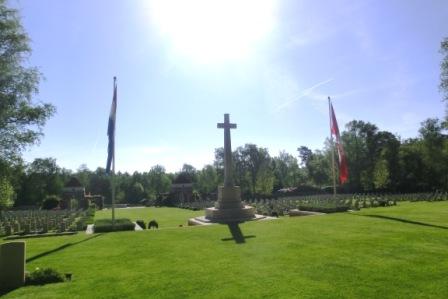
Cross of Remembrance at the Canadian War Cemetery in Holten, The Netherlands. (Photo credit: Daria Valkenburg)

September 4, 2025.  Pieter has been involved in finding photos of Canadians who are buried in all three Canadian War Cemeteries in The Netherlands since 2014, with stories of many soldiers told on this blog. 

While in The Netherlands and Belgium for the 80th Anniversary of Liberation Commemoration events, he placed flags at the graves of 383 soldiers in 14 cemeteries. At the Canadian War Cemetery in Holten, The Netherlands, flags were placed at 156 graves. Our visit coincided with The 2025 Faces Of Holten Exhibition, which ran for three weeks in May.

In Part 1, the graves and photos of soldiers who were killed near Posterenk in April 1945, and are buried in the Canadian War Cemetery in Holten, were featured. (See https://onthewarmemorialtrail.com/2025/08/24/on-the-war-memorial-trail-2025-faces-of-holten-exhibition-part-1-soldiers-killed-near-posterenk/)

In Part 2, the graves and photos of two soldiers whose names are listed on the Cenotaph outside the Borden-Carleton Legion were featured. (See https://onthewarmemorialtrail.com/2025/08/29/on-the-war-memorial-trail-2025-faces-of-holten-exhibition-part-2-the-soldiers-listed-on-the-cenotaph-in-borden-carleton/)

In Part 3, the graves and photos of soldiers killed in vehicle accidents were featured. (See https://onthewarmemorialtrail.com/2025/09/01/on-the-war-memorial-trail-2025-faces-of-holten-exhibition-part-3-soldiers-killed-while-travelling-in-vehicles/)

Now, in Part 4, six soldiers who lost their lives in the Battle of Leer during Operation Duck, whose stories have previously been told on this blog, are featured.  Four of these soldiers were in the North Nova Scotia Highlanders Regiment, while two were with the Stormont, Dundas and Glengarry Highlanders.

…6 soldiers who drowned during Operation Duck are commemorated…

Grave of Joseph ‘Ambroise’ Comeau. (Photo credit: Daria Valkenburg)

Joseph ‘Ambroise’ COMEAU, from Lower Saulnierville, Nova Scotia, was one of 5 soldiers from the North Nova Scotia Highlanders Regiment who drowned in a tragic accident in the Battle of Leer in Germany on April 28, 1945, aged 21.  You can read his story at https://onthewarmemorialtrail.com/2021/05/17/on-the-war-memorial-trail-a-tragic-drowning-on-the-leda-river-in-germany-part-3/

After sending a photo of the grave with Ambroise’s photo to his niece, Simone Comeau, she not only thanked us, but a few days later wrote to say that “…my son, Delphis, has a pen pal in The Hague and he told him about your project and that he had a great-uncle buried in the Holten cemetery. That pen pal went to visit his tomb the week of the commemorations and he sent Delphis a photo almost identical to the one you sent me.

Afterwards he sent him another one and he had added two flowers, a red one to represent Canada and an orange one to represent Holland. Delphis was so pleased that he wanted me to tell you….”  What a lovely gesture by the pen pal!

Grave of Lewis Wilkieson Marsh. (Photo credit: Pieter Valkenburg)

Lewis Wilkieson MARSH, from Sydney Mines, Nova Scotia, was one of 5 soldiers from the North Nova Scotia Highlanders Regiment who drowned in a tragic accident in the Battle of Leer in Germany on April 28, 1945, aged 19. You can read his story at https://onthewarmemorialtrail.com/2021/05/18/on-the-war-memorial-trail-a-tragic-drowning-on-the-leda-river-in-germany-part-4/

RCMP piper Mike Ward played a lament at the grave of Lewis Wilkieson Marsh of Nova Scotia.  (Photo credit: Daria Valkenburg)

While at the cemetery in Holten, we met others who were honouring the fallen, including an RCMP pipe band from Ottawa. One of the pipers noticed Pieter placing flags nearby at Lewis’s grave, and came over to play a lament. It was so hauntingly beautiful that I had tears in my eyes.

After sending a photo of the grave with the photo of Lewis to his niece, Burnie Reynaert, she wrote back to say “…Thank you, Daria and Pieter. My heart is full of gratitude for all you do. There are no words….

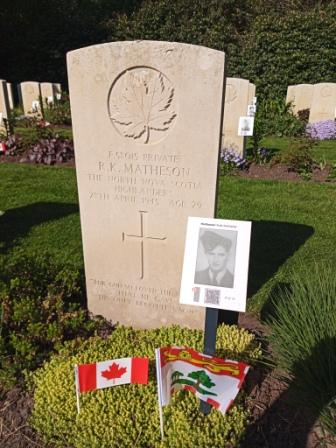
Grave of Ruel Kitchener Matheson.  (Photo credit: Pieter Valkenburg)

Ruel Kitchener MATHESON, from Dundas, Prince Edward Island, was one of 5 soldiers from the North Nova Scotia Highlanders Regiment who drowned in a tragic accident in the Battle of Leer in Germany on April 28, 1945, aged 29.  You can read his story at https://onthewarmemorialtrail.com/2021/05/18/on-the-war-memorial-trail-a-tragic-drowning-on-the-leda-river-in-germany-part-4/

Grave of Francis ‘Frank’ Eugene Munroe.  (Photo credit: Daria Valkenburg)

Francis ‘Frank’ Eugene MUNROE, from Halifax, Nova Scotia, was one of 19 men from with the Stormont, Dundas and Glengarry Highlanders who drowned during the crossing of the Ems River in Germany on April 28, 1945, at the age of 22, while participating in Operation Duck. You can read his story at https://onthewarmemorialtrail.com/2025/03/11/on-the-war-memorial-trail-tragedy-on-the-ems-part-2-the-wwii-soldier-from-halifax-who-drowned-during-operation-duck/

Grave of Lloyd William Murray.  (Photo credit: Daria Valkenburg)

Lloyd William MURRAY, from Tatamagouche, Nova Scotia, was one of 5 soldiers from the North Nova Scotia Highlanders Regiment who drowned in a tragic accident in the Battle of Leer in Germany on April 28, 1945, aged 27.  You can read his story at https://onthewarmemorialtrail.com/2021/05/16/on-the-war-memorial-trail-a-tragic-drowning-on-the-leda-river-in-germany-part-2/

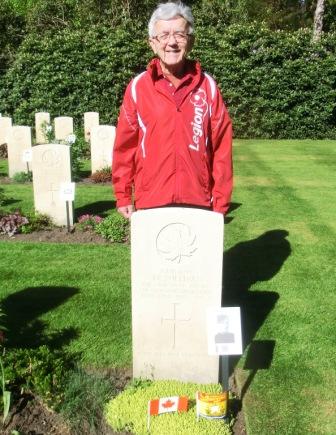
Pieter by the grave of James Edward Sullivan.  (Photo credit: Daria Valkenburg)

James Edward SULLIVAN, from Rexton, New Brunswick, one of 19 men serving with the Stormont, Dundas and Glengarry Highlanders who drowned during the crossing of the Ems River in Germany on April 28, 1945, at the age of 25, while participating in Operation Duck. You can read his story at https://onthewarmemorialtrail.com/2025/03/05/on-the-war-memorial-trail-tragedy-on-the-ems-part-1-the-wwii-soldier-from-rexton-who-drowned-during-operation-duck/

….All of the flags placed at graves were donated…

All of the flags placed at graves were donated.  Our thanks go to: 

  • Alan Waddell, Constituent Assistant, on behalf of Heath MacDonald, MP for Malpeque, for the Canadian flags.
  • Matt MacFarlane, MLA for District 19, Borden-Kinkora, for the Prince Edward Island flag. 
  • Armel ‘Mel’ Lanteigne, President of the Caraquet Legion in New Brunswick for the New Brunswick flag.
  • Kyle Graham, Research Officer, Military Relations, Nova Scotia Intergovernmental Affairs, on behalf of Premier Tim Houston, Province of Nova Scotia, for the Nova Scotia flags.
  • La Société acadienne de Clare at the request of Simone Comeau for the Acadian flag.

Thank you to Simone Comeau and Burnie Reynaert for their kind words.  In Part 5, the graves and photos of Indigenous soldiers killed will be featured as we continue with our 2025 European War Memorial Tour.

Pieter encourages readers with photos to come forward so that eventually all the known graves of Canadians buried in Holten will have a photo displayed by their grave. Email him at memorialtrail@gmail.com

© Daria Valkenburg

….Want to follow our research?…

If you are reading this posting, but aren’t following our research, you are welcome to do so.  Our blog address: https://onthewarmemorialtrail.com/

4 countries, 6 weeks, 7,000 km – an unforgettable war memorial journey in Europe…. Daria’s book ‘No Soldier Buried Overseas Should Ever Be Forgotten‘ is available in print and e-book formats.  Net proceeds of book sales help support research costs and the cost of maintaining this blog. For more information see https://nosoldierforgotten.com/

Subscribe to our YouTube Channel: On The War Memorial Trail With Pieter Valkenburg: https://www.youtube.com/channel/UCJ591TyjSheOR-Cb_Gs_5Kw

Never miss a posting!  Subscribe below to have each new story from the war memorial trail delivered to your inbox.

On The War Memorial Trail…..Tragedy On The Ems Part 1: The WWII Soldier From Rexton Who Drowned During Operation Duck

March 5, 2025. In 2021, during a period when we were all at home due to Covid, we translated, into English, ‘Holtense Canadezen’, Jan Braakman’s book about some of the soldiers buried in the Canadian War Cemetery in Holten, The Netherlands.  In October 2023, this was published in English as ‘Holten Heroes: Stories from a Canadian Field of Honour’.  (See https://onthewarmemorialtrail.com/2023/11/01/new-book-about-soldiers-buried-in-the-canadian-war-cemetery-in-holten-the-netherlands/)

The chapter ‘Drama On The Ems’ was about a tragic incident during the Battle of Leer in Germany on April 28, 1945, one of the final actions to end WWII in Europe. Operation Duck, which involved the crossing of the Ems and Leda rivers in northern Germany in order to take the port of Leer, turned out very badly for 19 men of the Stormont, Dundas and Glengarry Highlanders Regiment. 

Two Maritime soldiers mentioned in the chapter, one from Nova Scotia, and one from New Brunswick, were on the photo wish list from the Canadian War Cemetery in Holten, The Netherlands.  Pieter was successful in finding family and a photo of these men, who were both with the Stormont, Dundas and Glengarry Highlanders. 

…..James is remembered on a plaque in the United Church in Rexton….
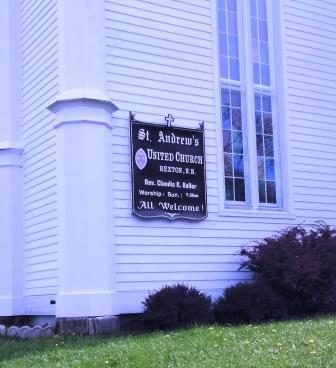
St. Andrew’s United Church in Rexton, New Brunswick.  (Photo credit: Daria Valkenburg)

James Edward SULLIVAN, from Rexton, New Brunswick, was one of the Maritimers. In a serendipitous coincidence, we’d visited Rexton to meet the family of another soldier – Janice Little and Gayle McBeath, nieces of WWII trooper Stanley Leigh MCBEATH. They took us to St. Andrew’s United Church, where Stanley’s name was listed on a plaque on the church organ. Then we noticed that James was also listed on the plaque! (See https://onthewarmemorialtrail.com/2024/02/03/on-the-war-memorial-trail-the-wwii-trooper-from-rexton-who-lost-his-life-three-days-before-his-birthday/)

James Sullivan and Stanley McBeath are listed on a memorial plaque on the organ in St Andrew’s United Church in Rexton.  (Photo credit: Daria Valkenburg)

….James’s niece had a photo!….
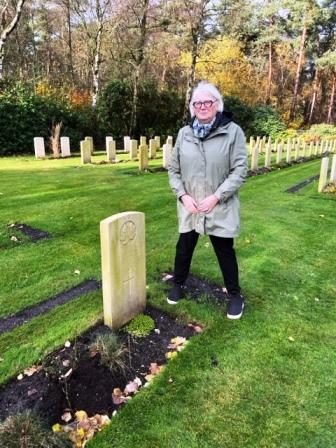
Barbara Sullivan at the grave of her uncle, James Sullivan, buried in the Canadian War Cemetery in Holten, The Netherlands.   (Photo courtesy of Barbara Sullivan)

Born July 7, 1919 in Main River, New Brunswick, James was the son of Edward and Augusta Sullivan. James had a younger brother, Kenneth, and it was through Kenneth’s daughter, Barbara Sullivan, that a photo was found, after she’d been contacted by Janice Little.  “I’m the niece of L/Corporal James Edward Sullivan of The Stormont, Dundas and Glengarry Highlanders.  I never knew him, he died a long while before I was born. His brother Kenneth is my dad.  Both of my parents passed away in 2001….”  Barbara wrote.

…..James enlisted under the NRMA in 1941….
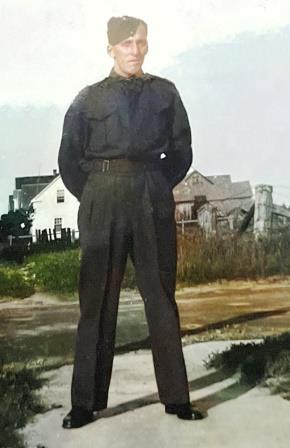
James Edward Sullivan. (Photo courtesy of the Sullivan Family.  Photo colourization by Pieter Valkenburg)

James originally enlisted under the National Resources Mobilization Act (NRMA) at the No. 7 NRMA Clearing Depot in Fredericton, New Brunswick on March 20, 1941 and began basic training at No. 70 Canadian Army Basic Training Centre in Fredericton. At the time, he stated he was employed as a truck driver and sawyer for a lumber company. (See https://en.wikipedia.org/wiki/National_Resources_Mobilization_Act)

On May 20, 1941, he was transferred to A1 Canadian Artillery Training Centre (CATC) at Camp Petawawa, Ontario for further training.  On July 26, 1941, he was sent to A23 Coast Defence and Anti-Aircraft Artillery Advanced Training Centre (C&AAATC) in Halifax, Nova Scotia for a few weeks.  The centre trained coast and anti-aircraft gunners. 

Next, James was attached to 1st (Halifax) Coast Brigade of the Royal Canadian Artillery in Halifax on August 21, 1941, which was responsible for providing coastal artillery support as part of the defences of Halifax, Nova Scotia.  

Devil’s Battery.  (Photo source: https://hmhps.ca)

On September 26, 1941, he was attached as a gunner to the 53rd Coast Battery of the 1st (Halifax) Coast Brigade, part of the defence of Devil’s Battery, and remaining there even after joining the active army in Halifax on February 1, 1942. 

James was sent back to A23 Coast Defence and Anti-Aircraft Artillery Advanced Training Centre (C&AAATC) in Halifax on August 31, 1942 for further training. After completing Range Takers Course No. 5 on October 10, 1942, he returned to the 53rd Coast Battery.

….James served in Newfoundland….

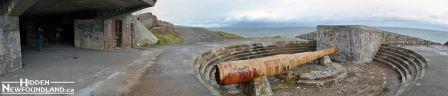
Cape Spear Battery.  (Photo source: https://www.hiddennewfoundland.ca)

On February 12, 1943, James was transferred to the 103rd Coast Battery of the Royal Canadian Artillery and sent to St. John’s, Newfoundland. Based at Cape Spear, the most eastern point in North America, the Battery was responsible for maintaining the 10″ guns.

Cape Spear’s close proximity to convoy routes and the entrance to St. Johns Harbour was an essential place to have a coastal defense battery, post-war signal station, and searchlight emplacement during World War II. (NOTE: Newfoundland and Labrador joined Canada on March 31, 1949.)

On November 18, 1943, James left Newfoundland for Shelburne, Nova Scotia and was transferred to the 104th Coast Battery of the Royal Canadian Artillery (RCA).

….James was transferred to the infantry….

On January 14, 1944, James was assigned to No. 1 Transit Camp in Windsor, Nova Scotia for preparation before being sent overseas.  However, instead of going overseas immediately, he was transferred to No. 60 Canadian Infantry (Basic) Training Centre (CIBTC) in Yarmouth, Nova Scotia for additional training.

Then, on April 9, 1944, he was sent to A14 Canadian Infantry Training Centre at Camp Aldershot, Nova Scotia for final preparations before going overseas. 

James was granted embarkation leave from June 2 to June 15, 1944, the last chance he had to see his family again.

….James left Canada for overseas service….

On June 25, 1944, James left Canada for the United Kingdom. Upon arriving on July 3, 1944 he was assigned to No. 4 Canadian Infantry Reinforcement Unit (CIRU). 

He continued his training for a few weeks before being transferred to the X-4 reinforcement list of the Canadian Infantry Corps (CIC), on July 26, 1944.  Three days later he was on his way to France, disembarking on July 30, 1944.

On July 31, 1944 he was assigned to the Stormont, Dundas and Glengarry Highlanders, part of the 21st Army Group, joining the Regiment in the vicinity of Le Vey, France, 23 km (14 miles) northwest of Falaise.  The Regiment needed downtime to get reorganized and to give the men a chance to train and have a rest following heavy fighting since landing in Normandy on D-Day.

He received a promotion to Lance Corporal a few weeks later, on August 19, 1944.  James remained with the Regiment as it fought across France, and into The Netherlands.  It was in Nijmegen to relieve the airborne troops, and helped guard the bridge while the Rhine crossing was prepared. The Regiment then fought through the Hochwald in Germany, and then north as it prepared to cross the Ems River and take the city of Leer on April 28, 1945, in what became known as Operation Duck.

… Operation Duck…

In the plan for Operation Duck, the Stormont, Dundas and Glengarry Highlanders would go across the Ems River towards the western edge of Leer. At the same time, the North Nova Scotia Highlanders would cross the Leda River in assault boats and secure the northern bank of the river in preparation for the attack to capture Leer. The Highland Light Infantry of Canada would cross the Leda River, where the Ems and Leda rivers meet.

These three Regiments were part of the 9th Canadian Infantry Brigade.  (See https://www.canadiansoldiers.com/history/battlehonours/northwesteurope/leer.htm)

While the men from the Highland Light Infantry all crossed safely, the North Nova Scotia Highlanders lost 5 men, and the Stormont, Dundas & Glengarry Highlanders lost 19.
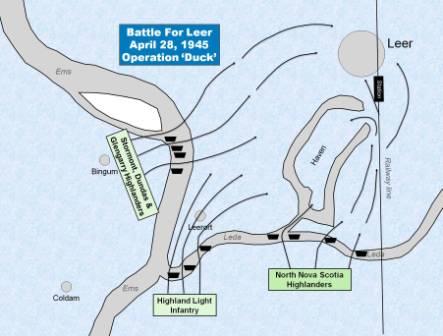
Map showing the Ems and Leda Rivers, and position of Regiments during the Battle for Leer.  (Map courtesy of and ©Jan Braakman)

…Why Operation Duck Was Important…
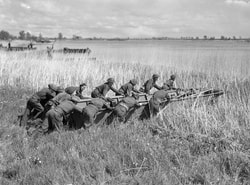
A Storm boat is moved into the water during Operation Duck on April 28, 1945. (Photo source: Library and Archives Canada)

A translated excerpt from Jan Braakman’s ‘Holten Heroes: Stories from a Canadian Field of Honour’ explained why Operation Duck was important. “…At the end of April 1945, Canadian troops stood just across the Dutch-German border in Ostfriesland (East Frisia) in front of the river Ems….” (See https://en.wikipedia.org/wiki/East_Frisia)

Leer was a challenge to capture. “…The town of Leer was on the other side of the river on the route to Emden. Surrounded by inaccessible lowlands in the north and with rivers (Ems and Leda) in the west and south, Leer was a well defensible and therefore difficult to capture port city. All access bridges over the Ems and Leda were blown up by the Germans. For the Canadians there was no other option than to reach the city by water….

River crossings can be tricky due to currents and tides, and in wartime, there is always the risk of enemy fire.  “….The Ems River has an open connection with the Wadden Sea, which means that tides influence water levels and currents in the river. Tides made the currents unpredictable, and the Canadian Army didn’t have accurate information about the tides. What was clear: high tide was the best time to make the crossing. Aerial photographs showed that German troops had fortified themselves well behind the dikes that surrounded the city…. 

A decision was made on how to cross the two rivers – the Leda and the Ems.. “ Only under the protection of a smoke screen and solid artillery support would it be possible to successfully complete the attack on Leer, using boats … General Simonds ordered that on April 28, 1945, before darkness fell, there had to be a solid bridgehead, from which the capture of Leer could be initiated. That meant that the attack had to be launched during the middle of the day, around three o’clock, when the water level was at its highest…” 

The Highland Light Infantry crossed safely “ at the point where the Leda flows into the Ems, about three kilometres south of the city centre…

The other two regiments ran into trouble.  “…The crossing was made at three different places. At the same time, artillery fire and attacks from the air put the German defence line to the test. The North Nova Scotia Highlanders would cross the Leda from the south bank and take the harbour of Leer, which abutted the city on a peninsula…

…The Stormont, Dundas & Glengarry Highlanders Regiment ran into trouble…

The Stormont, Dundas & Glengarry Highlanders Regiment was to cross the Ems River “…from the west bank of the Ems at Bingum to attack the city from the west.…” 

All three Regiments launched their attacks at the same time.  “….It began at half past two with fierce shelling, during which the positions of the German defence forces were fired upon. The attack from the south was spectacular and successful, with relatively few losses…. 

This wasn’t the case for the attack from the west. “….A number of boats….” from the Stormont, Dundas & Glengarry Highlanders Regiment “…showed motor defects or capsized. Some of the drowning men were rescued, but at the end of the day at least nineteen men from the Regiment were dead, drowned, or missing….

….James was one of the fatalities….

After WWII ended “a team from the Stormont, Dundas & Glengarry Highlanders returned to the Ems. They dragged the river, looking for the bodies of the missing men. Some of them were found with their full kit still attached to their bodies….

Sergeant G.W. McGill, who survived the crossing, had reported that at “….approximately 15:30 hours, 28-April-1945, I was crossing the river Ems in an assault craft during the attack on Leer. Suddenly, the nose of our craft dipped and the craft overturned and we were all thrown into the water. I came to the surface and was picked up by another assault craft, along with Cpl W.M.J. Wood. We cruised around for approximately ten minutes, but we could not see Sullivan anywhere. A check on the shore by the platoon commander indicated that Sullivan, Brough, and Oslund were missing….

James was not found until almost the end of May 1945.  “….25 year-old James E. Sullivan was …. initially reported missing. On May 28, his family was informed by telegram that ….” his body had been found.

….James is buried in the Canadian War Cemetery in Holten….

James was originally buried in Oldenburg, Germany, before being reburied in 1946 in the Canadian War Cemetery in Holten, The Netherlands.
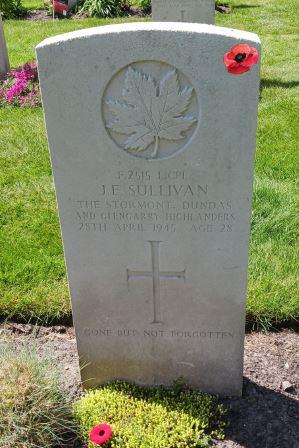
Grave of James Edward Sullivan in the Canadian War Cemetery in Holten, The Netherlands.  (Photo courtesy of Canadian Virtual War Memorial)

….Other soldiers from the Stormont Dundas Glengarry Highlanders who lost their lives that day…

In addition to James Edward Sullivan, 18 more soldiers from the Stormont, Dundas and Glengarry Highlanders lost their lives on April 28, 1945, and are listed below.  If there are asterisks beside the name (****) it means there is a brief anecdote in the ‘Drama On the Ems’ chapter in ‘Holten Heroes: Stories from a Canadian Field of Honour’. 

  • A/Cpl John SAWATSKY of Petaigan, Saskatchewan, aged 20
  • L/Cpl Merle Coleman MOORE of Breckenridge Station, Quebec, aged 22
  • Pte Frank Joseph BIERNASKI of Barry’s Bay, Ontario, aged 32 ****
  • Pte Walter James BROOKS of Toronto, Ontario, aged 28
  • Pte Leonard Gordon BROUGH of Sudbury, Ontario, aged 21**** 
  • Pte Steven John GRAVELLE of Peterborough, Ontario, aged 23
  • Pte Joseph Gerard HINDS of Orillia, Ontario, aged 20
  • Pte Earl Harcourt JOSLIN of Kingston, Ontario, aged 34****
  • Pte Ira Charles LANGILLE of Milton, Nova Scotia, aged 32 ****
  • Pte Cecil Albert LAWES of Frankford, Ontario, aged 28
  • Pte Frank Eugene MUNROE of Halifax, Nova Scotia, aged 22  
  • Pte Sidney Alexander OSLUND of Haileybury, Ontario, aged 29 ****
  • Pte Samuel Donald POWELL of Newcastle, Ontario, aged 22
  • Pte Edgar Douglas SMITH of Parrsboro, Nova Scotia, aged 28 ****
  • Pte Francis Wilber SPENCER of Stonecliffe, Ontario, aged 35 ****
  • Pte Jack Allan STEWARD of Belleville, Ontario, aged 24 ****
  • Pte Roy Ivenson THACKERAY of Peterborough, Ontario, aged 20 ****
  • Pte George Sidney WAKELY of Port Hope, Ontario, aged 31****

….A Tragic Drowning On The Leda River….

As mentioned in the ‘Holten Heroes’ excerpt, the crossing of the rivers to reach Leer involved three Regiments – Stormont Dundas and Glengarry Highlanders, North Nova Scotia Highlanders, and the Highland Light Infantry. 

The North Nova Scotia Highlanders were tasked with crossing the Leda River from the south bank and to then take the harbour of Leer.  5 soldiers from this Regiment lost their lives when the storm boat they were in capsized. Their stories were told in previous blog postings as a 4 part series:

….Blog posting about another soldier mentioned in the book Holten Heroes…

Tragedy On The Ems Part 2 will be about the other Maritimer on the photo wish list:  Frank Eugene MUNROE of Halifax, Nova Scotia.

Thank you to Jan Braakman for permission to quote from his book and use of the map showing the position of the Regiments, with translation into English by Pieter and Daria Valkenburg, and to Barbara Sullivan for sharing a photo of her uncle. If you have a story or photo to share, please contact Pieter at memorialtrail@gmail.com or comment on the blog. 

© Daria Valkenburg

….Want to follow our research?….

If you are reading this posting, but aren’t following our research, you are welcome to do so.  Our blog address: https://onthewarmemorialtrail.com/
4 countries, 6 weeks, 7,000 km – an unforgettable war memorial journey in Europe…. Daria’s book ‘No Soldier Buried Overseas Should Ever Be Forgotten‘ is available in print and e-book formats.  Net proceeds of book sales help support research costs and the cost of maintaining this blog. For more information see https://nosoldierforgotten.com/

You are also invited to subscribe to our YouTube Channel: On The War Memorial Trail With Pieter Valkenburg: https://www.youtube.com/channel/UCJ591TyjSheOR-Cb_Gs_5Kw

Never miss a posting!  Subscribe below to have each new story from the war memorial trail delivered to your inbox.
On The War Memorial Trail…..The WWII Trooper From Rexton Who Lost His Life Three Days Before His Birthday

20230918_094802 Sep 18 2023 Rexton village sign

Stanley McBeath’s family lives in Rexton, New Brunswick.  (Photo credit: Daria Valkenburg)

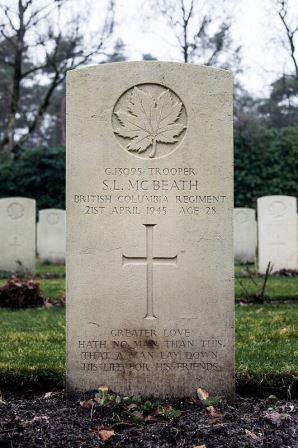
February 3, 2024. When Pieter looks for family of a soldier whose name is on a photo wish list for one of the Canadian War Cemeteries in The Netherlands, he never knows what to expect.  After he decided to research Stanley Leigh MCBEATH, whose family lived in Rexton, New Brunswick, Pieter wrote to St. Andrews United Church in Rexton and also called the minister.  He did that after finding a newspaper article about a Memorial Service held in August 1945 for Stanley and another WWII soldier from Rexton, James Edward SULLIVAN

Shortly after his inquiry, Pieter received a call from Janice Little, who explained that she was Stanley’s niece, daughter of his sister Audrey, and yes, she had a photo.

…Stanley enlisted in 1939….

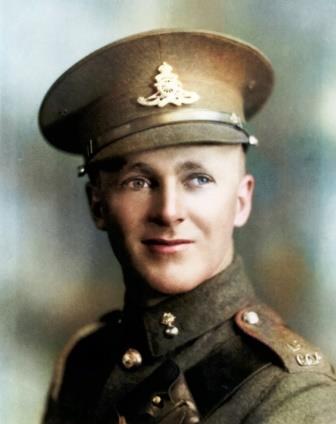
Stanley McBeath Coloured improved_photo(27)

Stanley Leigh McBeath. (Photo courtesy of the McBeath Family. Photo colourization by Pieter Valkenburg)

Born April 24, 1916 in Peter’s Mill, Kent County, New Brunswick, Stanley was the eldest son of Richmond Noble and Lilly Victoria (nee Peters) McBeath. Before enlisting with the 15th Heavy Battery of the 3rd (New Brunswick) Coast Brigade in St. John, New Brunswick on September 12, 1939, Stanley had been working for two years for H. Gauvin, who owned a garage in Rexton.  He also helped his parents on their farm. In his Occupational History Form, he indicated an interest in remaining in the army after the war ended.

After completing his basic training in St. John, Stanley was sent to Halifax to complete a Range Finders course.  A Range Finder was a key piece of equipment, used in machine guns, to measure distances to remote objects, and required expertise and skill to operate.  Soldiers selected for this specialist training were machine gunners, or mortarmen, with good eyesight and an elementary knowledge of mathematics.  Stanley completed this course on April 20, 1941.

…Stanley served with the 108th Battery as part of Atlantic Command….

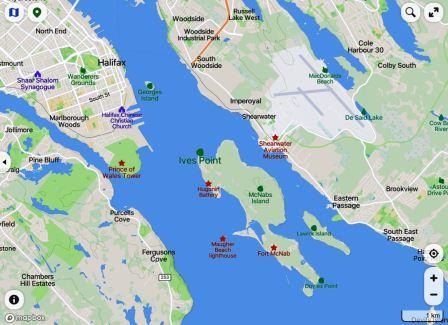
On May 15, 1942, Stanley was transferred to the 108th Battery and posted to Ives Point, Nova Scotia.  The battery was part of Atlantic Command, whose role was to strengthen and administer home defence facilities on Canada’s Atlantic Coast.

Screenshot 2024-01-30 at 12-44-04 Ives Point

Location of Ives Point. (Map source: https://mapcarta.com)

…Stanley was in Goose Bay as a gunner with an anti-aircraft battery….

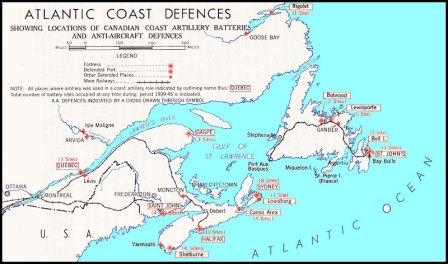
On October 15, 1942, Stanley was posted to Goose Bay, Labrador, temporarily attached to 30th Anti-Aircraft Battery.  (NOTE: Newfoundland and Labrador became part of Canada on March 31, 1949.)

Canada had built a massive air base at Goose Bay, Labrador as an alternative to Gander for transatlantic operations. This base became operational in late 1941. (See https://www.heritage.nf.ca/articles/politics/goose-bay-base.php) The bases at Gander and Goose Bay were vital links in the ferrying of military aircraft to Britain.  Anti-aircraft crews were part of coastal defence. 

Stanley remained in Goose Bay until July 23, 1943 when he was posted to Gaspe, Quebec, and reassigned back to the 108th Battery.  On November 26, 1943 he was sent to Shelburne, Nova Scotia for further training.

…Stanley qualified as a Canadian Armoured Corps Operator….

On April 18, 1944 Stanley was transferred to No. 1 Transit Camp in Windsor, Nova Scotia. Not long after that, on May 17, 1944, he was posted to No. 1 Canadian Armoured Corps Training Regiment (CACTR) in Borden, Ontario for additional training.  On October 7, 1944 he was qualified as a Canadian Armoured Corps (CAC) Operator.

Then, in preparation for overseas service, Stanley was assigned to No. 1 Canadian Armoured Corps Trained Soldiers Regiment (CACTSR), still in Borden, Ontario.

…Stanley left Canada for overseas service….

On November 25, 1944 Stanley left Canada, arriving in the United Kingdom on December 5, 1944, where he was assigned to No. 3 Canadian Armoured Corps Reinforcement Unit (CACRU).

On December 10, 1944, Stanley wrote a letter to his Aunt Janie McBeath, the sister of his father, who was a nurse in New York.  He gave his impression of England and noted the differences he saw for Christmas, which would be in two weeks. 

…Suppose that over in the US and Canada everything is taking on the holiday season, but here there is nothing at all.  But considering what this country has been through, I suppose it is a wonder it still exists. What has impressed me most is the sense of great age and changelessness (if there is such a word) – wars may come and go and times may have great changes, but this island goes on undisturbed by it all…

While in the United Kingdom, Stanley was temporarily attached to No. 2 Canadian Armoured Corps Reinforcement Unit (CACRU) while he took a gunnery course, which he completed on January 9, 1945.

…Stanley left the United Kingdom for Northwest Europe….

On March 24, 1945, Stanley was assigned to the X-4 Reinforcement list of the Canadian Armoured Corps as a Gunner Operator ‘C’ of the 9th Battalion and sent to North Western Europe.

On April 1, 1945 he was assigned to the 28th Canadian Armoured (British Columbia) Regiment, joining the Regiment in Germany as it travelled along the road between Calcar and Kleve, and crossed the Rhine River.    

By April 3, 1945 the Regiment had crossed the border back into The Netherlands, near Lochem, for a few days before returning to Germany. 

In a letter to his Aunt Janie, written on April 7, 1945, Stanley mentioned an experience in The Netherlands. “….Seen a show under kind of odd surroundings the other nite (sic.. night) – it was put on with a Dutch cow barn used as a theatre. But the cattle didn’t seem to mind…. At any rate the smell was familiar to me….

Stanley went on to explain that he was in a Regiment.  “…Belong to a unit now – not a bad outfit but don’t know any of them.  It’s taken a long, long time to get this far but am getting nearer the goal of ’39 all the time…”  Stanley was referring to 1939 when he enlisted for active service.

The Regiment reached Oldenburg, Germany on April 10, 1945 and the war diary daily reported encountering fierce resistance from the Germans.

The Battle for the Küsten Canal near Friesoythe and the advance slightly northwards towards Edewecht resulted in many casualties. Just after midnight on April 17, 1945, Stanley was in ‘B’ Squadron as the Regiment’s tanks supported the Algonquin Regiment during the first crossing of the Küsten Canal in assault boats. (See https://www.canadiansoldiers.com/history/battlehonours/northwesteurope/kustencanal.htm)

On Friday, April 20, 1945, the war diary entry for the 28th Canadian Armoured (British Columbia) Regiment noted that “… ‘B’ Squadron was still under command of the Algonquin Regiment…” and had moved to the location of the Regimental Headquarters between Friesoythe and Edewecht.

…Stanley lost his life on the road between Friesoythe and Edewecht….

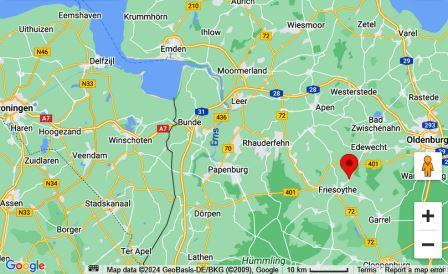
Screenshot 2024-02-01 at 13-05-30 The Coordinate Translator

Map shows the location where Stanley McBeath lost his life, using the coordinates from the war diary of the 28th Canadian Armoured (British Columbia) Regiment.  (Map source: Google maps)

The war diary entry for Saturday, April 21, 1945 for the 28th Canadian Armoured (British Columbia) Regiment:  “…Weather mild and warm….. ‘A’ Squadron remained under command of Argyll and Sutherland Highlanders of Canada and worked troops up with the forward infantry…. Lt Warmald was wounded and only two tanks of his troop reached their objective.  Another tank of ‘A’ Squadron was bazooked…”  Troops were sent to “…assist infantry in the evacuation of the wounded…

Somehow, in the confusion Stanley was initially reported missing, but later it was confirmed that he had been mortally wounded and died on  April 21, 1945, three days before his 29th birthday.

Stanley’s parents received a telegram from the Department of Defence on April 30, 1945, informing them that Stanley was missing.  This was followed up with a May 3, 1945 telegram saying he was ‘officially killed in action on April 21, 1945’. 

…An error by the Director of Records left Stanley’s family with false hope….

However, on May 7, 1945 the Moncton Times newspaper published a list of soldiers from New Brunswick who had been liberated from prisoner of war camps, and among the names was Stanley Leigh McBeath! 

You can imagine the confusion, mixed with hope, for the McBeath family. Richmond McBeath, Stanley’s father, wrote to the newspaper and asked where the information came from.  In a May 10, 1945 letter to the Department of Defence’s Director of Records, Richmond noted the response he got from the Moncton Times, saying that “…in their reply, they said ‘The Canadian Press’ which got the information from the Director of Records…

Richmond quite correctly stated that “…we do not understand this and ask for prompt confirmation or denial of your telegram of May 3…

On May 14, 1945, Richmond received a telegram from the Director of Records, confirming that Stanley had died on April 21, 1945, as per the May 3, 1945 telegram.  “…Trooper McBeath’s name was erroneously released to the press as a liberated prisoner of war, but appeared on the official casualty list dated 10th May as killed in action…”  

An apology was also provided. “…Sincerely regret the anxiety caused by the release of your son’s name as a liberated prisoner of war in error…”  It was small comfort for a family left in limbo for several days, hoping to hear that Stanley was alive.

….Stanley is buried in the Canadian War Cemetery in Holten….

Stanley was initially buried in the Temporary Canadian Military Cemetery in Friesoythe, Germany before being reburied on March 9, 1946 in the Canadian War Cemetery in Holten, The Netherlands.

Grave of Stanley McBeath from CVWM

Grave of Stanley Leigh McBeath in the Canadian War Cemetery in Holten, The Netherlands.  (Photo source: Canadian Virtual War Memorial)

….We met Stanley’s nieces….

20230918_104650 Sep 18 2023 Pieter with Janice Little & Gail McBeath

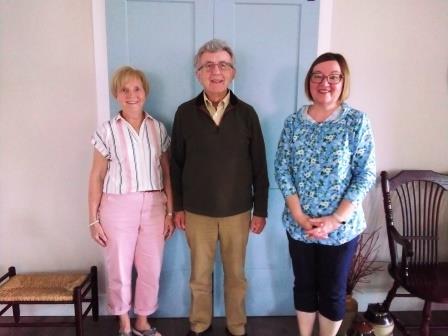
Janice Little (left), Pieter, Gayle McBeath (right).  (Photo credit: Daria Valkenburg)

In researching Stanley’s story, we were delighted to have the opportunity to meet Janice Little and her cousin, Gayle McBeath, who is the daughter of Stanley’s brother Harold.

In both of his surviving letters to his Aunt Janie, Stanley had mentioned that he hadn’t seen his brother Harold, who was with the North Shore (New Brunswick) Regiment.  Janice and Gayle told us that they did have a chance to talk to each other – two days before Stanley passed away.

20230918_100300 siblings of Stanley McBeath from Janice Little

Stanley’s surviving siblings. Standing left to right:  Helen, Audrey.  Seated, left to right:  Harold, Dorothy.  (Photo courtesy of the McBeath Family)

Janice and Gayle shared a photo of Stanley’s surviving siblings, and explained that the houses they themselves live in were part of the family farm where Stanley had grown up.

20230918_111450 Sep 18 2023 View from the street Stanley McBeath grew up on in Rexton

View from the street where Stanley grew up.  (Photo credit: Daria Valkenburg)

Stanley’s parents never forgot their son, ensuring his name was engraved on their gravestone.  Janice and Gayle took us to visit the grave at the St. Andrews United Church Cemetery in Rexton.

20230918_112949 Sep 18 2023 Stanley is listed on his parents grave at St Andrews United Church Cemetery in Rexton NB

Stanley is listed on his parents’ grave at St Andrews United Church Cemetery in Rexton, New Brunswick.  (Photo credit: Daria Valkenburg)

Thank you to Janice Little and Gayle McBeath for sharing photos and information.  Do you have photos or information to share? Email Pieter at memorialtrail@gmail.com, comment on the blog, or tweet to @researchmemori1.

© Daria Valkenburg

….Want to follow our research?….

If you are reading this posting, but aren’t following our research, you are welcome to do so.  Our blog address: https://onthewarmemorialtrail.com/

Front cover OnTheWarMememorialTrailinEurope4 countries, 6 weeks, 7,000 km – an unforgettable war memorial journey in Europe…. Daria’s book ‘No Soldier Buried Overseas Should Ever Be Forgotten‘ is available in print and e-book formats.  Net proceeds of book sales help support research costs and the cost of maintaining this blog. For more information see https://nosoldierforgotten.com/ 

You are also invited to subscribe to our YouTube Channel: On The War Memorial Trail With Pieter Valkenburg: https://www.youtube.com/channel/UCJ591TyjSheOR-Cb_Gs_5Kw

Never miss a posting!  Subscribe below to have each new story from the war memorial trail delivered to your inbox.