On The War Memorial Trail….. The WWII Diary Of Dr. Ross Part 2: Two Years And 20 Trips Aboard HMHS Lady Nelson

Dr. Alton Ross. (Photo courtesy of Judy Parks.  Photo colourization by Pieter Valkenburg)

March 23, 2025. During WWII, Dr. James ‘Alton’ ROSS, father of Judy Parks, was a doctor aboard the hospital ship HMHS Lady Nelson, Canada’s first hospital ship, which had 515 special hospital beds, special wards for shock cases, contagious diseases and fractures, private cabins, an operating room, a sterilizing room, an inspection room for minor dressings, a dispensary, and a portable x-ray outfit.

HMHS Lady Nelson.  Note the crosses on the side of the ship!  (Photo source: Wikipedia)

In Part 1, the first two of Alton’s twenty voyages aboard the ship were summarized, providing a window into life aboard a military hospital ship, as he found himself treating patients who’d been wounded in Sicily and mainland Italy. (See https://onthewarmemorialtrail.com/2025/03/16/on-the-war-memorial-trail-the-wwii-diary-of-dr-ross-part-1-assigned-to-hmhs-lady-nelson/)

Now, in Part 2, Alton’s story concludes with a return to Italy to pick up wounded servicemen and some of the devastation of war that he saw, and finally, after his 20th voyage he was able to return to the life of a civilian and a rural medical practice….

….Alton recorded Trip No. 3 aboard the HMHS Lady Nelson….

Alton’s third trip aboard the HMHS Lady Nelson began on March 4, 1944, with a round trip of 9,400 miles (15,128 km). 
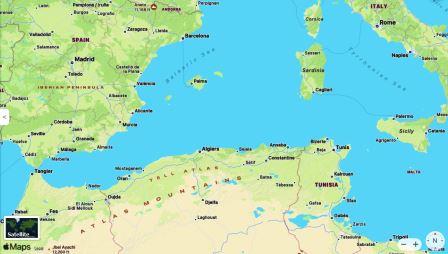
Trip No. 3 went from Halifax to Bizerte to Naples to Algiers.  (Map source: DuckDuckGo)

The route took him from the port of Halifax, Nova Scotia, across the Atlantic Ocean to Gibraltar, to Bizerte, Tunisia, and then on to Naples, Italy, from there to Algiers, Algeria, before sailing to Avonmouth, United Kingdom, and then returning to Halifax.

Alton’s diary recorded that the orchestra aboard ship, in which he played the saxophone, was larger than on his previous voyage. “…Orchestra increased by two trumpets, clarinet, and ….bass… and cymbal.  Put on three concerts across…

After leaving Halifax on March 4, 1944, the ship arrived in Gibraltar at 1:00 pm on March 13, 1944, with a stay of 7 hours before sailing on to Bizerte, Tunisia.  Alton noted that they “…had a dance that night…very successful….enjoyed by everyone.  Orchestra right on good rhythm…

In the morning of March 16, 1944, they …anchored off Bizerte in Tunisia just in bay north of Cape Bon where last of Germans gave up…..Tanker brought water to us….Remained there until 1:00 am 17 March then left for Naples…

On March 18, 1944, the ship …docked at Naples at 9:00 am…..Began loading shortly afterwards…..Left at 4:00 pm for Algiers…

When the ship had been anchored in Bizerte, no one left the ship and Alton finally found out why. “…Heard reason for not going into Bizerte was 27 enemy ships sunk in harbour…

On March 20, 1944, the ship “…docked at Algiers at 3:00 pm and loaded 50 patients…” before leaving port at 7:00 pm for England.

The ship arrived in Avonmouth on March 29, 1944, and after the patients were unloaded, Alton was free until April 1, 1944, when “…502 patients….” were brought onboard. The ship left for Halifax the following day, on a course which went “….far south this time.  Southwest to Azores, directly west on level with New York, then northwest into Halifax.  Trip seemed very long…” The journey ended when the ship arrived in Halifax on April 12, 1944.

Music remained a big part of Alton’s off-duty hours. While in England, the Auxiliary Service provided “…a trumpet and a trombone, which gave us 4 brass.  As all the boys were on day duty, we practiced about 6 to 7 nights coming from England….” 

Judy reflected on the morale boost that was provided by the orchestra.  “…The older I get I realize those crossings on the Lady Nelson were therapy sessions.  Dances and lots of music with a live orchestra…” were instrumental in “…keeping spirits up to the young volunteers anxious for some excitement on the way over, and also to the wounded returning….

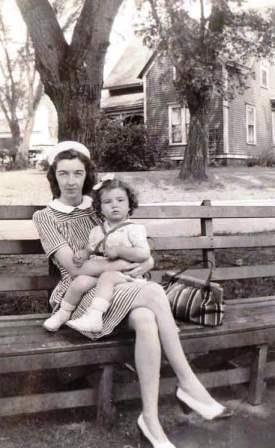
Alton’s wife Betty with their daughter Judy in New Glasgow, Nova Scotia, in a photo taken while Alton was on leave.  (Photo courtesy of Judy Parks)

At the end of Trip No. 3 Alton received 2 weeks leave, which he spent with his wife and daughter.

….Alton’s next few trips aboard the HMHS Lady Nelson were between Halifax and the United Kingdom….
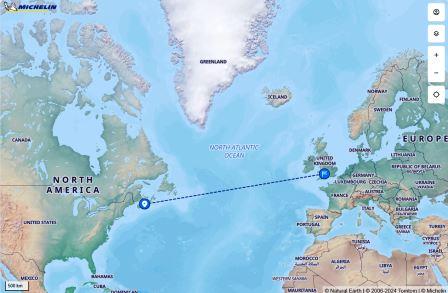
Trip No. 4 went from Halifax to Avonmouth.  (Map source: https://www.viamichelin.com)

There are 2,762 nautical miles between the Port of Halifax in Nova Scotia, and the Port of Avonmouth in the United Kingdom.  Alton’s next trip was between these two ports.

Trip No. 5 was to be the same route, but D-Day on June 6, 1944 resulted in an unexpected route change! “…Embarked 30 May carrying about 50 patients and half of 20 and 22 Canadian General Hospital staffs.  Trip over was started 31 May 44 and was fairly smooth but very foggy.

So far, nothing unusual, but then “…. on June 6th we heard the news of the Allied landings in Normandy. We were all greatly excited. On 7th June received word at 4:00 pm to change our course to the north of Ireland and again had heavy fog. At 2:00 am, 9th June went into Belfast for orders, then continued on past the Isle of Man to Liverpool….

On June 13, 1944, Alton wrote that the return journey to Canada began.  “…Loaded 505 patients…and sailed at 4:30 pm. Went around the north of Ireland…”  He noted that there were “….several cases of Malaria on board…”  Hospital records in Italy had reported since autumn 1943 that there was a severe malaria epidemic.

The next few trips found the ship returning to Liverpool rather than Avonmouth on its round trip journeys.  It wasn’t until Alton’s 14th trip in March 1945 that the Lady Nelson docked again in Avonmouth.

….Alton recorded two burials at sea on Trip No. 7….

On the return voyage back to Canada for Alton’s 7th trip, he recorded that the ship “…left Liverpool midnight 8 August….There were two burials at sea.  11th August MacGuire (sic) and 16th Captain Miller…

Private George Alfred MAGUIRE, born in Windsor, Ontario, had died aboard the Lady Nelson on August 11, 1944 from wounds received in action in France while serving with the Essex Scottish Regiment, at the age of 23, leaving behind his parents, Charles S. and Minnie Maguire, of London, Ontario. His name is inscribed on the Halifax Memorial in Point Pleasant Park in Halifax, Nova Scotia. 

Captain Theodore Albert MILLER, who was born in Halifax, Nova Scotia, had died of cancer on August 15, 1944 aboard the Lady Nelson, at the age of 47, while serving with the Royal Canadian Ordnance Corps, leaving behind his wife, Kathleen Miller of Regina, Saskatchewan, and their son David Graeme Miller. His name is inscribed on the Halifax Memorial in Point Pleasant Park in Halifax, Nova Scotia. 

….Alton looked forward to civilian life….

By June 1945, following his 16th trip aboard the Lady Nelson, Alton “…signed to go back to civilian life…

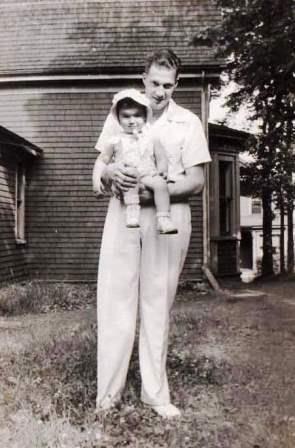
Alton with his daughter Judy in New Glasgow, Nova Scotia.  (Photo courtesy of Judy Parks)

After the conclusion of his 20th trip on October 9, 1945, “….Colonel Stone said I would be taken off the ship this trip. I went home to New Glasgow…

Following his discharge from the Royal Canadian Army Medical Corps (RCAMC), Alton returned to Salisbury, New Brunswick.  Judy explained that “…he started his practice up again, but when I was 4 he was diagnosed with cancer of the bowel and that is the only memory I have of him …in bed …very ill….” 

Sadly, Alton passed away on July 27, 1947, aged 32.  He’s buried at Christ Church Cemetery in Stellarton, Pictou County, Nova Scotia.

Alton recorded 20 trips in his diary, always being fortunate to return home for a few days with his wife and daughter between each voyage.  As he died when Judy was a child, the war diary was a way to get to know him, but she explained that she was “….50 years old” when her mother “…gave me the war diary…

Judy followed her father’s footsteps into a medical career, becoming a nurse. Going over his war diary made her reflect that “….people sometimes ask me if I was upset when my father died and I know I wasn’t.  I was only four.  No one told me he died…children were told nothing about death in those days. I suppose I thought he returned to war…

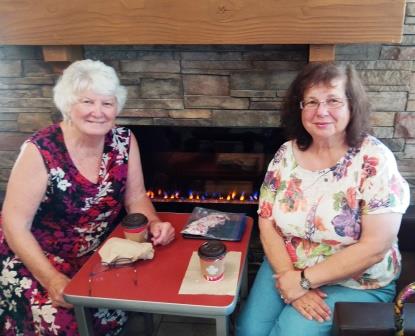
Judy Parks (left) with Daria, discussing the war service of Judy’s father. (Photo credit: Pieter Valkenburg)

Thank you to Judy Parks for sharing photos and her father’s war diary, and to Etienne Gaudet for finding newspaper articles.

© Daria Valkenburg

….Want to follow our research?….

If you are reading this posting, but aren’t following our research, you are welcome to do so.  Our blog address: https://onthewarmemorialtrail.com/
4 countries, 6 weeks, 7,000 km – an unforgettable war memorial journey in Europe…. Daria’s book ‘No Soldier Buried Overseas Should Ever Be Forgotten‘ is available in print and e-book formats.  Net proceeds of book sales help support research costs and the cost of maintaining this blog. For more information see https://nosoldierforgotten.com/

You are also invited to subscribe to our YouTube Channel: On The War Memorial Trail With Pieter Valkenburg: https://www.youtube.com/channel/UCJ591TyjSheOR-Cb_Gs_5Kw

Never miss a posting!  Subscribe below to have each new story from the war memorial trail delivered to your inbox.

The WWII Mariner From Kinkora Whose Ship Was Torpedoed In The Caribbean

February 20, 2020. On the Cenotaph outside the Borden-Carleton Legion there are 3 men who lost their lives due to being on ships that were torpedoed.  Two of these stories have already been told….

In WWI, mariner James Graham FARROW (FARRAR) lost his life when the ship he was working on was torpedoed in the English Channel on March 19, 1916.  The steamer, ‘Port Dalhousie, had been ferrying needed supplies from Britain to troops in France, while using the cover of being a fishing vessel. (See https://onthewarmemorialtrail.com/2019/01/20/the-mariner-whose-ship-was-torpedoed-in-the-english-channel/)

In WWII, Everett Samuel FRANCIS had the misfortune of being a passenger on the ferry S.S. Caribou when it was torpedoed off the coast of Newfoundland on Wednesday, October 14, 1942.  He was on his way back to his unit in Gander, and to meet his three week old daughter Greta, after being in Ontario for weapons training. Unfortunately, he was not one of the survivors. (See https://bordencarletonresearchproject.wordpress.com/2018/03/25/the-face-of-everett-samuel-francis/)

color photo Hughes, James Emmet

James Emmet Hughes. (Photo credit: courtesy “Around Kinkora Area” by G.K. Farmer.  Photo colourization by Pieter Valkenburg.)

Like James Graham FARROW (FARRAR), James Emmet HUGHES was a seaman in the Canadian Merchant Navy, not in the military.  Born in Kinkora on April 7, 1911, he was the son of Emmet Hughes and Mary Ann McKenna.

After joining the Waterman Steamship Agency of Mobile, Alabama, he was a trimmer aboard the Panamanian registered S.S. Ramapo, travelling between North America and England with badly needed supplies.  A trimmer works in the engine room on a coal-fired ship, such as the steamship Ramapo, responsible for loading of coal into the ship and delivering coal to the stoker or fireman. (See https://en.wikipedia.org/wiki/Coal_trimmer)

SS Ramapo under her former name Baron Wemyss.Courtesu of naviearmatori.net

S.S. Ramapo under her original name of Baron Wemyss. (Photo courtesy of http://www.naviearmatori.net)

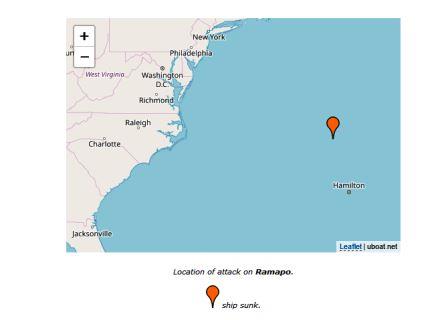
Hughes made two successful runs to England but then on a routing of London-Bermuda-Philadelphia, it was torpedoed by German U-Boat 108, captained by Klaus SCHOLTZ, 180 miles north of Bermuda. While Canadian Merchant Navy records list the event as having occurred on ‘approximately February 12, 1942’, the date it had arrived in Bermuda, German records of ships torpedoed by U-boats record the date as being February 16, 1942.

According to German records, as transcribed into English on https://www.uboat.net/allies/merchants/ship/1338.html, the ship had an international crew complement of 40, none of whom survived. “At 15.56 hours on 16 February 1942 the unescorted Ramapo (Master Johan Magnus Ørn Lorentzen) was hit on port side amidships by one G7e torpedo from U-108, broke in two after a boiler explosion and sank 11 minutes later about 180 miles north of Bermuda. The U-boat surfaced and questioned 34 men in lifeboats, but the survivors were never found. The master, 37 crew members and two gunners were lost.

Screenshot_2020-02-18 Ramapo (Panamanian Steam merchant) - Ships hit by German U-boats during WWII - uboat net

Map showing location of sinking of Ramapo.  (Map courtesy of http://www.uboat.net)

As you can imagine, in that time period, it was a long time before families learned that something had gone wrong.  On March 31, 1942, six weeks after the incident, The Guardian reported that the Hughes family had received a message from the steamship company, advising that it believed the ship had been sunk and all hands lost.

J.E. Hughes Guardian 31 march 1942 page 1

Source: Page 1 article in the March 31, 1942 edition of The Guardian.

Aboard the S.S. Ramapo on February 16, 1942 were the following crew members, per www.uboat.net:

Nationality Name Age Position
Greek Artavanis, Marios, Merchant Marine 29 Oiler
British Bailey, Mills Sandilands, Merchant Marine 44 Third Engineer
British Birch, John, Merchant Marine 50 Trimmer
Canadian Boyd, Fred, Merchant Marine 35 Messman
Canadian Boyer, Clarence, Merchant Marine 41 Fireman/Wiper
Canadian Brackenbury, Walter, Merchant Marine 22 Fireman/Wiper
Canadian Courville, Roland, Merchant Marine 18 Trimmer
Chilean Delano, Miguel, Merchant Marine 31 Second Mate
British Finch, Thomas, Merchant Marine 20 Messman
Dutch Glimmerveen, Albertus, Merchant Marine 38 Chief Cook
Canadian Green, William, Merchant Marine 29 Oiler
Norwegian Gustavsen, Karl Gustav, Merchant Marine 50 Chief Steward
Swedish Haggberg, Eric, Merchant Marine 22 Able Seaman
Norwegian Hansen, Bernhard, Merchant Marine 23 Fireman/Wiper
British Harris, William John, RN 24 Able Seaman (DEMS gunner)
Norwegian Helmers, Thorleif Gärtner, Merchant Marine 43 Chief Mate
British Hendry, Frederick William, Merchant Marine 52 First Engineer
Argentinian Hernandes, P., Merchant Marine 26 Fireman/Wiper
Canadian Hughes, James Emmet, Merchant Marine 31 Trimmer
Norwegian Kjennerud, Jul, Merchant Marine 24 Able Seaman
Canadian Knickle, Fred, Merchant Marine 39 Able Seaman
Norwegian Kristensen, Toralf, Merchant Marine 21 Able Seaman
Canadian Lalonde, Germain, Merchant Marine 20 Able Seaman
French Lawrence, Felix, Merchant Marine 30 Messman
British Leary, Vincent, Merchant Marine 35 Second Engineer
Norwegian Lie, Hans Kristian Jensen, Merchant Marine 20 Able Seamn
Canadian Lord, Ian McLean, Merchant Marine 18 Radio Operator
Norwegian Lorentzen, Johan Magnus Ørn, Merchant Marine 35 Master
Canadian Manoff, Paul, Merchant Marine 23 Ordinary Seaman
American McAdoo, John Cornelius, Merchant Marine 37 Messman
Canadian McDonald, Charlie, Merchant Marine 25 Fireman/Wiper
British Nicholson, William, Merchant Marine 36 Boatswain (Bosun)
Norwegian Olsen, Andreas, Merchant Marine 50 Chief Engineer
Irish Reynolds, William, Merchant Marine 28 Fireman/Wiper
British Sinclair, Leslie, Merchant Marine 20 Ordinary Seaman
Norwegian Vesterhus, Nils Andreas, Merchant Marine 38 Third Mate
American Vitalis, Vasilios, Merchant Marine 29 Cook
Canadian Waddell, Wesley, Merchant Marine 23 Oiler
Canadian Wilson, Edgar John, Merchant Marine 23 Ordinary Seaman
British Winder, Harry, Royal Navy 22 Able Seaman (DEMS gunner)
       

James Emmet Hughes is listed on the Halifax Memorial in Point Pleasant Park in Halifax, Nova Scotia, along with other Canadian mariners whose bodies were never recovered.

Halifax Memorial

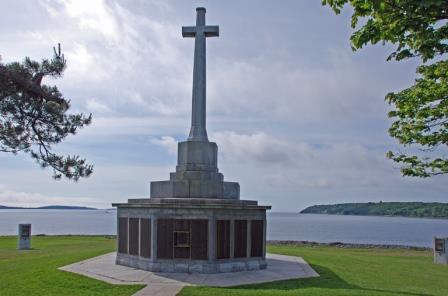
Halifax Memorial in Point Pleasant Park in Halifax, Nova Scotia. (Photo credit: Pieter Valkenburg)

Research continues on this and other stories.  If you have information or photos to share about James Emmet Hughes, the sinking of the Ramapo, or any of the crew members, please contact Pieter at memorialtrail@gmail.com or comment on the blog.

© Daria Valkenburg

….Want to follow our research?….

If you are reading this posting, but aren’t following our research, you are welcome to do so.  Our blog address: https://onthewarmemorialtrail.com/

4 countries, 6 weeks, 7,000 km – an unforgettable war memorial journey in Europe…. Daria’s book ‘No Soldier Buried Overseas Should Ever Be Forgotten‘ is available in print and e-book formats.  Net proceeds of book sales help support research costs and the cost of maintaining this blog. For more information see https://nosoldierforgotten.com/

You are also invited to subscribe to our YouTube Channel: On The War Memorial Trail With Pieter Valkenburg: https://www.youtube.com/channel/UCJ591TyjSheOR-Cb_Gs_5Kw

Never miss a posting!  Subscribe below to have each new story from the war memorial trail delivered to your inbox.
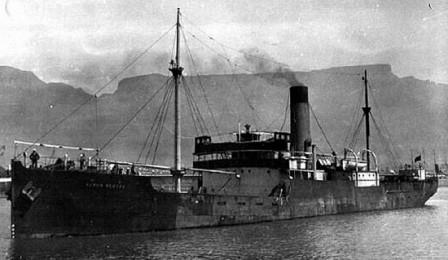
On The War Memorial Trail….The Mariner Whose Ship Was Torpedoed In The English Channel

January 20, 2019….Researching the names on the Cenotaph outside the Borden-Carleton Legion continually brings some surprises as we unlock the stories behind the names.  It’s well documented that there was a merchant navy in WWII, and there are many stories about the infamous U-boats used by the Nazis during WWII.  But, did you know that there was a merchant navy in WWI?……And did you know that there were German U-boats in WWI?…….

In researching what happened to James Graham FARROW (FARRAR), we learned that he was NOT a soldier, but served as Second Mate in WWI’s Merchant Navy aboard the SS Port Dalhousie, ferrying needed supplies from England to allied soldiers in France.

Farrow was born April 4, 1856 in Argyle Shore, the son of Henry Farrow and Mary Jane Gouldrup.  In 1897, he married Mary Jane Howatt and they had 4 children.  Mary Jane also had a son William from her first husband, John Morrell, and was the sister of Harold Keith HOWATT who served in the same regiment as William Galen CAMPBELL. Campbell is also listed on the Cenotaph outside the Borden-Carleton Legion.  (See Christmas At The Front During WW1)

A mariner, Farrow received his Captain’s papers by 1903.  He owned a schooner named ‘Eva May’, but sold it in 1906 and moved to a homestead in Saskatchewan.  However, by 1912 the family was back on Prince Edward Island, where, according to ‘Seafarers of the Atlantic Provinces, 1789-1935’, he was the owner and operator of a schooner registered on PEI, named ‘Howard L’.  (Source: Ancestry.com. Canada, Seafarers of the Atlantic Provinces, 1789-1935)

In a February 19, 1916 letter to his son Welton, who was living in Portland, Maine with his mother and siblings, Farrow explains that that he gave up the schooner and on December 27, 1915 he accepted a position as second mate aboard a steamer, and was currently sailing between France and England.  “I am here in France.  I had charge of a schooner and when I laid her up in Pictou, I got a job in this steamer as second mate. It is a good job with a little more wages than on the schooner.  I got $50 a month on the schooner and $55 a month here.  (Source: www.islandregister.com/letters/james farrow 1916.html)

Farrow explained that the steamer intended to return to Canada in July, but had decided to stay in Europe.  If he wanted to return to Canada, his way would be paid back after 6 months, but as he was paid promptly each month, he thought he would stay with the steamer.

Unfortunately, by the time that Welton Farrow received that letter, his father was dead.  On March 19, 1916, U-Boat 10 torpedoed the steamer Port Dalhousie, the ship he was on, and it sank in the English Channel.

From the New York Times, page 2, column 6:

U-BOAT ATTACKS FISHERMEN”

“Sinks two trawlers off Northeast Coast of England. London July 13 – Following the attack by a German submarine on the British port of Seaham Harbor on Tuesday night, a submarine raid on fishing near the English coast was reported by Lloyd’s today.   A German submarine attacked a British fishing fleet off the northeastern coast and sank the trawlers Florence and Dalhousie and several smaller vessels.” (Source: www.islandregister.com/letters/james farrow 1916.html )

Fake news isn’t a new phenomenon!  The story about Port Dalhousie being a fishing boat, as reported in a New York Times article, was a cover the boat used. When it sank, the cargo manifest said it was transporting steel billets.  Farrow and 18 other crew members perished, their bodies lost to the sea.

Farrow’s wife, Mary Jane, stayed in Maine.  In 1930 she moved to Waterville, where she lived until her death on May 15, 1956, when she was buried in the Tryon Peoples’ Cemetery in Tryon.

Service and duty were legacies of Farrow as his sons Ralph, Harold, and Welton also served in WWI.  Ralph and Harold enlisted in the Canadian Overseas Expeditionary Force in July 1917.  Welton served in the US Army.  Ralph’s son joined the US Air Force and served in WWII, but after the war he met an untimely death when his plane crashed in Florida during an exercise.  He’s buried in Arlington National Cemetery in Virginia.

With no body to bury, James Farrow is remembered on the memorial stone at the Tryon People’s Cemetery in Tryon and on the Halifax Memorial in Point Pleasant Park in Halifax.

memorial stone tpc pieter valkenbrg

Photo: Memorial stone at Tryon Peoples Cemetery in Tryon, PEI. Photo credit: Pieter Valkenburg

Photos: Halifax Memorial at Point Pleasant Park in Halifax. Photo credits: Pieter Valkenburg

Besides Farrow, two additional names from this Cenotaph Research Project are listed on the Halifax Memorial:

Although we know a lot about James Farrow’s life, we do NOT have a photo of him.  If anyone has photos or information to share, please let us know. You can send an email to memorialtrail@gmail.com or comment on this blog.

© Daria Valkenburg

….Want to follow our research?….

If you are reading this posting, but aren’t following our research, you are welcome to do so.  Our blog address: https://onthewarmemorialtrail.com/

4 countries, 6 weeks, 7,000 km – an unforgettable war memorial journey in Europe…. Daria’s book ‘No Soldier Buried Overseas Should Ever Be Forgotten‘ is available in print and e-book formats.  Net proceeds of book sales help support research costs and the cost of maintaining this blog. For more information see https://nosoldierforgotten.com/

You are also invited to subscribe to our YouTube Channel: On The War Memorial Trail With Pieter Valkenburg: https://www.youtube.com/channel/UCJ591TyjSheOR-Cb_Gs_5Kw

Never miss a posting!  Subscribe below to have each new story from the war memorial trail delivered to your inbox.
On the War Memorial Trail …..Desecration of Halifax Memorial

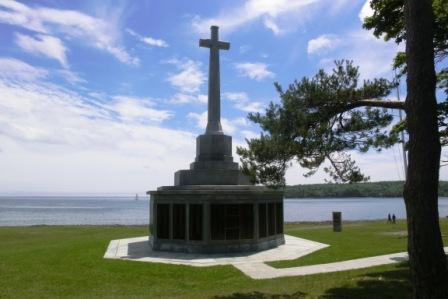
October 10, 2018.  In the quest to honour the names of those listed on the Cenotaph outside the Borden-Carleton Memorial, the memorial trail journey has taken us to Europe and several cemeteries and memorials here in Canada.  One of those journeys was to the Halifax Memorial in Point Pleasant Park in Halifax, which honours those who lost their lives at sea in wartime and have no known grave.

Halifax Memorial in Point Pleasant Park

Halifax Memorial at Point Pleasant Park in Halifax. (Photo credit: Pieter Valkenburg)

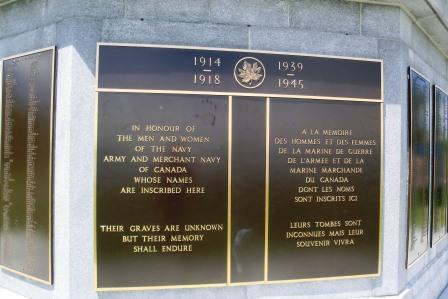
CIMG7670

Inscription on Halifax Memorial in Point Pleasant Park in Halifax. (Photo credit: Pieter Valkenburg)

Three names from the Cenotaph Research Project are listed on this monument:

  • Elmer Allistair MABEY, whose story was told in an earlier posting. (See: https://onthewarmemorialtrail.com/2018/06/27/the-wwii-sailor-who-died-in-an-accidental-explosion-and-fire/)
  • James Graham FARROW, whose ship was torpedoed by a U-boat in the English Channel during WWI.  Farrow was not in the military, but in the merchant ‘navy’, delivering crucial supplies from England to troops in France.
  • James Emmett HUGHES, whose ship was torpedoed in the Caribbean during WWII.  Like Farrow, he was not in the military, but in the merchant ‘navy’.

Three names from one monument from Prince Edward Island….  You can imagine our dismay….and disgust…. to read this morning that the monument was defaced.  (See https://www.cbc.ca/news/canada/nova-scotia/halifax-war-memorial-defaced-1.4854588)

This was a disrespectful act towards those who served their country in time of war, and who do not even have a grave that families can visit.  This memorial is a substitute for their grave, just as is the Vimy Memorial in France and the Menin Gate Memorial in Belgium, among many others.

It is especially sad that this desecration has happened as we near the 100th anniversary of the end of WWI.

UPCOMING PRESENTATION: Pieter will speak about the Cenotaph Research Project at South Shore United Church in Tryon, 7 pm on Friday, November 2, 2018.  This event is co-hosted by South Shore United Church and Tryon & Area Historical Society.  Note: this venue is equipped with a hearing loop for the benefit of those with hearing loss.  You are invited to bring photos and information on the men listed on the Cenotaph, or on any Canadian soldier buried in The Netherlands.  Email memorialtrail@gmail.com for more information.

© Daria Valkenburg

….Want to follow our research?….

If you are reading this posting, but aren’t following our research, you are welcome to do so.  Our blog address: https://onthewarmemorialtrail.com/

Front cover OnTheWarMememorialTrailinEurope4 countries, 6 weeks, 7,000 km – an unforgettable war memorial journey in Europe…. Daria’s book ‘No Soldier Buried Overseas Should Ever Be Forgotten‘ is available in print and e-book formats.  Net proceeds of book sales help support research costs and the cost of maintaining this blog. For more information see https://nosoldierforgotten.com/ 

You are also invited to subscribe to our YouTube Channel: On The War Memorial Trail With Pieter Valkenburg: https://www.youtube.com/channel/UCJ591TyjSheOR-Cb_Gs_5Kw

Never miss a posting!  Subscribe below to have each new story from the war memorial trail delivered to your inbox.

On The War Memorial Trail….The WWII Sailor Who Died In An Accidental Explosion and Fire

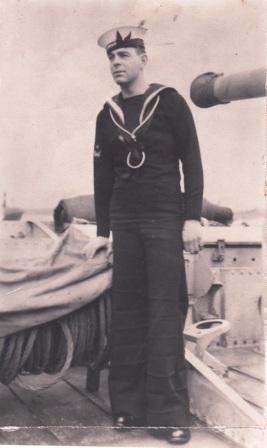
June 27, 2018.  In wartime, losing your life in battle is a terrible, but not unexpected event.  When someone loses their life in an accident, the tragedy is compounded.  The story of WWII sailor Elmer Allister MABEY, born June 2, 1918 in Tryon, son of Albert Mabey and Ellen McNeill, is about a promising young man who was very unfortunate.

Prior to enlistment, he worked with Wood and Company in Crapaud, R.T. Holman’s in Summerside, and lastly at Eastern Hay and Feed in Charlottetown.

Photo Elmer Allister Mabey Jun 2 1918 to Mar 12 1941

Elmer Allister Mabey. (Photo courtesy of Allister Mabey Family Collection.)

In September 1939 Mabey enlisted with the Royal Canadian Navy Volunteer Reserve in Charlottetown and was soon transferred to Halifax to complete a wireless course at the HMCS Stadacona base.  In November 1939 he was assigned to the HMCS Otter.

Formerly a private yacht known as the Conseco, it was renamed the Otter and turned over to the Royal Canadian Navy for war service as a coastal patrol vessel.  A wooden boat, reinforced with a steel hull, it normally spent its days sailing back and forth across Halifax Harbour, watching for floating mines and German U-boats (submarines).

On the morning of March 26, 1941, as the Otter sailed only 24 nautical miles from Halifax, an explosion and a fire ripped through the vessel, in what was later determined to be an accident. In a newspaper account, a crew member on a merchant ship who witnessed the event said that “the Otter sank like a stone, stern first, just after her blazing bow reared high in the air”. Once the captain recognized that the fire was too much, he gave the order to abandon ship.

When the order was given to abandon ship, the Otter’s crew barely fit into the two lifeboats and one inflatable raft. Although a Polish freighter and a Royal Navy submarine were nearby, rescue proved to be very difficult due to heavy seas.

One of the lifeboats was flipped by an unusually large wave when the Polish freighter came alongside. Sailors on the lifeboat were flung into the icy water, with some never seen again. Many of those rescued didn’t survive the trip to Halifax, despite the efforts of the Polish merchantmen who took turns applying artificial respiration and trying to warm the men.

The British Submarine found the inflatable raft.  15 men were on it, but by the time they could be rescued only four were still alive.

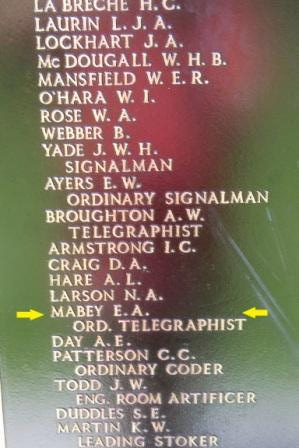
22 men survived, but two officers and 17 enlisted men died, among them Mabey.  To make this tragedy even worse, Mabey’s body was never recovered. The Halifax Memorial in Point Pleasant Park in Halifax, which we visited, honours those who lost their lives at sea in wartime, including those aboard the Otter.

Halifax Memorial in Point Pleasant Park

Halifax Memorial at Point Pleasant Park in Halifax. (Photo credit: Pieter Valkenburg)

cimg7671-jul-9-2017-halifax-memorial-mabey.jpg

Mabey’s name listed on the Halifax Memorial at Point Pleasant Park in Halifax. (Photo credit: Pieter Valkenburg)

A big thank you to Allister Mabey for sharing the photo of Mabey.  If you can add more to Mabey’s story, email us at memorialtrail@gmail.com, comment on the blog, or send a tweet to @researchmemori1. Comments or stories?  You can share them by email or by commenting on this blog.

UPCOMING PRESENTATION: Pieter has been invited to speak about the Cenotaph Research Project at St John The Evangelist Anglican Church in Crapaud at 7 pm on Thursday, July 12, 2018.  Location: 391 Nelson St, Trans Canada Hwy Rte, Crapaud, PE C0A 1J0.  Photos and information about soldiers welcome.

© Daria Valkenburg

…Want to follow our research?….

If you are reading this posting, but aren’t following our research, you are welcome to do so.  Our blog address: https://onthewarmemorialtrail.com/

Front cover OnTheWarMememorialTrailinEurope4 countries, 6 weeks, 7,000 km – an unforgettable war memorial journey in Europe…. Daria’s book ‘No Soldier Buried Overseas Should Ever Be Forgotten‘ is available in print and e-book formats.  Net proceeds of book sales help support research costs and the cost of maintaining this blog. For more information see https://nosoldierforgotten.com/ 

You are also invited to subscribe to our YouTube Channel: On The War Memorial Trail With Pieter Valkenburg: https://www.youtube.com/channel/UCJ591TyjSheOR-Cb_Gs_5Kw

Never miss a posting!  Subscribe below to have each new story from the war memorial trail delivered to your inbox.