September 19, 2023. In November 2021, following a CTV Atlantic interview with Pieter, he received an email from Linda Hood Jobe. “…I read your story with interest. I have a great-uncle who died in the war…” (See Forever grateful: Dutch Canadian tries to put faces to names of soldiers who fell liberating the Netherlands: https://atlantic.ctvnews.ca/forever-grateful-dutch-canadian-tries-to-put-faces-to-names-of-soldiers-who-fell-liberating-the-netherlands-1.5659567)

Linda Hood Jobe on a trip to Isle of Skye (Isle of Raasay) in September 2019. (Photo courtesy of Linda Hood Jobe)
Linda’s great-uncle, William Andrew HOOD, of Little Bras D’or, Cape Breton Island, Nova Scotia, was in the Royal Canadian Air Force (RCAF), and lost his life on June 29, 1943 when the plane he was in was shot down over The Netherlands. He’s buried in Eindhoven General Cemetery, The Netherlands.
“…My father was only a baby when William died, but I know that his death affected my grandfather very much. He was greatly missed by his sisters and brothers…” Linda explained.
Born on May 22, 1921, William was the son of Wilson and Maria (nee Ross) Hood. At the time of his enlistment on July 8, 1941 in Halifax, Nova Scotia, he was working for Lloyd Johnstone, a farmer in Bras d’Or. His application to the RCAF was sent to No. 1 Manning Depot in Toronto, Ontario.
Among the special skills that would be useful to the RCAF, William noted that he could swim and skate. He listed hockey, softball, and bowling as sports he participated in.
…William enlisted in the RCAF with a preference for ground duty….
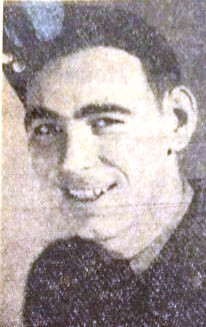
William Andrew Hood. (Photo submitted by Linda Hood Jobe)
When asked for his preference in enlisting, he said it was for ground duty – not flying duty – but that did not happen.
William was transferred to the RCAF’s No. 4 Repair Depot in Dartmouth, Nova Scotia on July 20, 1941. He was assigned to General Duties, which covered anything from guard duty to cleaning latrines.
On October 28, 1941, he was transferred to the No. 4 Repair Depot in Scoudouc, New Brunswick. The Scoudouc airfield was a repair depot used to service aircraft employed on long range anti-submarine patrols, including Liberators or B-24s, American built four engine bombers. It was used for aircraft testing and also served as an auxiliary landing field for #8 Service Flying School at Moncton.
…William trained as an air gunner….
In a June 23, 1942 interview at the No. 15 Recruiting Centre in Moncton, New Brunswick, William was assessed as “…frank and sincere…Good material for air gunner…”
On August 30, 1942 he was sent to the No. 9 Bombing & Gunnery School in Mont Joli, Quebec, located about 322 km (200 miles) east of Quebec City. In the 6 week course, William would have learned about the construction and fusing of bombs and the factors affecting bomb trajectories, how to take a gun apart and put it back together again, and participated in practice bombing exercises.
On December 19, 1942, William was awarded his Air Gunners Badge, and given 14 days embarkation leave.
…William left Canada for overseas service….
William left Canada on January 25, 1943, arriving in the United Kingdom on February 4, 1943, where he was assigned to No. 3 Personnel Reception Centre (PRC) in Bournemouth, England. This was the arrival point for thousands of aircrew after training in Canada.
On March 3, 1943, William was sent for further training at the No. 7 Air Gunnery School (AGS) at Stormy Down, a Royal Air Force station near Pyle, Brigend in Wales.
On March 23, 1943, he was sent to No. 22 Operational Training Unit (OTU) at Wellesbourne for 10 weeks of further training as a member of a bomber crew.
On May 18, 1943 William was briefly sent to No. 1659 Heavy Conversion Unit at Topcliffe in Yorkshire. This was a 5 week course to familiarize crews with the four-engined Halifaxes or Lancasters on which they would be flying on operations when they were posted to a squadron. The May 18, 1943 war diary noted that “…ten crews from 427 Squadron and four from 22 OTU reported in for Conversion Training…”
On June 10, 1943, having completed his training, William was posted to 419 Squadron, part of the No. 6 RCAF Group. He would not have participated in many operations as part of the Squadron before what would be his last flight – Halifax JD215.
…William was aboard the last flight of Halifax JD215….
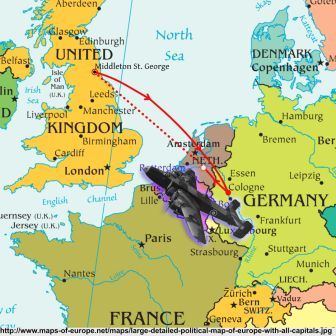
Map shows the plane’s path from England towards Cologne. It was shot down over The Netherlands on its return to England. (Map prepared by Wendy Nattress)
Just after 11:04 pm, on the evening of June 28, 1943, the crew of Halifax JD215 left Middleton St. George in England for a bombing raid over Cologne, Germany.

A Halifax Mark II bomber, similar to the one flown by Halifax JD215. (Photo credit: George Woodbine, Public domain, via Wikimedia Commons)
Halifax JD215 was among 608 Allied aircraft that participated in the raid over Cologne – 267 Lancasters, 169 Halifaxes, 85 Wellingtons, 75 Stirlings, and 12 Mosquitos. Unfortunately, 25 planes never made it back to England. According to a report on Canadian airmen lost in WWII in 1943, an “… intense Aurora Borealis display over the cloud base…” may have “…illuminated the bombers…” thereby contributing to the loss of aircraft by making them easier to spot.
Halifax JD215 successfully reached Cologne, but on its return to England, the plane was shot down over The Netherlands by Luftwaffe Major Günther Radusch in his German nightfighter. It was just after 2:13 am. Radusch claimed to have shot down 3 other Halifaxes that night.
… Halifax JD215 came down in a farmer’s field near Loon….

The plane came down over Waalre, located 5 km from Eindhoven. (Photo credit: Robert van der Ende)
The plane crashed near Loon in the municipality of Waalre, in a farmer’s field close to where a watermill, the Loondermolen, on the Dommel River, once stood. Waalre is just 5 km from Eindhoven. The mill was destroyed in 1940. (You can see a photo of the mill at https://www.molendatabase.org/molendb.php?step=details&nummer=5094)

The plane came down in a farmer’s field near Loon, near where a watermill, the Loondermolen, on the Dommel River, once stood. (Photo credit: Robert van der Ende)
A. Hendrikx, the mother of a friend of Robert van der Ende, remembers the crash. Born in December 1933, she lived in Waalre at the time, and told Robert that “… everybody had to take cover in shelters….”
Robert explained that “…during the war there were of course much fewer buildings and since the plane was shot down at night, it must have given a frightening sound. Incidentally, another plane was shot down not much later. That plane ended up in Aalst (nowadays also the municipality of Waalre)….” This was Lancaster ED979 of 619 Squadron, with a crew of 6 British and 1 Canadian. The Canadian was one of the two Air Gunners, Flight Sgt John Harvey William WALKER of Sunny Brae, New Brunswick. All were killed. This plane was also shot down by Major Radusch.
There were no survivors from Halifax JD215. All 7 crew members are buried in The Netherlands, but in 3 different cemeteries.
…The crew of Halifax JD215….
- Pilot – Flight Officer Harry Wilfred FOWLER of the RCAF – buried Mierlo War Cemetery. From St. Thomas, Ontario.
- Flight Engineer – Sgt John Edwin DICKSON of the RAF – buried Eindhoven General Cemetery.
- Navigator – Pilot Officer Warren Bretall MAYES of the RCAF – buried Canadian War Cemetery in Groesbeek. From Bellwood, Illinois, USA.
- Bomb Aimer – Pilot Officer David Renwick AGNEW of the RCAF – buried Canadian War Cemetery in Groesbeek. From Weyburn, Saskatchewan.
- Wireless Operator/Air Gunner – Flight Lt Almer Clement RAINE of the RCAF – buried Eindhoven General Cemetery. From Brampton, Ontario.
- Mid Upper Gunner – Sgt William Andrew HOOD of the RCAF – buried Eindhoven General Cemetery. From Little Bras D’or, Nova Scotia.
- Rear Gunner – Sgt William George OTTERHOLM of the RCAF – buried Canadian War Cemetery in Groesbeek. From Dixonville, Alberta.
…William is buried in Eindhoven General Cemetery….
After Linda, Sgt Hood’s great-niece, contacted us, Robert van der Ende visited his grave at Eindhoven General Cemetery.
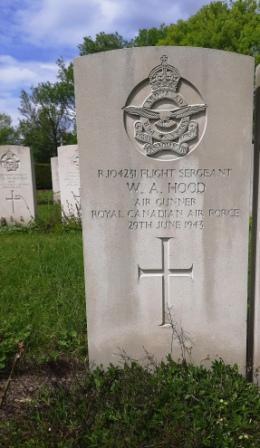
Grave of William Andrew Hood at Eindhoven General Cemetery. (Photo credit: Robert van der Ende)
John Edwin DICKSON and Almer Clement RAINE were originally buried in Woensel Cemetery as unidentified airmen. After their remains were identified, they were reburied in Eindhoven General Cemetery, but not beside William Andrew HOOD.
Harry Wilfred FOWLER’s body was not found until 1949, during the excavation of the aircraft wreckage. He is buried in Mierlo War Cemetery.
Warren Bretall MAYES, David Renwick AGNEW, and William George OTTERHOLM are buried in the Canadian War Cemetery in Groesbeek.
…A short video on The Last Flight Of Halifax JD215….
You can watch a short video summarizing the last flight of Halifax JD215:
Thank you to Linda Hood Jobe for telling us about her great-uncle. Thank you to Robert van der Ende for visiting the crash site and Eindhoven General Cemetery on our behalf. Thank you to post-production editor Wendy Nattress, who made the The Last Flight Of Halifax JD215 (S4E2) YouTube video a reality, and for preparing the map showing the flight path for Halifax JD215.
If you have a story to tell, please let Pieter know. You can email him at memorialtrail@gmail.com, or comment on the blog.
© Daria Valkenburg
…Want to follow our research?….
If you are reading this posting, but aren’t following the blog, you are welcome to do so. Our blog address: https://onthewarmemorialtrail.com/
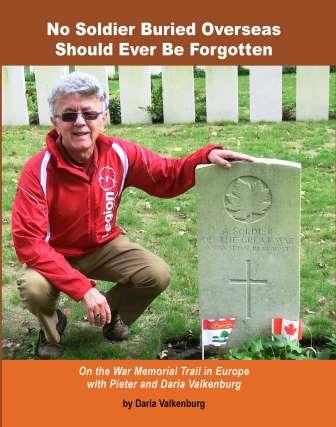 4 countries, 6 weeks, 7,000 km – an unforgettable war memorial journey in Europe…. Daria’s book ‘No Soldier Buried Overseas Should Ever Be Forgotten‘ is available in print and e-book formats. Net proceeds of book sales help support research costs and the cost of maintaining this blog. For more information see https://nosoldierforgotten.com/
Subscribe to our YouTube Channel: On The War Memorial Trail With Pieter Valkenburg: https://www.youtube.com/channel/UCJ591TyjSheOR-Cb_Gs_5Kw.
Never miss a posting! Subscribe below to have each new story from the war memorial trail delivered to your inbox.
 On The War Memorial Trail Research Project........ with Pieter and Daria Valkenburg