On The War Memorial Trail….. A Visit To Rhenen General Cemetery

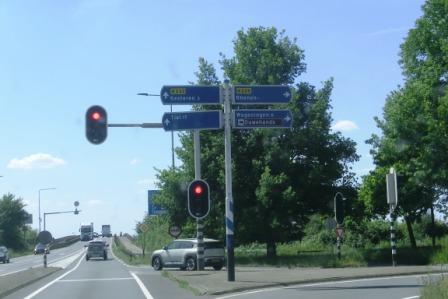
Sign directing us to Rhenen, The Netherlands.  (Photo credit: Daria Valkenburg)

November 3, 2025. While in Europe this spring for the 80th Anniversary of Liberation Commemoration events, we visited 14 cemeteries to place flags at the graves of 383 soldiers that Pieter has researched since 2014, with the stories of many of these soldiers previously told on this blog. 

On our way towards Zaltbommel for a family visit before going on to Belgium, we visited two cemeteries. The previous posting featured our visit to Uden War Cemetery, where George Glenn ‘Dusty’ MILLAR, of Winnipeg, Manitoba, is buried. (See https://onthewarmemorialtrail.com/2025/10/29/on-the-war-memorial-trail-paying-our-respects-to-spitfire-pilot-dusty-millar-at-uden-war-cemetery/)

This posting features our visit to Rhenen General Cemetery, where David ‘Lloyd’ George HOPE, of Moncton, New Brunswick, is buried.  The village of Rhenen is in the province of Utrecht, 26 kms (16 miles) from Arnhem and 47 kms (29 miles) from Utrecht.

….The Commonwealth War Graves were tucked away in a small section of the cemetery….

Pieter at the entrance to Rhenen General Cemetery.  (Photo credit: Daria Valkenburg)

This is a beautiful cemetery, with the Commonwealth War Graves in its own hedged section.  There are 23 WWII Commonwealth burials here, 3 of which are unidentified. In addition, there is 1 unidentified Polish soldier buried here.

The hedged area of Rhenen General Cemetery with the Commonwealth War Graves are located.  (Photo credit: Daria Valkenburg)

The war graves are located in a hedged part of Rhenen General Cemetery.  (Photo credit: Daria Valkenburg)

….Hope was one of 7 Royal Canadian Engineers from the 23rd Field Company killed during Operation Berlin….

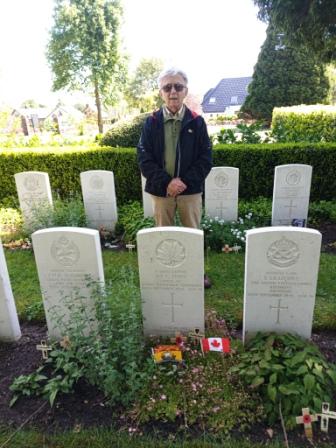
Pieter by the grave of David ‘Lloyd’ George Hope. (Photo credit: Daria Valkenburg)

David ‘Lloyd’ George Hope was serving with the Royal Canadian Engineers, 23rd Field Company, when he lost his life on September 26, 1944, aged 25.  He had drowned while trying to save glider pilots during the disastrous Operation Market Garden, one of 7 men from the 23rd Field Company who lost their lives in Operation Berlin – the evacuation of survivors of the British 1st Airborne at the end of the Battle of Arnhem/Oosterbeek.  

Pieter placed a Canadian and New Brunswick flag at Lloyd’s grave, and reminded me that his story had to be told in an upcoming posting.

….Ryan was another Royal Canadian Engineer from the 23rd Field Company killed during Operation Berlin….

Grave of Daniel William Ryan.  Behind his grave you can see the Polish flag at the grave of the unknown Polish soldier. (Photo credit: Pieter Valkenburg)

While looking at the graves, most of them of airmen, we noticed another Canadian grave!  Daniel William RYAN was also from the Royal Canadian Engineers.  Of course we placed a Canadian flag at his grave, but it wasn’t until later that evening that we learned he was from Sydney Mines, Nova Scotia, and had also been in the 23rd Field Company. 

We wondered if he’d been in the same boat as Lloyd Hope, but he was in a different boat, and had died when the boat he was in was hit by mortar fire.

….Royal Canadian Engineers from 23rd Field Company who were killed during Operation Berlin….

The Royal Canadian Engineers rescued most of the 2,400 evacuees in one night, using storm boats propelled by 50 horse power outboard motors! Unfortunately, 7 men from the 23rd Field Company lost their lives during Operation Berlin. (See https://www.strijdbewijs.nl/donald/operation.htm)

Killed in Boat I:

  • James Russell MARTIN, of Kingston, Ontario, aged 26, buried in the Canadian War Cemetery in Holten  
  • Sapper Harold Cecil MAGNUSSON, of St. John, New Brunswick, aged 22, buried in Gorinchem General Cemetery  
  • L/ Sapper Leslie Joseph ROHERTY, of Belledune River, New Brunswick, aged 22, listed on the Missing Memorial at the Canadian War Cemetery in Groesbeek
  • Daniel William RYAN, of Sydney Mines, Nova Scotia, aged 27, buried in Rhenen General Cemetery

Killed in Boat III:

  • Sapper David ‘Lloyd’ George HOPE, of Moncton, New Brunswick, aged 25, buried in Rhenen General Cemetery
  • Sapper Neil Arthur THOMPSON, born in Halifax, Nova Scotia, aged 23, buried in the Canadian War Cemetery in Groesbeek                       

Killed In An Orchard:

  • Sapper Ronald Tracy ‘Buck’ MCKEE, of St. Martin’s, New Brunswick, aged 36, buried in Arnhem Oosterbeek War Cemetery

The flags placed at the graves for David ‘Lloyd’ George Hope and Daniel William Ryan were donated.  Our thanks go to: 

  • Alan Waddell, Constituent Assistant, on behalf of Heath MacDonald, MP for Malpeque, for the Canadian flags.
  • Jean-Claude D’Amours, MLA for Edmundston-Madawaska Centre, Minister responsible for Military Affairs, with the help of Cécile LePage, Province of New Brunswick, for the New Brunswick flag. 

Our adventures continue as we share the highlights of our adventures on the 2025 European War Memorial Tour.

If you have a story or photo to share, please contact Pieter at memorialtrail@gmail.com or comment on the blog. 

© Daria Valkenburg

….Want to follow our research?…

If you are reading this posting, but aren’t following our research, you are welcome to do so.  Our blog address: https://onthewarmemorialtrail.com/

4 countries, 6 weeks, 7,000 km – an unforgettable war memorial journey in Europe…. Daria’s book ‘No Soldier Buried Overseas Should Ever Be Forgotten‘ is available in print and e-book formats.  Net proceeds of book sales help support research costs and the cost of maintaining this blog. For more information see https://nosoldierforgotten.com/

Subscribe to our YouTube Channel: On The War Memorial Trail With Pieter Valkenburg: https://www.youtube.com/channel/UCJ591TyjSheOR-Cb_Gs_5Kw

Never miss a posting!  Subscribe below to have each new story from the war memorial trail delivered to your inbox.

On The War Memorial Trail….. Paying Our Respects To Spitfire Pilot Dusty Millar At Uden War Cemetery

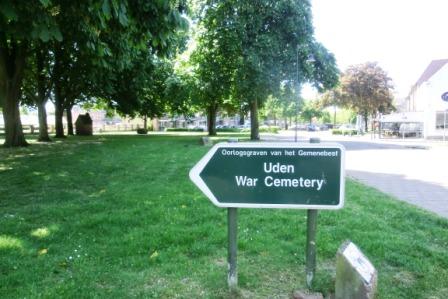
Sign directing us to Uden War Cemetery. (Photo credit: Daria Valkenburg)

October 29, 2025. While in Europe this spring for the 80th Anniversary of Liberation Commemoration events, we visited 14 cemeteries to place flags at the graves of 383 soldiers that Pieter has researched since 2014, with the stories of many of these soldiers previously told on this blog. 

For the first part of our trip, we were based in Holten. All too soon, it was time to slowly make our way towards Zaltbommel for a short stay there to visit family before going on to Belgium.  On the way to Zaltbommel, we visited Uden War Cemetery, where George Glenn ‘Dusty’ MILLAR, of Winnipeg, Manitoba, is buried.

Map showing location of Uden, The Netherlands. (Map source: http://www.gosur.com)

… Pilot Dusty Millar’s spitfire ran out of fuel and crashed…

‘Dusty’ was killed on September 28, 1944 while flying a Spitfire Mark IX on patrol with his squadron over Nijmegen, The Netherlands. After he reported on his radio that the plane was low in fuel, it crashed southeast of Weibosch near Schijndel, in the Dutch province of Noord-BrabantYou can read his story at https://onthewarmemorialtrail.com/2023/01/25/on-the-war-memorial-trail-the-wwii-pilot-whose-spitfire-ran-out-of-fuel/

… Uden War Cemetery was behind a church and in a residential area…

Pieter at the entrance to Uden War Cemetery. (Photo credit: Daria Valkenburg)

We initially had difficulty finding the cemetery once we arrived in Uden, as the car’s GPS led us on a merry dance and we were both frustrated by the time we finally found it.  We later learned that there was a direct route from the highway, with signs indicating where the cemetery was located, but somehow that option never registered with whoever designed the GPS maps!

The cemetery itself was located behind a church and in a residential area.  We expected it to be a small cemetery, and so were surprised to find that there are 437 soldiers and 259 airmen buried here.  According to the cemetery information, the airmen “….lost their lives in strategic bombing operations or in support of land forces…

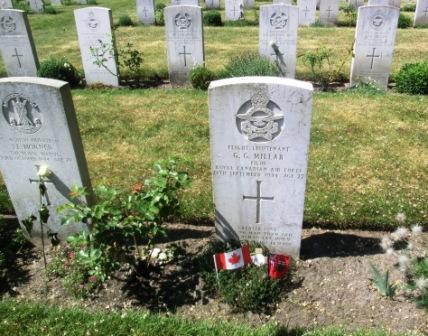
Pieter placed flags of Canada and Manitoba at Dusty Millar’s grave in Uden War Cemetery.  (Photo credit: Daria Valkenburg)

….53 Canadians are buried in Uden…

The cemetery register at Uden War Cemetery. (Photo credit: Daria Valkenburg)

Since this was a war cemetery, there was a visitors’ book located in the cemetery register box, in which I wrote that we paid our respects at Dusty’s grave and that he was a spitfire pilot from Manitoba.

We wrote that we visited Dusty Millar’s grave in the visitors’ book.  (Photo credit: Daria Valkenburg)

We thought that there would be more Canadians than Dusty buried here, so Pieter brought a few extra Canadian flags, but it turned out that there are 53 Canadians buried in Uden…. and we didn’t have enough flags. 

….A cafe was within walking distance of the cemetery…

I’m never without a camera!  (Photo credit: Pieter Valkenburg)

One of the advantages of visiting a war cemetery in a residential area is that there is more than a cemetery!  As we walked from the cemetery back towards the car, Pieter noticed a cafe within walking distance, so we went there, thinking to have something to drink and a much needed rest.  It was a Turkish bakery and cafe called Nfes.  We happily sat down and ordered red lentil soup (linzensoep) for lunch. The soup was delicious, the cafe an oasis of relaxation, and the service was very friendly…..just the break we needed before going on to Zaltbommel.

The flags placed at Dusty Millar’s grave were donated.  Our thanks go to: 

  • Alan Waddell, Constituent Assistant, on behalf of Heath MacDonald, MP for Malpeque, for the Canadian flag.
  • Brad Robertson, Chief of Protocol, Government of Manitoba, on behalf of Wab Kinew, Premier of Manitoba, for the Manitoba flag. 

Our adventures continue as we share the highlights of our adventures on the 2025 European War Memorial Tour. Coming up on our journey of remembrance is a visit to Rhenen General Cemetery.

If you have a story or photo to share, please contact Pieter at memorialtrail@gmail.com or comment on the blog. 

© Daria Valkenburg

….Want to follow our research?…

If you are reading this posting, but aren’t following our research, you are welcome to do so.  Our blog address: https://onthewarmemorialtrail.com/

4 countries, 6 weeks, 7,000 km – an unforgettable war memorial journey in Europe…. Daria’s book ‘No Soldier Buried Overseas Should Ever Be Forgotten‘ is available in print and e-book formats.  Net proceeds of book sales help support research costs and the cost of maintaining this blog. For more information see https://nosoldierforgotten.com/

Subscribe to our YouTube Channel: On The War Memorial Trail With Pieter Valkenburg: https://www.youtube.com/channel/UCJ591TyjSheOR-Cb_Gs_5Kw

Never miss a posting!  Subscribe below to have each new story from the war memorial trail delivered to your inbox.


On The War Memorial Trail…. Remembrance Week 2024 –Remembering Those Who Served In The RCAF During WWII

Remembrance_Day_2024_3840x2160

November 7, 2024.  As we reflect on the service and sacrifices made by so many who have served, both during conflicts and in peacetime, I took a look back at previous stories told over the years.  2024 commemorates 100 years of service for the Royal Canadian Air Force (RCAF) as a distinct military element, and so it seemed appropriate to dedicate this posting to stories previously told of those who served in the RCAF during WWII. 

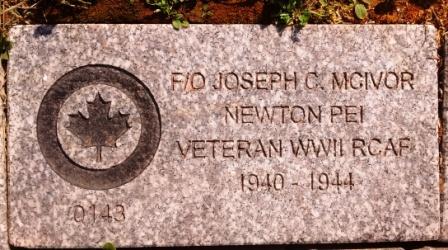
…The Air Force Heritage Park in Summerside has a commemorative stone honouring Flight Officer Joe McIver….

IMG_20190807_101837076 Entrance to Air Force Heritage Park Summerside

Entrance to Air Force Heritage Park in Summerside. (Photo credit: Daria Valkenburg)

Several years ago we visited the Air Force Heritage Park in Summerside to look at the commemorative stone honouring Flight Officer Joseph ‘Joe’ Charles MCIVER of Kinkora, Prince Edward Island.  Joe was the navigator aboard B24 Liberator MkVIII EV895 on November 18, 1944, when it went down near the Arctic Circle while on anti-submarine patrol looking for a suspected U-boat off Gardskagi, Iceland.  There were no survivors.

You can read his story at:

IMG_20190807_101038750 McIver Commemorative Stone Summerside

Commemorative Stone at Air Force Heritage Park, Summerside, Prince Edward Island. (Photo credit: Pieter Valkenburg)

 … Pilot Elmer Muttart saved his crew and the Dutch village of Wons but sacrificed his own life to do so ….

The very first airman whose story was researched by Pieter was that of Elmer Bagnall MUTTART of Cape Traverse, Prince Edward Island, whose name is listed on the Cenotaph outside the Borden-Carleton Legion.  Elmer was the pilot aboard Halifax L9561 when it was shot twice by German night fighters on October 12, 1941, while the plane was on its way to a bombing raid on Bremen, Germany. 

After ordering the crew to bail out, Elmer managed to steer the burning plane away from the Dutch village of Wons, in the province of Friesland, before it crashed in a farmer’s field, just outside the village. He was the only casualty and is buried in Harlingen General Cemetery in The Netherlands.  The rest of the crew spent the war years in prisoner of war camps before being liberated. On October 12, 2019, a memorial panel was placed near the crash site in Wons to honour Elmer and his crew, an emotional journey for all of us who attended.

You can read his story here:

 … Pilot Hubert Hall was a prisoner of war after his plane was shot down in 1942 ….

John ‘Hubert’ HALL of Summerside, Prince Edward Island, was the pilot aboard Wellington Z1203, which crashed in The Netherlands near Mijdrecht on the night of March 28/29, 1942.  Hubert spent the remainder of the war years as a prisoner of war in POW camp Stalag Luft III, located in present-day Żagań, Poland, before returning home to Canada.

You can read his story at:

… Navigator Bunky FitzGerald is in an unmarked grave after Halifax W1175 crashed off the Dutch coast….

Rowan Charles ‘Bunky’ FITZGERALD, of Charlottetown, Prince Edward Island, was the navigator aboard Halifax W1175 of the 405th Vancouver Squadron RCAF when it was hit by shellfire (flak) as the plane was returning from Bremen, Germany on the morning of June 28, 1942. 

The plane crashed into a sandbank in the Wadden Sea, off the Dutch coast between the Island of Texel and the mainland, 15.5 km from Harlingen, in the province of Friesland.  There were no survivors. Only one crew member’s body was identified, and was buried in Harlingen General Cemetery in The Netherlands. His grave is between 3 unknown graves, one of which may just contain the remains of Bunky FitzGerald. 

You can read his story at:

… Pilot Lorne MacFarlane survived all his flights and returned home…

Pilot Lorne MACFARLANE, of Fernwood, Prince Edward Island, successfully flew 40 missions overseas and was then assigned to fly dignitaries, mail, and personnel between England and the front lines until the war ended.  After returning safely back to Canada, he was the Officer In Charge at RCAF No 1 Radio and Navigation School in Summerside, Prince Edward Island.

You can read his story at:

… Wireless operator Bob Dickie almost made it safely back to England…

Robert ‘Bob’ James DICKIE, of Carlton (now Borden-Carleton), Prince Edward Island, was the wireless operator aboard Lancaster JB312 on February 21, 1944 when it collided with another plane during a bombing sortie in Stuttgart, Germany.  Although badly damaged, the plane was able make it back to England, but then crashed as it approached the runway. There were no survivors. Bob is buried at Cambridge City Cemetery in England.

You can read his story at:

… Pilot Leonard Unwin’s plane crashed on Christmas Eve…

Pilot Leonard Arthur UNWIN, of Windsor, Ontario, was a flying instructor in Summerside, Prince Edward Island and Moncton, New Brunswick, before going overseas in May 1943.  On December 24, 1944, he left from his base in Belgium, one of the pilots in a section of 4 Typhoon planes on an armed reconnaissance in the Utrecht area in The Netherlands. While attacking a convoy of three German trucks in Woudenberg, the plane’s tailpiece broke off, the plane destabilized, and crashed. He’s buried in Woudenberg Municipal Cemetery in The Netherlands.

You can read his story at:

… Flight student Ralph McCutcheon lost his life in a training accident…

Flight student Ralph Gordon MCCUTCHEON, of Toronto, Ontario, but who was born in Buffalo, New York, USA, lost his life in a tragic accident that happened during his training at the No. 9 Service Flying Training School RCAF in Summerside, Prince Edward Island on the morning of June 11, 1942.  While training in a Harvard MK2 plane, it crashed in a farm field in North Tryon, Prince Edward Island.

You can read his story at:

… Gunner William Andrew Hood was aboard the last flight of Halifax JD215…

William Andrew HOOD, of Little Bras D’or, Cape Breton Island, Nova Scotia, was the mid-upper gunner aboard Halifax JD215 when it was shot down over The Netherlands on June 29, 1943.  None of the crew survived. He’s buried in Eindhoven General Cemetery in Eindhoven, The Netherlands.

You can read his story at:

… Navigator Arnold Hupman was aboard Lancaster X KB728 VR-V when it exploded over Arnhem, The Netherlands…

Navigator Arnold Freeman HUPMAN, of East Side of Ragged Island, Shelburne County, Nova Scotia, lost his life when the Lancaster bomber he was in, Lancaster X KB728 VR-V, was attacked by a German night fighter and exploded on the outskirts of Arnhem, The Netherlands as it was returning from a bombing operation against the synthetic oil plant at Sterkrade in Germany on the night of June 16 to 17, 1944. There were no survivors, and all 7 crew members are now buried in the Canadian War Cemetery in Groesbeek, The Netherlands.

You can read his story at:

… Pilot Douglas MacKenzie did not survive the last flight of Halifax DT630…

Jack ‘Douglas’ MACKENZIE,  of Winnipeg, Manitoba, was the pilot of Halifax DT630 (call sign VR-T), one of 8 heavy Halifax bombers sent on a night raid to Hamburg, Germany on February 3, 1943.  It was shot down by a night fighter over the province of Drenthe in The Netherlands. 4 men died, including Douglas, while 3 survived and spent the remainder of the war in prisoner of war camps.  He’s buried in Sleen General Cemetery in The Netherlands, along with the other 3 casualties of that flight.

You can read his story at:

… Pilot Dusty Millar’s spitfire ran out of fuel and crashed…

George Glenn ‘Dusty’ MILLAR, of Winnipeg, Manitoba, was killed on September 28, 1944 while flying a Spitfire Mark IX on patrol with his squadron over Nijmegen, The Netherlands. After Dusty reported on his radio that the plane was low in fuel, it crashed southeast of Weibosch near Schijndel, in the Dutch province of Noord-BrabantHe is buried in Uden War Cemetery in The Netherlands.

You can read his story at:

May we never forget the sacrifices made by these airmen, and their families, during WWII.  Unfortunately, while we live free in Canada, so many people today live in a war zone and are experiencing death, uncertainty, and insecurity in not knowing what will happen next.  Lest we forget is never more appropriate.

If you have a story to tell, please let Pieter know. You can email him at memorialtrail@gmail.com, comment on the blog, or send a tweet to @researchmemori1.  

© Daria Valkenburg

….Want to follow our research?….

If you are reading this posting, but aren’t following our research, you are welcome to do so.  Our blog address: https://onthewarmemorialtrail.com/

Front cover OnTheWarMememorialTrailinEurope4 countries, 6 weeks, 7,000 km – an unforgettable war memorial journey in Europe…. Daria’s book ‘No Soldier Buried Overseas Should Ever Be Forgotten‘ is available in print and e-book formats.  Net proceeds of book sales help support research costs and the cost of maintaining this blog. For more information see https://nosoldierforgotten.com/ 

You are also invited to subscribe to our YouTube Channel: On The War Memorial Trail With Pieter Valkenburg: https://www.youtube.com/channel/UCJ591TyjSheOR-Cb_Gs_5Kw

Never miss a posting!  Subscribe below to have each new story from the war memorial trail delivered to your inbox.

On The War Memorial Trail…..The WWII Pilot Whose Spitfire Ran Out Of Fuel

January 25, 2023.  After seeing an interview on CTV National News about Pieter’s research into WWII soldiers and airmen buried in The Netherlands, Pieter received an email from Dave Montgomery.  

Dave Montgomery 1

Dave Montgomery, whose father’s best friend was RCAF Pilot George Glenn Millar. (Photo courtesy of Dave Montgomery)

Dave wrote that “…I became aware of your project of identifying Canadians killed in WW2 to liberate Holland when I saw your interview with CTV News recently.  

My father’s best friend, George Glenn Millar, nicknamed ‘Dusty’, was killed on September 28, 1944 in combat while flying a Spitfire Mark IX over Nijmegen, Holland.  He is buried at the Uden War Cemetery in North Brabant, Holland. He was from Winnipeg, Manitoba and was serving with 442 Squadron of the RCAF when killed. …  My father survived the war and lived a full life back in Canada and passed away in January 2013.  He never forgot his friend…

20220911_161454 Miller and Montgomery

George Glenn ‘Dusty’ Millar, left, with Thomas Richard Montgomery. (Photo courtesy of Dave Montgomery)

Dave included a photo, explaining that “… G. G. Millar is on the left.  My father, Thomas Richard Montgomery, is on the right….

….George Glenn attended university for one year before enlistment….
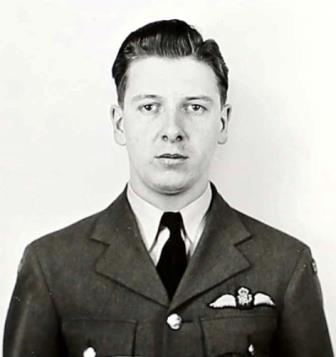
Millar G.G. foto 2

George Glenn ‘Dusty’ Millar.  (Photo courtesy of the Information Centre, Holten)

Born November 21, 1921 in Winnipeg, Manitoba, George Glenn MILLAR was the son of George Sawers and Janet Smith (nee Wilson) Millar. While a first-year student at the University of Manitoba, George joined the University’s Canadian Officers’ Training Corps (COTC) on April 7, 1941, part of the Non-Permanent Active Militia. In his attestation form, he stated that he had served 110 hours in the University of Manitoba Training Unit (UMTU). (See https://en.wikipedia.org/wiki/Canadian_Officers%27_Training_Corps)

In July 1941, he enlisted in the Royal Canadian Air Force (RCAF) in Winnipeg.  Asked about hobbies and sports, he wrote that he played golf extensively, occasionally played hockey, rugby, and baseball.  He was very clear in his goal – he wanted to enlist for flying duties and to be a pilot.

….George Glenn realized his goal of becoming a pilot….

In October 1941 he was sent to Edmonton, Alberta and then a few weeks later to Calgary, Alberta to #3 Service Flying Training School for flight training.  On December 12, 1941 he was sent back to Edmonton, to #16 Flight Training School, where he remained until April 25, 1942.  By the time he left he had put in 73 hours and 35 minutes into flying a Tiger Moth.

He was next posted to #1 Service Flying Training School in Camp Borden, Ontario on April 26, 1942, receiving his Pilot Flying Badge on August 14, 1942.   He had also learned to fly a Yale and a Harvard MK II.

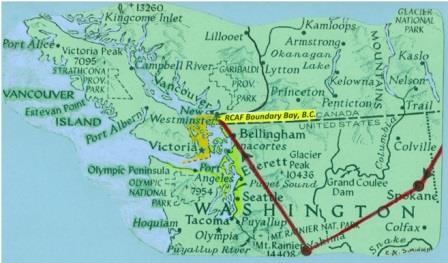
In August 1942 he was posted to No. 133 (F) Squadron in Lethbridge, Alberta, where he gained more experience in flying a Harvard MK II and learned to fly a Hurricane II B.  The Squadron moved to Boundary Bay, British Columbia at the beginning of October 1942.  (Note: the ‘F’ stood for ‘Fighter’)

Map RCAF Boundary Bay

Patrol path of No. 133 (F) Squadron included the Canadian section [orange] and the area in the United States from Bellingham to Tacoma, Washington, [yellow]. (Map source: https://clarencesimonsen.wordpress.com/category/rcaf-133-squadron/)

On October 5, 1942, George Glenn received a promotion to Pilot Officer, and then another promotion, to Flight Officer, on February 13, 1943. He remained with No. 133 (F) Squadron until May 15, 1943, when he was sent to No. 111 Squadron in Anchorage, Alaska.

Don Smith, an Associate Historian with the RCAF, explained that George Glenn “….arrived at No. 111 Squadron as a replacement pilot.  Millar was at No. 111 Squadron to get checked out in a new (for him) fighter type, the Curtis P-40K Kittyhawk.  He had been flying the Hawker Hurricane with No. 133 Squadron….

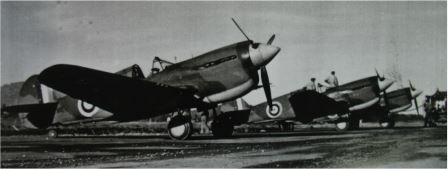
P-40 Kittyhawk Aircraft

P-40 Kittyhawk. (Photo credit: Department of National Defence (DND) PGB-1436)

….George Glenn’s Squadron participates in the Aleutian Islands Campaign in 1943 ….

Don went on to explain that “Millar did not remain long with No. 111 Squadron after he soloed in the Kittyhawk in late May 1943. By the end of August he was flying with No. 14 Squadron at Umnak Island, in the Aleutians, where he spent a one-week rotation at the forward assembly airfield on Amchitka Island the same month…

Dave Montgomery had done some research on George’s time in Alaska, and explained that “…. No. 14 Squadron and No. 111 Squadron were ordered to Alaska in 1943 to fight alongside the Americans fighting the Japanese who had landed at Kiska and Attu Islands in the Aleutian Islands of Alaska in June of 1942.   

These RCAF squadrons served at Anchorage, Kodiak Island, and Umnak Island bases with short postings to Adak Island and Amchitka Island when flying missions against the Japanese, who were dug in on Kiska Island. 

Several were killed there as the weather was atrocious, especially in the Aleutians.  Weather was the biggest killer of pilots in Alaska, not enemy guns.   

G.G. Millar flew with both 111 Squadron (briefly) and then 14 Squadron and flew missions with the US fliers to Kiska Island bombing and strafing the Japanese there  under overall command of Jack Chennault, the son of Claire Chennault who was the US Colonel (later General) who commanded the famous Flying Tigers in China!

No. 14 and 111 Squadrons returned to Patricia Bay in September of 1943 after the 5,000 Japanese on Kiska Island managed to escape under cover of fog and darkness in late July 1943 on Japanese naval destroyers sent there to evacuate them after the defeat of the Japanese forces on Attu Island by the US…..”   RCAF Patricia Bay was in Victoria, British Columbia.  (For more information on the Aleutian Islands Campaign, see https://en.wikipedia.org/wiki/Aleutian_Islands_campaign)

Don Smith explained that “Millar remained with No. 14 Squadron, going overseas with them, where the Squadron was renumbered from No. 14 Squadron to No. 442 (F) Squadron…

Dave Montgomery noted that “….No. 14 and 111 Squadrons sailed to England between January 20 to 27, 1944 on the SS Pasteur (a French passenger liner completed in 1939 and converted to a fast troop ship).  The Pasteur made the crossing alone rather than in a convoy since she could sail at up to 26 Knots.

On February 8, 1944, No. 14 Squadron was renumbered as 442 Squadron (equipped with Spitfire Mark IX fighters) and No. 111 Squadron was renumbered as No. 440 Squadron (equipped with Hawker Typhoon fighter bombers)….

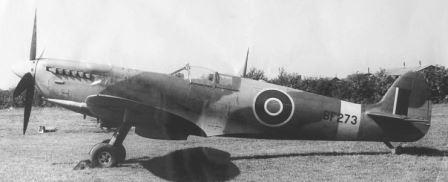
Spitfire Mk. IX

Spitfire Mark  IX.  (Photo source: Google image, from ‘Spitfire Mk IX Performance Testing, Aeroplane and Armament Experimental Establishment, Boscombe Down, 21 October, 1942.’)

….George Glenn’s Spitfire failed to return from a patrol near Nijmegen….

On August 14, 1944, George Glenn received his final promotion, to Flight Lieutenant.  Just over a month later, he had his final flight.  Don Smith explained that from September 20 to October 1, 1944, Base 68 at Le Culot/Beauvechain in Belgium “was occupied by 126 Wing, Group 83, 2nd Tactical Air Force (Canadian Fighter Wing), to provide air cover over the Arnhem/Nijmegen areas for Operation Market Garden….

NOTE: Operation Market Garden was an Allied military operation, from September 17 to 27, 1944, that succeeded in liberating Nijmegen and Eindhoven but failed in liberating the last bridge held in Arnhem, which would enable troops to the Rhine into Germany.  The movie ‘A Bridge Too Far’ dramatized this event. (See https://en.wikipedia.org/wiki/A_Bridge_Too_Far_(film))

It was from Base 68 at Le Culot/Beauvechain that George Glenn’s Squadron operated during that period. “….On September 28, 1944, while on a patrol over enemy territory in Spitfire PL490, his aircraft apparently ran out of fuel. F/L Millar was last seen over Nijmegen, Holland. While the record indicates F/L Millar’s aircraft ran out of fuel, the record for Spitfire PL490 suggests on 28 September, 1944, this aircraft, flown by F/L G.G. Millar, RCAF, was in aerial combat with Fw190s of the German Luftwaffe before the fuel shortage was reported….

This summary was similar to what was written in a September 30, 1944 letter to George Glenn’s mother by his Commanding Officer in No. 442 Squadron, Flight Lieutenant W A Olmstead.  “…On the morning of September 28th, Glen took off with the Squadron on a Patrol over enemy territory in Holland.  During this operation the Squadron were chasing some German aircraft when Glen reported on his radio that he was getting low in fuel and would have to return to friendly territory which he started out to do.

Later during the operation, Flight Lieutenant W.A. Olmstead, who was leading the Squadron, heard Glen on his radio saying that his engine was cutting and he would have to bail out or crash land. He was not seen at this point by any member of the Squadron, but it is believed he bailed out or crash landed somewhere in Holland at approximately 0945 hours….

The aircraft crashed 3 km (1.86 miles) southeast of Weibosch near Schijndel, in the Dutch province of Noord-Brabant.

….Why did the plane run out of fuel?….

We asked Don Smith why the Spitfire would have run out of fuel.  He said that although it was possible that the Spitfire “…PL490 suffered battle damage if involved in aerial combat with Fw190s, this cannot be confirmed…

Don went on to explain that ….the Merlin-powered Spitfire Mk IX was also known to have problems with vapour-lock in the fuel system, especially if the aircraft had been sitting in the sun prior to take-off. If the Spitfire PL490 was carrying an external belly-mounted auxiliary fuel tank at the time of its loss, this could create failure of the engine when switching from main tanks to external, or from external back to the main fuel tanks. The latter was more serious, since this would usually take place over enemy territory, as was the case on September 28, 1944.

As an example of this particular problem, No. 401 Squadron (RCAF) reported almost one quarter of pilots lost were due to this cause. These incidents were not mentioned as ‘tank problems’, but referred to such incidents as ‘engine failure’ or ‘engine trouble’.  

The actual cause of the loss of Spitfire PL490 will probably never be known. The Spitfire Mk IX had two tanks in front of the cockpit, one upper and one lower. Later models had another fuel tank added behind the cockpit. It is possible that the lower front tank could have been holed in combat, or the rear tank, depending on the age of PL490. In either case, F/L Millar would not have noticed the fuel leak….

….George Glenn Millar was buried in Uden War Cemetery….

Edwin van der Wolf, a volunteer researcher at the Canadian War Cemetery in Holten, wrote that George Glenn was temporarily buried in Weibosch before being reburied on July 23, 1946 at Uden War Cemetery in Uden, The Netherlands.  (See https://www.cwgc.org/visit-us/find-cemeteries-memorials/cemetery-details/2082100/uden-war-cemetery/)

Millar G.G. graffoto

George Glen Millar is buried in Uden War Cemetery.  (Photo courtesy Information Centre, Canadian Cemetery Holten)

Thank you to Dave Montgomery for sharing information about his father’s best friend, George Glenn Millar.  He is not forgotten!  Thank you to Don Smith for help with the aviation specifics and history, and to Edwin van der Wolf for sending photos and confirming burial information. If you have a story to share, please contact Pieter at memorialtrail@gmail.com, or comment on the blog.

© Daria Valkenburg

…Want to follow our research?….

If you are reading this posting, but aren’t following the blog, you are welcome to do so. Our blog address: https://onthewarmemorialtrail.com/.
Front cover OnTheWarMememorialTrailinEurope4 countries, 6 weeks, 7,000 km – an unforgettable war memorial journey in Europe…. Daria’s book ‘No Soldier Buried Overseas Should Ever Be Forgotten’ is available in print and e-book formats.  Net proceeds of book sales help support research costs and the cost of maintaining this blog. For more information on the book, please see https://nosoldierforgotten.com/

You are also invited to subscribe to our YouTube Channel: On The War Memorial Trail With Pieter Valkenburg: https://www.youtube.com/channel/UCJ591TyjSheOR-Cb_Gs_5Kw.

Never miss a posting!  Subscribe below to have each new story from the war memorial trail delivered to your inbox.