October 9, 2020. Four WWII soldiers on the Cenotaph outside the Borden-Carleton Legion lost their lives in Italy…. George Alfred DUNN of the Carleton & York Regiment, Ernest Murray NORTON of the West Nova Scotia Regiment, Arnold Dudley TAYLOR, also of the West Nova Scotia Regiment, and the subject of this posting, Albert Eugene ARSENAULT of the Cape Breton Highlanders.
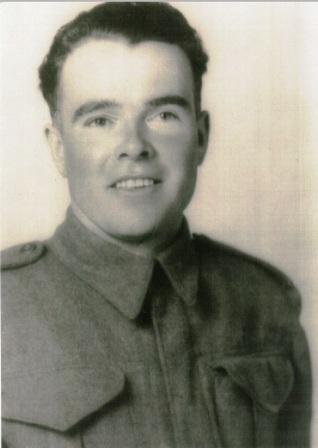
Albert Eugene Arsenault. (Photo courtesy of Borden-Carleton Legion Branch #10)
Albert was born on May 5, 1916 in Palmer Road, the son of Joseph and Philoman (Minnie) Arsenault, whose family later moved to Albany. A farm labourer before the war, at the time of his enlistment he was working as a lumberman with the Canadian Lumber Company in Stewiacke, Nova Scotia. On April 30, 1940, he enlisted with the PEI Highlanders in Dartmouth, Nova Scotia. The enlistment record indicated he spoke both English and French fluently.
Like so many soldiers, he served in several units. One of the first was the North Nova Scotia Highlanders. On September 25, 1942, he left for England, where he served as a military guard. He left for Italy on February 19, 1944, arriving on March 3, 1944. In May 1944 he was transferred to the Cape Breton Highlanders.
“The Allies began the day of August 30th with an air bombardment against German positions at dawn. At 5.30 p.m., the Perth Regiment attacked the end of a ridge northeast of Montecchio, while a knoll at the west end of the town and the high ground beyond were the objectives of the Cape Breton Highlanders. Both units faced incessant fire from the heights as well as minefields along the flat lands. The Perths managed to break through the line first, reaching and passing their objective. The Cape Breton troops had the support of tanks from the 8th Princess Louise’s (New Brunswick) Hussars, which helped three of their companies make it to the base of the knoll. After each attempt, however, they were driven back to the Foglia, with casualties totalling 19 members killed and 46 wounded. The Irish Regiment, which had been in reserve, was moved through the path of the Perths. Tanks and artillery guns were not yet available here and as a result the regiment lost 19 killed and 31 wounded.” (Source: https://www.veterans.gc.ca/eng/remembrance/memorials/overseas/second-world-war/italy/montecchio)
One of those killed in action while crossing the Foglia River near Montecchio, during the battle to take a knoll on the Gothic defence line on August 30, 1944 was Albert Arsenault. He was buried in the Montecchio War Cemetery in Italy. 582 Commonwealth soldiers, including 289 Canadians, who died in late August and September 1944 in the battle to break The Gothic Line, are buried here.

Montecchio War Cemetery, in the locality of Montecchio in the Commune of Montelabbate (Province of Pesaro). (Photo source: https://www.cwgc.org)
To read the previous postings on George Alfred Dunn and Ernest Murray Norton, see:
Dunn:
Norton:
- https://onthewarmemorialtrail.com/2019/02/13/the-last-valentine-from-a-wwii-soldier/
- https://onthewarmemorialtrail.com/2020/05/12/commemorative-coins-from-west-nova-scotia-regimental-association/
Pieter has not found family members who might have more information on Albert Eugene Arsenault. If you can help, please email Pieter at memorialtrail@gmail.com or comment on the blog.
© Daria Valkenburg
….Want to follow our research?…
If you are reading this posting, but aren’t following our research, you are welcome to do so. Our blog address: https://onthewarmemorialtrail.com/
 4 countries, 6 weeks, 7,000 km – an unforgettable war memorial journey in Europe…. Daria’s book ‘No Soldier Buried Overseas Should Ever Be Forgotten‘ is available in print and e-book formats. Net proceeds of book sales help support research costs and the cost of maintaining this blog. For more information see https://nosoldierforgotten.com/
Subscribe to our YouTube Channel: On The War Memorial Trail With Pieter Valkenburg: https://www.youtube.com/channel/UCJ591TyjSheOR-Cb_Gs_5Kw.
Never miss a posting! Subscribe below to have each new story from the war memorial trail delivered to your inbox.


 On The War Memorial Trail Research Project........ with Pieter and Daria Valkenburg