January 31, 2026. Last spring we were in The Netherlands and Belgium for the 80th Anniversary of Liberation Commemoration events, and placed flags at the graves of 383 soldiers in 14 cemeteries.
After visiting the Canadian War Cemetery in Bergen Op Zoom (see https://onthewarmemorialtrail.com/2026/01/12/on-the-war-memorial-trail-our-2025-visit-to-the-canadian-war-cemetery-in-bergen-op-zoom/) and the Canadian War Cemetery in Adegem (see https://onthewarmemorialtrail.com/2025/12/08/on-the-war-memorial-trail-a-visit-to-the-canadian-war-cemetery-in-adegem/), we were very interested in learning more about the Battle of the Scheldt, as so many of the men buried in these two cemeteries lost their lives in this battle.
….Why was the Battle of the Scheldt so important?…
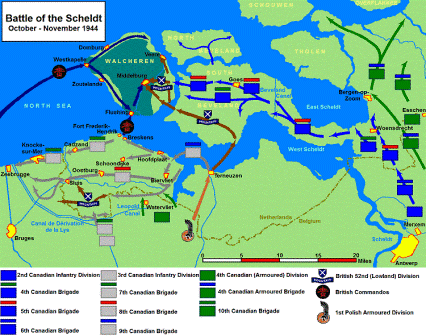
Map shows Battle of the Scheldt in The Netherlands. (Map source: http://www.canadiansoldiers.com)
The Battle of the Scheldt’s objective was to free up the way to the Port of Antwerp in Belgium for supply purposes. Canadian soldiers suffered almost 8,000 casualties (wounded and dead) in what turned out to be the battle with the most Canadian casualties in The Netherlands. (See https://www.veterans.gc.ca/eng/remembrance/history/second-world-war/scheldt)
….The Freedom Museum Zeeland focuses on the Battle of the Scheldt…
One sunny Saturday in May 2025 we visited the Freedom Museum Zeeland (Bevrijdingsmuseum Zeeland in Dutch) in the very small village of Nieuwdorp. This is a privately run museum that focuses on the Battle of the Scheldt. We found it very informative, with lots of displays and panels in 4 languages – Dutch, English, French, and German.
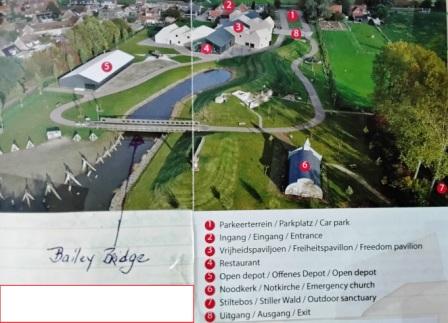
Site map from the Museum’s pamphlet.
The Museum pamphlet stated that the museum “…takes you through the eventful years in the province of Zeeland during World War II. The ‘Battle of the Scheldt’ is the central thread of this story. The fierce battle fought in the autumn of 1944 between the Allied and German troops for command over the Western Scheldt, the main waterway to the already liberated port of Antwerp. A battle that is often forgotten, despite its crucial significance for the ensuing liberation of Western Europe….”
While the battle isn’t forgotten in Canada, as it cost so many Canadian soldiers their lives, we were unaware that the struggle for control of the Scheldt began years earlier, with French forces trying to help protect Zeeland in May 1940.
A panel explained that “…on 16 May 1940 German SS troops cross the South Beveland Canal, taking the French by surprise. Come evening the Germans have already reached the Sloedam, the only connection with Walcheren island by land. The defence of the Sloedam is not impossible, so the French entrench themselves to stop the Germans….”
Unfortunately, on May 17, the Germans prevailed. “…Despite fierce resistance, the Germans succeed in crossing the Sloedam, thanks to heavy air support…”
The Mayor of Middelburg had “…anticipated the military violence and already advised citizens to leave town on 14 May. He was proved right because on 17 May a large part of the old town centre of Middelburg goes up in flames….”
The French retreated to Vlissingen, and boarded ships to leave. “…Dutch capitulation is reported to the Germans, who then invade Middelburg…” Zeeland was the last province of The Netherlands to be occupied, and remained under German occupation until November 1944.
The harrowing story of the effect of German occupation on Dutch citizens, and the struggle to liberate Zeeland in the fall of 1944 is vividly told through displays and information panels.
….We saw military equipment that had been featured in many of our stories…
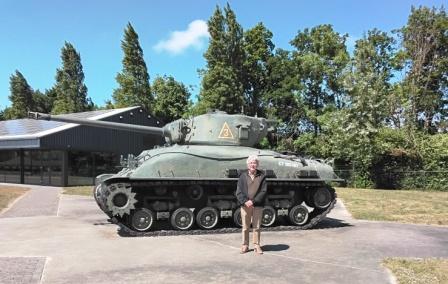
Pieter stands in front of a Sherman tank. (Photo credit: Daria Valkenburg)
After completing the circuit of information panels and displays indoors, we went outside to look at more displays and military equipment, including a Sherman tank.
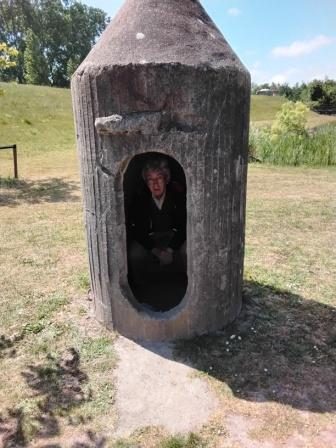
Pieter inside a German one-man bunker. (Photo credit: Daria Valkenburg)
One object that intrigued us was a German one-man bunker, made of reinforced concrete. An information panel explained that this “…Splitterschutzzelle (splinter protection cell) offered protection against shelling, air raids, and bombardments. They were often placed in residential districts, near factories or military installations….” While it offered some protection, the one-man bunker was not able to withstand a direct hit.
….We were able to drive across a Bailey bridge…
We were delighted to see a Bailey bridge, which we’d never seen in real life before. Pieter of course went across it, but it was a bit too far away for me to tackle. The bridge was in an area that was only for pedestrian traffic, and not for vehicles.
After seeing all of the exhibits and the military equipment, we returned to the parking lot. Just as we reached our vehicle, a man in a jeep pulled up and asked if we were the Canadians. When we’d paid the entrance fee for the museum, we’d mentioned that we were from Canada. The man in the jeep was Kees Traas, who owns the museum, and wanted to meet us.
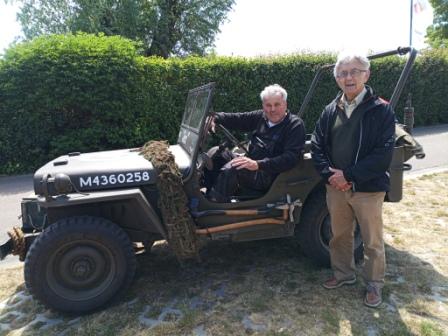
Pieter with Kees Traas in his WWII era jeep. (Photo credit: Daria Valkenburg)
Kees was very happy that Pieter spoke Dutch and the two of them became very engaged in conversation about the museum and how it began. Kees became my hero when he told Pieter to take the car and drive it across the Bailey bridge so that I could see it, and to make sure we stopped in at the church, which had a story about a Canadian soldier.
Pieter asked if the bridge could hold the car. “…Oh yes…” said Kees, “…it can hold 3 tons….” So an overjoyed Pieter got to experience travelling over a ‘temporary’ bridge that we’d only read about in war diaries.
A Bailey bridge, named after it’s British inventor, was “…an emergency bridge to replace bridges that were destroyed, or as an alternative next to bridges that did not have enough bearing capacity….”
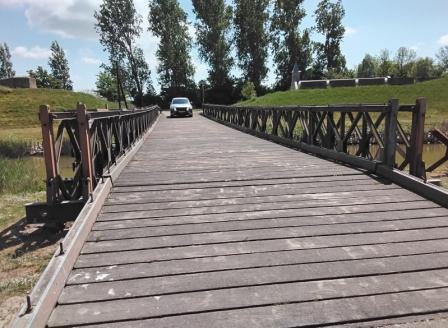
Pieter drove our vehicle across the Bailey bridge. The building seen on the right is a chapel. (Photo credit: Daria Valkenburg)
We went back and forth across the bridge, so that I could experience it, and then once more with just Pieter in the car, while I took photos of the crossing.
….The chapel featured the story of Jean-Maurice Dicaire….
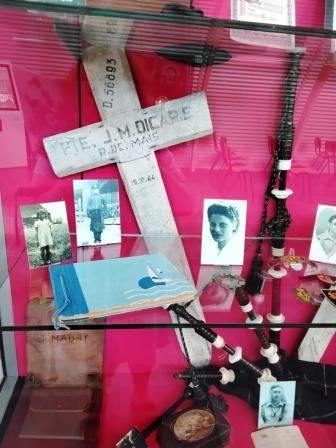
Display case in the chapel featured Pte Jean-Maurice Dicaire. (Photo credit: Daria Valkenburg)
We also visited the chapel that Kees had mentioned to us, which had a display case featuring the story of Jean-Maurice DICAIRE, born in Hawkesbury, Ontario, who was serving with Le Régiment de Maisonneuve, when he lost his life on October 29, 1944, aged 23.
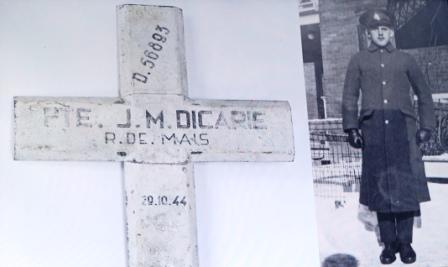
Jean-Maurice Dicaire was featured on an information panel in the chapel.
An information panel explained that the original grave marker had been found near a garbage container and given to the museum. Unlike many Canadian soldiers who were reburied in the Canadian War Cemetery in Bergen Op Zoom, Jean-Maurice’s body was never removed from the Kloetinge General Cemetery.
The original grave marker was likely discarded as his surname was incorrectly spelled. The wooden marker was replaced with a stone at his grave that has his correct surname. Today the grave marker with the incorrect spelling is in the chapel at the Freedom Museum Zeeland, as part of the memorabilia that features this young soldier.
Thank you to Kees Traas, Chair of the Freedom Museum Zeeland Foundation, for allowing us to drive over the Bailey bridge.
After arriving back at our hotel, we enjoyed a delicious and relaxing dinner. After visiting 383 graves in 14 cemeteries, in 2 countries, plus the Halifax L9561 memorial panel in Wons, we wanted to celebrate the completion of our goal.
But we still weren’t finished! More adventures awaited as we continued with our 2025 European War Memorial Tour to visit a special Indigenous Exhibit at the Freedom Museum in Groesbeek.
The research work continues for Pieter. If you have photos or information to share about soldiers buried in The Netherlands or Belgium, please email him at memorialtrail@gmail.com, or comment on the blog.
© Daria Valkenburg
….Want to follow our research?…
If you are reading this posting, but aren’t following our research, you are welcome to do so. Our blog address: https://onthewarmemorialtrail.com/
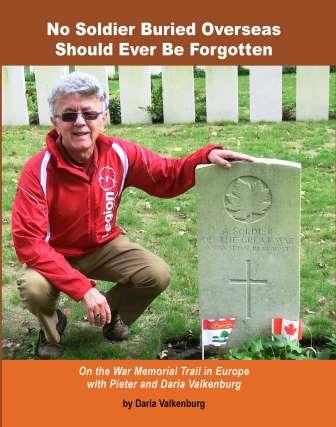 4 countries, 6 weeks, 7,000 km – an unforgettable war memorial journey in Europe…. Daria’s book ‘No Soldier Buried Overseas Should Ever Be Forgotten‘ is available in print and e-book formats. Net proceeds of book sales help support research costs and the cost of maintaining this blog. For more information see https://nosoldierforgotten.com/
Subscribe to our YouTube Channel: On The War Memorial Trail With Pieter Valkenburg: https://www.youtube.com/channel/UCJ591TyjSheOR-Cb_Gs_5Kw.
Never miss a posting! Subscribe below to have each new story from the war memorial trail delivered to your inbox.
 On The War Memorial Trail Research Project........ with Pieter and Daria Valkenburg