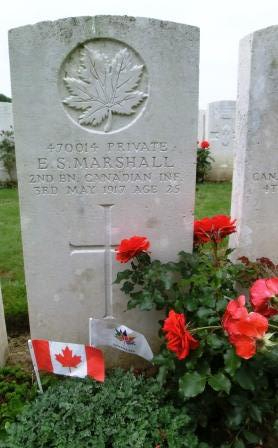
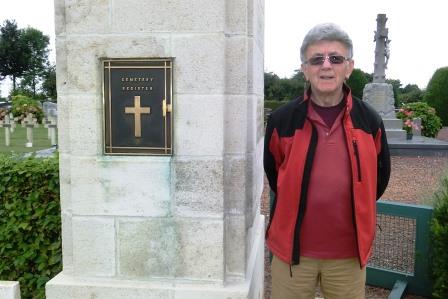
On The War Memorial Trail….We Visit Bac-Du-Sud British Cemetery To Honour James Ambrose Cairns

September 25, 2017.  Arras, France was our home base for our trips in and around the Vimy area.  Our hotel was across from the train station.  In front of the station was a plaza with restaurants surrounding it.  Of course, we took a stroll to see what was there.

CIMG8262 Sep 4 2017 Pieter on the street in Arras

Pieter in Arras. On the left is the plaza. We took a stroll to see which of the many cafes took our fancy. (Photo credit: Daria Valkenburg)

If we still had the idea that war memorials were only in cemeteries and in the countryside, we had a reality check as soon as we ventured outside the hotel.  In the plaza, across from the train station, is a large memorial to the people of Arras who lost their lives in the war.
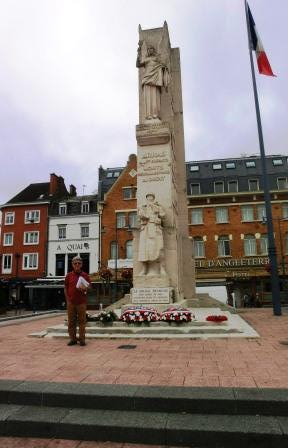
CIMG8263 Sep 4 2017 Pieter at monument opposite the train station in Arras

Pieter by the memorial to the fallen citizens in Arras. On the left is the plaza. We took a stroll to see which of the many cafes took our fancy. (Photo credit: Daria Valkenburg)

CIMG8264 Sep 4 2017 monument opposite the train station in Arras

The memorial in the plaza in Arras to the fallen citizens also honours the soldiers of France. The inscription says: The French Soldier. Yesterday a soldier of God, today a soldier of humanity, will always be a soldier of law. (Photo credit: Daria Valkenburg)

The memorials and cemeteries made us more determined than ever to honour the memories of as many of the soldiers on the Cenotaph outside the Borden-Carleton Legion in Prince Edward Island that we could while we were in Europe.  After we left the Ligny Saint-Flochel British Cemetery, we made our way to Bac-Du-Sud British Cemetery where James Ambrose CAIRNS is buried.

It was our first clue that visiting cemeteries can be a challenge. Bac-Du-Sud British Cemetery in Bailleulval, 13 km southwest of Arras, is just on the side of very busy highway, the N25.  If you think of a highway shoulder and widen the space slightly, you have an idea how we were parked. There are no actual parking spots, just the gate to the cemetery off the side of the highway.  Around the cemetery is a farmer’s field.

CIMG8491 Sep 6 2017 Bac Du Sud British cemetery where James A Cairns is buried

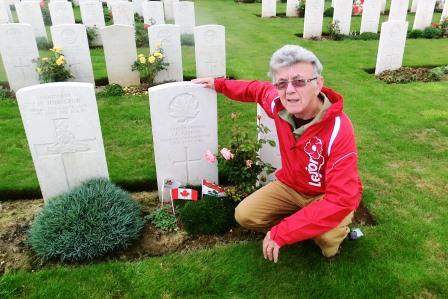
Pieter at Bac-Du-Sud British Cemetery, where James Ambrose Cairns is buried. (Photo credit: Daria Valkenburg)
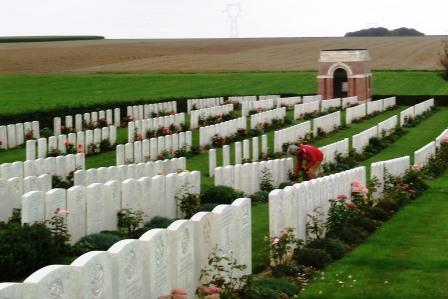
CIMG8492 Sep 6 2017 Bac Du Sud British cemetery where James A Cairns is buried

Pieter places flags at the grave of James Ambrose Cairns in Bac-Du-Sud British Cemetery. (Photo credit: Daria Valkenburg)

The cemetery has 688 WWI Commonwealth graves, of which 4 are unidentified, and 55 German graves.  According to the Commonwealth War Graves Commission, the cemetery began in March 1918 by the 7th, 20th, and 43rd Casualty Clearing Stations, but when Germans advanced at the end of March 1918, their place was taken by field ambulances of the units fighting on the Arras front, notably the 31st Division and the Canadian Corps.  In August and September 1918, once the Germans had been pushed back, the 45th and 46th Casualty Clearing Stations were posted here.

James Ambrose CAIRNS, son of Terrence Cairns and Elisabeth Hughes, was born March 16, 1895 in Emerald, PEI.  He was killed in action near Neuville – Vitasse (raid on ‘The Maze’) on June 13, 1918.  Neuville-Vitasse, 16.6 km from Bailleulval, was a village under the control of the Germans.  To protect their position, the Germans had a series of trenches, referred to as ‘The Maze’, on the outskirts of the village.  It was during a raid on these trenches that Cairns lost his life.

Although we have not been able to find a photo of James Ambrose Cairns, we were lucky to have an account of what happened from the Canada War Graves Register Circumstances of death:  Cairns “was one of a carrying party in the frontline trench, when an enemy shell burst nearby, fragments of the shell striking him in the head and body, inflicting fatal wounds. He was immediately taken to a Dressing station and later to the Canadian 4th Field ambulance where he died of his wounds the next morning.

An obituary in the Summerside Journal of September 11, 1918 gave a bit more information on what happened, as well as a few highlights of Cairns’ life and career in banking: “On the evening of June 12th, Pte. James A. Cairns was borne from the field of battle in France to a dressing station severely wounded. He was doing duty in a front line trench, being at the time one of a party, who were carrying out a dead comrade, when an enemy shell burst nearby inflicting fatal wounds, fragments of the shell striking him in the head and body. He was immediately taken out to a dressing station and died the next morning at No 4 Canadian Field Ambulance.

Pte. Cairns was 23 years of age at the time of his death. He enlisted when he was 21 years of age in Liverpool where he was one of the staff of the Royal Bank of Canada. He went to Lieutenant’s training school where he obtained his diploma but did not get a commission. He crossed to England in October 1916, and was held in reserve for some time, but growing eager to get to France he went as a private and was in action three months before his death. He worked in the Royal Bank of Canada in Summerside for three years, also in Tyne Valley, before being transferred to Liverpool, N.S.

CIMG8494 Sep 6 2017 Pieter by the grave of James A Cairns in Bac Du Sud British cemetery

Pieter by the grave of James Ambrose Cairns in Bac-Du-Sud British Cemetery after placing the flags of Canada, PEI, and Canada 150. (Photo credit: Daria Valkenburg)

In the next blog entry we visit Bellacourt Military Cemetery before continuing our search for the Manitoba and Grandcourt cemeteries. Do you have information or photos for James Ambrose Cairns?  Comments or stories?  You can share them by emailing us at memorialtrail@gmail.com or by commenting on this blog.

© Daria Valkenburg

….Want to follow our research?….

If you are reading this posting, but aren’t following our research, you are welcome to do so.  Our blog address: https://onthewarmemorialtrail.com/
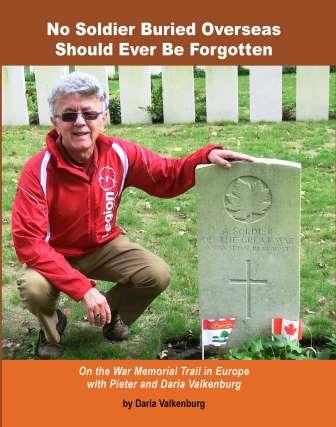
Front cover OnTheWarMememorialTrailinEurope4 countries, 6 weeks, 7,000 km – an unforgettable war memorial journey in Europe…. Daria’s book ‘No Soldier Buried Overseas Should Ever Be Forgotten‘ is available in print and e-book formats.  Net proceeds of book sales help support research costs and the cost of maintaining this blog. For more information see https://nosoldierforgotten.com/ 

You are also invited to subscribe to our YouTube Channel: On The War Memorial Trail With Pieter Valkenburg: https://www.youtube.com/channel/UCJ591TyjSheOR-Cb_Gs_5Kw

Never miss a posting!  Subscribe below to have each new story from the war memorial trail delivered to your inbox.

On The War Memorial Trail…..Paying Our Respects To Private Joseph Arthur Desroches

September 23, 2017.  We’re not inexperienced travellers, but even we can sometimes get into situations we simply can’t understand.  Quite often it happens with food and France gave us a real doozie.  Our hotel in Arras offered ‘le petit dejeuner’ (breakfast), served buffet style, so you picked what you wanted.

In the hotel you had a choice of hard-boiled or ‘fresh’ eggs.  I had no idea what ‘fresh eggs’ were so passed by them and chose a hard-boiled egg.  Pieter didn’t notice the hard-boiled eggs, just the ‘fresh’ eggs, and so he chose one, thinking how nice it was of the hotel to guarantee an egg that wasn’t old.

CIMG8466 Sep 6 2017 fresh eggs at Holiday Inn in Arras

‘Fresh’ eggs on offer at the hotel breakfast in Arras. (Photo credit: Daria Valkenburg)

I wish I’d taken a photo of his face when he cracked open his egg and saw……a raw egg.  It was fresh all right, straight from the chicken!

IMG_20170905_075317693 Sep 5 2017 Pieter tries to eat a raw egg

The ‘fresh’ egg was really a raw egg. (Photo credit: Pieter Valkenburg)

It took us two days to realize that the silver box beside the eggs, which we thought was some kind of fancy toaster, contained boiling water so you could cook your egg to your own specification.  Who would have guessed?

Over breakfast, Pieter determined that while he was going back to Caix to find the Manitoba Cemetery, if he had to search for it street by street, we first were getting gas and going to a few cemeteries that might be easier to find.  We got gas in the town of Vimy.  For those interested in the price of gas, it was 1.399 euros per litre (about $2.06 Canadian).

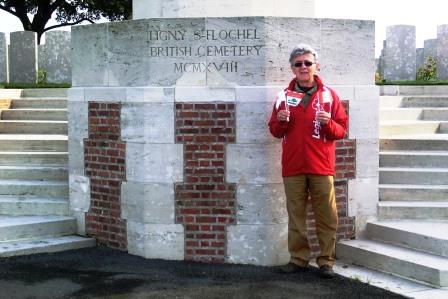
From Vimy we went to Ligny Saint-Flochel British Cemetery, where Joseph Arthur DESROCHES is buried.

CIMG8474 Sep 6 2017 Pieter at base of cross of remembrance at Ligny St Flochel British cemetery where Desroches is buried

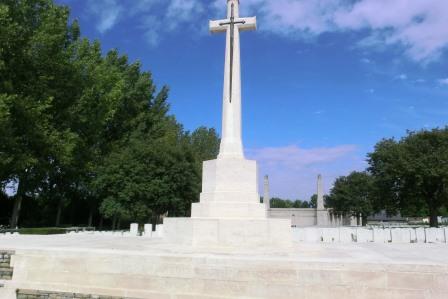
Pieter at the base of the Cross of Remembrance in Ligny Saint-Flochel British Cemetery. (Photo credit: Daria Valkenburg)

Joseph Arthur DESROCHES was born August 8, 1891 in Miscouche, the son of Zephirim Desroches and Priscilla Gaudet.  Unlike most of the soldiers on the Borden- Carleton Cenotaph, Desroches was married, to Mary Ann Wedge of Fernwood, and had four children: Elizabeth Eileen, Joseph Alfred, Lucy Priscilla, and Charles Arthur.  A farmer before the war who worked for Howard MacFarlane of Bedeque, he was wounded by a shot to his head at Cagnicourt on September 2, 1918, and died on September 4 at Number 7 Casualty Clearing Station, located in Ligny Saint-Flochel, 7.6 km of Cagnicourt.

We learned that a Casualty Clearing Station was located further back from the front line than Aid Posts and Field Ambulances, and manned by the Royal Army Medical Corps, with attached Royal Engineers and men of the Army Service Corps. Its job was to treat the wounded enough to allow him to return to duty or to keep him stable long enough to be evacuated to a Base Hospital.

According to the war diary of the Headquarters of the 3rd Canadian Infantry Brigade, 1st Canadian Division, in preparation for an attack on the Drocourt-Queant Line, several battalions assembled their positions in the early hours of September 2.  The 13th Battalion was on the left, and the 14th Battalion, which Desroches was part of, was immediately behind.  The 16th Battalion was on the right, with the 15th Battalion immediately behind.

The war diary went on to explain what happened on September 2:  “The 13th and 16th Battalions were to capture the 1st objective, including the Drocourt-Queant and support lines.  The 14th and 15th Battalions were then to leap-frog and capture Cagnicourt, Bois de Bouche, and Bois de Loison and advance up the Buissy Switch where the 13th Battalion were to go through and mop up the switch on the Brigade Frontage. 

Promptly at 5:00 am our barrage opened and the 13th and 16th Battalions advanced.  The German barrage came down very quickly within a minute of ours but was light and caused few casualties. 

The first phase of the attack went according to schedule and the 1st objective was reached on time. The 14th and 15th Battalions went through but after passing Cagnicourt were held up badly by machine gun fire from the flanks which were exposed, as our flanking brigades could not get up…

As with all of the graves of Islanders, Pieter put down the flags of Canada, Prince Edward Island, and Canada 150.  We were grateful to PEI Senator Mike Duffy, PEI MLA Jamie Fox, and MP Wayne Easter for providing us with flags and pins for this venture on the war memorial trail.

CIMG8482Sep 6 2017 grave of Arthur Desroches in Ligny St Flochel British cemetery

Grave of Joseph Arthur Desroches in Ligny Saint-Flochel British Cemetery. Note that the spelling of his surname is without an ‘s’. (Photo credit: Pieter Valkenburg)

CIMG8483 Sep 6 2017 Ligny St Flochel British cemetery where Desroches is buried farmers field in background

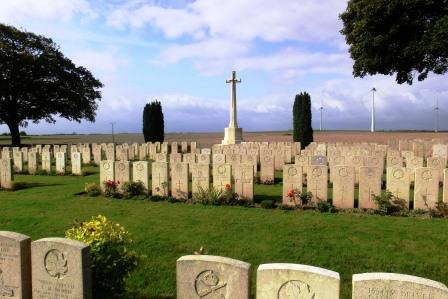
Ligny Saint-Flochel British Cemetery with the Cross of Remembrance and a farmer’s field in the background. (Photo credit: Daria Valkenburg)

The cemetery has 629 burials, of which 347 are Canadian and 46 German.  The German graves are similar to the Commonwealth graves, which was surprising as most German graves have only an iron cross on them. The German graves are set apart from the Commonwealth graves by an indentation in the ground, making an artificial step, like in a sunken living room.

Unfortunately, as with so many of the WW1 soldiers, we have not been able to find a photo or additional information on Joseph Arthur Desroches.

In the next blog entry we visit Bac-Du-Sud and Bellacourt cemeteries before continuing our search for the Manitoba and Grandcourt cemeteries. Do you have information or photos for Arthur Desroches?  Comments or stories?  You can share them by emailing us at memorialtrail@gmail.com or by commenting on this blog.

© Daria Valkenburg

….Want to follow our research?….

If you are reading this posting, but aren’t following our research, you are welcome to do so.  Our blog address: https://onthewarmemorialtrail.com/

Front cover OnTheWarMememorialTrailinEurope4 countries, 6 weeks, 7,000 km – an unforgettable war memorial journey in Europe…. Daria’s book ‘No Soldier Buried Overseas Should Ever Be Forgotten‘ is available in print and e-book formats.  Net proceeds of book sales help support research costs and the cost of maintaining this blog. For more information see https://nosoldierforgotten.com/ 

You are also invited to subscribe to our YouTube Channel: On The War Memorial Trail With Pieter Valkenburg: https://www.youtube.com/channel/UCJ591TyjSheOR-Cb_Gs_5Kw

Never miss a posting!  Subscribe below to have each new story from the war memorial trail delivered to your inbox.

On The War Memorial Trail…..Honouring The Memories of Kenneth John Bell And Charles Lowther

September 21, 2017.  After we left the Monument to the 1st Canadian Division, we began the hard work of trying to find the cemeteries where individual soldiers from the Cenotaph outside the Borden-Carleton Legion were buried.

Although Pieter had printed out detailed instructions from the Commonwealth War Graves Commission on the exact location of each cemetery and the burial locations, we soon found out that actually finding the cemeteries was easier said than done.

Pieter determined that the first cemetery we should go to was Moeuvres Communal Cemetery Extension where Private Charles Lowther is buried.  On the way to Moeuvres on a nerve racking ride, sharing the road with drivers who think they’re kamikaze pilots, we passed through the village of Vis-en-Artois and I demanded we stop for coffee and a badly needed toilet break.

Pieter gallantly tried to stop to accommodate me, to the annoyance of a Belgian truck driver who kept blowing his horn – the only one to do so on the trip.  But, luckily we found a parking spot and made it safely across the road to the café.

After using the facilities, I was able to order us coffee in my best schoolgirl French.  Everyone immediately picked us out as foreigners, and the owner asked if we were here to visit the British cemetery.  Why else would Les Anglaises be in town? And were we interested in the postcards?

….A postcard led to another cemetery we wanted to visit….

Bien sur”, I said.  I had no idea which cemetery he was asking about, but shopping is always fun.  Pieter was a bit annoyed until he realized that he wanted to go to this cemetery as that was where Corporal Kenneth John Bell, another name on the Cenotaph outside the Borden-Carleton Legion, was buried.  It turned out the British cemetery was just down the road from the café in Harcourt.  Now Pieter thought it was very smart of us to have stopped in the right café!

After our break, and postcards in hand, we made our way to the Vis en Artois British Cemetery. According to the information given by the Commonwealth War Graves Commission, the villages of Vis en Artois and Haucourt were taken by the Canadian Corps on August 27, 1918.  The cemetery began right after that date and was used by fighting units and ambulances until mid-October 1918.

CIMG8325 Sep 5 2017 Vis en Artois British Cemetery Cross of Remembrance

Cross of Remembrance at Vis en Artois British Cemetery, with the Memorial behind the graves. (Photo credit: Daria Valkenburg)

CIMG8337 Sep 5 2017 Vis en Artois British Cemetery

Memorial at Vis en Artois British Cemetery. (Photo credit: Daria Valkenburg)

Originally, the cemetery had 430 graves, of which 297 were Canadian.  After WWI the cemetery grew by adding graves from battlefields and smaller cemeteries in the area, until today it has 2,369 burials from WWI, 1,458 of them unidentified.

….Kenneth Bell shares a grave with another WWI soldier!….

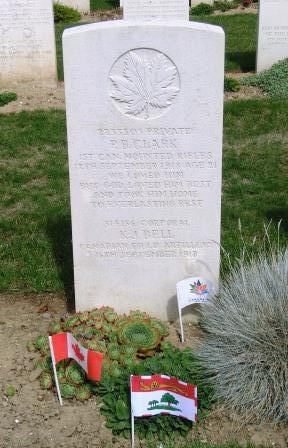
We found the grave of Kenneth Bell, but to our surprise he was not in a single grave.  He was buried with Private P. B. CLARK, who had died four days earlier than Bell.

CIMG8328 Sep 5 2017 grave of Cpl Kenneth Bel in Vis en Artois British Cemetery

Grave of Cpl Kenneth Bell, shared with Private P.B. Clark, at Vis en Artois British Cemetery. (Photo credit: Pieter Valkenburg)

Kenneth John BELL was born March 28, 1896 in Cape Traverse, the son of William Bell and Lucy Rogerson, and nephew of PEI Premier John Howatt Bell.  On September 16, 1918 he was hit by enemy shell fire, and was attended to by the medical officer of the brigade, but he died on the way to the dressing station. The location of the unit at the time of the casualty was Rumaucourt, 10.2 km from Harcourt.

It’s a shame as Bell, per his obituary, “had fought in the battles of the Somme, Vimy Ridge, Lens, Ypres, Passchendaele and many later battles and came out without a scratch”, only to die two months before the war’s end.  Unfortunately, we have not been able to find a photo or additional information on Corporal Bell.

CIMG8335 Sep 5 2017 Pieter by grave of Cpl Kenneth Bell in Vis en Artois British Cemetery

Pieter by the grave of Cpl Kenneth Bell, shared with Private P.B. Clark, at Vis en Artois British Cemetery. (Photo credit: Daria Valkenburg)

….Charles Lowther is buried 14 km from Kenneth Bell….

From Harcourt, we travelled 14 km (8.7 miles) further to Moeuvres Communal Cemetery Extension where Private Charles Lowther is buried.

CIMG8342 Sep 5 2017 Moeuvres Communal Cemetery Extension where Lowther is buried

Moeuvres Communal Cemetery Extension plaque. (Photo credit: Daria Valkenburg)

We soon learned that when we saw the word “Extension” by the name of a cemetery, it meant that the war graves were in a separate area, usually at the back, of a public cemetery.  In Moeuvres, the Extension has 565 Commonwealth burials and commemorations of WWI, with 263 unidentified graves.

CIMG8360 Sep 5 2017 Pieter at entrance to Moeuvres Communal Extension Cemetery

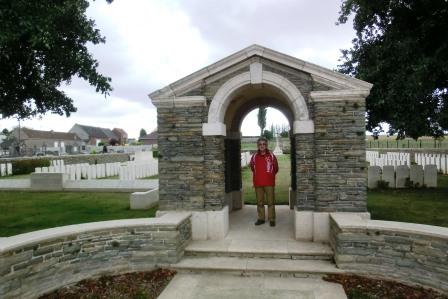
Pieter at the entrance to Moeuvres Communal Cemetery Extension. (Photo credit: Daria Valkenburg)

CIMG8343 Sep 5 2017 Pieter placing flags at Lowther grave at Moeuvres Communal Cemetery Extension

Pieter placing flags at the grave of Charles Lowther at Moeuvres Communal Cemetery Extension. You can see the cemetery extension is next to a farmer’s field. (Photo credit: Daria Valkenburg)

cimg8347-sep-5-2017-lowther-grave-at-moeuvres-communal-cemetery-extension.jpg

Grave of Charles Lowther at Moeuvres Communal Cemetery Extension. (Photo credit: Pieter Valkenburg)

Charles LOWTHER was born in North Carleton on September 27, 1896, the son of Henry and Bessie Lowther.  He died September 25, 1918 after being wounded by enemy shrapnel in a trench at Inchy-en-Artois, 2.1 km from Moeuvres.  He was evacuated by a unit of the 52nd division, who later reported him dead.

According to the war diary of the 25th Battalion, which Lowther was part of, for the 25th of September in Inchy-en-Artois:  “At about 6:00 am the enemy put down a heavy barrage on our lines and started to attack in force. Our S.O.S. was sent up and the field guns opened up immediately. We prevented the enemy from entering our trenches and in many places our men started over the top to meet the enemy, who was completely repulsed after some heavy fighting. The enemy continued to bombard our trenches the whole day, lifting fire towards the evening. At 11:00 pm the battalion was relieved by the 44th Canadian battalion. Casualties 6 O.R killed and 16 O.R. wounded…

O.R. refers to “Other Ranks”, ie not officers.  We looked to see if there were any other graves of men from the 25th Battalion but saw only one, that of an O. DAIGLE, who also died on September 25, 1918.

Unfortunately, as with Kenneth Bell, we have not been able to find a photo or additional information on Charles Lowther.

By this time it was 3:30 pm.  With the success we’d had so far today, Pieter wanted to find two more cemeteries, the Manitoba Cemetery in Caix and Grandcourt Cemetery in Grandcourt.  We should have quit while we were ahead, as by 7 pm we hadn’t found either cemetery and were getting very testy with each other. It was time to admit defeat for the day and go back to Arras for a well-deserved dinner and rest.

In the next blog entry we continue our search for the Manitoba and Grandcourt cemeteries. We need help to put a face to the name on these two graves.  Do you have information or photos for Kenneth Bell or Charles Lowther?  Comments or stories?  You can share them by emailing us at memorialtrail@gmail.com or by commenting on this blog.

© Daria Valkenburg

….Want to follow our research?….

If you are reading this posting, but aren’t following our research, you are welcome to do so.  Our blog address: https://onthewarmemorialtrail.com/

Front cover OnTheWarMememorialTrailinEurope4 countries, 6 weeks, 7,000 km – an unforgettable war memorial journey in Europe…. Daria’s book ‘No Soldier Buried Overseas Should Ever Be Forgotten‘ is available in print and e-book formats.  Net proceeds of book sales help support research costs and the cost of maintaining this blog. For more information see https://nosoldierforgotten.com/ 

You are also invited to subscribe to our YouTube Channel: On The War Memorial Trail With Pieter Valkenburg: https://www.youtube.com/channel/UCJ591TyjSheOR-Cb_Gs_5Kw

Never miss a posting!  Subscribe below to have each new story from the war memorial trail delivered to your inbox.
On The War Memorial Trail….Monuments In and Around Thélus

September 20, 2017.  When we first entered the town of Thélus on our way to Vimy Ridge, we passed by the Canadian Artillery Memorial, built to remember the sacrifice of Canadians from Artillery battalions who died in the battle for Vimy Ridge and the surrounding area.

When we were at the Vimy Ridge Visitors Centre, we saw a large photograph of this monument, taken when it was actually dedicated during the war.  The monument was built on top of a dugout.  The steps leading up to the monument marks the original entrance to the dugout.  The monument was unveiled by General Currie on April 9, 1918, a year after the Battle of Vimy Ridge.

IMG_20170905_112407215 Sep 5 2017 Photo of Cdn Artillery Memorial in Thelus at Vimy Visitors Centre

Photo of the Canadian Artillery Memorial as it was unveiled in Thélus on April 9, 1918. (Photo taken by Pieter Valkenburg of a panel at Vimy Ridge Visitors Centre)

After learning about the monument at the Visitors Centre, we made a stop to see the real one.

CIMG8308 Sep 5 2017 Pieter at Cdn Artillery Memorial in Thelus

Pieter at the Canadian Artillery Memorial in Thélus. The shell shaped columns surrounding the monument have actual fuses from shells attached to their tops! (Photo credit: Daria Valkenburg)

IMG_20170905_121853669 Sep 5 2017 Inscription on Cdn Artillery Memorial in Thelus

The inscription reads “Erected in memory of officers, non-commissioned officers and men of the Canadian Corps Artillery who fell during the Vimy operations April 1917.” This is followed by the units: Canadian Field Artillery, Canadian Garrison Artillery, Royal Field Artillery, Royal Garrison Artillery and the South African Heavy Artillery. (Photo credit: Pieter Valkenburg)

CIMG8303 Sep 5 2017 Rue des Artilleurs Canadiens in Thelus

The road leading out of Thélus towards Bailleul Sir Berhoult is called Rue des Artilleurs Canadiens (Street of the Canadian Artillery). (Photo credit: Daria Valkenburg)

CIMG8304 Sep 5 2017 Sign directions across from Cdn Artillery Memorial in Thelus

Across from the Canadian Artillery Monument is a sign leading to Bailleul Sir Berthoult. (Photo credit: Daria Valkenburg)

We then followed the road between Thélus and Bailleul Sir Berthoult.  Only 4 km separate these two towns, but it was the scene of much fighting on April 9, 1917 during the Battle of Vimy Ridge.

Not far down the road was a monument to the people of Thélus who perished during two world wars, a vivid reminder that not only soldiers are war casualties.

cimg8310-sep-5-2017-monument-to-thelus-war-dead-in-two-world-wars.jpg

Thélus memorial to its war dead in two world wars. (Photo credit: Daria Valkenburg)

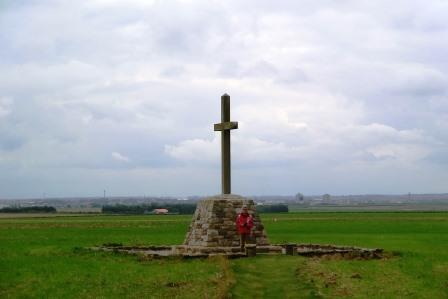
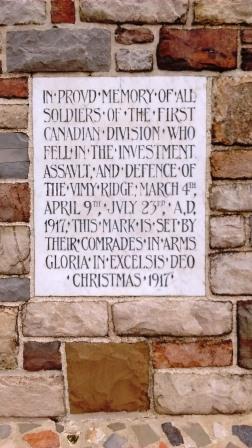
Halfway between the two towns, in a farmer’s field, is a memorial to the First Canadian Division, on the spot where they were opposite the First Bavarian Reserve Division.  By April 9, 1917 there wasn’t much left of the villages!

CIMG8314 Sep 5 2017 Pieter by sign directing you to Memorial to 1st Cdn Division

Pieter by the sign leading across a farmer’s field to the 1st Canadian Division Monument, about halfway between Thélus and Bailleul Sir Berthoult. (Photo credit: Daria Valkenburg)

We stopped at this monument to honour John ‘Lymon’ WOOD and Patrick Raymond ARSENAULT, both of whom were in the 1st Canadian Division during the Battle of Vimy Ridge, and whose names are inscribed on the Vimy Memorial.

After an article about these two men was published in the County Line Courier in April 2017, we heard from a Ernesto Brucker of Buenos Aires, Argentina, who noted that his father, Georg BRUCKER, had been part of the First Bavarian Reserve Division and had been captured as a prisoner of war on April 9, 1917, likely at or very near this exact spot.

CIMG8318 Sep 5 2017 Memorial to 1st Cdn Division halfway betwen Thelus & Bailleul

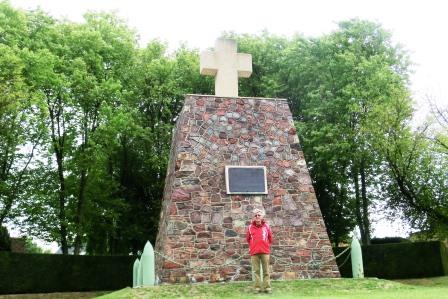
Pieter at the 1st Canadian Division Monument, about halfway between Thélus and Bailleul Sir Berthoult. (Photo credit: Daria Valkenburg)

IMG_20170905_123258340 Sep 5 2017 inscription on memorial to 1st Cdn Division

Inscription on the 1st Canadian Division Monument, about halfway between Thélus and Bailleul Sir Berthoult. (Photo credit: Pieter Valkenburg)

CIMG8316 Sep 5 2017 lone poppy along path leading to memorial to 1st Cdn Division outside Thelus

A lone poppy was growing on the path towards the 1st Canadian Division Monument, about halfway between Thélus and Bailleul Sir Berthoult. (Photo credit: Daria Valkenburg)

In the next blog entry we continue to visit the cemeteries in France where soldiers on the Borden-Carleton Cenotaph are buried.  Comments or stories?  You can share them by emailing us at memorialtrail@gmail.com or by commenting on this blog.

© Daria Valkenburg

….Want to follow our research?….

If you are reading this posting, but aren’t following our research, you are welcome to do so.  Our blog address: https://onthewarmemorialtrail.com/

4 countries, 6 weeks, 7,000 km – an unforgettable war memorial journey in Europe…. Daria’s book ‘No Soldier Buried Overseas Should Ever Be Forgotten‘ is available in print and e-book formats.  Net proceeds of book sales help support research costs and the cost of maintaining this blog. For more information see https://nosoldierforgotten.com/ 

You are also invited to subscribe to our YouTube Channel: On The War Memorial Trail With Pieter Valkenburg: https://www.youtube.com/channel/UCJ591TyjSheOR-Cb_Gs_5Kw

Never miss a posting!  Subscribe below to have each new story from the war memorial trail delivered to your inbox.

On The War Memorial Trail….Visiting The Canadian National Vimy Memorial

September 18, 2017.  After the tour of the Vimy Memorial Visitors’ Centre and the tunnels, we went to visit the Canadian National Vimy Memorial. Although familiar to us from seeing it on TV, the memorial is much larger and majestic in person.

CIMG8468 Sep 6 2017 Mother Canada memorial at Vimy Ridge

Canadian National Vimy Memorial from a distance. (Photo credit: Daria Valkenburg)

CIMG8295 Sep 5 2017 Canadian National Vimy Memorial closer up with twin white pylons

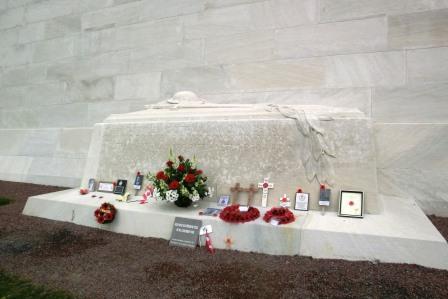
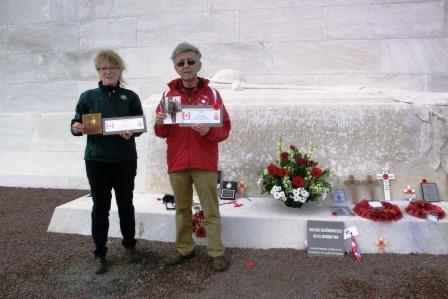
Canadian National Vimy Memorial showing the twin white pylons, one bearing the maple leaves of Canada, the other the fleurs-de-lys of France, to symbolize the sacrifices of both countries. Beside one of the pylons is the statue Canada Bereft. Below the pylons is The Tomb. (Photo credit: Daria Valkenburg)

Site manager Johanne Gagné noted that “this monument is special because it focuses on values the soldiers shared and ultimately gave their lives for.”  11,285 names are inscribed on the memorial, two of them who also are on the Cenotaph outside the Borden-Carleton Legion:  John Lymon Wood and Patrick Raymond Arsenault.  Pieter immediately went to search out these two names.

IMG_20170905_114855242 Sep 5 2017 Vimy Memorial Inscription Arsenault

Patrick Raymond Arsenault inscribed on Vimy Memorial. (Photo credit: Pieter Valkenburg)

IMG_20170905_115420984 Sep 5 2017 Vimy Memorial Inscription Wood

John Lymon Wood inscribed on Vimy Memorial. (Photo credit: Pieter Valkenburg)

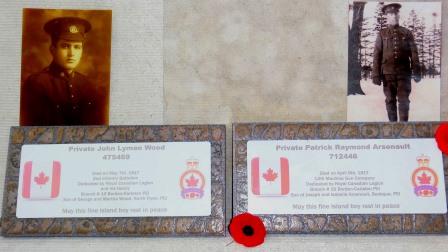
After finding the inscriptions, Pieter next looked for two plaques brought to the memorial in April by the students of Kinkora Regional High School and teacher Kevin Bustard.  Kevin had the plaques made after reading about Wood and Arsenault in an April 2017 article in the County Line Courier. (See CLC Apr 5 2017 p9 Two Unsung Heroes of Vimy Ridge)

To everyone’s surprise, the plaques were still at the Memorial. Arsenault’s was on The Tomb, and Wood’s was by his inscription.

CIMG8294 Sep 5 2017 tributes on The Tomb

Tributes left on The Tomb at the Vimy Canadian National Memorial. You can see the plaque for Patrick Raymond Arsenault on the far left. (Photo credit: Daria Valkenburg)

Pieter reunited both plaques with photos of the two soldiers.

CIMG8299 Sep 5 2017 Wood & Arsenault Plaques

Plaques and photos of John Lymon Wood and Patrick Raymond Arsenault. (Photo credit: Daria Valkenburg)

While the plaques were left at the Memorial, the photos and information about Wood and Arsenault were given to Johanne Gagné, who told us that “the French are still welcoming and grateful for the sacrifices made by Canadians and say thank you.  They are grateful to Canada for keeping the memory alive after 100 years.  It’s humbling.”

CIMG8301 Sep 5 2017 Sep 5 2017 Johanne Gagne with Wood and Pieter with Arsenault

Johanne Gagné with plaque and photo of John Lymon Wood while Pieter holds plaque and photo of Patrick Raymond Arsenault. (Photo credit: Daria Valkenburg)

This was the end of our tour of Vimy Ridge and the Memorial.  It had been a special day and we salute Johanne Gagné for the time she spent giving us a wonderful tour and patiently answering our many questions.  Merci beaucoup Johanne!

In the next blog entry we explore two of the memorials in the Thélus area.  Comments or stories?  You can share them by emailing us at memorialtrail@gmail.com or by commenting on this blog.

© Daria Valkenburg

….Want to follow our research?….

If you are reading this posting, but aren’t following our research, you are welcome to do so.  Our blog address: https://onthewarmemorialtrail.com/

Front cover OnTheWarMememorialTrailinEurope4 countries, 6 weeks, 7,000 km – an unforgettable war memorial journey in Europe…. Daria’s book ‘No Soldier Buried Overseas Should Ever Be Forgotten‘ is available in print and e-book formats.  Net proceeds of book sales help support research costs and the cost of maintaining this blog. For more information see https://nosoldierforgotten.com/ 

You are also invited to subscribe to our YouTube Channel: On The War Memorial Trail With Pieter Valkenburg: https://www.youtube.com/channel/UCJ591TyjSheOR-Cb_Gs_5Kw

Never miss a posting!  Subscribe below to have each new story from the war memorial trail delivered to your inbox.
On The War Memorial Trail….Visiting the Tunnels at Vimy Ridge

September 14, 2017.  After the tour of the Vimy Memorial Visitors’ Centre, Pieter and site manager Johanne Gagné went to explore the tunnels.  Pieter was in second heaven!  They saw two of the many tunnel systems, one used by the Black Watch, and one used by the Princess Patricia Light Infantry.

IMG_20170905_103810241 Entrance to a Vimy Tunnel used by Princess Pats

Photo: Entrance to a tunnel used by the Princess Patricia Light Infantry. (Photo credit: Pieter Valkenburg)

Some of the main tunnels at Vimy Ridge have been restored to make them safer and reinforced with concrete floors, as well as some of the walls.  All of the tunnels were named by the WWI soldiers so that they would know where they were.

Tunnels were used for two main purposes: to safeguard troops from enemy fire, and for transportation of materials such as bombs and mines that could be used to blow up German tunnels.  A narrow gauge railway system was installed as whatever materials were dug out to make the tunnels had to be transported out and then covered so that enemy observation planes couldn’t spot mounds of earth and be aware of where digging was going on.

Using the material transported into the tunnels, Allied forces tried to undermine the trenches of the Germans by blowing them up from inside the tunnels.  This had the advantage of allowing Allied forces to safely advance without being exposed to enemy fire.

IMG_20170905_105716402

Pieter by the as yet unrestored tunnel used by the Black Watch. Note the wagon in the background. (Photo credit: Johanne Gagné)

IMG_20170905_104523941 Tunnel used by Black Watch

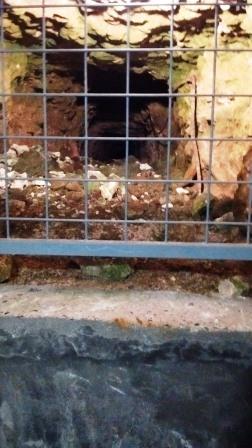
An as yet unrestored portion of the Grange tunnel. (Photo credit: Pieter Valkenburg)

IMG_20170905_104540988 Pieter in a reinforced part of the tunnel

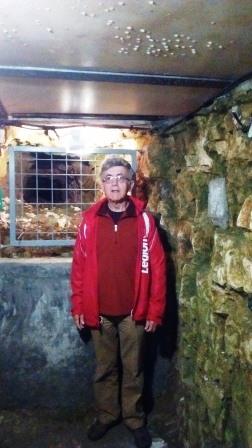
Pieter in a reinforced part of the Grange tunnel. (Photo credit: Johanne Gagné)

Some tunnels were designed for living quarters and as command centres.  Messages were passed along from the command centre by runners to the troops.  There were ways out of the tunnels into the trenches.

An interesting and surprising fact Pieter learned was that electricity was in the tunnels.  They had electric lights in the Vimy tunnels! As Johanne Gagné noted, “…So modern!..

Near Vimy was a tunnel called the Maison Blanche (“The White House”), so named because the outside building was white in colour.  That tunnel used candles for lighting.

In Pieter’s opinion, the unrestored tunnels gave a better picture of what had gone on at the time.  The restored tunnels give you a safer impression of what happened, but doesn’t have the impact of the dire conditions the men worked in. “…I was amazed by how many tunnels there were, going in all directions…” Pieter explained.  “It was a real maze…

From the observation post, you can still see a big crater where Allied troops blew up a trench.

CIMG8287 Sep 5 2017 Pieter & Johanne by observation post at Vimy Ridge

Pieter and Johanne Gagné by the observation post overlooking ‘no man’s land’ – territory that was not held by either the Germans or the Allies. (Photo credit: Daria Valkenburg)

We were very interested in the observation post as Gunner Harold Keith HOWATT of the 8th Siege Battery spent a lot of World War I in an observation post, and we had wondered what one looked like.  So Pieter went into one and took a look.

CIMG8289 Sep 5 2017 Pieter in observation post at Vimy Ridge

Pieter in an observation post at Vimy Ridge. (Photo credit: Daria Valkenburg)

Howatt participated in the Battle of Vimy Ridge in April 2017, and survived.  In fact, he survived the war and came back home to Augustine Cove and had a career as a teacher.

But back in February 1918, his unit was back at Vimy Ridge.   In his diary entry of Saturday, February 16, 1918, he recorded the following observations:

….In the afternoon I took a walk up to the top of Vimy Ridge.  It is some place, never yet have I seen a place so battle scarred.  There are shell holes everywhere, hardly two square yards of level ground on the ridge.  And the mine craters, they are tremendous.  Some must be from 40 to 50 feet deep and from 40 to 50 yards across. 

There is a large monument on the top to the 44th Battalion, with the names of all the officers and men, who were killed during the attack on the ridge on April 9, inscribed on it.  There is also a monument to the 78th Battalion, and one to a sergeant of the Winnipeg Grenadiers who set off an enemy mine and lost his life in the act.  The crater is called the ‘Winnipeg Grenadier’.  There is also a monument to a major and to Lieutenant Gass of the 5th Canadian Siege Battery, who was killed in an O. P. (note:  Observation Post) the day before Vimy was taken.

There was a party of English labour tourists on the top of the ridge while I was up there.  Was talking to one fellow for a few minutes, pointing out Lens, Avion, and place within our own lines, to him….

We weren’t sure if the crater referred to by Howatt is the same one to be seen from the observation post outside the Visitors Centre.  We did not see the monuments described by Howatt and guess they are no longer there.  And Vimy Ridge is now filled with trees, a barren landscape no more.

CIMG8286 Sep 5 2017 Vimy Ridge today is tree lined again

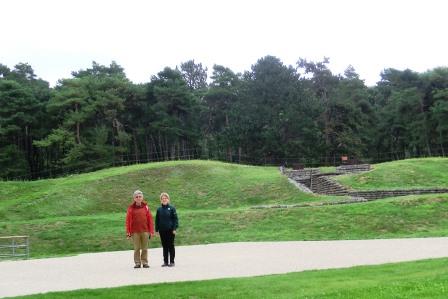
Vimy Ridge is now filled with trees. (Photo credit: Daria Valkenburg)

Johanne Gagné had given us a fantastic tour so far, but there was more.  In the next blog entry we visit the Canadian National Vimy Memorial, and bring along the photos of John Lymon Wood and Patrick Raymond Arsenault, whose names are inscribed on the memorial.

Comments or stories?  You can share them by emailing us at memorialtrail@gmail.com or by commenting on this blog.

© Daria Valkenburg

….Want to follow our research?….

If you are reading this posting, but aren’t following our research, you are welcome to do so.  Our blog address: https://onthewarmemorialtrail.com/

Front cover OnTheWarMememorialTrailinEurope4 countries, 6 weeks, 7,000 km – an unforgettable war memorial journey in Europe…. Daria’s book ‘No Soldier Buried Overseas Should Ever Be Forgotten‘ is available in print and e-book formats.  Net proceeds of book sales help support research costs and the cost of maintaining this blog. For more information see https://nosoldierforgotten.com/ 

You are also invited to subscribe to our YouTube Channel: On The War Memorial Trail With Pieter Valkenburg: https://www.youtube.com/channel/UCJ591TyjSheOR-Cb_Gs_5Kw

Never miss a posting!  Subscribe below to have each new story from the war memorial trail delivered to your inbox.
On The War Memorial Trail….A Visit To Vimy Ridge

September 12, 2017.  After a few hectic days when there was no time to do any writing as we were on the go from early morning until quite late in the evening, we now are settled for a few days in a quiet cottage in a forested area, and hopefully can catch up with all of the memorable days we’ve just experienced.

The most anticipated stop on our memorial trail of honouring the men listed on the Borden-Carleton Cenotaph was Vimy Ridge.  Two WWI soldiers are listed on the Canadian National Vimy Memorial, John ‘Lymon’ WOOD and Patrick Raymond ARSENAULT.

Our hotel was in Arras, and Vimy Ridge was a 20 minute drive from there.  Just before the turn-off to Vimy Ridge we passed through the town of Thélus.  There is one stop light in town.  To the left are signs directing you to cemeteries and memorials.  To the right are signs directing you to more memorials.

Right by the stop light is the Canadian Artillery Memorial, built to remember the sacrifice of Canadians from Artillery battalions who died in the battle for Vimy Ridge and the surrounding area.

CIMG8309 Sep 5 2017 Cdn Artillery Memorial in Thelus with sign posts

The Canadian Artillery Memorial in Thélus was built during WW1 by the Canadian Corps. (Photo credit: Daria Valkenburg)

It’s daunting to see how many reminders of war there are in France.  Everywhere you go, you see memorials and cemeteries – both civilian and military.  It’s a grim reminder of how many people lost their lives.  It’s impossible to ignore or forget.  And it’s a very big reminder of how many countries came to help in the Allied cause during World War I.  It truly became an international war.  Every one of them has at least one memorial and the war cemeteries are filled with Allied and German lives lost.

CIMG8270 Sep 2017 Pieter at entrance to Vimy Memorial Park

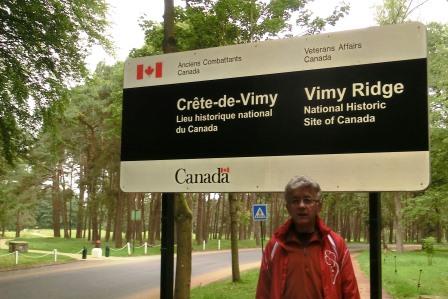
Pieter at the entrance to Vimy Ridge in France. (Photo credit: Daria Valkenburg)

The turn-off to the Vimy Ridge memorial and visitors centre is a tree-lined road, with jogging and walking paths, well used by citizens of the area.  It’s a public road that goes to the nearby villages of Givenchy and Vimy.

We were very lucky to have been given a guided tour of the Vimy Ridge Visitors Centre, which opened in April 2017, by site manager Johanne Gagné.

CIMG8275 Sep 5 2017 Pieter with site manager Johanne Gagne

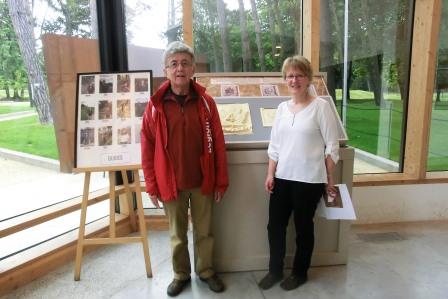
Pieter with Johanne Gagné, Senior Manager, European Operations at the Canadian National Vimy Memorial, who gave us a guided tour. (Photo credit: Daria Valkenburg)

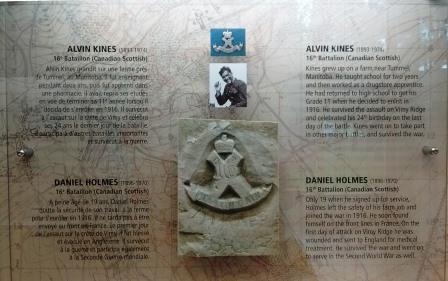
Among the many exhibits in the Visitors Centre is one that replicates the graffiti found in the tunnels of Vimy Ridge.  Using 3-D technology, exact replicas of the graffiti have been made, and researchers have tried, where possible, to provide a face and story to the men who made the graffiti.

Ms. Gagné noted that this graffiti display will be on tour in various places in Canada after leaving Vimy Ridge.  If it comes to your area, you won’t want to miss it!

We certainly had the right person to give us a tour, as Ms. Gagné worked for two years in Canada in developing the visitors centre before coming to France for two years as part of an interchange agreement with Parks Canada.  Hailing from Coteau-du-Lac, Quebec, she has a background in museology, exhibit design, and developing visitors programming.  Our interest was certainly caught, and this was from one exhibit only.

IMG_20170905_093513986 Sep 5 2017 Graffiti at Vimy Ridge by Kines & Holmes

Graffiti replicas of the 15th Battalion and a photo and short bio of two names inscribed below the insignia, that of Alvin Kines and Daniel Holmes. (Photo credit: Pieter Valkenburg)

The Visitors Centre has many interactive displays, in three languages (English, French, German), and one of the displays is very personal.  It tells the story of World War I from the perspectives of a young girl, a soldier, a nurse, etc, and all the stories are based on letters and diaries of real life people.

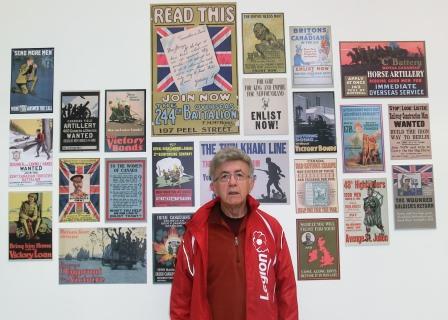
We were fascinated by a wall of patriotic signs, urging support for the war.

CIMG8277 Sep 5 2017 Vimy Ridge Visitors Centre Pieter by patriotic signs

Pieter by one of the displays of patriotic signs. (Photo credit: Daria Valkenburg)

An interactive display explained the troop movements during the Battle of Vimy Ridge on April 8, 1917.  Another interactive display gave a tour of the tunnels below Vimy Ridge. This was a marvellous solution to see the tunnels, especially if you were not physically capable of entering the tunnels yourself.

CIMG8283 Sep 5 2017 Daria by interactive displays in Vimy Ridge Visitors Centre

Daria by the interactive display of the Vimy Ridge tunnels. Behind are the displays of stories of WW1 by individuals. (Photo credit: Johanne Gagné)

We asked Ms. Gagné her perspective of the Vimy Ridge Visitors Centre and Memorial.  “Most of the time, people come and say that they came to honour the sacrifices made.  I asked myself, what does it mean to me?  Why have I spent three years on this project?  I’m giving the soldiers a voice.  I hope that through the exhibits, that we can show the public how the soldiers lived, what they saw, what they did, and close the loop by telling their stories”  The exhibits certainly do that.  They are interesting and well done.

The tour of the Visitors Centre over, it was time to see the rest of Vimy Ridge.  On Pieter’s bucket list was a tour of the tunnels, a wish that was granted, and discussed in the next blog.  While he and Ms. Gagné prepared themselves for the tunnels, I took a look at the tunnels from the comfort and safety of the Visitors Centre.

Comments or stories?  You can share them by emailing us at memorialtrail@gmail.com or by commenting on this blog.

© Daria Valkenburg

….Want to follow our research?….

If you are reading this posting, but aren’t following our research, you are welcome to do so.  Our blog address: https://onthewarmemorialtrail.com/

Front cover OnTheWarMememorialTrailinEurope4 countries, 6 weeks, 7,000 km – an unforgettable war memorial journey in Europe…. Daria’s book ‘No Soldier Buried Overseas Should Ever Be Forgotten‘ is available in print and e-book formats.  Net proceeds of book sales help support research costs and the cost of maintaining this blog. For more information see https://nosoldierforgotten.com/ 

You are also invited to subscribe to our YouTube Channel: On The War Memorial Trail With Pieter Valkenburg: https://www.youtube.com/channel/UCJ591TyjSheOR-Cb_Gs_5Kw

Never miss a posting!  Subscribe below to have each new story from the war memorial trail delivered to your inbox.
On The War Memorial Trail…..Paying Our Respects To Private Ellis Hooper

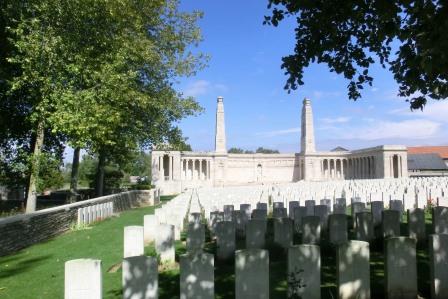
September 4, 2017.  After making the journey from The Netherlands to France, we stopped at our first French cemetery in the village of Aubigny en Artois, 15 km north-west of Arras.  Don’t let anyone tell you that the road between the Dutch border, through Belgium, and into northern France is quiet.  It isn’t!  It’s a madhouse on the highway!
And the names of places can get confusing.  We wondered why the GPS kept telling us to go in the direction of Rijssel – until we saw that the French name for Rijssel was Lille!

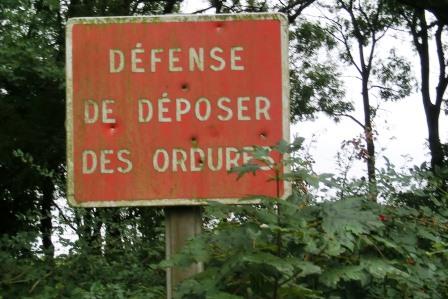
Then, just outside of Aubigny en Artois, we stopped at a parking spot off the highway, sort of like a rest stop but without any conveniences.  Pieter wanted to stretch his legs, but didn’t get very far when I saw a sign saying ‘Défense de déposer des ordures’.

CIMG8232

Memo to self… next time, bring a French-English dictionary! (Photo credit:  Pieter Valkenburg)

I saw the word ‘Défense’ and remembered all the stories about unexploded mines in the area.  While I had no idea what the rest of the sign said, I knew ‘Défense’ was a warning of some kind.  “Don’t go there”, I shouted, “it’s a mine field!”  Of course, Pieter paid no attention to me, and it wasn’t until we got to the hotel and I looked up the translation that we could laugh about it.  It says something along the lines of “Don’t dump your garbage”!

CIMG8234

We reach the village of Aubigny en Artois. (Photo credit:  Daria Valkenburg)

CIMG8258

Directions to the cemetery are clearly marked.  (Photo credit: Pieter Valkenburg)

CIMG8255

Entrance to the Aubigny Communal Cemetery.  The Extension is behind the cemetery, and has 2,771 Commonwealth burials from WWI and 7 from WWII.  There are 227 French burials prior to March 1916, and 64 German war graves. The original cemetery land was given to the commune of Aubigny in 1909 by former mayor Emile Delombre. (Photo credit:  Daria Valkenburg)

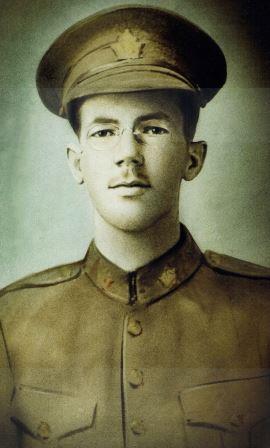
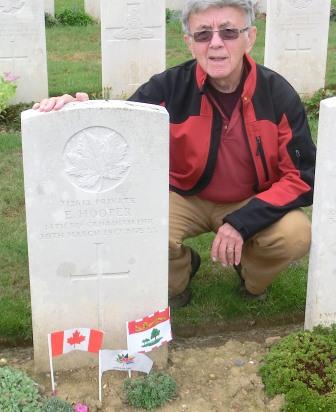
After the excitement of the parking spot sign, we finally reached the Aubigny Communal Cemetery Extension, and left the car to find the grave of Private Ellis Moyse HOOPER.  Hooper was born October 20, 1895 in Central Bedeque, son of Charles Frederick Allison Hooper and Bessie Marie nee Moyse.  Hooper enlisted in the 105th Battalion, C Company on March 4, 1916, and later transferred to the 14th Battalion of the Canadian Infantry. On March 30, 1917, he died at No. 30 Casualty Station of gunshot wounds to his leg and left arm.

Hooper, Ellis Moyse

Private Ellis Moyse Hooper.  (Photo credit:  Lana Churchill family collection)

CIMG8245

Right: Pieter by Hooper’s grave, after placing the flags of Canada, PEI, and Canada 150. (Photo credit:  Daria Valkenburg)

Hooper’s cousin, Ernest Shaw MARSHALL, of Ontario, who died May 3, 1917, is buried nearby.

cimg8246.jpg

Marshall’s grave was a few rows down from his cousin Hooper. (Photo credit:  Pieter Valkenburg)

As we left the cemetery, which is very well kept, we signed the guest register book. Each of the Commonwealth cemeteries has a register listing each soldier’s burial location, and there is a guest register.  If you visit, don’t forget to sign the register yourself!

CIMG8254

The register is in a compartment on the pillar by the entrance to the cemetery.  (Photo credit:  Daria Valkenburg)

This special visit was a prelude to our next stop on the memorial trail, the Vimy Memorial.  Comments or stories?  You can share them by emailing us at memorialtrail@gmail.com or by commenting on this blog.

© Daria Valkenburg

….Want to follow our research?….

If you are reading this posting, but aren’t following our research, you are welcome to do so.  Our blog address: https://onthewarmemorialtrail.com/

Front cover OnTheWarMememorialTrailinEurope4 countries, 6 weeks, 7,000 km – an unforgettable war memorial journey in Europe…. Daria’s book ‘No Soldier Buried Overseas Should Ever Be Forgotten‘ is available in print and e-book formats.  Net proceeds of book sales help support research costs and the cost of maintaining this blog. For more information see https://nosoldierforgotten.com/ 

You are also invited to subscribe to our YouTube Channel: On The War Memorial Trail With Pieter Valkenburg: https://www.youtube.com/channel/UCJ591TyjSheOR-Cb_Gs_5Kw

Never miss a posting!  Subscribe below to have each new story from the war memorial trail delivered to your inbox.