On The War Memorial Trail…..CWGC Volunteer At Cape Traverse Community Cemetery

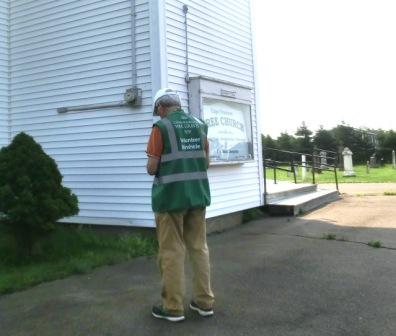
CWGC Volunteer Pieter trying to activate the Work App at Cape Traverse Community Cemetery.  (Photo credit: Daria Valkenburg)

August 8, 2025. Anyone who has visited a War Graves Cemetery managed by the Commonwealth War Graves Commission (CWGC) can attest to how well the graves are cared for and the incredible work done by the gardeners in ensuring that flowers and small shrubs are planted in each row of graves. 

And yes, the grass is kept green and well-watered, as we ourselves experienced while visiting one of the Canadian War Cemeteries in The Netherlands on a very hot day.  It wasn’t that I minded getting drenched, but I didn’t appreciate my carefully written spreadsheet of the graves to visit getting water-soaked!

We knew that the CWGC commemorates and cares for the graves of men and women of the Commonwealth that died during WWI and WWII, but were astounded to learn that this involves 1.7 million graves. Six member countries make up the CWGC– the United Kingdom, Canada, Australia, New Zealand, India, and South Africa.

According to the CWGC website, “… 23,000 locations in over 150 countries and territories….” are covered with “…. over 2,000 ‘constructed’ war cemeteries the largest being Tyne Cot in Belgium….” – which we had visited in 2017.

….Who is commemorated in a CWGC grave?…

CWGC commemorates personnel who died between August 4, 1914 and August 31, 1921 for WWI and September 3, 1939 and December 31, 1947 for WWII, while serving in a Commonwealth military force or specified auxiliary organization.

CWGC also commemorates those who died in the same WWI and WWII time period as above, after they were discharged from a Commonwealth military force, if their death was caused by their wartime service.

Commonwealth civilians who died between September 3, 1939 and December 31, 1947 as a consequence of enemy action, Allied weapons of war, or while in an enemy prison camp are also commemorated.

….Pieter is now a volunteer under CWGC’s National Volunteer Program…

Not all Canadians who died during WWI or WWII are buried overseas. They may have died of illness or accidents and were buried in Canada, but still have a CWGC gravestone.  Recently the CWGC asked for volunteers across Canada to be part of the National Volunteer Program and visit local cemeteries and gather information about the condition of CWGC war graves.

Having visited so many CWGC cemeteries, as well as CWGC graves in municipal cemeteries, in Europe, Pieter applied and was accepted as a volunteer.  After receiving training on how to inspect headstones, how to report a grave in need of repair, and how to safely clean headstones where required, he was assigned 4 cemeteries in the South Shore area on Prince Edward Island.   The 4 cemeteries are:

  • Cape Traverse Community Cemetery (3 CWGC graves)
  • Tryon People’s Cemetery (2 CWGC graves)
  • Kelly’s Cross (St Joseph) Parish Cemetery (1 CWGC grave)
  • Seven Mile Bay (St Peter’s) Cemetery  (4 CWGC graves)

….There are 3 CWGC graves at Cape Traverse Community Cemetery…
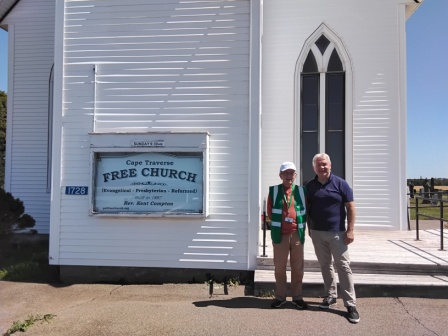
Pieter with Rev Kent Compton outside the Free Church of Scotland in Cape Traverse. (Photo credit: Daria Valkenburg

Cape Traverse Community Cemetery, formerly known as the Free Church of Scotland Cemetery, was first on Pieter’s list. A sub-committee of the Cape Traverse Ice Boat Heritage Incorporated maintains the cemetery on behalf of the Free Church of Scotland.  “…The church is still responsible for the cemetery and owns the land….” explained Reverend Kent Compton. 

Jim Glennie (left) and Andrew MacKay (right) with Pieter Valkenburg (centre).  (Photo credit: Daria Valkenburg)

…This is the third summer that we’re cutting the grass at the cemetery…” reflected Andrew MacKay. Andrew and Jim Glennie, two volunteers with the organization, said that the organization had been approached for help by older parishioners in the community.

….Three CWGC graves were inspected at Cape Traverse Community Cemetery…

There are 3 CWGC graves in this cemetery, whose stories have all been told over the years on this blog:

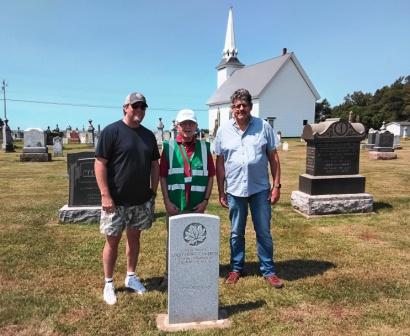
Andrew MacKay (left), Pieter Valkenburg (centre) and Jim Glennie (right) at the grave of Leigh Hunt Cameron.  (Photo credit: Daria Valkenburg)

….The 6 step process of inspecting and cleaning a grave…

The first grave Pieter inspected and cleaned at the Cape Traverse Community Cemetery was that of Elmyr Kruger…..

Step 1 – Take a photo of Elmyr’s  grave before cleaning begins.  (Photo credit: Daria Valkenburg)

Step 2 – Take a photo of the graves that are around Elmyr’s grave.  (Photo credit: Daria Valkenburg)

Step 3 – Gently brush off dirt on Elmyr’s grave.  (Photo credit: Daria Valkenburg)

Step 4 – Wash Elmyr’s grave with water.  (Photo credit: Daria Valkenburg)

Step 5 – Gently brush dirt off of the sides and back of Elmyr’s grave.  (Photo credit: Daria Valkenburg)
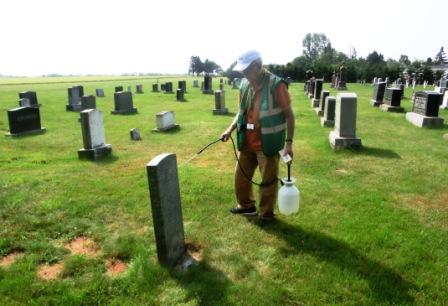
Step 6 – Wash the sides and back of Elmyr’s grave with water.  (Photo credit: Daria Valkenburg)

….Over 100 years old but a very clean grave now…
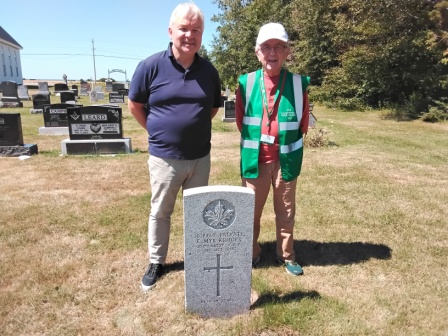
Rev Kent Compton and Pieter by the WWI grave of Elmyr Kruger.  (Photo credit: Daria Valkenburg)

The grave of Elmyr Kruger has been in place in the cemetery since October 1918, and now looks almost like new after being cleaned! Rev Compton and Pieter visited Elmyr’s grave a few days after it was cleaned.

….Can you help with finding photos?…

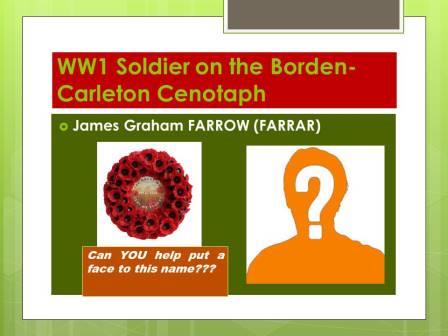
While a photo of Harold ‘Lloyd’ Lefurgey was provided by family years ago, no photo has yet been found for Elmyr Kruger or Leigh Hunt Cameron.  If you can help with finding a photo, please email Pieter at memorialtrail@gmail.com or comment on the blog.

When asked about his new role as a CWGC volunteer, Pieter had a simple reply. “…It’s an honour for me to take care of those graves, which I’ve already visited several times as a member of the Borden-Carleton Legion Branch, when we place flags at the graves of veterans during Remembrance Week…” (See https://onthewarmemorialtrail.com/2024/11/03/on-the-war-memorial-trail-borden-carleton-legion-honours-veterans-by-placing-flags-at-their-graves/)

© Daria Valkenburg

….Want to follow our research?…

If you are reading this posting, but aren’t following our research, you are welcome to do so.  Our blog address: https://onthewarmemorialtrail.com/
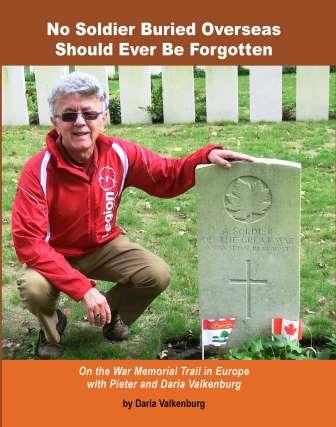
4 countries, 6 weeks, 7,000 km – an unforgettable war memorial journey in Europe…. Daria’s book ‘No Soldier Buried Overseas Should Ever Be Forgotten‘ is available in print and e-book formats.  Net proceeds of book sales help support research costs and the cost of maintaining this blog. For more information see https://nosoldierforgotten.com/

Subscribe to our YouTube Channel: On The War Memorial Trail With Pieter Valkenburg: https://www.youtube.com/channel/UCJ591TyjSheOR-Cb_Gs_5Kw

Never miss a posting!  Subscribe below to have each new story from the war memorial trail delivered to your inbox.

The WWI Names On The Cenotaph Have Stories Of Their Own

February 8, 2020. Recently, Pieter and a friend went to see the British WW1 movie ‘1917’, which is nominated for several Oscars and has a Canadian connection due to a map used in the film.  (For that story see https://www.cbc.ca/news/entertainment/1917-canadian-contribution-1.5450608)  The story takes place in France on April 6, 1917, and is about two men tasked with delivering a message to another unit to warn of a German ambush.  The men go through several towns and villages in France’s Western Front.  Canadians may remember this period as being the lead up to the Battle of Vimy Ridge on April 9, 1917.

Pieter found the movie of great interest for several reasons. It was a depiction of the horrors of war… without being overly gory.  After being through the trenches and tunnels in Vimy Ridge a few years ago, he was intrigued to see the way soldiers sat on either side of a trench while waiting to go up into battle.   But the main reason he liked the movie is that it told the story of two people.

Contrary to what we learn in history books and classes, in the end all history is the cumulative stories of individuals.  A list of names on a cenotaph, such as the one outside the Borden-Carleton Legion, is meaningless without knowing who those people were and what happened to them.  This is what started Pieter on the journey to uncover the stories behind the names on the Cenotaph.

Over the years, the stories of those from WWI have been told in this blog.  24 are listed on the Cenotaph and half of them died in France…. Patrick Raymond ARSENAULT and John Lymon ‘Ly’ WOOD are listed on the Vimy Memorial as their bodies were never identified.    Also killed in France were Kenneth John Martin BELL, James CAIRNS, James Ambrose CAIRNS, Arthur Leigh COLLETT, Bazil CORMIER, Patrick Phillip DEEGAN (DEIGHAN), Joseph Arthur DESROCHES, Percy Earl FARROW (FARRAR), Ellis Moyse HOOPER, and Charles W. LOWTHER.  We were at the Vimy Memorial and visited each grave.

Five men died in Belgium. Two are listed on the Menin Gate Memorial in Ypres, as their bodies were never identified: Charles Benjamin Murray BUXTON and George Albert CAMPBELL.  We visited Menin Gate and the area where they died.  We also visited the graves of James Lymon CAMERON, Vincent Earl CARR, and Arthur Clinton ROBINSON.

Vincent Carr, who died during the Battle of Passchendaele on October 30, 1918, was initially buried in a trench with 4 others – two Canadian and two British soldiers.  Decades later, when they were reburied in a Commonwealth War Graves Commission cemetery, all three Canadians were still identifiable.  The British Army’s cardboard identity ‘tags’ had disintegrated, leaving the two British soldiers as unidentified.  Today, DNA testing can be done to help with identity, but decades ago this was impossible.

Two men died in England.  John Goodwill HOWATT was wounded in France, and died in a British hospital.  Bruce Sutherland McKAY had gotten ill during the transport from Canada to England and also died in a British hospital.

Henry Warburton STEWART survived the war, only to fall ill while in Germany as part of the occupation forces.  He’s buried in a German cemetery in Cologne, which we visited.

James Graham FARROW (FARRAR) was not a soldier, but in the Merchant Navy, transporting vital supplies between England and France, when his ship was torpedoed by a U-boat.

Three men died on Canadian soil.  Leigh Hunt CAMERON died of illness, while Harry ROBINSON died from blood poisoning.  William Galen CAMPBELL was poisoned with mustard gas on May 28, 1918, a few months before the end of the war, but was able to return home.  And yes, we’ve visited those graves as well.

We were also able to tell you parallel stories, such as that of Clifford Almon WELLS, who had many of the same experiences as John Lymon Wood, and also died in France. Another story was that of George BRUCKER, of the German Army, who was taken prisoner during the Battle of Vimy Ridge, and survived the war, never forgetting the two ‘tall’ Canadians who didn’t shoot him.  Decades later his son, now in his 80s, is still hoping to thank the families of those two unknown men.

Thanks to Pieter’s curiosity in trying to find out why one Commonwealth War Graves Commission gravestone in a cemetery in Cape Traverse was not recorded on the Cenotaph, we were able to tell you the story of Elmyr KRUGER, a soldier from Saskatchewan who died of illness while guarding German prisoners of war from a POW camp in Amherst.

We’ve told the stories of each man, and shared our visits to the various cemeteries and war memorials.  As photos and letters came in, we shared those experiences as well.

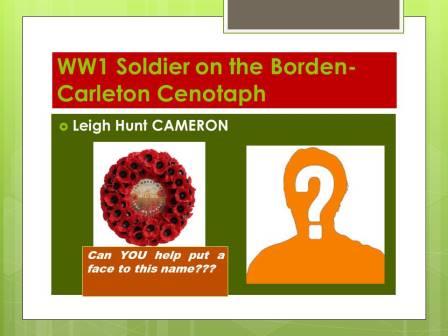
We are still missing photos of several of these soldiers, so the quest to put a face to every name and story is still ongoing.  Who are we missing?  Take a look and see if you can help:

Slide6

Slide8

Slide9

Slide10

Slide13

Slide15

Slide16

Slide20

Slide22

Slide23

UPDATE:  Photos of James Cairns, Joseph Arthur Desroches, and Harry Robinson have been found!

It’s great to watch a movie about fictional characters, but let’s not forget the stories of real life people! There won’t be any Academy Awards given out, but they will be remembered. Research continues to uncover more stories.  If you have a story or photo to share about any of the names mentioned in this posting, please contact Pieter at memorialtrail@gmail.com or comment on the blog.

© Daria Valkenburg

....Want to follow our research?…

If you are reading this posting, but aren’t following our research, you are welcome to do so.  Our blog address: https://onthewarmemorialtrail.com/

4 countries, 6 weeks, 7,000 km – an unforgettable war memorial journey in Europe…. Daria’s book ‘No Soldier Buried Overseas Should Ever Be Forgotten‘ is available in print and e-book formats.  Net proceeds of book sales help support research costs and the cost of maintaining this blog. For more information see https://nosoldierforgotten.com/

Subscribe to our YouTube Channel: On The War Memorial Trail With Pieter Valkenburg: https://www.youtube.com/channel/UCJ591TyjSheOR-Cb_Gs_5Kw

Never miss a posting!  Subscribe below to have each new story from the war memorial trail delivered to your inbox.
On the War Memorial Trail …..Update on Previous Postings about Elmer Muttart and Elmyr Kruger

November 3, 2018.   Once we tell a story about a particular person in this project, it usually turns out to be just the beginning of that person’s story.  Since this blog began, we’ve included updates, and we’ll continue to do so.  In this posting, we have two brief updates on two stories.

1. Elmer MUTTART, the PEI pilot from WWII: Several postings have been made about this pilot’s story and the work being done by Pieter, the Missing Airmen Memorial Foundation in The Netherlands, and the Tryon and Area Historical Society in Canada, to install a memorial panel in Wons, The Netherlands to honour Elmer and the crew of the Halifax bomber that was shot down on October 12, 1941.

UPDATE:  This project was completed in October 2019!

UPDATE: The ceremony to install the memorial panel is scheduled for October 12, 2019 in The Netherlands. 

Donations are still being collected towards the ‘Muttart Memorial Fund’ for a memorial panel in Wons, The Netherlands.  If you would like to donate, cheques may be written out to TAHS and mailed to Tryon & Area Historical Society (TAHS), PO Box 38, Crapaud PE C0A 1J0.  In the subject line, identify your cheque as being for the “Muttart Memorial Fund”.  A charitable donation receipt will be sent to all donors. 

If you wish to donate and you live in Europe:  Bank transfers may be made to Stichting Missing Airmen Memorial Foundation, Bank Account # (IBAN) NL35ABNA0569579856, and state in the subject line “Attn D.S. Drijver for Halifax L9561”.

2. Elmyr KRUGER, the WWI soldier from the prairies who is buried in Cape Traverse, PEI:  Elmyr’s story was told in a recent posting and in an article published in the County Line Courier. (See https://onthewarmemorialtrail.com/2018/10/25/the-forgotten-ww1-soldier/)

UPDATE: Pieter contacted the City of North Battleford Historic Archives and told them the story and asked if they might have more information and a photo.  After a search, archivist Tammy Donahue Buziak found a photo of the 232nd Battalion.  As Tammy wrote “Elmyr would most likely be in this image somewhere….”  Hopefully, one day, someone will identify Elmyr.  This story is getting quite a bit of attention.  We’ll have to rename the story the ‘No Longer Forgotten WWI Soldier’!

232nd Battalion

232nd (Saskatchewan) Overseas Battalion. (Photo courtesy of The City of North Battleford Historic Archives)

On October 31, the story that ran in the County Line Courier was republished in The Battlefords News-Optimist under the title ‘Forgotten First World War soldier from Mullingar. (See https://www.newsoptimist.ca/community/local-culture/forgotten-first-world-war-soldier-from-mullingar-1.23481997 and https://www.sasktoday.ca/north/in-the-community/forgotten-first-world-war-soldier-from-mullingar-4126223)

If you have photos or information to share on soldiers from the Cenotaph outside the Borden-Carleton Legion, please let us know. Send us an email to to memorialtrail@gmail.com, comment on the blog, or tweet to @researchmemori1.

UPCOMING PRESENTATION: Pieter has been invited to be a guest speaker at St John The Evangelist Church in Crapaud during their Remembrance Day service, which begins at 10:30 am on Sunday, November 11, 2018.

© Daria Valkenburg

….Want to follow our research?….

If you are reading this posting, but aren’t following our research, you are welcome to do so.  Our blog address: https://onthewarmemorialtrail.com/

Front cover OnTheWarMememorialTrailinEurope4 countries, 6 weeks, 7,000 km – an unforgettable war memorial journey in Europe…. Daria’s book ‘No Soldier Buried Overseas Should Ever Be Forgotten‘ is available in print and e-book formats.  Net proceeds of book sales help support research costs and the cost of maintaining this blog. For more information see https://nosoldierforgotten.com/ 

You are also invited to subscribe to our YouTube Channel: On The War Memorial Trail With Pieter Valkenburg: https://www.youtube.com/channel/UCJ591TyjSheOR-Cb_Gs_5Kw

Never miss a posting!  Subscribe below to have each new story from the war memorial trail delivered to your inbox.

On the War Memorial Trail …..The Forgotten WWI Soldier

October 25, 2018. Every November, volunteers from the Borden-Carleton Legion place Canadian flags at the graves of veterans in its service area.  This is a large undertaking, as veterans are buried at 9 cemeteries.  Most of the veterans in the cemeteries were survivors of wars and long after their period of active service. 

While most of the names listed on the Cenotaph outside the Borden-Carleton Legion died while on active service overseas, there are a few listed who died in Canada in accidents or from illness, while on active service during WWI or WWII.

Pieter wondered why one veteran, who died while on active service during WWI and is buried at the Free Church of Scotland Cemetery in Cape Traverse, wasn’t listed on the Cenotaph.  Was he missed?  He visited the cemetery to see the grave.  It was indeed a Commonwealth War Grave, showing that Elmyr KRUGER had died October 21, 1918.  (2024 NOTE:  The cemetery is now called Cape Traverse Community Cemetery)

cimg2643-sep-23-2018-elmyr-kruger-church-of-scotland-cemetery-cape-traverse.jpg

Grave of Elmyr Kruger at the Free Church of Scotland Cemetery in Cape Traverse. (Photo credit: Pieter Valkenburg)

He tried to find family on the island.  No one knew who Elmyr Kruger was.  He found a radio interview with Dr. Helen Herring, in which she recalled stories of “German prisoners of war who died of influenza being secretly buried at night in the cemetery.”  This wasn’t the first time Pieter had heard stories of German POWs buried on the island, but there was no proof.

….Elmyr was from Saskatchewan!….

While Kruger was a German name, and it was a puzzle why he was buried in a cemetery with mostly Scottish names, he had clearly been a Canadian soldier.  Pieter decided to investigate further.  From a search of the Canadian Virtual War Memorial, run by Veterans Canada,  he very quickly he learned that Elmyr was from the prairies, the son of Frank and Margaret Kruger of Millingar, North Battleford, Saskatchewan.

From his service file and research at Library and Archives Canada, Pieter discovered that Elmyr’s story was tied to the story of German POWs on the island, and a shameful episode in the way that WWI soldiers were treated by the local managers of the Canadian Government Railways.

Elmyr’s father Frank, who was born in Prussia, immigrated to the USA at age 2 with his family. After 21 years in the USA, the family moved to Manitoba in 1891.  His mother Margaret, nee Forsyth, was born in Manitoba, and had Scottish heritage.  Elmyr was born November 1, 1896 in the farming community of Melita, Manitoba, the oldest of 5 children.  Later the family moved to Millingar, Saskatchewan to farm there. 

When he enlisted on May 28, 1916 it would have been a hardship to his family, as he would have been the only son old enough to help on the farm.  Upon enlistment he was assigned to the newly formed 232nd (Saskatchewan) Overseas Battalion of the Canadian Expeditionary Force, where he unfortunately contracted measles and was hospitalized in North Battleford for two weeks, the Battalion’s base.

….Elmyr was transferred to the 6th Battalion Regiment for escort duty….

The 232nd Battalion was disbanded in the spring of 1917.  On July 21, 1918, Elmyr was transferred to the 6th Battalion Canadian Garrison Regiment from the 12th Battalion Canadian Garrison Regiment for escort duty.

There was a German prisoner of war camp in Amherst, Nova Scotia.  In 1918, an agreement was made to bring German prisoners to work on the Borden branch of the Prince Edward Island Railway. The July 6, 1918 Guardian newspaper noted that 60 prisoners, accompanied by guards and officers, would be coming to the Island for the purpose of “doing such labour as ditching, putting in new ties, ballasting and putting the road in shape for the new rails to be laid in September.  Eleven box cars are now being fitted up at the railway yard in Charlottetown for housing and otherwise accommodating the prisoners.  These include two dining cars, five sleeping cars, two officers’ cars, one car for cooking and another…

On August 5, 1918, the Guardian reported that 50 German prisoners, guarded by 27 men, arrived on the Island.  On August 17, 1918, the Guardian explained that the prisoners were mostly “soldiers from the big liner Kaiser Wilhelm der Grosse…”, with …several first class engineers among the number…”  The liner was captured by the British off the coast of Africa in August 1914, and most of the crew ended up in Amherst Internment Camp.

….Poor living conditions contributed to the illness and death of Elmyr and two other guards….

According to the doctor’s report, Elmyr became ill on October 11, 1918.  A report to the Commanding Officer of the Amherst Internment Camp, filed by Lt R. Dunbar-Abbott, the officer in charge of the prisoner of war camp in Port Borden, who himself had been ill, outlines the frustrating events that may have contributed to the illness and subsequent deaths of three men.  “While I was ill in hospital, a bad smell was noticed in the sleeping cars of the men.  Sgt Major Lucas had the floor boards taken up and found about 6 inches of manure underneath (human, horse, cow, and sheep).  The attention of Dr. J. McNeill was called to it and he remarked that it was not fit for cattle to live in.  Many of the cars leaked.  This was reported on September 27 and on several occasions after but nothing was done until November 7.  With the exception of the cook cars nothing was done to the other cars…

The reporting of the stinking cars was done to a Mr. Grady of the Railway.  He doesn’t come off well in the report, as the report is filled with Grady’s complaints about the cost of food for those working on the railway, and his refusal to help when men started to fall ill.  “Referring to the treatment on the outbreak of influenza, on October 12th I wired your instructions to Mr. Grady that proper accommodation should be provided for the sick.  Nothing was done until the 15th when an extra box car was sent to us, ostensibly to be used as a cook car but no stove was sent until late on the night of the 16th.  In the meantime food had to be cooked in a farm house and carried to the car by Mrs. Abbott, who helped me out…

In addition to his wife delivering food, Lt. Dunbar-Abbott received help from the Roman Catholic church.  “We were visited by the Rev. Father McIntyre, who, seeing the appalling state of affairs, obtained the sanction of his Bishop to use their Mission Hall at Borden as a hospital where 10 military patients and civilian cook MacDonald were moved in on the night of October 17th.  Next day three Railway employees were moved in, three of our men dying a few days later of pneumonia…

Repeated applications were made to Mr. Grady to provide a cook without any result…”  The report goes on to say that “farmers refused milk, and the stores supplies if they were on Mr. Grady’s account. I only procured them on my own personal account, in case Mr. Grady refused to pay…”  He noted that that he received no reply from Grady to his request for a cook or food supplies for the sick.

On October 17, two orderlies arrived.  A nursing sister plus hospital equipment came the following day to help at the temporary hospital.  “Later, a night nurse was sent for as the work was more than Mrs Abbott and Sister Fitzgerald could handle, the cases being so serious, and no cook….

Help came too late for Elmyr, who died in Port Borden (now Borden-Carleton) at 8 pm on October 21, 1918 of pneumonia after contracting Spanish flu. He was one of three guards who died.

On October 25, 1918, Sgt-Major Lucas reported on Elmyr’s burial.  “Acting on instructions from Lt. R. Dunbar-Abbott, I took the remains from Port Borden to the cemetery at Cape Traverse where he was buried.  I had a firing party of 6 men and 4 pallbearers…

According to the October 29, 1918 Guardian newspaper, two military funerals were held that day.  In addition to Pte Kruger, Pte John Richard, who died October 20, 1918 of pneumonia following Spanish flu, had his funeral at the same time as Pte Kruger.  The paper explained that “the deceased soldiers were returned men acting as guards at the Internment camp here. A firing party consisting of 15 men marched behind the remains of their dead comrades…”, after which the body of Richard went on to Amherst, while services for Kruger’s burial in Cape Traverse “were conducted by the Rev. James McDougald…” 

On October 31, 1918 a Court of Inquiry was held into Elmyr’s death and concluded that he “died from natural causes and that no blame is attachable to anybody…” No mention was made of the appalling and unsanitary conditions that the soldiers were subjected to.

There are no records of German prisoners of war being buried on Prince Edward Island.  Pte Elmyr Kruger, who was sent from Saskatchewan as one of the guards, is only one of the three guards buried on the island. Pte Richard was buried in Sackville, New Brunswick.  The third guard, Acting Corporal D. McKee, died on October 26, 1918.  His body was sent to Fargo, North Dakota for burial. We don’t know why Elmyr’s body was not sent to Saskatchewan for burial, nor has Pieter been able to find a photo of Elmyr.  But he’s no longer a forgotten soldier.

If you can add to this story, have photos or information to share on soldiers from the Cenotaph outside the Borden-Carleton Legion, or soldiers buried in The Netherlands, please let us know. You can share them by sending an email to memorialtrail@gmail.com or by commenting on this blog.

UPCOMING PRESENTATION: Pieter will speak about the Cenotaph Research Project at South Shore United Church in Tryon, 7 pm on Friday, November 2, 2018.  This event is co-hosted by South Shore United Church and Tryon & Area Historical Society.  Note: this venue is equipped with a hearing loop for the benefit of those with hearing loss.  You are invited to bring photos and information on the men listed on the Cenotaph, or on any Canadian soldier buried in The Netherlands.  Email memorialtrail@gmail.com for more info.

UPCOMING PRESENTATION: Pieter has been invited to be a guest speaker at St John The Evangelist Church in Crapaud during their Remembrance Day service, which begins at 10:30 am on Sunday, November 11, 2018.

© Daria Valkenburg

….Want to follow our research?….

If you are reading this posting, but aren’t following our research, you are welcome to do so.  Our blog address: https://onthewarmemorialtrail.com/

Front cover OnTheWarMememorialTrailinEurope4 countries, 6 weeks, 7,000 km – an unforgettable war memorial journey in Europe…. Daria’s book ‘No Soldier Buried Overseas Should Ever Be Forgotten‘ is available in print and e-book formats.  Net proceeds of book sales help support research costs and the cost of maintaining this blog. For more information see https://nosoldierforgotten.com/ 

You are also invited to subscribe to our YouTube Channel: On The War Memorial Trail With Pieter Valkenburg: https://www.youtube.com/channel/UCJ591TyjSheOR-Cb_Gs_5Kw

Never miss a posting!  Subscribe below to have each new story from the war memorial trail delivered to your inbox.