On The War Memorial Trail…..Found – Engine Part From The Last Flight Of Halifax L9561

Politiek Farm on the left with the village of Wons on the right. (Photo courtesy of Remko de Jong)

July 29, 2025.  After visiting 4 cemeteries in Friesland on the last day of April during our 2025 European War Memorial Tour, we were hot and tired, and faced a long drive back to where we were staying.  (See https://onthewarmemorialtrail.com/2025/07/23/on-the-war-memorial-trail-our-visit-to-4-cemeteries-in-friesland/)

However, we continued on to the village of Bolsward, as Makkum resident Remko de Jong had been informed that part of the engine from the last flight of Halifax L9561, which had been found on the Politiek Farm in Wons, was being displayed at an exhibition in the De Tiid (The Times) Museum in Bolsward. 

Map shows the location of the Politiek farm, the crash site where Halifax L9561 came down, and location of the Memorial Panel placed in 2019 in Wons.  (Map courtesy of Remko de Jong)

When we were at Harlingen General Cemetery earlier that day, we placed flags at the grave of RCAF Flight Sergeant Elmer Bagnall MUTTART of Cape Traverse, Prince Edward Island, who died on the night of October 12, 1941, at the age of 23, when the plane he was piloting was attacked by German nightfighters, and crashed near the village of Wons.  Elmer’s story has been well documented on this blog over the past years. (See https://onthewarmemorialtrail.com/2017/07/28/the-elmer-bagnall-muttart-story/)

The burning plane had crashed on the Politiek Farm, which we had visited in 2017. (See https://onthewarmemorialtrail.com/2018/02/07/on-the-war-memorial-trail-at-the-politiek-farm-in-wons/)

….Part of the engine from Halifax L9561 was found in 2023…

On October 22, 2023, Remko de Jong had sent photos, informing Pieter of a surprise discovery….. A piece of the engine from the last flight of Halifax L9561 had been found on the Politek farm in Wons. “… This is the front section attached to the main engine with the three propeller blades. … This engine was found five weeks ago on the land where Elmer Muttart’s Halifax crashed….I don’t yet know what will happen to it or where it will be displayed….”  (NOTE: Translation from the original Dutch)
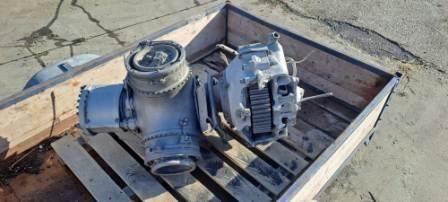
Engine part from Halifax L9561 found on the Politiek farm in 2023.  (Photo courtesy of Remko de Jong)

On October 30, 2023, Douwe Drijver of the Missing Airmen Memorial Foundation informed Pieter that “Mr. Cor Politiek from Wons recently informed us that a part of the Halifax had been found….” After photos were received, they were able to “….determine what was pulled from the clay. It’s the transmission from the engine to one of the propellers. The three blades were attached to this….”  (NOTE: Translation from the original Dutch) 

Any excitement about the find was tempered by uncertainty as to what would happen next. “…. If these are found at a depth of more than 30 centimetres, they are considered archaeological finds. This means they must be reported to the municipality or province. Mr. Politiek has since arranged this. There is now a chance that the transmission will be confiscated. Because the municipality responded with understanding, I advised everyone to do business with them….”  (NOTE: 30 cm is 11.8 inches)

….The engine part was sent to a museum in Bolsward…

Remko explained that the part had been found while using a metal detector, and that it was “….buried 1 to ½ metres below the ground…” on the Politiek farm.  “…Because of the depth at which the engine part was found, it was deemed the property of the province and therefore had to be sent to the museum in Bolsward….”  (NOTE: Translation from the original Dutch)

We heard nothing more about the find until this year, when Remko was informed that the engine would be displayed in an air exhibition at the regional museum in Bolsward towards the end of April.  He made an appointment for the three of us to visit the museum and to meet with the curator, as it turned out that no one in the museum was aware of the heroism displayed by Elmer Muttart in saving his crew and the village of Wons …. at the expense of his own life. 

Before we left for our trip, we shared the short documentary we’d made about the events that led up to a memorial panel being placed in Wons…..and we brought newspaper articles for the museum to have in its collection. See ‘He Died That We Might Live …the story of Halifax L9561(S1E2)’ …..

….The engine part was not on display in Bolsward…

When we arrived at the De Tiid Museum in Bolsward, we were met with disappointment.  The Air Exhibition did not display the engine part, nor did we see the curator.  Instead, one of the archivists, Nena Huizinga, came and showed us the engine part – which was on the floor in a closet, and not on display.

Nena Huizinga with Remko de Jong and Pieter beside the engine part sitting on the floor of a closet in De Tiid Museum in Bolsward.  (Photo credit: Daria Valkenburg)
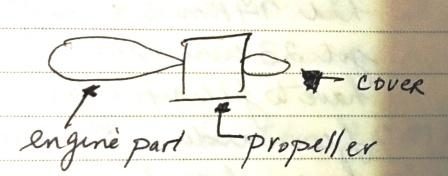
Sketch of the engine part from Halifax L9561, as drawn by Daria Valkenburg

Nena explained that she had watched the video, and was interested in the newspaper articles, as the story about Halifax L9561 was not one that the archivists at the museum were familiar with.  She didn’t know why the engine part was not part of the Air Exhibition, but said she would find out what happened.
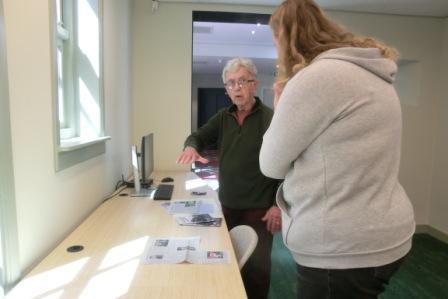
Pieter explaining to Nena Huizinga how the plane came down just outside Wons.  (Photo credit: Daria  Valkenburg)

….An explanation on why the engine part was not on display…

The next day, we received an email from Nena about the engine part and why it was sitting in a closet.  “….Today I asked the museum….why the engine block was not on display.” It had originally been part of the Air Exhibition, but “…apparently it was too heavy and the engine block had fallen through the museum furniture….” on which it had been displayed.  “….It was also leaking oil….”  (NOTE: Translation from the original Dutch) 

She went on to explain that “…next week they will look at it again, and hope to find a solution so that it can still be included in the exhibition….” Remko is actively following up on this story but unfortunately, almost 3 months after our visit, the engine part is still not on display. 
This concluded our visit to Friesland.  We’ll continue to share the highlights of our adventures on the 2025 European War Memorial Trail on our journey of remembrance. 

The research work continues for Pieter. If you have photos or information to share about soldiers buried in The Netherlands or Belgium, please email him at memorialtrail@gmail.com, or comment on the blog.    

© Daria Valkenburg

….Want to follow our research?…

If you are reading this posting, but aren’t following our research, you are welcome to do so.  Our blog address: https://onthewarmemorialtrail.com/
4 countries, 6 weeks, 7,000 km – an unforgettable war memorial journey in Europe…. Daria’s book ‘No Soldier Buried Overseas Should Ever Be Forgotten‘ is available in print and e-book formats.  Net proceeds of book sales help support research costs and the cost of maintaining this blog. For more information see https://nosoldierforgotten.com/

Subscribe to our YouTube Channel: On The War Memorial Trail With Pieter Valkenburg: https://www.youtube.com/channel/UCJ591TyjSheOR-Cb_Gs_5Kw

Never miss a posting!  Subscribe below to have each new story from the war memorial trail delivered to your inbox.

On The War Memorial Trail…..Our Visit To 4 Cemeteries In Friesland

July 23, 2025.  On a scorching hot sunny day, we travelled 2 hours to the province of Friesland, where we had planned to place flags at 4 cemeteries and to meet with Remko de Jong, a resident of Makkum, who coordinates the Christmas Eve Candle Lighting ceremony in his village and has shared photos with us for several years. (See https://onthewarmemorialtrail.com/2023/12/31/2023-christmas-eve-candle-lighting-in-the-netherlands/)

….Flags placed at 11 graves in Harlingen General Cemetery…

Our first stop on the war memorial trail in Friesland was at Harlingen General Cemetery in Harlingen, where we placed flags at 11 graves, 9 of them the graves of Canadian airmen. 

Daria at Harlingen General Cemetery.  (Photo credit: Pieter Valkenburg)

Pieter snapped the above photo of me at Harlingen General Cemetery, one of the 4 small cemeteries we visited today in the province of Friesland.  You can see me with a clipboard with names of the men and the provinces they came from so we knew which graves to visit and which provincial flags to place.

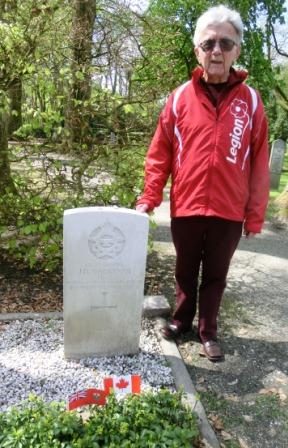
Pieter placing flags of Canada and Prince Edward Island at the grave of Elmer Bagnall Muttart. (Photo credit: Daria Valkenburg)

Our main reason for the trip to this cemetery was to place flags at the grave of RCAF Flight Sergeant Elmer Bagnall MUTTART of Cape Traverse, Prince Edward Island, who died on the night of October 12, 1941, at the age of 23, when the plane he was piloting was attacked by German nightfighters, and crashed near the village of Wons.  Elmer’s story has been well documented on this blog over the past years. (See https://onthewarmemorialtrail.com/2017/07/28/the-elmer-bagnall-muttart-story/)

Grave of Elmer Bagnall Muttart.  (Photo credit: Pieter Valkenburg)

We also placed flags at the grave of an unknown airman, in tribute to Rowan Charles ‘Bunky’ FITZGERALD of Charlottetown, Prince Edward Island, who lost his life on June 28, 1942, when the plane he was on was attacked and crashed into the sea.  His body has never been identified.  It’s not known if he’s buried in an unknown grave in this cemetery, but we lay flags there as one crew member from Australia was identified and is buried in the row behind Elmer Muttart. (See https://onthewarmemorialtrail.com/2022/10/12/on-the-war-memorial-trail-well-never-forget-uncle-bunky/)

We placed flags of Canada and Prince Edward Island at this unknown grave in honour of Rowan Charles ‘Bunky’ FitzGerald.  (Photo credit: Pieter Valkenburg)

In addition to visiting these two graves, we also placed flags at the graves of:

  • William Raymond James BROWN of Vancouver, British Columbia, died September 29, 1941 while serving in the RCAF
  • Donald Edward CAMPBELL of Rouleau, Saskatchewan, died June 26, 1943 while serving in the RCAF
  • Francis Arthur DAVIEAUX of Sioux Ste Marie, Ontario, died July 14, 1945 while serving in the Ontario Regiment
  • James MCDOWELL of Port Arthur (now part of Thunder Bay), Ontario, died May 16, 1943 while serving in the RCAF
  • Murray Hudley NESBITT of Toronto, Ontario, died May 13, 1943 while serving in the RCAF
  • John Beverley PLEASENCE of Chatham, Ontario, died July 22, 1942 while serving in the RCAF
  • William Maurice POPPLESTONE of Pilot Mound, Manitoba, died March 26, 1942 while serving in the RCAF
  • Thomas ‘Tommy’ Clayton REID of Toronto, Ontario, died July 22, 1945 while serving in the Sherbrooke Fusiliers
  • Robert WISHART of Hamilton, Ontario, died July 22, 1942 while serving in the RCAF

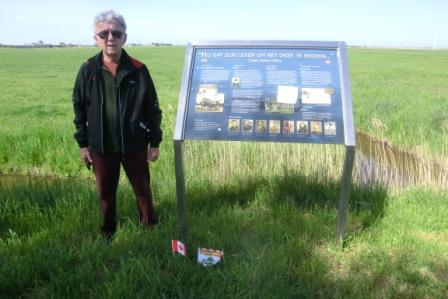
From Harlingen, we went towards Makkum, stopping at the Halifax L9561 Memorial Panel in Wons to place flags of Canada and Prince Edward Island in honour of the flight’s pilot and sole fatality, Elmer Bagnall MUTTART. (See https://onthewarmemorialtrail.com/2019/11/18/on-the-war-memorial-trail-the-memorial-panel-in-wons-is-unveiled/)

Pieter at the Memorial Panel in Wons, honouring the crew of the last flight of Halifax L9561.  (Photo credit: Daria Valkenburg)

…..Flags placed at two graves in Makkum…

In Makkum we met with Remko de Jong for lunch, and he joined us in visiting the next 3 cemeteries.  First up was the Donia Protestant Church Cemetery (also known as Wonseradeel (Makkum) Protestant Churchyard) in Makkum.

38 airmen are buried in this cemetery, which is located by Lake Ijsselmeer in the province of Friesland.  Most of the airmen’s bodies were recovered from the foot of the dikes surrounding Makkum, pushed there from the sea by winds blowing in from the southwest. Others were recovered by fishermen from Makkum who brought the corpses to their home port for burial.  (See https://www.zzairwar.nl/dossiers/954.html for more information.)

One of the airmen buried in Makkum is RCAF Flying Officer John Francis Edward TABOR of Ottawa, Ontario, who lost his life when the plane he was in, Halifax LK879 crashed at sea on the night of December 16, 1944 into December 17, 1944.  Remko mentioned that he had a very poor quality photo of this airman and asked for help in finding a better photo.  Pieter will have to add this request to his research list!

Another of the Canadian airmen buried in Makkum is RCAF Air Gunner Sgt George David NISBET of Conquest, Saskatchewan, whose body was recovered from the sea on June 7, 1944, after being reported missing on May 24.  He was aboard flight Halifax W1217 which was shot down by a nightfighter.

….We placed flags at one grave in Witmarsum…

Remko de Jong and Pieter at the grave of Stanley Adolfson Bishop. (Photo credit: Daria Valkenburg)

From Makkum we travelled to the village of Witmarsum. Our destination was the Wonseradeel (Witmarsum) Protestant Churchyard, where we placed flags at the grave of Stanley Adolfson BISHOP of Quebec, an RCAF Flying Officer serving with 100 Squadron of the Royal Air Force, died May 28, 1943, aged 26, when Lancaster III ED821 HW-A was shot down over The Netherlands by a night fighter. Six of the crew perished, with one survivor who became a prisoner of war.

…..Flags placed at two graves in Kimswerd…

Pieter outside Laurentiuskerk, where the cemetery in Kimswerd is located.  (Photo credit: Daria Valkenburg)

Our last cemetery stop was in the village of Kimswerd, to place flags at the graves of two airmen from 101 (RAF) Squadron, buried in the poorly maintained Wonseradeel (Kimswerd) Protestant Churchyard.  Both men were aboard Wellington III X3654 SR-K, in which all 6 crew members lost their lives.  

Thomas MCBRIDE of British Columbia, an RCAF Warrant Officer serving with 101 Squadron of the Royal Air Force, died August 18, 1942, aged 33.

Pieter and Remko de Jong by the grave of Earl Herbert Brown. To the left is the grave of Thomas McBride. (Photo credit: Daria Valkenburg)

Earl Herbert BROWN of Ontario, an RCAF Pilot Officer serving with 101 Squadron of the Royal Air Force, also died August 18, 1942, aged 26.

This concluded our visit to the 4 cemeteries in Friesland, but the day was not yet over! The three of us next travelled to De Tiid (The Times) Museum in Bolswerd, to look at an engine part belonging to the last flight of Halifax L9561, found at the crash site where Elmer Bagnall MUTTART lost his life. 

Over the next postings, we’ll continue to share the highlights of our adventures on the 2025 European War Memorial Trail on our journey of remembrance.  Next up – the visit to Bolsward.

The research work continues for Pieter. If you have photos or information to share about soldiers buried in The Netherlands or Belgium, or can contribute a photo of John Francis Edward TABOR, please email him at memorialtrail@gmail.com, or comment on the blog.    

© Daria Valkenburg

….Want to follow our research?…

If you are reading this posting, but aren’t following our research, you are welcome to do so.  Our blog address: https://onthewarmemorialtrail.com/

4 countries, 6 weeks, 7,000 km – an unforgettable war memorial journey in Europe…. Daria’s book ‘No Soldier Buried Overseas Should Ever Be Forgotten‘ is available in print and e-book formats.  Net proceeds of book sales help support research costs and the cost of maintaining this blog. For more information see https://nosoldierforgotten.com/

Subscribe to our YouTube Channel: On The War Memorial Trail With Pieter Valkenburg: https://www.youtube.com/channel/UCJ591TyjSheOR-Cb_Gs_5Kw

Never miss a posting!  Subscribe below to have each new story from the war memorial trail delivered to your inbox.

On The War Memorial Trail….A Visit To Sleen General Cemetery

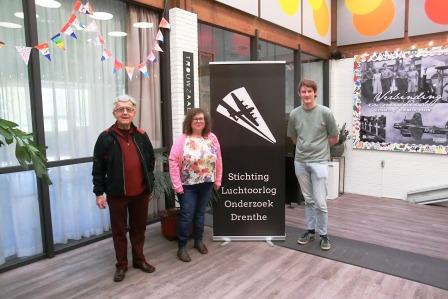
June 15, 2025.  On April 26, 2025 we travelled to Schoonebeek in the province of Drenthe, The Netherlands, to meet Yannic Wethly, one of the volunteers at the Air Research Drenthe Foundation (Stichting Luchtoorlog Onderzoek Drenthe).  This non-profit organization researches WWII air crashes in the province and places information panels near the crash sites.

We’d been involved with a similar organization in the province of Friesland, Missing Airmen Memorial Foundation, to honour the crew of the last flight of Halifax L9561 in which the pilot, Elmer Bagnall MUTTART of Cape Traverse, Prince Edward Island, lost his life. This led to a memorial panel being placed outside the village of Wons on October 12, 2019. (See https://onthewarmemorialtrail.com/2019/11/18/on-the-war-memorial-trail-the-memorial-panel-in-wons-is-unveiled/)

Yannic had gotten in contact about the last flight of Halifax DT630, in which the pilot, Jack Douglas MACKENZIE of Winnipeg, Manitoba, and three other crew members, lost their lives.  We’ve stayed in touch, and were happy to meet Yannic in person at an excellent exhibition that the organization held in Schoonebeek, entitled ‘The Last Flight – The airwar around Schoonebeek’.

Pieter and Daria with Yannic Wethly of the Air Research Drenthe Foundation.  (Photo courtesy of Valkenburg Family)

After touring the exhibit, we were joined by Yannic’s father, and in the end we were in Schoonebeek for 2 hours!

….Our first flags were placed at 4 graves in Sleen General Cemetery…

The village of Sleen was not far away from Schoonebeek.  (Photo credit: Daria Valkenburg)

From Schoonebeek we went to Sleen General Cemetery to honour the 4 airmen who lost their lives on February 3, 1943 during the last flight of Halifax DT630 (call sign VR-T), one of 8 heavy Halifax bombers sent on a night raid to Hamburg, Germany. 

The cemetery was outside the village of Sleen, and off of a narrow lane, with a farmer’s field on the other side of the cemetery.

Sign directing us to Sleen General Cemetery. (Photo credit: Daria Valkenburg)

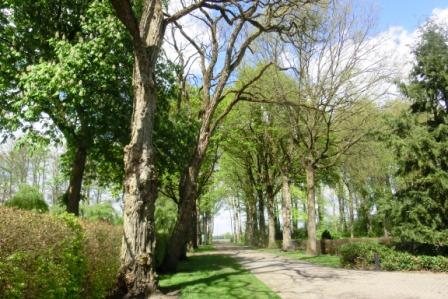
We didn’t know what to expect once we turned into the tree-lined entrance to the cemetery. It was much larger than we thought, and very well-maintained. 

The tree-lined entrance from the road into Sleen General Cemetery provided an aura of serenity. (Photo credit: Daria Valkenburg)

Out of a crew of 7, four men, all with the Royal Canadian Air Force (RCAF), died and are buried in Sleen:

  • Pilot P/O Jack Douglas MACKENZIE of Winnipeg, Manitoba
  • Flight Engineer Sgt. William Peter DUTHIE of Winnipeg, Manitoba
  • Air Gunner W/O II Raymond Hepton HILL of Montreal, Quebec
  • Air Gunner W/O II Lennox Alwin GONNETT of Westmount, Quebec

You can read Jack Douglas MacKenzie’s story at https://onthewarmemorialtrail.com/2023/02/19/on-the-war-memorial-trail-the-wwii-pilot-killed-at-the-controls-of-his-halifax-bomber/

After placing Canadian and provincial flags, Pieter paid his respects by the graves of the 4 airmen.  (Photo credit: Daria Valkenburg)

Canadian flags were placed at all four graves.  Manitoba flags were placed at the graves of Jack Douglas MacKenzie and William Peter Duthie.  Quebec flags were placed at the graves of Raymond Hepton Hill and Lennox Alwin Gonnett.

Pieter by Jack MacKenzie’s grave in Sleen General Cemetery. (Photo credit: Daria Valkenburg)

The three surviving crew members – 2 from the RCAF and 1 from the Royal Air Force (RAF) – spent the remainder of the war years in prisoner of war camps:

  • Navigator Sgt. William Nelson GARNETT, RCAF
  • Bomb Aimer Sgt. Eric Raymond MARQUAND, RCAF
  • Rear Air Gunner F/Sgt. Alexander Henry MILTON, RAF

Sleen General Cemetery was the first of 14 cemeteries that we visited during our trip, and the first 4 graves, out of a total of 383 graves, at which Pieter placed flags. All of the flags placed on our war memorial tour had been donated, as mentioned in an earlier posting. (See https://onthewarmemorialtrail.com/2025/06/04/on-the-war-memorial-trail-flags-and-pins-received-for-our-2025-european-war-memorial-tour/)

Thank you to the following for the donation of flags placed at the graves in Sleen General Cemetery:

  • Mario Henry and his brother Etienne Henry, who donated the Quebec flags
  • Wayne Ewasko, MLA for Lac Du Bonnet, Manitoba, Interim Leader of the Official Opposition, Province of Manitoba, who donated the Manitoba flags
  • Alan Waddell, Constituent Assistant, on behalf of Heath MacDonald, MP (Member of Parliament) for Malpeque, PEI, who donated the Canadian flags

Over the next several postings, we’ll continue to share the highlights of our adventures on the 2025 European War Memorial Tour.  Next up on our journey of remembrance is the Canadian War Cemetery in Groesbeek, where Pieter placed flags at 120 graves.

Now that we’re back home, the research work continues for Pieter.  If you have photos or information to share about soldiers buried in The Netherlands or Belgium, please email him at memorialtrail@gmail.com, or comment on the blog.    

© Daria Valkenburg

….Want to follow our research?…

If you are reading this posting, but aren’t following our research, you are welcome to do so.  Our blog address: https://onthewarmemorialtrail.com/

4 countries, 6 weeks, 7,000 km – an unforgettable war memorial journey in Europe…. Daria’s book ‘No Soldier Buried Overseas Should Ever Be Forgotten‘ is available in print and e-book formats.  Net proceeds of book sales help support research costs and the cost of maintaining this blog. For more information see https://nosoldierforgotten.com/

Subscribe to our YouTube Channel: On The War Memorial Trail With Pieter Valkenburg: https://www.youtube.com/channel/UCJ591TyjSheOR-Cb_Gs_5Kw

Never miss a posting!  Subscribe below to have each new story from the war memorial trail delivered to your inbox.

On The War Memorial Trail….Flags and Pins Received For Our 2025 European War Memorial Tour

June 4, 2025.  When Pieter decided he wanted to go to Europe for the 80th Anniversary of the Liberation of Europe in May 2025, planning began over a year in advance.  This would be our most ambitious war memorial tour, and Pieter wanted to ensure that the graves in The Netherlands and Belgium of as many of the soldiers and airmen that he’d researched over the past 11 years would be visited. He had a vision of being able to place, not only Canadian flags by the graves, but also provincial, and, where appropriate, Acadian flags.

A project like this didn’t happen overnight, and we needed help with donations of flags in order to meet Pieter’s goal.  Requests for flags began in the summer of 2024, and in the end we received donations of flags from most provinces.  Some came from provincial governments, others from politicians, and quite a few were donated by families of soldiers that had been researched, or readers of this blog. 

….Flags placed at 383 graves visited at 14 cemeteries.…

In addition, we received flags to place at the graves of two Indigenous soldiers, a very special tribute that we were honoured to be involved in.

We also received donations of Canadian flag pins and 80th anniversary pins to hand out, which were very popular with everyone we met along what turned out to be a 5 week journey along the war memorial trail.

By the time we returned back to Canada, Pieter had placed flags at 383 graves in 14 cemeteries in The Netherlands and Belgium!  We very much appreciate and want to recognize all who helped to provide flags and pins.

….Donations received of flags and pins…

We were blown away by the response to requests for flags, and the messages of support and encouragement we received.  The large Canadian flags were donated to small organizations in The Netherlands and Belgium who honour soldiers and airmen buried in smaller war cemeteries and in municipal or church cemeteries.  They also received small Canadian flags and flag pins. 

Some groups were involved with children in The Netherlands who are taught about the sacrifices made by Allied soldiers during WWII. We provided small Canadian flags, flag pins, and Frisbees for them to hand out.

Here below are the generous donors of flags and pins:

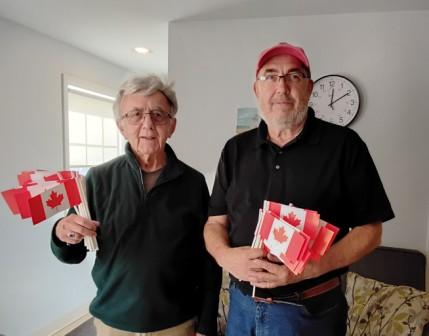
Pieter with Alan Waddell (right) from the office of Heath MacDonald with Canadian flags.  (Photo credit: Daria Valkenburg)

  • Alan Waddell, Constituent Assistant, on behalf of Heath MacDonald, MP (Member of Parliament) for Malpeque, Prince Edward Island and recently appointed as the Minister of Agriculture for the Government of Canada – small Canadian flags, flag pins, Frisbees
  • Mary Robinson, Senator for Prince Edward Island – large Canadian flags, flag pins
  • Jane MacAdam, Senator for Prince Edward Island – large Canadian flags

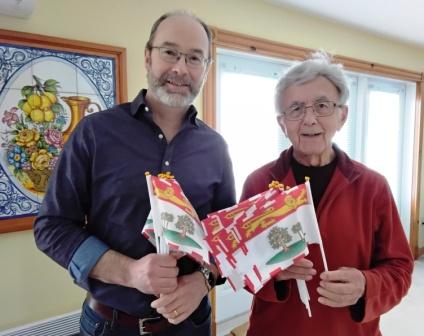
Matt MacFarlane (left) and Pieter hold flags from Prince Edward Island. (Photo credit: Daria Valkenburg)

  • Matt MacFarlane, MLA (Member of the Legislative Assembly) for District 19, Borden-Kinkora, Prince Edward Island – small PEI flags

After providing the flags from Prince Edward Island, Matt commented that “…I am happy to help with such important work…

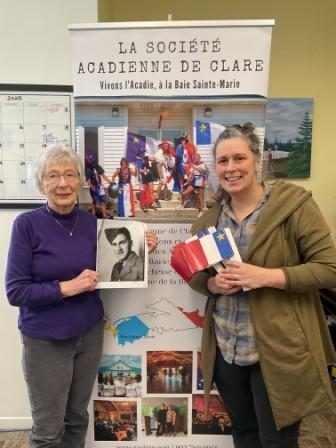
Simone Comeau (left) with Nathalie Robicheau. (Photo courtesy of Simone Comeau)

  • La Société acadienne de Clare at the request of Simone Comeau – small Acadian flags

For Simone, providing Acadian flags was very personal, to honour her uncle, Pte Joseph ‘Ambroise’ COMEAU. (See https://onthewarmemorialtrail.com/2021/05/17/on-the-war-memorial-trail-a-tragic-drowning-on-the-leda-river-in-germany-part-3/)  “…I picked up the flags yesterday. They are donated by ‘La Société acadienne de Clare.  Clare is the name of our municipality. In this picture we are standing in front of the banner of “La Société acadienne de Clare”. The lady presenting me the flags is the general director of the organization. Her name is Nathalie Robicheau and by coincidence she is the grand niece of J. Ambroise Comeau. Her father, my cousin, is the son of Ambroise’s other sister….” 

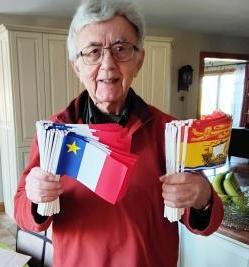
Pieter holds a selection of Acadian (left) and New Brunswick flags (right).  (Photo credit: Daria Valkenburg)

  • Jean-Claude D’Amours, MLA (Member of the Legislative Assembly) for Edmundston-Madawaska Centre, Minister responsible for Military Affairs, with the help of Cécile LePage, Province of New Brunswick – small New Brunswick and Acadian flags

For Cécile, helping to provide the flags was in honour of her uncle, Pte Ange Aimé LECLAIR. (See https://onthewarmemorialtrail.com/2024/11/27/on-the-war-memorial-trail-the-wwii-acadian-soldier-serving-with-le-regiment-de-maisonneuve-who-made-the-ultimate-sacrifice-in-the-hochwald-forest/)

  • Armel ‘Mel’ Lanteigne, President of the Caraquet Legion in New Brunswick – small New Brunswick flags, small Acadian flags, small Canadian flags

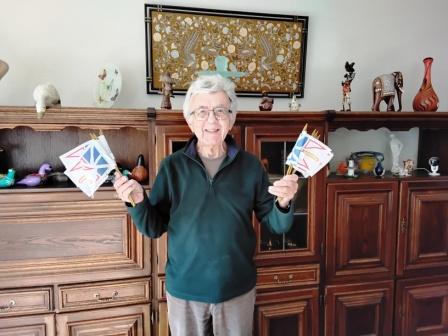
Pieter with flags of Newfoundland sent by Gerald Bartlett.  (Photo credit: Daria Valkenburg)

  • Gerald Bartlett in memory of Trooper John Frederick BARTLETT (whose story is yet to be written) – small Newfoundland flags
  • Mario Henry and his brother Etienne Henry – small Quebec flags
  • Kyle Graham, Research Officer, Military Relations, Nova Scotia Intergovernmental Affairs, on behalf of Premier Tim Houston, Province of Nova Scotia – small Nova Scotia flags

Kyle emailed us, saying “…as part of the Military Relations team for the Province, I am responding on behalf of …..” Premier Tim Houston.  “…Absolutely, our pleasure to support this…

Wayne enclosed a lovely note with the flags sent by his office. “…Thank you ….for the meaningful work you are doing to honour Canadian soldiers who made the ultimate sacrifice.  We are please to support your efforts.

We have enclosed ….Manitoba flags for your upcoming trip to The Netherlands for the 80th anniversary of the liberation.  We hope these flags will help commemorate the brave Manitoban soldiers and provide a special tribute at their gravesites….

  • Brad Robertson, Chief of Protocol, Government of Manitoba, on behalf of Wab Kinew, Premier of Manitoba

The flags were accompanied by a note from Brad, saying “…with thanks, on behalf of the Premier of Manitoba…

  • Peggy Menard – small Ontario flags
  • Don Coutts on behalf of the Muttart and Coutts families in memory of Flight Sergeant Elmer Bagnall MUTTART – small Ontario flags

Elmer Muttart was the first airman researched by Pieter, and his story has been extensively told on this blog.  You can read his story here:

  • Marie Renaud, MLA St Albert, Alberta at the request of Roman Berezowsky – small Alberta flags

….Two Indigenous flags received…

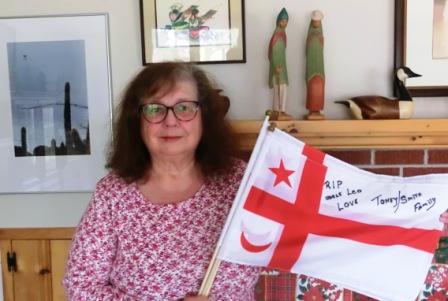
Daria with the very personalized Lnu flag to be placed at the grave of Leo Toney.  (Photo credit: Pieter Valkenburg)

Della explained that the term ‘Lnu’  means “the people, it’s what the Mi’kmaw people call themselves.  We are part of the Wabanaki Confederacy. People of the Dawnland, or People of the First Light. This area includes areas of NS, NB, PEI, eastern Quebec, and Maine. Made up of these nations Abenaki, Mi’kmaw, Penobscot, Passamaquoddy, and Wolastoqiyik …

Pieter holds the Wolasatoqey Nation flag to be placed at the grave of Sanford Steven Saulis. (Photo credit: Daria Valkenburg)

After I’d contacted Conrad to ask if the Wolastoqey used the same flag as the Mi’Kmaq, he replied that “….the Wolastoqey (we no longer recognize the term Maliseet) Nation is a distinct Nation of Peoples from the Mi’Kmaq much like the Portuguese are distinct from the Spanish yet have similar linguistic aspects. My Nation, along with the Mi’Kmaq, are two of the many First Nations that make up the Wabanaki Confederacy along with other Nations such as the Penobscot, Passamaquoddy, Abenaki, and other First Nation of the northeast seaboard as far as Manhattan.

Our Wolastoq Ancestors named our peoples after the Wolastoq river since it was a primary provider of water, fish and other foods including fiddleheads (mahsos) that grow along the river banks.  Our Ancestral lands intersect with the Mi’Kmaq through the central portions of NB covering the entirety of the Wolastoq River (St John River) from St. John to Rivere du Loup (St Lawrence) west towards Quebec City.…

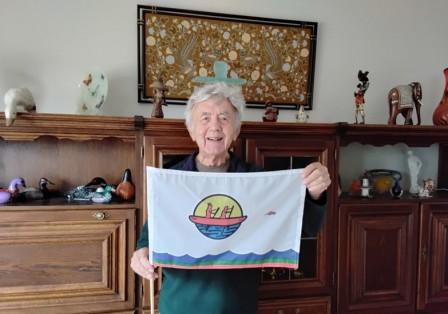
Conrad then arranged to send a flag for his uncle’s grave, saying that  “…the flag is courtesy of Grand Chief Ron Tremblay – a fellow Wolastoqey Nation citizen and designer of the flag….” and represents “…a muskrat swimming in front of the two in the canoe which was our primary means of transportation during Ancestral times…..”  

….80th Anniversary pins received…

  • Wendy Sewell, Assistant Defence Attaché, Embassy of the Kingdom of the Netherlands in Canada – 80th Anniversary of the Liberation of The Netherlands pins
  • Gerry Blom, Owner/Operator of the Dutch Truck – 80th Anniversary of the Liberation of The Netherlands pins

Thank you to everyone who provided flags and pins.  Over the next several postings, we’ll share the highlights of our adventures on the 2025 European War Memorial Trail….and how the flags were placed at the various cemeteries along our journey of remembrance.

Meanwhile, now that we’re back home, the research work continues for Pieter.  If you have photos or information to share about soldiers buried in The Netherlands or Belgium, please email him at memorialtrail@gmail.com, or comment on the blog.    

© Daria Valkenburg

….Want to follow our research?…

If you are reading this posting, but aren’t following our research, you are welcome to do so.  Our blog address: https://onthewarmemorialtrail.com/

4 countries, 6 weeks, 7,000 km – an unforgettable war memorial journey in Europe…. Daria’s book ‘No Soldier Buried Overseas Should Ever Be Forgotten‘ is available in print and e-book formats.  Net proceeds of book sales help support research costs and the cost of maintaining this blog. For more information see https://nosoldierforgotten.com/

Subscribe to our YouTube Channel: On The War Memorial Trail With Pieter Valkenburg: https://www.youtube.com/channel/UCJ591TyjSheOR-Cb_Gs_5Kw

Never miss a posting!  Subscribe below to have each new story from the war memorial trail delivered to your inbox.

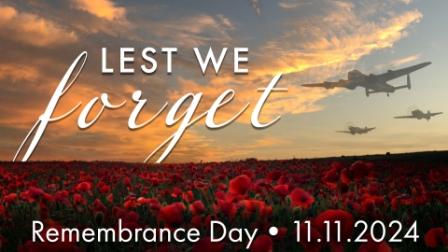
On The War Memorial Trail…. Remembrance Week 2024 – Reflections and Updates

1200x600-remembrance-day-1-1024x512

November 10, 2024.  When we write a story on the blog, we often receive additional information, sometimes about the soldiers we’ve written about, sometimes about other soldiers buried in the same cemetery or who served in the same unit. Occasionally we have a chance to meet families who’ve contributed photos and information on soldiers.  Each year we also try to visit a war memorial featuring a soldier. In this posting we feature a visit to the Sagkeeng War Memorial in Fort Alexander, Manitoba.

…Richard Reeves visited the grave of WWII soldier Everett Samuel Francis….

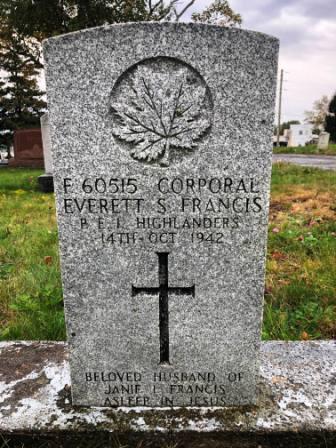
gravestone Everett Francis photo taken by Richard Reeves

Grave of Everett Samuel Francis in St. Matthew’s Presbyterian Cemetery in Grand Falls, Newfoundland.  (Photo credit: Richard Reeves)

One of the very first stories that Pieter researched of the names listed on the Cenotaph outside the Borden-Carleton Legion was that of WWII soldier Everett Samuel FRANCIS of Albany, Prince Edward Island.

On September 13, 1942, Everett was sent from Gander, Newfoundland, where his unit was based, to Long Branch, Ontario for a small arms training course.  He was on his way back to Gander aboard the railway ferry S.S. Caribou when it was torpedoed by German U-Boat 69 off the coast of Newfoundland on Wednesday, October 14, 1942.  101 survivors were rescued, but the captain, 30 crew, 57 service personnel, and 48 passengers were lost, including Everett. 

Everett and his wife, Janie Louise Mercer of Grand Falls, Newfoundland, were the parents of Greta, who had been born a few weeks earlier.  He was on his way home to meet his new-born daughter, who was to be christened in church on the Sunday after he was scheduled to return home, but never made it. He’s buried in St. Matthew’s Presbyterian Cemetery in Grand Falls, Newfoundland. 

In one of those interesting twists of fates, when Pieter was searching for a photo of Orville ‘Skip’ James REEVES, who was born in North Bay, Ontario, but was married to Mamie Thomas of Grand Falls, his nephew Richard Reeves not only provided a photo, but visited Everett’s grave on our behalf!  Watch for Skip’s story in a future posting.

You can read Everett’s story at:

….Nephew of WWII soldier Lt Arthur Affleck shared a memory of his last Sunday at church on Prince Edward Island…

Percy Affleck shared the following story about his uncle, Lt JamesArthur’ AFFLECK of Bedeque, Prince Edward Island:  “….The Affleck families of the Bedeque area were adherents of the United Church at Bedeque. (With a history dating back to the Methodist Church when part of the Affleck clan moved to Searletown from the Mt. Stewart area around 1858.)

According to Eldon Wright of Middleton, on his last Sunday at Church before shipping out for England, Arthur stood in full uniform on the church steps after the service and shook hands with everyone as they departed. At that era the Congregation would number in excess of 150 people and one can visualize the enthusiasm of the occasion, complete with good wishes. Arthur would have been fifth generation on the family tree dating to a marriage in Scotland in 1810…

Arthur was killed in action by artillery shells on September 17, 1944, during the first day of the Battle of Boulogne (Operation Wellhit), a 5 day battle to take the port of Boulogne from German control. He’s buried in the Calais Canadian War Cemetery in Leubringhen, France, 14 km from Calais.

You can read Arthur’s story at:

….Family of WWII Pilot Elmer Bagnall Muttart donated medals to the Borden-Carleton Legion…

20241022_185910 medals for Elmer Muttart at Borden-Carleton Legion

Shadow box with a photo of WWII Pilot Elmer Bagnall Muttart and his medals.  (Photo credit: Kathy Henry)

Don Coutts, nephew of WWII Pilot Elmer Bagnall MUTTART of Cape Traverse, Prince Edward Island wrote us, saying that his brother Peter  “has come across some of Elmer’s War Medals….” while going through their late mother’s boxes.  “…Do you think the Borden-Carleton Royal Canadian Legion would like them to display?…” 

The answer was yes, and a shadow box with a photo of Elmer and his medals is now on display on the Wall of Remembrance at the Borden-Carleton Legion.

Elmer was the pilot aboard Halifax L9561 when it was shot twice by German night fighters on October 12, 1941, while the plane was on its way to a bombing raid on Bremen, Germany.  After ordering the crew to bail out, Elmer managed to steer the burning plane away from the Dutch village of Wons, in the province of Friesland, before it crashed in a farmer’s field, just outside the village.  He was the only casualty and is buried in Harlingen General Cemetery in The Netherlands.

You can read Elmer’s story at:

….We visited the Sagkeeng War Memorial in Fort Alexander, Manitoba…

CIMG6783 May 9 2024 Pieter at Sagkeeng War Memorial re P Laforte

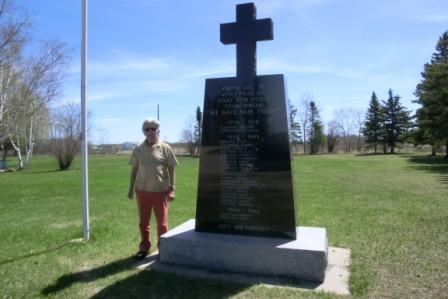
Pieter by the Sagkeeng War Memorial in Fort Alexander, Manitoba.  (Photo credit: Daria Valkenburg)

This past May we were in Winnipeg, and took a drive to the village of Fort Alexander on the Sagkeeng First Nation to visit the Sagkeeng War Memorial.  WWII Métis soldier Philip LAFORTE, who was born in Lac du Bonnet, Manitoba, is listed on this memorial.  

CIMG6785 May 9 2024 Sagkeeng War Memorial re P Laforte

WWII soldier Philip Laforte is listed on the Sagkeeng War Memorial in Fort Alexander, Manitoba.  (Photo credit: Daria Valkenburg)

While serving with the Royal Winnipeg Rifles, Philip lost his life on April 7, 1945 during the crossing of the Schipbeek Canal in The Netherlands.  He’s buried in the Canadian War Cemetery in Holten, The Netherlands.

You can read Philip’s story at:

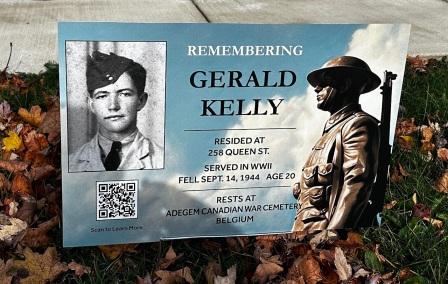
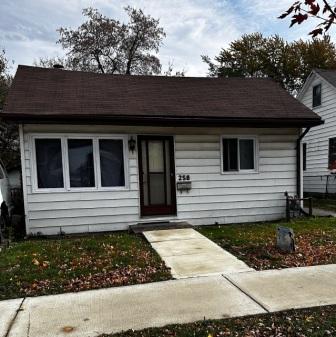
…. A Remembrance Plaque for WWII soldier Gerald Reginald Kelly was placed outside his former home in Sarnia …

Within a few hours one day we received two emails, both with a Sarnia, Ontario connection.  First, Don Coutts let us know about a memorial project in Sarnia, where Remembrance Plaques of soldiers would be placed outside their former homes during Remembrance Week. 

Then, Patrick Michiels of Belgium wrote to let us know that his family had adopted the grave of Private Gerald Reginald KELLY, who was from Sarnia, and is buried in the Canadian War Cemetery in Adegem, Belgium.  

What were the odds that this was a coincidence?  Since our friend Sandra Wallis lives in Sarnia, an email immediately went out to her, asking if she could find out if Gerald was one of the soldiers who had a Remembrance Plaque. 

IMG_8744 Gerald Kelly remembrance plaque in front of his house from Sandra

Remembrance Plaque honouring Gerald Kelly outside his former home in Sarnia. (Photo credit: Sandra Wallis)

IMG_8743 Nov 4 2024 Kellys house in Sarnia from Sandra

Gerald Kelly’s former home in Sarnia. You can see the Remembrance Plaque on the right.  (Photo credit: Sandra Wallis)

Sandra got in contact with Tom Slater and Tom St. Amand, two retired teachers, who spearheaded the Remembrance Plaque project, and learned that a plaque had been made for Gerald. Once it was in place at his former residence, she took photos of the house and the plaque.  These photos were shared with Patrick, and the two retired teachers are now in contact with him.

Gerald was serving with the Algonquin Regiment when he lost his life on September 14, 1944 during the Battle of the Leopold Canal.  He was killed as he tried to re-cross the Leopold Canal while trying to rescue a wounded sergeant.

Here are two articles about Sarnia’s Remembrance Plaque project:

…. Meeting families of two airmen from Halifax DT630 …

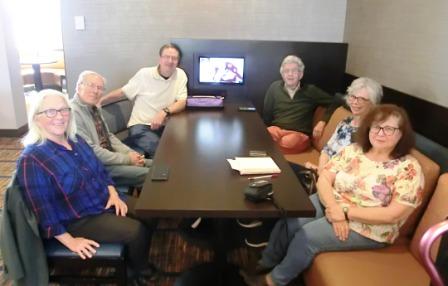
CIMG6764 May 8 2024 May 8 2024 Jamie Don Craig Pieter Sue Daria at Courtyard Marriott Winnipeg

Left to right: Jamie Nelson-Dixon, Don Dixon, Craig MacKenzie, Pieter, Sue MacKenzie, Daria. (Photo courtesy of Valkenburg Family)

After we wrote the story about Jack ‘Douglas’ MACKENZIE, of Winnipeg, Manitoba, the pilot of Halifax DT630 that was shot down by a night fighter over the province of Drenthe in The Netherlands on February 3, 1943, we were contacted by Yannic Wethly of Stichting Luchtoorlog Onderzoek Drenthe (Air Research Drenthe Foundation) in The Netherlands. “….We are still searching for the pictures of Warrant Officer Second Class Raymond Hepton ‘Ray’ Hill and Sergeant Eric ‘Raymond’ Marquand, both crew members of Halifax DT630….” he wrote.

Four men died when the plane went down, including Douglas and Ray, and all are buried in Sleen General Cemetery in The Netherlands. 

We were successful in finding a photo of Raymond Hepton ‘Ray’ HILL, who was from Montreal, Quebec, but did not find any surviving family. Both Ray and his brother died during WWII, there were no other siblings, and neither man was married. 

Like Douglas MacKenzie, Eric ‘Raymond’ MARQUAND, the bomb aimer on that flight, was from Winnipeg.  He had survived the crash and spent the remaining war years in prisoner of war camps before being liberated.  We were very happy when his niece, Jamie Nelson-Dixon, got in contact and provided a photo. 

When we were in Winnipeg this past May, we asked if Jamie, and Doug MacKenzie’s nephew, Craig MacKenzie, would like to meet us and each other.  They did, and we spent a wonderful afternoon together with Jamie’s husband Don and Craig’s wife Sue.

Raymond’s story will be coming up in a future posting, but you can read Douglas’ story at:

Thank you to Percy Affleck, Don Coutts, Don Dixon, Craig and Sue MacKenzie, Jamie Nelson-Dixon, Patrick Michiels, Richard Reeves, Tom Slater, and Sandra Wallis.  The work of remembrance of those who served continues. 

If you have a story to tell, please let Pieter know. You can email him at memorialtrail@gmail.com, or comment on the blog.  

© Daria Valkenburg

….Want to follow our research?….

If you are reading this posting, but aren’t following our research, you are welcome to do so.  Our blog address: https://onthewarmemorialtrail.com/

Front cover OnTheWarMememorialTrailinEurope4 countries, 6 weeks, 7,000 km – an unforgettable war memorial journey in Europe…. Daria’s book ‘No Soldier Buried Overseas Should Ever Be Forgotten‘ is available in print and e-book formats.  Net proceeds of book sales help support research costs and the cost of maintaining this blog. For more information see https://nosoldierforgotten.com/ 

You are also invited to subscribe to our YouTube Channel: On The War Memorial Trail With Pieter Valkenburg: https://www.youtube.com/channel/UCJ591TyjSheOR-Cb_Gs_5Kw

Never miss a posting!  Subscribe below to have each new story from the war memorial trail delivered to your inbox.
On The War Memorial Trail…. Remembrance Week 2024 –Remembering Those Who Served In The RCAF During WWII

Remembrance_Day_2024_3840x2160

November 7, 2024.  As we reflect on the service and sacrifices made by so many who have served, both during conflicts and in peacetime, I took a look back at previous stories told over the years.  2024 commemorates 100 years of service for the Royal Canadian Air Force (RCAF) as a distinct military element, and so it seemed appropriate to dedicate this posting to stories previously told of those who served in the RCAF during WWII. 

…The Air Force Heritage Park in Summerside has a commemorative stone honouring Flight Officer Joe McIver….

IMG_20190807_101837076 Entrance to Air Force Heritage Park Summerside

Entrance to Air Force Heritage Park in Summerside. (Photo credit: Daria Valkenburg)

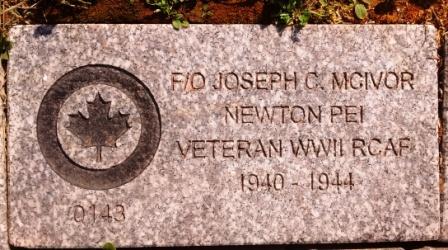
Several years ago we visited the Air Force Heritage Park in Summerside to look at the commemorative stone honouring Flight Officer Joseph ‘Joe’ Charles MCIVER of Kinkora, Prince Edward Island.  Joe was the navigator aboard B24 Liberator MkVIII EV895 on November 18, 1944, when it went down near the Arctic Circle while on anti-submarine patrol looking for a suspected U-boat off Gardskagi, Iceland.  There were no survivors.

You can read his story at:

IMG_20190807_101038750 McIver Commemorative Stone Summerside

Commemorative Stone at Air Force Heritage Park, Summerside, Prince Edward Island. (Photo credit: Pieter Valkenburg)

 … Pilot Elmer Muttart saved his crew and the Dutch village of Wons but sacrificed his own life to do so ….

The very first airman whose story was researched by Pieter was that of Elmer Bagnall MUTTART of Cape Traverse, Prince Edward Island, whose name is listed on the Cenotaph outside the Borden-Carleton Legion.  Elmer was the pilot aboard Halifax L9561 when it was shot twice by German night fighters on October 12, 1941, while the plane was on its way to a bombing raid on Bremen, Germany. 

After ordering the crew to bail out, Elmer managed to steer the burning plane away from the Dutch village of Wons, in the province of Friesland, before it crashed in a farmer’s field, just outside the village. He was the only casualty and is buried in Harlingen General Cemetery in The Netherlands.  The rest of the crew spent the war years in prisoner of war camps before being liberated. On October 12, 2019, a memorial panel was placed near the crash site in Wons to honour Elmer and his crew, an emotional journey for all of us who attended.

You can read his story here:

 … Pilot Hubert Hall was a prisoner of war after his plane was shot down in 1942 ….

John ‘Hubert’ HALL of Summerside, Prince Edward Island, was the pilot aboard Wellington Z1203, which crashed in The Netherlands near Mijdrecht on the night of March 28/29, 1942.  Hubert spent the remainder of the war years as a prisoner of war in POW camp Stalag Luft III, located in present-day Żagań, Poland, before returning home to Canada.

You can read his story at:

… Navigator Bunky FitzGerald is in an unmarked grave after Halifax W1175 crashed off the Dutch coast….

Rowan Charles ‘Bunky’ FITZGERALD, of Charlottetown, Prince Edward Island, was the navigator aboard Halifax W1175 of the 405th Vancouver Squadron RCAF when it was hit by shellfire (flak) as the plane was returning from Bremen, Germany on the morning of June 28, 1942. 

The plane crashed into a sandbank in the Wadden Sea, off the Dutch coast between the Island of Texel and the mainland, 15.5 km from Harlingen, in the province of Friesland.  There were no survivors. Only one crew member’s body was identified, and was buried in Harlingen General Cemetery in The Netherlands. His grave is between 3 unknown graves, one of which may just contain the remains of Bunky FitzGerald. 

You can read his story at:

… Pilot Lorne MacFarlane survived all his flights and returned home…

Pilot Lorne MACFARLANE, of Fernwood, Prince Edward Island, successfully flew 40 missions overseas and was then assigned to fly dignitaries, mail, and personnel between England and the front lines until the war ended.  After returning safely back to Canada, he was the Officer In Charge at RCAF No 1 Radio and Navigation School in Summerside, Prince Edward Island.

You can read his story at:

… Wireless operator Bob Dickie almost made it safely back to England…

Robert ‘Bob’ James DICKIE, of Carlton (now Borden-Carleton), Prince Edward Island, was the wireless operator aboard Lancaster JB312 on February 21, 1944 when it collided with another plane during a bombing sortie in Stuttgart, Germany.  Although badly damaged, the plane was able make it back to England, but then crashed as it approached the runway. There were no survivors. Bob is buried at Cambridge City Cemetery in England.

You can read his story at:

… Pilot Leonard Unwin’s plane crashed on Christmas Eve…

Pilot Leonard Arthur UNWIN, of Windsor, Ontario, was a flying instructor in Summerside, Prince Edward Island and Moncton, New Brunswick, before going overseas in May 1943.  On December 24, 1944, he left from his base in Belgium, one of the pilots in a section of 4 Typhoon planes on an armed reconnaissance in the Utrecht area in The Netherlands. While attacking a convoy of three German trucks in Woudenberg, the plane’s tailpiece broke off, the plane destabilized, and crashed. He’s buried in Woudenberg Municipal Cemetery in The Netherlands.

You can read his story at:

… Flight student Ralph McCutcheon lost his life in a training accident…

Flight student Ralph Gordon MCCUTCHEON, of Toronto, Ontario, but who was born in Buffalo, New York, USA, lost his life in a tragic accident that happened during his training at the No. 9 Service Flying Training School RCAF in Summerside, Prince Edward Island on the morning of June 11, 1942.  While training in a Harvard MK2 plane, it crashed in a farm field in North Tryon, Prince Edward Island.

You can read his story at:

… Gunner William Andrew Hood was aboard the last flight of Halifax JD215…

William Andrew HOOD, of Little Bras D’or, Cape Breton Island, Nova Scotia, was the mid-upper gunner aboard Halifax JD215 when it was shot down over The Netherlands on June 29, 1943.  None of the crew survived. He’s buried in Eindhoven General Cemetery in Eindhoven, The Netherlands.

You can read his story at:

… Navigator Arnold Hupman was aboard Lancaster X KB728 VR-V when it exploded over Arnhem, The Netherlands…

Navigator Arnold Freeman HUPMAN, of East Side of Ragged Island, Shelburne County, Nova Scotia, lost his life when the Lancaster bomber he was in, Lancaster X KB728 VR-V, was attacked by a German night fighter and exploded on the outskirts of Arnhem, The Netherlands as it was returning from a bombing operation against the synthetic oil plant at Sterkrade in Germany on the night of June 16 to 17, 1944. There were no survivors, and all 7 crew members are now buried in the Canadian War Cemetery in Groesbeek, The Netherlands.

You can read his story at:

… Pilot Douglas MacKenzie did not survive the last flight of Halifax DT630…

Jack ‘Douglas’ MACKENZIE,  of Winnipeg, Manitoba, was the pilot of Halifax DT630 (call sign VR-T), one of 8 heavy Halifax bombers sent on a night raid to Hamburg, Germany on February 3, 1943.  It was shot down by a night fighter over the province of Drenthe in The Netherlands. 4 men died, including Douglas, while 3 survived and spent the remainder of the war in prisoner of war camps.  He’s buried in Sleen General Cemetery in The Netherlands, along with the other 3 casualties of that flight.

You can read his story at:

… Pilot Dusty Millar’s spitfire ran out of fuel and crashed…

George Glenn ‘Dusty’ MILLAR, of Winnipeg, Manitoba, was killed on September 28, 1944 while flying a Spitfire Mark IX on patrol with his squadron over Nijmegen, The Netherlands. After Dusty reported on his radio that the plane was low in fuel, it crashed southeast of Weibosch near Schijndel, in the Dutch province of Noord-BrabantHe is buried in Uden War Cemetery in The Netherlands.

You can read his story at:

May we never forget the sacrifices made by these airmen, and their families, during WWII.  Unfortunately, while we live free in Canada, so many people today live in a war zone and are experiencing death, uncertainty, and insecurity in not knowing what will happen next.  Lest we forget is never more appropriate.

If you have a story to tell, please let Pieter know. You can email him at memorialtrail@gmail.com, comment on the blog, or send a tweet to @researchmemori1.  

© Daria Valkenburg

….Want to follow our research?….

If you are reading this posting, but aren’t following our research, you are welcome to do so.  Our blog address: https://onthewarmemorialtrail.com/

Front cover OnTheWarMememorialTrailinEurope4 countries, 6 weeks, 7,000 km – an unforgettable war memorial journey in Europe…. Daria’s book ‘No Soldier Buried Overseas Should Ever Be Forgotten‘ is available in print and e-book formats.  Net proceeds of book sales help support research costs and the cost of maintaining this blog. For more information see https://nosoldierforgotten.com/ 

You are also invited to subscribe to our YouTube Channel: On The War Memorial Trail With Pieter Valkenburg: https://www.youtube.com/channel/UCJ591TyjSheOR-Cb_Gs_5Kw

Never miss a posting!  Subscribe below to have each new story from the war memorial trail delivered to your inbox.

On The War Memorial Trail….. Presentation ‘Up Close With A Halifax Bomber’

Crapaud Hall Nov 7 2023 Presentation title page

November 9, 2023.  On November 7, 2023, we gave a presentation at Crapaud Hall in Crapaud, Prince Edward Island: ‘Up Close With A Halifax Bomber’ about our tour of a Halifax bomber and a summary of two Island airmen who lost their lives in one: Elmer Bagnall MUTTART and Rowan ‘Bunky’ Charles FITZGERALD.

70% of Canadians in Bomber Command flew in a Halifax bomber, which explained why so many of the casualties that Pieter has researched over the years were in a Halifax.  It was one of the reasons why Pieter was so interested in touring a Halifax bomber at the National Air Force Museum of Canada in Trenton, Ontario.  (See https://onthewarmemorialtrail.com/2023/09/23/on-the-war-memorial-trail-if-only-it-still-flew/)

When Connie MacKinnon asked if we would do a presentation at Crapaud Hall in Crapaud, Prince Edward Island, giving an overview of our tour was what we chose as the topic.

image_6487327 Nov 7 2023 Daria presenting at Crapaud Hall

Daria was the presenter for ‘Up Close With A Halifax Bomber’.  (Photo credit: Connie MacKinnon)

Elmert Muttart

Elmer Bagnall MUTTART was the pilot aboard Halifax L9561 when it was shot down on October 12, 1941 just outside the village of Wons, The Netherlands.  He was the sole fatality. You can read about him here: https://onthewarmemorialtrail.com/2020/01/31/he-died-that-we-might-live-video-is-now-on-youtube/

Bunky FitzGerald

Rowan ‘Bunky’ Charles FITZGERALD was the navigator aboard Halifax W1175 when was hit by shellfire and crashed into a sandbank in the Wadden Sea, off the Dutch coast, on June 28, 1942.  There were no survivors. You can read about him here: https://onthewarmemorialtrail.com/2022/10/12/on-the-war-memorial-trail-well-never-forget-uncle-bunky/

Nov 7 2023 Pieter and Daria answer questions at Crapaud Hall

Pieter joined Daria during the question and answer period following the presentation.  (Photo credit: Connie MacKinnon)

A lively question and answer period followed the presentation, with several attendees also sharing stories. It was an enjoyable experience for all of us!

CIMG6616 Nov 7 2023 Daria & Pieter With Edison Smith photo Kathy Henry

Daria and Pieter with Edison Smith.  (Photo credit: Kathy Henry)

Among the attendees was Edison Smith, grandson of WWII soldier Edison Alexander SMITH, who lost his life on March 25, 1945 during the Battle of Bienen in Germany. We very much appreciated the opportunity to meet him in person.  (You can read Edison Smith’s story at https://onthewarmemorialtrail.com/2023/03/04/on-the-war-memorial-trail-the-battle-of-bienen-part-1-the-wwii-soldier-whose-body-shielded-a-wounded-major/)

Do you have a story to share?  Please contact Pieter at memorialtrail@gmail.com, comment on the blog, or send a tweet to @researchmemori1

© Daria Valkenburg

….Want to follow our research?….

If you are reading this posting, but aren’t following our research, you are welcome to do so.  Our blog address: https://onthewarmemorialtrail.com/

Front cover OnTheWarMememorialTrailinEurope4 countries, 6 weeks, 7,000 km – an unforgettable war memorial journey in Europe…. Daria’s book ‘No Soldier Buried Overseas Should Ever Be Forgotten‘ is available in print and e-book formats.  Net proceeds of book sales help support research costs and the cost of maintaining this blog. For more information see https://nosoldierforgotten.com/ 

You are also invited to subscribe to our YouTube Channel: On The War Memorial Trail With Pieter Valkenburg: https://www.youtube.com/channel/UCJ591TyjSheOR-Cb_Gs_5Kw

Never miss a posting!  Subscribe below to have each new story from the war memorial trail delivered to your inbox.

On The War Memorial Trail… An Island Airman In Stalag Luft III Part 2: Escape From The POW Camp

October 30, 2023. In Part 1, Pieter’s research revealed how a small postcard-sized letter, written in September 1942 from POW camp Stalag Luft III, impacted two families from Prince Edward Island. (See https://onthewarmemorialtrail.com/2023/10/23/on-the-war-memorial-trail-an-island-airman-in-stalag-luft-iii-part-1-2-families-connected-by-1-letter-from-a-pow-camp/)

The letter was found by Don Coutts, nephew of WWII pilot Elmer Bagnall MUTTART of Cape Traverse, who lost his life on October 12, 1941.  It was written by John ‘Hubert’ HALL of Summerside, the pilot aboard Wellington Z1203, which crashed in The Netherlands near Mijdrecht on the night of March 28/29, 1942. 

The camp was near the town of Sagan, Lower Silesia, in what was then Nazi Germany (but now Żagań, Poland), 160 kilometres (100 miles) south-east of Berlin.  The movie ‘The Great Escape’ was based on an incident that happened in this camp in 1944. (See https://en.wikipedia.org/wiki/Stalag_Luft_III)

CIMG6475 Hubert Hall with mustache cropped and sharpened

John ‘Hubert’ Hall. (Photo courtesy of the Hall Family)

After meeting Hubert’s son, Robert ‘Bob’ Hall, and his wife Joanne Sheen, we came away with a wealth of information about Hubert, who sadly died young, at the age of 39.

CIMG6521 Oct 14 2023 Daria with Joanne Sheen & Bob Hall

Left to right: Joanne Sheen, Bob Hall, Daria Valkenburg (Photo credit: Pieter Valkenburg)

Now, in Part 2, more on Hubert’s story and his long march to freedom after leaving Stalag Luft III…..

Hubert was born January 4, 1915 in Summerside, Prince Edward Island, the son of Franklin and Marion (nee Howatt) Hall.  As a child, he and his brother Paddy went with their parents to Western Canada, and he attended school in Camrose, Alberta. Unfortunately, the family’s hope for a better economic future was disrupted by the Depression, and Mrs Hall returned to the Island with her sons.  Then, after WWII began, both sons enlisted in the RCAF.

Hubert enlisted at the RCAF Recruiting Centre in Moncton on June 26, 1940.  He took his initial flight training at No. 11 Elementary Flying Training School (EFTS) RCAF Station Cap de la Madeleine, in Trois-Rivières, Quebec.  He received primary pilot training, including solo flying of a basic training aircraft, and graduated on December 9, 1940.

In December 1940, he was sent to No. 2 Service Flying Training School (SFTS) RCAF Station Uplands in Ottawa, Ontario for continued pilot training on an advanced single or multi engine training aircraft.

CIMG6471 Print of Wellington bomber

Print of a Wellington bomber displayed in Bob Hall’s home office.  (Photo credit: D Valkenburg)

After receiving his wings, he left Canada for the United Kingdom and by May 1941 was training on a Wellington bomber at No. 12 Operational Training Unit (OTU) at RAF Benson, England.  

On June 19, 1941, Hubert began flying while attached to 142 Squadron of the RAF.  He was second pilot for 10 operations, and then pilot for 7 operations.  Wellington Z1203 turned out to be his 7th and final operation…..

…The air crew aboard the last flight of Wellington Z1203….

  • Pilot – Pilot Officer John ‘Hubert’ HALL, of the RCAF
  • Second Pilot – Flight Sgt Lawrence Hugh HOUGHTON, of the RAF
  • Navigator – Flight Sgt John Edward HARRITT, of the RAF
  • Wireless Operator/Air Gunner – Flight Sgt Arthur Richard TIDDER, of the RAF
  • Front Gunner – Sgt Geoffrey Peter WADSWORTH, of the RAF
  • Rear Gunner – Sgt Ernest Joseph PETTITT, of the RAF

….The last flight of Wellington Z1203….

GrimsbytoLubecktoMidrechtREV

Map shows the plane’s path from England towards Lübeck.  On the return to England, the plane was hit by flak near Kiel and diverted to The Netherlands where it crashed near Mijdrecht.  (Map prepared by Wendy Nattress)

According to the records, Wellington Z1203 departed RAF Grimsby at 21:28 pm on March 28, 1942 on a bombing operation to Lübeck, Germany. During the return to base in the early hours of March 29, the plane was hit by German flak as it crossed the coast near Kiel.  A fuel line was damaged, causing fuel loss. With insufficient fuel to return to England, the pilot – Hubert Hall – diverted the plane, turning inwards towards The Netherlands.

All six crew members were able to bail out and became prisoners of war for the duration of the war. The airplane dove into the ground and crashed in Mijdrecht, near Amsterdam Schiphol Airport.

…The long march to freedom….

According to Hubert’s Liberated Prisoner of War form, following the crash, he was first taken to Frankfurt, Germany, to Dulag Luft Frankfurt, a POW transit camp, for interrogation.  He was there from April 1, 1942 to May 7, 1942.  (See https://en.wikipedia.org/wiki/Dulag_Luft)

Hubert then was sent to POW camp Stalag Luft III in Sagan, Lower Silesia (Żagań, Poland).  He was there from May 9, 1942 until January 27, 1945.

As Russian forces advanced to less than 20 kilometres (12.4 miles) of Stalag Luft III, the POWs felt that liberation was only a matter of days away. Their hopes were dashed as on the evening of January 27, 1945, word came that Hitler had ordered the immediate evacuation of the camp. The POWs in all six compounds were instructed to prepare to march that very night. (See https://www.stalagluft3.com/long-march/)

The march began in the early hours of January 28, 1945, with the POWs trudging through heavy snow, cold weather, and even a blizzard.

march_map from Stalag Luft III

The long march from Stalag Luft III to Tarmstedt in the winter of 1945. (Map source: https://www.stalagluft3.com/long-march/)

Stuart Bruce Keith ‘Brack’ BRACKENBURY, an RCAF pilot from Ontario, was Hubert’s roommate in the Stalag, according to an account his daughter Ana Brickley gave to the Hall family. Brack was the pilot aboard the last flight of Hampden P1165, on an operation to Hüls, Germany, which was shot down and crashed at Winterswijk, Gelderland, The Netherlands on December 28, 1941. He was the only survivor of that crash.

Per her father’s recollection, Ana explained that they “…marched west away from the Russians and walked to a glass factory halfway to Hamburg, and stayed there a few months as they were too weak to walk further….”  This may be Marlag und Milag Nord in Tarmstedt, Germany, as Hubert’s Liberated Prisoner of War form stated he was there from February 4, 1945 until April 10, 1945.

marlag_und_milag_nord

Marlag und Milag Nord in Tarmstedt, Germany.  (Photo source: https://www.stalagluft3.com/long-march/)

Ana’s account noted that the men later “...went into boxcars….” by train “…to Hamburg and then walked to the Baltic Sea…”  They were eventually “…liberated in Lübeck... which is a Baltic port.  Hubert’s Liberated Prisoner of War Form noted that they were liberated on May 2, 1945 in Trenthorst, a small settlement on the estate of German business magnate Philipp F. Reemtsma.

Their ordeal wasn’t quite over as Ana recounted that “…the army was going to drive the liberated men in trucks back to France.  They objected. Winston Churchill heard about it and said ‘they flew in, and they’ll fly out’.  And they did…..

Hubert received his official discharge on July 27, 1945 in Halifax, Nova Scotia.

….Back on Prince Edward Island….

During his time as a POW, Hubert had contracted tuberculosis, and when he returned back to the Island, he …was in the sanatorium in Charlottetown…” Bob explained. 

Once he left the sanatorium, Hubert worked at Hall Manufacturing, and then became the Sheriff of Prince County on July 15, 1947.  In Canada, a sheriff is a law enforcement officer, but not a police officer, as in the USA.  Sheriffs’ offices in Canada are primarily concerned with court services such as security in and around the courts, post-arrest prisoner transfer, serving legal processes, fine collection.

Bob explained that his father met his mother, Audrey ‘Forrona’ England when he became Sheriff.  “…She worked at the Bank of Nova Scotia in Summerside, and most likely that’s where they met…” 

Bob shared a story about his parents’ first date.  “…My father had a gorgeous black Rover with red leather seats.  On their first date, they went for a drive. When they stopped, my mother opened the door, and a heavy wind gust blew the door off!...

Unfortunately, Hubert died in December 1954, leaving behind his wife Forrona and their two sons, Robert and Brenton. He’s buried at the People’s Cemetery in Summerside, Prince Edward Island, alongside his wife Forrona, who died in 2009.

Joanne Sheen wrote us, saying “….thank you so much for your visit. The tireless work and passion you both have for your project is amazing….Bob and I were very touched by the conversation….the visit brought Hubert to life.  Sad that it was a life cut short but Hubert was luckier than many in that he did get to return home and for a time, a happy life with his wife Forrona and two little boys….” 

Thank you to Bob Hall and Joanne Sheen for providing information about Hubert Hall. Thank you to Wendy Nattress, who prepared the map showing the flight path for Wellington Z1203, and to Yannic Wethly for sending Hubert’s Liberated Prisoner Of War Form.

Do you have a story to tell? Email Pieter Valkenburg at memorialtrail@gmail.com, comment on the blog, or send a tweet to @researchmemori1.  

© Daria Valkenburg

…Want to follow our research?….

If you are reading this posting, but aren’t following the blog, you are welcome to do so.  Our blog address: https://onthewarmemorialtrail.com/

Front cover OnTheWarMememorialTrailinEurope4 countries, 6 weeks, 7,000 km – an unforgettable war memorial journey in Europe…. Daria’s book ‘No Soldier Buried Overseas Should Ever Be Forgotten‘ is available in print and e-book formats.  Net proceeds of book sales help support research costs and the cost of maintaining this blog. For more information on the book, please see https://nosoldierforgotten.com/

You are also invited to subscribe to our YouTube Channel: On The War Memorial Trail With Pieter Valkenburg: https://www.youtube.com/channel/UCJ591TyjSheOR-Cb_Gs_5Kw

Never miss a posting!  Subscribe below to have each new story from the war memorial trail delivered to your inbox.

On The War Memorial Trail… An Island Airman In Stalag Luft III Part 1: 2 Families Connected By 1 Letter From A POW Camp

October 23, 2023. If you found a letter, written by someone you didn’t know, about your long-deceased uncle who died during WWII, what would your reaction be?  If you received a message saying that a 1942 letter from your long-deceased father was found, how would you react?   

….2 families…1 letter….

Two families were impacted by one small postcard-sized letter, written in September 1942 from POW camp Stalag Luft III.  The camp was near the town of Sagan, Lower Silesia, in what was then Nazi Germany (but now Żagań, Poland), 160 kilometres (100 miles) south-east of Berlin.  The movie ‘The Great Escape’ was based on an incident that happened in this camp in 1944. (See https://en.wikipedia.org/wiki/Stalag_Luft_III)

The letter was found by Don Coutts, nephew of WWII pilot Elmer Bagnall MUTTART of Cape Traverse, who lost his life on October 12, 1941.  Don found it amongst his mother’s effects after she died a few months ago.  He asked if we could “play detective in deciphering the handwriting and as well which prisoner of war camp it came from….”  Pieter was up for the challenge.

….The letter came from Stalag Luft III….

CIMG6475 Hubert Hall with mustache cropped and sharpened

John ‘Hubert’ Hall. (Photo courtesy of the Hall Family)

The letter was sent to Mrs.  Frank H. Hall in Summerside, and was written by John ‘Hubert’ HALL, the pilot aboard Wellington Z1203, which crashed in The Netherlands near Mijdrecht on the night of March 28/29,1942. Everyone on board that flight survived and spent the remainder of the war years in POW camps. 

Hubert was in Stalag Luft III, as was Geoffrey Douglas LEYLAND of the Royal Air Force, the Squadron Leader mentioned in the letter.  Pieter’s research found that Leyland had flown three times with Elmer Muttart as second pilot! (https://aviation-safety.net/wikibase/52841)  Leyland returned to England after the war and passed away in 1970.

Hubert Hall POW Letter p2

September 6, 1942 letter from Hubert Hall to his mother Marion Hall.

The text of the letter, from Hubert to his mother, reads “…Dear Mother, How are you dear? I’m quite well and managing all right, I hate washing clothes. A few days ago I happened to mention on parade PEI and Squadron Leader overheard me and asked me if I knew Elmer Muttart. At one time Squadron Leader was Elmer’s second pilot and his praise for Elmer’s capabilities as a pilot and the work he did was very high. He says he owes his life to Elmer’s flying one night before Elmer was missing. Mrs. Muttart might like to know of this…Lots of love, Hube…

One can imagine the relief that Mrs Hall felt in knowing that her son was alive and safe, but what she did next was a testament to her empathy for Annie Bagnall Muttart, whose son Elmer had died a year earlier.  She gave this precious letter to the Muttart family, and it was passed down to her daughter, Helen Coutts. (See https://onthewarmemorialtrail.com/2020/01/31/he-died-that-we-might-live-video-is-now-on-youtube/)

Elmer Bagnall Muttart (2)

Elmer Bagnall Muttart (Photo from Canadian Virtual War Memorial at http://www.veterans.gc.ca)

….The letter writer’s son was found….

The letter writer identified, Pieter’s next challenge was finding the family of Hubert and Mrs Frank Hall. The search led him to Robert ‘Bob’ Hall, who soon received a phone message from our intrepid detective! 

Bob was very surprised but called back immediately, confirming that Hubert was his father, and that his grandmother was Marion (nee Howatt) Hall. We met with him and his wife Joanne Sheen to learn more.

CIMG6521 Oct 14 2023 Daria with Joanne Sheen & Bob Hall

Left to right: Joanne Sheen, Bob Hall, Daria Valkenburg (Photo credit: Pieter Valkenburg)

Born January 4, 1915 in Summerside, Hubert enlisted at the RCAF Recruiting Centre in Moncton on June 26, 1940.  After receiving his wings, he left Canada for the United Kingdom and by May 1941 was sent for training on a Wellington bomber.

During his time as a POW, Hubert contracted tuberculosis, and when he returned back to the Island, he “…was in the sanatorium in Charlottetown…” Bob explained. 

Once he left the sanatorium, he worked at Hall Manufacturing, and then became the Sheriff of Prince County.  “…That’s when he met my mother, Forrona England. She worked at the Bank of Nova Scotia in Summerside, and most likely that’s where they met…” 

Bob noted that “…I was only three years old when my father died…” at age 39.  “…My mother was 29 when he died and she never got over it…

Joanne Sheen was excited to learn about the letter.  Bob agreed. “…It’s the only letter that we’ve seen from the POW camp…”  Written on very thin and flimsy paper, it’s not surprising that letters from POW camps might not have survived.  That made the 1942 letter a special remembrance.

Thank you to Don Coutts for sharing the letter from the POW camp, and to Bob Hall and Joanne Sheen for providing information about Hubert Hall. In Part 2: more on Hubert Hall’s story and his long march to freedom that began on January 27, 1945.

Do you have a story to tell? Email Pieter Valkenburg at memorialtrail@gmail.com, comment on the blog, or send a tweet to @researchmemori1.  

© Daria Valkenburg

…Want to follow our research?….

If you are reading this posting, but aren’t following the blog, you are welcome to do so.  Our blog address: https://onthewarmemorialtrail.com/

Front cover OnTheWarMememorialTrailinEurope4 countries, 6 weeks, 7,000 km – an unforgettable war memorial journey in Europe…. Daria’s book ‘No Soldier Buried Overseas Should Ever Be Forgotten‘ is available in print and e-book formats.  Net proceeds of book sales help support research costs and the cost of maintaining this blog. For more information on the book, please see https://nosoldierforgotten.com/

You are also invited to subscribe to our YouTube Channel: On The War Memorial Trail With Pieter Valkenburg: https://www.youtube.com/channel/UCJ591TyjSheOR-Cb_Gs_5Kw

Never miss a posting!  Subscribe below to have each new story from the war memorial trail delivered to your inbox.
On The War Memorial Trail….. ‘If Only It Still Flew!’

September 23, 2023.  After researching the story of WWII pilot Elmer Bagnall MUTTART of Cape Traverse, who sacrificed his life in order to save his crew and the Dutch village of Wons after his Halifax bomber was fatally targeted by a nightfighter on October 12, 1941, seeing an actual Halifax bomber plane was on Pieter’s bucket list.

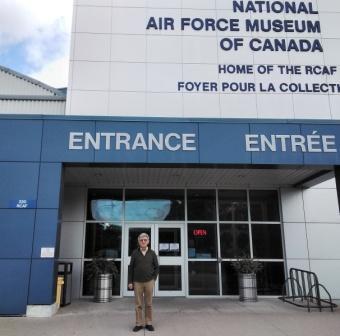
20230914_140657 Sep 14 2023 Pieter outside Natl RCAF Museum in Trenton

Pieter outside the National Air Force Museum of Canada in Trenton, Ontario.  (Photo credit: Daria Valkenburg)

…Pieter crossed an item off his bucket wish list!…

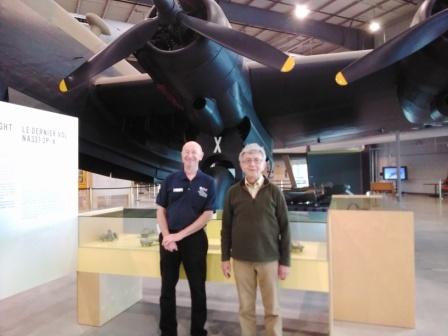
Pieter’s wish became a reality earlier this month when we travelled to the National Air Force Museum of Canada in Trenton, Ontario.  Elmer Muttart and his crew of Halifax L9561 were among the first to fly in the new Halifax bomber, Mark I.  The one in Trenton was a Mark VII, which had many modifications to make it safer. 

CIMG6456 Sep 14 2023 Pieter by Halifax Bomber

Pieter by the Mark VII Halifax bomber.  (Photo credit: Daria Valkenburg)

…The Halifax bomber was very versatile, once the initial design flaws were corrected…

Although designed during WWII, the original Halifax was intended for daytime flights – a foolish decision on the part of the British Ministry of Defence, given that there was nothing wrong with the eyesight of German pilots. 

It quickly became clear that sorties needed to be done at night.  However, flames from the exhaust emitted a red glow, making the bombers easy to spot by German pilots.  A cost-cutting measure by the Ministry of Defence resulted in using engines that were NOT recommended for the heavy Halifax bomber.  This meant that the bombers were slower than other planes, such as the Lancaster, and could not reach higher altitudes.  They were ‘sitting ducks’ and there were many losses of planes and airmen that could have been avoided had the safety of airmen been top of mind. 

Later models of the bomber, such as the Mark VII we toured, had these issues corrected, and our tour guide, Tim Whitehouse, an RCAF veteran, explained that the Halifax was beloved by the RCAF. “…5,797 were built over the years, along with 7,374 Lancasters...

The RCAF found that the Halifax bomber was very versatile.  “…They were flown by Bomber Command, Coastal Command, and 100 Group…”  We’d not heard of 100 Group before.  “…This was the electronic countermeasures group.  For example, they jammed German radar….

20230914_130746 Sep 14 2023 Tim Whitehouse and Pieter by Halifax bomber

Pieter with our guide, Tim Whitehouse, beside the Halifax Bomber we toured. (Photo credit: Daria Valkenburg)

 …The outside of the plane was huge …

We didn’t know what to expect, but the overwhelming sense we got was just how BIG the Halifax bomber was when we saw it inside the museum building.  Huge on the outside, it was quite cramped and narrow once you got inside. 

CIMG6461 Sep 14 2023 see the steps to get into the plane and guns

The tail turret in the foreground, but take a look at the step-stool, which shows where we entered the plane, and the small entry way.  Can you imagine doing that while carrying a parachute and in a flight suit?  (Photo credit: Daria Valkenburg)

 …Getting into the plane required agility …

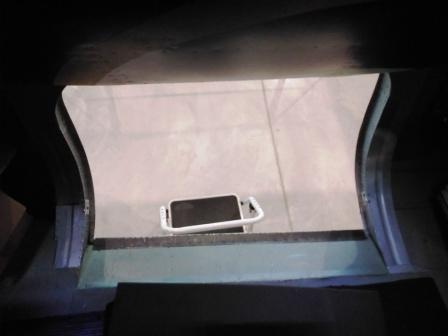
Getting into the plane was a challenge.  How air crew did it in woolen flight suits and carrying their parachutes and other gear is a testament to their agility!  There was a tiny entrance near the bottom of the plane which we had to crawl through. 

20230914_121954 Sep 14 2023 The hatch to get in and out of the bomber

This is the small space from which we entered and exited the plane.  (Photo credit: Daria Valkenburg)

20230914_122334 Sep 14 2023 Daria in belly of Halifax bomber

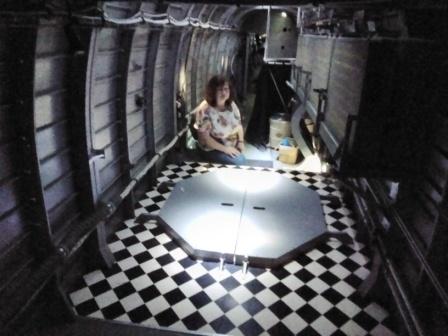
Once I got into the plane, I found that I was not agile enough to tour the cockpit or the rear gunner areas.  The flash of light at the bottom right is the entrance! The hexagonal shape was used to drop off secret agents behind the front. (Photo credit: Tim Whitehouse)

With help, I was able to get into the plane, but was unable to manage the steep step up to get into the cockpit area.  So I sat in the belly of the plane and had a nice rest. We asked Tim what the hexagonal shape was, as it looked like an escape hatch.

Tim explained that this feature was not in the early versions of the Halifax bomber, but was added later.  It wasn’t an escape hatch like we thought, but we weren’t too far wrong.  It was an exit out of the plane, used to drop off secret agents behind the front!

…Pieter in the pilot’s seat was a dream come true …

While I sat, Pieter and Tim continued the tour, beginning with the cockpit area.

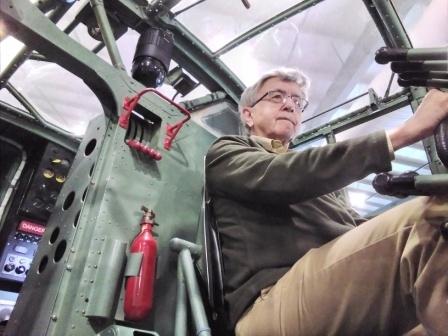
20230914_123226 Sep 14 2023 Pieter in the pilot seat of a Halifax bomber

Pieter in the pilot’s seat of a Halifax bomber! (Photo credit: Tim Whitehouse)

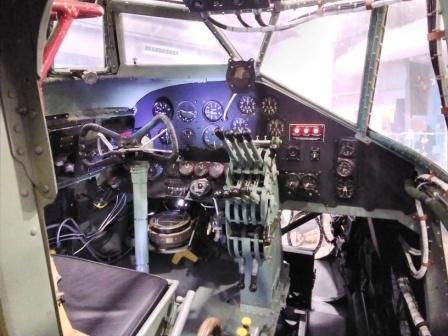
It was an emotional moment when Pieter sat in the pilot’s seat. “…I was overwhelmed by the instruments and how complex it was to operate this heavy plane with no computers….” 

20230914_125111 Sep 14 2023 Pilot control panel for Halifax bomber

The pilot’s control panel in the Halifax bomber. (Photo credit: Tim Whitehouse)

He kept thinking about the young men that flew these planes.  “…45% made the ultimate sacrifice in the first years of the war...” he told me.  But oh, how he wished that the plane still flew!  Luckily, the tour was the next best thing.

… ‘Where’s the ignition switch?’I asked …

After seeing what the control panel looked like, I asked him where the pilot turned the key into the ignition, as I didn’t see one.  OK, obviously I’ve never been in the cockpit of a plane, as I soon learned there is no key!  Starting a plane as complex as a Halifax bomber was not an easy task, and required each engine to be started separately, with a lot of steps that had to occur before that. 

For a sense of what is involved, you can watch this short video on the Halifax Bomber – Engine Start Sequence:

… Several crew members sat BELOW the pilot …

Pieter next toured the area BELOW the pilot where the navigator had his table and charts.  The wireless operator sat directly under the pilot.  The flight engineer sat behind the pilot and the  bomb aimer also sat below past the navigator in the nose of the plane.

CIMG6458 Sep 14 2023 Pilot sat on top navigator below

The small window at the top was where the pilot sat.  The windows below indicate where other crew members sat.  (Photo credit: Daria Valkenburg)

Exif_JPEG_420

The table used by the navigator, in the level below where the pilot and co-pilot sat.  (Photo credit: Pieter Valkenburg)

20230914_124329 Sep 14 2023 Pieter the bomb aimer

The bomb aimer also sat in the level below the pilot and co-pilot. This ‘bomb aimer’ got distracted! (Photo credit: Tim Whitehouse)

20230914_125156 Sep 14 2023 Pieter comes out of the bomb aimers position

Pieter coming out of the bomb aimer’s position.  The pilot’s seat is to the left. (Photo credit: Tim Whitehouse)

… The rear gunner sat in the tail turret …

After touring the front of the plane, Pieter moved to the back of the plane where the rear gunner sat in the tail turret, with the guns in front of him.   

20230914_125739 Sep 14 2023 Inside the rear gun tail turret

The rear gunner control panel.  (Photo credit: Tim Whitehouse)

20230914_125919 Sep 14 2023 Pieter in rear gunner position in tail turret

Pieter in the rear gunner’s seat.  (Photo credit: Tim Whitehouse)

… There were no ejection seats if you needed to quickly exit the plane …

We could only wonder at the bravery of the aircrew and marvel at Elmer Muttart’s piloting skills that he was able to keep a burning plane steady enough for the crew to safely exit on October 12, 1941– at night and while under attack.  There were no ejection seats!  There were several escape hatches on the plane, but normally the crew left the same way we did – through that little trap door!  The rear gunner had an alternate escape hatch through the window of the tail turret.

We were reluctant to leave the plane, but all good things come to an end, and our adventure as Halifax bomber crew members left us with an even deeper respect for those brave men who flew during the war. 

Thank you to our excellent tour guide, Tim Whitehouse, for making the experience so memorable, and to the National Air Force Museum of Canada for allowing tours of the plane.

Do you have a story to tell? Pieter encourages you to email him at memorialtrail@gmail.com, comment on the blog, or tweet to @researchmemori1.    

© Daria Valkenburg

…Previous stories about aircrew who lost their lives in a Halifax bomber….

…Want to follow our research?…

If you are reading this posting, but aren’t following our research, you are welcome to do so.  Our blog address: https://onthewarmemorialtrail.com/

Front cover OnTheWarMememorialTrailinEurope4 countries, 6 weeks, 7,000 km – an unforgettable war memorial journey in Europe…. Daria’s book ‘No Soldier Buried Overseas Should Ever Be Forgotten‘ is available in print and e-book formats.  Net proceeds of book sales help support research costs and the cost of maintaining this blog. For more information see https://nosoldierforgotten.com/

Subscribe to our YouTube Channel: On The War Memorial Trail With Pieter Valkenburg: https://www.youtube.com/channel/UCJ591TyjSheOR-Cb_Gs_5Kw

Never miss a posting!  Subscribe below to have each new story from the war memorial trail delivered to your inbox.