On the War Memorial Trail ….. In Cologne

February 26, 2018.  After visiting the graves of all the names listed on the Cenotaph outside the Borden-Carleton Legion who were buried or listed on monuments in France, Belgium, and The Netherlands, we had one visit and one country left for this trip… to the Cologne Southern Cemetery, located in the Südfriedhof Cemetery in Cologne, Germany, and the grave of WWI soldier Lt. Henry Warburton STEWART.

This trip almost proved to be my undoing.  After a long drive to Cologne, we finally found the cemetery, located at an intersection of tram lines in a busy part of Cologne.  Pieter was in a rush to get moving after the long car ride, and sprinted ahead to find the Commonwealth War Graves Cemetery.

Südfriedhof Cemetery is a very large public cemetery, the largest we’ve ever been in, with many paths and turns.  Only one small sign at the entrance indicates that there is a Commonwealth War Graves Cemetery located here.  Once inside the cemetery, we soon learned that there are no directional markers to it.
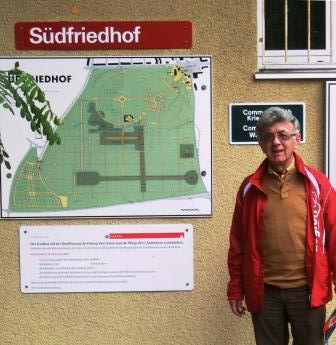
CIMG9274 Sep 24 2017 Cologne Pieter at entrance to Sudfriedhof cemetery

Sign at the entrance to Südfriedhof Cemetery with a map of the cemetery, and a very small sign behind Pieter’s head giving an indication that there is also a Commonwealth War Graves Cemetery located here. (Photo credit: Daria Valkenburg)

With Pieter long gone, I slowly hobbled my way on the gravel paths, trying to figure out where to go.  Most cemeteries are in clear lines, but this one was like a maze.  It was beautifully maintained, but quite dark and to my mind, a bit depressing.  As it was a Sunday, there were many people in the cemetery.  When we’d been in cemeteries in South America, many were like parks, with wide paths, park benches, and children laughing and playing.  People sat on benches and visited with each other. Outside the entrance, there were kiosks selling ice cream, balloons, and flowers.  Not this cemetery.  It was quiet and people talked very softly to each other.  Occasionally I saw people tending the graves of their family members.

It was very humid, and as I made my way, hoping not to get lost, I could feel my hair curling and frizzing.  My arthritic hip was aching and walking with a cane on gravel meant moving even more slowly than usual.  After close to a km of walking, I finally saw what I believed to be a sign to the Commonwealth War Graves Cemetery.  The sign said “Graves of the Victims of the War from 1914-1918”.

CIMG9284 Sep 24 2017 Cologne sign at Sudfriedhof cemetery directing one to the victims of WW1

Sign pointing to the graves of WWI victims. (Photo credit: Daria Valkenburg)

I took that path and came into an area of the cemetery surrounded by hedges, making a rather dark cemetery look even drearier.  To my surprise, however, the WW1 victims were German soldiers who had died during the war.  It took me a long time afterwards to realize that to their families, they were just as much victims as Allied soldiers.

Only one young man was in this part of the cemetery, planting flowers by a grave.  I hesitantly asked if he knew where the Commonwealth War Graves Cemetery was.  He looked at me for quite a few minutes and at first I thought he wasn’t going to answer, but then figured out that he was as surprised to find me in that part of the cemetery as I was.  “Just follow the path and you will come to the gate for the English soldiers” he said.  We wished each other a good day and I kept on.

Finally, I found the gate to the Cologne Southern Cemetery and discovered it was the back door gate, not the entrance.  Pieter was waiting by the grave of Henry Warburton Stewart, and had already put down the flags and written in the cemetery register.  He’d forgotten who had the camera, otherwise he probably would have already gone back to the car!
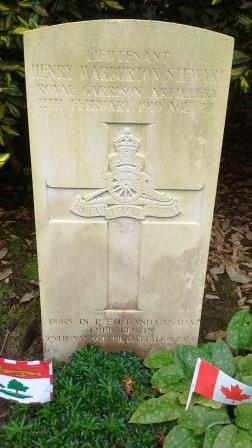
IMG_20170924_113711423 Sep 24 2017 grave of Henry Warburton Stewart at Cologne Southern Cemetery

Grave of Henry Warburton Stewart at Cologne Southern Cemetery. (Photo credit: Pieter Valkenburg)

The story of Henry Warburton Stewart is a sad one, as he survived WW1, only to die of pneumonia after contracting Spanish flu in Germany, far away from his comrades.  Born in Strathgartney on April 15, 1884, the son of Robert Bruce Stewart and Ann, nee Warburton, he was a civil engineer when he enlisted as a private with the 29th Battalion (Tobin’s Tigers) in Vancouver on November 30, 1914.
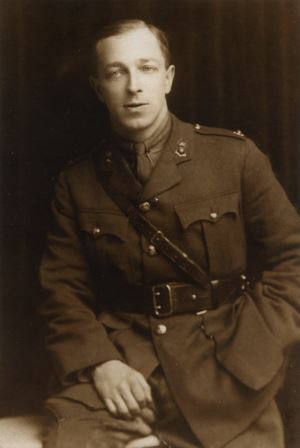
Henry Warburton Stewart

Henry Warburton Stewart. (Photo courtesy B. Stewart family collection)

After serving in the trenches of France for two years, he was discharged with excellent recommendations by the Canadian Army on March 9, 1917 in England and commissioned as a Lieutenant in the Imperial Army’s 77th Siege Battery Royal Garrison Artillery.  Since we have not been able to get access to the war diaries of this unit, we presume that he was sent to Germany as part of the post-occupation forces and there fell ill, dying on February 11, 1919 at No. 2 Canadian Field Hospital in Bonn.  He was buried with military honours at Poppelsdorf Cemetery in Bonn.

In 1922, it was decided that the graves of Commonwealth soldiers who had died in Germany should be brought together in one of four cemeteries within Germany.  Stewart was reburied in Cologne Southern Cemetery.
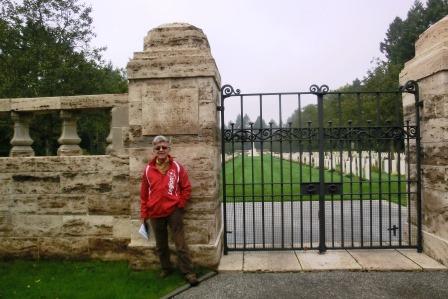
CIMG9281 Sep 24 2017 Cologne Pieter at entrance to Cologne Southern Cemetery in Sudfriedhof cemetery

Pieter at the entrance to Cologne Southern Cemetery, located in Südfriedhof Public Cemetery in Cologne. (Photo credit: Daria Valkenburg)

Unlike the portion of the cemetery where the German soldiers rest, Cologne Southern Cemetery is open and airy.
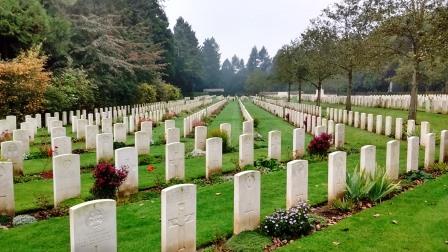
IMG_20170924_114611116_HDR Sep 24 2017 View of graves in Cologne Southern Cemetery

Commonwealth war graves in Cologne Southern Cemetery. (Photo credit: Pieter Valkenburg)

After paying our respects to Lt. Stewart, we slowly made our way back towards the car.  Pieter noticed a pastry shop across the road and suggested we mark the end of our war memorial tour with a piece of cake and a cup of coffee.
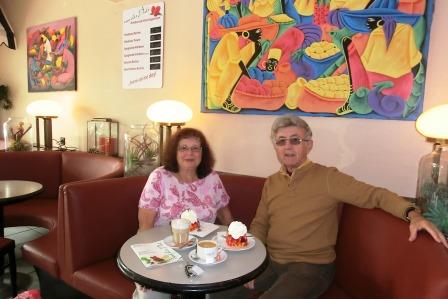
CIMG9286 Sep 24 2017 Cologne time for a fruit tart and coffee at Van der Put cafe after Sudfriedhof cemetery

Coffee break at Van der Put café in Cologne.

So, after four European countries and 7,000 km on the rental car, the research now continues on Canadian soil.  We had an amazing adventure and met many wonderful people dedicated to helping to remember the wartime sacrifices of Canadian and other Allied soldiers.  We are humbled and grateful to play a small part in this.

Unfortunately, we know little about Stewart’s service in the Imperial Army as those records are not digitized and are at The British National Archives.  If anyone has more information, please let us know.  As well, photos are still needed for many of the names on the Cenotaph outside the Borden-Carleton Legion.   Please share your photos, comments, or stories by emailing us at memorialtrail@gmail.com or by commenting on this blog.

© Daria Valkenburg

….Want to follow our research?….

If you are reading this posting, but aren’t following our research, you are welcome to do so.  Our blog address: https://onthewarmemorialtrail.com/
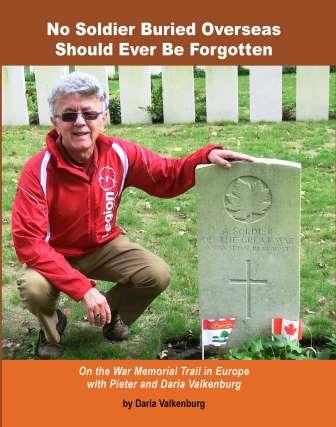
Front cover OnTheWarMememorialTrailinEurope4 countries, 6 weeks, 7,000 km – an unforgettable war memorial journey in Europe…. Daria’s book ‘No Soldier Buried Overseas Should Ever Be Forgotten‘ is available in print and e-book formats.  Net proceeds of book sales help support research costs and the cost of maintaining this blog. For more information see https://nosoldierforgotten.com/ 

You are also invited to subscribe to our YouTube Channel: On The War Memorial Trail With Pieter Valkenburg: https://www.youtube.com/channel/UCJ591TyjSheOR-Cb_Gs_5Kw

Never miss a posting!  Subscribe below to have each new story from the war memorial trail delivered to your inbox.
On the War Memorial Trail ….. At Holten Canadian War Cemetery

January 20, 2018.  After visiting the Information Centre at the Canadian War Cemetery in Holten, we went into the cemetery itself to lay flags at the graves of five known soldiers from PEI.  Two of them, William Douglas SHERREN and George Martin MCMAHON are listed on the Cenotaph outside the Borden-Carleton Legion.

We had wondered why the cemetery had more landscaping than most Commonwealth War Cemeteries and why it was not on one level, but terraced.  Edwin van der Wolf, our guide, explained that the cemetery originally was on flat ground.  The Canadian government acquired more land than was used in the belief that the war would last longer and go into Denmark, resulting in more casualties. Luckily, that didn’t happen, and meant that the excess land could be used for landscaping.

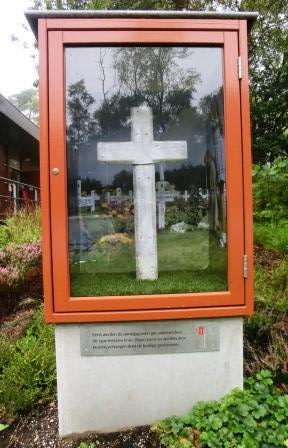
When the cemetery was first opened, metal crosses were used to mark each grave, and there is a display in front of the Information Centre that shows one.

CIMG9100 Sep 18 2017 display of original metal cross used in Holten Cemetery

Metal cross originally used to mark each grave in Holten Canadian War Cemetery. (Photo credit: Daria Valkenburg)

Originally, the Cross of Sacrifice in the cemetery was placed further back than in its present location.  Similar to the story we’d heard about the placement of a Cross of Sacrifice at Groesbeek Canadian War Cemetery, Edwin noted that he had heard that when Holten Cemetery began, Lt. General Guy Granville Simonds, Commander of the 2nd Canadian Army, “wanted the Cross of Sacrifice to be 60 metres high and lit up so that it could be seen across the German border as a reminder of who had conquered them.”  Whether this story is true or not, we don’t know.

CIMG9123 Sep 18 2017 Holten Cemetery Pieter & Edwin van der Wolf by cross of remembrance

Pieter with Edwin van der Wolf by the Cross of Sacrifice at Holten Canadian War Cemetery. (Photo credit: Daria Valkenburg)


IMG_20170918_133147255_HDR Sep 18 2017 landscaping at Holten Cemetery

Landscaped grounds of Holten Canadian War Cemetery. (Photo credit: Pieter Valkenburg)

The first grave where flags were placed was that of Captain William Douglas Sherren, born November 25, 1914 in Crapaud, son of William Douglas Sherren and Florence Amanda nee Carrier.  Married to Florence Mead Strickland, he was the father of two sons, Hubert and Harrison Blair.  An electrician before the war, Sherren enlisted on January 6, 1941 as a Lieutenant with the First Survey Regiment, Royal Canadian Artillery.  On March 29, 1944 he was promoted to Captain.

Wiliam Douglas Sherren

William Douglas Sherren. (Photo courtesy of Holten Canadian War Cemetery Information Centre)

On July 9, 1944, not long after D-Day, he arrived in France from England.  He was recognized by King George VI as a Member of the Military Division of the Most Excellent Order of the British Empire in March 1945, in recognition of gallant and distinguished service in North West Europe.

Unfortunately, on April 25, 1945, while in Germany, the vehicle he was travelling in struck a landmine. He was severely wounded and died on April 28, 1945.  Originally buried in Cloppenburg Hospital Cemetery in Lower Saxony, he was reburied in Holten Canadian War Cemetery in 1947, after the war ended.

IMG_20170918_134108826 Sep 18 2017 grave of WD Sherren Holten cemetery

Grave of Captain William Douglas Sherren at Holten Canadian War Cemetery. (Photo credit: Pieter Valkenburg)

The next set of flags were placed at the grave of Gunner George Martin McMahon, born January 14, 1913 in Emerald Junction, son of  Peter A McMahon and Catherine nee Monaghan.  Married to Margaret Kathleen Greenan, he was the father of 5 children. In addition, one child, Joseph Louis died in 1942 at the age of three months, and another child, Georgie, was born in November 1945 after McMahon’s death.  Prior to enlistment in Montreal with the Royal Canadian Artillery on December 7, 1943, he was a machinist with Canadian Vickers Ltd.  Fluent in both English and French, his army record noted he could play the violin.

OLYMPUS DIGITAL CAMERA

George Martin McMahon. (Photo courtesy “Around Kinkora Area” by G. K. Farmer)

McMahon left Canada for England in March 1945, and was sent to North West Europe in May 1945.  According to a letter to his widow, written by Colonel C. L. Laurin, McMahon was on “a short leave to Amsterdam in company of a comrade with the same regiment.  On the evening of the 10th of August 1945, at approximately 11:50 pm, they parted company…” 

McMahon’s friend returned to the Army leave hotel alone.  The following day, this soldier, made enquiries and was informed that the body of the deceased had been found in a canal….”  It was determined that he had accidentally drowned on August 11, 1945.   He was first buried in Hilversum Community Cemetery, and in 1946 was reburied in Holten Canadian War Cemetery.

IMG_20170918_134412720 Sep 18 2017 G McMahon grave Holten Cemetery

Grave of George Martin McMahon at Holten Canadian War Cemetery. (Photo credit: Pieter Valkenburg)

After visiting McMahon’s grave we went on to place flags at the graves of three more known soldiers from PEI: Carman GILLCASH, Frederick Charles CHEVERIE, and Daniel Peter MacKenzie.

Edwin van der Wolf told us that MacKenzie had been with the Carleton & York Regiment, which liberated the village of Posterenk.  This is where MacKenzie, plus 5 more from his unit, lost his life from sniper fire from Germans using the village’s windmill as a hideout.  For the past two years, on April 13, the people from the village commemorate the event around the old windmill.

Do you have more information or photos on these five soldiers from PEI?  Have you visited Holten Cemetery and its Information Centre?  Do you know of more soldiers from PEI buried in the Cemetery?  You can share your comments and stories by emailing us at memorialtrail@gmail.com or by commenting on this blog.

© Daria Valkenburg

….Want to follow our research?….

If you are reading this posting, but aren’t following our research, you are welcome to do so.  Our blog address: https://onthewarmemorialtrail.com/

Front cover OnTheWarMememorialTrailinEurope4 countries, 6 weeks, 7,000 km – an unforgettable war memorial journey in Europe…. Daria’s book ‘No Soldier Buried Overseas Should Ever Be Forgotten‘ is available in print and e-book formats.  Net proceeds of book sales help support research costs and the cost of maintaining this blog. For more information see https://nosoldierforgotten.com/ 

You are also invited to subscribe to our YouTube Channel: On The War Memorial Trail With Pieter Valkenburg: https://www.youtube.com/channel/UCJ591TyjSheOR-Cb_Gs_5Kw

Never miss a posting!  Subscribe below to have each new story from the war memorial trail delivered to your inbox.

On The War Memorial Trail….A Visit To Tyne Cot Cemetery

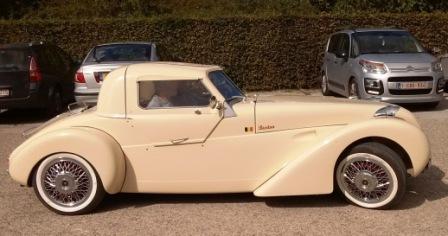
November 10, 2017.  While we were in Zonnebeke, we made a stop on the war memorial trail at Tyne Cot Cemetery.  In France, unless it was a big cemetery or memorial, like Vimy Ridge or Beau Hamel, there were few visitors.  In Belgium, to our surprise, members of car and motorcycle clubs visited the various cemeteries and memorials as part of their touring schedules.  During our visit to Tyne Cot Cemetery, a club for a car named Burton stopped on their own war memorial rally tour.

The Burton is a Dutch sports car based on French 2CV technology. The Burton is an open, nostalgic-looking sports car built on the chassis of the 2CV with a modern fibreglass body and built from a kit. Of course, car-mad Pieter couldn’t resist taking a few photos as he made his way from the parking lot to the cemetery.

IMG_20170909_151921275 Sep 9 2017 Burton car in Tyne Cot cemetery parking lot

Burton sports car in the parking lot of Tyne Cot Cemetery in Zonnebeke. (Photo credit: Pieter Valkenburg)

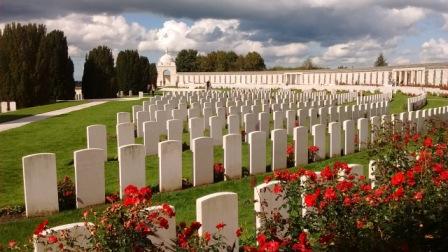
Tyne Cot Cemetery is the largest Commonwealth War Cemetery in the world, with 11,956 graves, of which 1,011 are Canadian.  Most were killed during the Battle of Passchendaele.  In addition, 34,957 soldiers with no known grave, who died after August 15, 1917, have their names engraved on the cemetery walls.  Those soldiers with no known grave who died before August 15, 1917 are listed on the Menin Gate Memorial (See A Daytime Visit To Menin Gate Memorial in Ypres).

IMG_20170909_153120338 Sep 9 2017 Tyne Cot Cemetery graves with wall of those with no known grave

Names of soldiers with no known grave, who died after August 15, 1917 are engraved on the walls of Tyne Cot Cemetery. (Photo credit: Pieter Valkenburg)

Surprisingly, with the large number of war dead in Tyne Cot, no one from the Cenotaph outside the Borden-Carleton Legion is buried or commemorated there.  But if you are on a war memorial trail, it would be a shame to miss seeing the largest cemetery.

IMG_20170909_153208728 Sep 9 2017 Tyne Cot Cemetery graves

Tyne Cot Cemetery in Zonnebeke. (Photo credit: Pieter Valkenburg)

As we made our way to the cemetery and the visitors centre, we passed by a grassy area of plastic poppies with messages from the public in Britain. This was an initiative of the Royal British Legion’s Passchendaele 100 Memorial, who collected the poppies and brought them to the cemetery.  Some of the messages commemorated a loved one, others were very general in nature.  It certainly made for a colourful display!

IMG_20170909_152308460 Sep 9 2017 plastic poppies in field in Tyne Cot cemetery in Zonnebeke

Plastic poppies with messages from the British public on display at Tyne Cot Cemetery. (Photo credit: Pieter Valkenburg)

We learned that a Victoria Cross recipient from the 27th (City of Winnipeg) Battalion is buried here, James Peter ROBERTSON, a private who was killed on November 6, 1917 during the final phase of the Battle of Passchendaele.  When his platoon was blocked by barbed wire and a German machine gun, he dashed to an opening in the enemy position, and rushed the gun, killing four German soldiers and turning the machine gun on the rest of the Germans.  This allowed the platoon to continue towards its objective.  Afterwards, when two Canadian snipers were wounded in front of their trench, he went out and carried one in, while under fire.  Unfortunately, he was killed as he returned with the second man.  With Daria being from Winnipeg, Pieter of course visited the grave of this soldier and placed flags.

IMG_20170909_152917733 Sep 9 2017 grave opf JP Robertson in Tyne Cot cemetery

Grave of Victoria Cross recipient James Peter Robertson, buried at Tyne Cot Cemetery in Zonnebeke. (Photo credit: Pieter Valkenburg)

 We are continually humbled by the depth of sacrifice from the soldiers.  Like in northern France, you can’t go very far before you encounter another cemetery or memorial.  As we continued on the War Memorial Trail, we thought of the two other soldiers from the Cenotaph project who died in this area, George Campbell and Charles Buxton, and whose names are on the Menin Gate Memorial.

As Buxton was with the Princess Patricia’s Light Infantry, our next stop was the Princess Patricia’s Light Infantry Memorial in Zonnebeke.  Comments or stories?  You can share them by emailing us at memorialtrail@gmail.com or by commenting on this blog.

© Daria Valkenburg

….Want to follow our research?….

If you are reading this posting, but aren’t following our research, you are welcome to do so.  Our blog address: https://onthewarmemorialtrail.com/

Front cover OnTheWarMememorialTrailinEurope4 countries, 6 weeks, 7,000 km – an unforgettable war memorial journey in Europe…. Daria’s book ‘No Soldier Buried Overseas Should Ever Be Forgotten‘ is available in print and e-book formats.  Net proceeds of book sales help support research costs and the cost of maintaining this blog. For more information see https://nosoldierforgotten.com/ 

You are also invited to subscribe to our YouTube Channel: On The War Memorial Trail With Pieter Valkenburg: https://www.youtube.com/channel/UCJ591TyjSheOR-Cb_Gs_5Kw

Never miss a posting!  Subscribe below to have each new story from the war memorial trail delivered to your inbox.

On The War Memorial Trail….The Calais Canadian War Cemetery

October 8, 2017.  Following a restful night in Caen, we made our way to the final cemetery we were visiting in France, the Calais Canadian War Cemetery in Leubringhen, 14 km from Calais, where Lt. James Arthur AFFLECK is buried.  This is the second WWII grave we visited in France.

Calais was liberated by the Canadian 1st Army early in September 1944 as they advanced up the French coast into Belgium, in pursuit of retreating German forces.  Most of the burials in the Calais Canadian War Cemetery are from this period of fighting.  There are 704 Commonwealth burials from WWII, of which 30 are unidentified.  594 of these burials are of Canadian soldiers. There also are 6 Czech and 19 Polish war graves.

After the earlier struggles we had getting to the Commonwealth War Cemeteries in France, this cemetery was surprisingly easy to find.  It was the first one we were at that had a sign on the highway, and it was conveniently located right off of the highway exit to Leubringhen, a village that’s halfway between Calais and Boulogne.  There was even a parking area!

CIMG8630 Sep 8 2017 sign for Calais Cdn War Cemetery

Sign off of the highway exit directing us to Calais Canadian War Cemetery. (Photo credit: Daria Valkenburg)

James Arthur Affleck was born April 15, 1920 in Bedeque, Prince Edward Island, the son of Robert Bruce Affleck and Mary Eliza MacCallum.  A farmer before he enlisted with the North Nova Scotia Highlanders on March 3, 1942, he was killed in action by artillery shells on September 17, 1944, during the first day of the Battle of Boulogne (Operation Wellhit), in a 5 day battle to take the port of Boulogne from German control.

Arthur Affleck

Lt. James Arthur Affleck. (Photo courtesy of Percy Affleck Family Collection)

In ‘No Retreating Footsteps: The Story of the North Nova Scotia Highlanders’, published in 1954, author Will Bird tells what happened on September 17, 1944 on pages 222 and 223:

L/Cpl K. L. Miller was with Sgt. P. J. Whalen as A Company went up to attack.  They rode almost over the crest of the first hill, then began crawling inside a hedge and used it for cover until they came to a gap and some large craters.  There was barbed wire around a number of buildings, and a far one seemed to have been used for a garage.  Direct bomb hits had crashed the first two buildings to wreckage.  The next was a pillbox but heavy mortar fire descended and forced everyone to take shelter in the craters.  Sgt. Whalen was killed and before the barrage let up three others had lost their lives. Miller worked along a distance toward the pillbox and was told the officer, too, had been killed…. The officer killed during the heavy shelling was Lt. Affleck and it was his first battle….

The path from the parking area to the cemetery is lined with trees and is hauntingly beautiful and gives the appearance of the peace that those who died in battle deserve – well, except for the fierce wind.  It was a reminder of the windy areas back on Prince Edward Island!

CIMG8629 Sep 8 2017 walkway to Calais Cdn War Cemetery

Grassy walkway from the parking lot to Calais Canadian War Cemetery. (Photo credit: Daria Valkenburg)

CIMG8617 Sep 8 2017 Pieter outside Calais Cdn War Cemetery

Pieter at the entrance to Calais Canadian War Cemetery. We were taking bets on how long the rain would hold off. (Photo credit: Daria Valkenburg)

The sky was black but the rain held off long enough for Pieter to plant flags by Lt. Affleck’s grave.

CIMG8621 Sep 8 2017 Pieter at Afflecks grave at Calais Cdn War Cemetery

Pieter at the grave of Lt. James Arthur Affleck in Calais Canadian War Cemetery. (Photo credit: Daria Valkenburg)

As we were going back to the car, however, the downpour began!   Luckily, we were only 74 km from our destination of De Panne, a coastal town that would be our base in Belgium.

In the next blog entry we return to the WWI war memorial trail, this time in the area around Ypres, Belgium. Do you have photo or info on James Arthur Affleck?  Comments or stories?  You can share them by emailing us at  memorialtrail@gmail.com or by commenting on this blog.

© Daria Valkenburg

….Want to follow our research?….

If you are reading this posting, but aren’t following our research, you are welcome to do so.  Our blog address: https://onthewarmemorialtrail.com/

Front cover OnTheWarMememorialTrailinEurope4 countries, 6 weeks, 7,000 km – an unforgettable war memorial journey in Europe…. Daria’s book ‘No Soldier Buried Overseas Should Ever Be Forgotten‘ is available in print and e-book formats.  Net proceeds of book sales help support research costs and the cost of maintaining this blog. For more information see https://nosoldierforgotten.com/ 

You are also invited to subscribe to our YouTube Channel: On The War Memorial Trail With Pieter Valkenburg: https://www.youtube.com/channel/UCJ591TyjSheOR-Cb_Gs_5Kw

Never miss a posting!  Subscribe below to have each new story from the war memorial trail delivered to your inbox.