The WWI Names On The Cenotaph Have Stories Of Their Own

February 8, 2020. Recently, Pieter and a friend went to see the British WW1 movie ‘1917’, which is nominated for several Oscars and has a Canadian connection due to a map used in the film.  (For that story see https://www.cbc.ca/news/entertainment/1917-canadian-contribution-1.5450608)  The story takes place in France on April 6, 1917, and is about two men tasked with delivering a message to another unit to warn of a German ambush.  The men go through several towns and villages in France’s Western Front.  Canadians may remember this period as being the lead up to the Battle of Vimy Ridge on April 9, 1917.

Pieter found the movie of great interest for several reasons. It was a depiction of the horrors of war… without being overly gory.  After being through the trenches and tunnels in Vimy Ridge a few years ago, he was intrigued to see the way soldiers sat on either side of a trench while waiting to go up into battle.   But the main reason he liked the movie is that it told the story of two people.

Contrary to what we learn in history books and classes, in the end all history is the cumulative stories of individuals.  A list of names on a cenotaph, such as the one outside the Borden-Carleton Legion, is meaningless without knowing who those people were and what happened to them.  This is what started Pieter on the journey to uncover the stories behind the names on the Cenotaph.

Over the years, the stories of those from WWI have been told in this blog.  24 are listed on the Cenotaph and half of them died in France…. Patrick Raymond ARSENAULT and John Lymon ‘Ly’ WOOD are listed on the Vimy Memorial as their bodies were never identified.    Also killed in France were Kenneth John Martin BELL, James CAIRNS, James Ambrose CAIRNS, Arthur Leigh COLLETT, Bazil CORMIER, Patrick Phillip DEEGAN (DEIGHAN), Joseph Arthur DESROCHES, Percy Earl FARROW (FARRAR), Ellis Moyse HOOPER, and Charles W. LOWTHER.  We were at the Vimy Memorial and visited each grave.

Five men died in Belgium. Two are listed on the Menin Gate Memorial in Ypres, as their bodies were never identified: Charles Benjamin Murray BUXTON and George Albert CAMPBELL.  We visited Menin Gate and the area where they died.  We also visited the graves of James Lymon CAMERON, Vincent Earl CARR, and Arthur Clinton ROBINSON.

Vincent Carr, who died during the Battle of Passchendaele on October 30, 1918, was initially buried in a trench with 4 others – two Canadian and two British soldiers.  Decades later, when they were reburied in a Commonwealth War Graves Commission cemetery, all three Canadians were still identifiable.  The British Army’s cardboard identity ‘tags’ had disintegrated, leaving the two British soldiers as unidentified.  Today, DNA testing can be done to help with identity, but decades ago this was impossible.

Two men died in England.  John Goodwill HOWATT was wounded in France, and died in a British hospital.  Bruce Sutherland McKAY had gotten ill during the transport from Canada to England and also died in a British hospital.

Henry Warburton STEWART survived the war, only to fall ill while in Germany as part of the occupation forces.  He’s buried in a German cemetery in Cologne, which we visited.

James Graham FARROW (FARRAR) was not a soldier, but in the Merchant Navy, transporting vital supplies between England and France, when his ship was torpedoed by a U-boat.

Three men died on Canadian soil.  Leigh Hunt CAMERON died of illness, while Harry ROBINSON died from blood poisoning.  William Galen CAMPBELL was poisoned with mustard gas on May 28, 1918, a few months before the end of the war, but was able to return home.  And yes, we’ve visited those graves as well.

We were also able to tell you parallel stories, such as that of Clifford Almon WELLS, who had many of the same experiences as John Lymon Wood, and also died in France. Another story was that of George BRUCKER, of the German Army, who was taken prisoner during the Battle of Vimy Ridge, and survived the war, never forgetting the two ‘tall’ Canadians who didn’t shoot him.  Decades later his son, now in his 80s, is still hoping to thank the families of those two unknown men.

Thanks to Pieter’s curiosity in trying to find out why one Commonwealth War Graves Commission gravestone in a cemetery in Cape Traverse was not recorded on the Cenotaph, we were able to tell you the story of Elmyr KRUGER, a soldier from Saskatchewan who died of illness while guarding German prisoners of war from a POW camp in Amherst.

We’ve told the stories of each man, and shared our visits to the various cemeteries and war memorials.  As photos and letters came in, we shared those experiences as well.

We are still missing photos of several of these soldiers, so the quest to put a face to every name and story is still ongoing.  Who are we missing?  Take a look and see if you can help:

Slide6

Slide8

Slide9

Slide10

Slide13

Slide15

Slide16

Slide20

Slide22

Slide23

UPDATE:  Photos of James Cairns, Joseph Arthur Desroches, and Harry Robinson have been found!

It’s great to watch a movie about fictional characters, but let’s not forget the stories of real life people! There won’t be any Academy Awards given out, but they will be remembered. Research continues to uncover more stories.  If you have a story or photo to share about any of the names mentioned in this posting, please contact Pieter at memorialtrail@gmail.com or comment on the blog.

© Daria Valkenburg

....Want to follow our research?…

If you are reading this posting, but aren’t following our research, you are welcome to do so.  Our blog address: https://onthewarmemorialtrail.com/
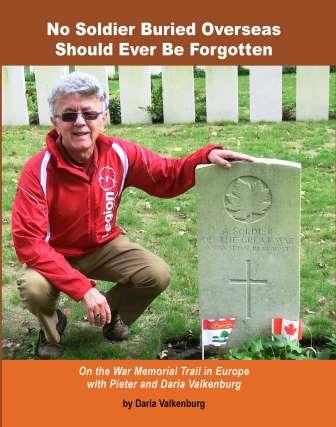
4 countries, 6 weeks, 7,000 km – an unforgettable war memorial journey in Europe…. Daria’s book ‘No Soldier Buried Overseas Should Ever Be Forgotten‘ is available in print and e-book formats.  Net proceeds of book sales help support research costs and the cost of maintaining this blog. For more information see https://nosoldierforgotten.com/

Subscribe to our YouTube Channel: On The War Memorial Trail With Pieter Valkenburg: https://www.youtube.com/channel/UCJ591TyjSheOR-Cb_Gs_5Kw

Never miss a posting!  Subscribe below to have each new story from the war memorial trail delivered to your inbox.
The Parallel WW1 Experiences of John Lymon Wood & Clifford Almon Wells

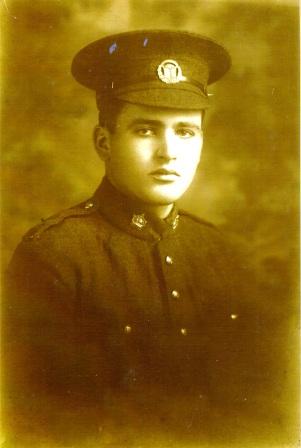
September 16, 2019.  Sometimes we learn more about a particular soldier’s experience by reading about a soldier in a similar situation.  This was the case when I read “From Montreal To Vimy Ridge and Beyond: The Correspondence of Lt Clifford Almon Wells”, edited by his step-father, Pastor G.G.S. Wallace of a Baptist Church in Montreal, and published in 1917.  Wells was not an Islander, but he enlisted in the Princess Patricia Canadian Light Infantry 4th University Company, as did John Lymon WOOD, whose story has been told previously in blog postings.  (See WWI Soldier John Lyman Wood’s Connection With Acadia University and Learning About The Two Names On The Vimy Memorial)

Wells enlisted in September 1915, Wood on October 12, 1915.  At the time of enlistment, Wells was doing graduate work towards his PhD in archeology at John Hopkins University in Baltimore, Maryland while Wood was a second year engineering student at Acadia University in Wolfville, Nova Scotia.

Photo Lyman Wood

Photo: John Lyman Wood shortly after enlistment in October 1915. (Photo courtesy of Gene Rogerson collection)

Lt Clifford Almon Wells in 1916

Clifford Almon Wells in summer 1916. (Photo courtesy of “From Montreal To Vimy Ridge and Beyond: The Correspondence of Lt Clifford Almon Wells”)

On October 19, 1915, in a letter to his brother, Wood explained that he was packing his trunk in preparation for leaving Wolfville for Montreal. Like so many university educated men, an officer’s commission had been suggested by the recruitment office. “….I wish I had gone in the heavy artillery at Charlottetown now, but I’ll get a commission as Lieutenant if I can.  A man stands a far better chance of coming back if he goes in the artillery, but I suppose that is not the right way to look at it though.  The men are needed more in the Infantry, so I suppose it is only right to go where you are the most needed and where you can do the most good….I never hated to leave a place so bad as I do Wolfville this time.  But I must be doing what is right for there seems no other way out of it.” (Excerpt of a letter on page 157 of ‘Remember Yesterday: A History of North Tryon Prince Edward Island 1769-1992 Volume 1’, published in 1993)

Both Wells and Wood were in Montreal, preparing for being sent abroad.  In a November 2, 1915 letter, Wells wrote that “… the 4th University Company, bring recruited overstrength already, has received orders to be ready to sail on the 11th. Thousands of troops sail from Montreal every month without anyone being any the wiser.  Trains come in at night, stop on the wharf alongside the transports and by daybreak the men are on the way.  So it will be with us… The city just swarms with soldiers at present, as two full battalions have been sent back from the camp at Valcartier, which is closed for the winter…

There was a delay in leaving Montreal, as in the end they didn’t leave until November 26, 1915, by train enroute to Halifax.  In a November 26, 1915 letter, Wells noted that “… We did not leave Montreal until nearly 11 o’clock, as we waited for several carloads of troops from Winnipeg to join us.”  He explained that sentries were posted at the train doors, and no one except officers and platoon sergeants were allowed to pass from car to car without special permission.

They arrived in Halifax in the afternoon of November 27, 1915, and Wells sent a brief letter to his mother, saying that “...We reached Halifax two hours ago, and came aboard the ‘Lapland’ almost immediately.

On November 28, 1915 the SS Lapland, which had arrived from New York, sailed from Halifax, arriving in Plymouth, England on December 7.  During the voyage, Wells wrote several letters.  On December 3, 1915, he made the observation that “….There are about 2,000 other troops aboard.  The 37th Battalion from the West, the 92nd Highlanders, units of the A.S.C. Cyclists, etc.”  Wells went on to explain that they had to be alert for U-boats.  “Today we are fairly in the danger zone.  Our company’s machine gun is mounted aft, while other guns are mounted forward.  The decks are lined with men armed with rifles.  So we are all ready for submarines.  Tonight every man must sleep on deck by the life-boat or raft to which he has been assigned.  All portholes are darkened at night and every precaution is taken to render the ship invisible.

Upon arrival, they were both sent to the 11th Reserve Battalion, stationed at St. Martin’s Plain in Shorncliffe, near Folkestone, for infantry training for needed reinforcements to the Canadian Corps in the field.  In a December 9, 1915 letter, Wells wrote about the culture shock he’d experienced.  “It has rained steadily, with an intermission yesterday, ever since we reached Plymouth Sunday morning until now.  The camp is one sea of mud – such mud as I never dreamed of before.  I never shine my shoes now, as the first step out of the hut buries them in 3 or 4 inches of slime.  We are quartered in huts which hold about 40 men each….

He then explained that “The streets in Shorncliffe are very dimly lighted by night on account of the danger from Zepps, and every window in every hut is covered with a blanket when the lights are switched on.  Outside it is pitch dark and one wallows in mud and water when compelled to go out at night.

Like Wood, Wells soon found out that while the British were interested in troops as ‘cannon fodder’, a system of discrimination already existed to prevent them from becoming officers, contrary to what they were told when they signed up.  He discussed this in a continuation of his December 9 letter:  “I have bad news in one respect.  An order has been passed by which no more Canadian soldiers are given commissions in the Imperial Army except when a Colonel applies to have a certain man as an officer in his command.  There is consequently a good deal of dissatisfaction in our company, as many of us were practically promised commissions when we enlisted.”  Wells began working his contacts to get a commission.

In a December 29, 1915 letter, Wells wrote that “…It is reported that a carload of Christmas mail for soldiers was accidentally burned….”  He wondered if this could be why he had not received mail.  On January 7, 1916, he wrote that he’d heard that “two carloads of mail from Canada were accidentally burned.”  One can imagine the disappointment that he and his fellow Canadians felt when no letters or parcels arrived for Christmas!

Still trying to figure out how to get a commission, in the same letter, Wells explained that if he wasn’t successful in his quest while in England “…. I may go to the front as a Corporal or even a private, as I understand that NCOs like myself, who have never seen active service, lose one or more of their stripes when they first go to the trenches.  I should expect, of course, to regain them in a short time, but I do not like the idea of making any retrogressive steps...

In January 1916, Wells did become a Lieutenant, and on January 16, wrote to his mother that “I have been wonderfully lucky in being commissioned with the Canadian and not the Imperial Army.  This is how it happened.  A sudden shortage of officers occurred in the division, and the various battalions were asked to recommend for promotion NCOs not below the rank of Sergeant. The 11th Reserve Battalion was asked to recommend four.  I was one of the four.”  Like so many other Canadian soldiers, Wood never got promoted beyond Private.

While Wells stayed healthy and went to the Canadian Military School for a Bombing Course, Wood ended up in hospital as of January 21, 1916 with appendicitis, then gastritis, and measles. In a March 4, 1916 letter, Wells mentioned the measles outbreak.  “There are a number of cases of measles in the camp, and as soon as one hut is released from quarantine, one or two more have to be quarantined.

Wood was discharged on April 15, 1916 to the 39th Battalion, where he was sent for training as a Signaller.  In August 1916, Wells was transferred to the 8th Battalion of the 1st Canadian Division and sent to France.  Wood arrived in France on December 22, 1916, as part of the Second Infantry Battalion.

Both men survived the Battle of Vimy Ridge, with Wells describing the day in an April 20, 1917 letter to his mother: “The Huns were completely surprised, and made little resistance.  Our artillery barrage was wonderful beyond description, lifting forward from objective to objective with clocklike precision, and practically obliterating the German trenches as it passed them.  The men followed the barrage steadily and fearlessly, and prisoners were streaming back five minutes after we went ‘over the top’.  Most of the prisoners were entirely cowed, and thankful to be prisoners….  I came through it without a scratch.”  Unfortunately, before his mother received the letter, she was officially notified of his death on April 28, 1917, at the age of 25.

Wood’s luck ran out on May 3, 1917, when he was killed in action during the Battle of Arras, in the third battle of the Scarpe near Fresnoy, at the age of 19.  In “Hell Upon Earth: A Personal Account of Prince Edward Island Soldiers in the Great War, 1914-1918”, published in 1995, author J. Clinton Morrison, Jr. explained that Wood, a Signaller, “was killed in the Fresnoy darkness while repairing telephone communications during the pre-dawn attack.”  His body was never recovered and his name is engraved on the Vimy Memorial in France.

While it’s not known if Wells and Wood ever met each other, their military lives had many parallels and they died within 5 days of each other in France.  If anyone has more information, please contact Pieter at memorialtrail@gmail.com or comment on the blog.   Please note that we are still looking for photos of 10 names listed on the Cenotaph from WW1.  See Appeal For Relatives Of These WW1 Casualties! for more information.

 © Daria Valkenburg