On The War Memorial Trail….The Search For The Trench Where WWI Soldier Vincent Carr Was Originally Buried

December 22, 2025.  The very first story uncovered by Pieter, when he began researching the names on the Cenotaph outside the Borden-Carleton Legion, was that of WWI soldier Vincent Earl CARR, who lost his life on October 30, 1917 during the Battle of Passchendaele in Belgium.  Born May 3, 1894 in North Tryon, Prince Edward Island, Vincent was the son of Robert and Catherine (nee McLeod) Carr, and the husband of Bessie Carr (who died exactly a year later!) 

Photo: Vincent Carr in 1915, in the uniform of the 55th Battalion. (Photo courtesy of Delbert Carr collection. Photo colourization: Pieter Valkenburg)

….Why were 3 WWI Canadian Soldiers were buried side by side?…

Vincent is buried in Cement House Cemetery in Langemark, Belgium, which we visited in 2017.  During that visit, Pieter noticed that the graves on either side of him were Canadians from the same unit as Vincent, and that they had died on the same day. 
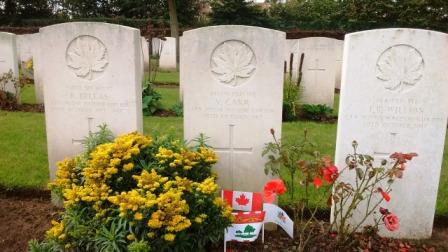
Photo at Cement House Cemetery of Bellas, Carr, and Willson.  (Photo credit: Pieter Valkenburg)

While in Passchendaele, a brochure ‘Did Your Granddad Fight in Passchendaele 1917?’ from the Memorial Museum Passchendaele 1917 invited people to submit names and photos. In return, museum staff would send a trench map with the approximate place where the person was killed. 
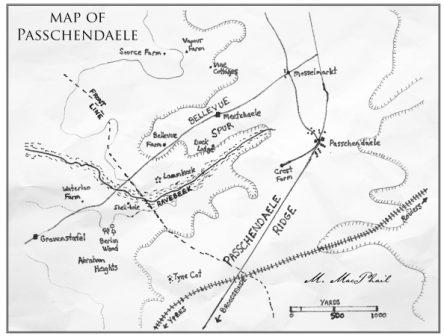
You can see Abraham Heights towards the bottom left corner of the map. (Map: courtesy http://www.darrellduthie.com/maps/)

….A trench map showed that Vincent Carr and 4 other soldiers were buried in Abraham Heights…

It took almost 2 years before we received the trench map in October 2019, along with more information on what happened on October 30, 1917.  On that fateful day, Vincent Carr, and two soldiers from Ontario, Jack Bingham WILLSON and Robert BELLAS, were all killed by the same high explosive shell on Abraham Heights.  They had been buried in the same grave on Abraham Heights, where they lost their lives, along with 2 British soldiers. 

In 1939, when all 5 bodies were exhumed and reburied in Cement House Cemetery, all three Canadians were still identifiable.  The British Army’s cardboard identity ‘tags’ had disintegrated, leaving the two British soldiers as unidentified.   (See https://onthewarmemorialtrail.com/2019/09/01/the-three-ww1-soldiers-who-were-buried-together-at-passchendaele/ )

The Memorial Museum Passchendaele 1917 wrote us that: “…According to the War Diary of the 1st Canadian Motor Machine Gun Brigade, three machine gun companies were in the field around October 30. ‘A’-Battery from the 28th till the 31st of October, ‘B’-Battery from the 29th till the 31st of October and the ‘Eaton’-Battery from the 30th October till the 1st of November. Although the positions on Abraham Heights (28.D.15.b.7.4.) were abandoned on the 29th to take up new positions just north of Tyne Cot Cemetery (28.D.16.b.6.9.), many runners were sent to the supply stores behind the front to resupply the machine guns on the front line. It’s likely that the men were killed by shellfire while hauling equipment between the gun positions and the back areas….”  (Note: The numbers and letters in brackets beside Abraham Heights and Tyne Cot Cemetery are the GPS coordinates.)

Trench map showing the coordinates where Carr, Willson, and Bellas were originally buried on Abraham Heights. (Map: courtesy of Memorial Museum Passchendaele 1917)

….Where EXACTLY had the men been buried?…

While in Belgium, Pieter’s cousin François Breugelmans and his wife Mieke de Bie joined us for this portion of our 2025 European War Memorial Tour. We drove to Zonnebeke, home of the Memorial Museum Passchendaele 1917, hoping that someone would be able to decipher the coordinates on the trench map sent to us in 2019…which of course we’d brought with us, along with articles from the County Line Courier newspaper about Vincent’s story to date.  Could we find the exact location?

François and I were excited to figure out the trench map coordinates.  Pieter thought it was a fool’s errand after over 100 years, and pointed out that since I’m directionally challenged (ie get lost everywhere), it would be a miracle if we found out where it was.  He and Mieke decided to sit on a couch and wait for the results of the discussion with the museum receptionist.

Mieke and Pieter left the trench map discussion to François and Daria. (Photo credit: Daria Valkenburg)

The museum receptionist was astonished by the question posed, but was so interested she said to wait while she made a phone call.  One of the archivists was called in to help.  “…I remember this map!…” he exclaimed.
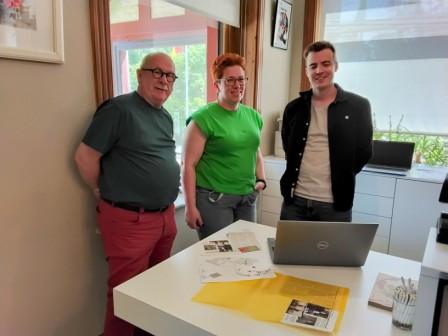
François Breugelmans (left) with the Museum receptionist, and the young archivist (right) who figured out the coordinates on the trench map.  (Photo credit: Daria Valkenburg)

The archivist overlaid the trench map with a Google map, found the location, and then showed us a street view of how it looks today…..in a farm field near Beecham Farm. 
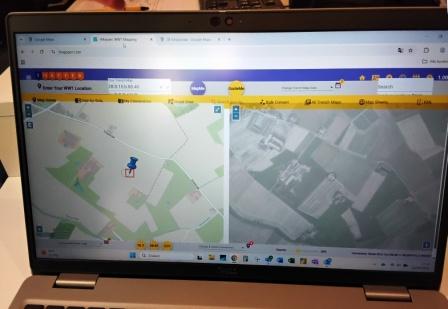
Side by side view – the trench map (left) and Google map (right) was shown to us on the archivist’s laptop.  (Photo credit: Daria Valkenburg)
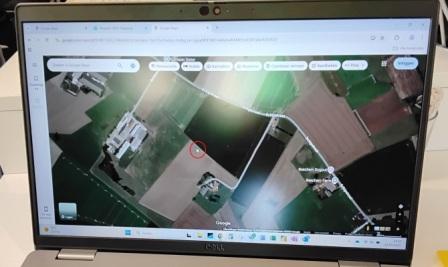
A red circled arrow marked the location of where the trench was on Google Street View Maps.  (Photo credit: Daria Valkenburg)

….We searched for the location that was on the map…

We thanked the museum personnel and immediately went to the location marked on the map, finding out it was just outside Zonnebeke.  We got excited when we saw a sign indicating that we were beside Beecham Farm. It still existed!

Beecham Farm was still in existence!  (Photo credit: Daria Valkenburg)

Across the road from Beecham Farm we could see Tyne Cot Cemetery, which we’d visited in 2017.  (See https://onthewarmemorialtrail.com/2017/11/12/a-visit-to-tyne-cot-cemetery/)
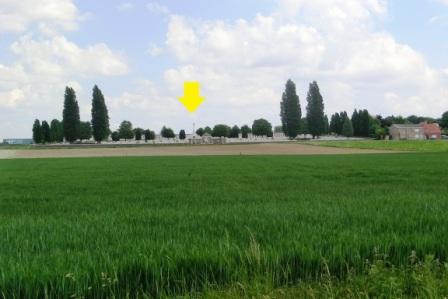
We could see Tyne Cot Cemetery (see yellow arrow) across the road from Beecham Farm.  (Photo credit: Daria Valkenburg)

Tyne Cot was listed on the original trench map, so we knew were in the right location!  A field belonging to Beecham Farm was the location of the trench where Vincent Carr was originally buried.

The trench where Vincent Carr was originally buried was in this field on Beecham Farm. (Photo credit: Daria Valkenburg)
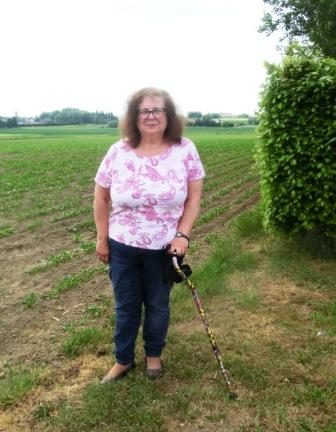
I felt like a detective who’d solved a mystery, while standing beside the field at Beecham Farm where Vincent Carr was originally buried! (Photo credit: François Breugelmans)

….We celebrated our success in Ypres…

Flush with the victory of finding the original trench location….not bad for 4 seniors… we decided to celebrate with a well-earned snack and rest in Ypres before continuing on with our 2025 European War Memorial Tour in Belgium.  It was over 30oC and very humid, and we needed a break!

We enjoyed a drink and bitterballen in Ypres.  (Photo credit: Daria Valkenburg)

Of course, no trip to Ypres was complete without a stop at the Peter de Groote chocolate shop!  I never pass up their delicious ginger chocolates!
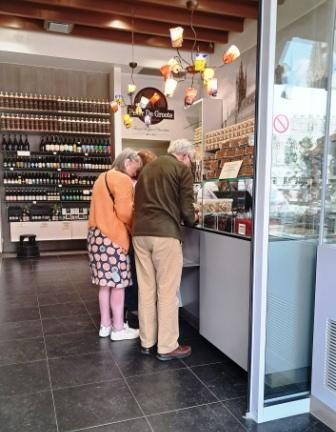
Daria, Mieke, and Pieter at the chocolate shop in Ypres.  (Photo credit: François Breugelmans)
Thank you to the staff at Memorial Museum Passchendaele 1917 in Zonnebeke for helping us in our quest to find the trench location. Thank you also to François Breugelmans and Mieke de Bie for joining us on our Belgian adventures.

Our adventures continue as we share the highlights of our 2025 European War Memorial Tour. 

If you have a story or photo to share, please contact Pieter at memorialtrail@gmail.com or comment on the blog. 

© Daria Valkenburg

….Want to follow our research?…

If you are reading this posting, but aren’t following our research, you are welcome to do so.  Our blog address: https://onthewarmemorialtrail.com/
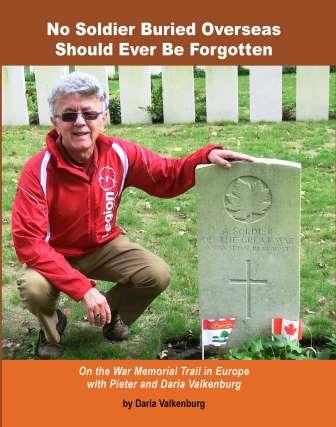
4 countries, 6 weeks, 7,000 km – an unforgettable war memorial journey in Europe…. Daria’s book ‘No Soldier Buried Overseas Should Ever Be Forgotten‘ is available in print and e-book formats.  Net proceeds of book sales help support research costs and the cost of maintaining this blog. For more information see https://nosoldierforgotten.com/

Subscribe to our YouTube Channel: On The War Memorial Trail With Pieter Valkenburg: https://www.youtube.com/channel/UCJ591TyjSheOR-Cb_Gs_5Kw

Never miss a posting! Subscribe below to have each new story from the war memorial trail delivered to your inbox.

The Three WWI Soldiers Who Were Buried Together At Passchendaele

September 1, 2019.  The very first story uncovered by Pieter, when he began researching the names on the Cenotaph outside the Borden-Carleton Legion, was that of WWI soldier Vincent Earl CARR, who lost his life on October 30, 1917 during the Battle of Passchendaele in Belgium.  (See The Cenotaph Research Project Begins)  Why Vincent Carr?  His was the first photo provided for the project by Vincent’s nephew, Delbert Carr of Tryon, and his wife Helen.

CIMG3083 Aug 31 2019 Pieter with Helen & Delbert Carr

Pieter with Helen and Delbert (seated) Carr of Tryon. (Photo credit: Daria Valkenburg)

Vincent was born May 3, 1894 in North Tryon, the son of Robert Carr and Catherine McLeod.  On June 2, 1914, he enlisted in the 55th Battalion in Sussex, New Brunswick, and recorded his trade as labourer.  On October 30, 1915 his unit sailed to England aboard the S.S. Corsican, arriving on November 9, 1915.

shorter photo of vincent carr

Photo: Vincent Carr in 1915, in the uniform of the 55th Battalion. (Photo courtesy of Delbert Carr collection. Photo colourization: Pieter Valkenburg)

On April 6, 1916 he was transferred to the 36th Battalion, and then 2 months later, on June 23, 1916, he was sent for training at the 86th Machine Gun Battalion, later re-designated as the Canadian Machine Gun Depot.  On July 28, 1916 he became part of the 1st (also called “A”) Canadian Motor Machine Gun Battery and arrived in France with his unit the next day.

In an excerpt from the November 1, 1917 Operation Report for October 28-31, 1917 by Lt C.P. Gilman, Acting Officer in Charge, of the “A” Battery of the First Canadian Motor Machine Gun Brigade wrote:  … “On the evening of the 29th ….were in position to fire on targets given for the Zero hour, which was 5:50 am morning of the 30th.  As soon as we opened fire, we were subjected to an intense bombardment of our positions, and we were forced to retire 6 hours later, after sustaining 28 casualties…..

Vincent was one on those casualties, and is buried in Cement House Cemetery.  When we visited it in 2017, Pieter noticed that the graves on either side of him were Canadians from the same Canadian Motor Machine Gun Brigade unit as Carr, and that they died on the same day.  We took a photo of all three graves: R. Bellas, our Vincent Carr, and J. B. Willson.  (See On The War Memorial Trail of Passchendaele and Surrounding Area)

While we were in Passchendaele, we picked up a brochure ‘Did Your Granddad Fight in Passchendaele 1917?’ from the Memorial Museum Passchendaele 1917, inviting people to submit names and photos. The brochure went on to say that “in return for your cooperation you will receive a copy of a trench map with the approximate place where he was killed.  With this comes a short report based on the war diaries of his unit.”  We already had the war diary report, but a trench map was something unique, so we sent in the information, along with the observation that Bellas and Willson were buried near Carr.  Maybe they were in the same trench?

We waited for the trench map with great anticipation and ….. nothing happened.  Almost two years later, though, long after we’d forgotten about the inquiry we’d made, we received an email from the Memorial Museum Passchendaele 1917, with the long promised trench map and more information on what happened on October 30, 1917.

On that fateful day, researchers discovered that Vincent Carr, Jack Bingham WILLSON, and Robert BELLAS were all killed by the same high explosive shell on Abraham Heights. This is what we had expected after seeing the graves side by side in Cement House Cemetery, but to our surprise we learned that they had been buried in the same grave on Abraham Heights.

CarrVincent

Trench map showing the coordinates where Carr, Willson, and Bellas were originally buried on Abraham Heights. (Map: courtesy of Memorial Museum Passchendaele 1917)

map of passchendaele showing abraham heights

You can see Abraham Heights towards the bottom left corner of the map. (Map: courtesy http://www.darrellduthie.com/maps/)

The Memorial Museum Passchendaele 1917 wrote us that: “According to the War Diary of the 1st Canadian Motor Machine Gun Brigade, three machine gun companies were in the field around October 30. ‘A’-Battery from the 28th till the 31st of October, ‘B’-Battery from the 29th till the 31st of October and the ‘Eaton’-Battery from the 30th October till the 1st of November. Although the positions on Abraham Heights (28.D.15.b.7.4.) were abandoned on the 29th to take up new positions just north of Tyne Cot Cemetery (28.D.16.b.6.9.), many runners were sent to the supply stores behind the front to resupply the machine guns on the front line. It’s likely that the men were killed by shellfire while hauling equipment between the gun positions and the back areas.” (Note: The numbers and letters you see in brackets beside Abraham Heights and Tyne Cot Cemetery are the GPS coordinates.)

Private Jack Bingham Willson was born January 17, 1897 in Plattsville, Ontario.  Sgt Robert Bellas was born August 1, 1886 in Morland, Cumbria, England, but had immigrated to Canada.  Both Willson and Bellas enlisted in Toronto.

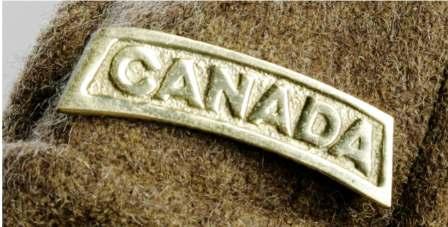
A 1939 report of exhumation and reburial to Cement House Cemetery confirmed that Carr, Willson, and Bellas were recovered from one grave.  Unlike many soldiers who were never identified, they were identified by the ‘titles’ on the shoulder of their uniform identifying them as Canadian, and the identifying discs that they were still wearing.  The report indicates that two unknown British soldiers had been recovered from the same grave at Abraham Heights.

CWM_SupplyLine_CanadaShoulderTitle_EN_FINAL_20140922_Page_1

A metal shoulder title was worn by Canadian soldiers on both shoulder straps of the khaki service dress uniform. (Photo credit: courtesy of https://www.warmuseum.ca)

We thank the Memorial Museum Passchendaele 1917 for the information they sent. If anyone can provide a photo or more information on Vincent Carr, Jack Bingham Willson, or Robert Bellas, please contact Pieter at memorialtrail@gmail.com or comment on the blog.   Please note that we are still looking for photos of 10 names listed on the Cenotaph from WWI.  See Appeal For Relatives Of These WW1 Casualties! for more information.

 © Daria Valkenburg

….Want to follow our research?…

If you are reading this posting, but aren’t following our research, you are welcome to do so.  Our blog address: https://onthewarmemorialtrail.com/

4 countries, 6 weeks, 7,000 km – an unforgettable war memorial journey in Europe…. Daria’s book ‘No Soldier Buried Overseas Should Ever Be Forgotten‘ is available in print and e-book formats.  Net proceeds of book sales help support research costs and the cost of maintaining this blog. For more information see https://nosoldierforgotten.com/

Subscribe to our YouTube Channel: On The War Memorial Trail With Pieter Valkenburg: https://www.youtube.com/channel/UCJ591TyjSheOR-Cb_Gs_5Kw

Never miss a posting!  Subscribe below to have each new story from the war memorial trail delivered to your inbox.
On The War Memorial Trail…We Visit Passchendaele and Surrounding Area

November 2, 2017.  After hearing so much about Passchendaele and the terrible 100 days of fighting over a mere 8 km of territory in 1917, we had to go and see the area for ourselves.  245,000 allied soldiers alone were casualties, not to mention Belgian citizens and German soldiers. We kept thinking, “How could it be worth such a heavy sacrifice?”

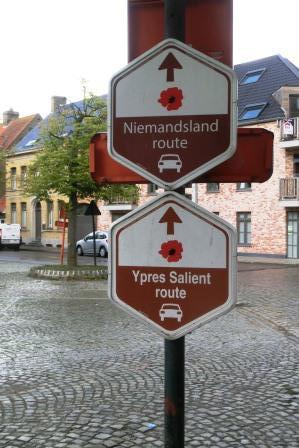
We followed two routes in this area, the Ypres Salient Route, and No Man’s Land Route (Niemandsland Route in Flemish).

CIMG8738 Sep 9 2017 sign saying Ypres Salient Route

Signs along the road marked the routes you could follow on the war memorial trail in Belgium. (Photo credit: Pieter Valkenburg)

One soldier on the Cenotaph outside the Borden-Carleton Legion, Vincent CARR, died on October 30, 1917 during the Battle of Passchendaele.  His story was told earlier in this blog.  (See links to The Cenotaph Research Project Begins and The WWI Names On The Cenotaph).  He’s buried at Cement House Cemetery in Langemark, and our first stop on the war memorial trail in the Passchendaele area was there.

CIMG8723 Sep 9 2017 Pieter at Cement House Cemetery with flags

Pieter at the entrance to Cement House Cemetery. (Photo credit: Daria Valkenburg)

Cement House was the military name given to a fortified farm building on the Langemark-Boesinghe (now called Boezinghe) road.  There are 3,952 WWI Commonwealth graves, 2,225 of them unidentified.  There are an additional 22 WWII graves, 5 of which are unidentified.

After placing the flags on Carr’s grave, we saw that the graves on either side of him were Canadians from the same Canadian Motor Machine Gun Brigade unit as Carr, and that they died on the same day.  It seemed only right to take a photo of all three graves and pay tribute to R. BELLAS, our Vincent CARR, and J. B. WILLSON.

IMG_20170909_131617502 Graves of Bellas Carr Willson in Cement House Cemetery

The graves of R. Bellas, V. Carr, and J. B. Willson in Cement House Cemetery. (Photo credit: Pieter Valkenburg)

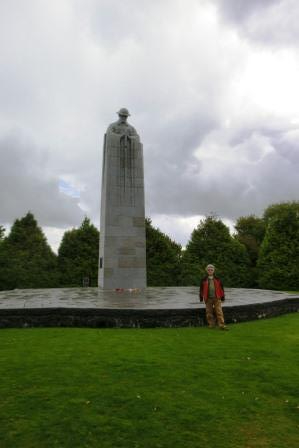
After leaving Cement House Cemetery, we stopped at the St. Julien Memorial (Sint Juliaan in Flemish), a Canadian War Memorial commemorating the Canadian First Division’s participation in the Second Battle of Ypres in World War I.  This was a nasty battle where the troops faced the first poison gas attacks along the Western Front on April 22, 1915.  The memorial is commonly known as the Brooding Soldier, the name given to the statue sculpted by Frederick Chapman Clemesha, an architect from Regina who was also a WWI veteran.

Unfortunately, the heavens opened as we arrived in the parking lot.  We waited a few minutes in the hope that the rain would stop, but no luck.  There was a big tour bus beside us and no one got out of it either.  After ten minutes the bus left (guess they had to stay on schedule).  At that point Pieter said, rain or not, he was going to the memorial.  Only his cousin François was willing to join him!  Mieke and I stayed in the car.

cimg8733-sep-9-2017-pieter-by-brooding-soldier-monument-st-juliaan-memorial-in-langemark.jpg

St. Julien Memorial in Langemark. (Photo credit: François Breugelmans)

The sculpture is a stone tower, topped by the head and shoulders of a soldier, whose head is bowed.  The soldier is in the pose of a serviceman standing with ‘reversed arms’ – resting his hands on the rifle butt and the rifle pointing with its barrel to the ground. This pose is a gesture of mourning and respect for the fallen.

The memorial is inscribed as follows: THIS COLUMN MARKS THE BATTLEFIELD WHERE 18,000 CANADIANS ON THE BRITISH LEFT WITHSTOOD THE FIRST GERMAN GAS ATTACKS THE 22ND-24TH OF APRIL 1915. 2,000 FELL AND HERE LIE BURIED.

The location of the statue is where the Canadian position was when they were attacked by gas.  None of the troops had gas masks.  They tried to protect themselves as best they good, and some pressed handkerchiefs soaked with urine around their mouths.  As we now know, this did little good.

A few minutes after the Pieter and François came back into the car and we pulled away from the parking lot, it stopped raining and the sun came out.  It was like a message had been received!

Although it was after 2 pm, and three of us were hungry and tired, we had a few more stops before Pieter would allow us to have a rest and lunch!  We grumbled that he had forgotten we were volunteers on this journey, not military recruits!  Our war memorial route continues in the next blog entry.

As yet, we have not been able to find any information on Vincent Carr’s wife, Bessie Carr, who came from Summerside, and died in 1918, a year after her husband.  Can you help?  If you are related to R. Bellas or J. B. Willson, we’d like to hear from you as well.  Comments or stories?  You can share them by emailing us at memorialtrail@gmail.com or by commenting on this blog.

© Daria Valkenburg

….Want to follow our research?….

If you are reading this posting, but aren’t following our research, you are welcome to do so.  Our blog address: https://onthewarmemorialtrail.com/

Front cover OnTheWarMememorialTrailinEurope4 countries, 6 weeks, 7,000 km – an unforgettable war memorial journey in Europe…. Daria’s book ‘No Soldier Buried Overseas Should Ever Be Forgotten‘ is available in print and e-book formats.  Net proceeds of book sales help support research costs and the cost of maintaining this blog. For more information see https://nosoldierforgotten.com/ 

You are also invited to subscribe to our YouTube Channel: On The War Memorial Trail With Pieter Valkenburg: https://www.youtube.com/channel/UCJ591TyjSheOR-Cb_Gs_5Kw

Never miss a posting!  Subscribe below to have each new story from the war memorial trail delivered to your inbox.