On The War Memorial Trail….. The WWII Soldier From Saint-Basile Who Lost His Life During The Advance Towards Xanten

February 5, 2025. We never know what a photo search might lead to once Pieter begins researching a soldier. In the case of a WWII soldier listed as being from New Brunswick, the search led to his birth in the province of Quebec, to his enlistment in Ontario, to the widow of his nephew, and finally to a Legion in New Brunswick where a shadow box with photos had been donated.

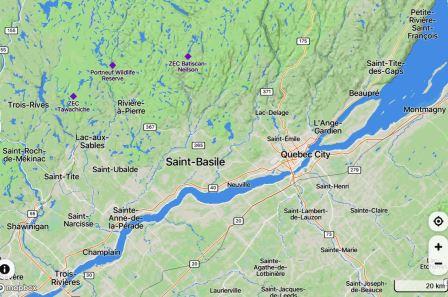
Joseph ‘Albert Noel’ LAMONTAGNE was born on December 25, 1918 in Saint-Basile, Quebec, the son of Joseph Lamontagne and Marie ‘Alexina’ Jacques. Saint-Basile is in Portneuf Regional County Municipality in Quebec, past Quebec City.  To our surprise, we realized we’d driven past the turn-off to Saint-Basile every time we travelled between our home in Prince Edward Island and Ottawa, Ontario!

Albert Noel Lamontagne was born in Saint-Basile, Quebec.  (Map source: Mapcarta)

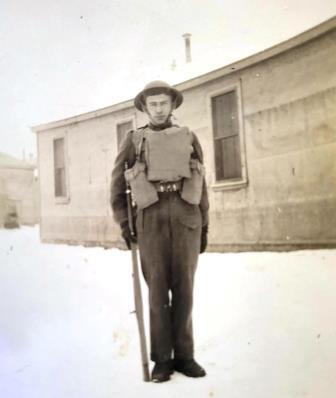
…..Albert Noel enlisted under the NRMA in 1942….

Albert Noel originally enlisted under the National Resources Mobilization Act (NRMA) in North Bay, Ontario on January 8, 1942 and began basic training at No. 2 NRMA Clearing Depot, before joining the active army on January 20, 1942.   He took his basic training at No. 22 Canadian Army Basic Training Centre in North Bay. (See https://en.wikipedia.org/wiki/National_Resources_Mobilization_Act)

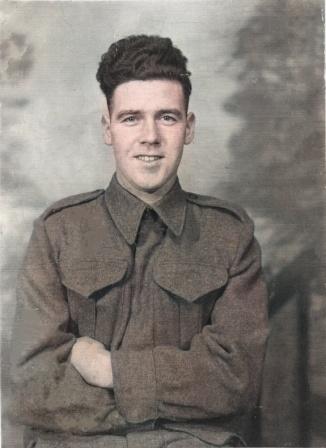
Albert Noel Lamontagne in training.  (Photo courtesy of the Albert Joseph Chevarie Family)

At the time of his enlistment, he had been working as a labourer, having left school after completing Grade 3 in Quebec City.  He spoke French and had a basic knowledge of English. His father had died in 1920, and his mother had remarried, in 1928, to Emilien Chevarie.  His brother, Paul-Emile, was also in the Canadian Army. As well, he had a sister Rose-Aimée, a half-brother George, and a half-sister Juliette.

  ….George Chevarie’s son was the key to finding a photo of Albert Noel….

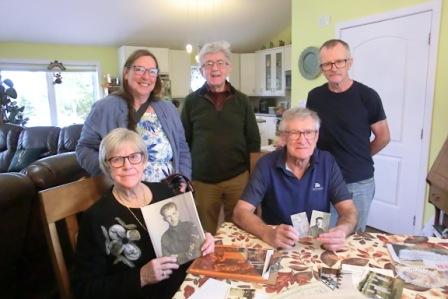
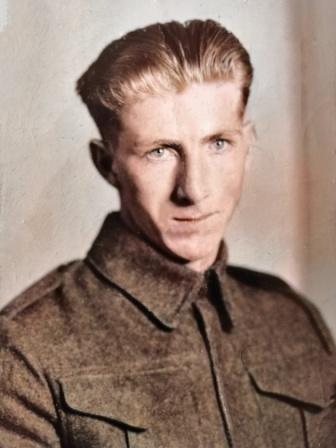
It was through Albert Noel’s half-brother, George Chevarie, that a photo of Albert Noel was found.  George’s son, Albert Joseph, had died in 2020. However, after Pieter spoke to Joyce Chevarie, the widow of Albert Joseph Chevarie, she told him that her husband had donated a shadow box with a photo of Albert Noel, a letter, and his medals to the Royal Canadian Legion branch in Richibucto, New Brunswick.

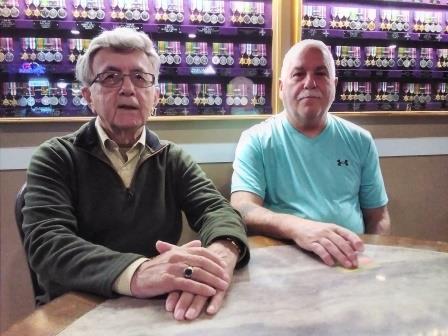
Pieter then got in contact with the Legion in Richibucto.  Legion Branch president Malcolm John took everything out of the shadow box donated by the family of Albert Chevarie, photographed each item, and emailed the photos to Pieter!  The next time we were in New Brunswick, we visited the Legion and met Malcolm.

Pieter with Malcolm John (right), President of the Richibucto Legion in New Brunswick.  (Photo credit: Daria Valkenburg)

….Albert Noel served in Newfoundland….

On March 12, 1942, Albert Noel was sent to A23 Coast Defence and Anti-Aircraft Artillery Advanced Training Centre (CD & AA) in Halifax, Nova Scotia.  A23 was a Coast and Anti-Aircraft Artillery Training Centre established to train coast and anti-aircraft gunners.

Upon completing his training, Albert Noel was given embarkation leave on May 5, 1942, prior to being posted to Newfoundland with the 106th Coast Battery of the Royal Canadian Artillery (RCA) on June 1, 1942.  The Battery was part of Atlantic Command, tasked with strengthening and administering home defence facilities on Canada’s Atlantic Coast. 

Albert Noel was in Botwood, at a Royal Canadian Air Force (RCAF) base, which had aircraft patrolling the east coast of the Atlantic. Canadian Army personnel based at Botwood were charged with protection of military facilities that had been installed there. (See https://www.heritage.nf.ca/articles/politics/botwood-base.php)

Location of Botwood Military Base in Newfoundland. (Map source: http://postalhistorycorner.blogspot.com/2012/12/wwii-canadian-forces-in-newfoundland.html)

Albert Noel was in Newfoundland at the same time as two other soldiers whose stories have been told on this blog:

….Albert Noel volunteered for paratroop training….

In an interview for his Personnel Selection Record on September 30, 1943, while at Botwood, Albert Noel volunteered for Paratroop Training.  The interviewer recorded that Albert Noel “….has a good training record and seems a very dependable, reliable type, although badly handicapped by lack of education. Not suitable for Paratroops under present regulations which require Grade VI education…”  Albert Noel had only completed Grade 3.

On February 14, 1944, Albert Noel left Newfoundland for Shelburne, Nova Scotia and was transferred to the 104th Coast Battery of the Royal Canadian Artillery (RCA).

On May 1, 1944, Albert Noel was assigned to No. 1 Transit Camp in Windsor, Nova Scotia for final training and preparation before being sent overseas.  He then was transferred to No. 1 Infantry Training Battalion in Camp Debert, Nova Scotia on June 8, 1944.

While at No. 1 Infantry Training Battalion, he was re-interviewed on June 28, 1944 and again volunteered for Paratroop Training.  The response was the same: “…not suitable for Paratroops.  His education is lacking…

On July 21, 1944, Albert Noel was sent to the Training Brigade Group in Debert, and granted 2 weeks embarkation leave, the last chance he had to see his family again.

Albert Noel Lamontagne in dress uniform.  (Photo courtesy of the Albert Joseph Chevarie Family)

….Albert Noel’s mother tried to have him released….

The embarkation leave in July must have been bittersweet, as after the death of Albert Noel’s stepfather in April 1944, his mother, who was living in St. Charles, New Brunswick, had contacted the Military Authorities in June 1944, asking that her son be returned home. 

She was interviewed on June 21, 1944 and explained that “….I am left alone with two children, one boy George Chevarie, 14 years of age, and one girl Julia Chevarie, 11 years of age…..The reason I want my son to come home is because I am sick, suffering from liver trouble…

Although Mrs Chevarie had acute hepatitis and was unable to work, the military did not consider this grounds to release Albert Noel.  The report stated that her doctor was consulted, and in his opinion her son “…could not help her much, insofar as her sickness goes…” 

Therefore, the report concluded that “…if her son was home he could not help her very much, other than financial circumstances… It was further pointed out that Mrs Chevarie was already was receiving a Dependents’ Allowance. Albert Noel remained in the Canadian Army.

….Albert Noel left Canada for overseas service….

On September 2, 1944, Albert Noel left Canada for the United Kingdom. Upon arriving on September 6, 1944 he was assigned to No. 3 Canadian Infantry Reinforcement Unit (CIRU). 

He continued his training for a few weeks before being transferred to the X-4 reinforcement list of the Canadian Infantry Corps (CIC), part of the 10th Battalion, on October 7, 1944.  The next day he was on his way to Northwest Europe, disembarking on October 9, 1944.

….Albert Noel was transferred to Les Fusiliers Mont-Royal….

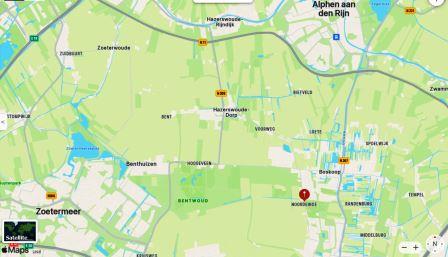
Albert Noel joined Les Fusiliers Mont-Royal in Noordeinde, The Netherlands. (Map source: DuckDuckGo)

On October 18, 1944, Albert Noel was transferred to ‘C’ Company of Les Fusiliers Mont-Royal, joining them in Noordeinde, The Netherlands.

Then, on December 14, 1944, Albert Noel received a promotion, from Private to Lance Corporal. On February 15, 1945, he was promoted again, to Acting Corporal.

.….The battle to clear Xanten began in early March 1945 ….

By February 17, 1945, the Regiment was in Germany, in place for the Battle of Hochwald Gap, part of Operation Blockbuster, as part of the 6th Canadian Infantry Brigade, along with several other Canadian Regiments.  This offensive began on February 28, 1945 to clear the Germans from the Reichswald, a heavily forested area between the Maas and the Rhine Rivers, driving them back over the Rhine, taking the fight well into German territory.

On March 1, 1945 the war diary for the 6th Canadian Infantry Brigade stated that “…the task of clearing the high ground south of Calcar was completed…..Relief of 10 Canadian Infantry Brigade commenced at 0400 hours. Some mortaring and shelling reported during the takeover but relief completed by first light…

This account matched the March 1, 1945 entry in the war diary for Les Fusiliers Mont-Royal. “….Battalion moves to a concentration …” near “….ESSEN to relieve 10 Cdn Inf Bde at first light 2 March 45…

An update in the March 2 1945 war diary explained that “6 Cdn Inf Bde relieves the Argyle and Sutherland Regiment which has been taking a severe beating by both small arms and gun fire which continue as we get in position with our companies…Enemy resistance is very stubborn and a screen of TIGERS and Self Propelled guns is reported….

Sharon Adams wrote in the March 2022 Legion Magazine’s articleThe Taking Of Xantenthat  “In early March, the Canadians were assigned to take Xanten, established by the Romans in about 15 B.C. and the place from which the German 256th Infantry Division launched its 1940 invasion of the Netherlands.

It began with opening approaches to the town by Les Fusiliers Mont-Royal. Resistance was stiff. On March 3, a direct hit took out the wireless radio set and operator in the lead company…

.….Albert Noel lost his life on March 3, 1945 ….

The war diary for March 3, 1945 for the 6th Canadian Infantry Brigade reported that it was raining as troops moved into position.  “…Going was very hard due to the rise in ground, heavy growth of trees, and the well dug in positions of the enemy.  The enemy within the forest is not strong in numbers but equipped with many automatic weapons….

The Fusiliers Mont-Royal started on their way at 1400 hours.  Going was very hard with the advance being hampered by heavy shelling and mortaring from the south east….

The March 3, 1945 war diary entry for Les Fusiliers Mont-Royal confirmed the challenges they faced. “….Enemy, although offering stubborn resistance in the gap, is reported to be withdrawing over the RHINE. Tac R reports the road Geldern – Wesel jammed with traffic moving north east and ferries at Wesel and Xanten very active. Enemy must hold line in front of Xanten until last possible moment to protect escape routes.

Muddy condition of country renders support task of tanks very difficult. Evacuation of wounded and transportation of rations to forward troops is a problem….

At some point during March 3, 1945, Albert Noel lost his life during the battle, aged 26, one of 8 fatal casualties of the Regiment.  The other 7 men who died that day were:

  • Lionel BEAUDOIN of Magog, Quebec, aged 20
  • Wilbert FIOLA of Verdun, Quebec, aged 19
  • Henry Edward LACELLE of Massey, Ontario, aged 27
  • Lucien Joseph MASSON of Callender, Ontario, aged 25
  • Gerard PAQUETTE of Montreal, Quebec, aged 22
  • Roger TAILLEFER of Montreal, Quebec, aged 18
  • Philias ZASTE of Rose du Lac, Manitoba, aged 21

.….Albert Noel is buried in Groesbeek….

Albert Noel was initially buried in the Canadian Military Cemetery in Bedburg, Germany, before being reburied in the Canadian War Cemetery in Groesbeek, The Netherlands. 

The original grave for Albert Noel Lamontagne at the Canadian War Cemetery in Groesbeek. (Photo courtesy of the Albert Joseph Chevarie Family)

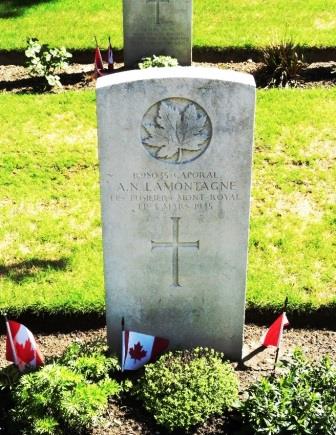
Grave of Albert Noel Lamontagne in the Canadian War Cemetery in Groesbeek, The Netherlands.  (Photo source: Find A Grave)

Thank you to Joyce Chevarie for letting us know where to find a photo, to Malcolm John, President of RCL 30 in Richibuto for sharing the photos of Albert Noel Lamontagne, and to Shawn Rainville for newspaper research. If you have a story or photo to share, please contact Pieter at memorialtrail@gmail.com or comment on the blog. 

© Daria Valkenburg

….Want to follow our research?….

If you are reading this posting, but aren’t following our research, you are welcome to do so.  Our blog address: https://onthewarmemorialtrail.com/
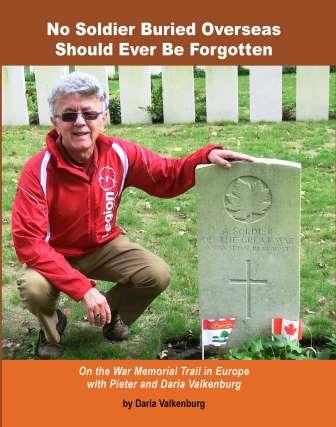
4 countries, 6 weeks, 7,000 km – an unforgettable war memorial journey in Europe…. Daria’s book ‘No Soldier Buried Overseas Should Ever Be Forgotten‘ is available in print and e-book formats.  Net proceeds of book sales help support research costs and the cost of maintaining this blog. For more information see https://nosoldierforgotten.com/

You are also invited to subscribe to our YouTube Channel: On The War Memorial Trail With Pieter Valkenburg: https://www.youtube.com/channel/UCJ591TyjSheOR-Cb_Gs_5Kw

Never miss a posting!  Subscribe below to have each new story from the war memorial trail delivered to your inbox.
On The War Memorial Trail…..The Bulger Brothers – Part 1: The WWII Soldier From Foxley River Killed During The Battle of Moerbrugge

August 5, 2024.  Can you imagine how difficult it was for parents to send their children off to conflict zones during WWII, and having to live with the uncertainty of whether they would return safely? For the Bulger family of Foxley River, Prince Edward Island, they suffered a double tragedy, losing two sons:  Harold ‘Hal’ Gabriel BULGER, who is buried in the Canadian War Cemetery in Adegem, Belgium, and Lawrence William BULGER, who is buried in the Canadian War Cemetery in Groesbeek, The Netherlands.

We were aware of Lawrence Bulger from last year’s series on soldiers from the North Nova Scotia Highlanders who lost their lives during the Battle of Bienen on March 25, 1945. As his name was not on a photo wish list, we didn’t research his story at that time. (See https://onthewarmemorialtrail.com/2022/11/29/on-the-war-memorial-trail-the-search-for-a-photo-of-austin-havelock-munroe-is-on-youtube/

This year we decided to tell the story of one more soldier killed during the Battle of Bienen, and asked Edison Smith for help in contacting a family member for Lawrence Bulger.  Edison’s grandfather, Edison Alexander SMITH, and great-uncle Ralph Schurman BOULTER, both lost their lives in the Battle of Bienen.  As they were from the same area of the Island, the families would have known each other.  Sometimes, it’s as simple as that to make contact with the family of a soldier!

We then learned that Lawrence’s brother, Harold ‘Hal’ Gabriel, also served in WWII and was killed in action on September 10, 1944 near the town of Oostkamp in Belgium during the early stages of the Battle of the Scheldt. (See https://www.veterans.gc.ca/eng/remembrance/history/second-world-war/scheldt and https://en.wikipedia.org/wiki/Battle_of_the_Scheldt)

We decided to tell the story of both brothers, and began with Hal, the first of the brothers to lose his life.

….Hal’s family was soon found….

Shortly after the request was made, Edison wrote to say “I was up to O’Leary this past week and spoke with my father and did some digging around for a relative of the Bulgers you had asked me about.  I was able to speak with Bev and Bernard Jeffery….. I briefly explained the work you … do and she was kind enough to email me some info and pictures which I have forwarded to you…

Bev also contacted us, explaining that her “mother was Harold and Lawrence’s sister Agatha….”  The family historian in the family, Bev was the keeper of the family photos and information.  Edison had found the right person!

It wasn’t long before we had a chance to meet Bev, and to learn more about the Bulger brothers.

CIMG6836 May 27 2024 Bev Jeffery & Pieter Mill River Resort

Pieter with Bev Jeffery at Mill River Resort in Mill River, Prince Edward Island.  (Photo credit: Daria Valkenburg)

Born September 9, 1918 in Portage, Prince Edward Island, Hal was the son of Gabriel and Anne ‘Annie’ Marion (nee Milligan) Bulger of Foxley River, Prince Edward Island.  One of 16 children, Hal had two brothers and thirteen sisters. 

…..Hal enlisted in 1940….

Harold Bulger colourized and restored by Pieter

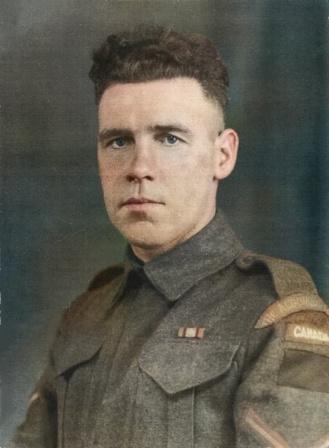
Harold ‘Hal’ Gabriel Bulger. (Photo courtesy of Bev Jeffery.  Photo restoration and colourization by Pieter Valkenburg)

After leaving school at the age of 13, Hal worked on the family farm until he enlisted with the PEI Highlanders in Charlottetown, Prince Edward Island on July 31, 1940. After completing his basic training at No. 62 Canadian Army (Basic) Training Centre in Charlottetown, Hal was sent to Dartmouth, Nova Scotia for additional training.

Leo Lynch, Leo Moran, Harold Bulger, Cecil MacKinnon

Left to right: Leo Lynch, Leo Moran, Harold ‘Hal’ Bulger, Cecil MacKinnon. (Photo courtesy of Bev Jeffery)

During a furlough in March 1941, a notice in the March 22, 1941 edition of the Summerside Journal noted that Pte. Leo Moran, Freeland, Pte. John McFayden, Freeland, Pte. Leo Lynch, Portage, Pte. Harold Bulger, Freeland, all of the P.E.I. Highlanders, returned to their unit in Nova Scotia. They were the guests of the Veterans’ Guard, Summerside….

HAROLD BULGER AND mother ANNIE BULGER 001

Harold ‘Hal’ Gabriel Bulger with his mother, Annie Bulger. (Photo courtesy of Bev Jeffery)

On June 4, 1941, Hal was transferred to A13 Canadian Infantry Training Centre in Camp Valcartier, Quebec, as preparation for guard duty in Newfoundland. 

Hal was sent to Newfoundland….

NFLD Map shows Botwood

Location of Botwood Military Base in Newfoundland. (Map source: http://postalhistorycorner.blogspot.com/2012/12/wwii-canadian-forces-in-newfoundland.html)

After France was occupied by the Germans in 1940, Newfoundland’s defensive position became more precarious. A British dominion at the time, Newfoundland did not join Canada until March 31, 1949. 

In 1940, Canada assumed responsibility for the defence of Newfoundland with the establishment of ‘W Force’, a Canadian garrison force responsible for defending Newfoundland against enemy incursions and providing security for existing and proposed defence facilities during WWII. It included infantry, artillery, and anti-aircraft units. (See https://en.wikipedia.org/wiki/Military_history_of_Newfoundland_during_World_War_II)

On July 23, 1941, as part of ‘W Force’, Hal was sent to Botwood, Newfoundland.  In addition to the PEI Highlanders, troops from the Black Watch of Canada, Royal Rifles of Canada, The Algonguin Regiment, Queens Own Rifles, also served at various times. While an RCAF base in Botwood had aircraft patrolling the east coast of the Atlantic, Canadian Army personnel based at Botwood were charged with protection of military facilities that had been installed there, as well as in Gander. (See https://www.heritage.nf.ca/articles/politics/botwood-base.php)

…..Four other soldiers were in Botwood…..

Hal was in Botwood at the same time as four other soldiers whose stories have been told on this blog:

Hal briefly returned to Canada….

Harold Bulger aboard a ship likely in 1943 from NFLD

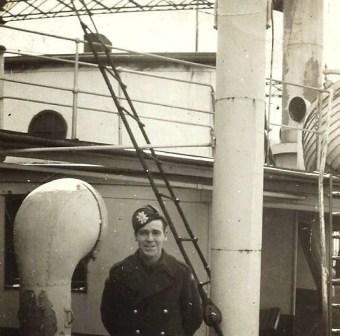
Harold ‘Hal’ Bulger aboard a ship returning to Canada from Newfoundland. (Photo courtesy of Bev Jeffery)

Hal remained in Newfoundland until February 12, 1943, when he was briefly sent to A14 Canadian Infantry Training Centre in Camp Aldershot, Nova Scotia and then on to Camp Sussex, New Brunswick. 

On February 23, 1943, he sent his mother a brief letter, thanking her for “…the $5.00 you sent me…” as he was getting low “…on tobacco and money….”  He explained that he didn’t know “…just when I will get home, but I will be home the first chance I get.  I might have to stay here a month before I get home…”  Based on Hal’s service record, he never did get leave to go home.

On March 8, 1943, Hal was no longer attached to ‘W’ Force, and remained at Camp Sussex until March 27, 1943, when he was transferred to the No. 1 Transit Camp in Debert, Nova Scotia, for final preparation and training before being sent overseas. 

In a March 16, 1943 interview for his Personnel Selection Record, it was noted that Hal was a “…pleasant, smiling, sturdy, well-behaved stable lad…

….Hal left Canada for overseas service….

On April 10, 1943, Hal left for Great Britain with the PEI Highlanders.  Upon arrival on April 17, 1943, he was assigned to No. 7 Canadian Infantry Reinforcement Unit (CIRU).

On June 25, 1943, he was briefly assigned to the Princess Louise Fusiliers, before being transferred to the Algonquin Regiment on August 21, 1943.  On May 28, 1944, Hal was promoted from Private to Lance Corporal. 

Harold Bulger in Algonquin Regiment Harold Bulger photo restored & colourized by Pieter

Harold ‘Hal’ Gabriel Bulger in his Algonquin Regiment uniform. (Photo courtesy of Bev Jeffery. Photo restoration and colourization by Pieter Valkenburg)

An excerpt from a research paper entitled ‘Rebuilding Trust: The Algonquin Regiment at War, July-September 1944’ by Ty Backer, noted that “In the summer of 1944, the Algonquins received word from divisional commander, General Kitching that the 4CAD would be used after the secret invasion of Normandy….” 4CAD refers to 4th Canadian Armoured Division. 

There was a delay in moving into France as although D-Day was a success, “…the failure to capture Caen on D-Day set back the division’s schedule for deployment… Formations were not able to move as far into Normandy as planners hoped, leaving 4CAD with no room to land at the beachheads until Caen and its surrounding area were captured. Consequently, they were delayed nearly a month and a half…

….Hal survived Operation Tractable and Operation Totalize….

Hal remained in the United Kingdom until July 20, 1944, when he and his Regiment left for France, arriving in Normandy on July 25, 1944, as part of the 21st Army Group, along with “the rest of the 10th Infantry Brigade landed in Normandy. Initially tasked with breaking through and driving south behind enemy lines, the battalion had to ensure getting armoured vehicles and infantry past the heavily entrenched areas surrounding the greater Caen area…” 

This was the lead-up to Operation Totalize, an offensive to break through German defences south of Caen and then capture the high ground north of the city of Falaise.  (See https://en.wikipedia.org/wiki/Operation_Totalize)

On August 2, 1944, Hal wrote to his father from France.  “…Well, Pop, I suppose you are going to kill me for not writing sooner, but really it is hard to get time to write over here….This is quite the place…but I can’t talk French….”  The letter ended with “…All my love. Your ever loving son. Hal…

By the end of August 1944, the Regiment was on the move towards the liberation of Belgium. Liberating the port of Antwerp, Belgium was key.  “…As the Allies progressed deeper into Europe, their supply lines needed to be augmented and strengthened…” 

The Allied High Command “…tasked 4CAD with fighting preliminary skirmishes of the Scheldt battle along the northern sector of the coast. The Algonquins and the rest of the 4CAD were tasked with clearing the areas west of the Leopold Canal on the Dutch-Belgian border.”

….Hal lost his life during the Battle of Moerbrugge….

Screenshot 2024-08-05 at 10-44-28 Moerbrugge · 8020 Oostkamp Belgium

Map shows location of Oostkamp and Moerbrugge, near Bruges in Belgium.  (Map source: Google maps)

The Algonquin Regiment arrived in Belgium from France on September 8, 1944.  The next day, the Regiment attempted to cross a bridgehead at Moerbrugge near Oostkamp, not far from Bruges, during the Battle of Moerbrugge. (See https://www.canadiansoldiers.com/history/battlehonours/northwesteurope/moerbrugge.htm)

In ‘Warpath The Story of the Algonquin Regiment 1939-1945’, author Major G. L. Cassidy wrote that “…On the evening of the 9th, ‘D’ Company was detailed to cover the bridging operations in Oostkamp, and moved up to do the job. The remainder of the battalion moved south to the chateau area behind the bridgehead. Enemy resistance was still heavy across the canal….

Hal was in ‘C’ Company, which was to cross the bridgehead at Moerbrugge across the Ghent-Bruges Canal the next day.  The War Diary for September 10, 1944 for the Algonquin Regiment recorded that “…at 21:00 hours ‘C’ Company was ordered to cross the canal and consolidate at Eekhoute farm by passing through the Argyll and Sutherland Highlanders of Canada.  The position was taken and held against continuous enemy fire. Casualties were reported to be 4 killed and 4 wounded...

Hal was one of the fatal casualties.  The other 3 soldiers who lost their lives that day were:

  • Pte Gerald Bertram MCEACHERN of Galt, Ontario
  • Sgt Marquis De MYERS of Wawota, Saskatchewan
  • Cpl John Walter PARYSEK of Timmins, Ontario

….Hal is buried in Adegem….

Hal was initially buried in Moerbrugge, before being reburied in the Canadian War Cemetery in Adegem, Belgium, along with the other 3 Algonquin Regiment soldiers killed on September 10, 1944.

Grave of Harold Gabriel Bulger from CVWM

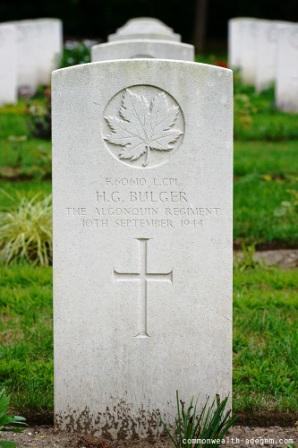
Grave of Harold Gabriel Bulger in the Canadian War Cemetery in Adegem, Belgium. (Photo courtesy of Canadian Virtual War Memorial)

P1450929 May 11 2024 Patrick Michaels at grave of Harold Bulger in Adegem

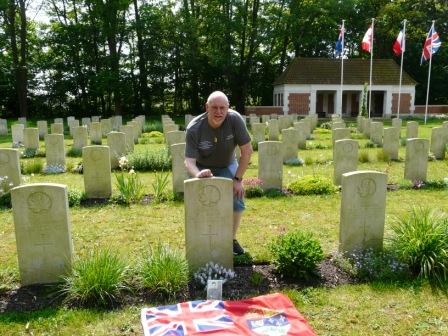
Patrick Michiels visited the grave of Harold ‘Hal’ Gabriel Bulger in Adegem in May 2024, bringing with him the Red Ensign and a photo of Hal.  (Photo courtesy of Patrick Michiels)

Belgian citizen Patrick Michiels, Moderator of the Facebook group Canadian Scottish Regiment Adegem Canadian War Cemetery, visited Hal’s grave on May 11, 2024 at our request.  He brought with him a photo of Hal and the Red Ensign flag that was the precursor of the Maple Leaf flag we are familiar with. (See https://en.wikipedia.org/wiki/Canadian_Red_Ensign)

Coming up in Part 2, the Bulger Brothers series continues, with Lawrence William BULGER, who lost his life six months after Hal’s death.

Thank you to Bev Jeffery for submitting photos and information on her Uncle Harold, to Edison Smith for contacting the Jeffery family, and to Patrick Michiels for visiting the Canadian War Cemetery in Adegem and taking a photo of Hal’s grave.

Do you have photos or information to share? Email Pieter at memorialtrail@gmail.com, comment on the blog, or tweet to @researchmemori1.

© Daria Valkenburg

…..Missed the stories on Smith and Boulter?….

To read about Edison Smith’s grandfather and great-uncle, please see:

….Want to follow our research?….

If you are reading this posting, but aren’t following our research, you are welcome to do so.  Our blog address: https://onthewarmemorialtrail.com/

Front cover OnTheWarMememorialTrailinEurope4 countries, 6 weeks, 7,000 km – an unforgettable war memorial journey in Europe…. Daria’s book ‘No Soldier Buried Overseas Should Ever Be Forgotten‘ is available in print and e-book formats.  Net proceeds of book sales help support research costs and the cost of maintaining this blog. For more information see https://nosoldierforgotten.com/ 

You are also invited to subscribe to our YouTube Channel: On The War Memorial Trail With Pieter Valkenburg: https://www.youtube.com/channel/UCJ591TyjSheOR-Cb_Gs_5Kw

Never miss a posting!  Subscribe below to have each new story from the war memorial trail delivered to your inbox.
On The War Memorial Trail….. The WW2 Stretcher-Bearer Whose Compassion Cost Him His Life

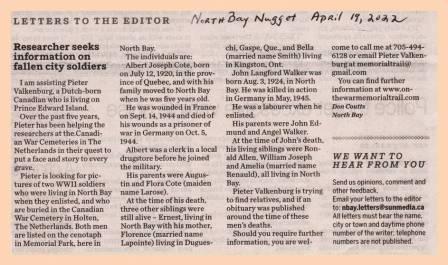
July 27, 2022. Before we travelled to North Bay, Ontario in May for an Author Talk at the North Bay Public Library, Pieter and Don Coutts prepared a letter to the editor for the local newspapers to see if photos could be found for two North Bay soldiers buried in the Canadian War Cemetery in Holten, The Netherlands: Albert Joseph COTE and John ‘Jack’ Langford WALKER.

The letter ran in the North Bay Nugget on April 19, 2022, and resulted in family of Jack Walker submitting a photo.  No family of Albert Joseph Cote came forward, but we soon uncovered enough information and references in other sources to determine that his story needed to be told.

Apr 19 2022 Letter to Editor North Bay Nugget

The letter to the editor incorrectly lists Flora’s maiden name as Larose.  It was McGinnis.  When she remarried, her surname changed from Cote to Larose.

Photo AJ Cote North Bay Nugget Oct 3 1944

Albert Joseph Cote. (Photo source: October 3, 1944 edition of North Bay Nugget newspaper)

Albert Joseph COTE was born in Quebec on July 12, 1920, the son of Augustin and Flora (nee McGinnis) Cote. His father died in 1922 in Hull (now Gatineau), Quebec and his mother remarried to Xavier Larose.  When Albert was 5 years old the family moved to North Bay.

…Albert was an active participant at the North Bay Vocational School…

Albert attended the North Bay Collegiate Institute and Vocational School (in 1958 the name changed to North Bay Algonquin Composite School) in North Bay.  Judie Klassen contacted archivist Edward Drieger of the Harris Library at the University of Nipissing, who wrote that Albert was “a member of Form II B Vocational with Mr. K.E. Thomson in 1938.  It also appears that Albert was a member of the Junior Literary Society and a Form representative to the Northland Echo Staff….”  He also sent her two photos that included Albert.

Albert Cote yearbook 1 p39

Photo from the 1938 Algonquin Composite School yearbook. (Source: Harris Library at the University of Nipissing)

Albert Cote yearbook 2 Northland Echo

Photo from the 1938 Algonquin Composite School yearbook. (Source: Harris Library at the University of Nipissing)

…Albert enlisted shortly after his 20th birthday…

Before he enlisted on July 27, 1940 with ‘B’ Company of The Algonquin Regiment, Albert worked as a messenger boy for a newspaper, a call boy for the Canadian Pacific Railway, and as a clerk in Ligget’s Drugstore.  According to his service record he spoke French as well as English.

His Personnel Selection Record with the Canadian Army noted that he “… takes part in most sports…” and …reads anything – mostly fiction….”  The report also stated that he was taking the “…Legion course – music group ‘C’…” and it was recommended that he “…continue as present bandsman…”  Unfortunately, no mention was made of which instrument he played!

…Albert and his Regiment served in Newfoundland…

NFLD Map shows Botwood

Location of Botwood Military Base in Newfoundland. (Map source: http://postalhistorycorner.blogspot.com/2012/12/wwii-canadian-forces-in-newfoundland.html)

Albert went to Port Arthur (now Thunder Bay), Ontario for training, and then was sent to Botwood, Newfoundland in July 1942.  Why Botwood? An RCAF base in Botwood had aircraft patrolling the east coast of the Atlantic. Canadian Army personnel, including members of The Algonquin Regiment, based at Botwood were charged with protection of military facilities that had been installed there. (See https://www.heritage.nf.ca/articles/politics/botwood-base.php)

… Albert and his Regiment were sent to Normandy, France…

In January 1943 he left Newfoundland for #2 Transit Camp in Debert, Nova Scotia in preparation for going overseas.

On June 11, 1943, Albert and The Algonquin Regiment left for England, arriving on June 19, 1943.

A year later, he and his Regiment landed in Normandy, France on July 25, 1944, as part of the 10th Infantry Brigade, 4th Canadian Armoured Division.  They were part of the contingent to capture Falaise as Allied troops moved through France following D-Day on June 6, 1944.

…Albert was mentioned for his heroism during Operation Tractable…

On August 14, Operation Tractable began north of Falaise, with Canadian and Polish troops, supported by a British tank brigade. The aim of this battle was to capture Falaise and then the smaller towns of Trun and Chambois. (See https://en.wikipedia.org/wiki/Operation_Tractable)

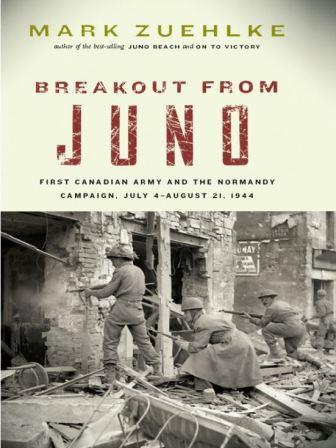
Title page Breakout from JunoMark Zuehlke mentioned Albert in Chapter 27 of his book ‘Breakout From Juno’. On August 17, 1944, the Algonquin Regiment was in the area of Damblainville.  “….The Algonquins were the lead element in a long column of 10th Infantry Brigade and other 4th Armoured Division formations expecting to push across the Ante River bridge and advance on Trun…

After crossing the Ante River, Captain Clark Robertson’s platoon tried to seize a small railway bridge west of Point 77, where they were headed next.  As one section of troops crossed the railroad, they were attacked by gunfire.  Robertson was ordered to pull back.

Zuehlke explains what happened next. “…Extracting the section across the tracks proved no easy matter, but the men escaped under covering fire from the rest of the company. When it was discovered that a seriously wounded man had been left behind, ‘A’ Company’s stretcher-bearer, Private A.J. Cote went to get him.

As everyone else threw out fire, Cote dashed forward, found the man, quickly tended to his wounds, and carried him to safety.  ‘Quite the bravest act I saw during the entire war’ Robertson said later, even though Cote’s gallantry went officially unrecognized…

…Albert was in Belgium during the Battle of the Leopold Canal…

By September The Algonquin Regiment had moved up through northwest Europe into Belgium to be part of the preparations for the upcoming Battle of the Scheldt and the liberation of The Netherlands.

Leopoldkanaal_10-06-2008_12-56-18

The Leopold Canal in peacetime. (Source:Wikipedia)

The Algonquin Regiment was tasked with establishing a bridgehead across the Leopold Canal. This was unsuccessful for many reasons, and resulted in the Battle of the Leopold Canal on September 13-14, 1944. They failed because  “…a diversion failed to draw the German forces away, the boat launch was late and the artillery support ended too quickly. Many of the paddlers from other regiments assigned to assist The Algonquin Regiment never arrived, forcing the Algonquin troops to move the heavy assault boats across the canal and over the island where many German soldiers fired at them from hidden slit trenches….” (Source: https://www.canada.ca/en/department-national-defence/services/military-history/history-heritage/casualty-identification-military/battle-leopold-canal-september-13-14-1944.html)

…Albert’s heroism continued during the Battle of the Leopold Canal…

On September 14, 1944, in the midst of heavy casualties, Allied troops were ordered to withdraw, with gunners firing all their ammunition in an attempt to provide cover for the retreating men.

Terrible Victory book coverMark Zuehlke mentions Albert Cote again in ‘Terrible Victory’:  “….The firing had the desired result, holding the Germans sufficiently at bay to enable most of the Algonquins to escape….

…Not all the Canadians managed to get out, despite men attempting to drag or carry the wounded while others protected them with covering fire. A number of the more badly injured had to be left. Stretcher-bearer Private Albert Joseph Coté volunteered to remain with three tourniquet cases. Soon after the other Algonquins headed off, shellfire wrecked the building where he and the wounded men sheltered. Coté was fatally wounded….

Finding Bill book coverThis wasn’t the end of the story, however!  Albert was mentioned in ‘Finding Bill’ by Henrietta T. O’Neill, published in 2009.  She records the recollection of Cpl Bill O’Neill in one excerpt: “Back at headquarters, a request for air re-supply was denied due to lack of aircraft, and by 12:00 that afternoon a withdrawal order was issued, accompanied by a heavy artillery barrage and smoke screen. Realizing they were being surrounded in the barn, Private A. J. Coté, a young stretcher-bearer, volunteered to stay with three soldiers who were too wounded to move. Later, the building was shelled by the Germans and Coté fatally wounded…
Albert didn’t die in the barn, but was badly wounded with a gunshot wound to his right thigh.  He was taken prisoner of war.

…Albert’s untreated wounds cost him his life…

Screenshot 2022-07-26 at 16-17-33 Leopold Canal to Bad Fallingbostel

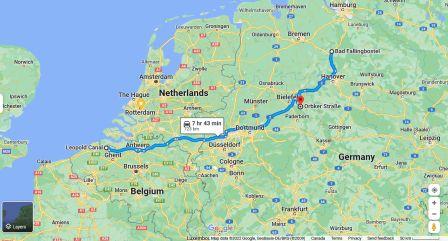
A badly wounded Albert Cote was transported from the Leopold Canal in Belgium, to a field hospital in Fallingbostel, Germany.  After his death, he was initially buried in a prisoner of war cemetery in Orbke. (Map source: Google)

Albert ended up in Kriegs Lagerlazarett (Field Hospital) Stalag 11B near Fallingbostel, Germany.  Most likely, he would have been transported there by train along with other prisoners of war. International Red Cross reports from November 1944 indicate that conditions were dire there, with limited medical care, limited medical supplies such as dressings, and the supply of drugs was exhausted. (See https://www.pegasusarchive.org/pow/cSt_11B_History1.htm)

According to the German records, Albert died on October 5, 1944 and was initially buried in the Prisoner of War Cemetery in Orbke, 800 km northeast of Fallingbostel.

…..Albert is buried in the Canadian War Cemetery in Holten….

In March 1948, Albert was reburied in the Canadian War Cemetery in Holten.

cote, albert j. gravestone

Albert Joseph Cote is buried in the Canadian War Cemetery in Holten, The Netherlands. (Photo courtesy of the Information Centre Canadian Cemetery Holten)

…..Albert Cote is listed on the North Bay Cenotaph in Memorial Park….

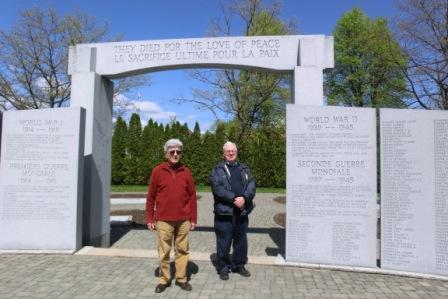
CIMG5568 May 18 2022 Pieter and Don at North Bay Memorial

Pieter and Don Coutts by a section of the Wall of Honour in Memorial Park in North Bay, Ontario.  (Photo credit: Daria Valkenburg)

DSCN2391 A J Cote name is at the very bottom

Albert Joseph Cote, buried in the Canadian War Cemetery in Holten. (Photo credit: Don Coutts)

Although he never received official recognition for his heroism, Albert Cote was remembered by several of the men he served with, and he is recognized on the Wall of Honour in Memorial Park in North Bay, Ontario where he grew up.

Researching this story took on a life of its own, as so many people volunteered their help.  Thank you to Shawn Rainville and Judie Klassen for researching the newspaper archives.  Judie also found the book references in which Albert Cote was mentioned and researched the Cote family.  Thank you to archivist Edward Drieger of the Harris Library at the University of Nipissing for the information about Albert Cote’s school activities.

Staff at the North Bay Public Library, the Nipissing District Branch of the Ontario Genealogical Society, and Captain Tim Feick and Cpl Brayton of The Algonquin Regiment independently dug into the archival material.  Special thanks go to the North Bay Nugget newspaper for its extensive coverage of WWII soldiers from the time period.

Both Mark Zuehlke and Henrietta T. O’Neill were contacted in case they had additional information on Albert Cote other than what was in their books.  Both responded, but nothing more could be added.

As our North Bay adventures conclude, we thank Don Coutts for guiding us around North Bay and arranging for the events we were able to participate in, and the North Bay Public Library for the invitation to do an Author Talk.

If you know of any soldiers that are buried in The Netherlands please let Pieter know. You can email him at memorialtrail@gmail.com, comment on the blog, or send a tweet to @researchmemori1.

…Missed the previous postings about our North Bay Memorial Trail visit?…

…Want to follow our research?….

If you are reading this posting, but aren’t following the blog, you are welcome to do so.  See https://onthewarmemorialtrail.com/ or email me at dariadv@yahoo.ca and ask for an invitation to the blog.

Front cover OnTheWarMememorialTrailinEuropeDaria’s book ‘No Soldier Buried Overseas Should Ever Be Forgotten‘ is available in print and e-book formats.  For more information see https://nosoldierforgotten.com/

Upcoming Author Talk: Thursday, August 11, 2022 – Victoria-By-The-Sea, Prince Edward Island, part of the ‘Our Island Talks’ series, and hosted by Victoria Playhouse and Victoria Historical Association. Time: 2:00 pm.

You are also invited to subscribe to our YouTube Channel: On The War Memorial Trail With Pieter Valkenburg: https://www.youtube.com/channel/UCJ591TyjSheOR-Cb_Gs_5Kw.

© Daria Valkenburg