On the War Memorial Trail ….. In Cologne

February 26, 2018.  After visiting the graves of all the names listed on the Cenotaph outside the Borden-Carleton Legion who were buried or listed on monuments in France, Belgium, and The Netherlands, we had one visit and one country left for this trip… to the Cologne Southern Cemetery, located in the Südfriedhof Cemetery in Cologne, Germany, and the grave of WWI soldier Lt. Henry Warburton STEWART.

This trip almost proved to be my undoing.  After a long drive to Cologne, we finally found the cemetery, located at an intersection of tram lines in a busy part of Cologne.  Pieter was in a rush to get moving after the long car ride, and sprinted ahead to find the Commonwealth War Graves Cemetery.

Südfriedhof Cemetery is a very large public cemetery, the largest we’ve ever been in, with many paths and turns.  Only one small sign at the entrance indicates that there is a Commonwealth War Graves Cemetery located here.  Once inside the cemetery, we soon learned that there are no directional markers to it.
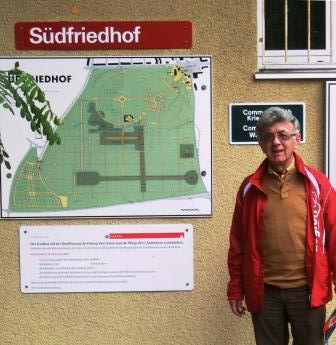
CIMG9274 Sep 24 2017 Cologne Pieter at entrance to Sudfriedhof cemetery

Sign at the entrance to Südfriedhof Cemetery with a map of the cemetery, and a very small sign behind Pieter’s head giving an indication that there is also a Commonwealth War Graves Cemetery located here. (Photo credit: Daria Valkenburg)

With Pieter long gone, I slowly hobbled my way on the gravel paths, trying to figure out where to go.  Most cemeteries are in clear lines, but this one was like a maze.  It was beautifully maintained, but quite dark and to my mind, a bit depressing.  As it was a Sunday, there were many people in the cemetery.  When we’d been in cemeteries in South America, many were like parks, with wide paths, park benches, and children laughing and playing.  People sat on benches and visited with each other. Outside the entrance, there were kiosks selling ice cream, balloons, and flowers.  Not this cemetery.  It was quiet and people talked very softly to each other.  Occasionally I saw people tending the graves of their family members.

It was very humid, and as I made my way, hoping not to get lost, I could feel my hair curling and frizzing.  My arthritic hip was aching and walking with a cane on gravel meant moving even more slowly than usual.  After close to a km of walking, I finally saw what I believed to be a sign to the Commonwealth War Graves Cemetery.  The sign said “Graves of the Victims of the War from 1914-1918”.

CIMG9284 Sep 24 2017 Cologne sign at Sudfriedhof cemetery directing one to the victims of WW1

Sign pointing to the graves of WWI victims. (Photo credit: Daria Valkenburg)

I took that path and came into an area of the cemetery surrounded by hedges, making a rather dark cemetery look even drearier.  To my surprise, however, the WW1 victims were German soldiers who had died during the war.  It took me a long time afterwards to realize that to their families, they were just as much victims as Allied soldiers.

Only one young man was in this part of the cemetery, planting flowers by a grave.  I hesitantly asked if he knew where the Commonwealth War Graves Cemetery was.  He looked at me for quite a few minutes and at first I thought he wasn’t going to answer, but then figured out that he was as surprised to find me in that part of the cemetery as I was.  “Just follow the path and you will come to the gate for the English soldiers” he said.  We wished each other a good day and I kept on.

Finally, I found the gate to the Cologne Southern Cemetery and discovered it was the back door gate, not the entrance.  Pieter was waiting by the grave of Henry Warburton Stewart, and had already put down the flags and written in the cemetery register.  He’d forgotten who had the camera, otherwise he probably would have already gone back to the car!
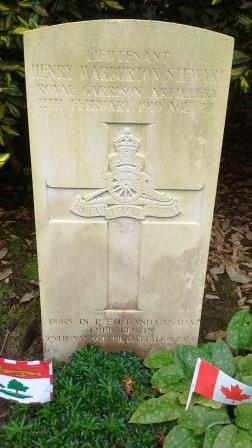
IMG_20170924_113711423 Sep 24 2017 grave of Henry Warburton Stewart at Cologne Southern Cemetery

Grave of Henry Warburton Stewart at Cologne Southern Cemetery. (Photo credit: Pieter Valkenburg)

The story of Henry Warburton Stewart is a sad one, as he survived WW1, only to die of pneumonia after contracting Spanish flu in Germany, far away from his comrades.  Born in Strathgartney on April 15, 1884, the son of Robert Bruce Stewart and Ann, nee Warburton, he was a civil engineer when he enlisted as a private with the 29th Battalion (Tobin’s Tigers) in Vancouver on November 30, 1914.
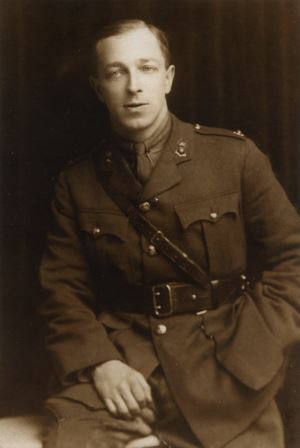
Henry Warburton Stewart

Henry Warburton Stewart. (Photo courtesy B. Stewart family collection)

After serving in the trenches of France for two years, he was discharged with excellent recommendations by the Canadian Army on March 9, 1917 in England and commissioned as a Lieutenant in the Imperial Army’s 77th Siege Battery Royal Garrison Artillery.  Since we have not been able to get access to the war diaries of this unit, we presume that he was sent to Germany as part of the post-occupation forces and there fell ill, dying on February 11, 1919 at No. 2 Canadian Field Hospital in Bonn.  He was buried with military honours at Poppelsdorf Cemetery in Bonn.

In 1922, it was decided that the graves of Commonwealth soldiers who had died in Germany should be brought together in one of four cemeteries within Germany.  Stewart was reburied in Cologne Southern Cemetery.
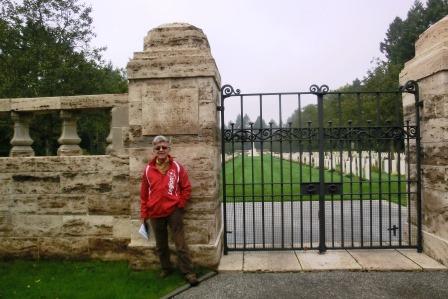
CIMG9281 Sep 24 2017 Cologne Pieter at entrance to Cologne Southern Cemetery in Sudfriedhof cemetery

Pieter at the entrance to Cologne Southern Cemetery, located in Südfriedhof Public Cemetery in Cologne. (Photo credit: Daria Valkenburg)

Unlike the portion of the cemetery where the German soldiers rest, Cologne Southern Cemetery is open and airy.
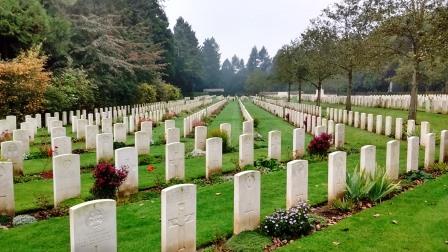
IMG_20170924_114611116_HDR Sep 24 2017 View of graves in Cologne Southern Cemetery

Commonwealth war graves in Cologne Southern Cemetery. (Photo credit: Pieter Valkenburg)

After paying our respects to Lt. Stewart, we slowly made our way back towards the car.  Pieter noticed a pastry shop across the road and suggested we mark the end of our war memorial tour with a piece of cake and a cup of coffee.
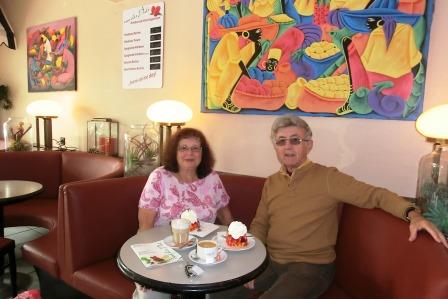
CIMG9286 Sep 24 2017 Cologne time for a fruit tart and coffee at Van der Put cafe after Sudfriedhof cemetery

Coffee break at Van der Put café in Cologne.

So, after four European countries and 7,000 km on the rental car, the research now continues on Canadian soil.  We had an amazing adventure and met many wonderful people dedicated to helping to remember the wartime sacrifices of Canadian and other Allied soldiers.  We are humbled and grateful to play a small part in this.

Unfortunately, we know little about Stewart’s service in the Imperial Army as those records are not digitized and are at The British National Archives.  If anyone has more information, please let us know.  As well, photos are still needed for many of the names on the Cenotaph outside the Borden-Carleton Legion.   Please share your photos, comments, or stories by emailing us at memorialtrail@gmail.com or by commenting on this blog.

© Daria Valkenburg

….Want to follow our research?….

If you are reading this posting, but aren’t following our research, you are welcome to do so.  Our blog address: https://onthewarmemorialtrail.com/
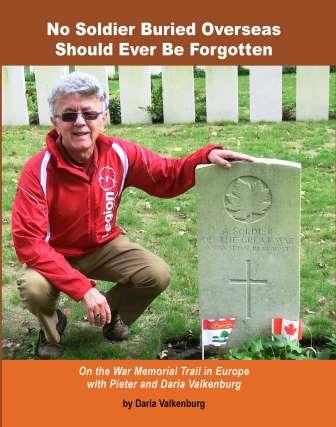
Front cover OnTheWarMememorialTrailinEurope4 countries, 6 weeks, 7,000 km – an unforgettable war memorial journey in Europe…. Daria’s book ‘No Soldier Buried Overseas Should Ever Be Forgotten‘ is available in print and e-book formats.  Net proceeds of book sales help support research costs and the cost of maintaining this blog. For more information see https://nosoldierforgotten.com/ 

You are also invited to subscribe to our YouTube Channel: On The War Memorial Trail With Pieter Valkenburg: https://www.youtube.com/channel/UCJ591TyjSheOR-Cb_Gs_5Kw

Never miss a posting!  Subscribe below to have each new story from the war memorial trail delivered to your inbox.
On the War Memorial Trail ….. At Harlingen General Cemetery

February 3, 2018.  In July 2017, the County Line Courier published a story about PEI Pilot Elmer Bagnall Muttart (See CLC July 19 p20 WWII Pilot Saved Dutch Village), whose name is listed on the Cenotaph outside the Borden-Carleton Legion. This blog had two previous entries about him.  (See The Elmer Bagnall Muttart Story and The Media Interview With CBC ).  This blog entry is about our visit to his grave at Harlingen General Cemetery in The Netherlands.

Elmer Bagnall Muttart (2)

Elmer Bagnall Muttart (Photo from Canadian Virtual War Memorial at http://www.veterans.gc.ca)

Elmer Bagnall MUTTART, born March 14, 1918 in Cape Traverse, son of Louis (Lewis) Muttart and Annie Bagnall, was an RCAF pilot assigned to the 10th Operational Training Unit in England in March 1941, where he trained to fly a Whitley, a twin-engine medium bomber.  On May 19, 1941 he was transferred to the 78th Squadron at the air base in Middleton St. George and had 20 successful flights in enemy territory as either co-pilot or pilot.  On September 24, 1941 he transferred to the 76th Squadron for retraining to fly the new four engine Halifax plane, a heavy bomber.

On October 12, 1941, with his regular navigator Reg ALEXANDER and six other crew members, Muttart began his 21st mission into enemy territory.  The crew members of Halifax L9561 were:

  • Pilot – F/S Elmer Bagnall MUTTART (age 23)
  • Co-Pilot – P/O Norman Frank TRAYLER (age 21)
  • Flight Engineer – Sgt David COTSELL (age 21)
  • Bomb Aimer – Sgt Leslie Albert ROBERTS (age 25)
  • Navigator – Sgt Reginald William Purchase ALEXANDER (age 22)
  • Wireless Operator – Sgt William Herbert HUNT (age 22)
  • Gunner – Sgt George Henry PATTERSON (age 28)
  • Gunner – Sgt John William DUFFIELD (age 20)

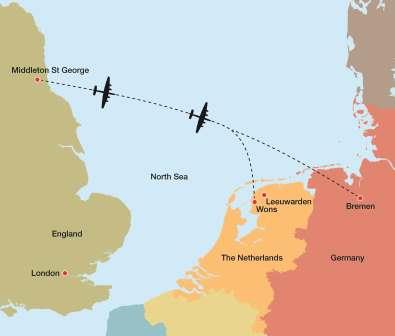
Flying Halifax L9561 as part of a group of 100 bombers, they left England at 7:30 pm and headed towards their target – a bombing raid on Bremen, Germany.  At 10:15 pm, Muttart’s plane was shot upon.  He managed to steer the plane south, passing over the town of Harlingen, where the plane was shot a second time.  Just past the village of Wons, the plane crashed, but not before all of the crew members, except for Muttart, had parachuted out.  The crew members, all British, spent the rest of the war in various prisoner of war camps.

Muttart was buried in Harlingen General Cemetery, in the province of Friesland, on October 16, 1941 by the German military. This is a public cemetery with 67 Commonwealth burials from WW II, most of them airmen. 22 are unidentified. In addition, there are four unidentified war graves of other nationalities.

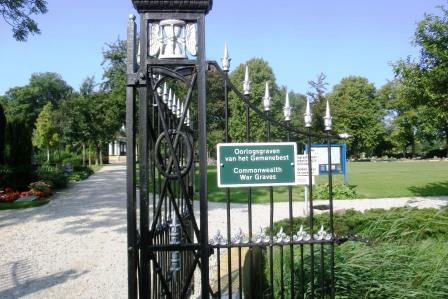
CIMG8076 Aug 28 2017 Harlingen Cemetery entrance gate

Entrance to Harlingen General Cemetery. (Photo credit: Daria Valkenburg)

When we went to pay our respects at Muttart’s grave with flags and a bouquet of flowers, we were joined by two members of the Missing Airmen Memorial Foundation, a non-profit organization dedicated to preserving the history of Allied planes shot down in The Netherlands during WW II.  The Foundation plans to honour the Halifax L9561 crew with a memorial plaque to be placed in Wons, near the site of the plane crash, and is raising funds for an event planned for October 2018.

We thought a Canadian contribution towards this would be a fitting tribute to honour Muttart, and the Tryon and Area Historical Association in Prince Edward Island agreed to help with a fundraising project, “Muttart Memorial Fund” for donations made within Canada.  Funds raised will be transferred to the Missing Airmen Memorial Foundation.

The Tryon & Area Historical Society is pleased to sponsor Pieter and Daria Valkenburg for carrying out the Elmer Bagnall Muttart Memorial Project. The Society will also administer the receiving of donations to go toward the cost of the Memorial. Registered Charity tax receipts will be issued…, says Jack Sorensen, Chair of the Tryon & Area Historical Society Inc.

Meeting with Alexander Tuinhout, Secretary for the Foundation, and Douwe Drijver, Treasurer for the Foundation, at Harlingen General Cemetery at Muttart’s grave was a fitting way to get acquainted as we begin to work on this joint project.

CIMG8019 Aug 28 2017 Harlingen Cemetery Pieter Alexander Douwe by Muttarts grave

Pieter on the left with Alexander Tuinhout, centre, and Douwe Drijver on the right, at Elmer Muttart’s grave in Harlingen General Cemetery. We had brought along a Canadian flag for the Foundation to use in their commemoration services. (Photo credit: Daria Valkenburg)

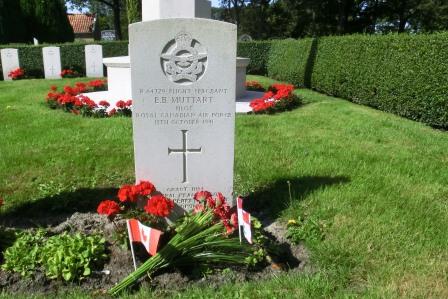
CIMG8014 Aug 28 2017 Harlingen Cemetery Muttarts grave

Grave of Elmer Bagnall Muttart in Harlingen General Cemetery. (Photo credit: Pieter Valkenburg)

One of the stories we had heard about Muttart’s burial is that he was buried with “full military honours” by the German military.  We had no idea if that was true, until we received a copy of a letter written by Gunner Sgt John William DUFFIELD, one of Muttart’s crew members.  Duffield was injured during the plane crash and ended up in a hospital.

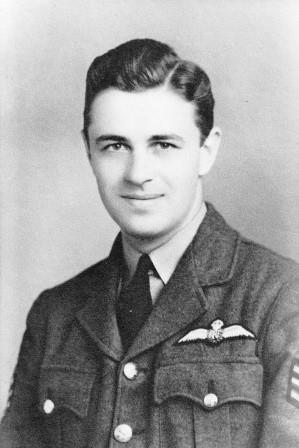
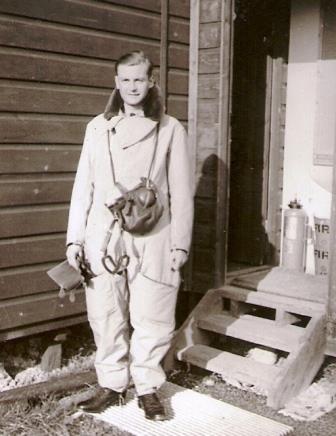
John Duffield in uniform

John Duffield in his flight suit. (Photo courtesy of Lesley Newland)

In a January 2, 1946 letter to Muttart’s father, Louis Muttart, Duffield wrote what happened:

Elmer, better known as ‘Happy’ on the squadron, was not my skipper, but for the fateful night of October 12th, I was loaned to his crew to fulfill my duties as a rear gunner.  He was my own skipper’s friend, and as he was such a good pilot, I was glad to be flying with him although it was only for the night.

We were on our way to Bremen and just over the Dutch coast when we were attacked from underneath.  I had my oxygen mask and microphone blown off my face and was hit on the left leg, hand, and body.  From this time onwards, I was out of communication with the crew.

We finally had two fighters attacking us and I managed to get one of them.  Our inner port engine caught fire, but by wonderful flying, Happy managed to keep the machine from spinning, but was unable to keep it from diving.  As a result he told us to jump from it.

Halifax_L9561_Wons-2

Estimated path taken by Halifax L9561 on October 12, 1941 after they were hit and diverted towards Wons. (Drawing courtesy of the Missing Airmen Memorial Foundation)

Duffield continued in his 1946 letter, “By this time I was paralyzed up the left side of my body and in trying to jump from the rear turret, my right leg became jammed.  It was only when I pulled my ‘chute that I freed myself.  I then became unconscious.

In a November 11, 2000 letter to Peter Hinchcliffe, who was researching German night fighters of WW II, Duffield wrote that “I came to lying on the ground, surrounded by German officers and Dutch civilians.  An ambulance soon arrived and I was on my way to hospital.  The following day, a tall, good looking German officer arrived and introduced himself as Helmut Lent.” The hospital was in nearby Leeuwarden.  Major Helmut LENT was the commander of 4./NJG 1 squadron, stationed at the airfield in  Leeuwarden.   A member of Lent’s squadron, Lt. Leopold FELLERER was responsible for shooting down the plane.

Duffield wrote about Lent in his 1946 letter to Muttart’s father, saying that Lent “later became the crack night fighter ace of the German Air Force.  He met his death in June 1944.  He asked me to send you his deepest sympathy for your son’s death.  Although he was our enemy, I can assure you that he meant it.  Happy was given a full military funeral and all arrangements were made by this pilot.  He bought a wreath for me on behalf of the crew in red, white, and blue flowers.

Alexander Tuinhout and Douwe Drijver told us that over 400 Allied planes crashed in Friesland and surrounding water, plus 150 German planes.  Most of the time, there were no survivors of plane crashes, making the 7 survivors of Halifax L9561 unusual.

In the next blog entry, we visit the Politiek farm in Wons, site of the plane crash, and speak with Cor Politiek, who was 9 years old in 1941 when the plane crashed on his parents’ dairy farm.

Do you have a story or photos about Halifax L9561, its crew members, John Duffield, or Elmer Muttart?  You can share your comments and stories by emailing us at memorialtrail@gmail.com  or by commenting on this blog.

UPDATE:  This project was completed in October 2019!

If you would like to make a donation in support of the commemoration plaque for Halifax L9561, the information follows below:

In Canada:  Cheques may be written out to TAHS and mailed to Tryon & Area Historical Society (TAHS), PO Box 38, Crapaud PE C0A 1J0.  In the subject line, identify your cheque as being for the “Muttart Memorial Fund”.  A charitable donation receipt will be sent to all donors.

In Europe: Bank transfers may be made to Stichting Missing Airmen Memorial Foundation, Bank Account # (IBAN) NL35ABNA0569579856, and state in the subject line “Attn D.S. Drijver for Halifax L9561”.

© Daria Valkenburg

….Want to follow our research?….

If you are reading this posting, but aren’t following our research, you are welcome to do so.  Our blog address: https://onthewarmemorialtrail.com/

Front cover OnTheWarMememorialTrailinEurope4 countries, 6 weeks, 7,000 km – an unforgettable war memorial journey in Europe…. Daria’s book ‘No Soldier Buried Overseas Should Ever Be Forgotten‘ is available in print and e-book formats.  Net proceeds of book sales help support research costs and the cost of maintaining this blog. For more information see https://nosoldierforgotten.com/ 

You are also invited to subscribe to our YouTube Channel: On The War Memorial Trail With Pieter Valkenburg: https://www.youtube.com/channel/UCJ591TyjSheOR-Cb_Gs_5Kw

Never miss a posting!  Subscribe below to have each new story from the war memorial trail delivered to your inbox.
On the War Memorial Trail ….. At Holten Canadian War Cemetery

January 20, 2018.  After visiting the Information Centre at the Canadian War Cemetery in Holten, we went into the cemetery itself to lay flags at the graves of five known soldiers from PEI.  Two of them, William Douglas SHERREN and George Martin MCMAHON are listed on the Cenotaph outside the Borden-Carleton Legion.

We had wondered why the cemetery had more landscaping than most Commonwealth War Cemeteries and why it was not on one level, but terraced.  Edwin van der Wolf, our guide, explained that the cemetery originally was on flat ground.  The Canadian government acquired more land than was used in the belief that the war would last longer and go into Denmark, resulting in more casualties. Luckily, that didn’t happen, and meant that the excess land could be used for landscaping.

When the cemetery was first opened, metal crosses were used to mark each grave, and there is a display in front of the Information Centre that shows one.

CIMG9100 Sep 18 2017 display of original metal cross used in Holten Cemetery

Metal cross originally used to mark each grave in Holten Canadian War Cemetery. (Photo credit: Daria Valkenburg)

Originally, the Cross of Sacrifice in the cemetery was placed further back than in its present location.  Similar to the story we’d heard about the placement of a Cross of Sacrifice at Groesbeek Canadian War Cemetery, Edwin noted that he had heard that when Holten Cemetery began, Lt. General Guy Granville Simonds, Commander of the 2nd Canadian Army, “wanted the Cross of Sacrifice to be 60 metres high and lit up so that it could be seen across the German border as a reminder of who had conquered them.”  Whether this story is true or not, we don’t know.

CIMG9123 Sep 18 2017 Holten Cemetery Pieter & Edwin van der Wolf by cross of remembrance

Pieter with Edwin van der Wolf by the Cross of Sacrifice at Holten Canadian War Cemetery. (Photo credit: Daria Valkenburg)


IMG_20170918_133147255_HDR Sep 18 2017 landscaping at Holten Cemetery

Landscaped grounds of Holten Canadian War Cemetery. (Photo credit: Pieter Valkenburg)

The first grave where flags were placed was that of Captain William Douglas Sherren, born November 25, 1914 in Crapaud, son of William Douglas Sherren and Florence Amanda nee Carrier.  Married to Florence Mead Strickland, he was the father of two sons, Hubert and Harrison Blair.  An electrician before the war, Sherren enlisted on January 6, 1941 as a Lieutenant with the First Survey Regiment, Royal Canadian Artillery.  On March 29, 1944 he was promoted to Captain.

Wiliam Douglas Sherren

William Douglas Sherren. (Photo courtesy of Holten Canadian War Cemetery Information Centre)

On July 9, 1944, not long after D-Day, he arrived in France from England.  He was recognized by King George VI as a Member of the Military Division of the Most Excellent Order of the British Empire in March 1945, in recognition of gallant and distinguished service in North West Europe.

Unfortunately, on April 25, 1945, while in Germany, the vehicle he was travelling in struck a landmine. He was severely wounded and died on April 28, 1945.  Originally buried in Cloppenburg Hospital Cemetery in Lower Saxony, he was reburied in Holten Canadian War Cemetery in 1947, after the war ended.

IMG_20170918_134108826 Sep 18 2017 grave of WD Sherren Holten cemetery

Grave of Captain William Douglas Sherren at Holten Canadian War Cemetery. (Photo credit: Pieter Valkenburg)

The next set of flags were placed at the grave of Gunner George Martin McMahon, born January 14, 1913 in Emerald Junction, son of  Peter A McMahon and Catherine nee Monaghan.  Married to Margaret Kathleen Greenan, he was the father of 5 children. In addition, one child, Joseph Louis died in 1942 at the age of three months, and another child, Georgie, was born in November 1945 after McMahon’s death.  Prior to enlistment in Montreal with the Royal Canadian Artillery on December 7, 1943, he was a machinist with Canadian Vickers Ltd.  Fluent in both English and French, his army record noted he could play the violin.

OLYMPUS DIGITAL CAMERA

George Martin McMahon. (Photo courtesy “Around Kinkora Area” by G. K. Farmer)

McMahon left Canada for England in March 1945, and was sent to North West Europe in May 1945.  According to a letter to his widow, written by Colonel C. L. Laurin, McMahon was on “a short leave to Amsterdam in company of a comrade with the same regiment.  On the evening of the 10th of August 1945, at approximately 11:50 pm, they parted company…” 

McMahon’s friend returned to the Army leave hotel alone.  The following day, this soldier, made enquiries and was informed that the body of the deceased had been found in a canal….”  It was determined that he had accidentally drowned on August 11, 1945.   He was first buried in Hilversum Community Cemetery, and in 1946 was reburied in Holten Canadian War Cemetery.

IMG_20170918_134412720 Sep 18 2017 G McMahon grave Holten Cemetery

Grave of George Martin McMahon at Holten Canadian War Cemetery. (Photo credit: Pieter Valkenburg)

After visiting McMahon’s grave we went on to place flags at the graves of three more known soldiers from PEI: Carman GILLCASH, Frederick Charles CHEVERIE, and Daniel Peter MacKenzie.

Edwin van der Wolf told us that MacKenzie had been with the Carleton & York Regiment, which liberated the village of Posterenk.  This is where MacKenzie, plus 5 more from his unit, lost his life from sniper fire from Germans using the village’s windmill as a hideout.  For the past two years, on April 13, the people from the village commemorate the event around the old windmill.

Do you have more information or photos on these five soldiers from PEI?  Have you visited Holten Cemetery and its Information Centre?  Do you know of more soldiers from PEI buried in the Cemetery?  You can share your comments and stories by emailing us at memorialtrail@gmail.com or by commenting on this blog.

© Daria Valkenburg

….Want to follow our research?….

If you are reading this posting, but aren’t following our research, you are welcome to do so.  Our blog address: https://onthewarmemorialtrail.com/

Front cover OnTheWarMememorialTrailinEurope4 countries, 6 weeks, 7,000 km – an unforgettable war memorial journey in Europe…. Daria’s book ‘No Soldier Buried Overseas Should Ever Be Forgotten‘ is available in print and e-book formats.  Net proceeds of book sales help support research costs and the cost of maintaining this blog. For more information see https://nosoldierforgotten.com/ 

You are also invited to subscribe to our YouTube Channel: On The War Memorial Trail With Pieter Valkenburg: https://www.youtube.com/channel/UCJ591TyjSheOR-Cb_Gs_5Kw

Never miss a posting!  Subscribe below to have each new story from the war memorial trail delivered to your inbox.

On the War Memorial Trail ….. At The Canadian War Cemetery in Groesbeek

December 25, 2017.  During lunch with members of the Royal Canadian Legion in The Netherlands, we mentioned that we would be going to the Canadian War Cemetery in Groesbeek to lay flags at the graves of Prince Edward Island soldiers, and one from New Brunswick.  Although we had a list of 17 soldiers, only one was listed on the Cenotaph outside the Borden-Legion Carleton, George Preston SMITH of Kinkora, who was with the North Shore (New Brunswick) Regiment.

Placing flags at the grave of a soldier from New Brunswick was at the request of our friend, Brenda Graves of North Tryon, in memory of her uncle Frank Edward MCGOVERN. He also was from the North Shore (New Brunswick) Regiment, and died February 26, 1945 at the age of 19. Brenda, who is researching her family history, unfortunately has only a poor quality photo of her uncle.  Can anyone help put a face to this name?

Just outside the cemetery, by the parking lot, is a banner asking people for help in the Faces to Graves Foundation Groesbeek project.  The project was begun by members of the Royal Canadian Legion in The Netherlands to create a virtual memorial for all who are buried at the Groesbeek Canadian War Cemetery or listed on the Groesbeek Memorial.  2,338 soldiers are buried here.

CIMG8926 Sep 15 2017 faces to grave banner at Groesbeek cemetery

Faces to Graves Foundation banner. (Photo credit: Pieter Valkenburg)

Many of the war dead were brought to this cemetery from nearby Germany. Fallen Canadian soldiers from WWII, who were buried in German battlefields, were reinterred here (except for one who is buried in Reichswald Forest War Cemetery in Germany). General Harry Crerar, who commanded Canadian land forces in Europe, had ordered that Canadian dead were not to be buried on German soil.

CIMG8928 Sep 15 2017 Daria at Groesbeek cemetery

Daria at entrance to Groesbeek Canadian War Cemetery, with flowers to place at the grave of Frank Edward McGovern. (Photo credit: Pieter Valkenburg)

CIMG8937 Sep 15 2017 Groesbeek cemetery grave of Brendas uncle FE McGovern

Grave of Frank Edward McGovern at Groesbeek Canadian War Cemetery. (Photo credit: Daria Valkenburg)

George Preston Smith (2)

George Preston Smith. (Photo courtesy of Canadian Virtual War Memorial)

Private George Preston SMITH was born September 3, 1923 in Kinkora, the son of William Wilfred and Mabel Smith.  A store clerk before enlisting on April 1, 1943, he served in England, France, and Belgium, before meeting his death in Belgium in an unfortunate accident on November 12, 1944.  Smith was accidentally killed while trying to take his Stengun out of the back of a military truck. The gun was under a pile of greatcoats. He grabbed it by the muzzle and gave it a hard pull, causing the cocking piece to be pulled back far enough. When he let it go, the cocking piece went forward again with enough pressure to push a round into the chamber and fire it.

On November 15, 1944, he was buried in the Civil Cemetery in Malden, Belgium.  In 1946, his remains were exhumed and he was reburied in the Groesbeek Canadian War Cemetery.

CIMG8940 Sep 15 2017 Groesbeek cemetery Pieter at the grave of George Preston Smith

Pieter by the grave of Private George Preston Smith. (Photo credit: Daria Valkenburg)

After paying our respects to McGovern and Smith, Pieter placed flags on two more graves of PEI soldiers.  We had been invited by Alice van Bekkum, of the Faces to Graves Foundation, to participate in a special ceremony, along with members of the Royal Canadian Legion in The Netherlands.  Wish Of A Lifetime Canada (see https://wishofalifetime.ca/), an organization that fulfills seniors’ dreams and shares their stories to inspire those of all ages, had granted a wish that had a PEI connection.

Harriet Jenereaux, born in West Point, PEI, now living in Nova Scotia, wanted to see the grave of her father, Sgt Edison Alexander SMITH, who is buried in the cemetery in Groesbeek.  Harriet and her husband Keith were flown to The Netherlands, members of the Royal Canadian Legion provided a colour party, and Alice van Bekkum paid for a bugler to play The Last Post at the grave.   (See https://www.youtube.com/watch?v=BgXkld9BUIA)

CIMG8948 Sep 15 2017 Groesbeek cemetery bugler with Yvonne and Berry Swarthoff providing colour parade

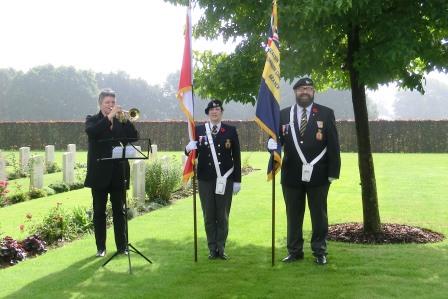
Bugler with Royal Canadian Legion’s colour party of Yvonne and Berry Swarthoff at Groesbeek Canadian War Cemetery. (Photo credit: Daria Valkenburg)

Before Harriet arrived at the cemetery, Pieter made sure that Canadian and PEI flags were placed at her father’s grave, and that of her uncle, L/Cpl Ralph Schurman BOULTER, her mother’s brother.  Smith, aged 32, and Boulter, aged 28, were in the North Nova Scotia Highlanders, and were both killed in battle while crossing the Rhine on March 25, 1945.

CIMG8952 Sep 15 2017 Groesbeek cemetery Alice van Bekkum

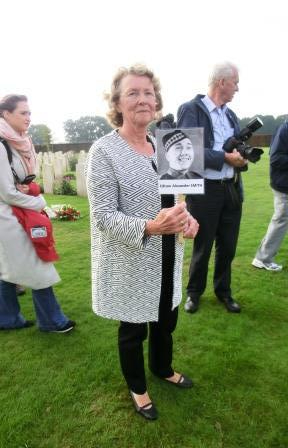
Alice van Bekkum arranged for a photo of Smith to be placed by his grave. (Photo credit: Daria Valkenburg)

As Harriet neared her father’s grave, she called out to her husband Keith, “There’s Daddy!”  It was a poignant moment for us, the Dutch members of the Legion, an astonishing amount of reporters and press photographers, plus a representative of Phillips, the Dutch sponsor of Wish of a Lifetime.

CIMG8950 Sep 15 2017 Groesbeek cemetery Harriet Jenereux at her fathers grave

Harriet Jenereaux kneels at her father’s grave. (Photo credit: Daria Valkenburg)

After the ceremony and greeting Harriet, it was time for us to enjoy a cup of coffee and a piece of Dutch apple cake.  We’d return to place flags at the graves of the other 14 soldiers from PEI once all the commotion regarding Harriet’s visit had diminished.

Do you have relatives buried in Groesbeek Canadian War Cemetery?  If so, please consider participating in the Faces to Graves project by submitting photos and stories either through their website at http://facestograves.nl/index.html or by email to info@facestograves.nl.  Alternatively, you can contact us and we will forward your info for you.

Comments or stories?  You can share them by emailing us at memorialtrail@gmail.com, or commenting on the blog.

© Daria Valkenburg

…Want to follow our research?…

If you are reading this posting, but aren’t following our research, you are welcome to do so.  Our blog address: https://onthewarmemorialtrail.com/

Front cover OnTheWarMememorialTrailinEurope4 countries, 6 weeks, 7,000 km – an unforgettable war memorial journey in Europe…. Daria’s book ‘No Soldier Buried Overseas Should Ever Be Forgotten‘ is available in print and e-book formats.  Net proceeds of book sales help support research costs and the cost of maintaining this blog. For more information see https://nosoldierforgotten.com/

Subscribe to our YouTube Channel: On The War Memorial Trail With Pieter Valkenburg: https://www.youtube.com/channel/UCJ591TyjSheOR-Cb_Gs_5Kw.

Never miss a posting!  Subscribe below to have each new story from the war memorial trail delivered to your inbox.
On the War Memorial Trail ….. A Taste of Canada in The Netherlands

December 22, 2017.  After travelling through Europe for weeks, and arriving in The Netherlands for the next phase of our war memorial tour, we were delighted to receive an invitation from the Royal Canadian Legion in The Netherlands for lunch at their home base in Lochem.  While we knew that the home base was in a restaurant called Mondani, we were completely astonished to see that it was a Canadian restaurant.  We eagerly went inside and found a piece of west coast Canada!

CIMG8916 Sep 13 2017 Mondani Restaurant in Lochem

Photo: Pieter outside the Canadian restaurant Mondani in Lochem, The Netherlands. (Photo credit: Daria Valkenburg)

Owners Berry Swarthoff, of The Netherlands, and his wife Yvonne, from Dawson Creek, BC, opened their restaurant in 1991. With a pan-Canadian menu, including a seafood cocktail from Prince Edward Island, it’s a great place to meet and enjoy a taste of Canada.  They even serve Tim Horton’s coffee upon request.

CIMG8920 Sep 13 2017 Berry & Yvonne Swarthoff Mondani Restaurant in Lochem

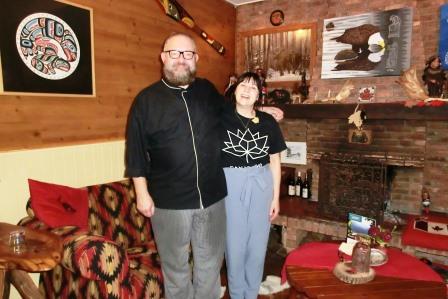
Photo: Berry and Yvonne Swarthoff in their Canadian restaurant Mondani in Lochem, The Netherlands. (Photo credit: Daria Valkenburg)

The Royal Canadian Legion in The Netherlands, of which the Swarthoffs are members, is one of 5 branches in Europe.  Pieter and I were invited for lunch to meet with other members of the Legion, including Branch President Gerard Hendricks and Vice-President Martin Reelick.  Alice van Bekkum, president of the Faces to Graves project at the Canadian War Cemetery in Groesbeek, was also present.  Of the 18 known PEI soldiers buried in Groesbeek, one is on the Cenotaph outside the Borden-Carleton Legion.  Pieter intended to place flags on the graves of all 18 soldiers.

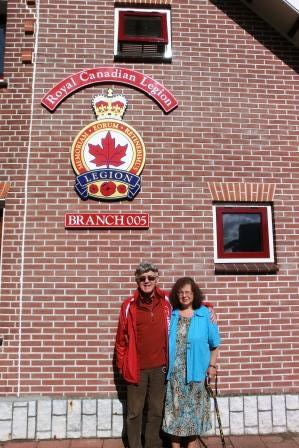
CIMG8925 Sep 13 2017 Daria & Pieter by Legion sign at Mondani restaurant in Lochem

Photo: Pieter and Daria by the Legion sign at Restaurant Mondani in Lochem, The Netherlands. (Photo credit: Berry Swarthoff)

CIMG8919 Sep 13 2017 Mondani Restaurant in Lochem Legion members

Photo: Left to right: Gerard Hendricks, Martin Reelick, Pieter Valkenburg, Alice van Bekkum. (Photo credit: Daria Valkenburg)

The main purpose of the Dutch branch of the Royal Canadian Legion is remembrance.  We have 40 to 50 events annually normally, and then every five years we have 65 extra commemorations...” said Hendricks.  “Many families had daughters who were war brides, and many Canadian soldiers were stationed in The Netherlands after the war.  Plus, 85% of The Netherlands was liberated by Canadian troops.  Many friendships still survive.  So a Royal Canadian Legion branch here is most appropriate….”

The branch has members from the Dutch public, as well as Canadian embassy officials, Canadian expats, and even a Canadian pilot on exchange with the Dutch Air Force.

Since the Legion uses the Mondani restaurant as its home base, there are few fixed costs.  Travel costs, and the costs of flags for colour parties make up the bulk of the Legion’s expenses.  “We travel across The Netherlands, and in April we were at Vimy Ridge for the 2017 commemoration ceremonies...” noted Hendricks.

To help with finances, the Canadian Embassy in The Hague hosts an annual fundraiser at the ambassador’s residence, plus the Legion sells T-shirts, bags, and hats to raise money.

The lunch was a Dutch one, not Canadian, but it was delicious, and we were enveloped in a warm atmosphere of friendship.  After the Dutch members of the Legion left, Berry, who surely knows what Canadians like, asked if we’d like a piece of lemon meringue pie.  Did we ever!  And it was delicious.  My mother, who was an excellent cook and baker, could not have made a better pie.

The visit to Lochem reminded us not only of home, but that so many people in Europe are grateful for the help Canada gave in the liberation of their countries.  We were very much looking forward to continuing our war memorial trail in Pieter’s country of birth.  As in Belgium, we would be joined by friends, old and new, who shared in honouring the soldiers who gave their lives during war.

Comments or stories?  You can share them by emailing us at memorialtrail@gmail.com or by commenting on this blog.

© Daria Valkenburg

….Want to follow our research?….

If you are reading this posting, but aren’t following our research, you are welcome to do so.  Our blog address: https://onthewarmemorialtrail.com/

Front cover OnTheWarMememorialTrailinEurope4 countries, 6 weeks, 7,000 km – an unforgettable war memorial journey in Europe…. Daria’s book ‘No Soldier Buried Overseas Should Ever Be Forgotten‘ is available in print and e-book formats.  Net proceeds of book sales help support research costs and the cost of maintaining this blog. For more information see https://nosoldierforgotten.com/ 

You are also invited to subscribe to our YouTube Channel: On The War Memorial Trail With Pieter Valkenburg: https://www.youtube.com/channel/UCJ591TyjSheOR-Cb_Gs_5Kw

Never miss a posting!  Subscribe below to have each new story from the war memorial trail delivered to your inbox.
On The War Memorial Trail….The Princess Patricia’s Light Infantry Memorial

November 18, 2017.  On July 30 of this year we posted a blog entry on WWI soldier Charles Benjamin Murray BUXTON, known as Charlie, and asked for a photo and information on him. (See Who Can Put A Face To Charles Benjamin Murray Buxton?)  As well, the request was included in an article in the County Line Courier that was published on August 9.  (See CLC p30 Aug 9 2017 Face for Arsenault)

We included an excerpt from an August 13, 1915 letter written to Charlie Buxton’s aunt, Minnie Marchbank of Alma, letting her know that her son George was all right.  It was through the Marchbank connection that we were able to find a photo, actually two!

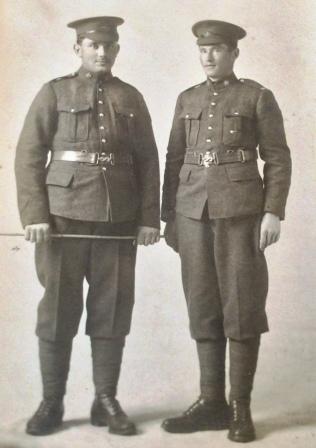
George Marchbank survived the war, and his son John of Nanton, Alberta, a veteran of the Korean War, had a photo of his father and Buxton, which he shared.

IMG_0185 photo of george marchbank and charles buxton

George Marchbank on the left, and Charles Buxton on the right. (Photo courtesy of John Marchbank family collection)

John Marchbank

Royal Canadian Legion member John Marchbank, son of George Marchbank, the cousin of Charles Buxton. (Photo courtesy of John Marchbank family collection)

The second photo of Charlie came from a period just before the war interrupted his career as a school inspector in West Prince.  Through the newspaper archives, Pieter found a 1954 reference to a display of hockey photos found at Myricks store in Alberton.  One of the photos was of the 1915 Alberton Regal Hockey Team… and one of the players in the photo was C. B. Buxton!

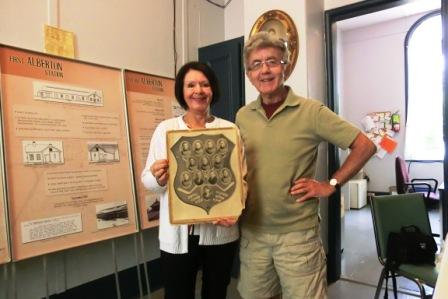
It appeared that while inspecting schools, Charlie stayed with his aunt Minnie, and found time to play on the Alberton Regal Hockey Team.  A call to the Alberton Museum verified that they had the team photo.  We immediately made a trip to Alberton and met with Arlene Morrison, Museum Manager, who explained that the 1915 photo was donated by Eileen Oulton.

CIMG7941 Aug 11 2017 Arlene Morrison and Pieter with 1915 hockey photo

Arlene Morrison and Pieter Valkenburg at Alberton Museum with the 1915 Alberton Regal Hockey Team Photo. (Photo courtesy of Eileen Oulton Collection)

OLYMPUS DIGITAL CAMERA

Inset from the team photo of Charles Benjamin Buxton, who played centre for the 1915 Alberton Regal Hockey Team. (Photo courtesy of Eileen Oulton Collection)

As Charlie was with the Princess Patricia’s Light Infantry, our next stop on the war memorial trail in Belgium was the Princess Patricia’s Light Infantry Memorial in Zonnebeke. The Princess Pats were the first Canadian troops to arrive in Belgium, and fought in most of the battles in Belgium between 1915 and 1918.

The memorial is right beside a corn field, on land donated by Jules van Ackere in 1958, right at the edge of the road.

CIMG8789 Sep 9 2017 Pieter at PPLI memorial in Zonnebeke

Pieter at the Princess Patricia’s Light Infantry Memorial in Zonnebeke. You can see the maple tree behind the memorial. (Photo credit: Daria Valkenburg)

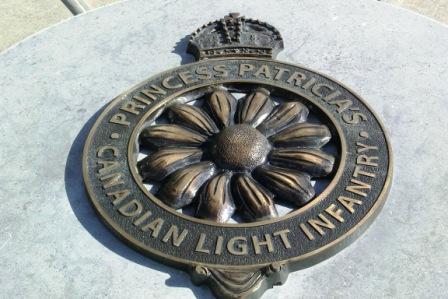
The memorial was redone in 2015 and has a centennial plaque plus a bronze Marguerite daisy insignia, indicative of the cap badge worn by the troop during 1915.  As well, a Canadian Sugar maple tree was planted.

CIMG8784 Sep 9 2017 insignia of PPLI with bronze marguerite flower

Bronze Marguerite daisy insignia on the memorial. (Photo credit: Daria Valkenburg)

The memorial, which is much smaller than Pieter expected, commemorates the Battle of Frezenberg on May 8, 1915, marking the area they successfully defended, the Bellewaarde Ridge.  By the end of the battle, out of a complement of 546, only 4 officers and 150 men had survived.

Charlie Buxton was not in this battle. He enlisted on April 10, 1915 in the 1st University Company, which was formed to reinforce the Patricia Patricia’s Light Infantry, and sailed to England, then travelled on to France.  On July 17, 1915 he was taken on strength by the Patricia Patricia’s Light Infantry in France.

Charlie died in June 1916 in Sanctuary Wood, during the Battle of Mount Sorrel, our next stop on the war memorial trail.

Comments or stories?  You can share them by emailing us at memorialtrail@gmail.com or by commenting on this blog.

© Daria Valkenburg

….Want to follow our research?….

If you are reading this posting, but aren’t following our research, you are welcome to do so.  Our blog address: https://onthewarmemorialtrail.com/

Front cover OnTheWarMememorialTrailinEurope4 countries, 6 weeks, 7,000 km – an unforgettable war memorial journey in Europe…. Daria’s book ‘No Soldier Buried Overseas Should Ever Be Forgotten‘ is available in print and e-book formats.  Net proceeds of book sales help support research costs and the cost of maintaining this blog. For more information see https://nosoldierforgotten.com/ 

You are also invited to subscribe to our YouTube Channel: On The War Memorial Trail With Pieter Valkenburg: https://www.youtube.com/channel/UCJ591TyjSheOR-Cb_Gs_5Kw

Never miss a posting!  Subscribe below to have each new story from the war memorial trail delivered to your inbox.
On The War Memorial Trail…We Visit Passchendaele and Surrounding Area

November 2, 2017.  After hearing so much about Passchendaele and the terrible 100 days of fighting over a mere 8 km of territory in 1917, we had to go and see the area for ourselves.  245,000 allied soldiers alone were casualties, not to mention Belgian citizens and German soldiers. We kept thinking, “How could it be worth such a heavy sacrifice?”

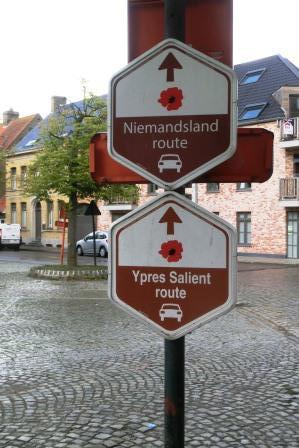
We followed two routes in this area, the Ypres Salient Route, and No Man’s Land Route (Niemandsland Route in Flemish).

CIMG8738 Sep 9 2017 sign saying Ypres Salient Route

Signs along the road marked the routes you could follow on the war memorial trail in Belgium. (Photo credit: Pieter Valkenburg)

One soldier on the Cenotaph outside the Borden-Carleton Legion, Vincent CARR, died on October 30, 1917 during the Battle of Passchendaele.  His story was told earlier in this blog.  (See links to The Cenotaph Research Project Begins and The WWI Names On The Cenotaph).  He’s buried at Cement House Cemetery in Langemark, and our first stop on the war memorial trail in the Passchendaele area was there.

CIMG8723 Sep 9 2017 Pieter at Cement House Cemetery with flags

Pieter at the entrance to Cement House Cemetery. (Photo credit: Daria Valkenburg)

Cement House was the military name given to a fortified farm building on the Langemark-Boesinghe (now called Boezinghe) road.  There are 3,952 WWI Commonwealth graves, 2,225 of them unidentified.  There are an additional 22 WWII graves, 5 of which are unidentified.

After placing the flags on Carr’s grave, we saw that the graves on either side of him were Canadians from the same Canadian Motor Machine Gun Brigade unit as Carr, and that they died on the same day.  It seemed only right to take a photo of all three graves and pay tribute to R. BELLAS, our Vincent CARR, and J. B. WILLSON.

IMG_20170909_131617502 Graves of Bellas Carr Willson in Cement House Cemetery

The graves of R. Bellas, V. Carr, and J. B. Willson in Cement House Cemetery. (Photo credit: Pieter Valkenburg)

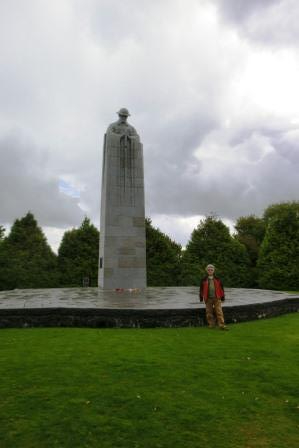
After leaving Cement House Cemetery, we stopped at the St. Julien Memorial (Sint Juliaan in Flemish), a Canadian War Memorial commemorating the Canadian First Division’s participation in the Second Battle of Ypres in World War I.  This was a nasty battle where the troops faced the first poison gas attacks along the Western Front on April 22, 1915.  The memorial is commonly known as the Brooding Soldier, the name given to the statue sculpted by Frederick Chapman Clemesha, an architect from Regina who was also a WWI veteran.

Unfortunately, the heavens opened as we arrived in the parking lot.  We waited a few minutes in the hope that the rain would stop, but no luck.  There was a big tour bus beside us and no one got out of it either.  After ten minutes the bus left (guess they had to stay on schedule).  At that point Pieter said, rain or not, he was going to the memorial.  Only his cousin François was willing to join him!  Mieke and I stayed in the car.

cimg8733-sep-9-2017-pieter-by-brooding-soldier-monument-st-juliaan-memorial-in-langemark.jpg

St. Julien Memorial in Langemark. (Photo credit: François Breugelmans)

The sculpture is a stone tower, topped by the head and shoulders of a soldier, whose head is bowed.  The soldier is in the pose of a serviceman standing with ‘reversed arms’ – resting his hands on the rifle butt and the rifle pointing with its barrel to the ground. This pose is a gesture of mourning and respect for the fallen.

The memorial is inscribed as follows: THIS COLUMN MARKS THE BATTLEFIELD WHERE 18,000 CANADIANS ON THE BRITISH LEFT WITHSTOOD THE FIRST GERMAN GAS ATTACKS THE 22ND-24TH OF APRIL 1915. 2,000 FELL AND HERE LIE BURIED.

The location of the statue is where the Canadian position was when they were attacked by gas.  None of the troops had gas masks.  They tried to protect themselves as best they good, and some pressed handkerchiefs soaked with urine around their mouths.  As we now know, this did little good.

A few minutes after the Pieter and François came back into the car and we pulled away from the parking lot, it stopped raining and the sun came out.  It was like a message had been received!

Although it was after 2 pm, and three of us were hungry and tired, we had a few more stops before Pieter would allow us to have a rest and lunch!  We grumbled that he had forgotten we were volunteers on this journey, not military recruits!  Our war memorial route continues in the next blog entry.

As yet, we have not been able to find any information on Vincent Carr’s wife, Bessie Carr, who came from Summerside, and died in 1918, a year after her husband.  Can you help?  If you are related to R. Bellas or J. B. Willson, we’d like to hear from you as well.  Comments or stories?  You can share them by emailing us at memorialtrail@gmail.com or by commenting on this blog.

© Daria Valkenburg

….Want to follow our research?….

If you are reading this posting, but aren’t following our research, you are welcome to do so.  Our blog address: https://onthewarmemorialtrail.com/

Front cover OnTheWarMememorialTrailinEurope4 countries, 6 weeks, 7,000 km – an unforgettable war memorial journey in Europe…. Daria’s book ‘No Soldier Buried Overseas Should Ever Be Forgotten‘ is available in print and e-book formats.  Net proceeds of book sales help support research costs and the cost of maintaining this blog. For more information see https://nosoldierforgotten.com/ 

You are also invited to subscribe to our YouTube Channel: On The War Memorial Trail With Pieter Valkenburg: https://www.youtube.com/channel/UCJ591TyjSheOR-Cb_Gs_5Kw

Never miss a posting!  Subscribe below to have each new story from the war memorial trail delivered to your inbox.
On The War Memorial Trail….Visiting Lt. John McCrae’s Field Hospital Bunker Outside Ypres

October 29, 2017. Lt. John McCrae (November 30, 1872 – January 28, 1918) is famous as the author of the poem we recite every Remembrance Day, “In Flanders Fields”.  So it was an honour to visit the place where he wrote the poem and have a look at the horrendous conditions in which, as a military surgeon, he had to work in his field hospital bunker (dressing station).

The Canadian government has a memorial to John McCrae that features “In Flanders Fields” at the site of this field hospital bunker located beside the Commonwealth War Graves Commission’s Essex Farm Cemetery. The Belgian government calls this site the “John McCrae Memorial Site”.

IMG_20170909_123444276 Sep 9 2017 John McCrae Memorial

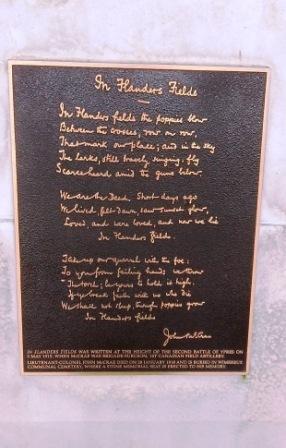
John McCrae Memorial with the poem “In Flanders Fields” in his handwriting at the far right. (Photo credit: Pieter Valkenburg)

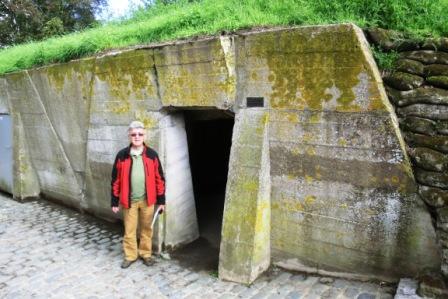
During the Second Battle of Ypres, fought from 22 April – 25 May 1915 for control of Ypres, Dr McCrae treated the wounded from a hastily dug, 8 foot by 8 foot bunker dug in the back of the dyke along the Yser Canal in Boezinge, about 2 miles north of Ypres.

CIMG8720 Sep 9 2017 John McCrae Memorial Site Pieter outside field hosptial bunker

Pieter at the entrance to the field bunker hospital where Lt. John McCrae worked as a military surgeon during the Second Battle of Ypres. Note that it was built into the dyke. (Photo credit: Daria Valkenburg)

After his friend, Lt. Alexis Helmer, was killed in the battle, legend has it that McCrae wrote the poem, ‘In Flanders Fields’, on May 3, 1915 as he sat upon the back of a medical field ambulance near this bunker at Essex Farm.

IMG_20170909_123455044 Sep 9 2017 John McCrae poem In Flanders Fields

The poem “In Flanders Fields” in his handwriting on the John McCrae Memorial. (Photo credit: Pieter Valkenburg)

In June 1915, McCrae was sent to set up No. 3 Canadian General Hospital at Dannes-Camiers near Boulogne-sur-Mer in northern France.  It was there that he died of pneumonia on January 28, 1918.  We wonder if he was aware that over a hundred years after he wrote the poem, the poppy and his poem remain a symbol of remembrance to the fallen.

We were deeply touched by the visit to the field hospital bunker, and weren’t surprised in the least when it started to rain.  It seemed as though rain was part of the memorial.  No one from the Cenotaph outside the Borden-Carleton Legion was buried at Essex Farm Cemetery, so we went on to Cement House Cemetery, which will feature in the next blog entry.

Have you been to the John McCrae Memorial Site?  Comments or stories?  You can share them by emailing us at memorialtrail@gmail.com or by commenting on this blog.

© Daria Valkenburg

….Want to follow our research?….

If you are reading this posting, but aren’t following our research, you are welcome to do so.  Our blog address: https://onthewarmemorialtrail.com/

Front cover OnTheWarMememorialTrailinEurope4 countries, 6 weeks, 7,000 km – an unforgettable war memorial journey in Europe…. Daria’s book ‘No Soldier Buried Overseas Should Ever Be Forgotten‘ is available in print and e-book formats.  Net proceeds of book sales help support research costs and the cost of maintaining this blog. For more information see https://nosoldierforgotten.com/ 

You are also invited to subscribe to our YouTube Channel: On The War Memorial Trail With Pieter Valkenburg: https://www.youtube.com/channel/UCJ591TyjSheOR-Cb_Gs_5Kw

Never miss a posting!  Subscribe below to have each new story from the war memorial trail delivered to your inbox.

On The War Memorial Trail….Grandcourt Road Cemetery in Farmers Fields

September 28, 2017.  After a few successful cemetery finds, we decided to make a second attempt at finding Grandcourt Road Cemetery, the burial place of Arthur Leigh COLLETT.  We finally found it in the afternoon on a very narrow path between farm fields, one km south of the village of Grandcourt in the spectacularly beautiful Somme Valley.

CIMG8361 Sep 5 2017 we reach the Somme Valley in France

We reach the Somme Valley in France. (Photo credit: Pieter Valkenburg)

The Commonwealth Graves Commission write up on the cemetery warned that access was difficult, saying “Please note that parking is difficult.  There is no permanent pathway to the cemetery.  Visitors must cross two fields to reach the cemetery.”  They weren’t kidding!

By “no permanent pathway” they meant you had to drive down a very narrow path which had inches to spare on either side on our small rental car.  We were dwarfed by a cornfield on one side and a potato field on the other.

CIMG8535 Sep 6 2017 corn is higher than car by Grandcourt Road Cemeter

You can see how close we were to the cornfield! (Photo credit: Daria Valkenburg)

Needless to say, there was no parking and no way to turn around except to drive backwards!  We simply stopped the car beside the sign pointing to the cemetery and crossed our fingers in the hope that no one would come along down the road or we would be in trouble before anyone saw the car.

The next challenge, now that we found the location, was getting to the cemetery.  It involved crawling up a set of steps to the first field.  One look at the steps, with no railing, and it was clear that only Pieter was attempting this journey.

CIMG8520 Sep 6 Sep 6 2017 steps going up to Grandcourt Road Cemetery

The steps leading up to the fields that one had to cross in order to reach Grandcourt Road Cemetery. The bottom step is inches away from our car! (Photo credit: Pieter Valkenburg)

From the top of the steps it was another 500 metres, across two fields, before Pieter reached the cemetery.  Poor Arthur Collett!  From Rhodes Scholar to lie buried in a field in the middle of nowhere!

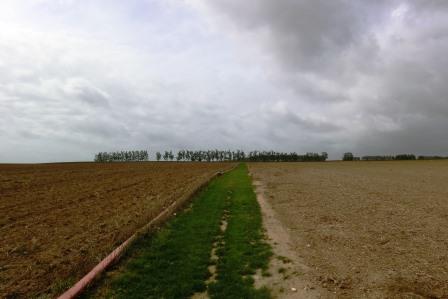
In one field, the farmer had made a grass path to walk along, in order to reach the cemetery, a thoughtful gesture that was much appreciated.

CIMG8522 Sep 6 2017 grass path leading to Grandcourt Road Cemetery

Grass path across a farmer’s field towards Grandcourt Road Cemetery. The trees in the distance indicate the cemetery location. (Photo credit: Pieter Valkenburg)

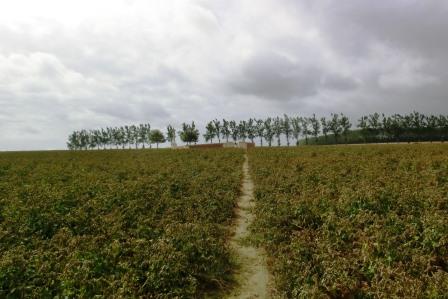
The second field wasn’t as easy to cross.  That farmer found his potatoes more important than providing access to the cemetery, and did not have a grass path.  Luckily for Pieter, it was not raining or he would have been stuck in the mud.

CIMG8523 Sep 6 2017 second field potatoes more important than access to Grandcourt Rd Cemetery

Second farmer’s field did not have a grass path towards Grandcourt Road Cemetery. The trees in the distance indicate the cemetery location. (Photo credit: Pieter Valkenburg)

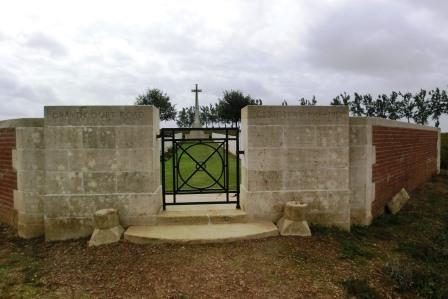
Eventually, however, Pieter reached the gates of the cemetery, and learned it was made in the spring of 1917 when the Ancre battlefield was cleared.  There are 391 WWI burials, 108 of them unidentified.  390 are British soldiers, and one, our Lt Arthur Collett, the lone Canadian burial.

CIMG8524 Sep 6 2017 gates of Grandcourt Rd Cemetery

After crossing two farmers’ fields, Pieter reached Grandcourt Road Cemetery. (Photo credit: Pieter Valkenburg)

Arthur Leigh COLLETT was born December 8, 1888 in Victoria, Prince Edward Island, the son of Ella May Simmons, and was the adopted son of William Henry Collett and Alice M.  Moore.  After receiving a Bachelor of Arts from King’s College in Halifax, Nova Scotia, he went to Oxford as a Rhodes Scholar, but shortly afterwards enlisted in the 12th Regiment in September 1914, later transferring to the 8th Battalion of The Gloucestershire Regiment.  According to the King’s College history, he “at once forsook his work at Oxford and enlisted in the Imperial Army.  He served in France with the 8th Gloucesters.

Arthur Collett 1

Arthur Collett. (Photo courtesy of Heather and Paul Moore Family Collection)

In a Pioneer newspaper article from July 15, 1916, came word of an injury, which he survived. “Mr. W. H. Collett, Victoria, has received a cablegram from London, England, notifying him that his son Lieut. A. L. Collett, was wounded on July 3rd. Lieut. Collett, who is a Rhodes scholar and also an Oxford M.A., went over to England with the First Contingent and was later transferred to the 8th Gloucester Regiment.

Unfortunately, he died in action on November 18, 1916 during the last day of the Battle of the Ancre.  The Battle of the Ancre, fought against the German 1st Army between November 13 and 18, 1916, was the final large British attack of the Battle of the Somme.

The war diary for November 18, 1916 of the 8th Battalion Gloucestershire Regiment made the following record:  “Formed up in artillery formation preparatory to attack on Western outskirts of. Grandcourt. 6:10 a.m. attack launched, first objective reached and carried. The 10th regiment was right on our right being partially held up our flank was in the air. Casualties: 12 Officers, 283 Other Ranks.

And so that’s how Arthur Collett ended up in Grandcourt Road Cemetery, sharing a grave with an unknown soldier.

CIMG8528 Sep 6 2017 grave of Arthur Collett at Grandcourt Rd Cemetery

Grave of Arthur Collett in Grandcourt Road Cemetery. (Photo credit: Pieter Valkenburg)

After placing the flags by Collett’s grave, Pieter had to retrace his steps back across two fields and down the narrow steps, then squeeze himself into the small space between the steps and the car.  Then we had to gingerly inch our way back out onto an actual road.  We were lucky.  No one came onto the path while we were there!

Grandcourt Road Cemetery is difficult to access, and requires a lot of time, determination, and a good level of physical fitness.  Consequently, it’s not well visited.  Pieter wrote in the Guest Register and noted the previous entry was dated four months earlier.

In the next blog entry we visit the Newfoundland Memorial at Beaumont-Hamel Newfoundland Battlefield Memorial Park before we continue our search for the Manitoba Cemetery. Do you have information or photos for Arthur Collett? Comments or stories?  You can share them by emailing us at memorialtrail@gmail.com or by commenting on this blog.

© Daria Valkenburg

….Want to follow our research?….

If you are reading this posting, but aren’t following our research, you are welcome to do so.  Our blog address: https://onthewarmemorialtrail.com/

Front cover OnTheWarMememorialTrailinEurope4 countries, 6 weeks, 7,000 km – an unforgettable war memorial journey in Europe…. Daria’s book ‘No Soldier Buried Overseas Should Ever Be Forgotten‘ is available in print and e-book formats.  Net proceeds of book sales help support research costs and the cost of maintaining this blog. For more information see https://nosoldierforgotten.com/ 

You are also invited to subscribe to our YouTube Channel: On The War Memorial Trail With Pieter Valkenburg: https://www.youtube.com/channel/UCJ591TyjSheOR-Cb_Gs_5Kw

Never miss a posting!  Subscribe below to have each new story from the war memorial trail delivered to your inbox.

On The War Memorial Trail…..Paying Our Respects To Private Ellis Hooper

September 4, 2017.  After making the journey from The Netherlands to France, we stopped at our first French cemetery in the village of Aubigny en Artois, 15 km north-west of Arras.  Don’t let anyone tell you that the road between the Dutch border, through Belgium, and into northern France is quiet.  It isn’t!  It’s a madhouse on the highway!
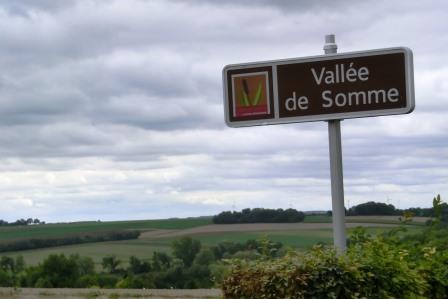
And the names of places can get confusing.  We wondered why the GPS kept telling us to go in the direction of Rijssel – until we saw that the French name for Rijssel was Lille!

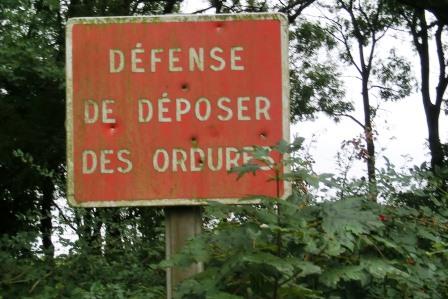
Then, just outside of Aubigny en Artois, we stopped at a parking spot off the highway, sort of like a rest stop but without any conveniences.  Pieter wanted to stretch his legs, but didn’t get very far when I saw a sign saying ‘Défense de déposer des ordures’.

CIMG8232

Memo to self… next time, bring a French-English dictionary! (Photo credit:  Pieter Valkenburg)

I saw the word ‘Défense’ and remembered all the stories about unexploded mines in the area.  While I had no idea what the rest of the sign said, I knew ‘Défense’ was a warning of some kind.  “Don’t go there”, I shouted, “it’s a mine field!”  Of course, Pieter paid no attention to me, and it wasn’t until we got to the hotel and I looked up the translation that we could laugh about it.  It says something along the lines of “Don’t dump your garbage”!

CIMG8234

We reach the village of Aubigny en Artois. (Photo credit:  Daria Valkenburg)

CIMG8258

Directions to the cemetery are clearly marked.  (Photo credit: Pieter Valkenburg)

CIMG8255

Entrance to the Aubigny Communal Cemetery.  The Extension is behind the cemetery, and has 2,771 Commonwealth burials from WWI and 7 from WWII.  There are 227 French burials prior to March 1916, and 64 German war graves. The original cemetery land was given to the commune of Aubigny in 1909 by former mayor Emile Delombre. (Photo credit:  Daria Valkenburg)

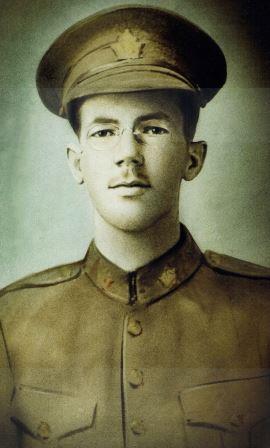
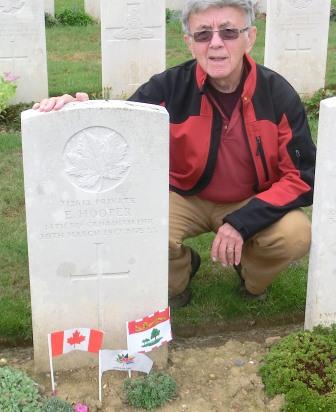
After the excitement of the parking spot sign, we finally reached the Aubigny Communal Cemetery Extension, and left the car to find the grave of Private Ellis Moyse HOOPER.  Hooper was born October 20, 1895 in Central Bedeque, son of Charles Frederick Allison Hooper and Bessie Marie nee Moyse.  Hooper enlisted in the 105th Battalion, C Company on March 4, 1916, and later transferred to the 14th Battalion of the Canadian Infantry. On March 30, 1917, he died at No. 30 Casualty Station of gunshot wounds to his leg and left arm.

Hooper, Ellis Moyse

Private Ellis Moyse Hooper.  (Photo credit:  Lana Churchill family collection)

CIMG8245

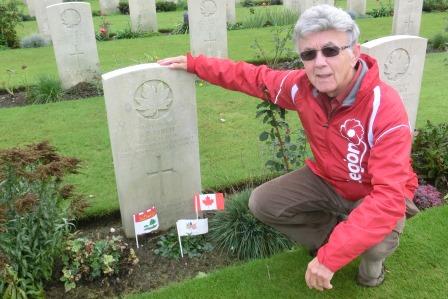
Right: Pieter by Hooper’s grave, after placing the flags of Canada, PEI, and Canada 150. (Photo credit:  Daria Valkenburg)

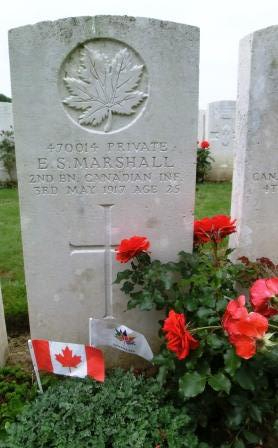
Hooper’s cousin, Ernest Shaw MARSHALL, of Ontario, who died May 3, 1917, is buried nearby.

cimg8246.jpg

Marshall’s grave was a few rows down from his cousin Hooper. (Photo credit:  Pieter Valkenburg)

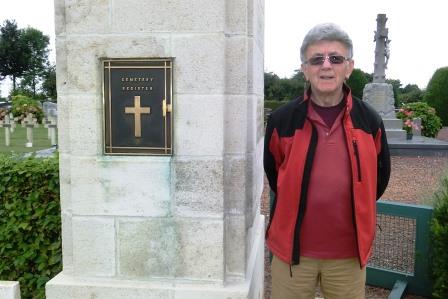
As we left the cemetery, which is very well kept, we signed the guest register book. Each of the Commonwealth cemeteries has a register listing each soldier’s burial location, and there is a guest register.  If you visit, don’t forget to sign the register yourself!

CIMG8254

The register is in a compartment on the pillar by the entrance to the cemetery.  (Photo credit:  Daria Valkenburg)

This special visit was a prelude to our next stop on the memorial trail, the Vimy Memorial.  Comments or stories?  You can share them by emailing us at memorialtrail@gmail.com or by commenting on this blog.

© Daria Valkenburg

….Want to follow our research?….

If you are reading this posting, but aren’t following our research, you are welcome to do so.  Our blog address: https://onthewarmemorialtrail.com/

Front cover OnTheWarMememorialTrailinEurope4 countries, 6 weeks, 7,000 km – an unforgettable war memorial journey in Europe…. Daria’s book ‘No Soldier Buried Overseas Should Ever Be Forgotten‘ is available in print and e-book formats.  Net proceeds of book sales help support research costs and the cost of maintaining this blog. For more information see https://nosoldierforgotten.com/ 

You are also invited to subscribe to our YouTube Channel: On The War Memorial Trail With Pieter Valkenburg: https://www.youtube.com/channel/UCJ591TyjSheOR-Cb_Gs_5Kw

Never miss a posting!  Subscribe below to have each new story from the war memorial trail delivered to your inbox.