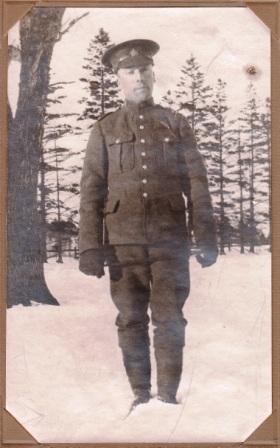
On The War Memorial Trail…..The WWI Signaller From Covehead Killed During The Battle Of Vimy Ridge

CIMG8269 Sep 5 2017 Pieter at entrance to Vimy Memorial Park

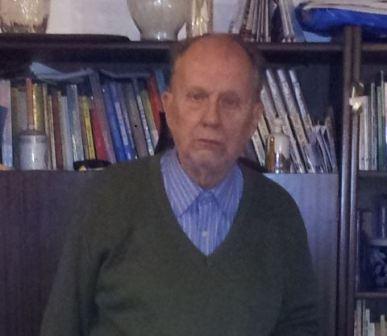
Pieter at the entrance to Vimy Ridge National Historic Site in France. We brought along a copy of the County Line Courier newspaper that publishes many of the stories about Island soldiers. (Photo credit: Daria Valkenburg)

June 14, 2023.  After visiting the Vimy National Memorial in France and having researched several soldiers who fought during the Battle of Vimy Ridge, we have an ongoing interest in learning more about those who fought in that battle on Easter Monday, April 9, 1917.

20230530_102553 Pieter and Connie

Pieter with Connie Paynter. (Photo credit: Daria Valkenburg)

…Two brothers from Covehead enlisted …

Therefore, when Connie Paynter of Summerside contacted us about a 20 year old relative who was killed in action at Vimy, we wanted to meet her. “…My grandfather and my great-uncle, who lived in Covehead, both served in WWI.  Only my grandfather, Lawrence Ivy Marshall, returned home…” she said.

Connie’s great-uncle, Merrill Augustus MARSHALL, was born on July 4, 1896 in Charlottetown, Prince Edward Island, the son of James Lawrence and Hattie Lillian (nee Carr) Marshall. 

When he enlisted with the 55th Battalion on May 1, 1915 in Charlottetown, he noted that he had served in the 82nd Regiment militia for a year, with the rank of Sergeant.  Before enlisting, he had worked on his father’s farm. 

20230530_100452 Merill Marshall from Connie

Merrill Augustus Marshall while serving with the 82nd Regiment, Canadian Militia.  (Photo courtesy of Connie Birt Paynter)

While he was in the 82nd Regiment Militia, Merrill was sent to Valcartier, Quebec, where his brother Lawrence was also stationed.   In an August 22, 1914 letter that Lawrence wrote to his mother from Valcartier, he noted that “…Merrill has the job of orderly so far.  He will do alright if he keeps that job all the time…

…Merrill was too young for active service …

However, as Merrill was underage for active service, he was soon on his way back home.  In a September 9, 1914 letter from Merrill to his mother, written from 12 Battalion, 3 Brigade, Valcartier, Quebec:  “…I will be home whenever we get the pay that is coming to us here. It will be 15 dollars.  We got seven dollars and 40 cents that was coming to us from town.  I am sending you 5 dollars this time.  I won’t be here very much longer now.  Our names are in for us to go home whenever we get our money given to us…

…Merrill soon re-enlisted! …

A few months later, he re-enlisted and arrived at Camp Sussex, New Brunswick on May 10, 1915.  After completing basic training he left Canada with the 55th Battalion on October 30 1915, aboard the RMS Corsican, which sailed from Montreal, Quebec. (See http://the-weatherings.co.uk/pccship0063.htm)

Merrill arrived at Devonport, England on November 9, 1915, and was sent to Bramshott Camp in Hants.

His brother Lawrence was also in England.  In a November 29, 1915 letter to his mother, written from Bramshott Camp, Lephook Hants, 55th Battalion, No 10 Company, UK, Merrill assured her that  “…I am well and having a good time… The drill isn’t half as hard as it was in Canada.  We have good food and a good hut to stay in …. Don’t have to sleep in tents and suffer with the cold.  Now we have a stove and lots of coal to burn so we are happy.  I am getting a pass to Leicester to see Lawrence day after tomorrow….

…Merrill trained to be a Signaller …

On April 8, 1916, Merrill was transferred from the 55th Battalion to the Canadian Signals Base with the 39th Reserve Battalion in West Sandling in the United Kingdom, where he trained to be a Signaller.  He would have encountered fellow Islander, John ‘Lymon’ WOOD of North Tryon, who arrived there on April 16, 1916 for the same training as a Signaller.

Signallers were responsible for military communications, providing commanders with information on where troops were, what they were doing, and whether supplies were sufficient. Communication was done using message-carrying pigeons, flags, and human runners. Some messages could be sent using Morse code or signalling lamps.  Signalling lamps were portable and aimed a focused beam of light at a receiving signaller. Light could be transmitted over long distances much faster and more safely than a runner exposed to enemy fire.

Merrill was transferred to the 6th Reserve Battalion in Shorncliffe on January 4, 1917.  His brother Lawrence, who had been in the French trenches and was back in England, showed concern in a January 29, 1917 letter to his father, written from Canadian Convalescent Hospital, Staff Hut A1, Wood Cote Park, Epsom, Surrey, England: “…Had a letter from Merrill yesterday. He is in Shorncliffe and having a good time of it.  I hope that it will only last the rest of the war and hope and pray that he never sees the trenches, because you have a pretty slim chance of getting back alive out there, and by the talk of things there is going to be harder fighting out there this spring than there has  been.  They are putting every man that’s fit out there this spring and try to make one big drive for the last time, but I don’t think that there is much use of doing it. Germany ain’t beat yet nor won’t be for a while…

…Merrill was sent to France in advance of the Battle of Vimy Ridge …

Lawrence was right to be worried, as on February 7, 1917, Merrill was transferred to the 21st Battalion in East Sandling.  The following day, he arrived at the Canadian Base Depot at Rouelles Camp in Le Havre, France.  A few days later he joined his unit, and on February 15, 1917 he was on the front line, as a Signaller, with the 21st Battalion in Thelus, near Vimy Ridge.

In a February 11, 1917 letter to his father, written from Canadian Convalescent Hospital, Staff Hut A1, Wood Cote Park, Epsom, Surrey, England, Lawrence asked “…Have you heard from Merrill since he went to France?  I have been expecting a letter from him the last week, but did not receive any.  He will find quite a difference over there to what he had in England, but still he will get a good job as he is a signaller.  He may never have to go into the trenches at all….

Then, in an April 16, 1917 letter from Lawrence to his mother, written from Canadian Convalescent Hospital, Staff Hut A1, Wood Cote Park, Epsom, Surrey, England he wrote that “…I had a letter from Merrill. He was fine when he wrote.  He said that it wasn’t too bad out there yet.  I only hope that he will come through it all safe and sound….” 

…Merrill lost his life during the Battle of Vimy Ridge …

Unfortunately, by the time Lawrence wrote his letter, Merrill was dead.  He had lost his life on Easter Monday, April 9, 1917, during the Battle of Vimy Ridge, killed during the advance on the Ridge.

Merrill was buried near where he fell.  His grave location was registered as being in ‘Thelus, near Neuville, St. Vaast, 4 ½ miles North North-East of Arras, France’.

… Merrill’s grave couldn’t be found …

However, years later, when what we know today as the Commonwealth War Graves Commission went to move the trench burials into cemeteries, his remains could not be located.  Continuous artillery fire over the next year and a half remaining in the war likely destroyed his grave and many others.

This happened to fellow Islander George Albert CAMPBELL, who was killed during the Battle of Mount Sorrel in Belgium, and buried in Maple Copse Cemetery, east of Zillebeke.  By the time the war ended, the cemetery had been destroyed and out of 256 named burials, only  26 could still be identified.  (See https://onthewarmemorialtrail.com/2017/12/08/two-campbell-brothers-in-ww1/)

Once it was determined that Merrill’s remains could not be found, his name was commemorated on the Canadian National Vimy Memorial.

Merrill is also remembered on his parents’ grave at St. James United Presbyterian Cemetery in Covehead, Prince Edward Island.

1571637_6 Memorial St James United Church PEI

Grave of Merrill Augustus Marshall’s parents at St. James United Presbyterian Cemetery in Covehead.  (Photo source: http://www.findagrave.com)

Thank you to Connie Paynter for providing a photo of Merrill, and sharing the letters written by her great-uncle and grandfather. 

If you have a story to tell, email Pieter at memorialtrail@gmail.com, comment on the blog, or tweet to @researchmemori1

© Daria Valkenburg

… Previous postings about soldiers who fought during the Battle of Vimy Ridge and our visit to the Vimy National Memorial….

…Want to follow our research?…

Follow our blog

If you are reading this posting, but aren’t following the blog, you are welcome to do so. Our blog address: https://onthewarmemorialtrail.com/.
Front cover OnTheWarMememorialTrailinEurope4 countries, 6 weeks, 7,000 km – an unforgettable war memorial journey in Europe…. Daria’s book ‘No Soldier Buried Overseas Should Ever Be Forgotten‘ is available in print and e-book formats.  Net proceeds of book sales help support research costs and the cost of maintaining this blog. For more information see https://nosoldierforgotten.com/

You are also invited to subscribe to our YouTube Channel: On The War Memorial Trail With Pieter Valkenburg: https://www.youtube.com/channel/UCJ591TyjSheOR-Cb_Gs_5Kw

Never miss a posting!  Subscribe below to have each new story from the war memorial trail delivered to your inbox.

The WWI Names On The Cenotaph Have Stories Of Their Own

February 8, 2020. Recently, Pieter and a friend went to see the British WW1 movie ‘1917’, which is nominated for several Oscars and has a Canadian connection due to a map used in the film.  (For that story see https://www.cbc.ca/news/entertainment/1917-canadian-contribution-1.5450608)  The story takes place in France on April 6, 1917, and is about two men tasked with delivering a message to another unit to warn of a German ambush.  The men go through several towns and villages in France’s Western Front.  Canadians may remember this period as being the lead up to the Battle of Vimy Ridge on April 9, 1917.

Pieter found the movie of great interest for several reasons. It was a depiction of the horrors of war… without being overly gory.  After being through the trenches and tunnels in Vimy Ridge a few years ago, he was intrigued to see the way soldiers sat on either side of a trench while waiting to go up into battle.   But the main reason he liked the movie is that it told the story of two people.

Contrary to what we learn in history books and classes, in the end all history is the cumulative stories of individuals.  A list of names on a cenotaph, such as the one outside the Borden-Carleton Legion, is meaningless without knowing who those people were and what happened to them.  This is what started Pieter on the journey to uncover the stories behind the names on the Cenotaph.

Over the years, the stories of those from WWI have been told in this blog.  24 are listed on the Cenotaph and half of them died in France…. Patrick Raymond ARSENAULT and John Lymon ‘Ly’ WOOD are listed on the Vimy Memorial as their bodies were never identified.    Also killed in France were Kenneth John Martin BELL, James CAIRNS, James Ambrose CAIRNS, Arthur Leigh COLLETT, Bazil CORMIER, Patrick Phillip DEEGAN (DEIGHAN), Joseph Arthur DESROCHES, Percy Earl FARROW (FARRAR), Ellis Moyse HOOPER, and Charles W. LOWTHER.  We were at the Vimy Memorial and visited each grave.

Five men died in Belgium. Two are listed on the Menin Gate Memorial in Ypres, as their bodies were never identified: Charles Benjamin Murray BUXTON and George Albert CAMPBELL.  We visited Menin Gate and the area where they died.  We also visited the graves of James Lymon CAMERON, Vincent Earl CARR, and Arthur Clinton ROBINSON.

Vincent Carr, who died during the Battle of Passchendaele on October 30, 1918, was initially buried in a trench with 4 others – two Canadian and two British soldiers.  Decades later, when they were reburied in a Commonwealth War Graves Commission cemetery, all three Canadians were still identifiable.  The British Army’s cardboard identity ‘tags’ had disintegrated, leaving the two British soldiers as unidentified.  Today, DNA testing can be done to help with identity, but decades ago this was impossible.

Two men died in England.  John Goodwill HOWATT was wounded in France, and died in a British hospital.  Bruce Sutherland McKAY had gotten ill during the transport from Canada to England and also died in a British hospital.

Henry Warburton STEWART survived the war, only to fall ill while in Germany as part of the occupation forces.  He’s buried in a German cemetery in Cologne, which we visited.

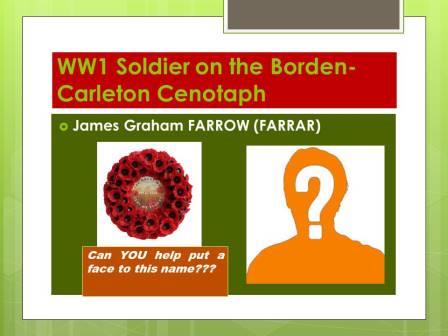
James Graham FARROW (FARRAR) was not a soldier, but in the Merchant Navy, transporting vital supplies between England and France, when his ship was torpedoed by a U-boat.

Three men died on Canadian soil.  Leigh Hunt CAMERON died of illness, while Harry ROBINSON died from blood poisoning.  William Galen CAMPBELL was poisoned with mustard gas on May 28, 1918, a few months before the end of the war, but was able to return home.  And yes, we’ve visited those graves as well.

We were also able to tell you parallel stories, such as that of Clifford Almon WELLS, who had many of the same experiences as John Lymon Wood, and also died in France. Another story was that of George BRUCKER, of the German Army, who was taken prisoner during the Battle of Vimy Ridge, and survived the war, never forgetting the two ‘tall’ Canadians who didn’t shoot him.  Decades later his son, now in his 80s, is still hoping to thank the families of those two unknown men.

Thanks to Pieter’s curiosity in trying to find out why one Commonwealth War Graves Commission gravestone in a cemetery in Cape Traverse was not recorded on the Cenotaph, we were able to tell you the story of Elmyr KRUGER, a soldier from Saskatchewan who died of illness while guarding German prisoners of war from a POW camp in Amherst.

We’ve told the stories of each man, and shared our visits to the various cemeteries and war memorials.  As photos and letters came in, we shared those experiences as well.

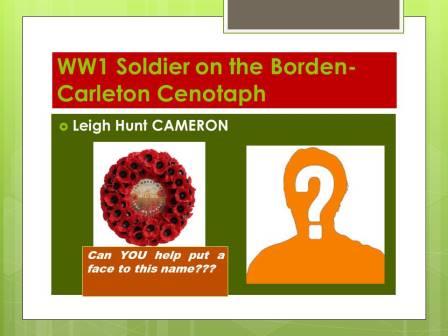
We are still missing photos of several of these soldiers, so the quest to put a face to every name and story is still ongoing.  Who are we missing?  Take a look and see if you can help:

Slide6

Slide8

Slide9

Slide10

Slide13

Slide15

Slide16

Slide20

Slide22

Slide23

UPDATE:  Photos of James Cairns, Joseph Arthur Desroches, and Harry Robinson have been found!

It’s great to watch a movie about fictional characters, but let’s not forget the stories of real life people! There won’t be any Academy Awards given out, but they will be remembered. Research continues to uncover more stories.  If you have a story or photo to share about any of the names mentioned in this posting, please contact Pieter at memorialtrail@gmail.com or comment on the blog.

© Daria Valkenburg

....Want to follow our research?…

If you are reading this posting, but aren’t following our research, you are welcome to do so.  Our blog address: https://onthewarmemorialtrail.com/

4 countries, 6 weeks, 7,000 km – an unforgettable war memorial journey in Europe…. Daria’s book ‘No Soldier Buried Overseas Should Ever Be Forgotten‘ is available in print and e-book formats.  Net proceeds of book sales help support research costs and the cost of maintaining this blog. For more information see https://nosoldierforgotten.com/

Subscribe to our YouTube Channel: On The War Memorial Trail With Pieter Valkenburg: https://www.youtube.com/channel/UCJ591TyjSheOR-Cb_Gs_5Kw

Never miss a posting!  Subscribe below to have each new story from the war memorial trail delivered to your inbox.
On The War Memorial Trail….. Luck and Humanity During the Battle of Vimy Ridge

September 29, 2018.  Over the past few years, as the stories of the men on the Cenotaph outside the Borden-Carleton Legion are researched by Pieter, the level of death, destruction, and hatred from war is incomprehensible.  If you travel through any of the WWI and WWII sites in Europe, you see memorials and cemeteries.  In Normandy, France it seems as though there is a reminder of the war dead around every corner.

In a kill or be killed environment of war, survival was a luck of the draw.  In April 2017, the County Line Courier published ‘Two Unsung Heroes of Vimy Ridge’, a story about two soldiers on the Cenotaph whose names are listed on the Vimy National Memorial in France, Patrick Raymond ARSENAULT and John ‘Lymon’ WOOD. (See Learning About The Two Names On The Vimy Memorial) After this article was published, we were contacted by Ralf Gräfenstein of Berlin, Germany, who is helping the son of a WWI German soldier determine what happened at Vimy Ridge.

photo of Ernesto

Ernesto Brucker of Buenos Aires, Argentina.

Ernesto Ricardo Brucker, now in his 80s, who lives in Buenos Aires, Argentina, is hoping to find the Canadians who took his father prisoner during the Battle of Vimy Ridge, so he could thank them for saving his father’s life and not killing him when he surrendered.

Because of the actions of two unknown ‘tall’ Canadians, Brucker survived the Battle of Vimy Ridge and spent the remainder of the war in a Prisoner of War camp in Skipton, England.  According to the Skipton documents, he was taken prisoner between Thélus and Bailleul-Sir –Berthoult, 4.4 km south-east of Thelus.

Jorge Brucker Skipton

Georg (Jorge) Brucker at Skipton POW Camp in England. (Photo courtesy of E. Brucker)

Not only were 3,400 Germans were taken prisoner on April 9, 1917, but there were 4 Canadian Divisions involved in the battle. Could we find out how Brucker became a prisoner of war?

Georg (later known as Jorge) BRUCKER was born November 2, 1896 in Erlangen, Germany, and 18 years old when WWI started.  He joined the army and was sent to Poland, then to France.  During the Battle of Vimy Ridge, he was the Lieutenant in charge of a platoon in Machine Gun Company 1 of the Royal Bavarian Reserve Infantry Regiment I in Thélus.  They had been in the Arras area since October 1914 and held the villages of Thélus, Bailleul and the southern slope of the ridge.

On April 9, 1917, the 1st Canadian Division, under the command of Major General Arthur Currie, faced the 1st Bavarian Reserve Division, under the command of General of the Infantry Karl von Fassbender, halfway between the villages of Thélus and Bailleul-Sir –Berthoult. The 1st Canadian Division was stretched along a front of about two kilometres, with six battalions. The furthest from Vimy Ridge, they had some four kilometres of battlefield to cross in order to reach it!

Initial attack by 1st Cdn Division

Initial attack by the 1st Canadian Division (Source: http://www.webmatters.net/txtpat/index.php?id=1497)

The 13th Machine Gun Company was attached to the 1st Canadian Division in order to support the Infantry Brigades.  This is the unit that Patrick Raymond ARSENAULT was in. Was it a twist of irony that both Arsenault and Brucker were in Machine Gun Companies – on opposing sides?  Unlike Brucker, Arsenault lost his life in a shell attack on April 9, sometime around 7 am.  His body was never recovered.  Either he was buried in an unknown grave, or the shell attack scattered his body parts, making identification impossible.

John ‘Lymon’ WOOD was also in the 1st Canadian Division, as a member of the 2nd Canadian Battalion (Eastern Ontario Regiment), which was part of the 1st Canadian Infantry Brigade during the Battle of Vimy Ridge.  Wood survived the Battle of Vimy Ridge, but his luck ran out on May 3, 1917, when he was killed in action during the Battle of Arras.

Left: Patrick Raymond Arsenault in 1916 in Summerside.  (Photo courtesy of Paul Arsenault collection)  Right: John Lyman Wood shortly after enlistment in October 1915.  (Photo courtesy of Gene Rogerson collection)

Dr. Jack Sheldon researched and translated German reports from the battle.  In his 2008 book “The German Army on Vimy Ridge 1914-1917”, he recorded a description made by Brucker’s Commanding Officer, Major Meyer of the 1st Battalion Reserve Infantry Regiment:

“…At 5:30 am on 9 April enemy drum fire, supplemented by machine gun fire, came down.  It was impossible to make out the position and in fact it was almost impossible to make out signal flares amidst the clouds of smoke and dirt thrown up by the shells.  At 6:30 am heavy small arms fire could be heard and, at that moment, a message was sent by light signal to the rear.  ‘Heavy enemy attack.’  About half an hour later the wounded Muketier Hangemann happened to pass Battalion Headquarters, reporting that the British (meaning the Canadians) had overrun the right flank of 1st Bavarian Reserve Division and had then attacked our battalion in great strength from the left and rear….

In the final attack, the 1st Brigade, which John ‘Lymon’ Wood was part of, passed through the other two Brigades while the artillery dropped thousands of rounds.  As the attack began again, the wind started to turn, blowing snow and smoke from the burning village of Thélus into the faces of the Bavarians. This helped to hide the approaching Canadians, who encountered little resistance. By 1 pm the battle was over.

It’s not clear at which point Brucker was taken prisoner, but most likely it happened by 11:30 am at the latest, based on reports by Major Meyer, as recorded in Dr. Jack Sheldon’s book “The German Army on Vimy Ridge 1914-1917”:  “…Not until 11:30 am, when all the grenades had been thrown and there was no longer any prospect of timely relief, did the remainder of the garrison decide, reluctantly, to surrender...

In the book, ‘The History of the 2nd Canadian Battalion (East. Ontario Regiment) Canadian Expeditionary Force in the Great War 1914-1919’ by Colonel W. W. Murray, he records an account of the capture of German machine gunners in the morning.  “The Scouts found considerable work.  Ptes I. F. Wismer and J.F. Harrison performed a particularly daring feat near the Loen Weg.  Working in advance of No. 1 Company, they observed an enemy machine gun coming into action against the Fourth.  Pushing forward, they secured the gunner, an officer.  The pair then descended into an adjacent dug-out and forced the surrender of three more officers and four men, together with the gun…”  Were these the two Canadians who captured Georg Brucker?  It’s unlikely we’ll ever know.

At the end of the day, the 1st Division had crossed four kms of battlefield, captured 2,500 prisoners, 40 machine guns and 27 cannons at a cost of 2,500 of their own men killed or injured.  Wood survived, Arsenault died, and Brucker was taken prisoner.

Many people today may be wondering why so many German prisoners of war were allowed to surrender during the battle, and not simply killed.  In his 1986 book ‘Vimy’, author Pierre Berton gives a reason why not every Canadian soldier saw the German army as ‘the enemy’:  “…Letters and wartime reminiscences suggest that the Canadians often resented their own brass more than they disliked the grey-clad German.  You shot at him because he was shooting at you, but it wasn’t a personal matter.  He too was walling in the mud, only a few yards away….

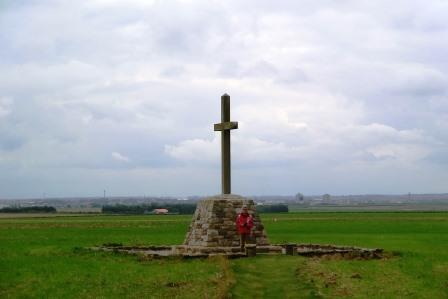
Today, a memorial to the 1st Canadian Division sits in a farmer’s field, marking the Canadian and German front lines on April 9, 1917, on the road between Thélus and Bailleul-Sir –Berthoult.  Somewhere along this line is the spot where Brucker’s last moments of WWI before becoming a prisoner of war played out.

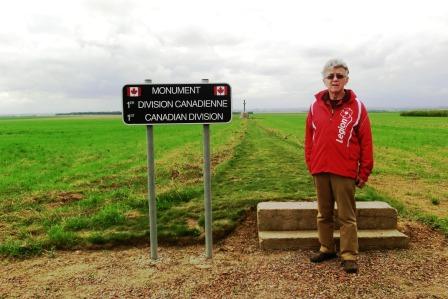
CIMG8314 Sep 5 2017 Pieter by sign directing you to Memorial to 1st Cdn Division

Line in farmer’s field, halfway between Thélus and Bailleul-Sir –Berthoul, marks the front line where German and Canadian troops faced each other on April 9, 1917. (Photo credit: Daria Valkenburg)

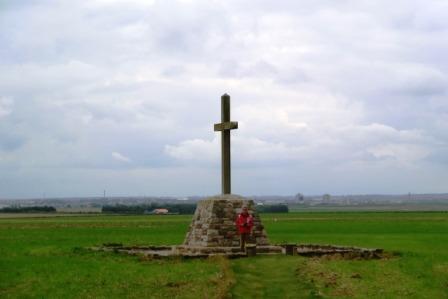
CIMG8318 Sep 5 2017 Memorial to 1st Cdn Division halfway betwen Thelus & Bailleul

Memorial honouring the 1st Canadian Division in farmer’s field, halfway between Thélus and Bailleul-Sir –Berthoul, along the line where German and Canadian troops faced each other on April 9, 1917. (Photo credit: Daria Valkenburg)

After two years in Skipton, Brucker was sent to a Military Camp in Lockstedt, Germany in October 1919, and went on to work in a bank in Bavaria. He was sent on a secondment for one year to Argentina, where he met his wife.  They married in 1923 and he stayed in Argentina until his death on December 26, 1984.

Although we were unable to give Ernesto a complete answer of who to thank for saving his father’s life, we did find out the approximate area where he became a prisoner of war, surrendering to a regiment of the 1st Canadian Division (For a list of the regiments in the 1st Canadian Division see https://en.wikipedia.org/wiki/Battle_of_Vimy_Ridge_order_of_battle.) Georg Brucker was very lucky to have surrendered to soldiers who showed humanity, not revenge.

If you can add to this story, have photos or information to share on soldiers from the Cenotaph outside the Borden-Carleton Legion, or soldiers buried in The Netherlands, please let us know. You can share them by sending an email to memorialtrail@gmail.com or by commenting on this blog.

© Daria Valkenburg

….Want to follow our research?….

If you are reading this posting, but aren’t following our research, you are welcome to do so.  Our blog address: https://onthewarmemorialtrail.com/

Front cover OnTheWarMememorialTrailinEurope4 countries, 6 weeks, 7,000 km – an unforgettable war memorial journey in Europe…. Daria’s book ‘No Soldier Buried Overseas Should Ever Be Forgotten‘ is available in print and e-book formats.  Net proceeds of book sales help support research costs and the cost of maintaining this blog. For more information see https://nosoldierforgotten.com/ 

You are also invited to subscribe to our YouTube Channel: On The War Memorial Trail With Pieter Valkenburg: https://www.youtube.com/channel/UCJ591TyjSheOR-Cb_Gs_5Kw

Never miss a posting!  Subscribe below to have each new story from the war memorial trail delivered to your inbox.

On The War Memorial Trail….Monuments In and Around Thélus

September 20, 2017.  When we first entered the town of Thélus on our way to Vimy Ridge, we passed by the Canadian Artillery Memorial, built to remember the sacrifice of Canadians from Artillery battalions who died in the battle for Vimy Ridge and the surrounding area.

When we were at the Vimy Ridge Visitors Centre, we saw a large photograph of this monument, taken when it was actually dedicated during the war.  The monument was built on top of a dugout.  The steps leading up to the monument marks the original entrance to the dugout.  The monument was unveiled by General Currie on April 9, 1918, a year after the Battle of Vimy Ridge.

IMG_20170905_112407215 Sep 5 2017 Photo of Cdn Artillery Memorial in Thelus at Vimy Visitors Centre

Photo of the Canadian Artillery Memorial as it was unveiled in Thélus on April 9, 1918. (Photo taken by Pieter Valkenburg of a panel at Vimy Ridge Visitors Centre)

After learning about the monument at the Visitors Centre, we made a stop to see the real one.

CIMG8308 Sep 5 2017 Pieter at Cdn Artillery Memorial in Thelus

Pieter at the Canadian Artillery Memorial in Thélus. The shell shaped columns surrounding the monument have actual fuses from shells attached to their tops! (Photo credit: Daria Valkenburg)

IMG_20170905_121853669 Sep 5 2017 Inscription on Cdn Artillery Memorial in Thelus

The inscription reads “Erected in memory of officers, non-commissioned officers and men of the Canadian Corps Artillery who fell during the Vimy operations April 1917.” This is followed by the units: Canadian Field Artillery, Canadian Garrison Artillery, Royal Field Artillery, Royal Garrison Artillery and the South African Heavy Artillery. (Photo credit: Pieter Valkenburg)

CIMG8303 Sep 5 2017 Rue des Artilleurs Canadiens in Thelus

The road leading out of Thélus towards Bailleul Sir Berhoult is called Rue des Artilleurs Canadiens (Street of the Canadian Artillery). (Photo credit: Daria Valkenburg)

CIMG8304 Sep 5 2017 Sign directions across from Cdn Artillery Memorial in Thelus

Across from the Canadian Artillery Monument is a sign leading to Bailleul Sir Berthoult. (Photo credit: Daria Valkenburg)

We then followed the road between Thélus and Bailleul Sir Berthoult.  Only 4 km separate these two towns, but it was the scene of much fighting on April 9, 1917 during the Battle of Vimy Ridge.

Not far down the road was a monument to the people of Thélus who perished during two world wars, a vivid reminder that not only soldiers are war casualties.

cimg8310-sep-5-2017-monument-to-thelus-war-dead-in-two-world-wars.jpg

Thélus memorial to its war dead in two world wars. (Photo credit: Daria Valkenburg)

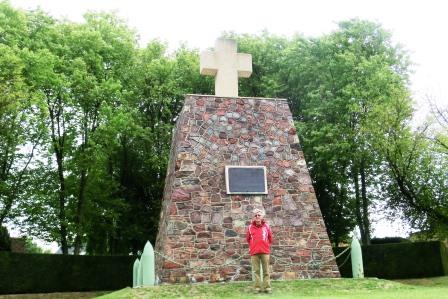
Halfway between the two towns, in a farmer’s field, is a memorial to the First Canadian Division, on the spot where they were opposite the First Bavarian Reserve Division.  By April 9, 1917 there wasn’t much left of the villages!

CIMG8314 Sep 5 2017 Pieter by sign directing you to Memorial to 1st Cdn Division

Pieter by the sign leading across a farmer’s field to the 1st Canadian Division Monument, about halfway between Thélus and Bailleul Sir Berthoult. (Photo credit: Daria Valkenburg)

We stopped at this monument to honour John ‘Lymon’ WOOD and Patrick Raymond ARSENAULT, both of whom were in the 1st Canadian Division during the Battle of Vimy Ridge, and whose names are inscribed on the Vimy Memorial.

After an article about these two men was published in the County Line Courier in April 2017, we heard from a Ernesto Brucker of Buenos Aires, Argentina, who noted that his father, Georg BRUCKER, had been part of the First Bavarian Reserve Division and had been captured as a prisoner of war on April 9, 1917, likely at or very near this exact spot.

CIMG8318 Sep 5 2017 Memorial to 1st Cdn Division halfway betwen Thelus & Bailleul

Pieter at the 1st Canadian Division Monument, about halfway between Thélus and Bailleul Sir Berthoult. (Photo credit: Daria Valkenburg)

IMG_20170905_123258340 Sep 5 2017 inscription on memorial to 1st Cdn Division

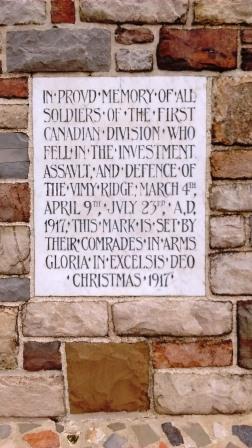
Inscription on the 1st Canadian Division Monument, about halfway between Thélus and Bailleul Sir Berthoult. (Photo credit: Pieter Valkenburg)

CIMG8316 Sep 5 2017 lone poppy along path leading to memorial to 1st Cdn Division outside Thelus

A lone poppy was growing on the path towards the 1st Canadian Division Monument, about halfway between Thélus and Bailleul Sir Berthoult. (Photo credit: Daria Valkenburg)

In the next blog entry we continue to visit the cemeteries in France where soldiers on the Borden-Carleton Cenotaph are buried.  Comments or stories?  You can share them by emailing us at memorialtrail@gmail.com or by commenting on this blog.

© Daria Valkenburg

….Want to follow our research?….

If you are reading this posting, but aren’t following our research, you are welcome to do so.  Our blog address: https://onthewarmemorialtrail.com/

4 countries, 6 weeks, 7,000 km – an unforgettable war memorial journey in Europe…. Daria’s book ‘No Soldier Buried Overseas Should Ever Be Forgotten‘ is available in print and e-book formats.  Net proceeds of book sales help support research costs and the cost of maintaining this blog. For more information see https://nosoldierforgotten.com/ 

You are also invited to subscribe to our YouTube Channel: On The War Memorial Trail With Pieter Valkenburg: https://www.youtube.com/channel/UCJ591TyjSheOR-Cb_Gs_5Kw

Never miss a posting!  Subscribe below to have each new story from the war memorial trail delivered to your inbox.

WWI Soldier Private Patrick Raymond Arsenault Uncovered

CIMG7870 Pieter Valkenburg and Paul Arsenault Great Nephew of P.R. Arsenault.JPG

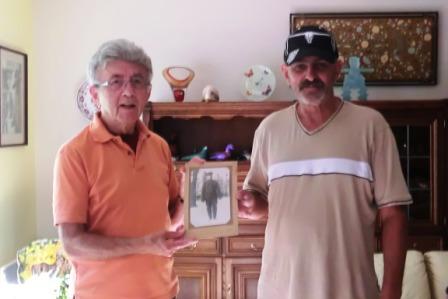
Photo: Pieter with Paul Arsenault and a photo of Patrick Raymond Arsenault.  (Photo credit: Daria Valkenburg)

August 7, 2017. With the 100th anniversary of the end of WWI coming up in 2018, Pieter has been actively searching for photos of the men listed on the Cenotaph who died during WW1 as he would like to have a Wall of Remembrance in the Legion.

Private Patrick Raymond ARSENAULT, who was born in Bedeque on October 14, 1896 to Joseph Arsenault and Isabella nee Richard, is one of the two men on the Cenotaph whose names are on the Vimy Memorial in France.

In the lead-up to the centenary of the Battle of Vimy Ridge in April, his story was told in newspapers, and in a French language interview on CBC Radio-Canada given by Don Arsenault.  More coverage was given in the Journal Pioneer (see http://www.journalpioneer.com/news/local/2017/4/9/special-day-of-remembrance-for-bedeque-soldier.html ) and La Voix Acadienne following the commemoration ceremonies at the Legion in April. (See http://www.lavoixacadienne.com/index.php/patrimoine/1756-des-soldats-a-vimy-sont-honores.)  Unfortunately, up to that time, no family had been found, and no photo was available.

On Saturday, August 5, Paul Arsenault of Borden-Carleton, great-great-nephew of Arsenault, contacted Pieter to say he had a photo of his great-great-uncle after his aunt, Eileen Perry, showed him an article about Arsenault in the County Line Courier (See CLC Apr 5 2017 p9 Two Unsung Heroes of Vimy Ridge).  …I found the photo in a chest that my mother Noreen had saved from her mother…” he said.  Noreen and Eileen are the granddaughters of Private Arsenault’s sister Mary Ethel Gaudet.

Patrick Raymond Arsenault from Paul Arsenault.jpg

Photo: Patrick Raymond Arsenault in 1916 in Summerside.  (Photo courtesy of Paul Arsenault collection)

It’s wonderful when family members are willing to help in the Cenotaph Research Project! Thank you Paul!  Readers, do you have more information on Patrick Raymond Arsenault?  Let us know by commenting on this blog, or email Pieter at memorialtrail@gmail.com.

See related article published on August 9, 2017  CLC p30 Aug 9 2017 Face for Arsenault

© Daria Valkenburg

….Want to follow our research?….

If you are reading this posting, but aren’t following our research, you are welcome to do so.  Our blog address: https://onthewarmemorialtrail.com/

Front cover OnTheWarMememorialTrailinEurope4 countries, 6 weeks, 7,000 km – an unforgettable war memorial journey in Europe…. Daria’s book ‘No Soldier Buried Overseas Should Ever Be Forgotten‘ is available in print and e-book formats.  Net proceeds of book sales help support research costs and the cost of maintaining this blog. For more information see https://nosoldierforgotten.com/ 

You are also invited to subscribe to our YouTube Channel: On The War Memorial Trail With Pieter Valkenburg: https://www.youtube.com/channel/UCJ591TyjSheOR-Cb_Gs_5Kw

Never miss a posting!  Subscribe below to have each new story from the war memorial trail delivered to your inbox.