October 18, 2023. Last fall we visited the war memorial in Saulnierville, Nova Scotia, as two soldiers that Pieter had researched are listed on this monument. Coincidentally, both are buried in the Canadian War Cemetery in Holten. At the time of our visit, we’d told the story of one of the soldiers, but not the other. (See https://onthewarmemorialtrail.com/2022/11/09/on-the-war-memorial-trail-the-importance-of-remembrance/)
This second soldier was Joseph ‘Edmond’ ROBICHEAU, from Meteghan, Nova Scotia, who lost his life on April 14, 1945 near Deventer, The Netherlands, while serving with the Royal 22e Regiment.
Born November 16, 1923 in Meteghan, Edmond was the son of Césaire and Vitaline Robicheau. When he enlisted at the No. 6 National Resources Mobilization Act (NRMA) Clearing Depot in Halifax, Nova Scotia, on August 18, 1943, he noted that he had worked as a fisherman for 2 years and had served in the 2nd Battalion West Nova Scotia Infantry (Reserve) since October 1942. (See https://en.wikipedia.org/wiki/National_Resources_Mobilization_Act)
…A photo of Edmond was found in Saulnierville…
Although Edmond had 3 brothers and 4 sisters, Pieter was not able to find any family members during the photo search. This unfortunately happens more often than you’d think. A photo was found through a nearby resident, Ann Louise Doucet, who explained that “…the photo is located at the Clare Veterans Association…” in Saulnierville, Nova Scotia, “… so I would credit them as there is no name on the photo…”

Joseph ‘Edmond’ Robicheau. (Photo source: Clare Veterans Association)
… Edmond served in the Coast Battery and home defence…
On September 17, 1943, Edmond was sent to No. 61 Canadian Army Basic Training Centre (CABTC) in New Glasgow, Nova Scotia for training as a gunner. After completing his basic training, he was attached to A23 Training Centre in Halifax, Nova Scotia on November 16, 1943. A23 was a Coast and Anti-Aircraft Artillery Training Centre established to train coast and anti-aircraft gunners.
On March 11, 1944, Edmond was transferred to the 16th (C) Regiment of the Royal Canadian Artillery and sent to Sydney, Nova Scotia. Not long afterwards, on April 26, 1944, he was assigned to the 104th Coast Battery of the Royal Canadian Artillery and posted to Shelburne, Nova Scotia.
The 104th Coast Battery was garrisoned at Fort McNutt on McNutt’s Island, as coastal defence to protect the port of Shelburne. The threat of German submarine activity was a concern. This is why Shelburne had been designated as an alternate port to Halifax Harbour during the war.
On September 7, 1944, Edmond transferred to the Royal Regiment of Canada, and sent for a 4 day tactical training course at the Special Infantry Training Camp in Vernon, British Columbia on September 27, 1944.
On October 1, 1944, Edmond was attached to the 1st Battalion Oxford Rifles, part of the Royal Regiment of Canada, which served in Canada in a home defence role as part of the 16th Infantry Brigade, 8th Canadian Division.
… Edmond left Canada for overseas service in January 1945…
On January 2, 1945, Edmond was among the soldiers of the 1st Battalion Oxford Rifles who left Canada for the United Kingdom, arriving on January 8, 1945. The Battalion was disbanded on January 10, 1945 to provide reinforcements for the First Canadian Army.
Edmond was assigned to No. 6 Canadian Infantry Training Regiment (CITR) upon arrival, for further training, then to No. 4 Canadian Infantry Training Regiment (CITR) on February 4, 1945.
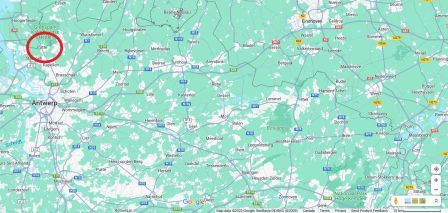
Putte, Belgium is near the Dutch border. (Map source: Google maps)
On March 9, 1945 he was sent to North West Europe as part of the X-4 reinforcement troops of the 21st Army Group. Then, on April 2, 1945 he was transferred to the Royal 22e Regiment (also known as the Van Doos), joining them while they were in Putte, Belgium.
In the Regimental history, ‘The Royal 22e Regiment’, author Serge Bernier records that “…on April 4, the regiment made an incursion into the Reichswald, near Clèves, which the Canadians had recently liberated at considerable cost...” Clèves (Kleve in English) is just over the Dutch border in Germany.
After a few days, the Regiment made its way back into The Netherlands. “…On the 10th the Royal 22e left the sector, passing through Clèves and Emmerich, before moving into eastern Holland, and stopping near Zutphen. On the 13th it crossed the Yssel to take up a position in a bridgehead that the 3rd Brigade would use as a base to attack the town of Appeldoorn....” Yssel refers to the IJssel River in The Netherlands.
… Edmond lost his life during the Battle of the Five Woods…
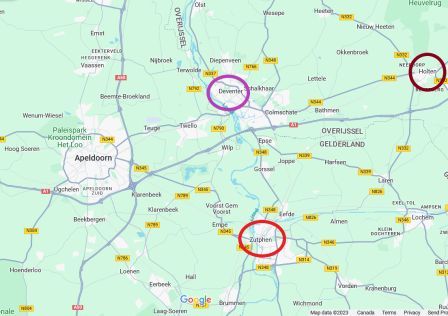
The locations in The Netherlands where the Royal 22e Regiment for April 1945, where Robicheau was initially buried and where he is permanently buried. (Map source: Google maps)
The next day, April 14, 1945, the Regiment received a change in plans. “… The WNSR and the CYR were the first to leave, closely followed by the Royal 22e, but at 7:30 am the regiment received orders to capture a well-defended wooded area....” WNSR refers to West Nova Scotia Regiment. CYR refers to Carleton & York Regiment.
This was the Battle of the Five Woods. “…Assisted by tanks, the companies performed mopping-up operations in the sector for 24 hours. The assignment proved costly: 11 men were reported killed, 19 wounded and two missing…” Among those who lost their lives that day was Edmond Robicheau.
…Edmond is buried in the Canadian War Cemetery in Holten…
He was initially buried in a temporary cemetery near Deventer, before being reburied in the Canadian War Cemetery in Holten, The Netherlands in 1946.
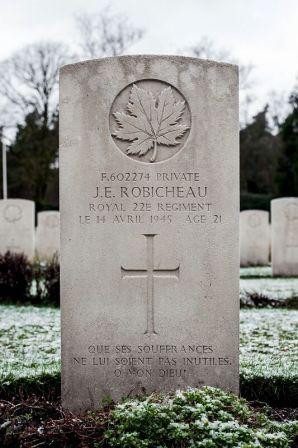
Grave of Joseph ‘Edmond’ Robicheau. (Photo source: Canadian Virtual War Memorial)
Thank you to Ann Louise Doucet for sending a photo of Joseph Robicheau. Thank you also to David (dryan67) from the WW2Talk Forum for sharing information from the Royal 22e Regimental history. If you have a story to tell, please let Pieter know. You can email him at memorialtrail@gmail.com, comment on the blog, or send a tweet to @researchmemori1.
© Daria Valkenburg
…Want to follow our research?….
If you are reading this posting, but aren’t following the blog, you are welcome to do so. Our blog address: https://onthewarmemorialtrail.com/
 4 countries, 6 weeks, 7,000 km – an unforgettable war memorial journey in Europe…. Daria’s book ‘No Soldier Buried Overseas Should Ever Be Forgotten‘ is available in print and e-book formats. Net proceeds of book sales help support research costs and the cost of maintaining this blog. For more information on the book, please see https://nosoldierforgotten.com/
You are also invited to subscribe to our YouTube Channel: On The War Memorial Trail With Pieter Valkenburg: https://www.youtube.com/channel/UCJ591TyjSheOR-Cb_Gs_5Kw.
Never miss a posting! Subscribe below to have each new story from the war memorial trail delivered to your inbox.
 On The War Memorial Trail Research Project........ with Pieter and Daria Valkenburg