April 12, 2024. One of the biases faced by many soldiers during the war was the perception that an excellent education would result in an intelligent and capable leader of those in battle. This was not always the case, unfortunately, and often an otherwise obvious candidate for promotion into an officer rank was not chosen, solely based on his early educational background.
In researching the story of Joseph Taylor MACLEOD of Barney’s River, Nova Scotia, Pieter encountered a well-respected, capable, and intelligent man, who was rightfully promoted several times. However, due to having left school after completing Grade 5, he did not rise as high in rank as he might have if he had been a high school graduate. What he did achieve during his military service is a testament to what can happen when promotions are based on merit.
….Joseph enlisted with The Pictou Highlanders….
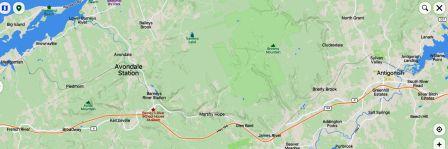
Map shows Avondale Station, Nova Scotia, where Joseph Taylor MacLeod was born. (Map source: http://www.mapcarta.com)
Born November 11, 1914 in Avondale Station, Pictou County, Nova Scotia, Joseph Taylor MACLEOD was the son of Robert and Ella Margaret MacLeod. He was the youngest in his family and had 5 brothers and 1 sister. Two of his brothers also served during WWII.
When Joseph enlisted with The Pictou Highlanders in Mulgrave, Nova Scotia on August 5, 1940, he was married and living in Barney’s River, Nova Scotia. He had left school at age 13, after completing Grade 5, and was working as a tallyman in a sawmill for Robert Gillis. He’d also worked as a truck driver for his father, a butcher, for several years.
His Personnel Selection Record noted that Joseph enjoyed playing baseball, hockey, and softball, and liked to read about history.
….Joseph’s son Cyril provided a photo….
On September 10, 1935, Joseph had married Irene Elizabeth McGregor and they had 4 children. One son, Cyril Raymond, kindly provided a photo of his father when Pieter contacted him.

Joseph Taylor MacLeod. (Photo courtesy of Cyril MacLeod)
….Joseph was in the Intelligence Section of The Pictou Highlanders….
After completing basic training, Joseph took advantage of training opportunities, such as a chemical warfare course in January 1941 in Long Branch, Nova Scotia. He qualified as a Motorcyclist Class III on May 5, 1941. On October 6, 1941, he was promoted to Lance Corporal, and was assigned to the Intelligence Section under Major Manning, Intelligence Officer for The Pictou Highlanders, in Dartmouth, Nova Scotia.
A month later, he was promoted to Lance Corporal, and then, in April 1942 to Corporal. On June 1, 1942 he was promoted again, to Lance Sergeant. All this time he worked in the Intelligence Section of The Pictou Highlanders.
….Joseph was temporarily assigned overseas….
On June 2, 1942, Joseph was sent overseas as a NCO (Non-Commissioned Officer), serving as Acting Platoon Sergeant with the Seaforth Highlanders of Canada until September 21, 1942. He was then posted to the NETC (Non-Effective Transit Depot) until October 7, 1942, when he was transferred back to Canada.
On November 1, 1942, he returned to The Pictou Highlanders and was sent to the No. 6 District Depot in Halifax, Nova Scotia, before being transferred to Sussex Camp in Sussex, New Brunswick.
On March 16, 1943, he was sent to Newfoundland as Acting Platoon Sergeant. He continued taking training, completing a Junior Leaders Course in Gander from May to June 1943.
Joseph’s lack of higher education, which was attributed to the distance he lived from school, would eventually hinder his chances at further promotion. While in Newfoundland he was recommended for a commission – which would mean he would become an officer – but his education level “…spoiled his chances…” according to his Personnel Selection Record.
On August 22, 1943, he returned from Newfoundland and was assigned to Debert, Nova Scotia. Upon his return, Joseph had been told that his rank as Acting Platoon Sergeant was to be confirmed, but then bad luck intervened when the 7th Division was disbanded.
On October 1, 1943, Joseph was sent to No. 1 Transit Camp in Windsor, Nova Scotia, in preparation for overseas service.
….Joseph left Canada for overseas service….
On November 26, 1943, Joseph left Canada for the United Kingdom, arriving on December 1, 1943, and assigned to No. 7 Canadian Infantry Reinforcement Unit (CIRU). He arrived in the United Kingdom as Lance Sergeant, but was then reduced to Corporal.
In a December 14, 1943 interview to update his Personnel Selection Record, the interviewer noted that Joseph felt “…somewhat let down by the non-confirming of his rank in Canada, in view of his long and varied service and qualifications, but has decided to take it philosophically…”
A listing of qualifications noted that Joseph qualified as a Driver I/C (Driver, internal combustion), and Motorcyclist Class III (MCIII), Assistant Quartermaster Instructor (AIQI), and Chemical Warfare Q2.
The Personnel Selection Record continued by recording that Joseph “…liked his work with Intelligence Section Pictou Highlanders, but could not carry rank of Lance Sergeant there, so was obliged to become Acting Platoon Sergeant…”
On March 22, 1944, with the rank of Corporal, Joseph was transferred to the North Nova Scotia Highlanders. In May 1944, he requested to revert to the rank of Private.
Joseph remained with the North Novies in the United Kingdom until July 24, 1944, when he was sent to France as part of the 21st Army Group. Now a Private, he was transferred to the Royal Hamilton Light Infantry (nicknamed The Rileys) on July 27, 1944.
….Joseph was wounded during the Battle for Clair Tizon….
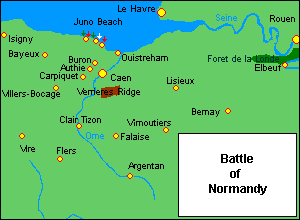
Map with location of Clair Tizon. (Map source: http://www.canadiansoldiers.com)
On August 12, 1944, the Royal Hamilton Light Infantry was ordered to advance towards Clair Tizon, France. At a small crossroads near the abandoned hamlet of Barbery, they encountered fierce German resistance as they moved through wheat fields.
The German counterattacks were an attempt to hold the Falaise pocket, but by dusk the Germans withdrew. The Canadians had won, but at a cost of 20 soldiers killed and 100 wounded. (See http://canadiansoldiers.com/history/battlehonours/northwesteurope/clairtison.htm)
Among the wounded was Joseph. He was admitted to the 43rd Battalion General Hospital, and then the 110th Battalion General Hospital. He didn’t return to his Regiment until October 2, 1944.
On October 18, 1944, he was promoted to Lance Sergeant. On January 7, 1945, he received what would be his final promotion – to Acting Sergeant.
….As the Rileys travelled towards Groningen they were attacked by the Dutch SS guarding a concentration camp….
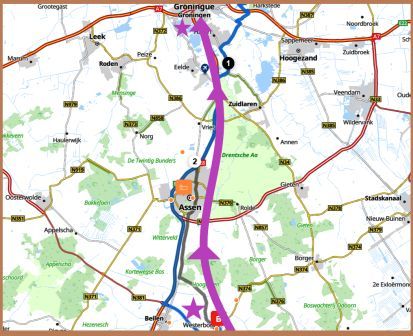
Map shows route taken by the RHLI as they moved from Westerbork towards Groningen. (Map source: http://www.viamichelin.co.uk)
An excerpt from Semper Paratus: The History of the Royal Hamilton Light Infantry (Wentworth Regiment) 1862-1977 by Kingsley Brown, Sr, Kingsley Brown, Jr, and Brereton Greenhous, recorded that “…the RHLI crossed the Ijeselson Canal by a small foot bridge on April 10 and, moving quickly on tanks and Kangaroos, reached the outskirts of Groningen within two days. At this point the battalion again became the spearhead for 4th Brigade and 2nd Division…”
A description of the fight that followed noted that “…. ‘it took more than a day for the Battalion to fight its way into Groningen’ John Lisson recalled. ‘The Germans were not only firing light arms, but blasting us with four-barreled flak guns. They had developed a nasty technique of firing at the glazed tile roofs of the buildings and bringing them crashing down on top of us. The tiles would fly off in sharp fragments just like shrapnel’….”
As if this wasn’t enough to deal with, the Rileys had encountered members of the Dutch SS who had been guarding the Westerbork concentration camp, who “…were fighting desperately because they had nothing to expect but the firing squad if they were caught…” (See https://en.wikipedia.org/wiki/Westerbork_transit_camp)
….Joseph was killed by sniper fire during the Battle of Groningen….
After travelling from Westerbork to Assen and then on towards Groningen, the War Diary for the Royal Hamilton Light Infantry for April 13, 1945 stated that by 4 pm they had arrived “…approximately one mile from Groningen, our final objective. Tactical Headquarters was set up in a farm house while the Companies continued to their objective in the town. The opposition in this sector was increasing, consisting mainly of medium machine gun and small arms fire…”
The Battle of Groningen would not be an easy victory. (See https://www.canadiansoldiers.com/history/battlehonours/northwesteurope/groningen.htm and https://library.mcmaster.ca/battle-groningen-april-1945)
Conditions had deteriorated by the evening of April 13. “…Word was received that the forward elements are meeting serious resistance in the form of small arms fire, road blocks, and mines….”
At the same time as over 100 prisoners of war began surrendering, sniper fire continued. By 8:30 pm, the War Diary entry stated that “…we have suffered several fatal casualties from snipers…” Among the casualties was Joseph.
….Joseph is buried in the Canadian War Cemetery in Holten….
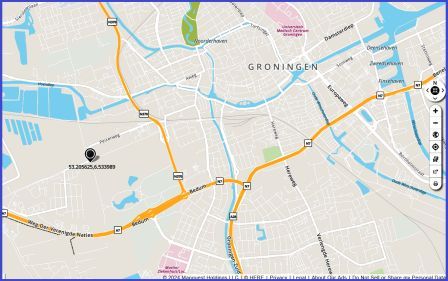
According to the GPS coordinates provided at the time, Joseph was initially buried beside what is today the Peizerweg in Groningen. The black circle marks the spot. (Map source: Mapquest)
On April 15, 1945, Joseph was initially buried beside a road in Groningen, before being reburied the following year in the Canadian War Cemetery in Holten, The Netherlands.
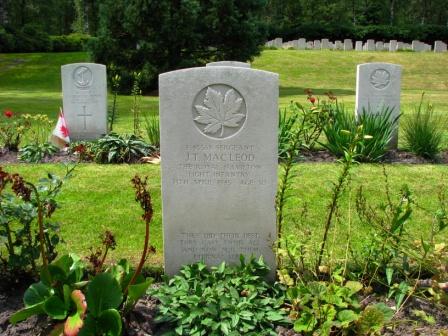
Grave of Joseph Taylor MacLeod in the Canadian War Cemetery in Holten, The Netherlands. (Photo courtesy of the Information Centre Canadian Cemetery Holten)
….Sam Matvichuk also died during the Battle of Groningen….
Sam MATVICHUK, whose story was previously told, also lost his life during the Battle of Groningen, while serving with the Royal Regiment of Canada. You can read his story here: https://onthewarmemorialtrail.com/2022/08/19/on-the-war-memorial-trail-the-wwii-soldier-born-in-broadacres-who-died-during-the-battle-of-groningen/
Thank you to Cyril MacLeod for sharing a photo of his father, Henk Vincent for sharing the Royal Hamilton Light Infantry War Diary for April 1945, and to David Ryan for sharing an excerpt from Semper Paratus: The History of the Royal Hamilton Light Infantry (Wentworth Regiment) 1862-1977.
Do you have photos or information to share? Email Pieter at memorialtrail@gmail.com, comment on the blog, or tweet to @researchmemori1.
© Daria Valkenburg
….Want to follow our research?….
If you are reading this posting, but aren’t following our research, you are welcome to do so. Our blog address: https://onthewarmemorialtrail.com/
 4 countries, 6 weeks, 7,000 km – an unforgettable war memorial journey in Europe…. Daria’s book ‘No Soldier Buried Overseas Should Ever Be Forgotten‘ is available in print and e-book formats. Net proceeds of book sales help support research costs and the cost of maintaining this blog. For more information see https://nosoldierforgotten.com/
You are also invited to subscribe to our YouTube Channel: On The War Memorial Trail With Pieter Valkenburg: https://www.youtube.com/channel/UCJ591TyjSheOR-Cb_Gs_5Kw.
Never miss a posting! Subscribe below to have each new story from the war memorial trail delivered to your inbox.
 August 19, 2022. When researchers at the Information Centre at the Canadian War Cemetery in Holten, The Netherlands decided to honour 27 soldiers of Ukrainian heritage that are buried in the cemetery, they were missing photos of 4 soldiers. (See



 On The War Memorial Trail Research Project........ with Pieter and Daria Valkenburg